

Vincent van Gogh · Auvers-sur-Oise · 1890
Van Gogh in Auvers-sur-Oise: 70 days, 74 paintings
From the village to the panoramic fields, Van Gogh's last ten weeks do not form a simple epilogue: they constitute a period of autonomous, dense and extraordinarily lucid invention.
Arriving on May 20, 1890, the painter observed the houses, gardens, faces and cultures of Vexin. He died on July 29. Between these two dates, he produced a set which renewed the portrait, the landscape and the very format of the canvas.

Understand the period
A final chapter, but above all a new pictorial beginning
The popular story sometimes reduces Auvers to a black sky, a few crows and the death of an artist. The works tell a broader reality. Van Gogh arrives with the hope of finding an independent life near Paris, his brother Theo, Jo and their child. He chooses a village already frequented by painters and places himself under the gaze of Doctor Paul Gachet.
His production is intense, but it is not improvised. He varies the formats, returns to similar motifs, compares the rhythms of fields and architecture, and continues his reflection on the "modern portrait". The concerns are real; they cancel neither the method, nor the culture, nor the mastery.
On May 17, 1890, Van Gogh left the Saint-Rémy-de-Provence asylum and spent a few days in Paris. He moved to Auvers on May 20, at the inn run by Arthur-Gustave Ravoux. The proximity of the capital allows you to see Theo without living in the heart of Paris, while the landscape of Vexin offers immediate diversity: cottages, sloping streets, gardens, agricultural plateau, paths and banks of the Oise.
The Musée d'Orsay lists 74 paintings and 33 drawings for these two months. This figure gives an idea of the energy deployed, not of mechanical manufacturing. Some canvases are very constructed; others keep areas fast or open. The thirteen "double square" formats, approximately one meter long and fifty centimeters high, show how Van Gogh seeks a new scale.
Documented timeline
Ten weeks between trust, work and worry
The dates make it possible to resist the story of an uninterrupted march towards catastrophe. The stay experiences impulses, meetings, projects, then family and financial tensions which weigh more heavily in July.
Installation
Van Gogh arrives in Auvers and stays with the Ravoux. He almost immediately began painting the cottages and the surroundings of the village.
First motives
Houses, gardens and fields create a palette of greens, purples and blues more northern than that of Provence.
Faces and church
He painted Doctor Gachet, Adeline Ravoux and the church seen from the apse, while multiplying landscapes and drawings.
Double square
The fields and gardens are gaining width. In a letter around July 10, he associated sadness and loneliness with vast landscapes, but also a "healthy and strengthening" countryside.
Last days
Tree roots is now considered his last job. Wounded on July 27, Van Gogh died two days later near Theo.
The Auvergne context
An artists' village observed without nostalgia

See North after South
Auvers is not an isolated retreat. The railway line connects the village to Paris, and its artistic history is already strong: Charles-François Daubigny lived there, while Corot, Pissarro and Cézanne worked there. Doctor Gachet knows several impressionists and collects their works.
Van Gogh, however, notices this place with his own instruments. In a letter dated May 21, he described Auvers as "definitely very beautiful" and insisted on its colorful richness. Bourgeois houses, thatched roofs and agricultural plots are not memories of a still world: the diagonals, the strong contours and the chromatic oppositions give them an unstable and contemporary presence.
The village serves as a laboratory. Van Gogh moves the horizon, simplifies volumes and transforms paths or trees into rhythms. The pattern remains recognizable, but the canvas organizes a gaze experiment.
People, not symbols
Gachet, Adeline and those close to the stay
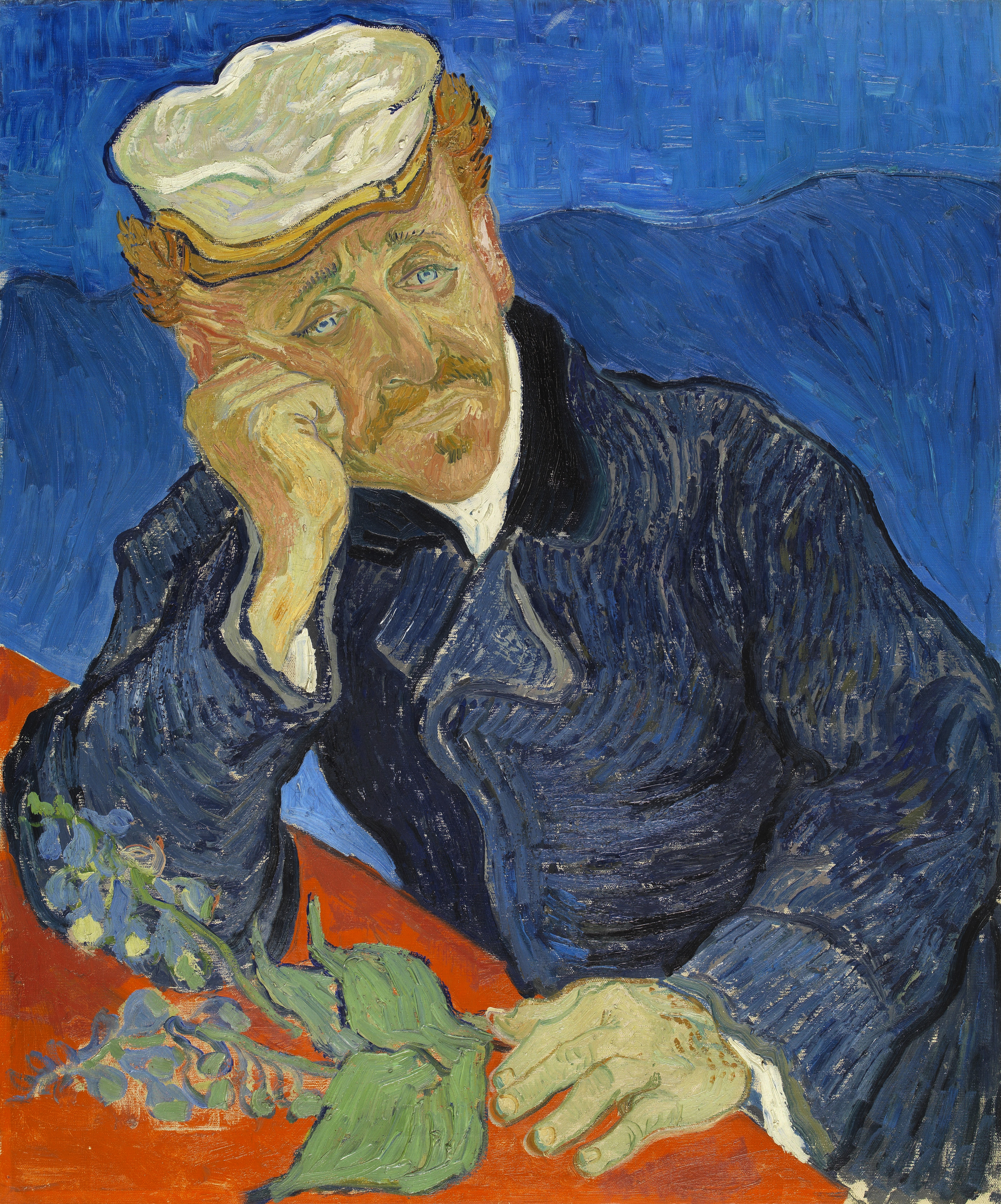
The melancholic doctor
Paul Gachet is a doctor, collector, engraver and amateur painter under the name Paul Van Ryssel. He knows Pissarro, Cézanne, Guillaumin, Monet and Renoir. Camille Pissarro recommended him to Theo as a possible interlocutor for Vincent. The relationship between the two men is, however, more complex than a simple patient-doctor relationship: they talk about art, work and exchange works.
In the portrait at the Musée d'Orsay, Gachet leans on his hand. The curve of the head responds to that of the table; blue cools the scene. Digital, a medicinal plant, refers to his profession. Van Gogh seeks the "heartbroken expression of our time": a human state rendered by pose, color and rhythm.
There are two painted versions of the portrait, as well as an etching. Variations in background, flowers and execution show that repetition is not a servile copy: it allows the psychological and plastic accent to be shifted.

Adeline Ravoux, blue on blue
On June 24, Van Gogh wrote to Theo that he had just painted a young girl "in blue against a blue background", the daughter of his landlords. He believes she is around sixteen years old; research on Adeline Ravoux establishes that she was thirteen. This small gap reminds us of the usefulness of comparing letters to archives.
Van Gogh took several portraits of Adeline. The background establishes almost no depth, so the face, hairstyle and shoulders are carried by the colored chords. Blue does not have a unique meaning: it creates unity, makes skin tones vibrate and gives the figure a calm monumentality.
In Auvers, the models come from the immediate circle: Gachet, his daughter Marguerite, Adeline, children and a few young women. This restricted availability stimulates direct solutions - tight framing, simplified contours, weaved backgrounds - which give each a distinct presence.
Visual analysis
The Church of Auvers: architecture set in motion
Painted between June 4 and 8, 1890, the work measures 93 × 74.5 cm and belongs to the Musée d'Orsay. It shows the church seen from the apse, framed by two paths which separate in the foreground.
 123456
Compact sky
Deep blue does not describe accurate weather; it acts as a colored mass that brings the bottom closer together.
Gothic silhouette
The building remains identifiable, but its lines undulate. Topographic fidelity gives way to expression.
Blue shadows
The walls are not white: purple, blue and gray give weight to the shadow areas.
Dark windows
The openings punctuate the facade like notes and reinforce the contrast with the roofs.
Bifurcated paths
Two curves envelop the building. Their movement draws the gaze instead of installing it facing the monument.
Discreet figure
A woman walks the path. Its small scale measures architecture without becoming a religious narrative.
Painting does not seek the changing effect of light on a monument: it produces the expressive experience of a church, recognizable but transformed.
Reading based on the notice from the Musée d'Orsay; any additional symbolic interpretation must remain cautious.Horizons and double square
The fields: immensity, solitude and restorative force
On about July 10, Van Gogh described vast fields under choppy skies to Theo and Jo. He wants to express sadness and "extreme solitude", but adds that these landscapes also speak of what he finds healthy and strengthening in the countryside. Holding these two ideas together avoids an exclusively funeral reading.

A panoramic look
Thirteen works from the living room adopt an elongated format close to the double square: twelve landscapes and a vertical portrait. This proportion modifies the gaze. No single center dominates; the eye circulates laterally, as when it actually sweeps across an agricultural plateau.
The plots become bands of color, separated by paths or tree lines. Short touches can follow the crops, while the sky receives wider gestures. The table does not reproduce every detail: it distributes speeds.
Wheat field with crows is often presented as the last painting. Recent research invites us to correct this myth: its exact date in the sequence remains uncertain, and the Van Gogh Museum considers Tree roots like the last work, painted on the morning of July 27.
Color, material and gesture
A palette from the North, pushed to intensity
Van Gogh observed more purples in Auvers and frequently contrasted blues, greens, yellows and earthy reds. Color does not fill a prior drawing: it constructs volumes, separates planes and regulates the emotional temperature of the whole.
Storm blue
To bring the sky closer together and give the landscape an almost material density.
Gray blue
In houses, portraits and distances, like a link between air and matter.
Wheat yolk
Solar shine, dry stubble or accent that awakens a cold ensemble.
Cultivated green
Fields are never flat: each plot has its own rhythm.
Shadow violet
It replaces black and makes walls, clothes and floors vibrate.
Earth red
Roofs, paths and contours warm the blues and structure the space.

The key as structure
Visible speed does not mean absence of construction. Van Gogh directs his keys: curves in the trunks, obliques in the paths, tight in the crops and freer in the clouds.
In Tree roots, the horizon almost disappears. The viewer faces a fragment of an embankment where the shapes fit together. Some areas seem unfinished; the whole remains powerfully organized by blues, greens and ochres.
The symbol of "torn off" roots may seem tempting after Van Gogh's death. The Van Gogh museum evokes this reading, but it should not make us forget the first fact: the painter observes a real pattern of undergrowth and transforms it through color and framing.
Works, variants and conservation
A period dispersed between museums and collections
Auvers' paintings are today distributed among numerous institutions. The table below gives reliable benchmarks without claiming to draw up a complete catalog raisonné.
| Work or series | Established benchmarks | Which varies | Associated location |
|---|---|---|---|
| Doctor Paul Gachet | Two oil paintings and an etching in 1890. | Background, flowers, intensity of the drawing and execution. | First version at the Musée d’Orsay; second version in private collection. |
| Adeline Ravoux | Several portraits of the innkeepers' daughter, aged thirteen. | Framing, hairstyle, format and treatment of the blue background. | Versions divided between museums and collections. |
| The Auvers Church | Painted between June 4 and 8, 1890, oil on canvas, 93 × 74.5 cm. | This is the only canvas showing the entire church; it appears elsewhere in views of the village. | Musée d'Orsay, Paris. |
| Daubigny Garden | Important July reason, linked to Van Gogh's admiration for Daubigny. | Two painted compositions and a letter drawing; details and proportions differ. | Versions notably in Hiroshima and Basel. |
| Panoramic fields | Twelve landscapes in elongated format among thirteen "double squares". | Crops, weather, horizon height, presence of paths or birds. | Van Gogh Museum and other international collections. |
| Tree roots | Considered the last work, painted on the morning of July 27. | The exact location was proposed with strong plausibility, not as absolute certainty. | Van Gogh Museum, Amsterdam. |
Auvers gallery
From the intimate garden to the open plain
These views all belong to the Auvers universe. They show to what extent the period goes beyond just dark icons: gardens, houses, portraits and cultures form a whole with very different climates.


Living with reproduction
Choosing a work by Auvers for your interior
A successful reproduction respects the format, the direction of the key and the color ratios which give the work its tension. The choice then depends on the room and the atmosphere sought.
To open a wall
A "double square" landscape is suitable above a sofa, low sideboard or bed. Its horizontality visually expands the room.
To create a face-to-face encounter
Adeline or Gachet works in an office, a library or a fairly wide corridor: the portrait establishes a presence.
For strong architecture
The Auvers Church requires a quiet wall. Its verticality and contrasts are enough to structure a space.
For organic energy
Tree roots dialogue with wood, linen, muted greens and lightly loaded contemporary interiors.
Tune without imitating
It is not necessary to take all the colors from the painting in the room. Choose a secondary shade - gray blue, ocher or olive green - and leave the other surfaces more neutral.
Soft side light reveals the material. Avoid direct sunlight and frontal reflections. On a large canvas, a simple brown or black wooden frame lets the touch breathe; an American box reinforces the contemporary effect.
Lounge
Favor panoramas, with a width close to two thirds of the furniture placed underneath.
Bedroom
Choose gardens or plains with softer accords rather than the most tense contrasts.
Office
A portrait or a view of the village brings a presence without saturating the visual field.
Hanging
Place the center of the work around 145 -155 cm from the ground, then adjust to the actual height of the furniture.
Selection verified in the store
Four works by Auvers available for reproduction
The four sheets below correspond to active products verified in the Alpha Reproduction catalog. They cover the panoramic landscape, the garden, the portrait and the last motif.
Wheat field under storm clouds
A great horizontal breath, between density of the sky and rhythm of the wheat.
GardenThe Daubigny Garden
An abundant space where each plant becomes movement.
PortraitPortrait of Adeline Ravoux
A blue-on-blue accord, calm and intensely present.
Last workTree roots
An organic and almost abstract composition, ideal in a contemporary interior.
Institutional sources
Four benchmarks to go further
The facts, dates and conservation information were cross-checked with museum notices and the scientific edition of the correspondence. Visual analyzes are formulated as such.
Presentation of the period, 74 paintings, 33 drawings and series of elongated formats.
Musée d'Orsay - The Church of AuversDating, dimensions, provenance and analysis of the work preserved in Paris.
Musée d'Orsay - Doctor Paul GachetCollection instructions, dimensions, iconography and history of the first version.
Van Gogh Letters - Letter 898Letter from July 1890 on the vast fields, the solitude and the strength of the countryside.
Van Gogh Letters - Letter 891Letter of June 24 on Adeline Ravoux, extended formats and works in progress.
Van Gogh Museum - Gallery Texts: AuversLandmarks on the latest landscapes and the identification of Tree roots as a final job.
Frequently asked questions
Van Gogh in Auvers-sur-Oise, in eight precise answers
When did Van Gogh live in Auvers-sur-Oise?
He settled in Auvers on May 20, 1890 and died there on July 29, 1890. His stay lasted approximately 70 days.
Why did Van Gogh choose Auvers-sur-Oise?
He wants to get closer to Theo while living outside Paris. Auvers offers a rural environment, an artistic tradition and the presence of Doctor Paul Gachet, recommended by Camille Pissarro.
How many works does he create during this stay?
The exhibition organized by the Musée d'Orsay and the Van Gogh Museum contains 74 paintings and 33 drawings in just over two months.
Is wheat field with crows his last painting?
There is no evidence to confirm this. The exact chronology of several paintings remains delicate. The Van Gogh Museum considers today Tree roots, painted on the morning of July 27, as his last work.
Where is the Church of Auvers-sur-Oise located?
The painting is kept at the Musée d'Orsay in Paris. Painted between June 4 and 8, 1890, it measures 93 × 74.5 cm.
Are there several portraits of Doctor Gachet?
Yes. Van Gogh created two painted versions of the portrait and an etching. The first version, with the digital one placed on the table, belongs to the Musée d'Orsay; the second is in a private collection.
What is "double square" format?
It is a very elongated format, approximately 50 × 100 cm. Van Gogh used it in Auvers for thirteen paintings, including twelve landscapes, in order to extend the visual field and circulate the gaze laterally.
Which Auvers reproduction to choose for a living room?
A horizontal landscape like Wheat field under storm clouds suitable for a wide wall. For a more vertical or intimate space, a portrait of Adeline Ravoux or an architectural composition creates a more concentrated focal point.
0 comments