


100 paintings - time, death and fragility
The 100 most famous vanities in painting
From the skull of Philippe de Champaigne to the meditations of Cézanne, Van Gogh and Ensor: a hundred paintings which transform the objects of the world into a reminder of our finitude.
Painting vanity
Why is beauty reminiscent of death?
Vanity first attracts with the precision of a glass, a flower, a jewel or an instrument. Then a skull, a flame or a damaged fruit reverses the pleasure in meditation on time.
Vanity shows things vividly to remind us that their beauty, their worth and our own presence are temporary.
The 100 most famous vanities in pictures
Twenty-five paintings which fixed the major symbols of time and death.
#1
Vanity - Philippe de Champaigne
Champaigne reduces vanity to three objects: the tulip represents life, the skull death and the hourglass time. Their isolation gives the allegory an almost emblematic clarity.
See this reproduction → #2
#2
The Ambassadors
Holbein celebrates knowledge, diplomacy and wealth before contradicting them with an anamorphic skull, visible correctly from the side. The painting thus forces the viewer to literally change their point of view.
See this reproduction → #3
#3
In Ictu Oculi
Death extinguishes a candle above attributes of power, arts and ecclesiastical offices. The Latin inscription means "in the blink of an eye" and announces the instantaneous abolition of human hierarchies.
See this reproduction → #4
#4
Finished Gloriae Mundi
Valdés Leal shows the corpses of a bishop and a knight of Calatrava in the process of corruption. The scales held by the hand of Christ shift the judgment of social glory towards the works of the soul.
See this reproduction → #5
#5
Allegory of Vanity
An angel presents Pereda with a pile of crowns, jewelry, weapons, maps and imperial portraits dominated by a skull. Accumulation transforms the history of the powerful into an inventory of goods without duration.
See this reproduction →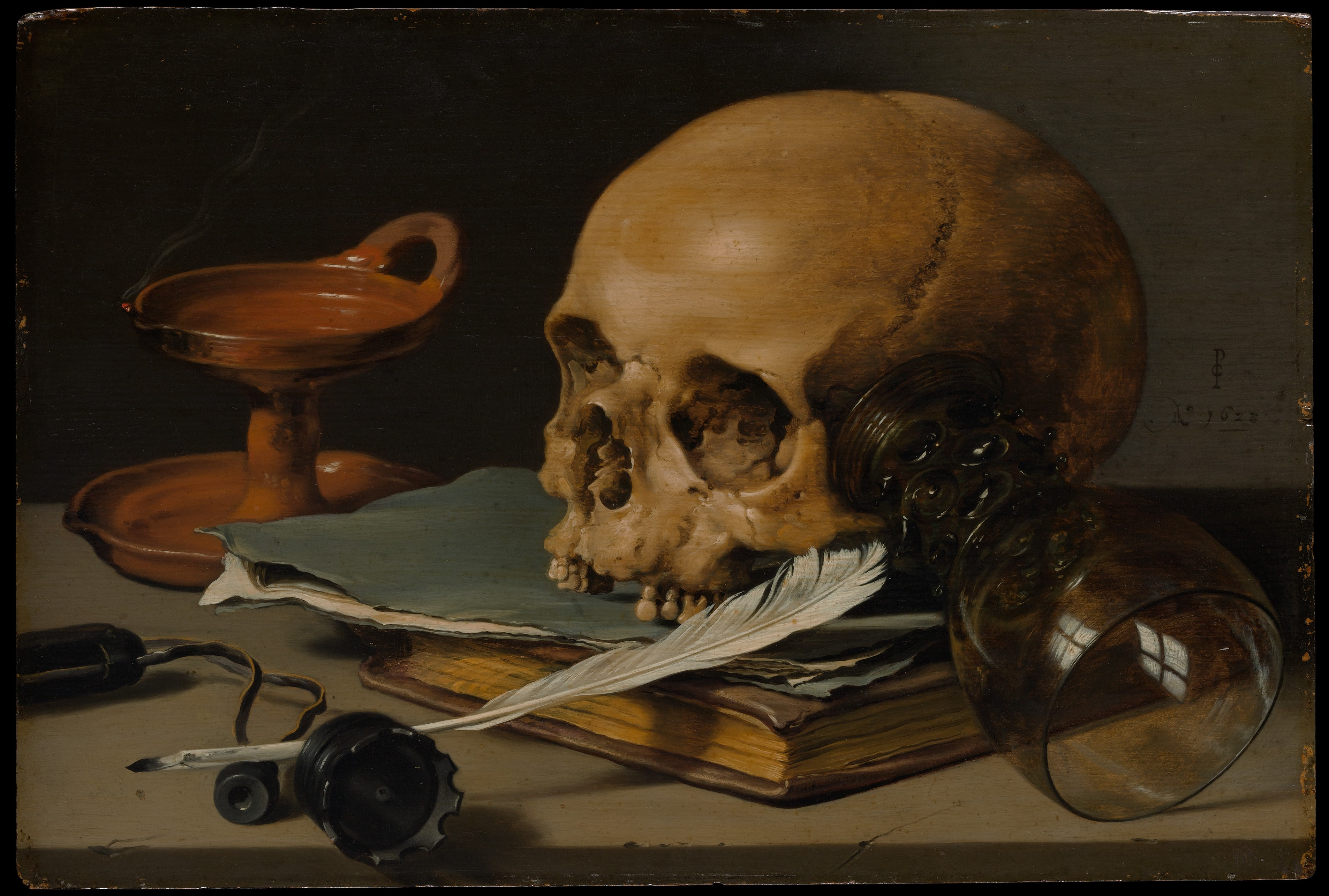 #6
#6
Still life with skull and feather
Claesz combines skull, feather, inverted glass, lamp off and watch. The almost monochrome range draws attention to the surfaces while reminding us that knowledge, pleasure and time lead to the same term.
Public domain image; notice: Metropolitan Museum of Art, New York.
See the museum notice → #7
#7
Vanity to musical instruments, with the five senses
Lute, violin, books, glass, watch and skull summon the five senses and the arts. Claesz makes each material shine, but the silent instrument and the extinguished light turn this virtuosity against the desire for possession.
See this reproduction → #8
#8
Vanitas, still life
Jacques de Gheyn places a large skull in a niche, surrounded by a bubble, a cut flower, smoke and coins. The figures of Heraclitus and Democritus contrast tears and laughter in the face of the madness of the world.
See this reproduction → #9
#9
Vanity with books, musical instruments and skull
Necklace piles up books, scores, instruments, jewelry and skulls in a composition that imitates the disorder of a scholarly cabinet. The wealth of knowledge itself becomes provisional when time and death close all reading.
See this reproduction → #10
#10
Vanity with books, manuscripts and skull
The crumpled manuscripts, skull and instruments show how fragile written memory and reputation remain. Collier excels at painting paper, leather and metal, but this precision serves precisely to denounce their perishable nature.
See this reproduction →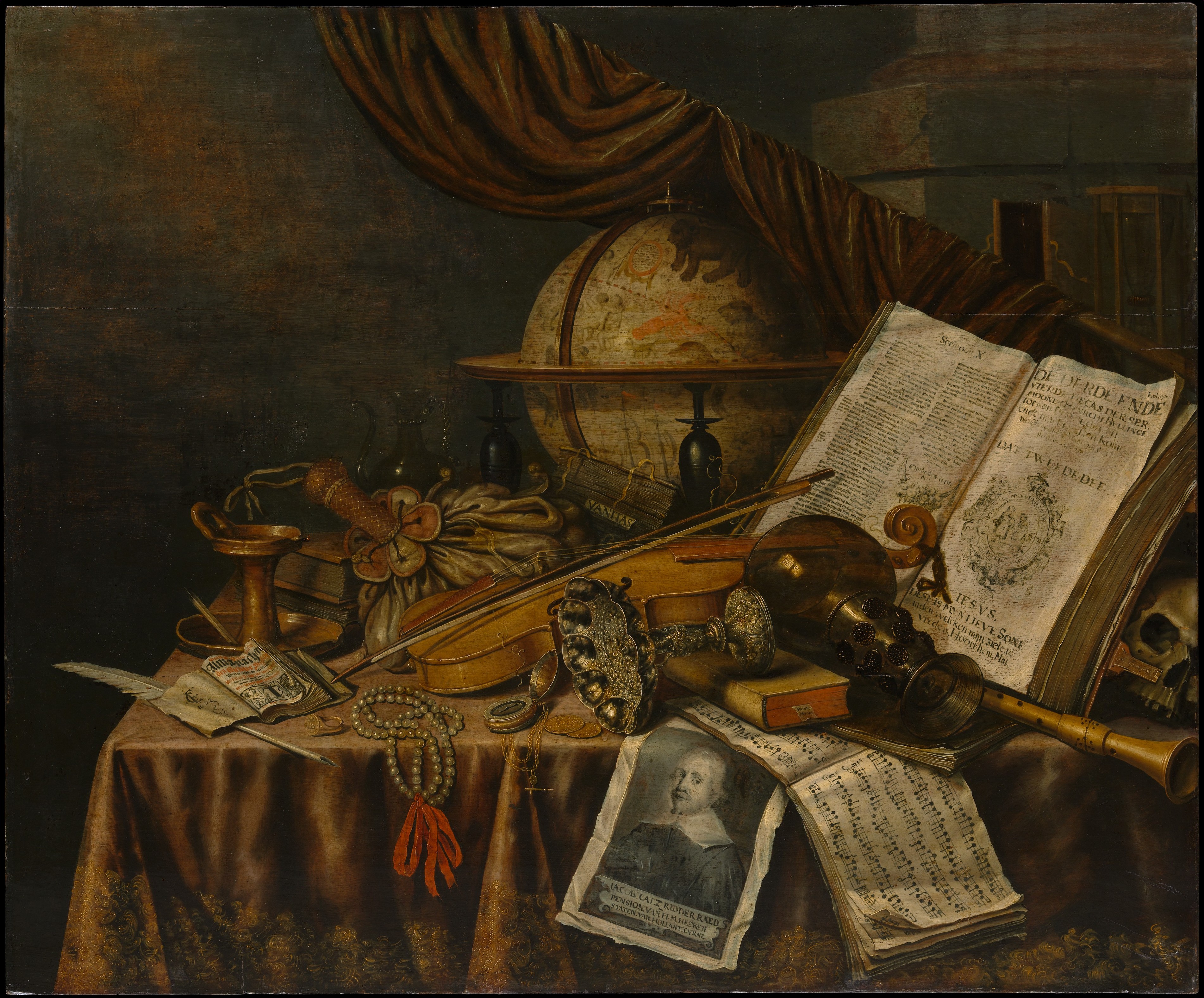 #11
#11
Vanity to books, globes and crown
Collier opposes books, scientific instruments and globes to the insignia of wealth and sovereignty, including the crown and the purse. Material abundance resembles an inventory of the world, but the watch reminds us that possessing, knowing and governing remain subject to time.
Public domain image; notice: Metropolitan Museum of Art, New York.
See the museum notice → #12
#12
Triptych of Earthly Vanity
Memling's polyptych opposes naked woman, mirror, skull and hell to images of salvation. The beauty that contemplates itself is only a sign of a moral journey where each choice involves the destiny of the soul.
See this reproduction → #13
#13
Vanity
Memling shows a naked young woman holding a mirror, the embodiment of earthly vanity. The elegance of the body and jewelry is deliberately seductive: moral danger comes from the very pleasure that the image provides.
See this reproduction → #14
#14
The Madeleine with the smoking flame
Madeleine meditates in front of a flame that smokes after being blown away. The Tower combines silence, skull and dying light to represent the passage from worldly desire to inner examination.
See this reproduction → #15
#15
The Madeleine in the mirror
The mirror reflects Madeleine's skull rather than face. The Tower thus transforms the traditional object of coquetry into an instrument of truth, while the night light encloses the scene in suspended time.
See this reproduction → #16
#16
The Madeleine with two flames
A real flame and its reflection build two luminous foci around Madeleine. The skull placed on his knees gives physical weight to meditation, far from a purely abstract allegory.
See this reproduction → #17
#17
The Madeleine at the night light
The concealed night light models Madeleine, her hands and the objects of penance without lighting the entire room. The Tower makes darkness a mental space where conversion remains intimate.
See this reproduction → #18
#18
Saint Jerome writing - Caravaggio
Caravaggio contrasts the bleached skull with Jerome's aging body, leaning over his translation of the Bible. The arm line directly links physical mortality and mental work.
See this reproduction → #19
#19
Saint Jerome in meditation
Jerome leans towards the skull as towards an interlocutor. Caravaggio strips the scene of all scenery so that meditation on death becomes almost a silent dialogue.
See this reproduction → #20
#20
Pyramid of skulls
Cézanne stacks four skulls like monumental fruits. The sockets and bony planes replace the apples of his still lifes, giving the pictorial construction a new gravity at the end of his life.
See this reproduction → #21
#21
The Three Skulls
Géricault studies three human skulls with the anatomical frankness acquired during his research for The Raft of the Medusa. The proximity of the bones refuses any idealization of death.
See this reproduction → #22
#22
Skull with lit cigarette
Van Gogh paints a smoking skeleton with unusual black humor. The cigarette ironically animates a body deprived of life and can deride the academic teaching of anatomy.
See this reproduction → #23
#23
Young man holding a skull
The young man from Hals shows the skull to the viewer while smiling. This contrast between present vitality and future death links the portrait to the "memento mori" without removing the energy of the model.
See this reproduction → #24
#24
Saint Francis contemplating a skull
Zurbaran represents Francis absorbed in front of a skull which he holds like an object of prayer. The homespun, solitude and vertical light give Franciscan poverty an almost sculptural intensity.
See this reproduction → #25
#25
Soap Bubbles - Jean Siméon Chardin
Chardin catches the breath of a young man who forms a bubble at the edge of a window. The game becomes an image of fragile life: brilliant, perfectly round and capable of bursting immediately.
See this reproduction →Skulls, hourglasses, candles, bubbles and books make the disappearance visible.
 #26
#26
Soap Bubbles - Édouard Manet
Manet takes the old motif of the bubble but simplifies the decor and modeling. The concentrated teenager embodies a moment without tomorrow, treated with the modern frankness of a painting that shows its own material.
See this reproduction → #27
#27
Soap Bubbles - David Teniers the Younger
At Teniers, the soap bubble belongs to a genre scene where the game first attracts attention. Its imminent disappearance, however, introduces a lesson in brief pleasures at the heart of everyday life.
See this reproduction → #28
#28
Two children blowing bubbles, circa 1617
Van Dyck represents two children absorbed by the bubbles they blow. The motif opposes youth and fragility, while the elegance of the portrait makes the brevity of this age more noticeable.
See this reproduction → #29
#29
And in Arcadia ego
Two shepherds discover a tomb bearing the inscription "Et in Arcadia ego". Guercino introduces death into the very heart of Arcadia, a poetic place supposed to escape the misfortunes of the world.
See this reproduction → #30
#30
Vanity - Simon Vouet
Vouet personifies Vanity in the guise of a young woman surrounded by ephemeral attributes. The beauty of the model is not condemned alone: it becomes the means of making people feel the speed with which time transforms it.
See this reproduction → #31
#31
Vanity - Titian
Titian associates the female figure with the mirror and the signs of time. Venetian sensuality makes the warning more complex, as the painting celebrates beauty just as he claims it will disappear.
See this reproduction → #32
#32
Vanity - John William Waterhouse
Waterhouse takes up the theme of the woman in the mirror in Pre-Raphaelite language. Hair, jewelry and reflective surface construct a seductive image whose subject remains excessive attention to appearance.
See this reproduction → #33
#33
Vanity - Mattia Preti
Mattia Preti dramatizes vanity with violent chiaroscuro and objects of mortality. The luminous contrast brings the allegory closer to the religious scene and transforms the moral warning into an appearance.
See this reproduction → #34
#34
Vanity - Le Guerchin
Guerchin gives Vanity a meditative rather than triumphant presence. The attributes of time and death interrupt self-contemplation and direct the gaze towards that which cannot be preserved.
See this reproduction → #35
#35
Vanity - David Teniers the Younger
Teniers treats Vanity as a familiar figure surrounded by readable symbols. The moral lesson thus enters the register of the daily scene, without losing the reference to time which consumes everything.
See this reproduction → #36
#36
Vanity - Nicolas de Largillière
Largillière combines French elegance, precious accessories and a reminder of mortality. The refinement of the portrait becomes further proof of the fragility of statuses, fashions and reputation.
See this reproduction → #37
#37
Pumps and vanities
John Collier composes a late allegory where social pageantry explicitly meets the consciousness of death. The title "Pumps and vanities" refers to the splendor of the ceremonies as much as to their emptiness.
See this reproduction → #38
#38
Self-portrait with vanity still life
Van Hoogstraten represents himself with objects of a vanity still life. The self-portrait directly questions the painter's ambition: even virtuosity, fame and work remain subject to time.
See this reproduction → #39
#39
Modesty and Vanity
Luini opposes Modesty and Vanity in the form of female figures. The moral contrast comes through looks, gestures and attributes rather than through a story, in the tradition of Renaissance allegories.
See this reproduction → #40
#40
Portrait of a man - Memento mori
Previtali makes the portrait of a man a personal meditation through the inscription or the accompanying sign of death. The individual affirms his presence while recognizing his future disappearance.
See this reproduction → #41
#41
Portrait of a man with a skull
Lotto associates the living face with the skull held or shown, a direct shortcut between identity and finitude. The portrait becomes less a social celebration than an exercise in lucidity.
See this reproduction → #42
#42
Cupid with soap bubble
Rembrandt depicts Cupid busy blowing a bubble. The god of love is subject to the classic image of brevity, suggesting that desire and pleasure disappear as quickly as the iridescent sphere.
See this reproduction → #43
#43
Cupid with an hourglass
The hourglass placed near Cupid measures the duration of love and beauty. Guido Reni contrasts the ideal softness of the child with an instrument whose flow remains irreversible.
See this reproduction → #44
#44
Hourglass
The hourglass attributed to Giorgione isolates one of the simplest symbols of vanity. The invisible passage of grains gives time a material and silent form.
See this reproduction → #45
#45
Time like an old man with a scythe and a winged hourglass
Teniers personifies Time as a winged old man armed with a scythe and accompanied by an hourglass. The allegory makes visible a force that ages bodies, destroys works and equalizes conditions.
See this reproduction → #46
#46
Vanity, known as La Vieille Coquette
Strozzi paints an elderly woman still attached to jewelry and a mirror, hence the nickname "Old Coquette". The scene confronts a desire for appearance and a transformation of the body without reducing the character to a simple caricature.
See this reproduction → #47
#47
Death pursuing the herd of humans
Ensor shows Death leading a crowd of all conditions. The skeleton is no longer an object placed on a table, but a social power which pursues all of humanity in a grotesque parade.
See this reproduction → #48
#48
Book, mask and skull
The mask, the book and the skull bring together in Ensor identity played, culture and death. The objects resemble theater props abandoned after the performance.
See this reproduction → #49
#49
Skull
Cézanne treats the skull as an autonomous volume, subject to the same searches for planes and tones as his apples. The object, however, retains a more frontal and disturbing presence.
See this reproduction → #50
#50
Skull and candlestick
The vertical candlestick accompanies the skull in a stripped-down device. The absent flame transforms the lighting instrument into a sign of an already extinguished life.
See this reproduction →Cézanne, Van Gogh, Ensor and their contemporaries directly confront finitude.
 #51
#51
Still life with skull
In this still life, Cézanne places the skull among ordinary objects without theatrical staging. Death enters the workshop as a motif to be looked at at length.
See this reproduction → #52
#52
Three skulls
Three skulls form a group whose orientations vary like those of faces. Cézanne gives them a strange collective presence through the sole construction of volumes.
See this reproduction → #53
#53
Three skulls on an oriental carpet
The Oriental carpet contrasts chromatic richness and whitened bones. Cézanne thus takes up an old tension of vanity between material luxury and the disappearance of the owner.
See this reproduction → #54
#54
Skeleton skull
Van Gogh studies a skeletal skull with a touch that follows the cavities and joints. The anatomical exercise becomes a portrait of a presence deprived of a name.
See this reproduction → #55
#55
Two skulls in a window niche
Holbein places two skulls in a stone niche, like anonymous relics. The stable architecture contrasts with human remains and reminds us that the monument sometimes survives those it was to celebrate.
See this reproduction → #56
#56
Boy with a skull
Enckell associates the boy's youth with a skull that condenses his future. Norse symbolism transforms the traditional contrast into a psychological questioning of self-awareness.
See this reproduction → #57
#57
A hermit gazing at a skull
Salvator Rosa shows an isolated hermit facing the skull, far from goods and honors. The wild landscape prolongs the inner withdrawal and makes meditation a refusal of the social world.
See this reproduction → #58
#58
Books, candle and bronze statuette
Stoskopff arranges books, candles and small sculptures with severe precision. Written culture, art and light share the same vulnerability: they can be interrupted, forgotten or destroyed.
See this reproduction → #59
#59
Still life with flowers. Vanity
De Heem associates the brightness of flowers with their inevitable wilting. Insects, fragile petals and signs of time transform the bouquet into meditation on a beauty captured just before its disappearance.
See this reproduction → #60
#60
Vanity with a royal crown and the portrait of Charles I of England
The crown and portrait of Charles I recall a power overthrown by history. Van de Vinne transforms royal emblems into objects of vanity after the execution of the English sovereign.
See this reproduction → #61
#61
End of snack
Heda shows the remains of a meal: glass, dishes, lemon and displaced objects signal a pleasure that has already passed. The absence of guests makes disorder a measure of time.
See this reproduction → #62
#62
Still life with poppy, insects and reptiles
Van Schrieck's poppy, insects and reptiles make up an undergrowth where beauty, poison, predation and decomposition coexist. Vanity is read in the natural cycle rather than in a human skull.
See this reproduction → #63
#63
Saint John the Baptist (front); a skull (back)
Memling's diptych associates Jean-Baptiste alive with a skull painted on the reverse. The material reversal of the panel moved from a sacred portrait to a reminder of mortality.
See this reproduction → #64
#64
Allegory of prudence triumphing over vanity (Allegory of faith)
Teniers opposes prudence or faith to the attributes of vanity. The allegory is not limited to denouncing earthly goods: it proposes a virtue capable of ordering their use.
See this reproduction → #65
#65
Allegory of Vanity - Joachim von Sandrart
Sandrart personifies Vanity as a sumptuously dressed woman, surrounded by objects of pleasure and prestige. Theatrical lighting makes these seductions very present, precisely to better recall their fleeting character.
See this reproduction → #66
#66
Vanity with a skull placed on books
Linard places a monumental skull on closed books, near a burning candle and a small vase of flowers. The sobriety of the whole makes knowledge, light and flowering three different measures of the same limited time.
See this reproduction → #67
#67
Vanity - Jacob Jordaens
Jordaens builds an almost tumultuous accumulation of weapons, tableware, jewelry and precious objects. The figures that frame this treasure remind us that military power, wealth and collection protect neither aging nor death.
See this reproduction → #68
#68
Saint Jerome in penance
Titian places Jerome in a landscape of retreat where the skull, the book and the rock accompany penance. Nature contributes to the distance taken from the world.
See this reproduction → #69
#69
Saint Jerome writing - Jusepe de Ribera
Ribera shows Jérôme writing in a light that accentuates hands, face and paper. Scholarly inspiration erases neither age nor fatigue from the body.
See this reproduction → #70
#70
Saint Jerome penitent - Jusepe de Ribera
The penitent Jerome of Ribera joins Spanish austerity and Neapolitan naturalism. The skull is not a decorative accessory, but the concrete partner of an examination of conscience.
See this reproduction → #71
#71
Vanity, Moderation and Death
Stradanus brings together Naked Vanity, Moderation and Death in a multi-voiced allegory. The mirror, opposing gestures and abandoned objects confront desire to appear, self-control and the inevitable term of all beauty.
See this reproduction → #72
#72
The Hay Cart: allegory of the vanity of the world
Mostaert encloses the procession of the "hay cart" in a transparent globe. Princes, religious people and common people compete for paltry wealth: the image transposes the biblical formula according to which all human glory fades like grass.
See this reproduction → #73
#73
Vanity - Auguste Toulmouche
Toulmouche shows an elegant woman absorbed by her reflection in a large mirror. The pink dress, bouquet and refined decor celebrate appearance while giving the word "vanity" its worldly meaning: the gaze closes on its own image.
See this reproduction → #74
#74
Repentant Saint Magdalene renounces the vanities of life
Le Brun represents Madeleine at the moment when she renounces the jewelry and fabrics of her worldly life. Her open gesture, the dark landscape and the rejected objects transform the conversion into a visible break between earthly luxury and spiritual aspiration.
See this reproduction → #75
#75
Saint Jerome with a skull (after Albrecht Dürer)
Reymerswale uses a model from Dürer to show Jerome surrounded by books, writings and a skull. The scholarly cabinet itself becomes a space of vanity where erudition must remain humble.
See this reproduction →Madeleines, hermits and saints transform the signs of mortality into an inner examination.
 #76
#76
Still life: allegory of the vanities of human life
Steenwyck directs a ray of light towards the skull, the watch and the extinguished lamp, while books, instruments, shell and saber embody knowledge, pleasure, rarity and power. The composition contrasts the apparent permanence of objects with human time which makes them derisory.
Public domain image; notice: National Gallery, London.
See the museum notice → #77
#77
The penitent Madeleine in a landscape
Artemisia places Madeleine in a landscape which materializes her withdrawal from the world. Penance does not remove the character's strength: it redirects his energy towards an inner transformation.
See this reproduction → #78
#78
Penitent Magdalene - Artemisia Gentileschi
In this Madeleine, Artemisia Gentileschi favors inner conflict over the simple display of symbols. The living body and the signs of renunciation make conversion present.
See this reproduction → #79
#79
Penitent Magdalene - El Greco
El Greco lengthens Madeleine's figure and spiritualizes the landscape around her. His gaze detached from the world transforms repentance into momentum towards an invisible reality.
See this reproduction → #80
#80
Penitent Madeleine - Bartolomé Esteban Murillo
Murillo gives Madeleine a devotional sweetness accessible to the faithful. Tears, solitude and attributes of penance make the saint a model of conversion.
See this reproduction → #81
#81
Penitent Magdalene - Titian
Titian maintains a balance between sensuality of the body and intensity of repentance. This tension explains the fortune of his Madeleines, where beauty becomes what must be surpassed without being denied.
See this reproduction → #82
#82
Still life with statuette, shells and books
Stoskopff lines up glass cup, statuette, rare shells, books and shavings box in a severe space. These collectibles embody art, knowledge and curiosity, but their silent stillness reminds us that all possession ends without an owner.
See this reproduction → #83
#83
Still life with silver cup and watch
Heda describes an upside-down silver cup, an open watch, a glass and the remains of a meal with its characteristic gray-brown palette. The disorder seems recent: pleasure, wealth and time have left their traces after the guest's departure.
See this reproduction → #84
#84
The penitent Madeleine - Philippe de Champaigne
Philippe de Champaigne strips Madeleine of worldly brilliance to favor silence, prayer and signs of finitude. Classical restraint transforms repentance into inner discipline.
See this reproduction → #85
#85
Still life with flowers with watch
Van Aelst combines a vibrant bouquet with a watch, whose mechanism measures how long the flowers cannot hold back. Species from different seasons compose an ideal beauty, already contradicted by the tilting petals.
See this reproduction → #86
#86
Still life with flowers and a watch
Cute places an open watch at the foot of a sumptuous bouquet of tulips, roses, poppies, anemones, daffodils and irises. Snails, caterpillars and other insects signal that time is already acting on this meticulously ordered beauty.
Public domain image; notice: Rijksmuseum, Amsterdam.
See the museum notice → #87
#87
Soap bubbles - Thomas Couture
Couture shows a young man blowing bubbles in the privacy of a workshop. The iridescent sphere floats for a few seconds in front of him: the old symbol of "homo bulla" becomes a modern scene about the fragility of pleasure and attention.
See this reproduction → #88
#88
Soap Bubbles - Willem van Mieris
Van Mieris places the bubble game in a richly detailed Dutch interior. The child and adults observe a shiny shape promised to burst, while cage, rugs and household objects broaden the lesson to the comfort of home.
See this reproduction → #89
#89
Penitent Magdalene - Orazio Gentileschi
Orazio Gentileschi builds a clear and silent Madeleine, where fabrics, flesh and light remain carefully measured. Penance appears to be a considered decision.
See this reproduction → #90
#90
Penitent Madeleine - Le Guerchin
The Guercino dramatizes Madeleine with the chiaroscuro and intensity of the gesture. The old worldly life remains suggested, but the picture focuses on the moment of change.
See this reproduction → #91
#91
Penitent Mary Magdalene - Peter Paul Rubens
Rubens gives Mary Magdalene a physical vitality that makes repentance all the more powerful. Conversion does not deny the life of the body: it transforms its direction.
See this reproduction → #92
#92
Penitent Madeleine - Pompeo Batoni
Batoni places Madeleine in the elegance of the 18th century while retaining a skull, book or meditative gaze. The ancient theme becomes a moral image intended for a more worldly culture.
See this reproduction → #93
#93
Penitent Mary Magdalene - Francesco Hayez
Hayez translates penance into the emotional language of romanticism. Madeleine's isolation and facial sensitivity shift vanity toward psychological experience.
See this reproduction → #94
#94
Penitent Mary Magdalene
Böcklin places the penitent in a symbolist atmosphere where landscape, silence and the presence of death become ambiguous. Christian tradition encounters modern concern.
See this reproduction → #95
#95
Penitent Magdalene - Filippino Lippi
Filippino Lippi represents Madeleine according to Florentine devotion of the Renaissance, attentive to gesture, clothing and moral transformation. Repentance is part of a readable history of salvation.
See this reproduction → #96
#96
The Penitent Madeleine - Anton Raphael Mengs
Mengs subjects the Madeleine to the classical ideal of clarity and measure. The passion for repentance remains contained by a composition that seeks moral balance.
See this reproduction → #97
#97
The Penitent Madeleine - Corrado Giaquinto
Giaquinto gives Madeleine the decorative momentum of late Baroque. Color and movement nevertheless serve as a subject of renunciation, creating a tension specific to religious painting of the 18th century.
See this reproduction → #98
#98
Soap bubbles
Brendekilde shows a bubble hanging in front of an absorbed child. Daily realism retains the old meaning of the motif: the game is beautiful precisely because it does not last.
See this reproduction → #99
#99
Children blow bubbles
Several children bubble in an outdoor scene. Brendekilde transforms the memento mori into a tender observation of childhood and its fleeting moments.
See this reproduction → #100
#100
Penitent Mary Magdalene
Ribera represents Mary Magdalene in a solitude where light, tears and attributes of penance concentrate attention. The saint closes the classification as a figure of passage between earthly attachment and spiritual hope.
See this reproduction →The language of vanities
Three gateways into vanity
Skulls, flowers, watches, bubbles and books do not all express the same idea: their meaning depends on the history, the place and the gestures that surround them.
Time
Hourglasses, watches, smoking locks and cut flowers give a visible shape to what never stops moving forward.
Appearances
Mirrors, jewelry, instruments and fabrics seduce before revealing that beauty, knowledge and wealth have no guarantee of eternity.
Memory
The portrait, the still life and the penitent figure preserve a face or an object while recognizing that it already belongs to time.
A painted story of vanity
From medieval mirror to modern skull
Memling, Holbein and Renaissance painters introduced skull, mirror and hourglass into portraiture and moral allegory.
Claesz, Collier, Champaigne, Pereda and Valdés Leal make vanity one of the great pictorial languages of the 17th century.
Géricault, Cézanne, Van Gogh and Ensor then reduced the genre to direct, physical and modern confrontations with death.
Sources and catalog
Check and continue
Public collections complete the historical context of the works.
Vanities from the 17th century
01Louvre MuseumPhilippe de Champaigne and the French masters02Prado MuseumPereda, Valdés Leal and Spanish paintingFrequently asked questions
Understand vanity rankings
Method, symbols, genres and links: useful landmarks for browsing the hundred paintings.
Why are there so many skulls, flowers and watches?
Because these objects oppose the body, beauty and the measurement of time in an immediately understandable image, but open enough to receive several readings.
What's vanity in painting?
A vanity recalls the brevity of life and the fragility of earthly goods by means of skulls, hourglasses, candles, flowers, bubbles or precious objects.
Why include Madeleines and Saints Jerome?
These meditating figures, often accompanied by a skull, a book or a flame, belong to the same visual culture of finitude.
Is a still life always a vanity?
No. Only works where signs of time, disappearance or fragility really structure the meaning have been retained.
Does vanity have to be dark?
No. A luminous or sumptuous palette can reinforce the contrast between visible beauty and its predicted disappearance.
Can a vanity be bright or sumptuous?
Yes. Bouquets, fabrics, glasses and bubbles can be bright or sumptuous; their beauty makes even the warning more noticeable.
0 comments