


Java · Bali · Sumatra · modernities
Indonesian Painting: 100 Essential Masterpieces
Two centuries of painting between empire, independence and regional inventions
From Raden Saleh to Affandi, from Sudjojono to the Balinese workshops, these hundred paintings tell the story of an archipelago that transforms romanticism, social realism, ritual narrative and abstraction into deeply personal voices.
A plural story
Paint the archipelago without flattening it
Raden Saleh returns from his European training with the means of romanticism, but he uses them to tell Java, its animals and the capture of Diponegoro from a point of view that colonial painting had never granted to defeated. In the 20th century, Sudjojono demanded a social truth, while Affandi made gesture and matter an almost physical experience.
Indonesian painting is not a single school: it is a conversation with several islands, sometimes polite, often passionate.
Bali preserves and renews his stories of the Ramayana, Emiria Sunassa paints people and regions rarely placed in the center, Hendra Gunawan colors the struggle and Sadali opens an abstract meditative path. The classification begins with the most famous images, then reveals these trajectories without forcing them to walk at the same pace.
Enter the rankingOne hundred Indonesian paintings to know
Diponegoro, fires, parties, portraits and struggles: twenty works that gave Indonesian painting its most instantly recognizable images.
#001Raden Saleh
The Arrest of Prince Diponegoro
Raden Saleh resumes the arrest of Diponegoro, Java warlord, by responding to the version painted for Dutch general De Kock. The prince remains standing, furious and surrounded by his supporters: it is no longer a submission colonial, but the representation of a betrayal and a dignity that refuses to bow.
See the institution's notice → #002
#002Raden Saleh
Forest fire
Raden Saleh transforms an animal chase in the jungle into a very large format romantic drama. Fire, panic and tangle of bodies are not just a spectacle: they give tropical nature power historical and emotional comparable to the great European scenes.
See reproduction →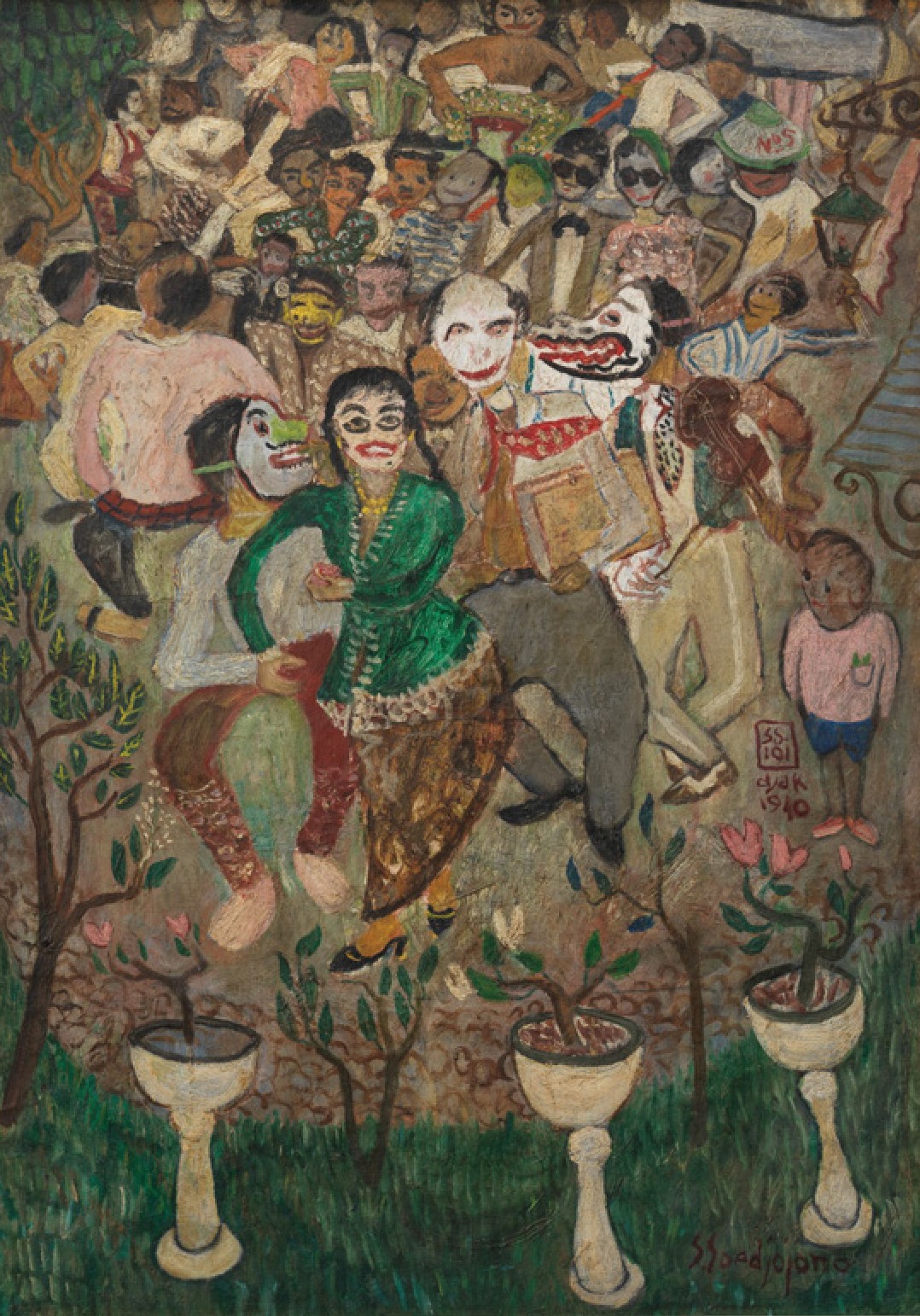 #003
#003S. Sudjojono
Tjap Go Meh
Sudjojono paints the celebration that closes the Chinese New Year as a truly lively, dense and slightly chaotic crowd. The work breaks with the seductive landscapes of "Beautiful India": gestures, costumes and urban disorder become signs of a multiple Indonesian society.
See the institution's notice →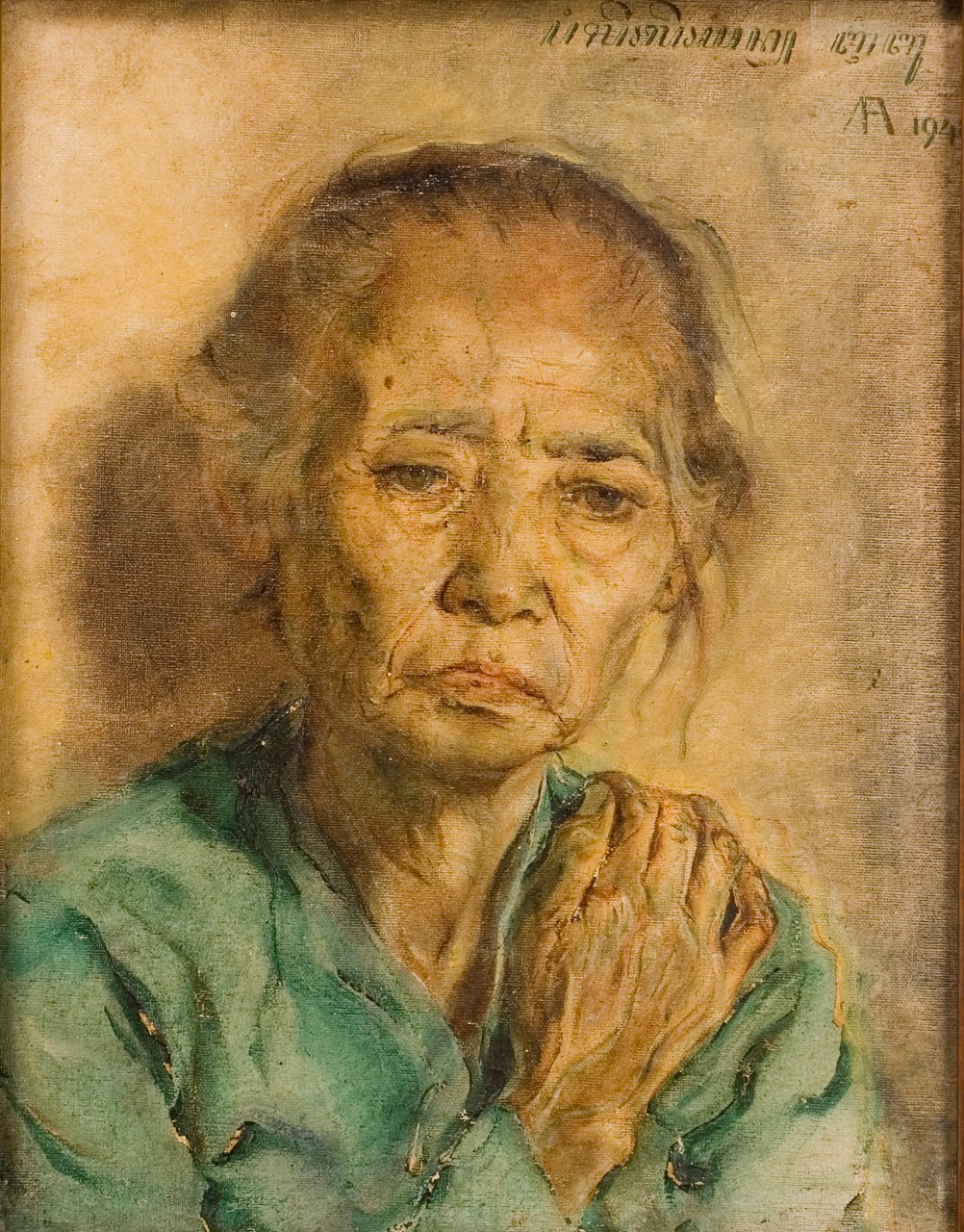 #004
#004Affandi
My mother
This 1941 portrait belongs to Affandi's realistic period, before his famous expressionist casts. The crossed arms, the closed face and the undone hair make the model's fatigue noticeable; family proximity, however, prevents any sentimental idealization.
See the institution's notice →.jpg.html) #005
#005S. Sudjojono
We stand guard, Motherland
Painted in 1965, this vast painting places the nation not in an abstract allegory, but in a scene of collective vigilance. Sudjojono confronts the figures with the "Motherland" and makes painting a space where patriotism and concern politics and citizen responsibility remain deliberately tense.
See the institution's notice →.jpg.html) #006
#006Affandi
Black bird, sun, man
A wandering musician advances under the sun, a motif that Affandi associated with vital energy. The paint cords directly pressed from the tube record the movement of the hand; the daily subject thus becomes a declaration on work, walking and perseverance.
See the institution's notice → #007
#007Raden Saleh
Ship in distress
A ship fights against a sea that occupies almost the entire picture. Raden Saleh takes up the Dutch tradition of storm sailing, but the swept barrel, heavy skies and experience of crossings between Java and Europe move the subject towards human fragility facing the ocean.
See reproduction → #008
#008Raden Saleh
Wounded lion
The injured lion is neither a trophy nor a simple zoological study. Raden Saleh focuses attention on the animal's resistance, its tense body and gaze, making hunting a moral drama where wild power still survives the injury.
See reproduction →.tif/jcr:content/renditions/cq5dam.web.1280.1280.jpeg) #009
#009Djoko Pekik
Eat drinks for tourism promotion
A kuda kepang dancer, who has entered a trance, completes the ordeal of eating glass. The title refers to the tourist campaign launched in 1989: Djoko Pekik shows how a community ritual can be converted into a commercial spectacle under the Suharto regime.
See the institution's notice →.jpg.html) #010
#010Hendra Gunawan
War and Peace
Hendra Gunawan brings together in the same canvas the wounds of the conflict and the desire to start living again. Its intensely colored figures do not describe a specific battle; they condense the Indonesian revolutionary experience and the ability of communities to survive the upheaval.
See the institution's notice →.jpg.html) #011
#011Emiria Sunassa
Papuan man with birds of paradise
Emiria Sunassa represents a healer holding two birds of paradise, emblems long coveted by the European feather trade. His frontal gaze and the greens which connect body and vegetation affirm the Papuan presence in the national imagination at the time of anti-colonial struggles.
See the institution's notice →.tif/jcr:content/renditions/cq5dam.web.1280.1280.jpeg) #012
#012Affandi
Self-portrait
Affandi depicts himself with the same pressed, fast and thick lines that he applies to landscapes or animals. The face becomes a surface crossed by energy rather than a stable mask; the self-portrait records time, fatigue and the desire to paint.
See the institution's notice →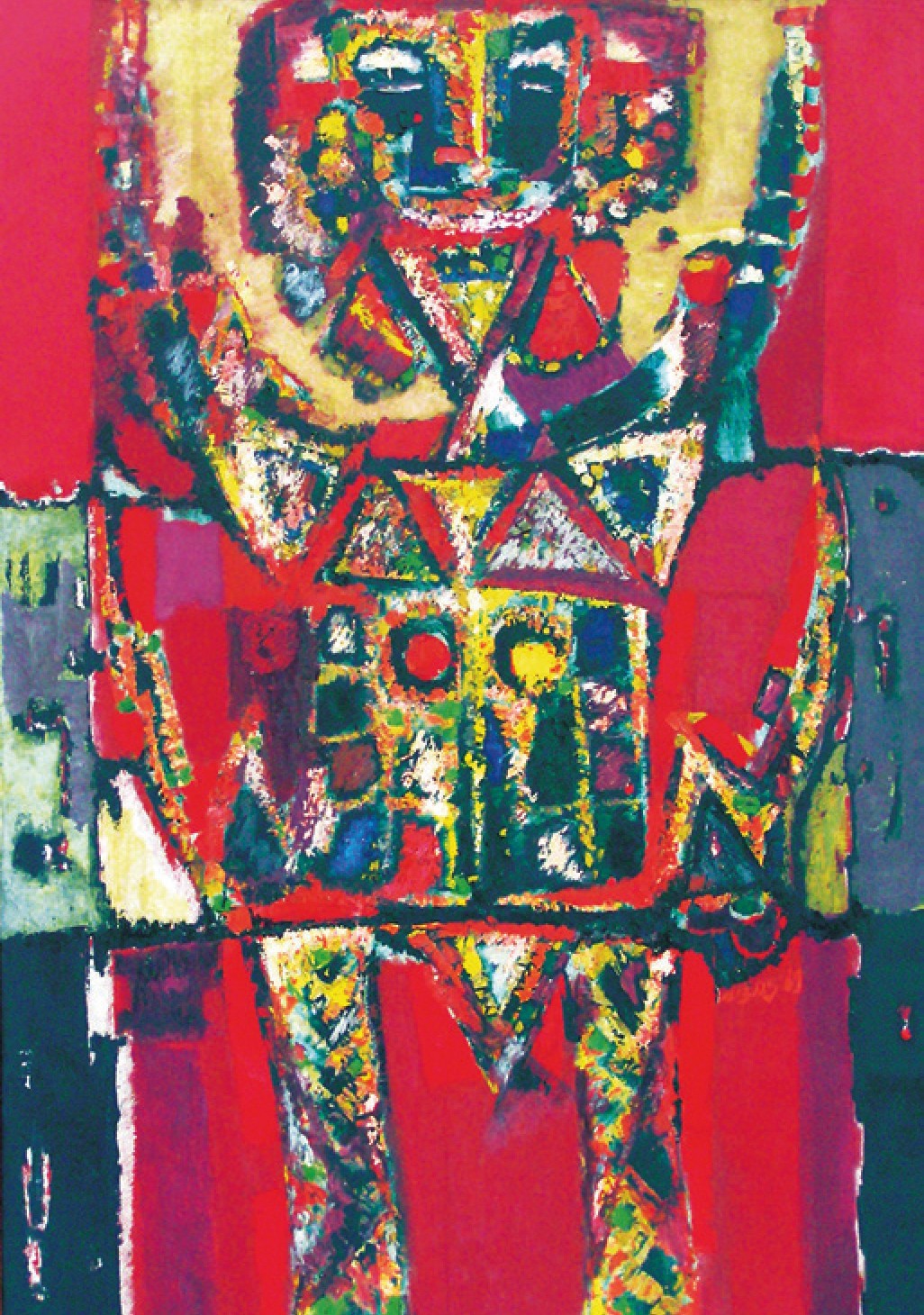 #013
#013Abas Alibasyah
Garuda
Abas Alibasyah does not literally describe Indonesia's iconic bird: he reconstructs it in geometric fragments. The reds, yellows and greens, the rough material and the echo of the sculptures of the archipelago make the national symbol a primitive, almost totemic presence.
See the institution's notice →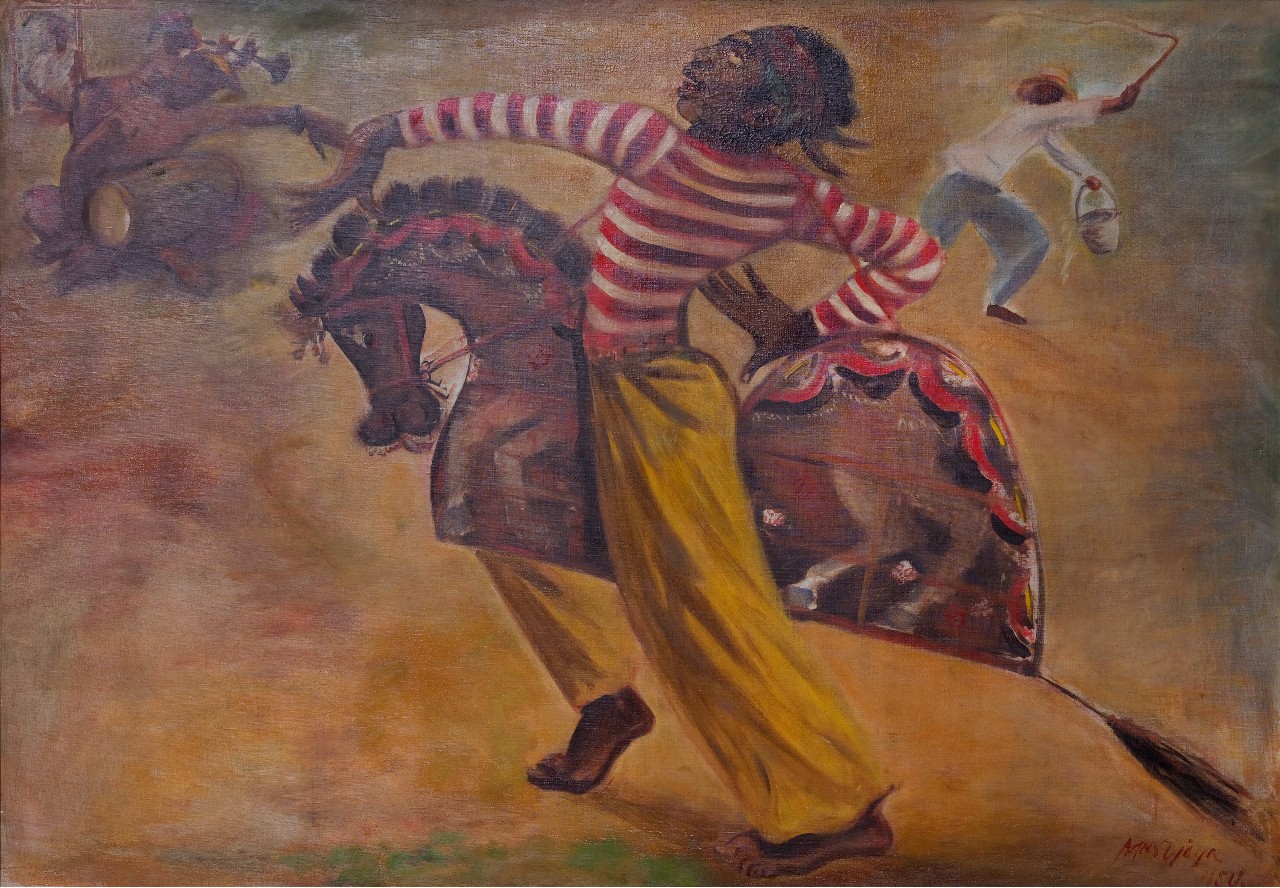 #014
#014Agus Djaya
Kuda Lumping (braided horse dance)
The dancer rides a bamboo horse effigy while musicians and playmaker lead the ritual. Agus Djaya seeks here a modernity rooted in the living arts of Java: color and pose condense rhythm, trance and cultural identity.
See the institution's notice →.jpg.html) #015
#015Ahmad Sadali
Painting
Under a strongly textured yellow field, a dark blue shape and an almost concealed Arabic inscription move the reading between material and sign. Sadali, returning from trips to America and Europe, looked in 1966 for an abstraction where islamic spirituality and modernist experimentation respond to each other.
See the institution's notice →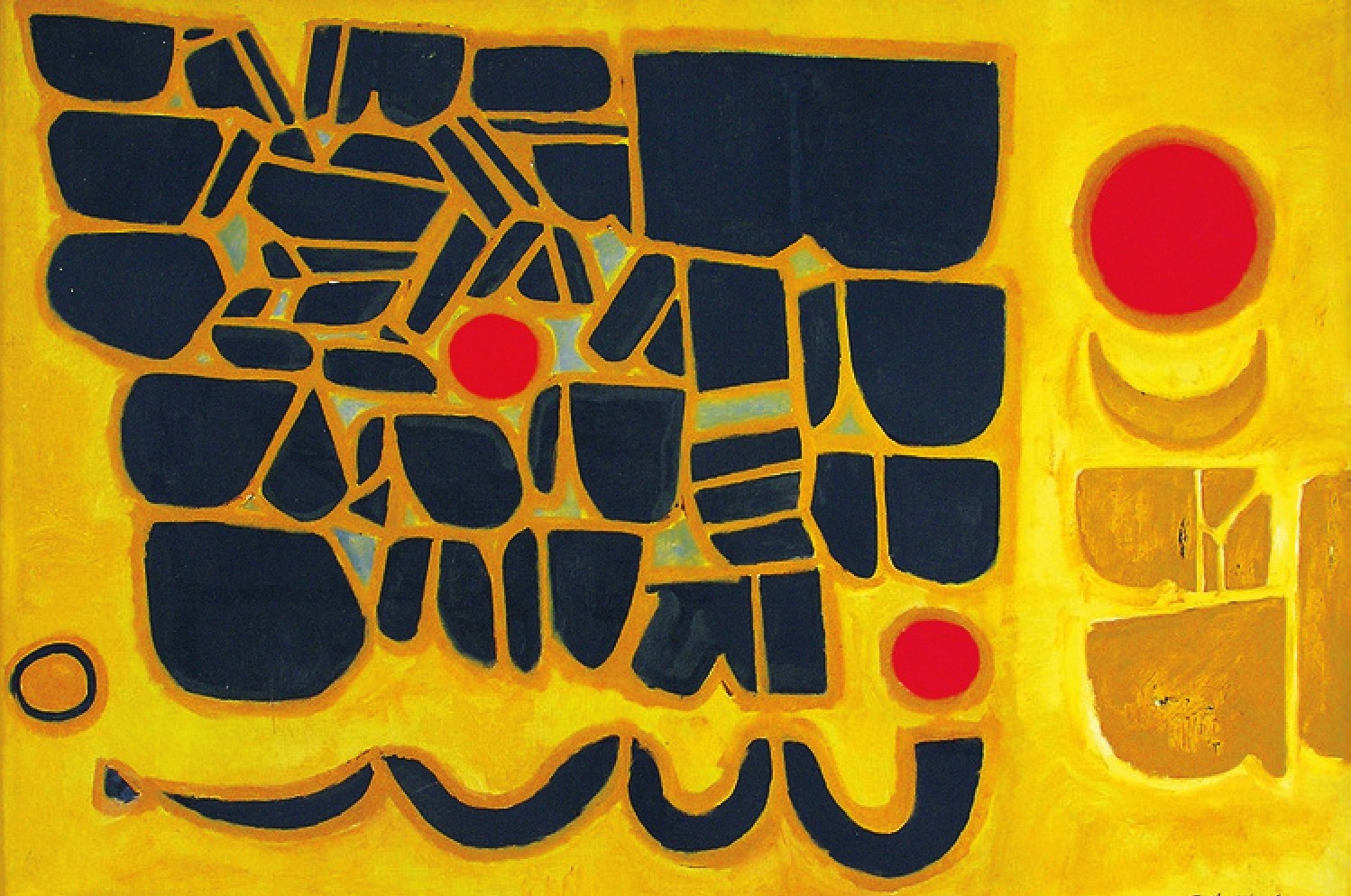 #016
#016Fadjar Sidik
Spatial dynamics
Fadjar Sidik replaces objects with a system of shapes that seem to attract, repel and float. This "spatial dynamic" asserts that Indonesian abstraction is not a simple international borrowing: it can organize an autonomous experience of rhythm and balance.
See the institution's notice →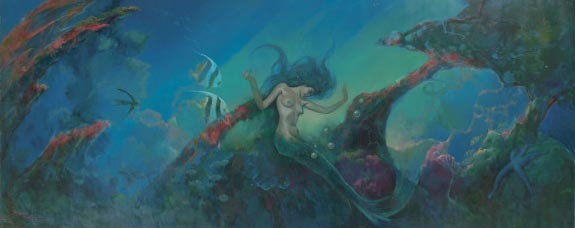 #017
#017Basoeki Abdullah
Fight for the restoration of democracy and the rights of the people
Basoeki Abdullah here abandons the worldly portrait and the ideal landscape for a vast political allegory. Bodies, gestures and ascending composition transform the democratic demand into a public scene, revealing a committed facet of a painter often considered only virtuoso.
See the institution's notice →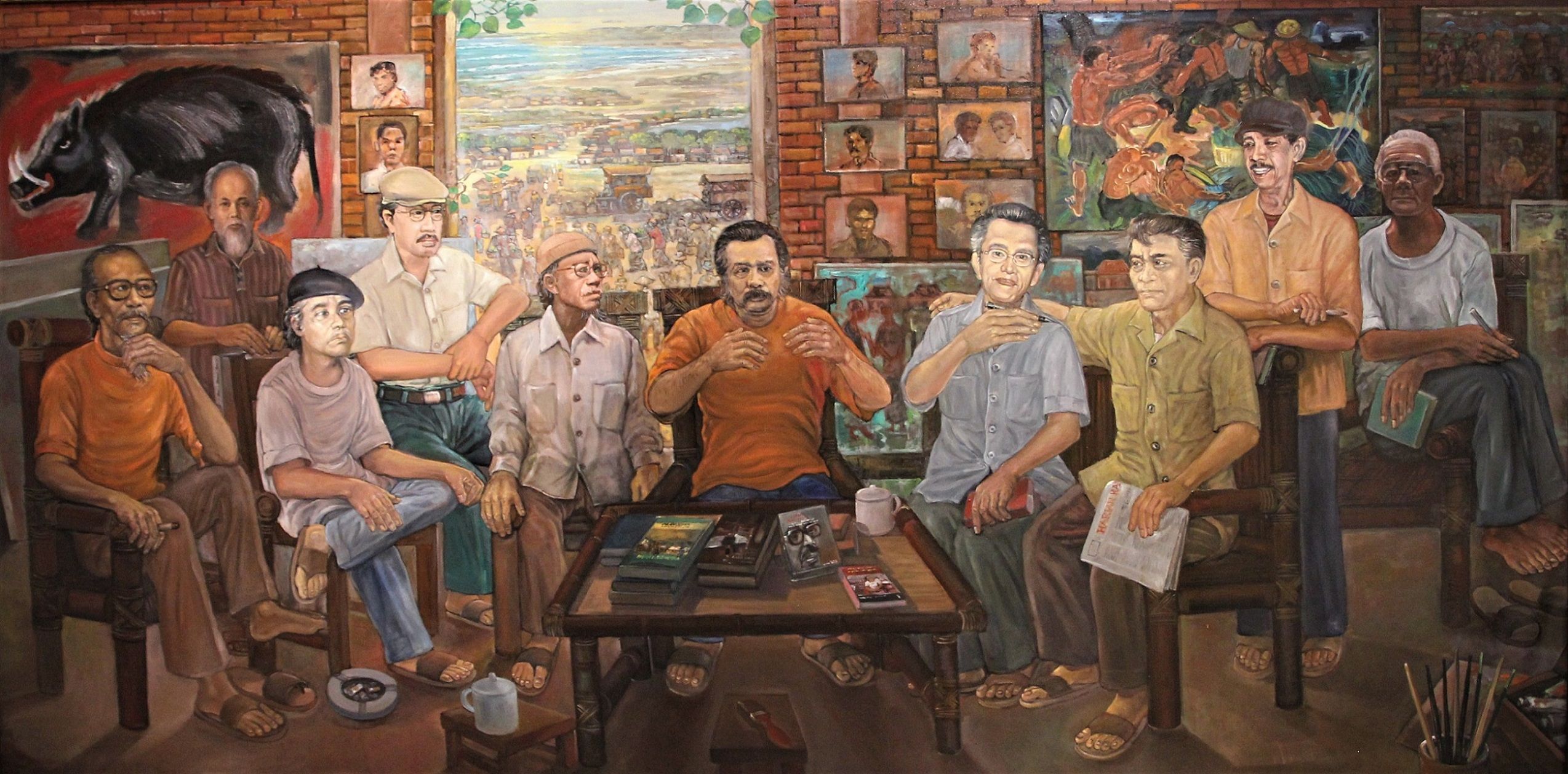 #018
#018Sanggar Bumi Tarung
Discussion at the Bumi Tarung workshop
The workshop discussion becomes a historical subject in its own right. By representing artists and activists united, the work recalls that Sanggar Bumi Tarung conceived of creation as a collective practice, linked to popular struggles and debates on the social function of art.
See the institution's notice →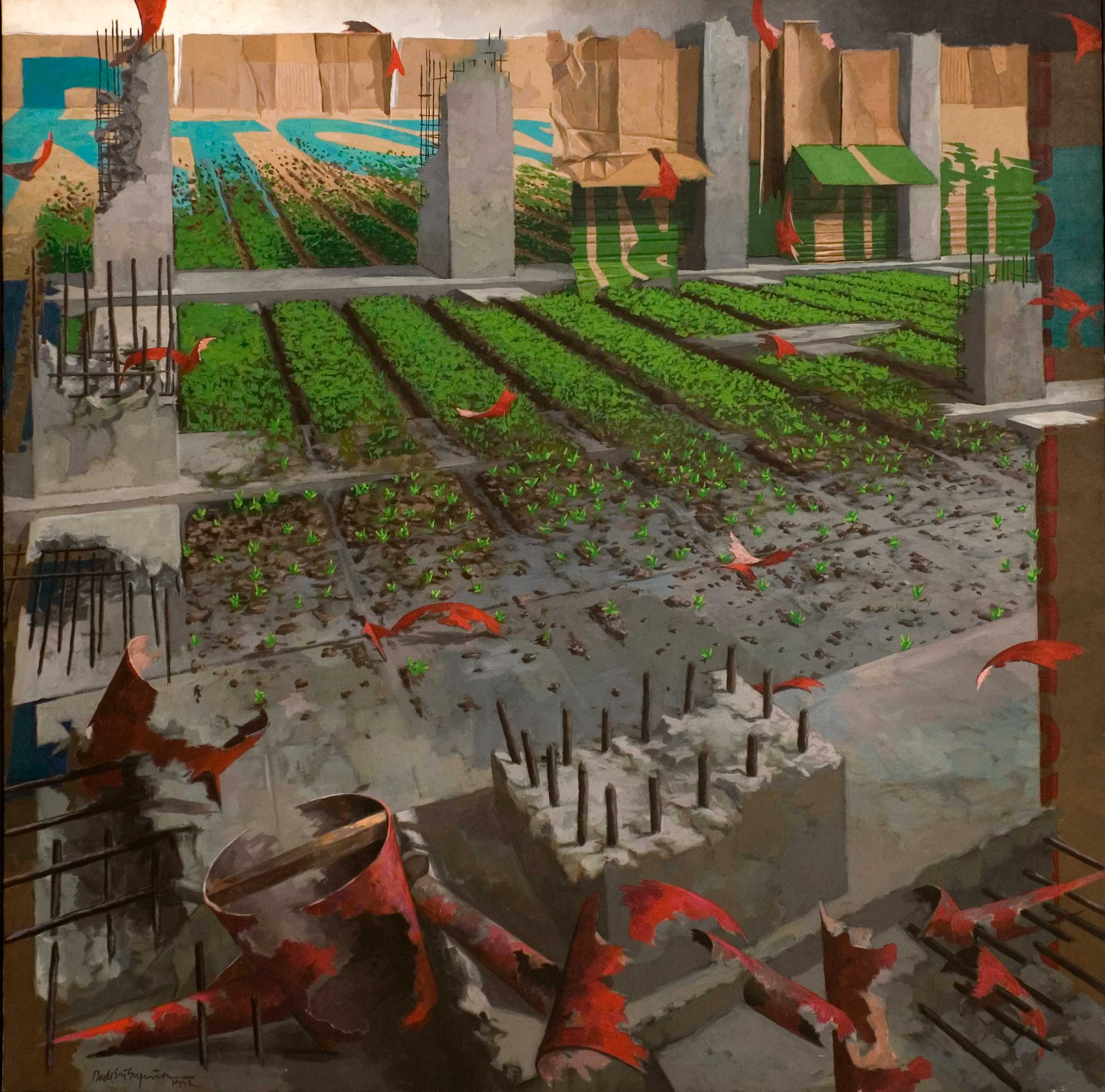 #019
#019Dede Eri Supria
What strives to grow
Dede Eri Supria confronts a fragile push with the harsh environment of the modern city. Its precise realism, close to photorealism, does not celebrate urban growth: it shows its contradictions, the persistent hope and the vulnerability of what tries to find a place there.
See the institution's notice → #020
#020Raden Saleh
The Shipwreck
A boat breaks against the rocks under an almost entirely black sky. This 1840 navy shows how Raden Saleh assimilates the sublime European romantic: lightning, foam and tiny silhouettes measure human helplessness in the face of natural violence.
See reproduction →The revolution, the village, the theater and the work enter painting with a frankness that refuses the well-combed but too silent tropics.
 #021
#021Agus Djaya
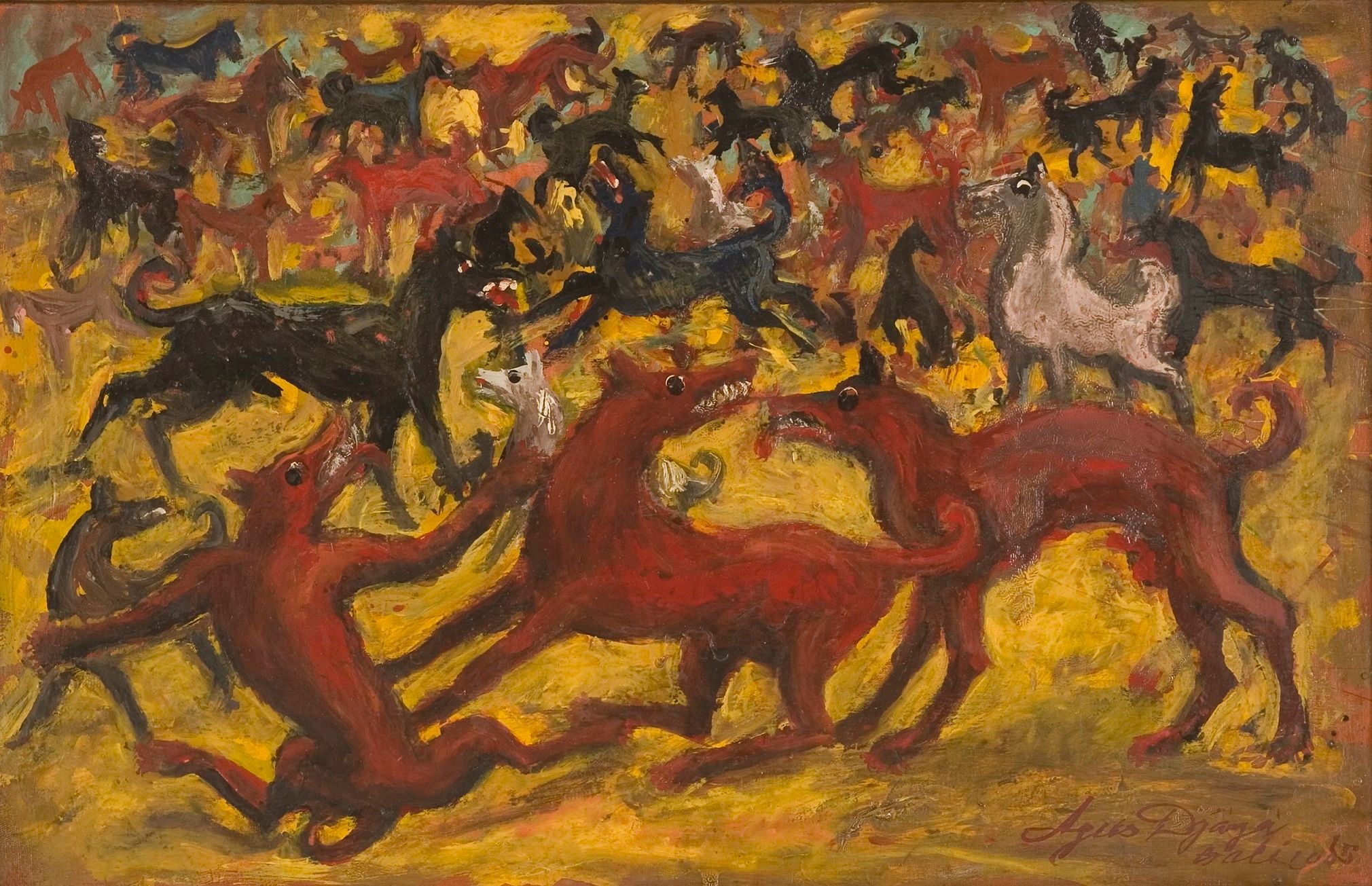
The World of Dogs
Made during the upheavals of 1965, this melee of red, black, brown and white dogs functions as a political satire. The animals argue and bite each other without clearly distinguishing allies and adversaries: Agus Djaya paints social disintegration in the form of a brutal fable.
See the institution's notice →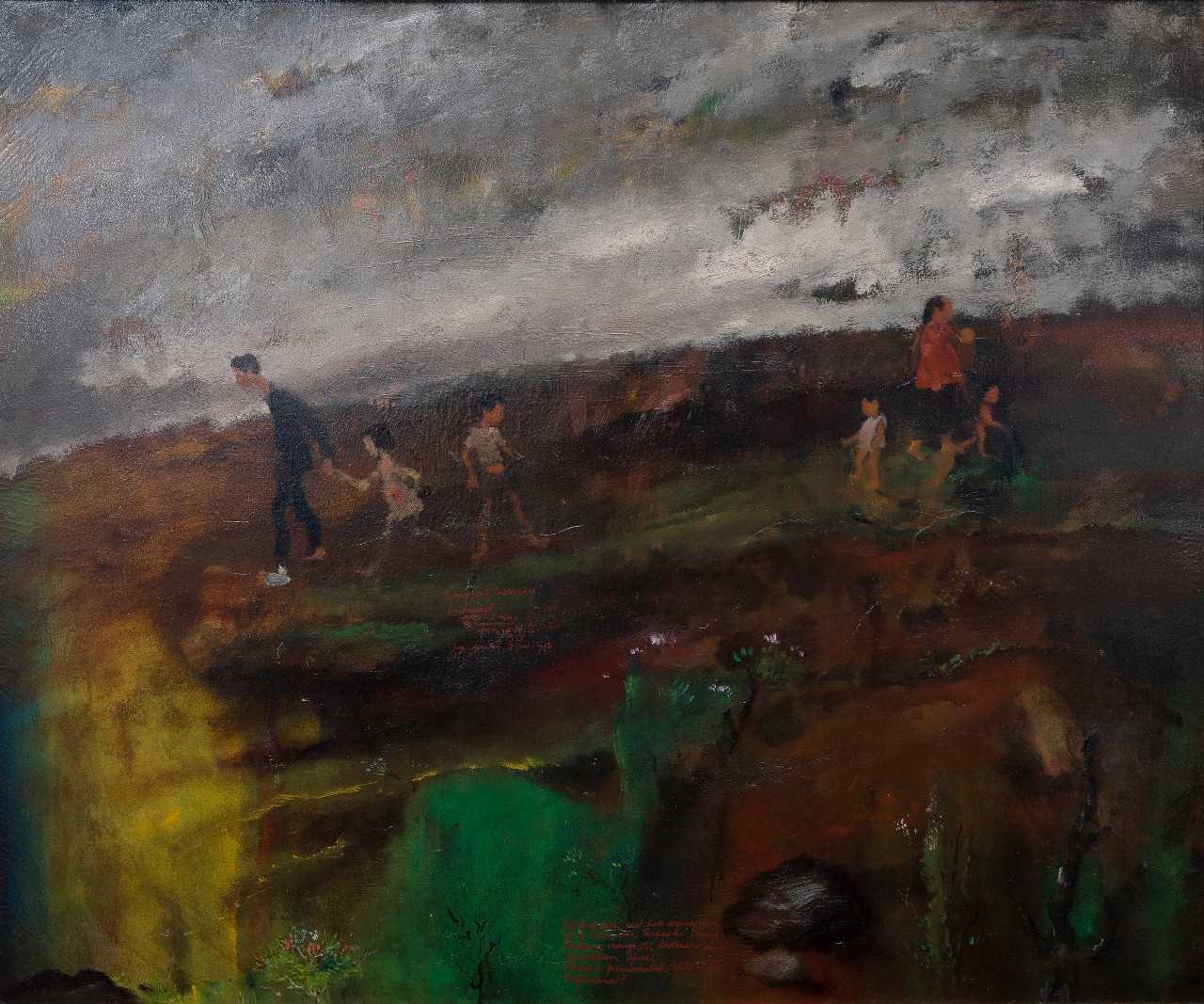 #022
#022Harijadi Sumadidjaja
At the crossroads
Harijadi makes the crossroads an image of collective choice in post-independence Indonesia. The trajectories, the looks and the division of space prevent a purely anecdotal reading: everyone seems to have to decide on a direction in the middle of a still unstable future.
See the institution's notice → #023
#023Raden Saleh
Portrait of Betsy Teengs
Painted in Java in 1855, Betsy Teengs appears with the restraint of a European portrait, but her Dutch, Chinese and Indonesian family history inscribes the image in mixed colonial society. Saleh accurately renders childhood, costume and status without reducing the model to a type.
See reproduction →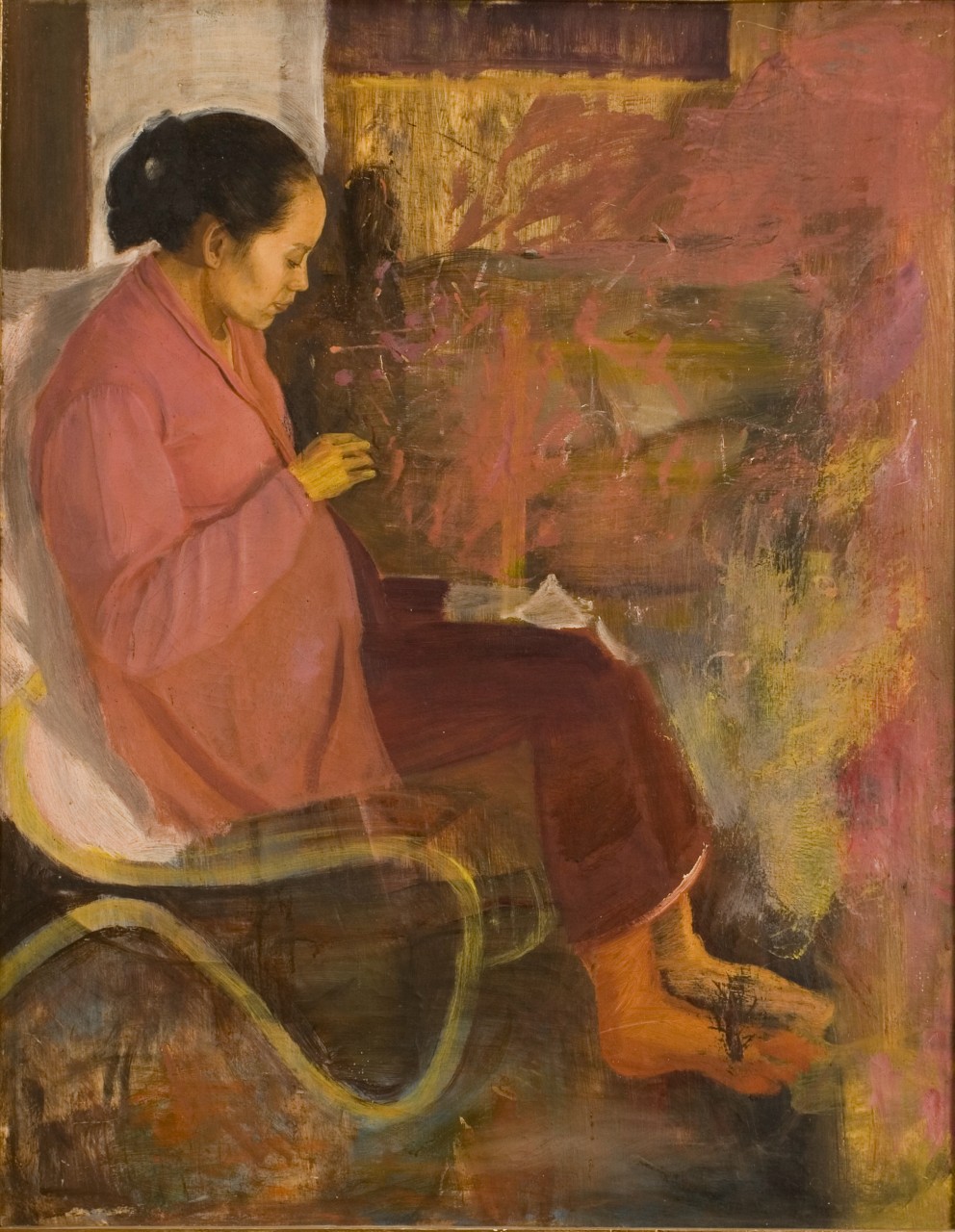 #024
#024S. Sudjojono
Mother sewing
A woman absorbed in sewing embodies the dignity of domestic work during the war years. Sudjojono refuses decorative exoticism: posture, hands and tight space give daily activity a historical, almost silent gravity.
See the institution's notice →.jpg.html) #025
#025Amrus Natalsya
Those who are driven from their land
A hand armed with a cane tears a family from the land it protects. Founding member of Sanggar Bumi Tarung, Amrus Natalsya transforms peasant exploitation into an immediately readable image: the central child gives social conflict a human measure.
See the institution's notice →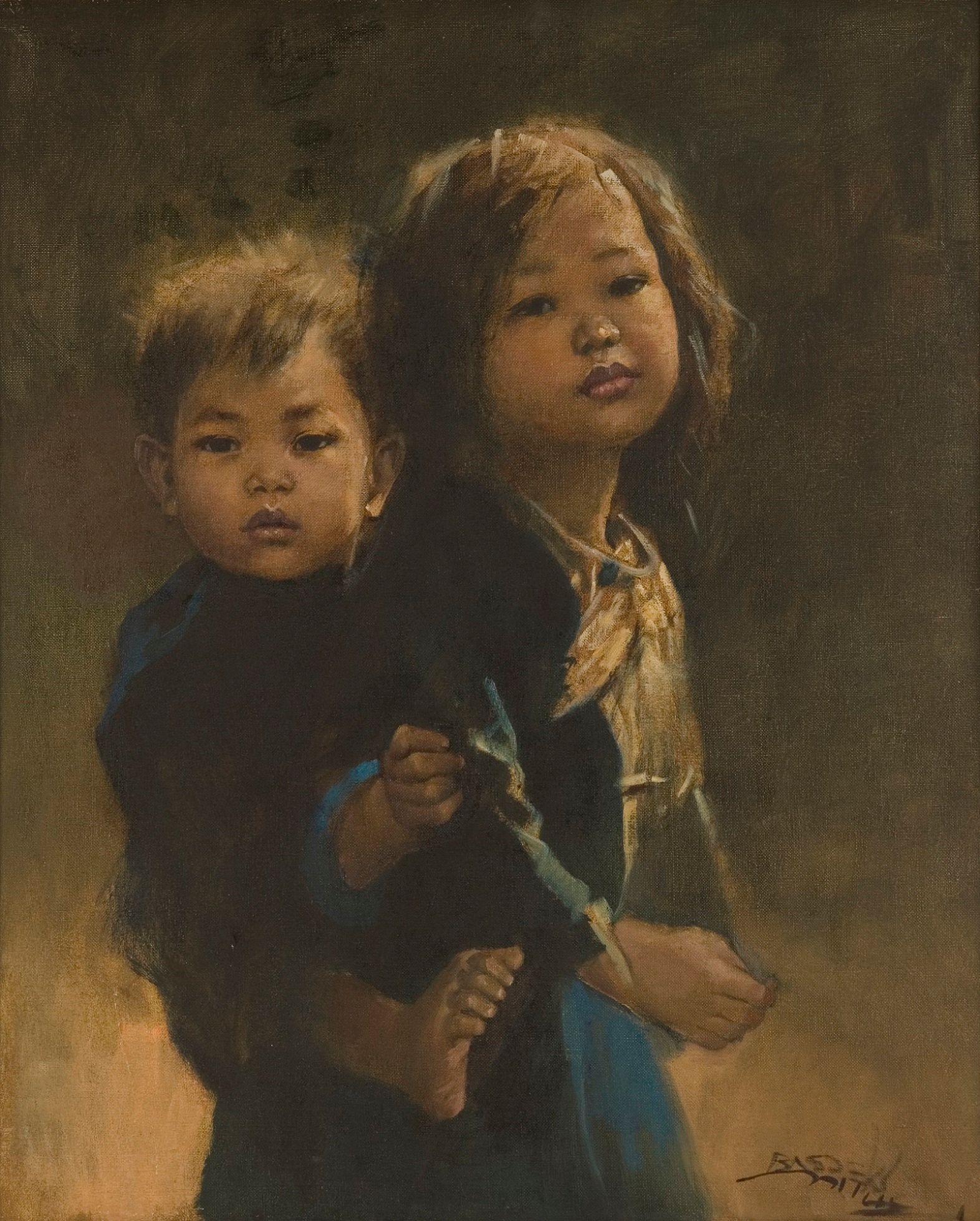 #026
#026Basoeki Abdullah
Brother and Sister
Basoeki Abdullah puts his academic virtuosity at the service of a family relationship rather than an official portrait. The close positions, the softness of the modeling and the age differences construct a story of protection and confidence, without resorting to a spectacular setting.
See the institution's notice →.jpg.html) #027
#027Wakidi
The Sianok Canyon
Wakidi painted this West Sumatran canyon all his life, at different times and from several viewpoints. Far from an interchangeable tourist landscape, the mists, cliffs and light reflect an intimate knowledge of an inhabited and regularly revisited place.
See the institution's notice →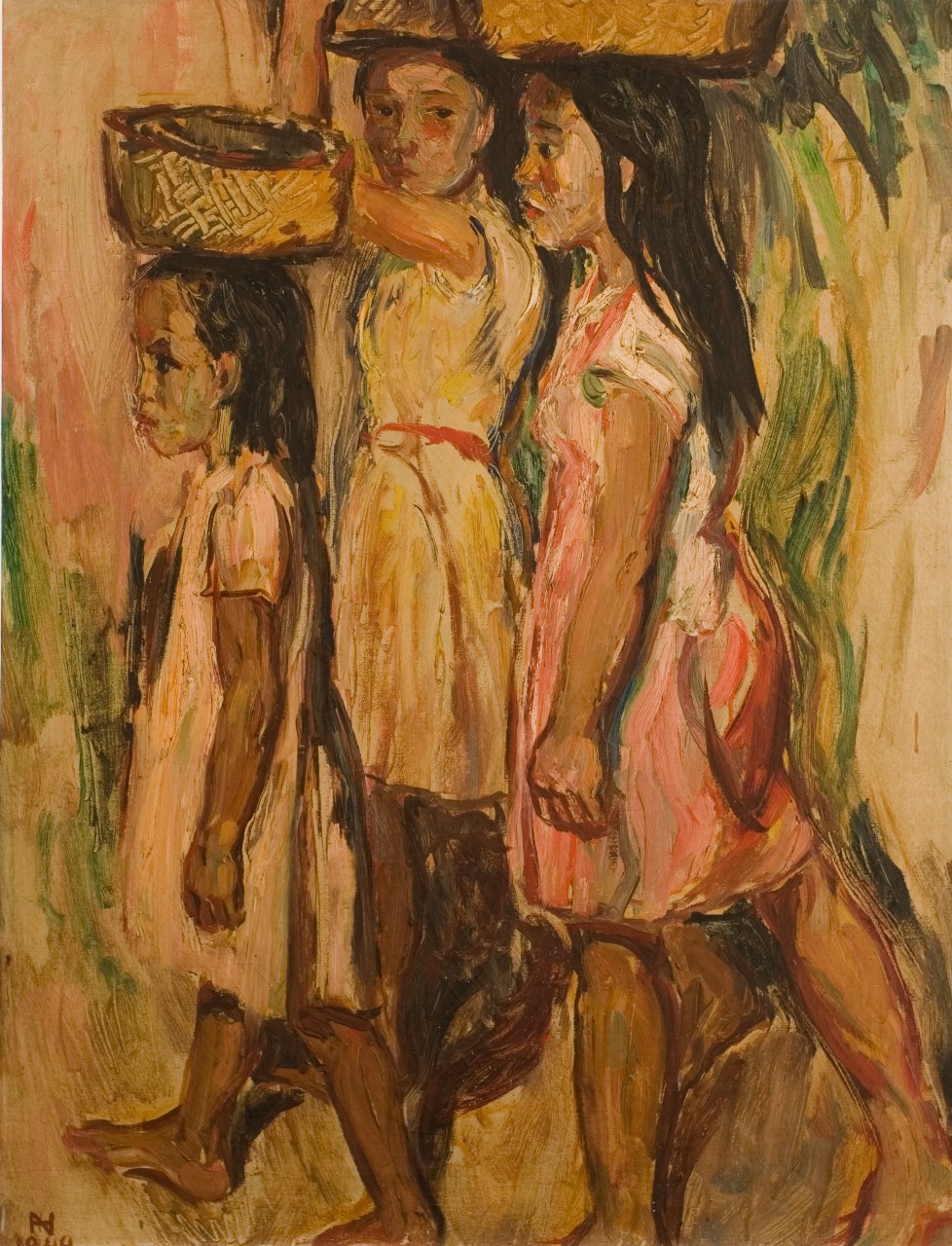 #028
#028Henk Ngantung
Three Young Girls from Minahasa
The three young women are not presented as regional curiosities. Henk Ngantung gives their postures and proximity a calm presence, making the collective portrait a tribute to the human diversity of the archipelago in the aftermath of independence.
See the institution's notice →.tif/jcr:content/renditions/cq5dam.web.1280.1280.jpeg) #029
#029Emiria Sunassa
Danger behind the lotus
A hunter targets an invisible threat behind the vegetation. By mixing dayak and Papuan attributes, Emiria Sunassa does not seek ethnographic accuracy: she questions the construction of a diverse national identity, while the dark jungle resists the modern gaze.
See the institution's notice → #030
#030Raden Saleh
Portrait of Adolphe Jean Philippe Hubert Désiré Bosch
Raden Saleh deploys here the mastery of official portraiture acquired in Europe. The costume, attitude and precision of the face indicate the rank of the model, but psychological attention prevents the image from being reduced to an inventory of social signs.
See reproduction →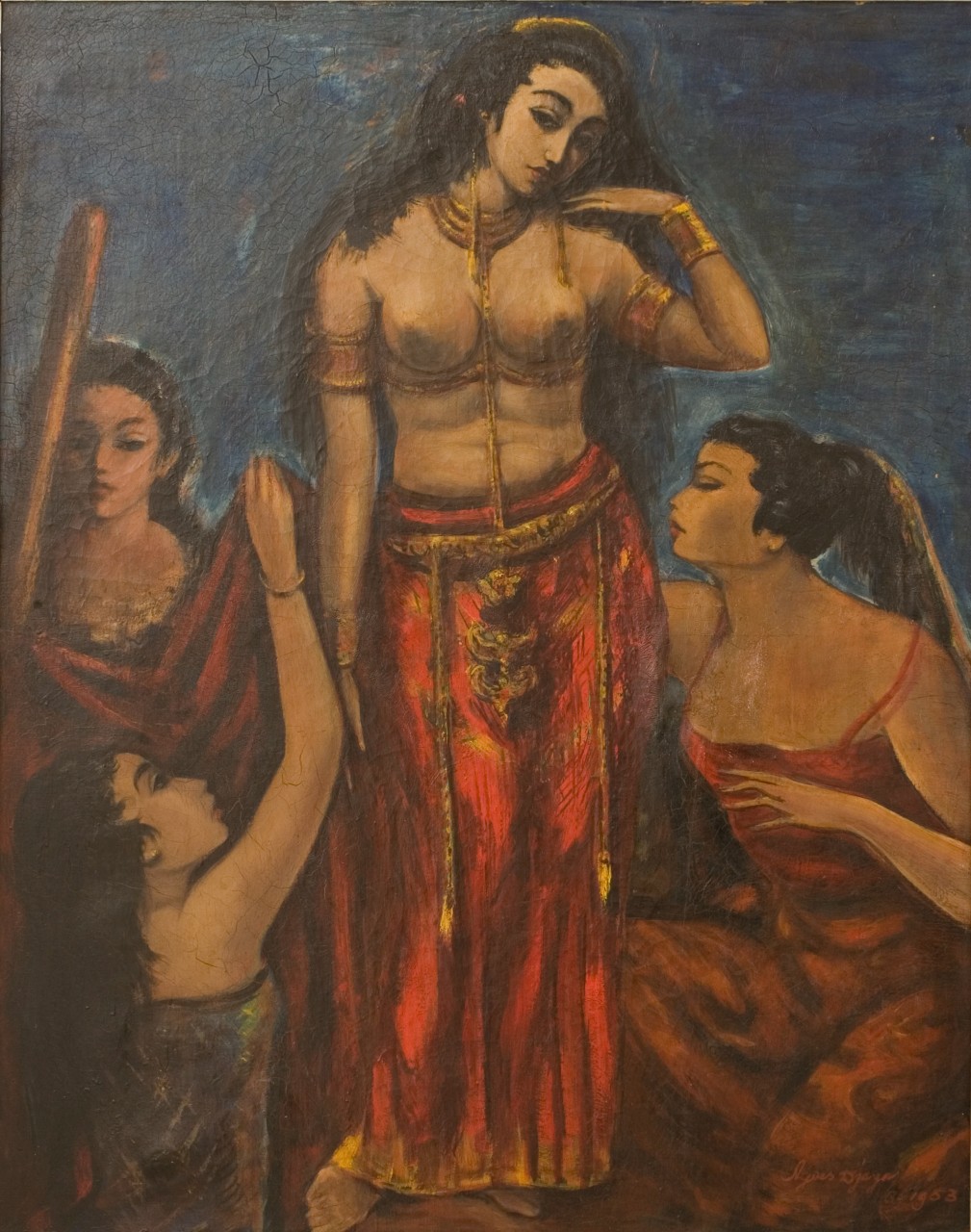 #031
#031Agus Djaya
The Toilet before the show
A performer adorns herself before a traditional performance. Through this waiting scene, Agus Djaya connects modern painting to the costumes, gestures and reliefs of Java; the preparatory moment counts as much as the spectacle and affirms the intellectual value of popular arts.
See the institution's notice →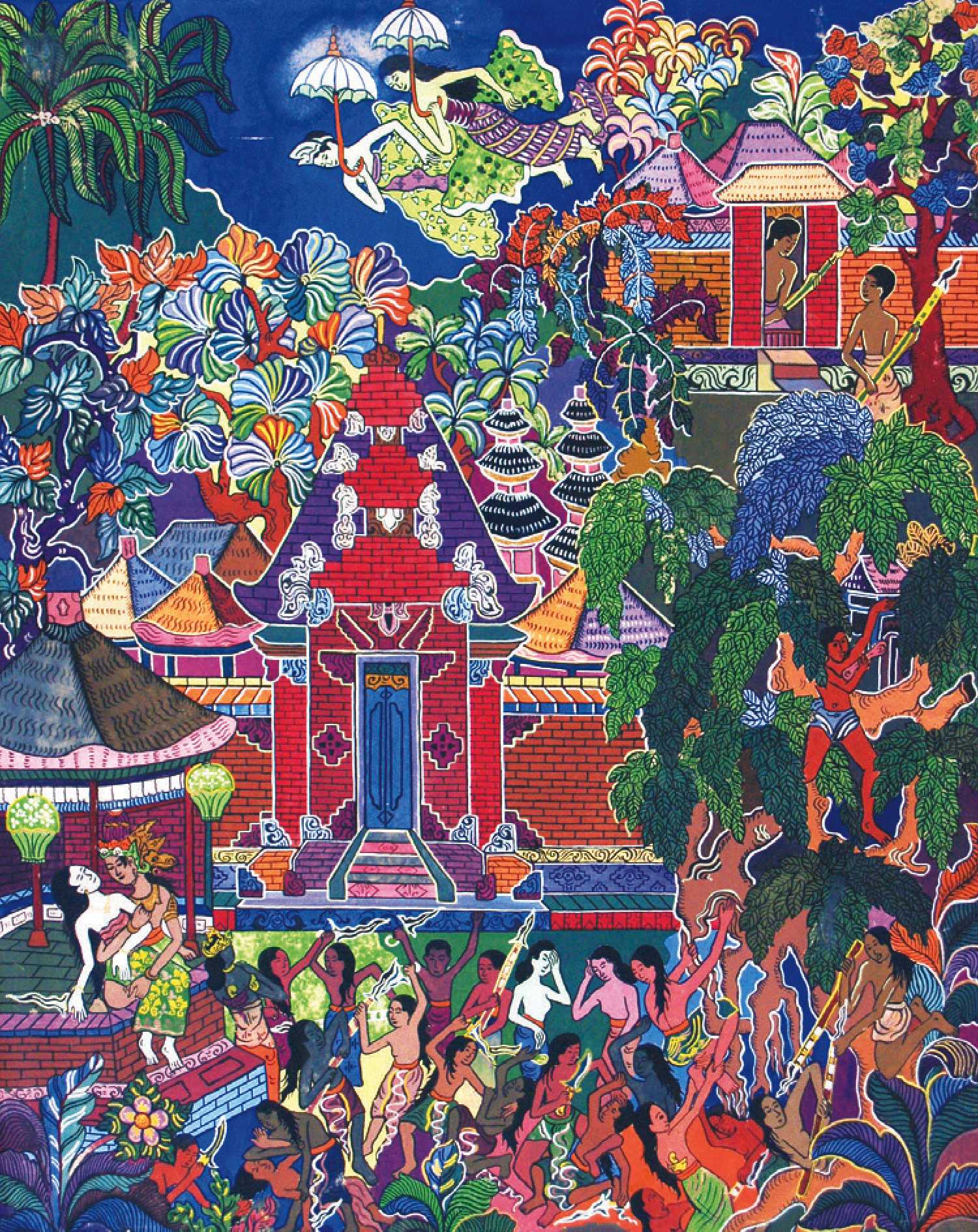 #032
#032I Ketut Soki
The Legend of Jayaprana
The Balinese legend of Jayaprana and Layonsari, lovers victims of royal desire, unfolds in numerous episodes in a continuous space. I Ketut Soki preserves the dense narration of village painting: each group of figures advances the tragic story.
See the institution's notice →.tif/jcr:content/renditions/cq5dam.web.1280.1280.jpeg) #033
#033Emiria Sunassa
Resin harvesting
Emiria Sunassa is interested in working in the forest without transforming it into an exotic setting. Harvesting gestures, trees and the dark matter of the landscape connect daily economy and natural environment; the work thus broadens the narrative of Indonesian modernity beyond the cities of Java.
See the institution's notice →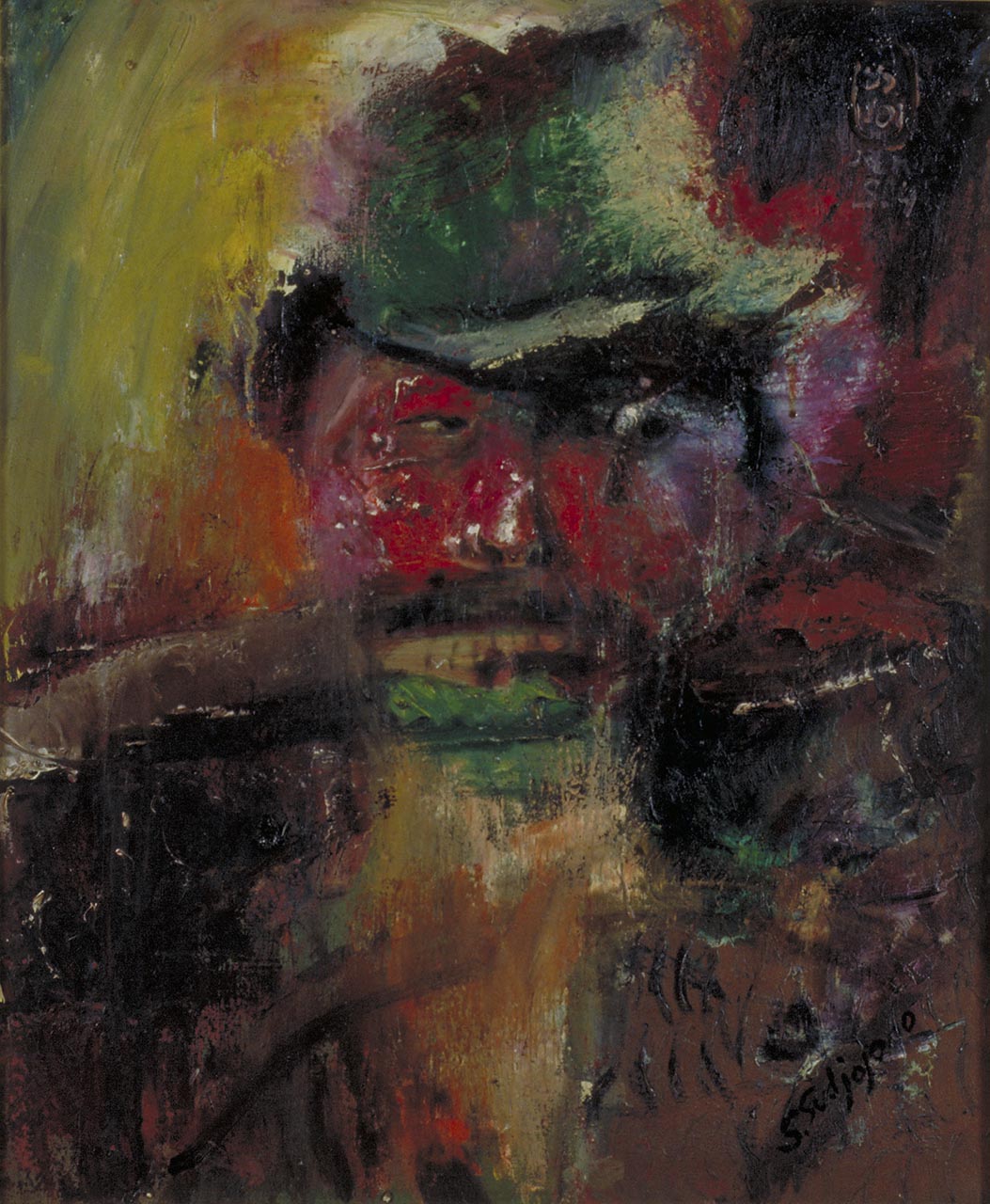 #034
#034S. Sudjojono
Man figure
Painted in 1929, this figure belongs to the years when Sudjojono sought a painting capable of showing inner truth rather than colonial picturesqueness. The model occupies the space with an almost harsh frankness: psychological presence and construction of the body take precedence over elegance.
See the institution's notice →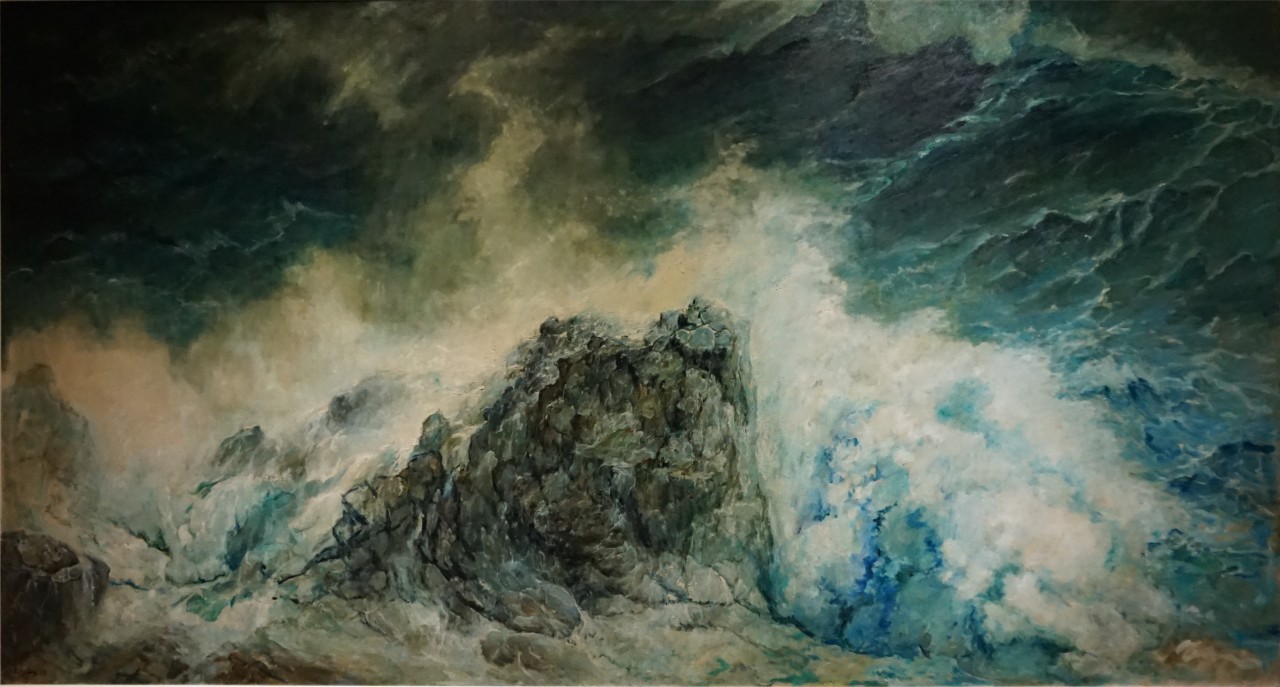 #035
#035Henk Ngantung
The Unshakeable Rock
The rock beaten by the elements functions as a metaphor for constancy. Henk Ngantung, a painter engaged in the political life of Jakarta, here combines landscape and moral character: the mineral mass resists without theatrical heroism, solely by its duration.
See the institution's notice →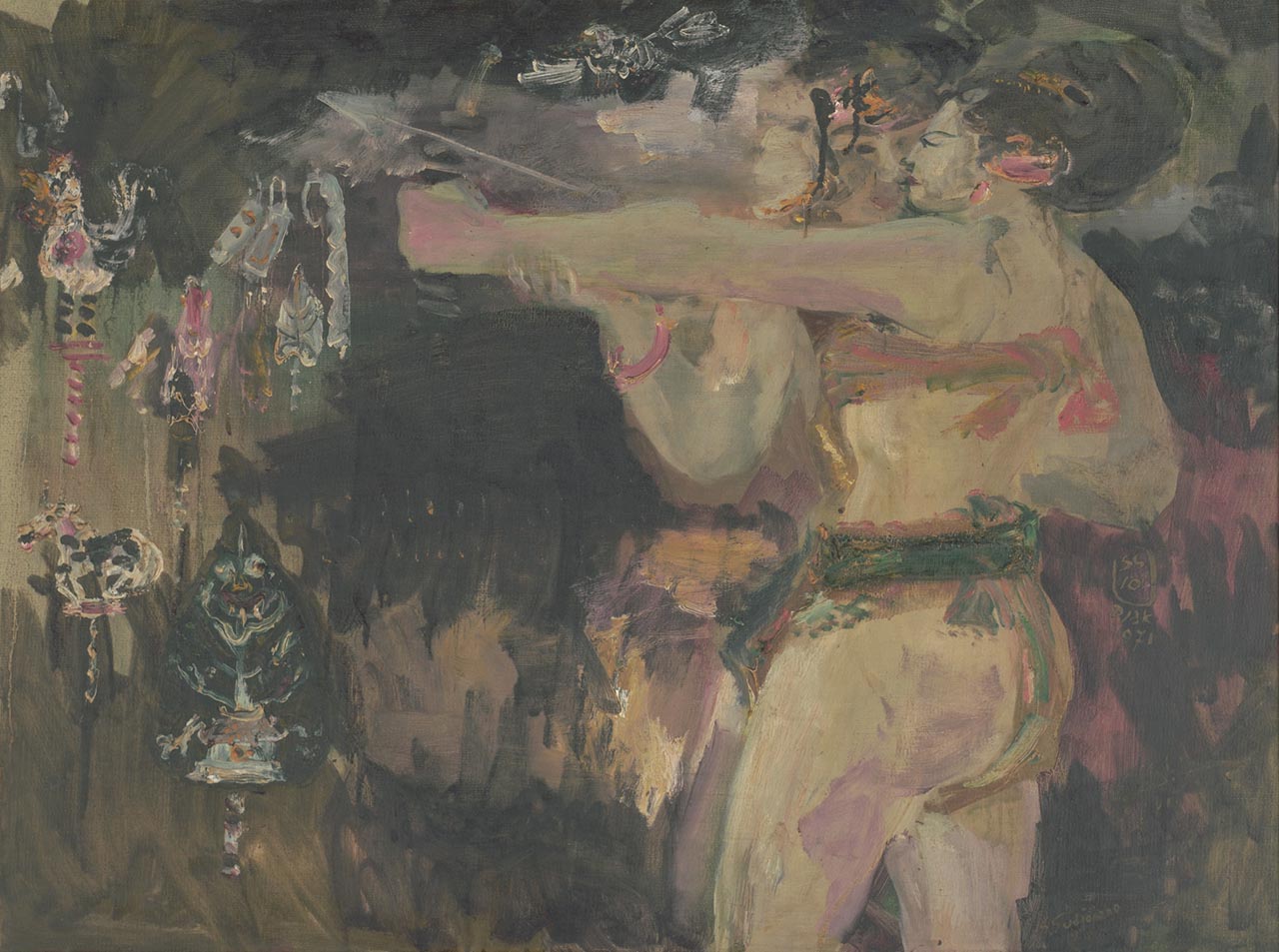 #036
#036S. Sudjojono
Arjuna arches
The hero of the Mahabharata draws his arc in a composition where the myth becomes present action. Sudjojono does not copy the iconography of shadow theater: he gives Arjuna a body weight and tension that brings the epic closer to modern experience.
See the institution's notice →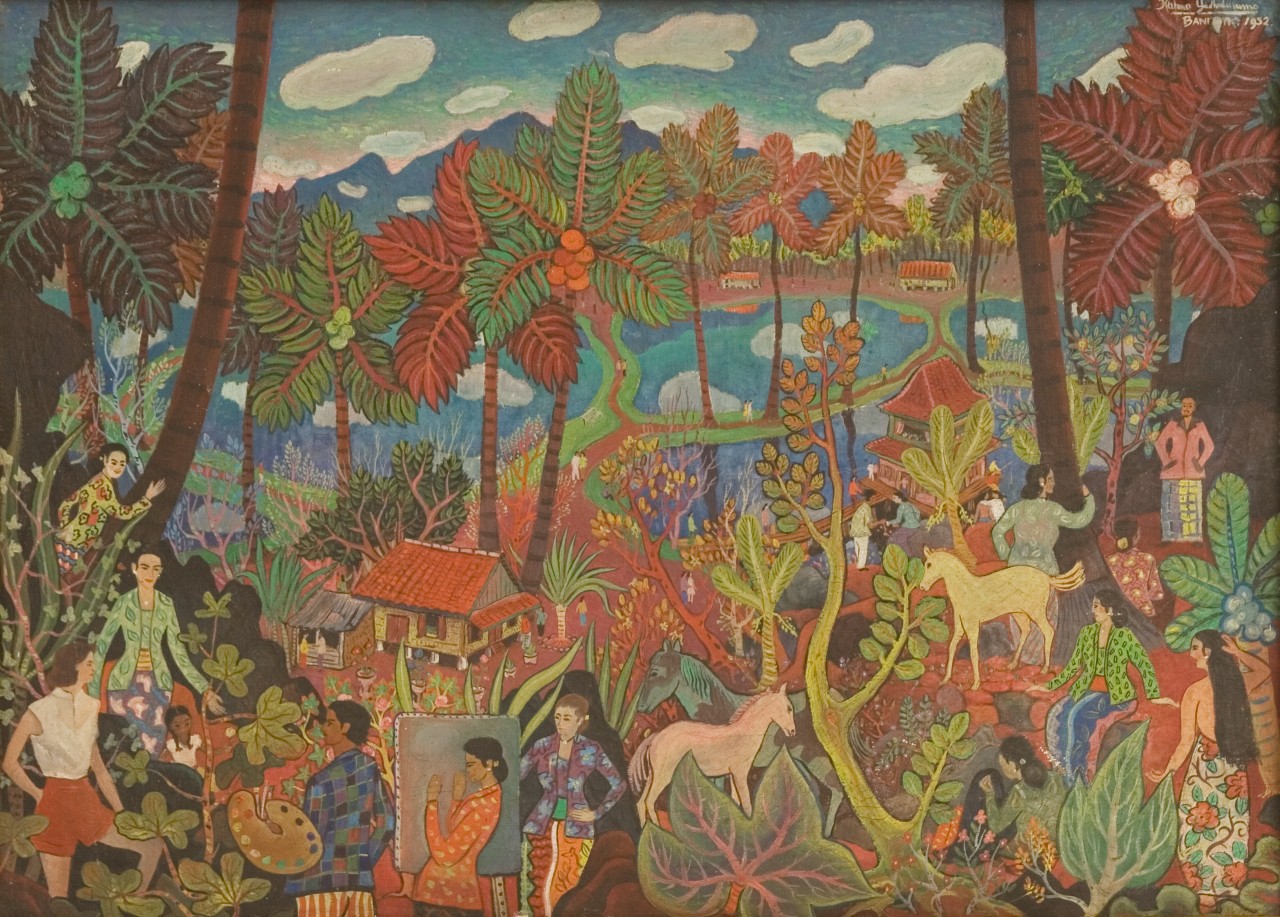 #037
#037Kartono Yudhokusumo
Bandung
Kartono Yudhokusumo organizes the city and its relief like a built landscape, where houses, streets and vegetation form a readable network. The work belongs to the search for a modern national vision: Bandung is neither a colonial panorama nor a simple report, but a lived space.
See the institution's notice →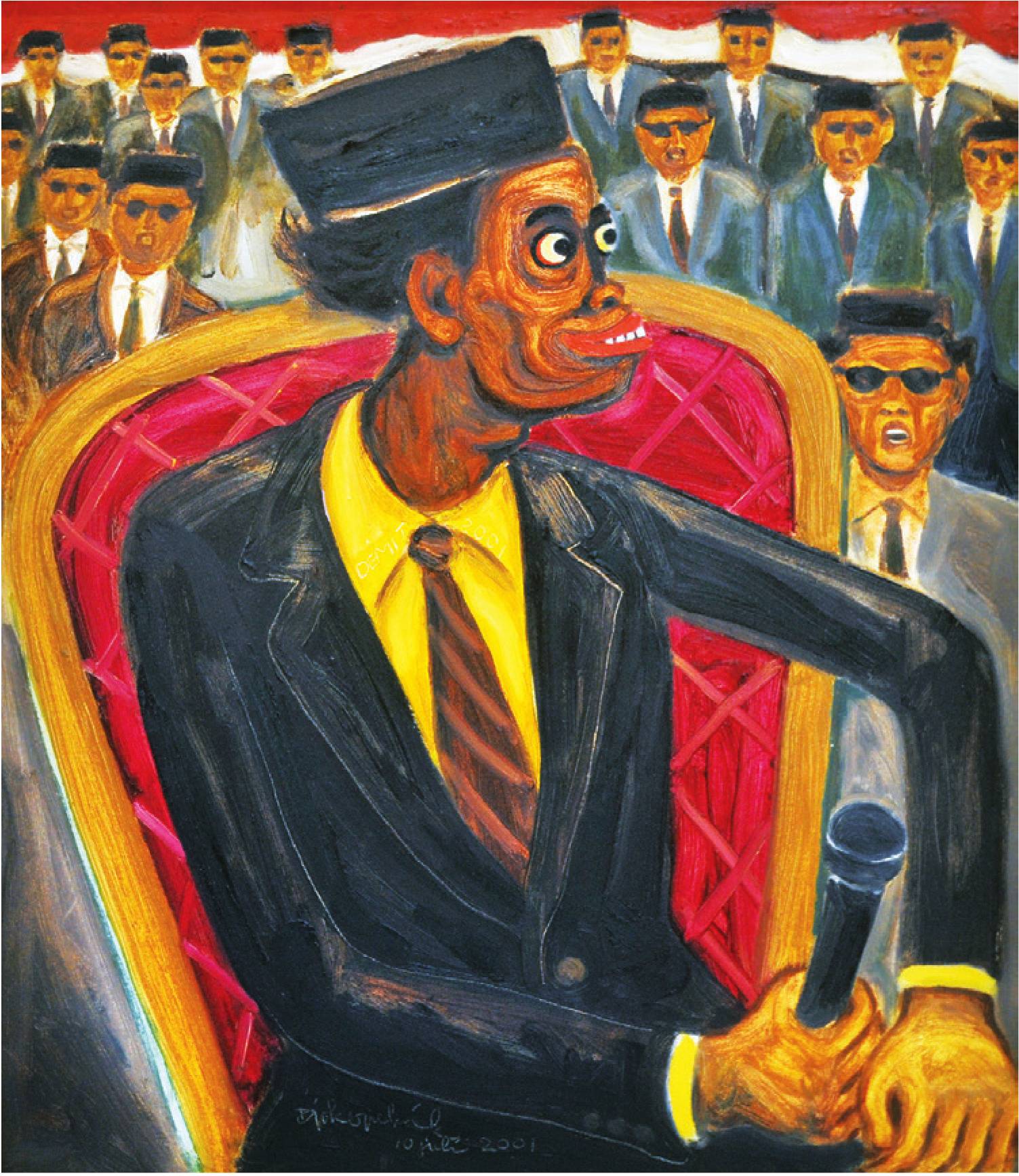 #038
#038Djoko Pekik
Demon 2000
Djoko Pekik reactivates the figure of the demit, a disturbing spirit of Javanese folklore, to look at Indonesia at the turn of the millennium. The fantastic serves as a critical tool: behind the creature can be guessed the political fears, disillusionments and survivals of the old order.
See the institution's notice →.jpg.html) #039
#039Basoeki Abdullah
Sunset
The setting sun transforms rice fields and cottages into a harmonious vision of a pre-industrial countryside. The luminous virtuosity of Basoeki Abdullah explains the appeal of the image, but his idealization also invites us to question the urban desire for a rural world that has remained intact.
See the institution's notice →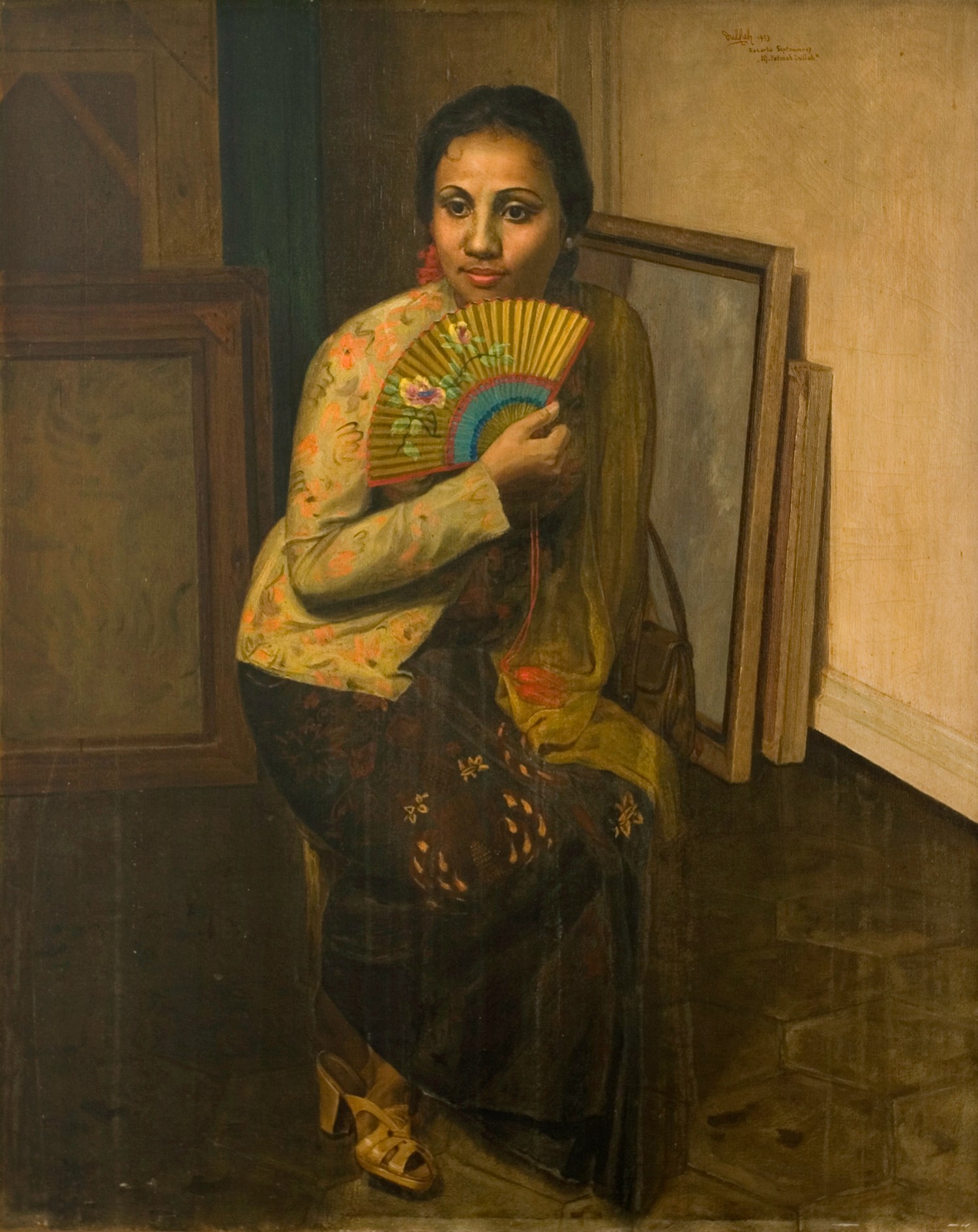 #040
#040Dullah
My wife
Dullah paints his wife without the solemn attributes of a commissioned portrait. The intimate title, the look and the sobriety of the pose bring the painting back to a personal relationship; realistic precision serves prestige less than emotional memory.
See the institution's notice →Portraits, wayang, animals and ancient stories become the laboratories of a modernity which passes through the body as much as through ideas.
 #041
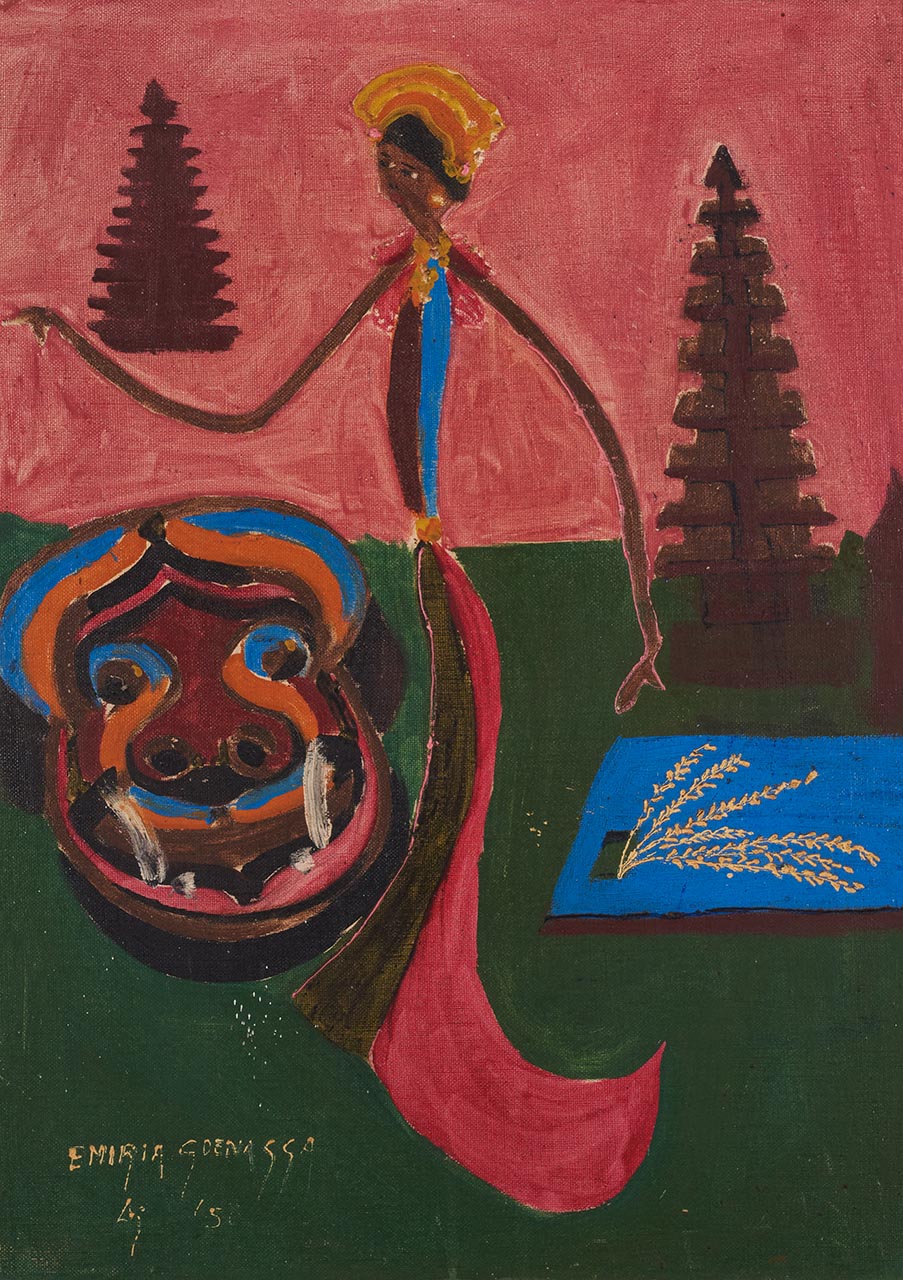
#041Emiria Sunassa
Sri Padi, goddess of rice
The rice goddess links fertility, agricultural work and Javanese belief. Emiria Sunassa treats Sri as a living presence rather than a folk illustration; the image reminds us that food, land and the sacred share the same cultural narrative.
See the institution's notice →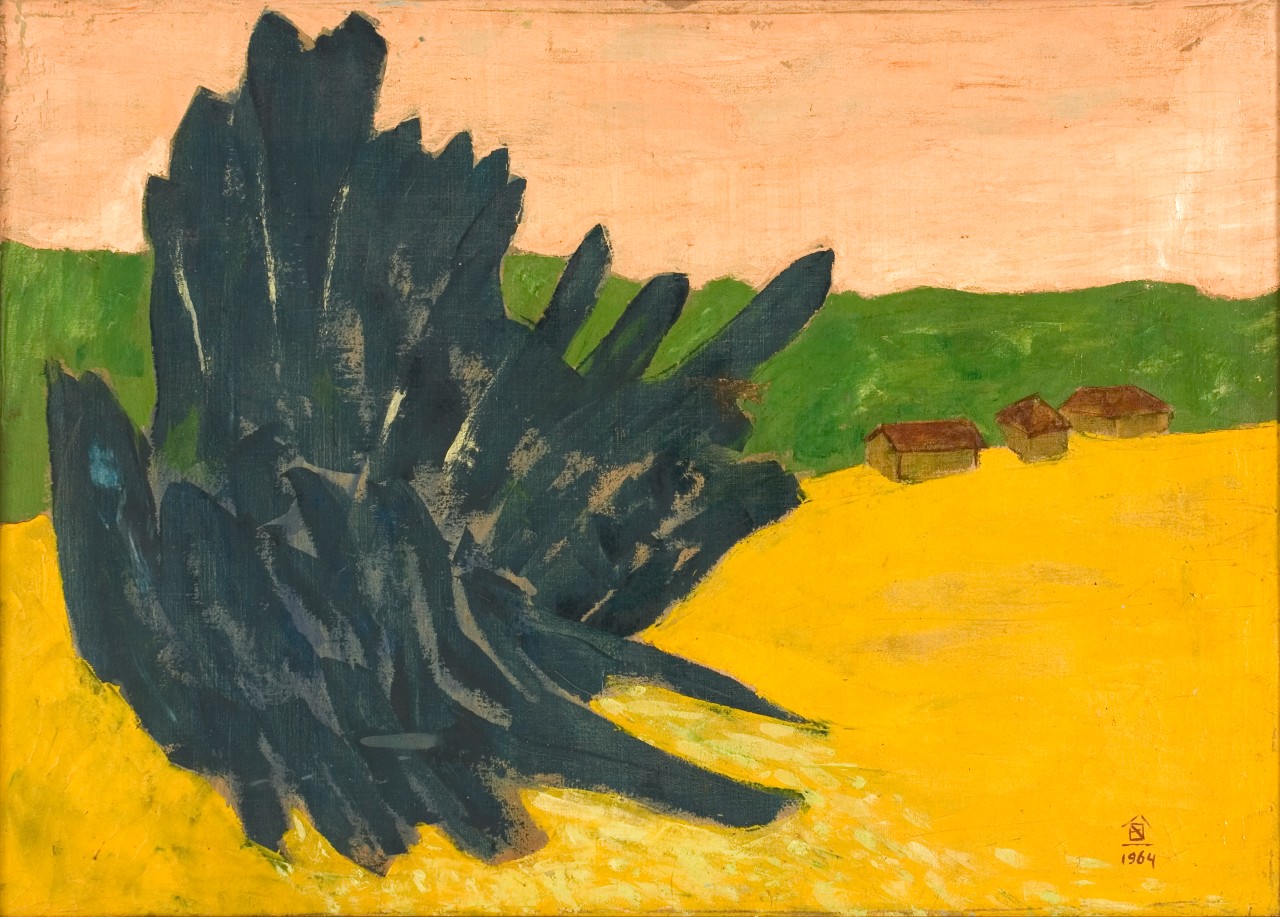 #042
#042Nashar
Three Houses
Three houses are enough for Nashar to move the landscape towards sensation. Simplified volumes and colorful intervals avoid topographical description: what matters is the silent rhythm of a place, as it persists in memory.
See the institution's notice →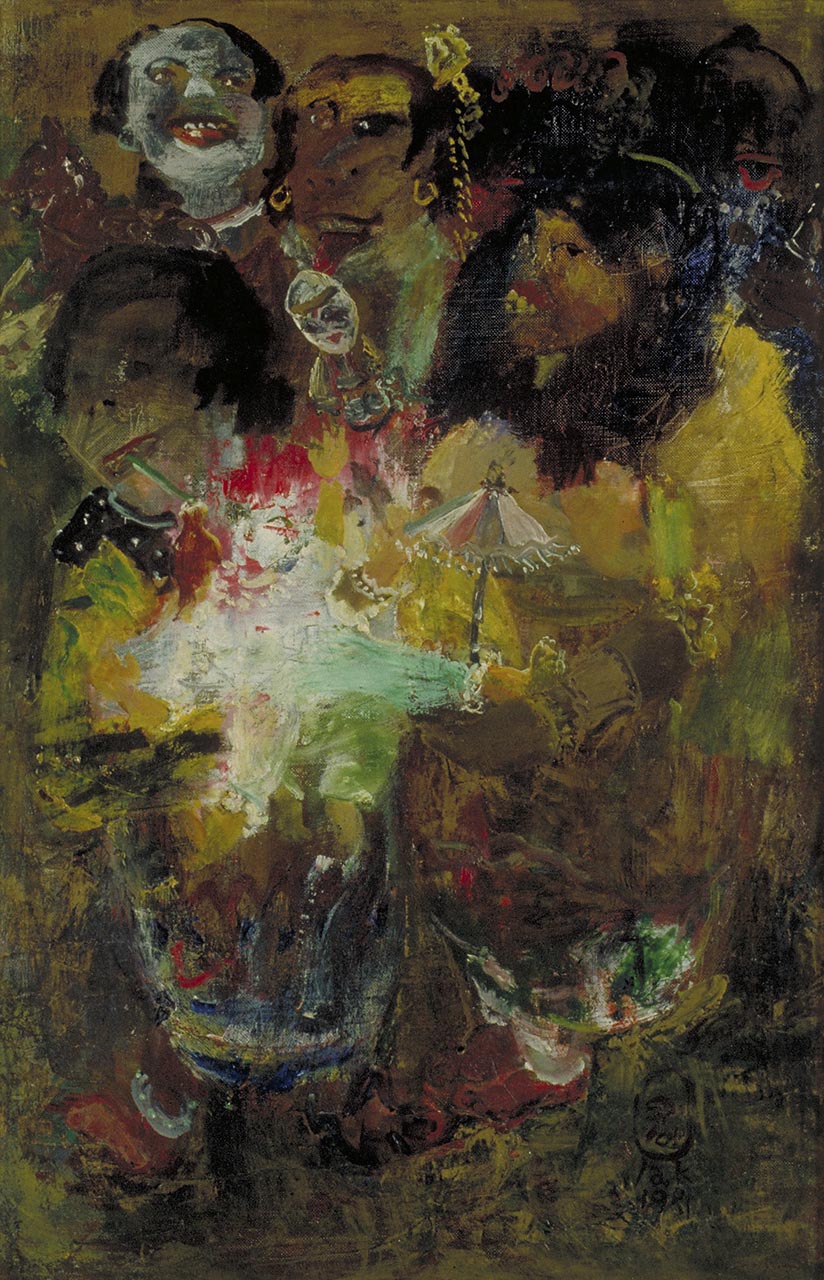 #043
#043S. Sudjojono
The Punakawan
Semar and the other clown servants of the wayang bring humor and wisdom to heroic stories. Sudjojono gives them the scale of a modern painting: marginal figures become the true commentators on power, close to the public and free to say what the heroes keep quiet.
See the institution's notice →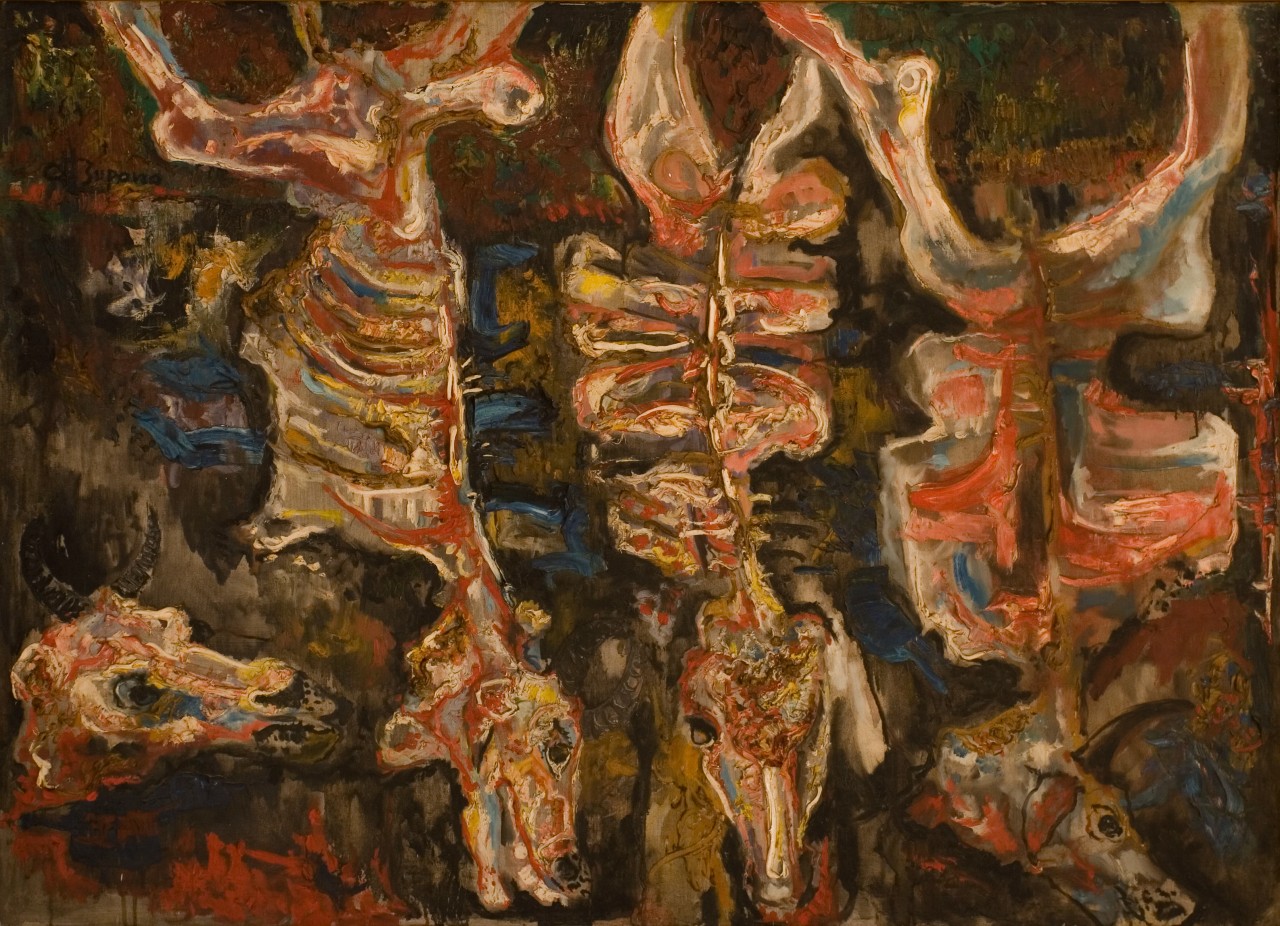 #044
#044OH Supono
The Slaughter
The slaughter scene is shown as harsh collective work, without picturesque detour. OH Supono organizes gestures, body and animal around the same center of tension; the painted material forces the eye to face a reality usually kept off-camera.
See the institution's notice →.jpg.html) #045
#045Sudjana Kerton
Gamelan Orchestra
Sudjana Kerton translates music through the repetition of instruments, the alignment of bodies and the circulation of the gaze. The gamelan is not treated as a folk accessory: the whole becomes a social architecture where each musician depends on the common rhythm.
See the institution's notice →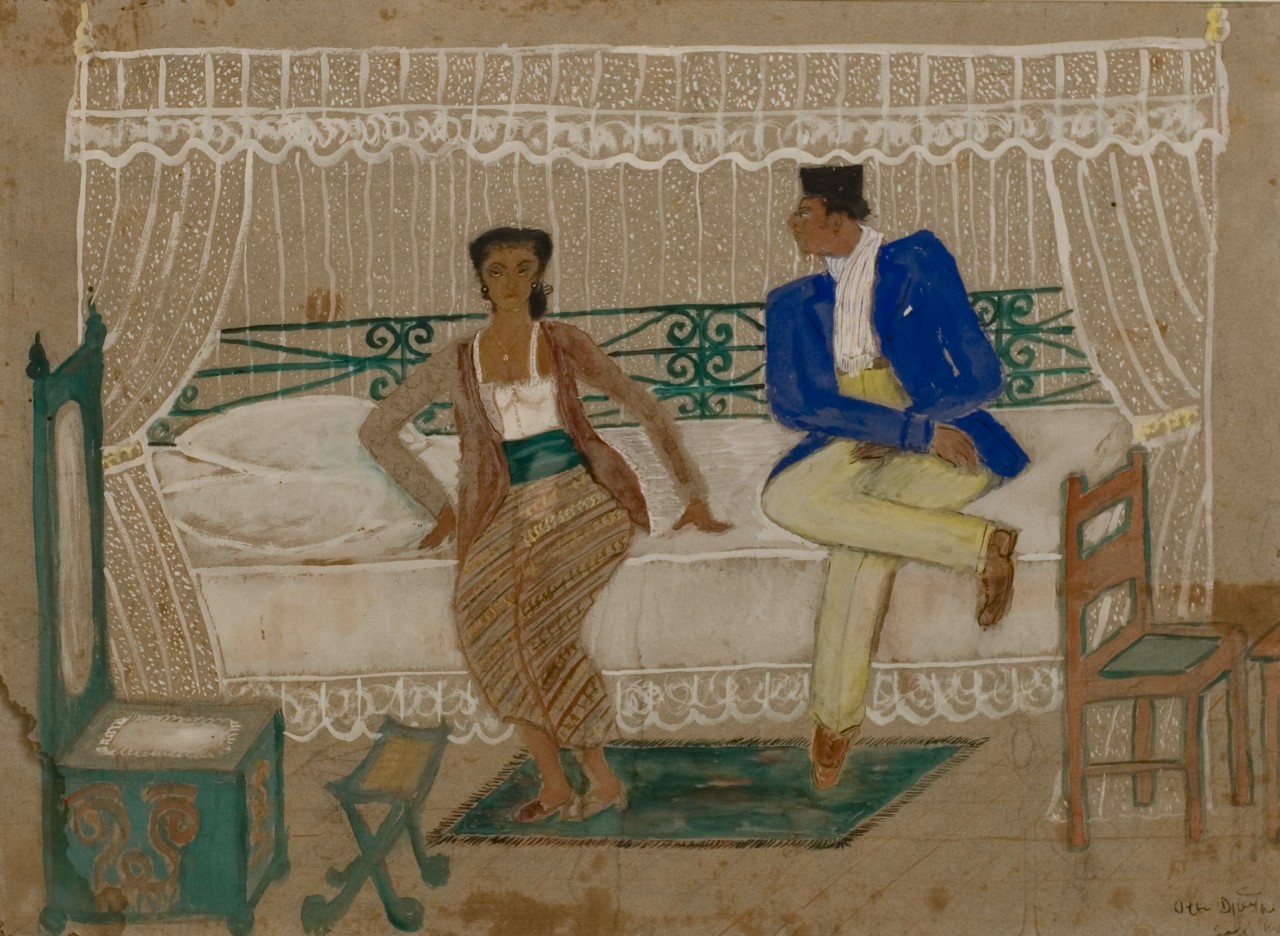 #046
#046Otto Djaya
The meeting
Otto Djaya condenses the meeting into a few silhouettes and narrative signs, with a freedom inherited from satirical drawing and popular theater. The economy of means gives face-to-face encounter a fruitful ambiguity: meeting, negotiation or confrontation also remain possible.
See the institution's notice →.tif/jcr:content/renditions/cq5dam.web.1280.1280.jpeg) #047
#047Sudjana Kerton
War in Indonesia: The Fight for Independence
Produced at the end of the 1940s, this watercolor captures the struggle for independence without monumentalizing the fighters. The speed of the medium corresponds to the urgency of the event; movement, fear and solidarity take precedence over heroic pose.
See the institution's notice →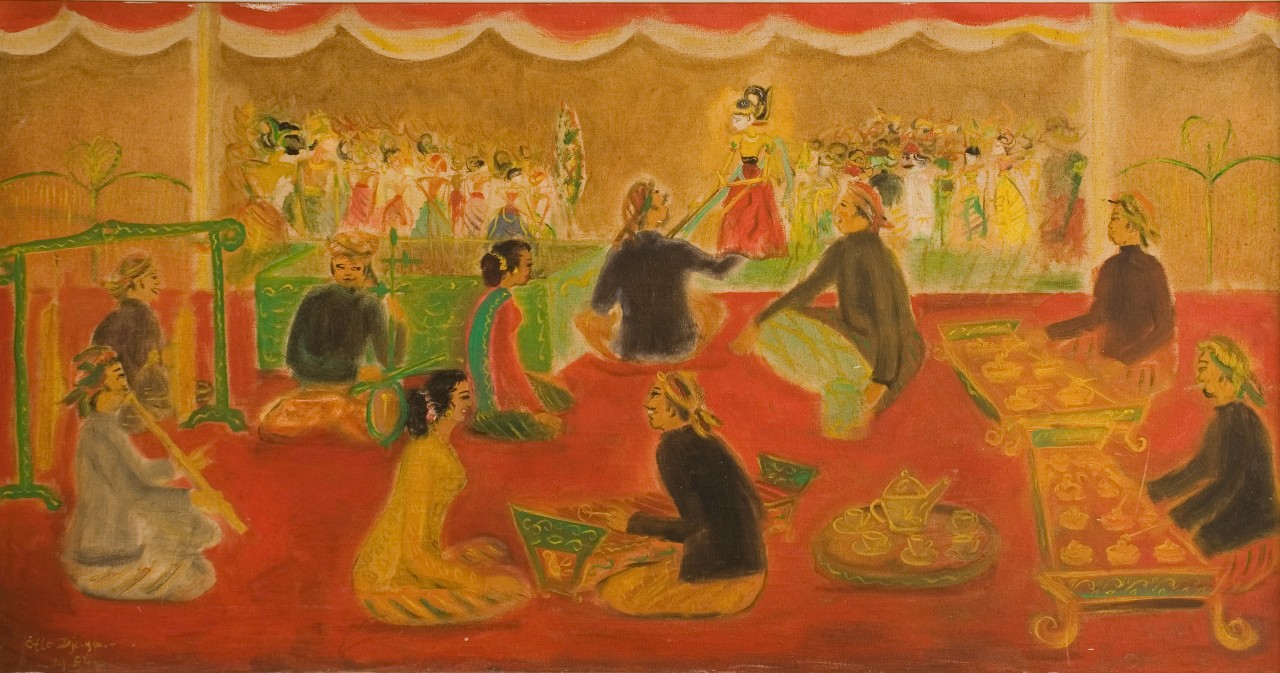 #048
#048Otto Djaya
Wayang golek
The wooden puppets of the wayang golek are enlarged to become autonomous characters. Otto Djaya preserves their frontality and their codified gestures, while using modern color to remind us that popular theater remains a living and critical language.
See the institution's notice →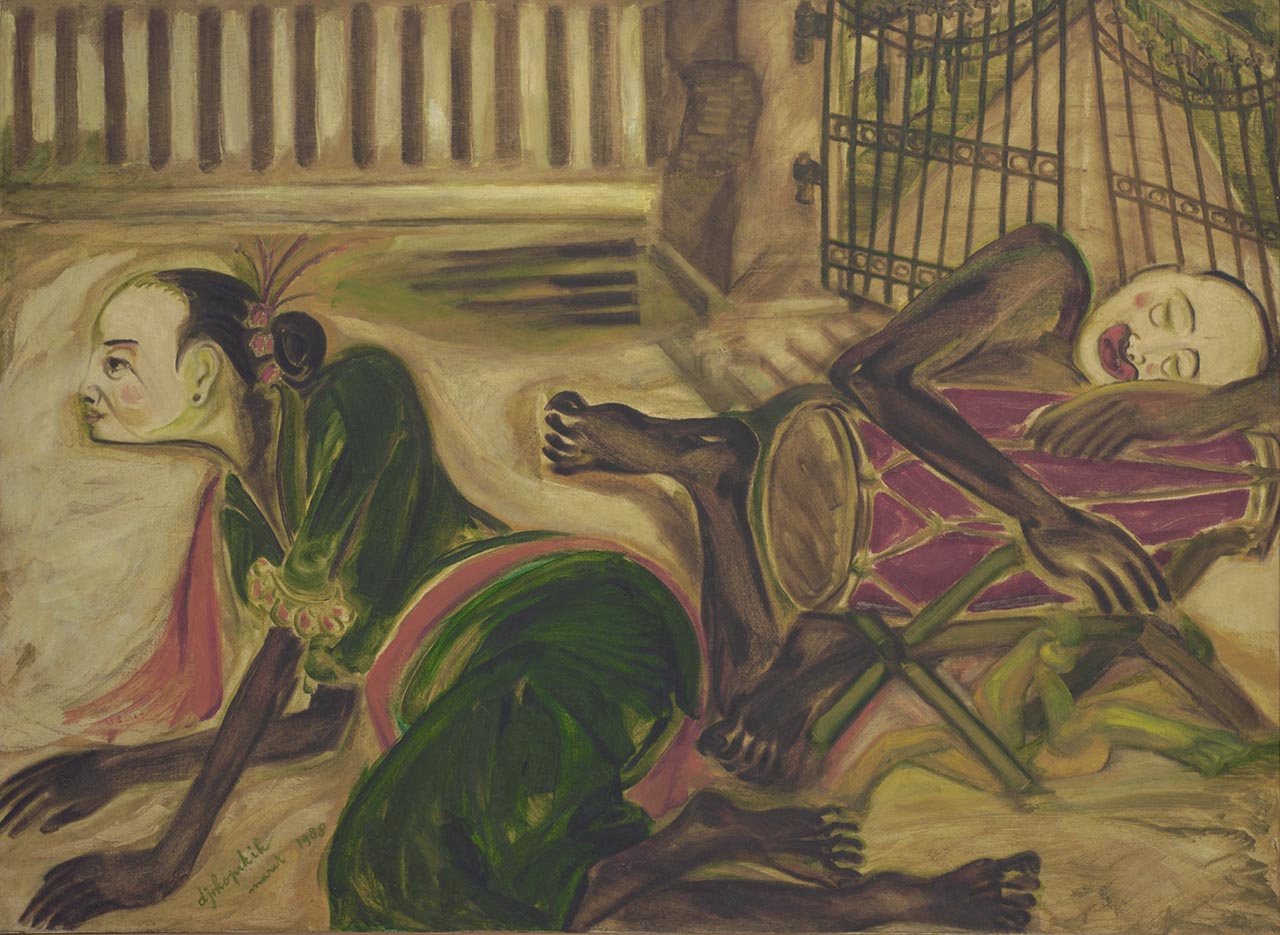 #049
#049Djoko Pekik
After the performance
Djoko Pekik chooses the moment when the show is over and the bodies leave their public roles. Fatigue, props and relaxation of poses reveal the human economy behind the performance, far from the perfectly regulated tourist image.
See the institution's notice →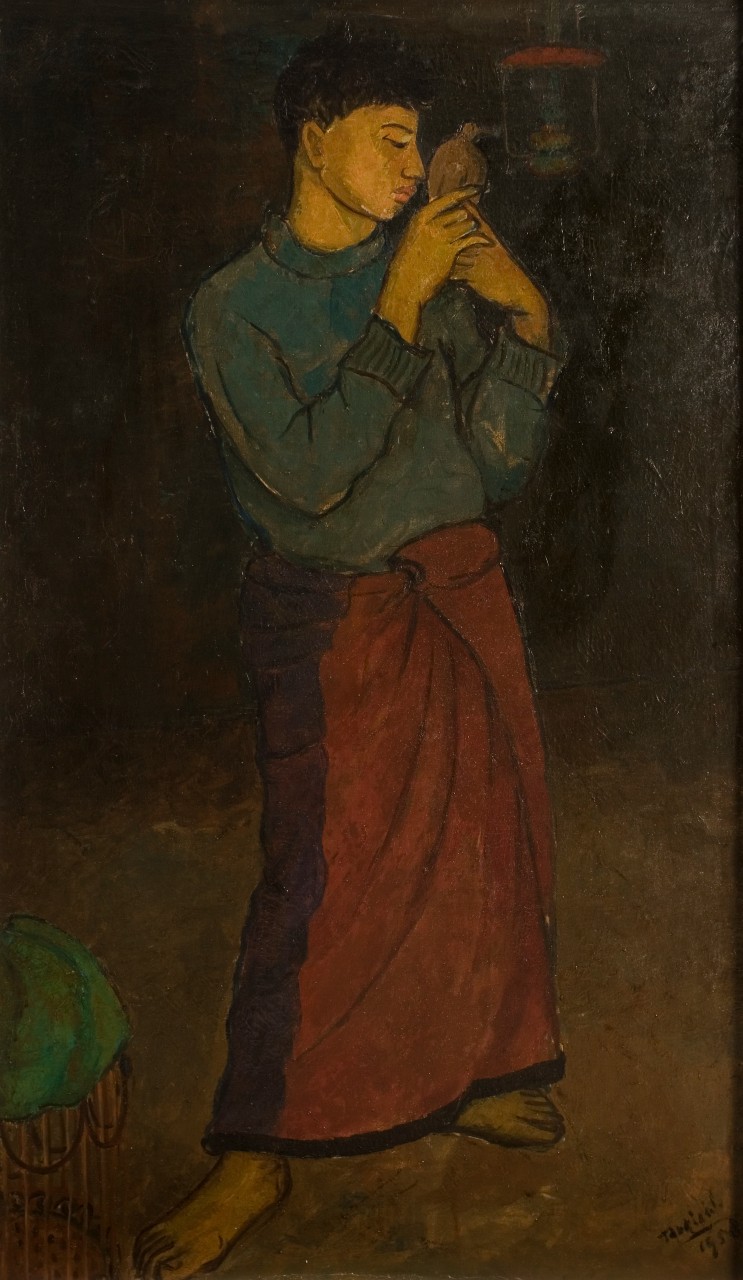 #050
#050Itji Tarmizi
The Child and the Bird
The child and the bird respond to each other with scale, gaze and fragility. Itji Tarmizi transforms a simple scene into a meditation on attention to the living; the relationship between the two subjects matters more than any spectacular story.
See the institution's notice → #051
#051Djoko Pekik
Rocky hill
The rocky hill imposes a mass that seems both geological and political. Djoko Pekik gives the landscape an almost bodily density: nature becomes the place where resistance, memory and social tensions accumulate.
See the institution's notice →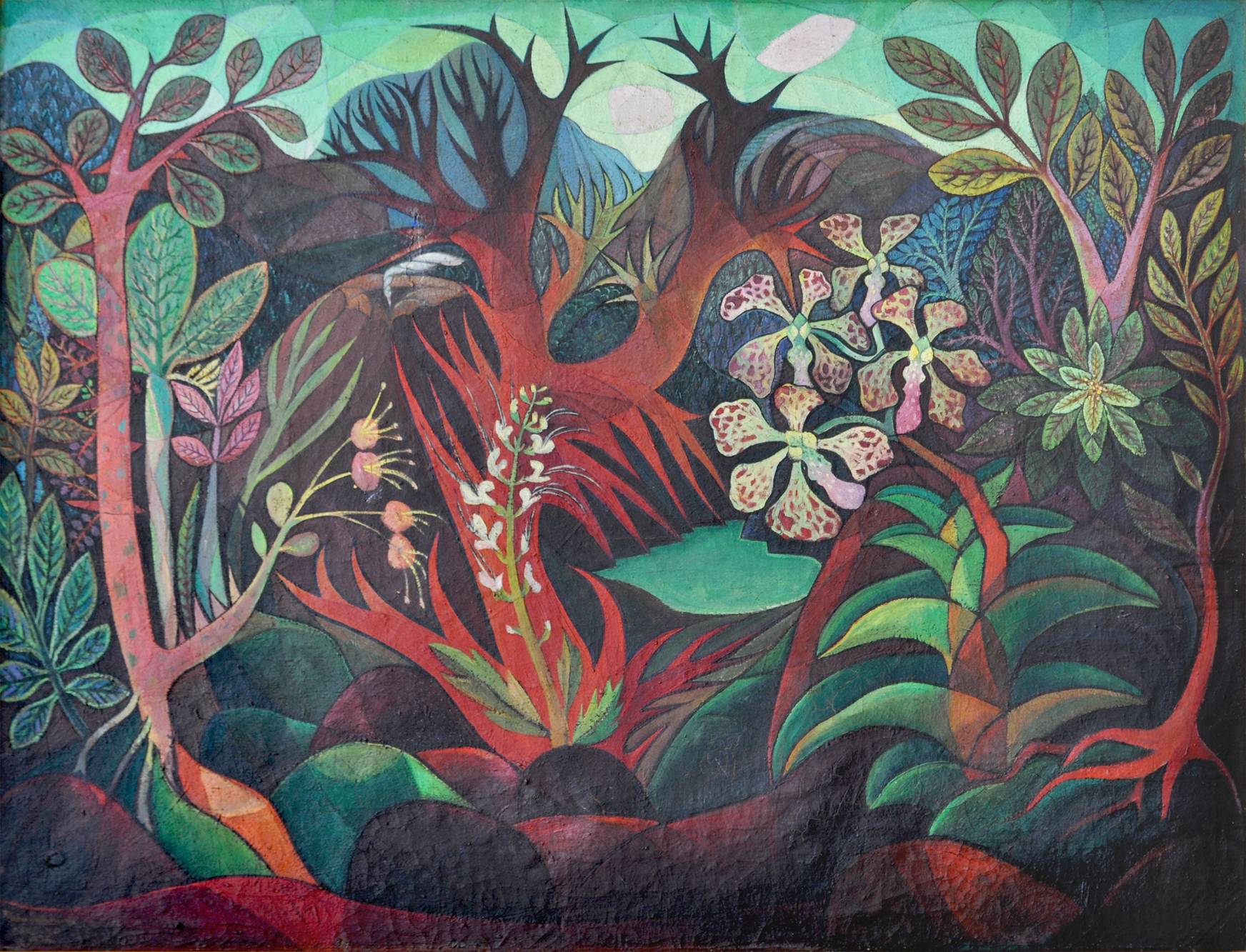 #052
#052Kartono Yudhokusumo
Orchid
Kartono Yudhokusumo isolates the orchid to examine its structure rather than to produce a simple decorative image. The relationships between stem, petals and background transform the flower into a modern construction, precise and sensitive at the same time.
See the institution's notice →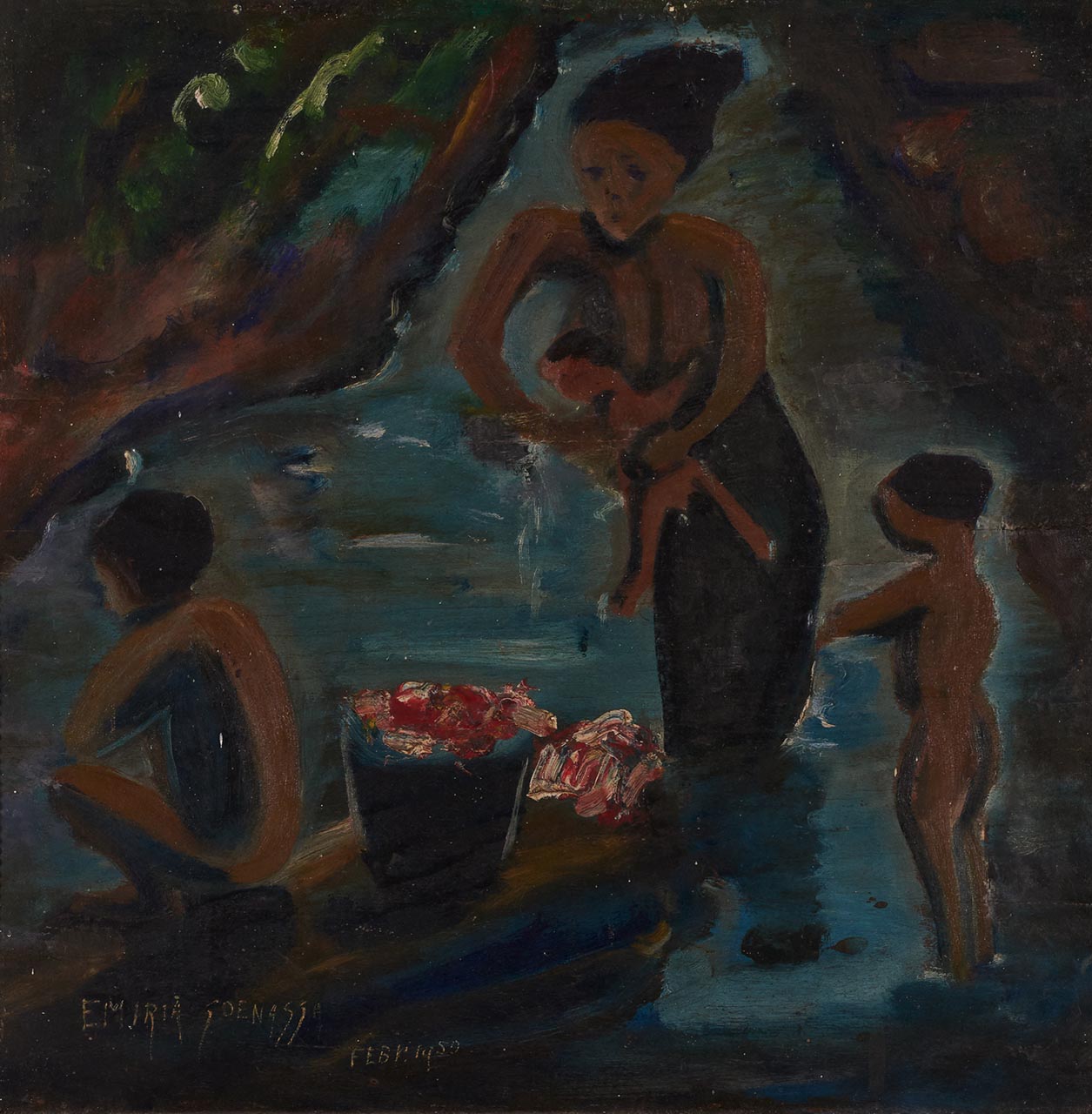 #053
#053Emiria Sunassa
Swimming in the river
Swimming is approached as a daily use of the landscape and not as an exotic nude. Emiria Sunassa connects bodies to current, banks and vegetation; the river appears as a social as well as a natural space.
See the institution's notice →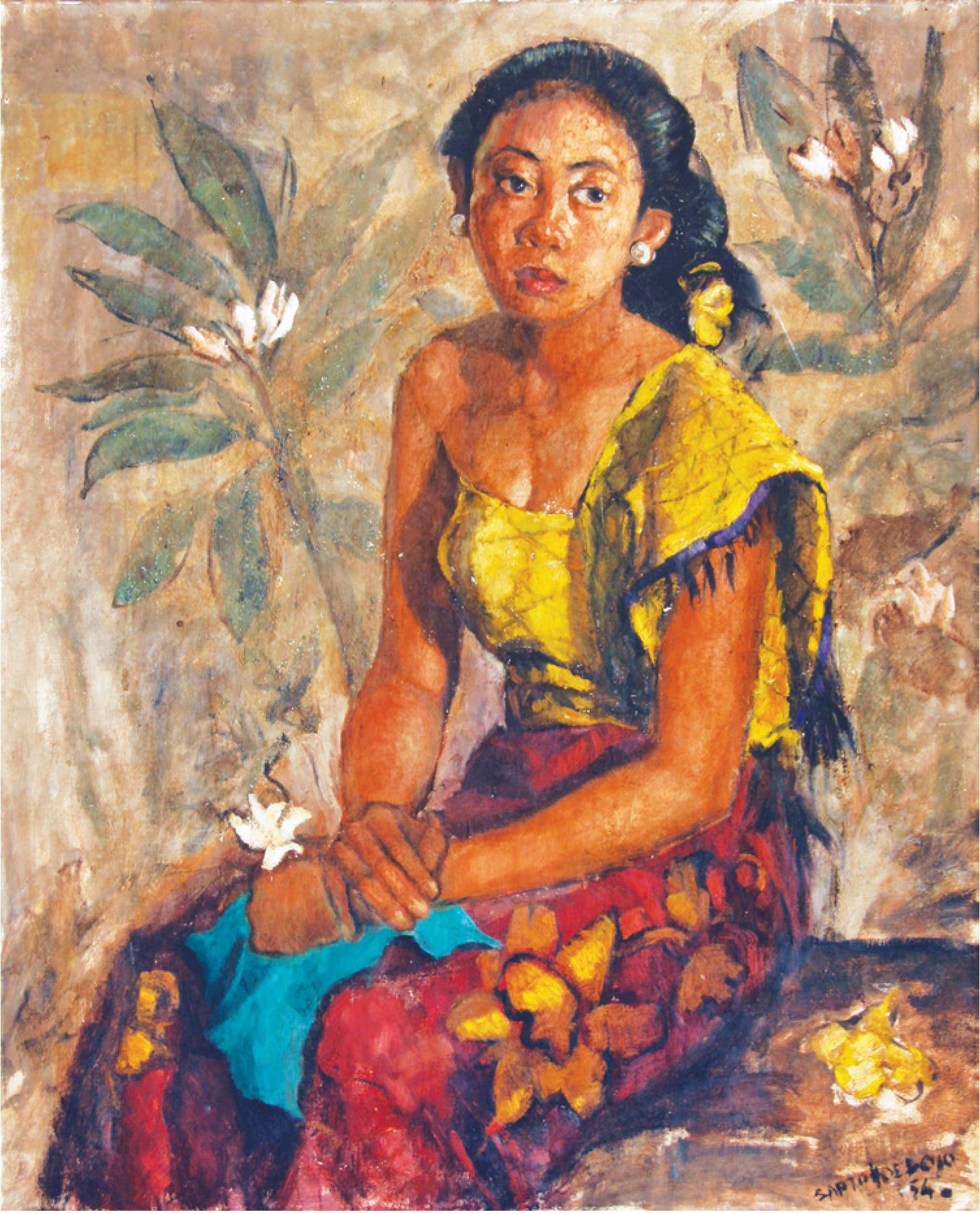 #054
#054Sapto Hoedojo
Young Balinese girl
Sapto Hoedojo focuses his attention on the face and bearing of the young Balinese woman. The model is not absorbed by a postcard setting: color and simplification of shapes build an individual, calm and direct presence.
See the institution's notice → #055
#055S. Sudjojono
Angklung player
The bamboo instrument requires a repetitive gesture that Sudjojono makes visible in the arms and rhythm of the body. The musician is less a folkloric type than a cultural actor: his movement gives the canvas its imaginary sound structure.
See the institution's notice →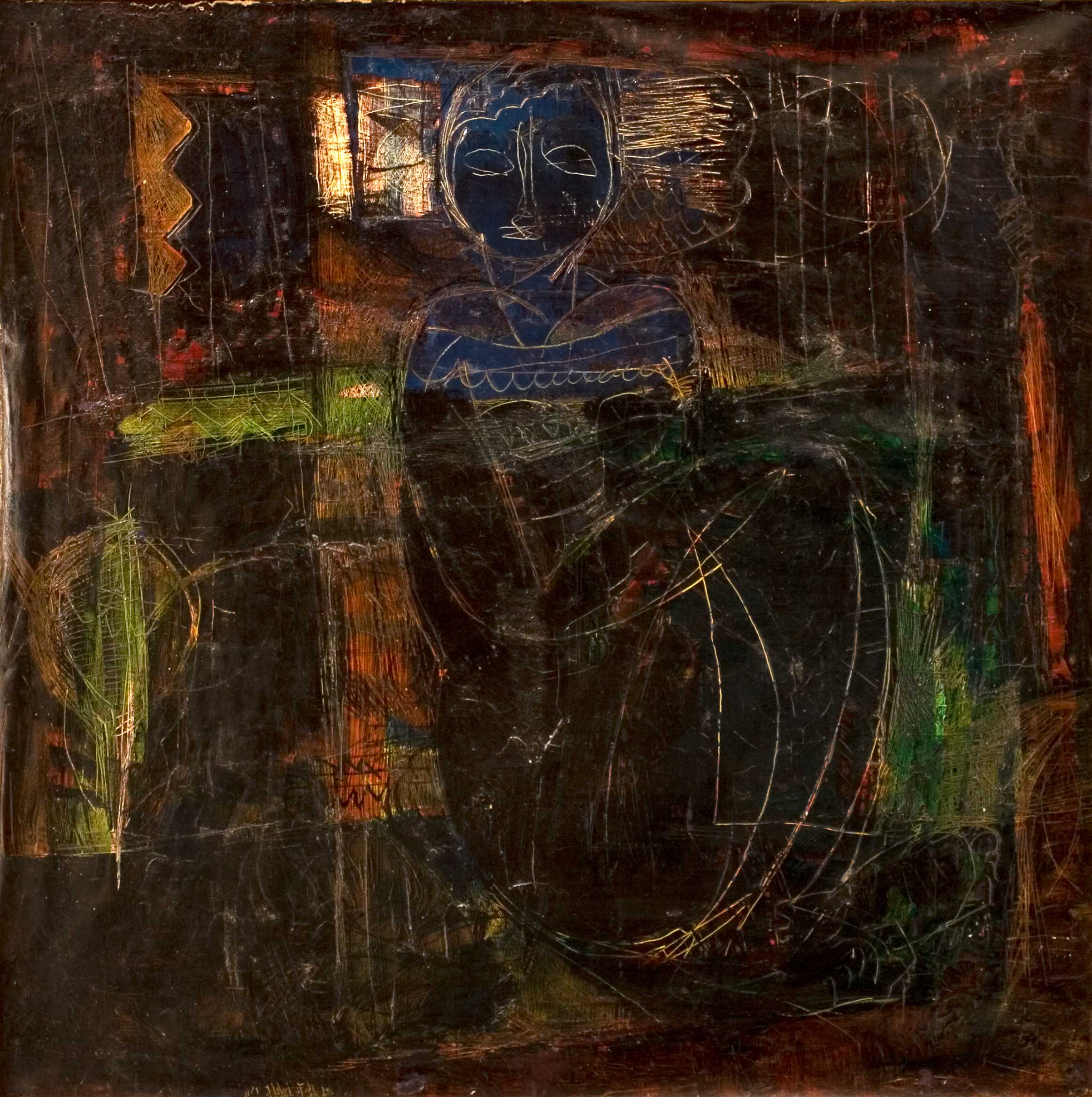 #056
#056Sjahwil
Young girl
Sjahwil constructs this portrait through restraint: few accessories, a stable pose and attention to the face. This economy avoids anecdote and allows the model to exist as a person rather than as a general representation of youth.
See the institution's notice →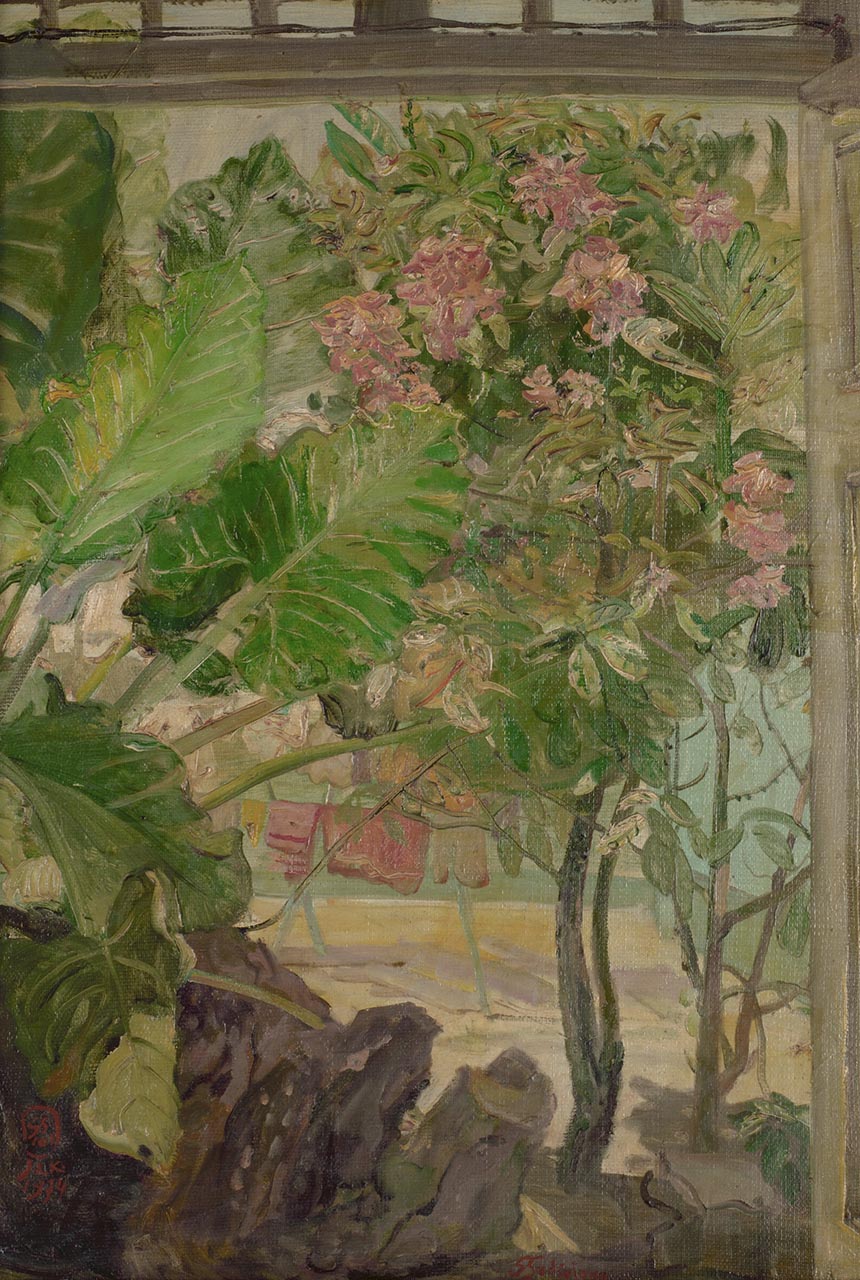 #057
#057S. Sudjojono
In my garden
The private garden offers Sudjojono a calmer subject than his political scenes, without losing his demand for lived truth. Plants, objects and familiar depth compose an indirect self-portrait: the place reveals the habits and attachments of the person who inhabits it.
See the institution's notice →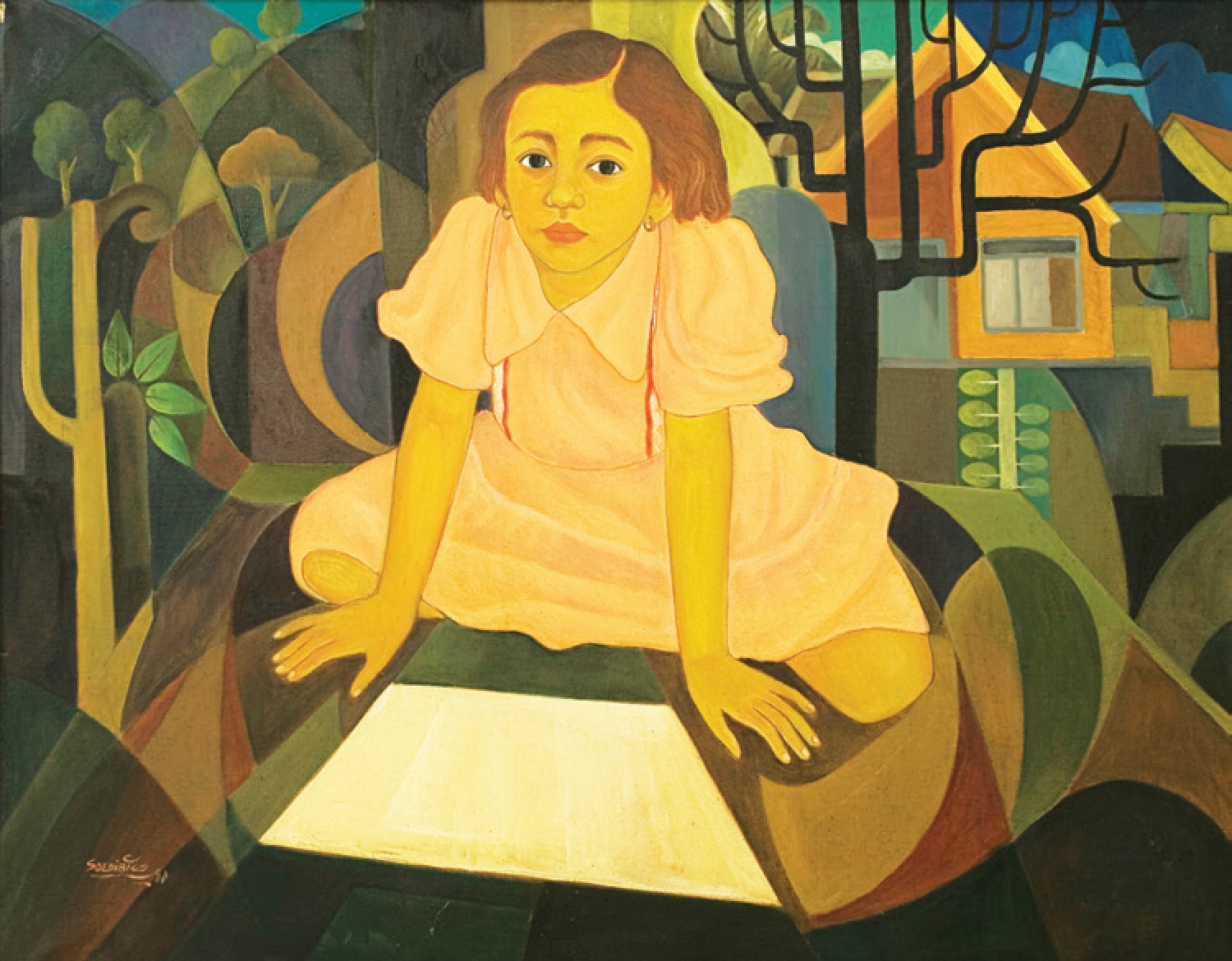 #058
#058Soedibio
Asti
The first name reduces the distance between model and spectator. Soedibio favors Asti's singular identity, posture and expression, rather than an explicit social role; the portrait becomes an encounter contained in the colored material.
See the institution's notice →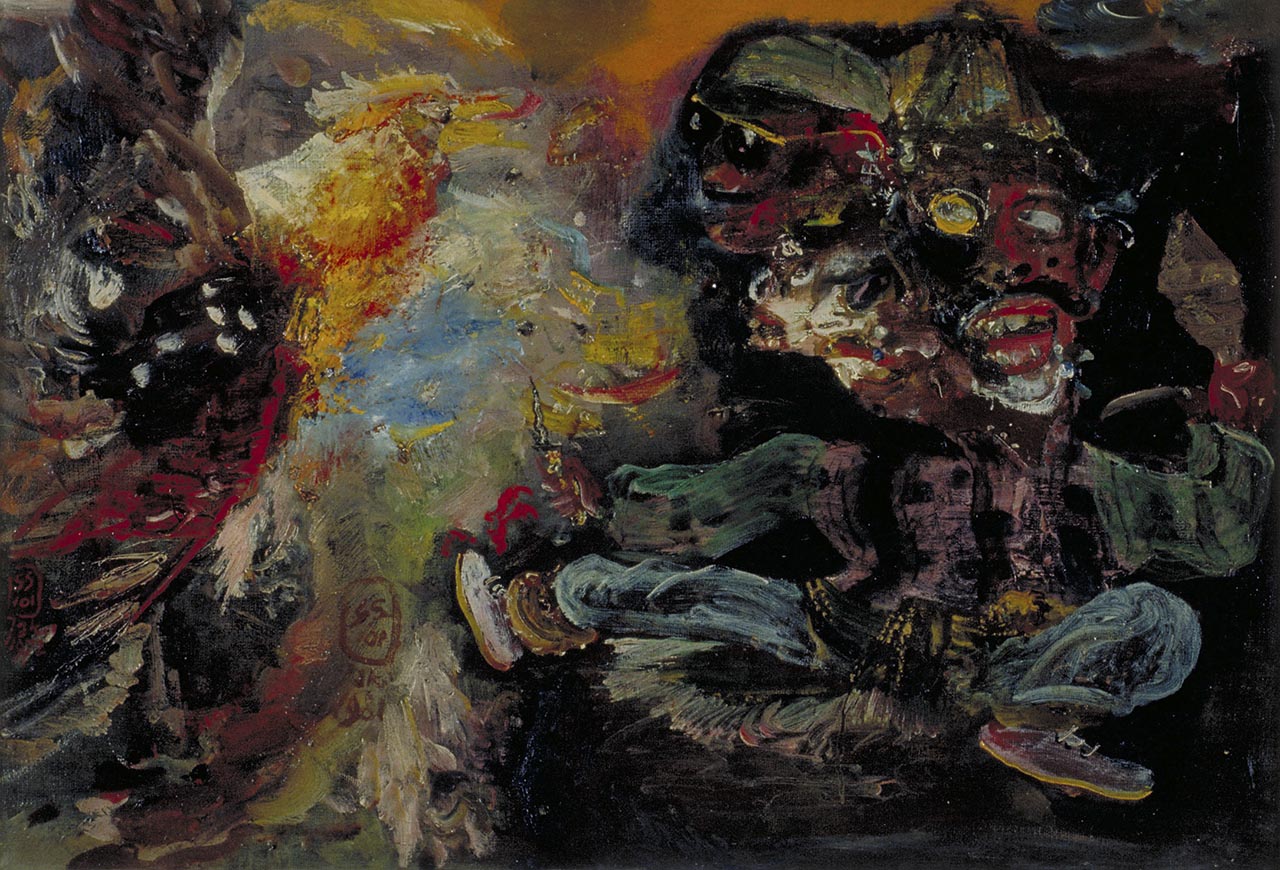 #059
#059S. Sudjojono
Air combat between Dasamuka and Jatayu
In the Ramayana, the bird Jatayu tries to snatch Sita from the kidnapper Dasamuka. Sudjojono chooses combat suspended in the air: diagonals, wings and weapons transform the moral episode - defending the innocent at the cost of her life - into visual shock.
See the institution's notice →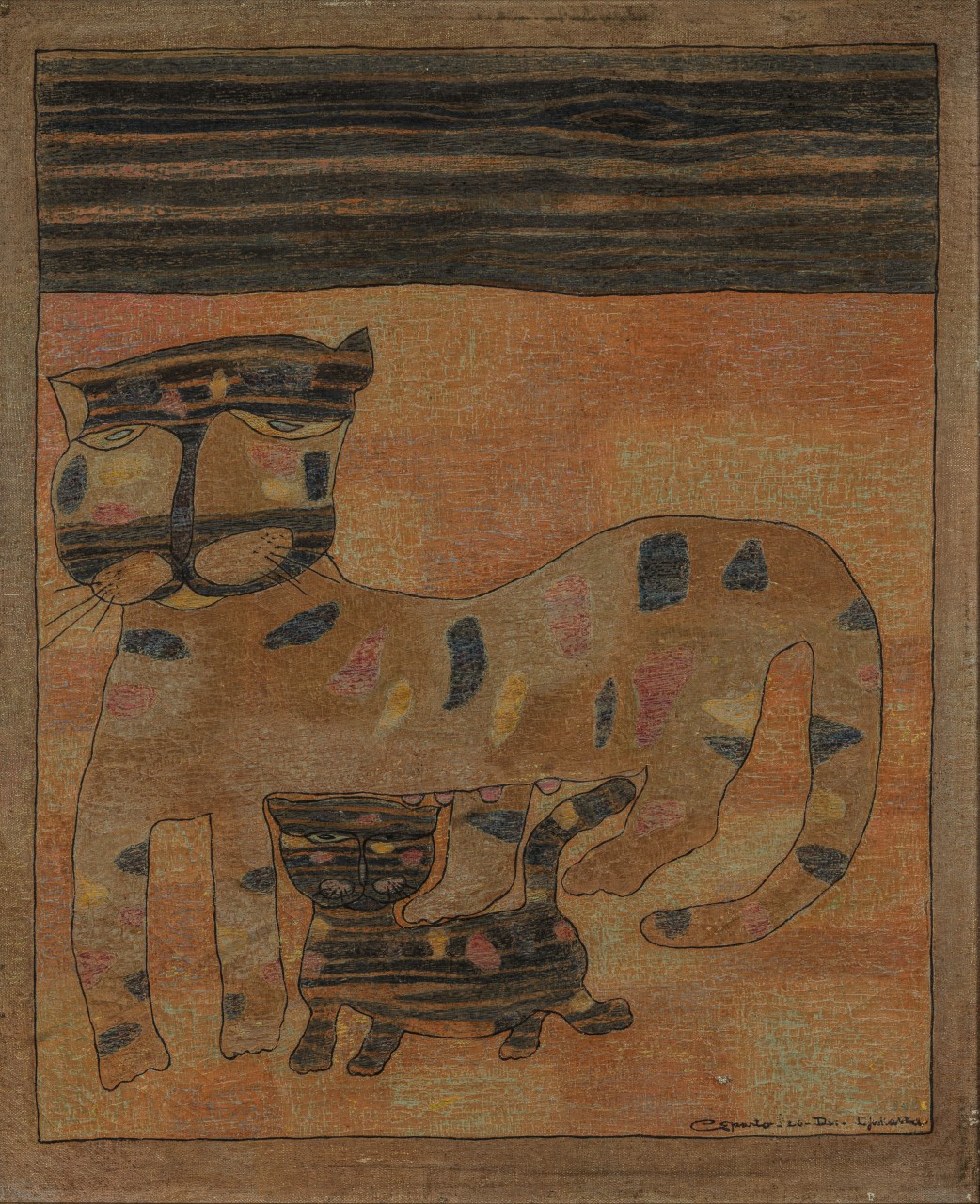 #060
#060Suparto
Cat
Suparto makes the cat a fully pictorial subject, attentive to the silhouette, coat and waking attitude. The intimate format and concentration on the animal slow down the gaze, far from the great national stories which often dominate the history of the period.
See the institution's notice →Sadali, Popo Iskandar, Fadjar Sidik and their contemporaries moved painting towards material, rhythm and new forms of contemplation.
 #061
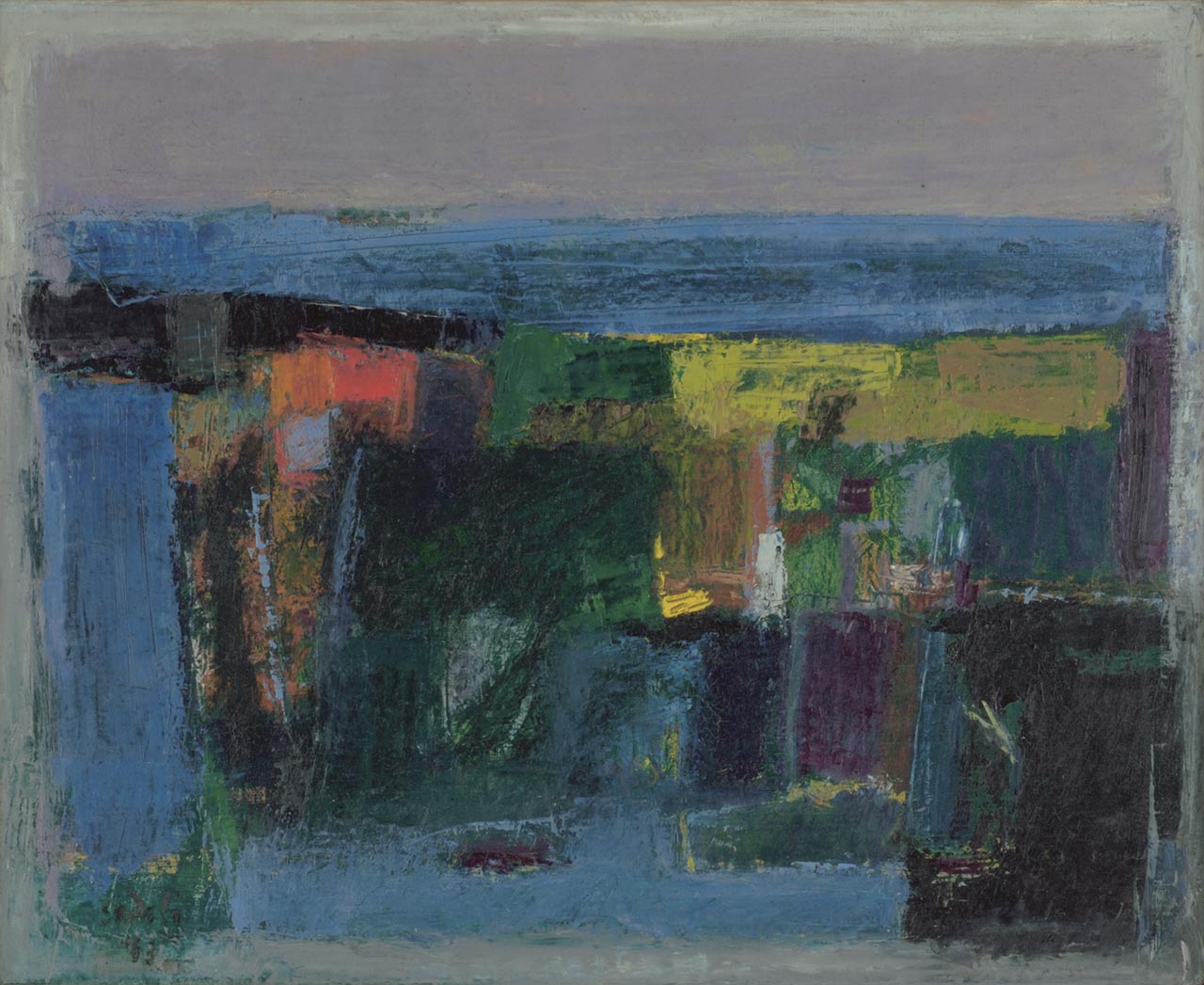
#061Ahmad Sadali
Untitled abstraction
This 1963 painting belongs to the moment when Sadali gradually abandoned too rigid cubist structures. Color, material and sign still float without a dominant calligraphic reference; the work allows us to follow the birth of his abstract spiritual language.
See the institution's notice →.jpg.html) #062
#062Popo Iskandar
Two Cubist Nudes
Popo Iskandar fragments two bodies without completely dissolving them in geometry. Angular volumes are used to measure proximity, balance and difference between figures; cubism here becomes a flexible tool, adapted to one's own research.
See the institution's notice →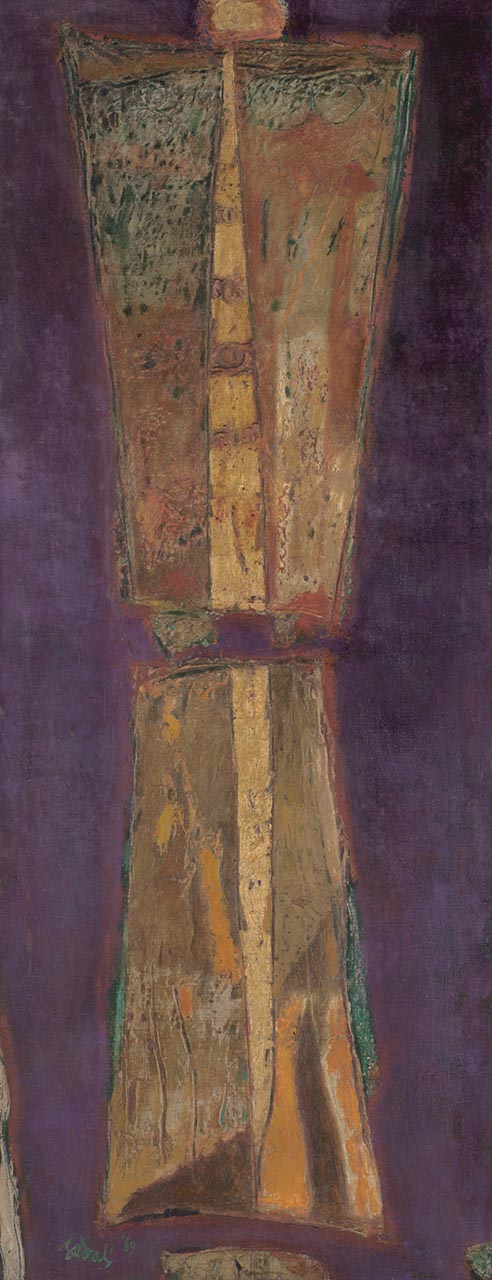 #063
#063Ahmad Sadali
Abstract composition
Sadali superimposes dark fields, material accidents and luminous accents until producing an almost mineral surface. The composition does not illustrate any precise story; it invites an experience of contemplation where the physical thickness of the painting carries an interior meaning.
See the institution's notice →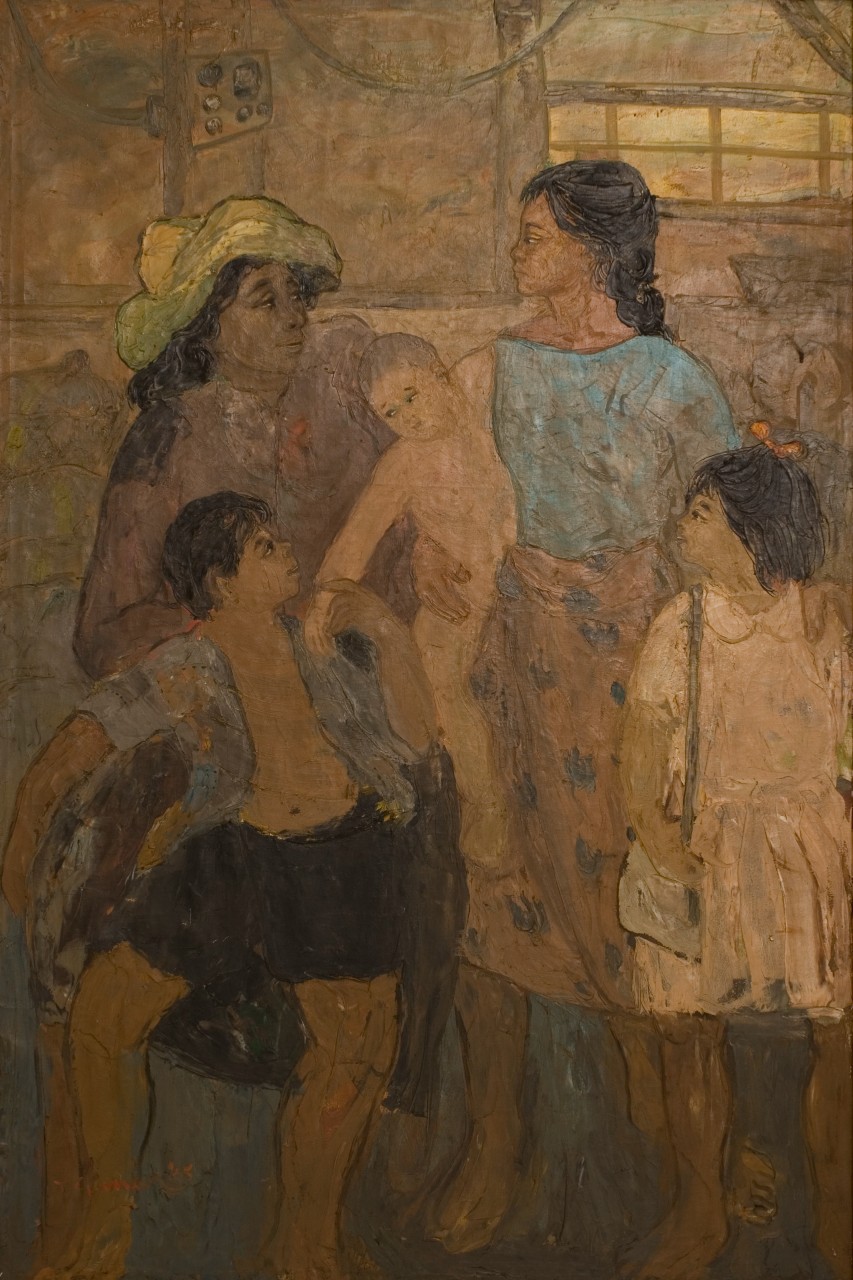 #064
#064Tatang Ganar
Collection for the construction of a building
A request for contribution, a common gesture in collective life, becomes the subject of the painting. Tatang Ganar observes the negotiation of looks and positions: behind the possible humor, the work speaks of solidarity, social pressure and the concrete creation of a common good.
See the institution's notice →.jpg.html) #065
#065Ahmad Sadali
New York skyline
Painted after Sadali's American stay, the New York horizon is not described building by building. The city is reduced to vertical and luminous relationships; this abstract filter shows how an international experience nourishes a vocabulary soon to be reoriented towards spirituality.
See the institution's notice →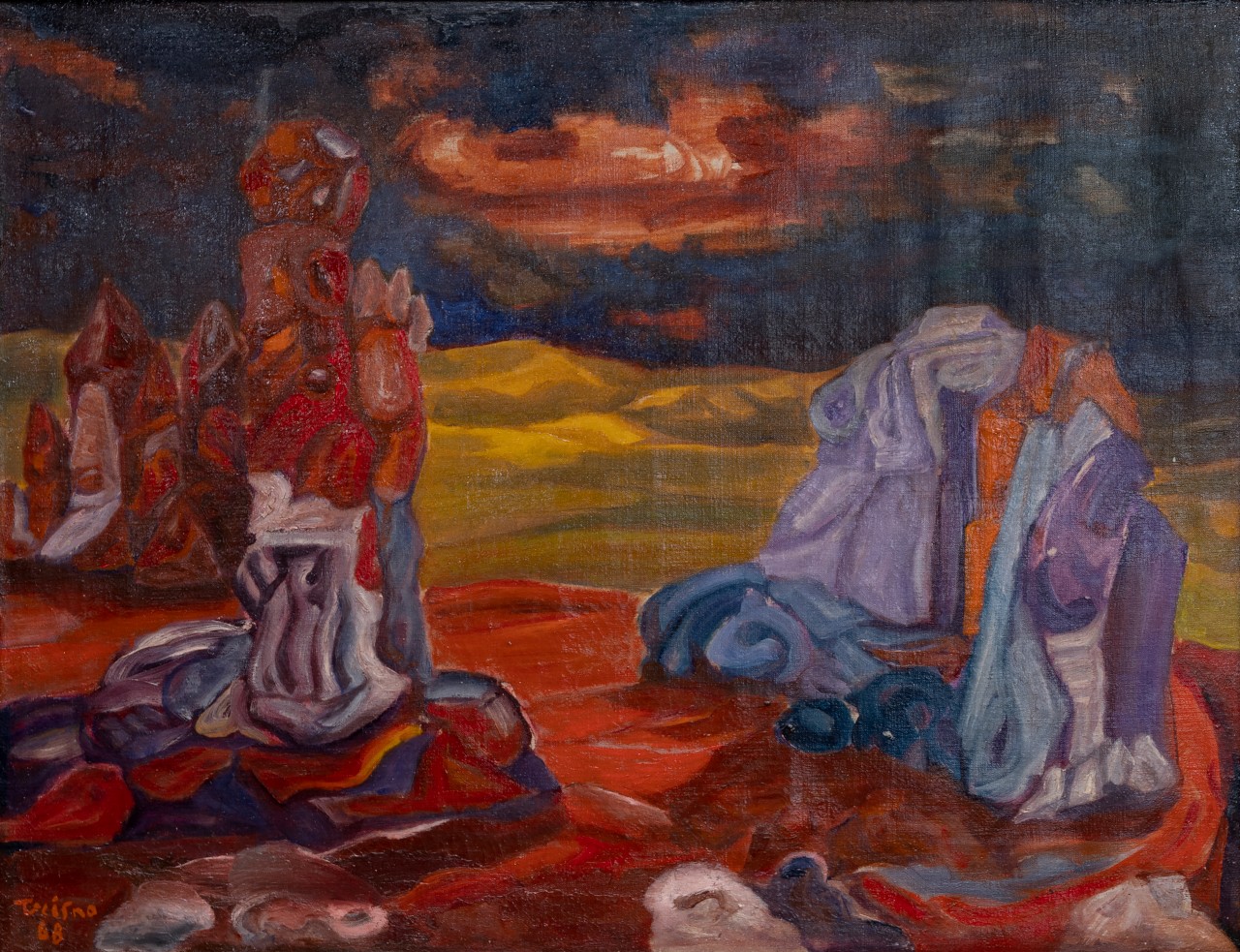 #066
#066Trisno Sumardjo
Mountains
Trisno Sumardjo simplifies the reliefs until they become rhythm, color and distance. The landscape no longer seeks to prove the beauty of the tropics: it examines how a few shots can make one feel the extent and geological permanence.
See the institution's notice →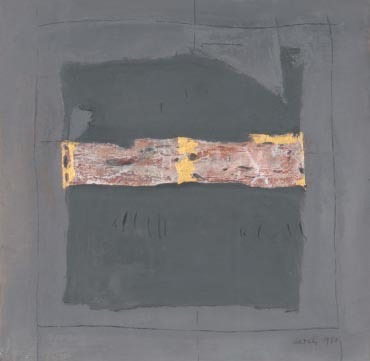 #067
#067Ahmad Sadali
Horizontal bars with gold vestige
Dark bars hold a fragment of gold like a precious trace in the middle of a proven surface. Sadali associates geometric austerity with a material that seems worn by time; the little that remains thus acquires a meditative intensity.
See the institution's notice →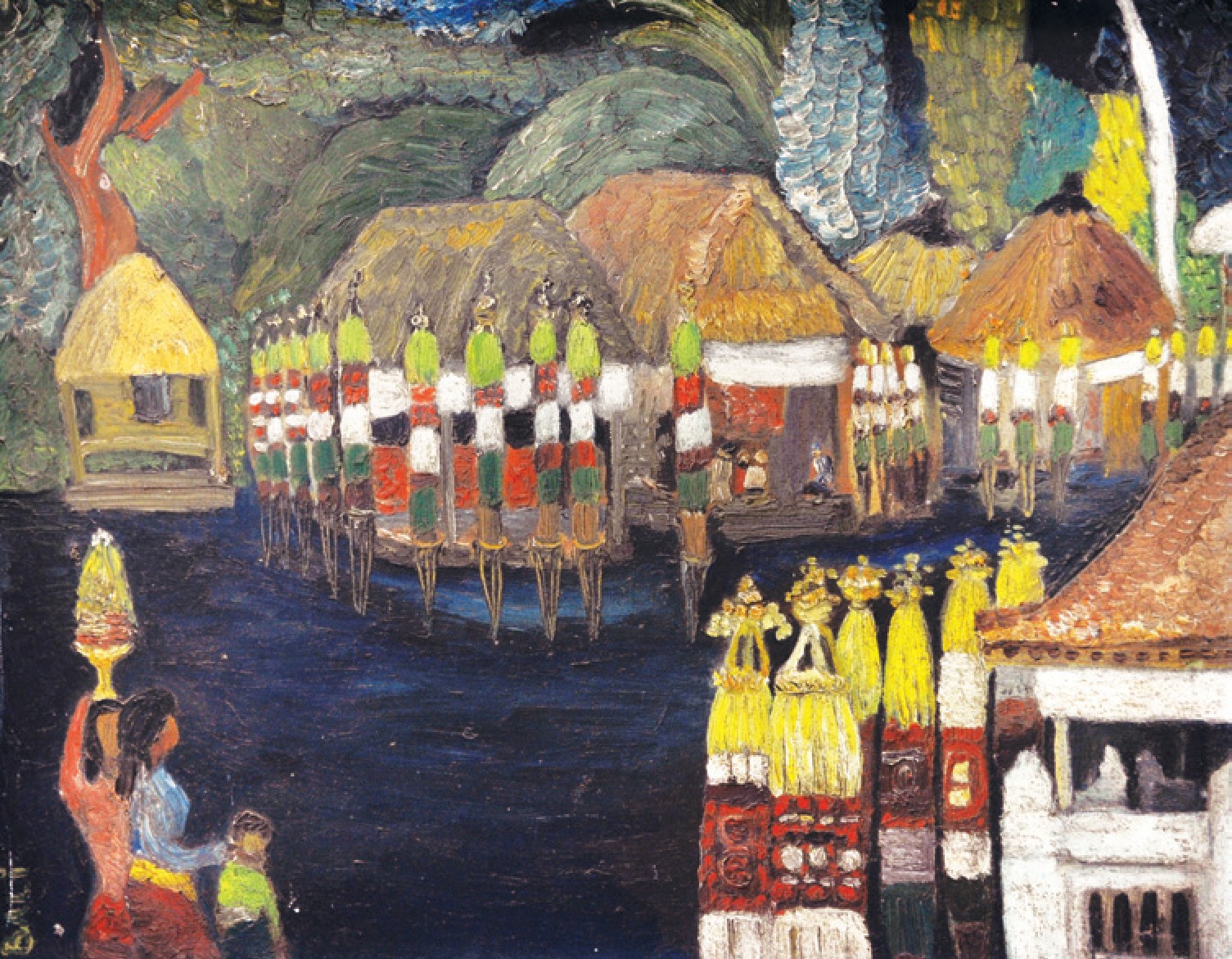 #068
#068Trisno Sumardjo
Balinese ceremony
The procession is structured by the repetition of figures and offerings rather than by a main character. Trisno Sumardjo observes how ritual temporarily transforms public space, connecting community, movement and Balinese landscape.
See the institution's notice →.jpg.html) #069
#069Sudjana Kerton
Free time
Sudjana Kerton dwells on a moment without a major event. The relaxed postures and calm circulation between the characters show that leisure is also a social fact: a way of living together in time after work.
See the institution's notice →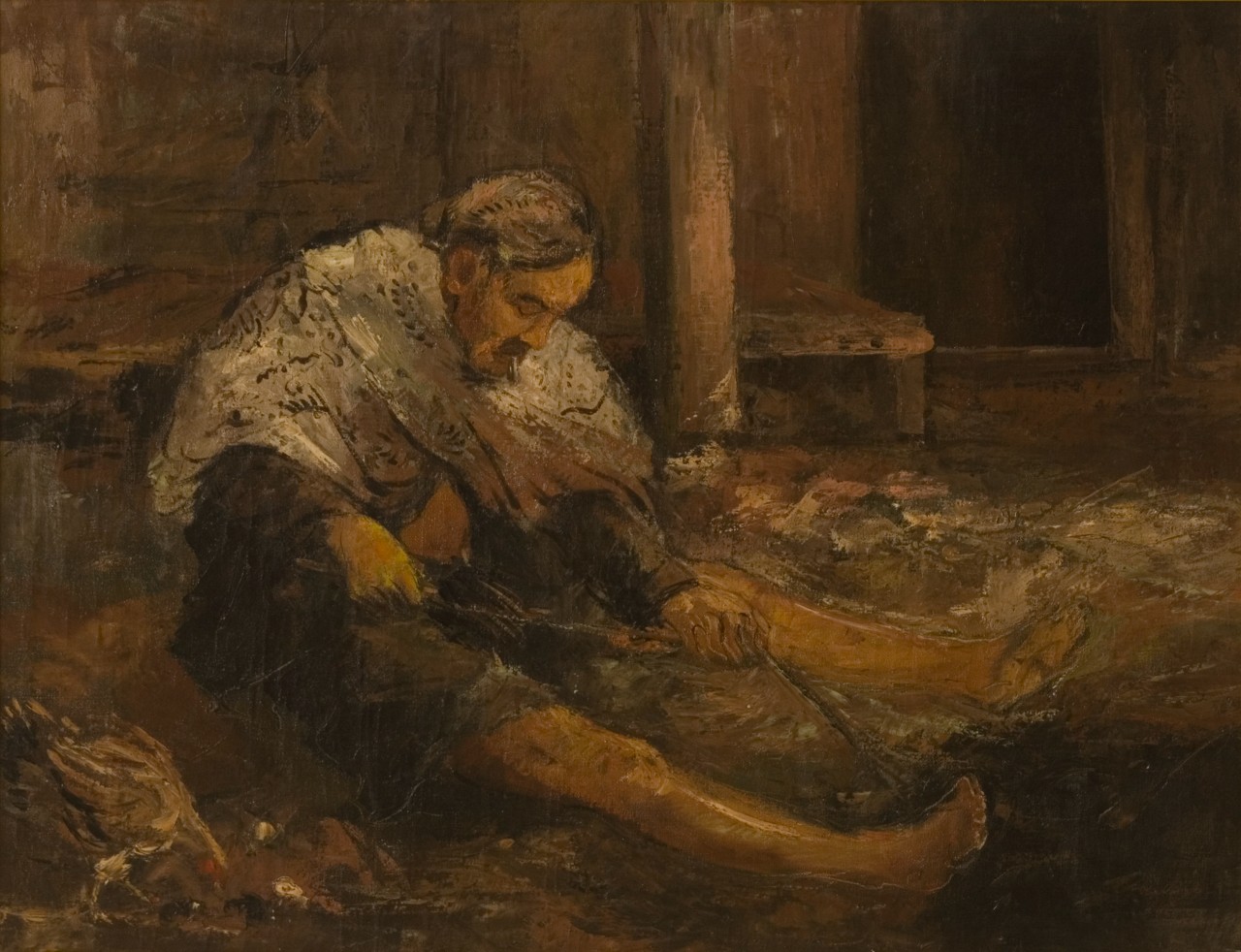 #070
#070Trubus Soedarsono
Mbah Irosentono
The respectful term "Mbah" immediately places the model in a relationship of age and community closeness. Trubus Soedarsono gives the marked face and pose a quiet monumentality, making the portrait of an elder a reservoir of memory.
See the institution's notice →.jpg.html) #071
#071Sudjana Kerton
Flirting with Jamu's saleswoman
A traditional medicine saleswoman becomes the center of a small street comedy. Kerton observes the play of looks and the distance between bodies; humor does not make the traveling work or the autonomy of the woman in demand disappear.
See the institution's notice →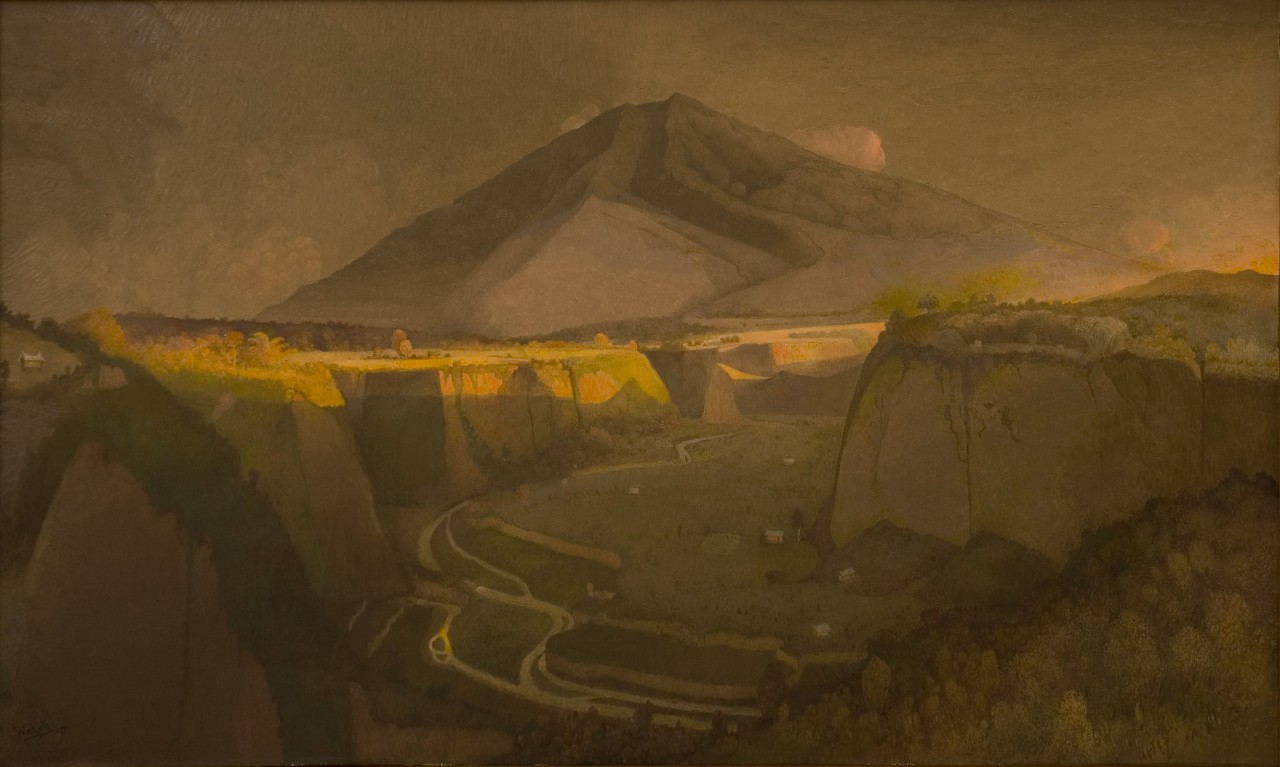 #072
#072Wakidi
Canyon Valley
Wakidi returns to the West Sumatran Canyon in a late work where the reliefs, vegetation and atmosphere have been known for a long time. The view is not a generic setting: it condenses several decades of observation of the same territory.
See the institution's notice →.jpg.html) #073
#073Sudjana Kerton
Village life
The life of the kampung unfolds in small simultaneous actions, without a single hero. Kerton makes habitat, passages and exchanges a collective composition; the village is understood as a network of relationships rather than as a nostalgic landscape.
See the institution's notice →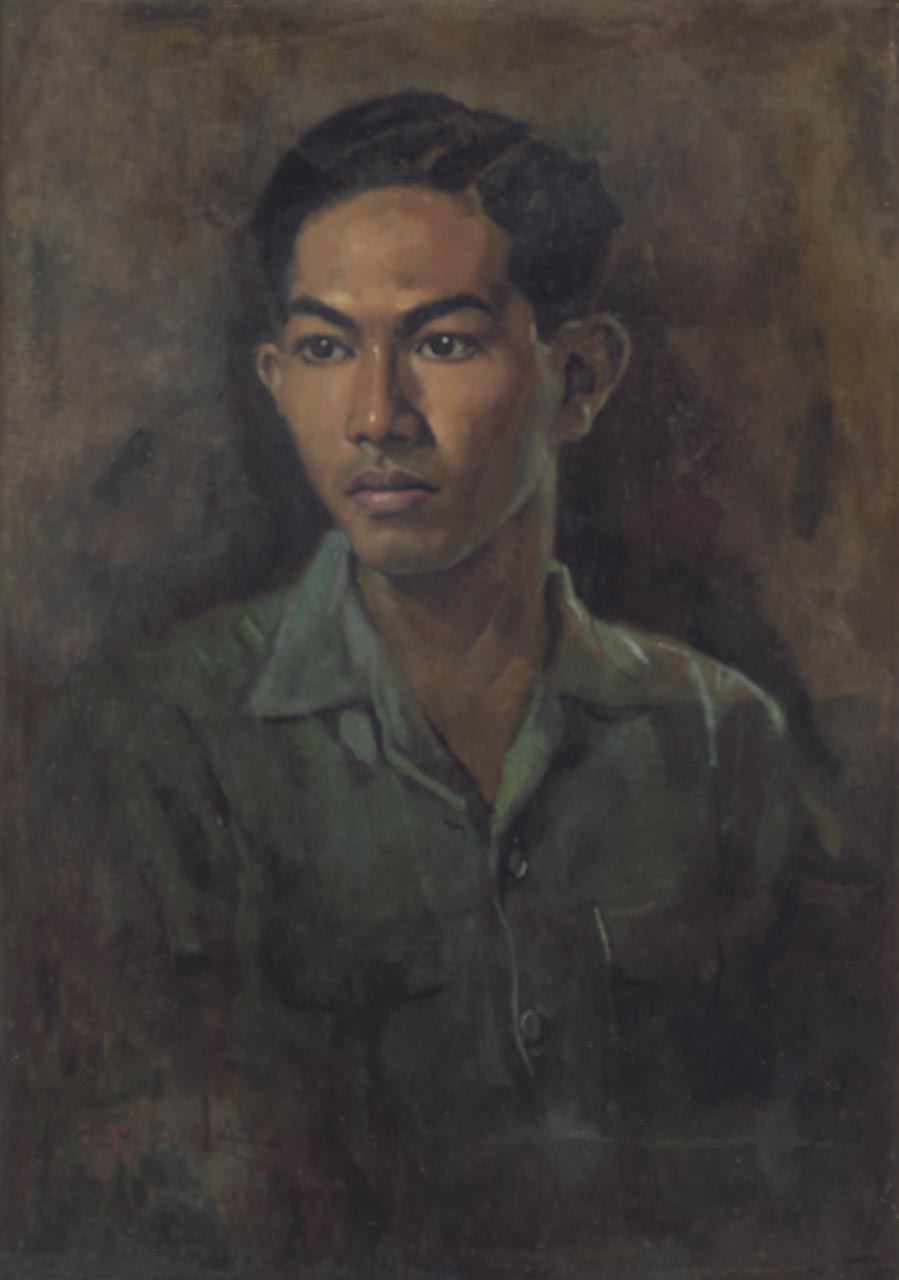 #074
#074Basoeki Abdullah
Guritno
This portrait shows Basoeki Abdullah's ability to reconcile resemblance, elegance and psychological presence. The proper name anchors the image in a precise relationship: the model not only serves to demonstrate the virtuosity of the painter, it imposes his individuality.
See the institution's notice →.tif/jcr:content/renditions/cq5dam.web.1280.1280.jpeg) #075
#075Emiria Sunassa
Chrysanthemums
Chrysanthemums offer Emiria Sunassa a subject where color and material can unfold without an explicit national narrative. Still life nevertheless reveals its view: flowers are not ordered like a decorative emblem, they retain growth, density and irregularity.
See the institution's notice →.jpg.html) #076
#076Lee Man Fong
Self-portrait at the workshop
Lee Man Fong represents himself surrounded by European casts and chrysanthemums associated with Chinese painting. The workshop becomes a map of his affiliations: born in China, active in Indonesia and trained through contact with several traditions, he refuses a unique artistic identity.
See the institution's notice →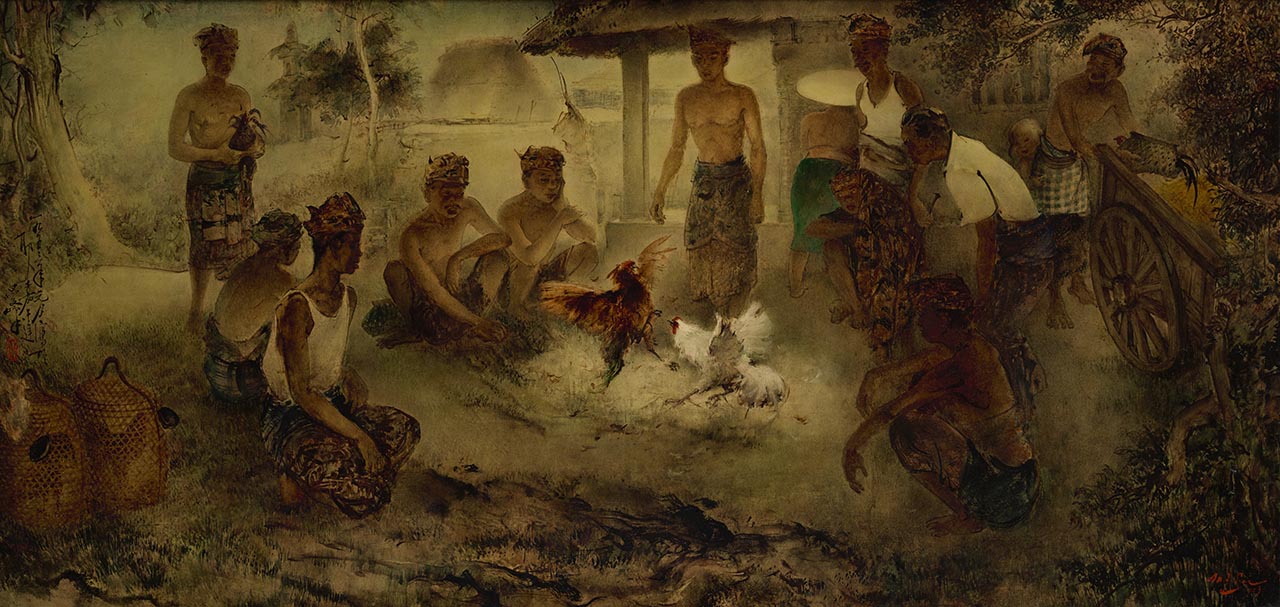 #077
#077Lee Man Fong
Fighting roosters
The two roosters tie the composition in a circle of beaks, wings and legs. Lee Man Fong combines the precision of animal observation with the condensed space of Chinese painting; the confrontation becomes moving calligraphy.
See the institution's notice →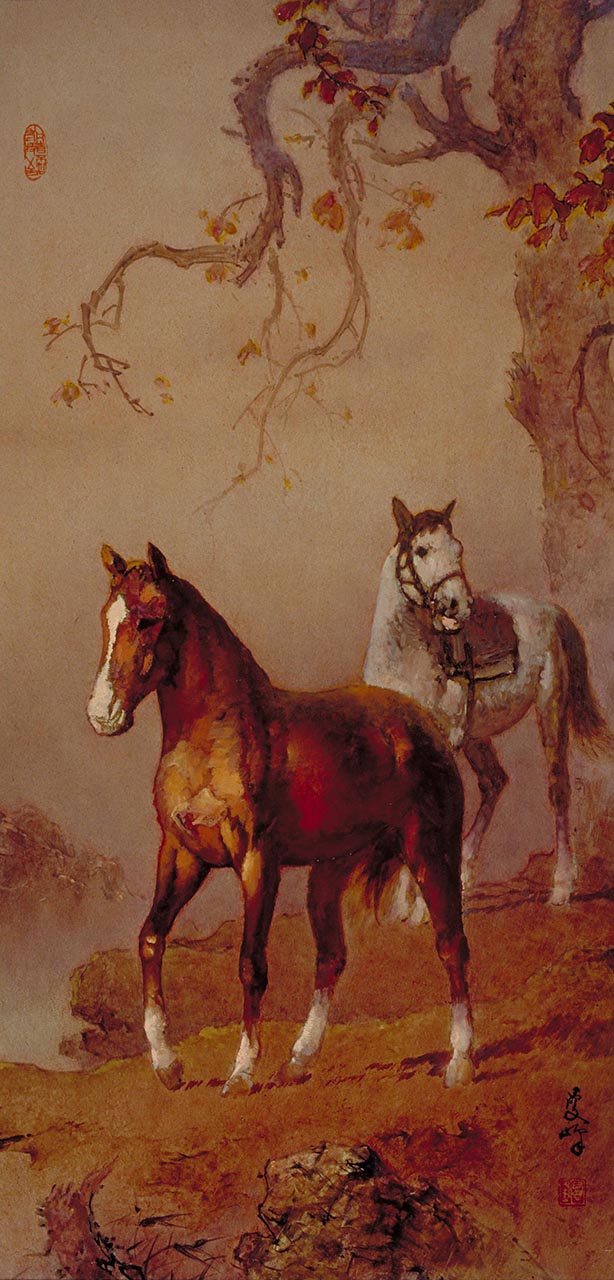 #078
#078Lee Man Fong
Horses
Lee Man Fong paints horses in soft masses and nervous lines, attentive to their collective balance. The subject recalls Chinese tradition, but the oil on panel and the density of the bodies produce a personal synthesis, neither ancient copy nor Western naturalism.
See the institution's notice →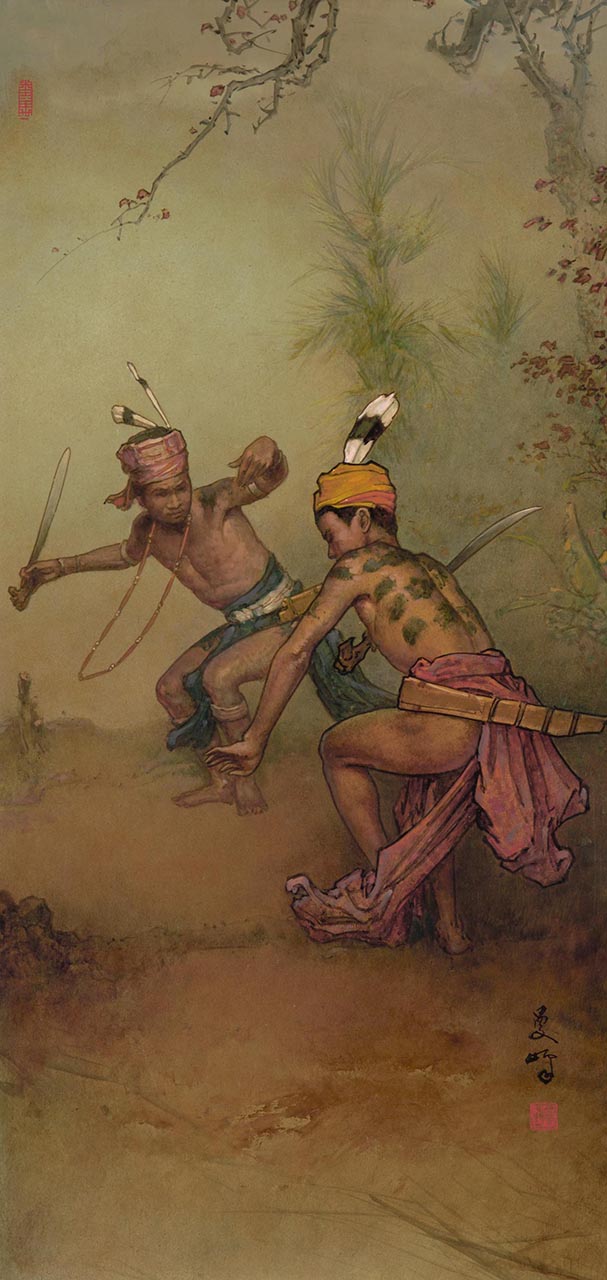 #079
#079Lee Man Fong
Dayaks of the Sea Dance
The dance is constructed by the repetition of gestures and the relationship between group and ground. Lee Man Fong treats the Dayaks as actors in a ceremony, not as exotic silhouettes; the composition emphasizes the rhythmic cohesion of the community.
See the institution's notice →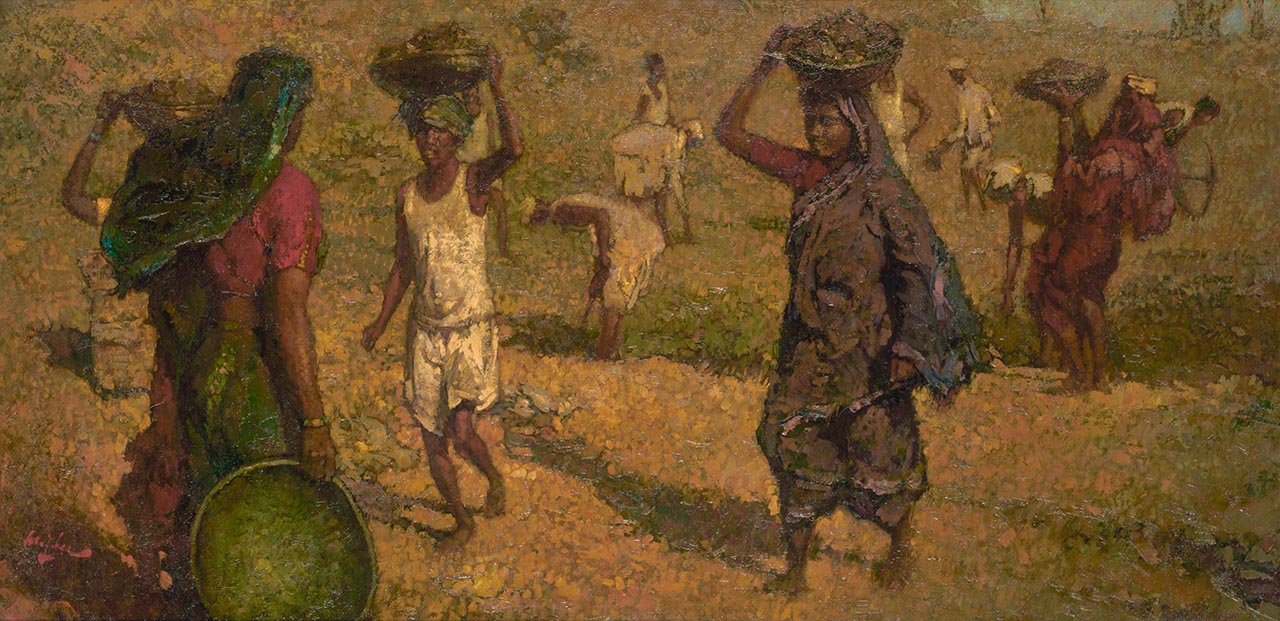 #080
#080Lee Man Fong
The Builders
The title can designate both those who build and the forces of development who transform the territory. Lee Man Fong brings together the figures in a work scene where verticals, tools and movements give concrete form to modernization.
See the institution's notice →Balinese workshops, landscape painters and Affandi's latest works close the route with visions where tradition, tourism and lived experience continue to collide.
 #081
#081Lee Man Fong
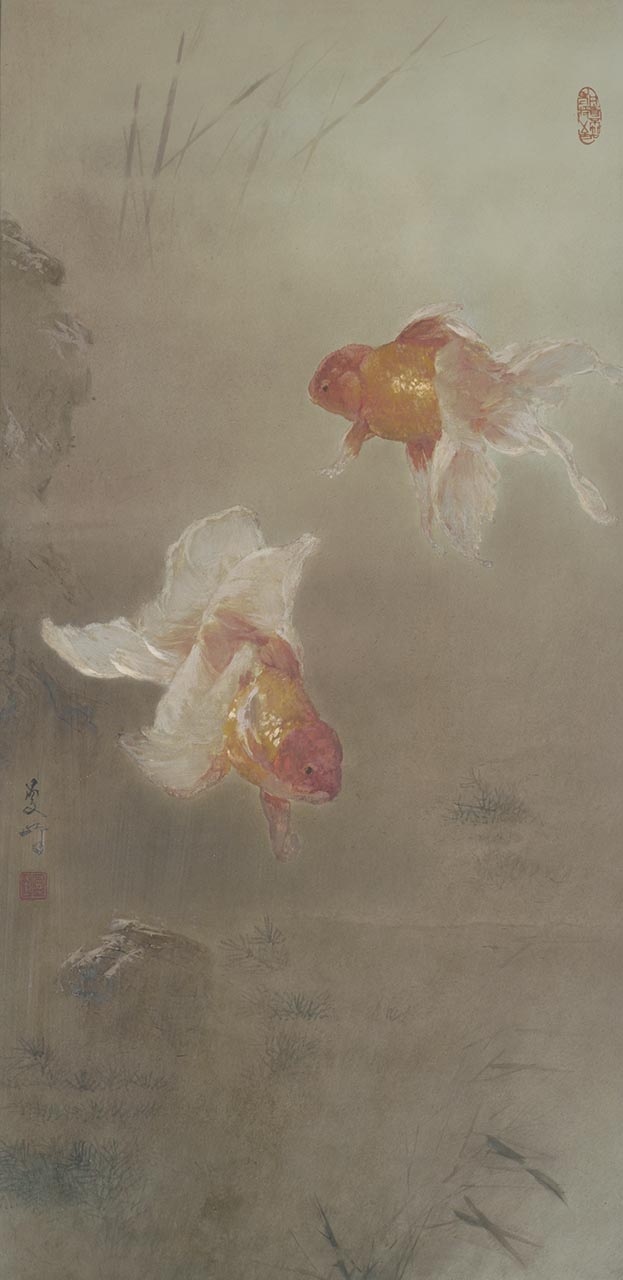
Two Goldfish
Two goldfish float in an almost depthless space, heir to Chinese painting. Lee Man Fong, however, uses oil on panel: transparency, fin movement and surrounding emptiness show how he transposes an ink tradition into another medium.
See the institution's notice →.jpg.html) #082
#082Srihadi Soedarsono
Sunset on Sanur beach
In Sanur, Srihadi Soedarsono reduces sea, horizon and sky to large colored areas. The sunset is not a detailed tourist memory: it becomes a physical experience of space, light and breathing of the landscape.
See the institution's notice →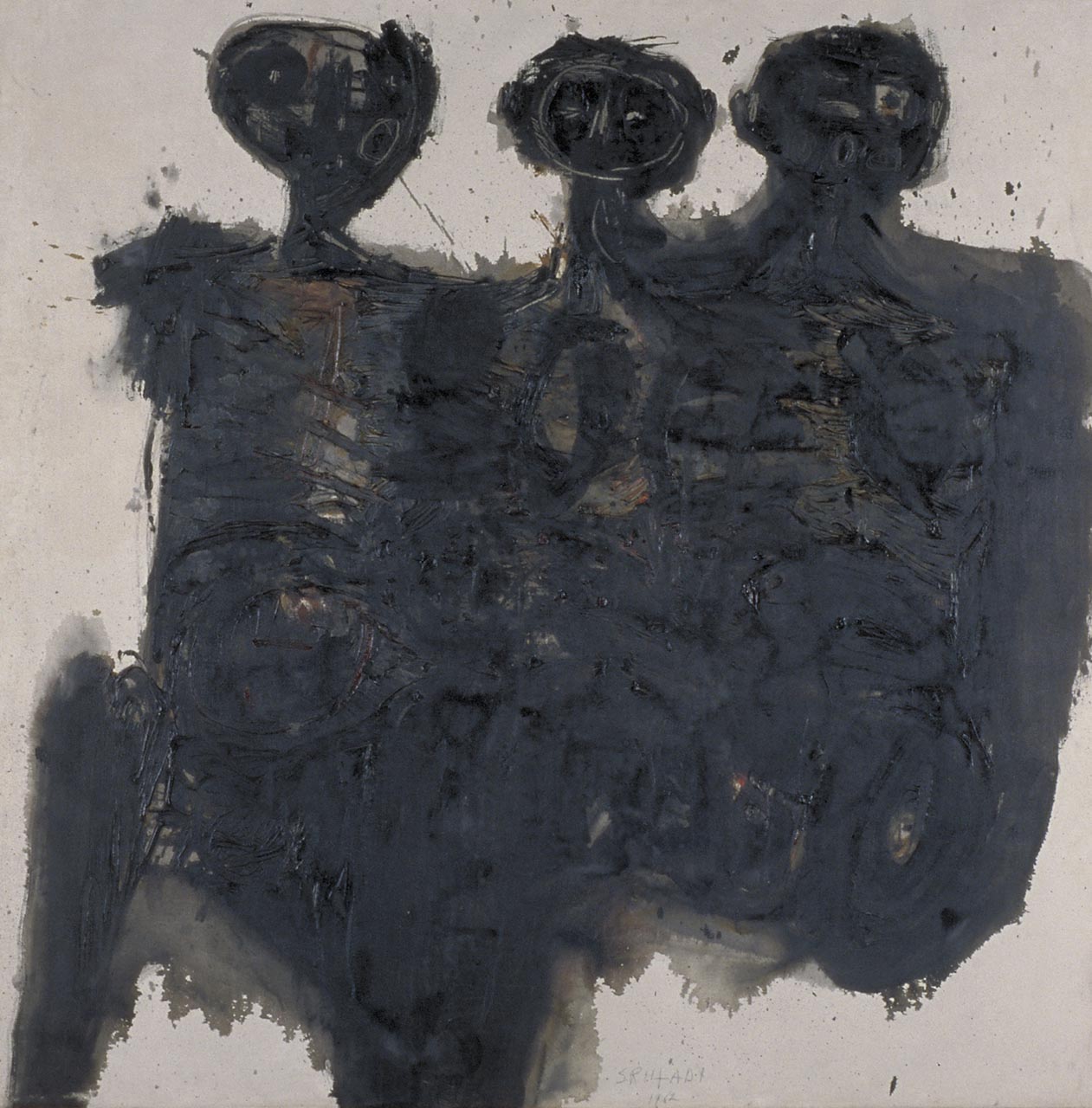 #083
#083Srihadi Soedarsono
Three Figures
Three presences are enough to organize the canvas by distances, silences and mass relationships. Srihadi Soedarsono avoids explicit narrative; the work examines how bodies share a space, each autonomous but defined by the other two.
See the institution's notice →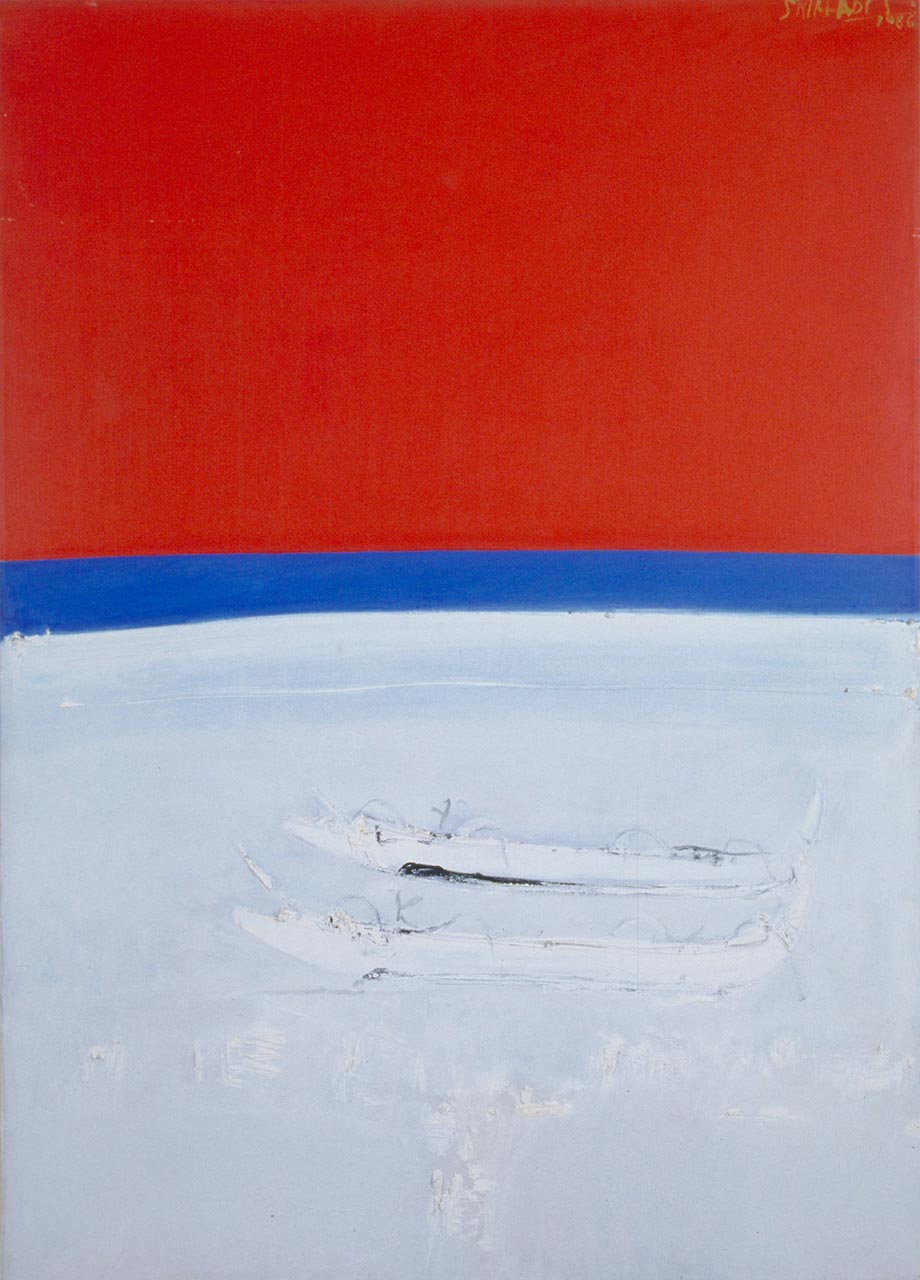 #084
#084Srihadi Soedarsono
Horizon and Boat
A tiny boat measures the immensity of the horizon. Srihadi simplifies the scene to the point of making the separation between water, sky and boat felt; this economy gives the seascape a contemplative rather than anecdotal dimension.
See the institution's notice →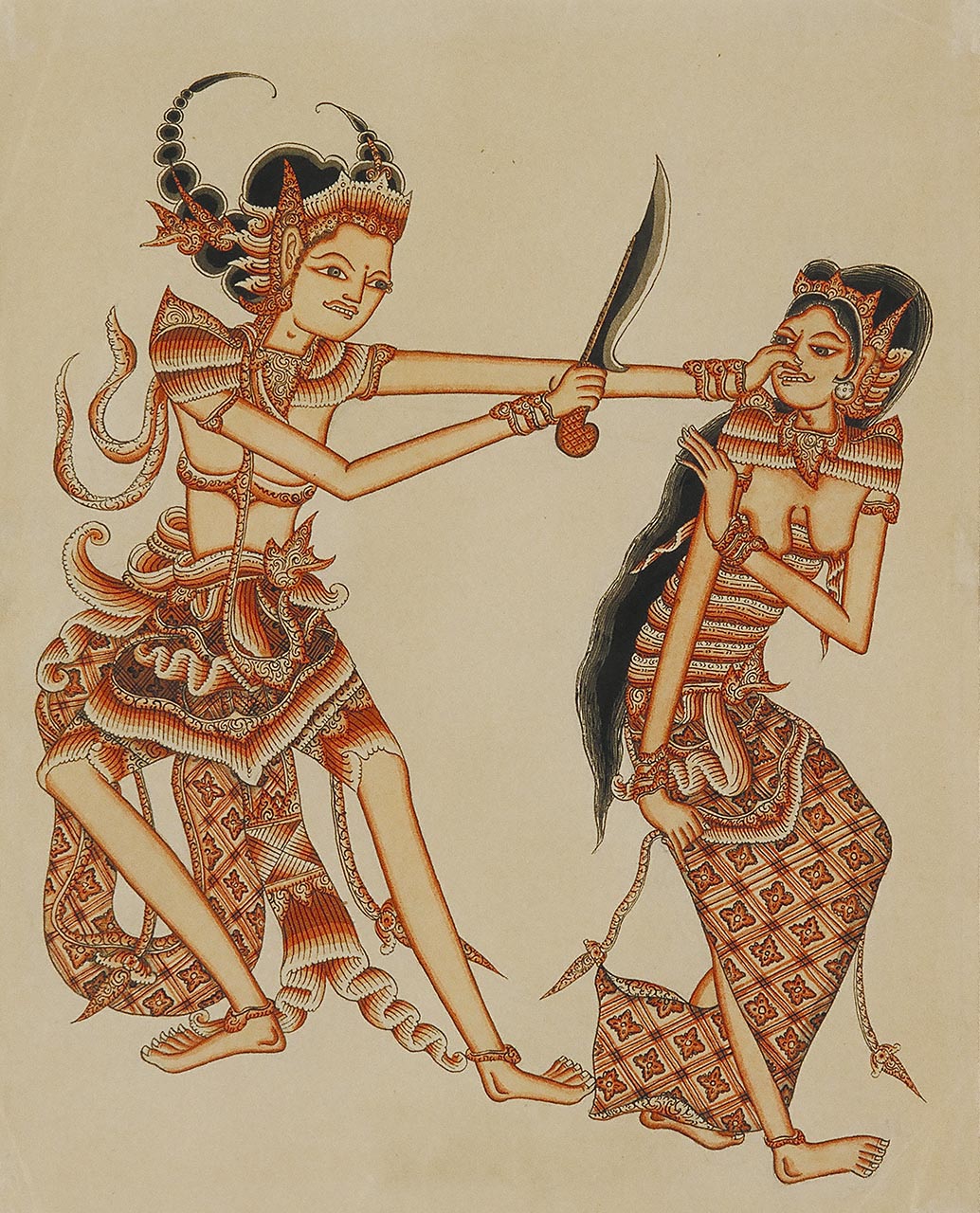 #085
#085Ida Bagus Made Nadera
Laksmana and the demoness
Laksmana defeats an evil force in an episode of the Ramayana. The tight contours, shadows and theatrical attitudes derive from wayang kulit; this sheet testifies to the renewal of Balinese painting of the 1930s through contact with new papers and brushes.
See the institution's notice →.jpg.html) #086
#086I Made Sukarya
Rajapala History
Rajapala surprises celestial nymphs in the bath and steals the clothing of one of them, Sulandari, so that she cannot leave. The painting unfolds the episodes in a continuous space, allowing the gaze to reconstruct a story of desire, cunning and separation.
See the institution's notice →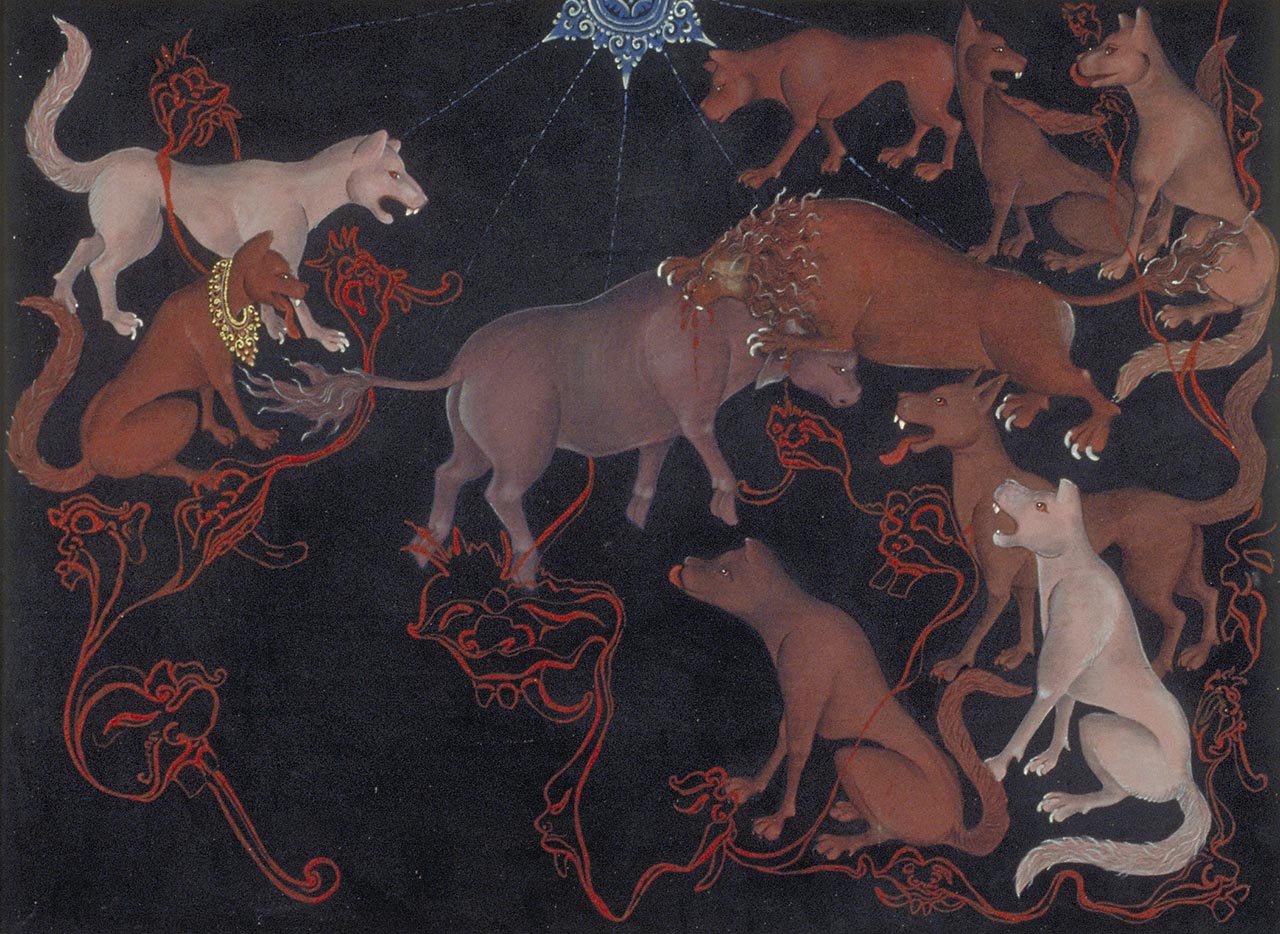 #087
#087I Made Sujendra
Pack of dogs watching a lion attack a bull
The lion and the bull occupy the center of a tension observed by the pack. Painted in tempera on fabric, the animal scene combines dense Balinese narration and study of movement; each animal participates in anticipating the outcome.
See the institution's notice →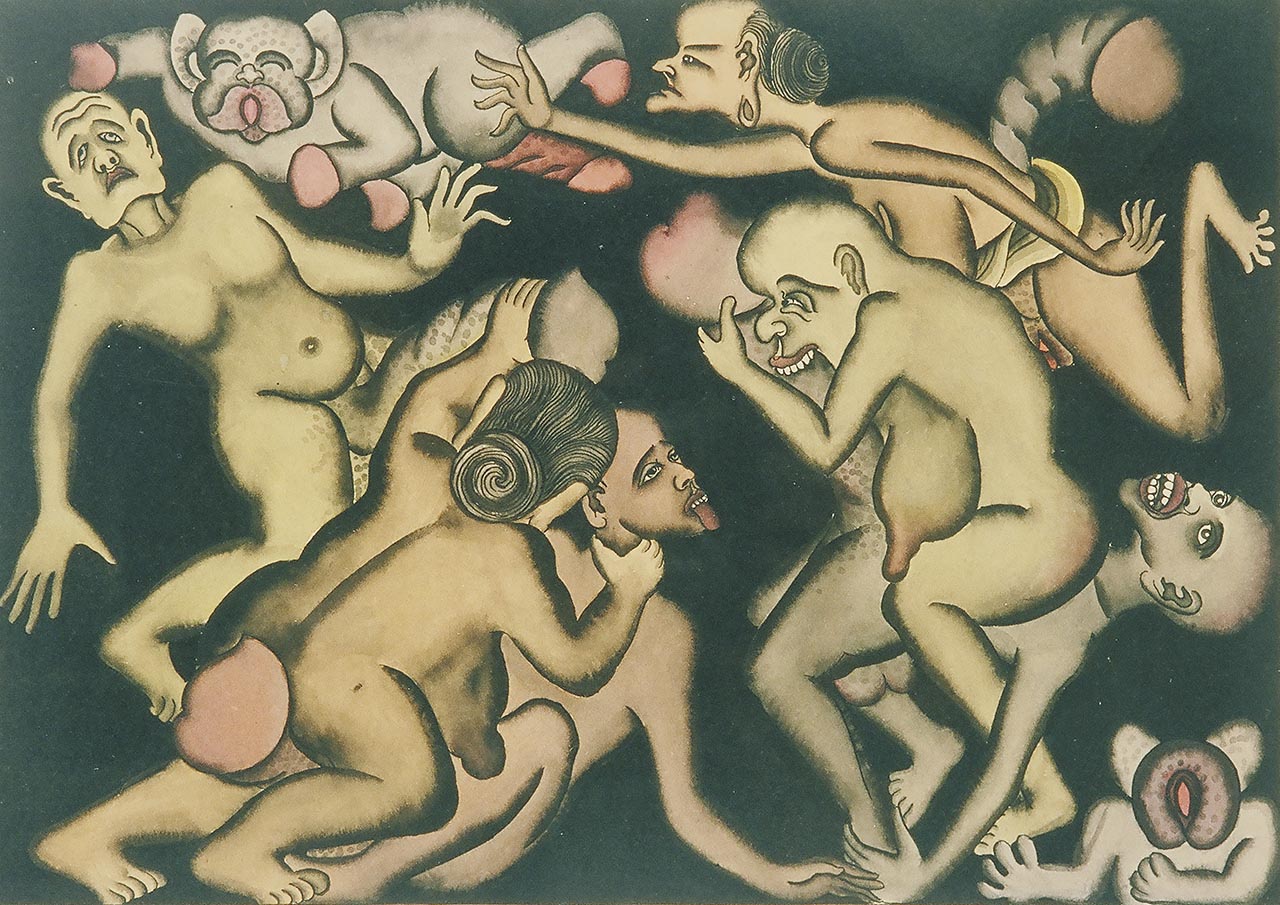 #088
#088Ida Bagus Ketut Soenia
Tantric scene
This scene combines body, energy and symbols in a ritual vocabulary that cannot be reduced to eroticism. The painter organizes the figures according to Balinese spiritual logic; the little leaf functions as a space of cosmic action.
See the institution's notice →.jpg.html) #089
#089Anak agung gede meregeg
Rama, Sita and Laksmana in the forest
Exiled in the forest, Rama, Sita and Laksmana advance into a world where each tree, animal and figure carries a part of the story. Balinese graphic density abolishes the void and transforms the landscape into an active network of signs.
See the institution's notice → #090
#090Ida Bagus Made Nadera
Sanghyang Dedari and Sanghyang Jaran dances in the village square
Sanghyang trance dances are represented in the heart of the village, surrounded by musicians and spectators. The composition shows that the performance is not isolated entertainment: it involves ritual protection, community and circulation between visible world and invisible forces.
See the institution's notice →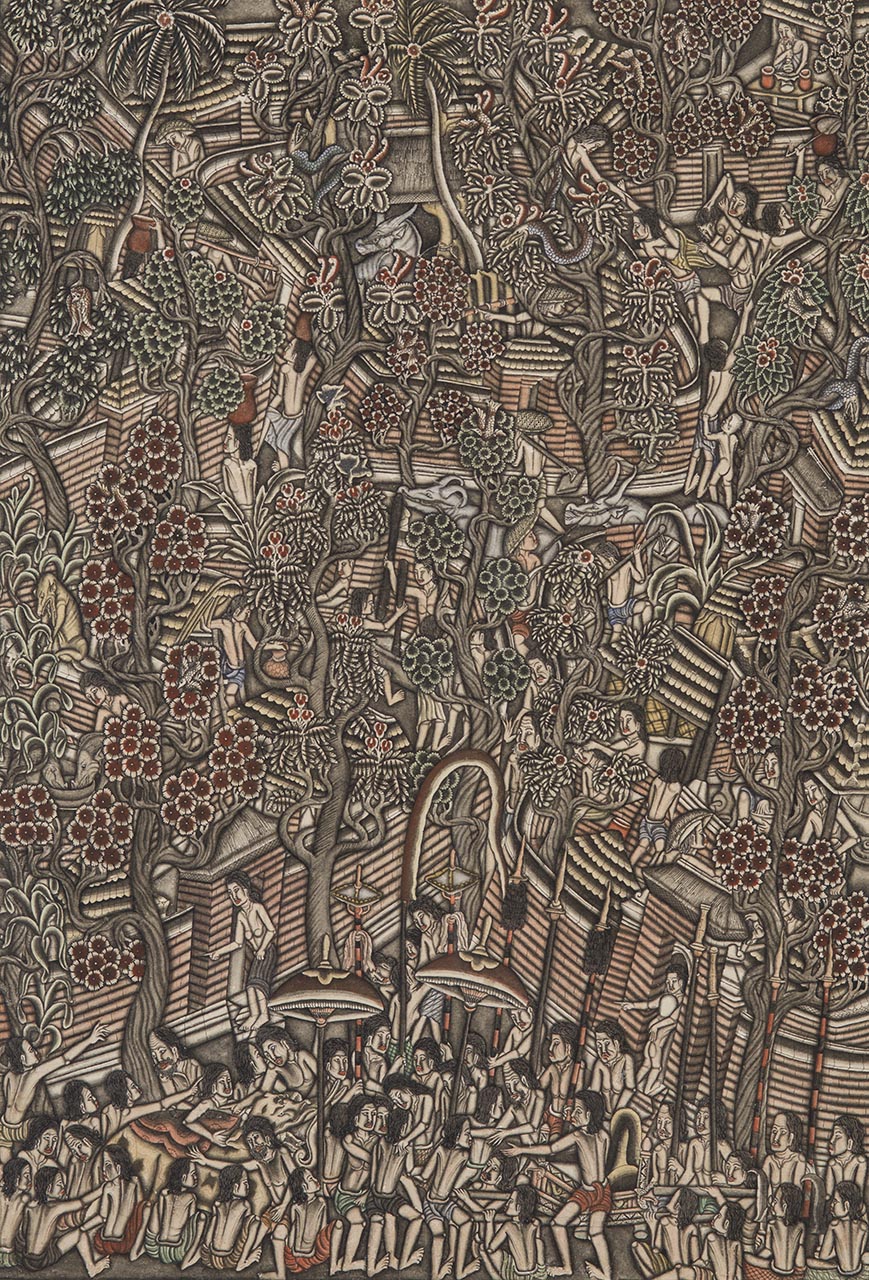 #091
#091Ida Bagus Diding
Wedding procession
The procession crosses the sheet like a collective movement regulated by costumes, offerings and repetition of steps. The Balinese painter gives as much importance to the social environment as to the bride and groom: the union belongs to the entire community.
See the institution's notice → #092
#092Antoine Auguste Joseph Payen
The Citarum River at Priangan, with figures on a raft of trunks
Professor of Raden Saleh, Antoine Payen describes the Citarum as a space that is both topographical and lived. The raft of trunks gives the scale of the current and reminds us that the landscape of Java is also a route of circulation and work.
See reproduction → #093
#093Leo Eland
Lake Toba
Leo Eland builds Lake Toba by atmospheric depth, line of reliefs and water stability. The Indonesian motif is treated in the tradition of oil landscape, but its volcanic geography imposes its own monumentality.
See reproduction → #094
#094Abdullah Suriosubroto
Indonesian village at sunset
Abdullah Suriosubroto envelops the village in twilight light that unifies houses, vegetation and relief. A major figure in modern Indonesian landscape, he makes the change of atmosphere the real subject rather than a picturesque inventory of rural architecture.
See reproduction → #095
#095Isaac Israels
Self-portrait with Javanese prince Raden Mas Jodjana
Isaac Israels represents himself alongside the Javanese dancer and prince Raden Mas Jodjana. The double portrait records a relationship between artists rather than an exotic encounter: the two figures share the pictorial space while retaining clearly distinct identities.
See reproduction →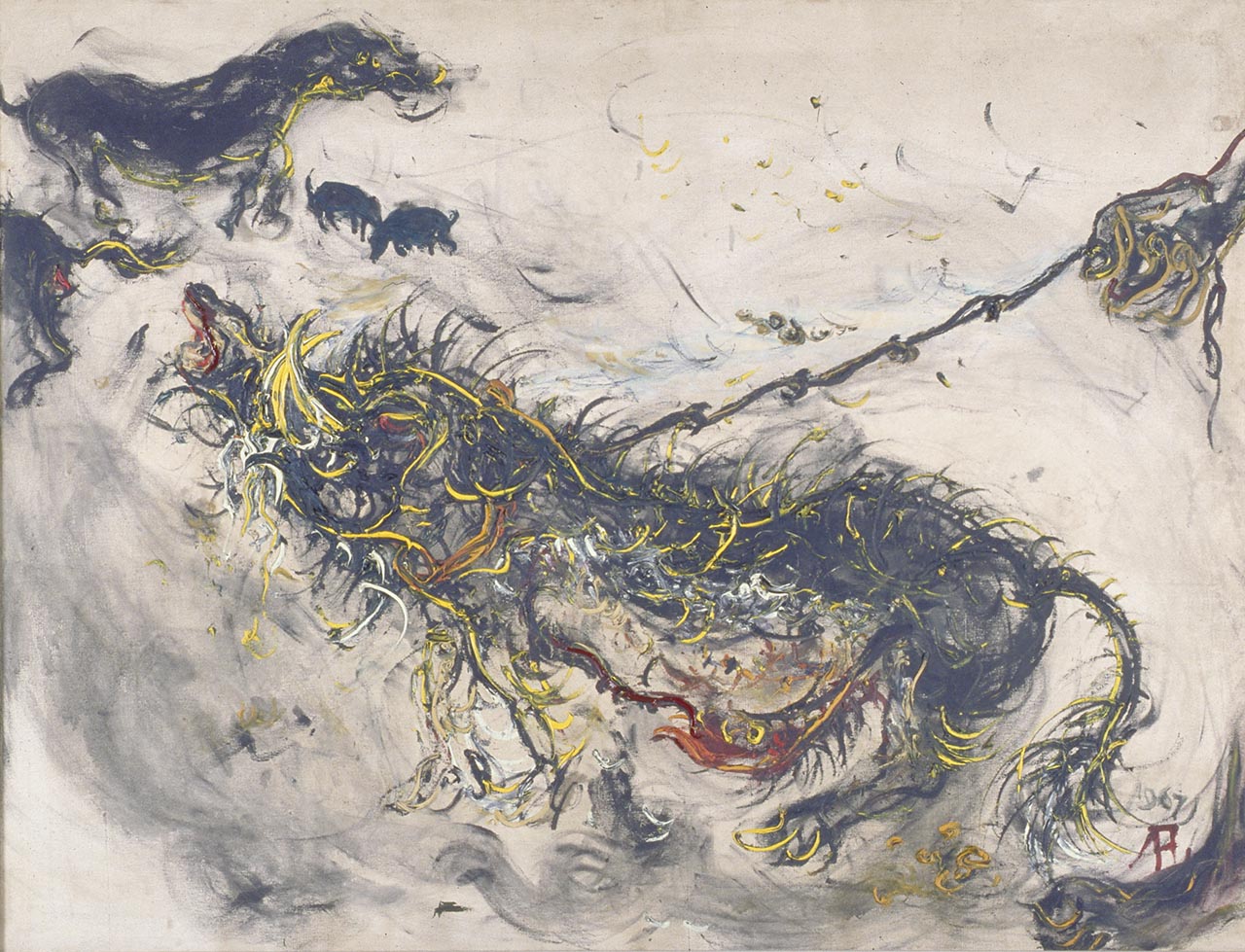 #096
#096Affandi
Boar
The wild boar emerges from a network of thick and fast lines. Affandi does not seek zoological description: he grasps weight, momentum and aggressiveness through the very gesture of painting, to the point of making animal energy and pictorial energy coincide.
See the institution's notice →.tif/jcr:content/renditions/cq5dam.web.1280.1280.jpeg) #097
#097Affandi
Fishing boat in Semarang
The hull and masts seem to twist under the impulse of the pressed lines of the tube. Affandi paints the boat as a working organism marked by the sea and human hands; the port of Semarang becomes an experience of strength and instability.
See the institution's notice →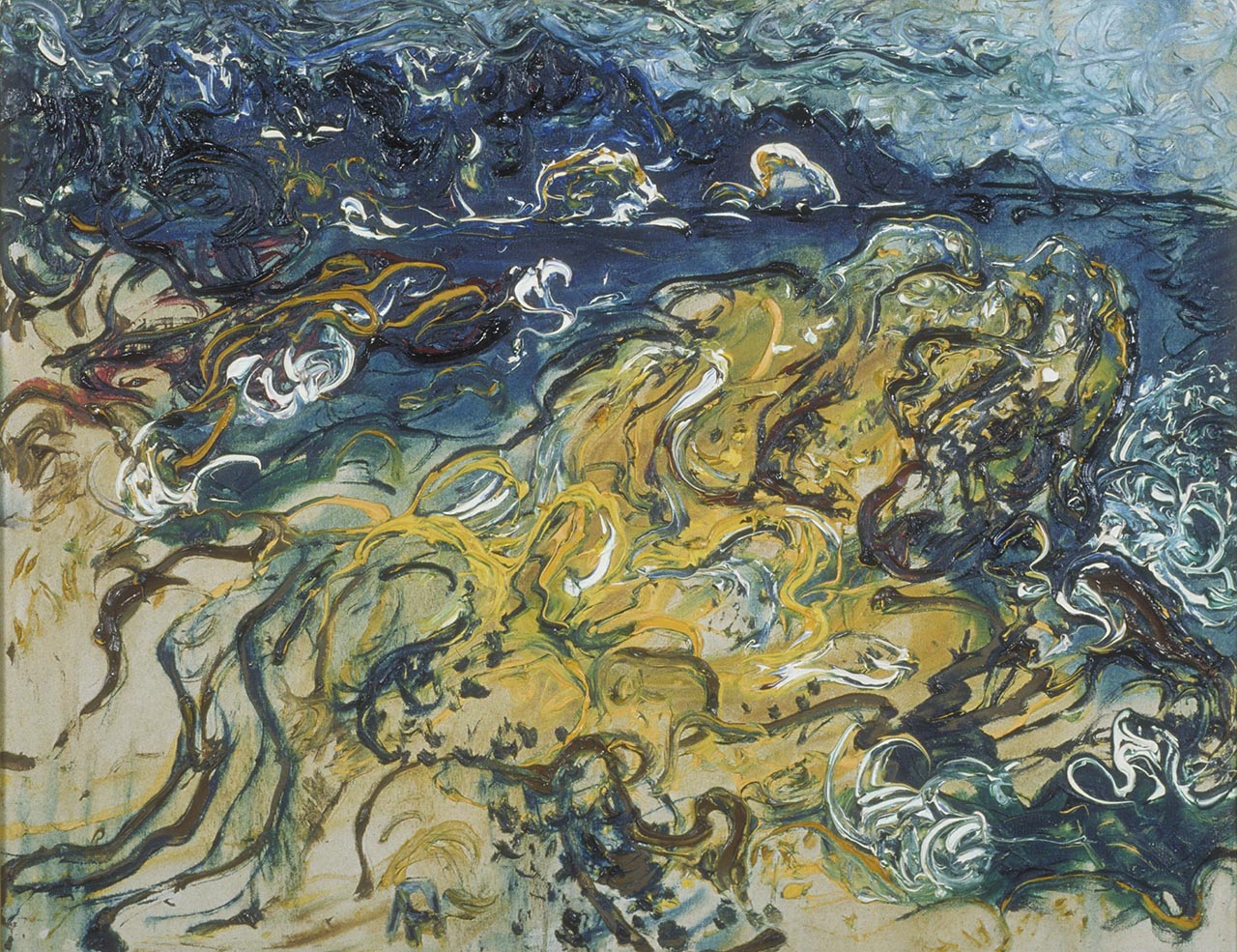 #098
#098Affandi
Carmel Beach
Facing the Californian coast, Affandi retains his gestural writing rather than adopting an agreed American landscape. Rocks, water and light are translated into tense lines; the journey reveals the ability of his language to absorb a foreign place without losing its intensity.
See the institution's notice →.tif/jcr:content/renditions/cq5dam.web.1280.1280.jpeg) #099
#099Affandi
Storm in Bali
Under the storm, Bali ceases to be the bright island of tourist images. Affandi circulates wind, rain and agitation in the very material of the canvas; the landscape is experienced as a force which momentarily disorganizes all stability.
See the institution's notice →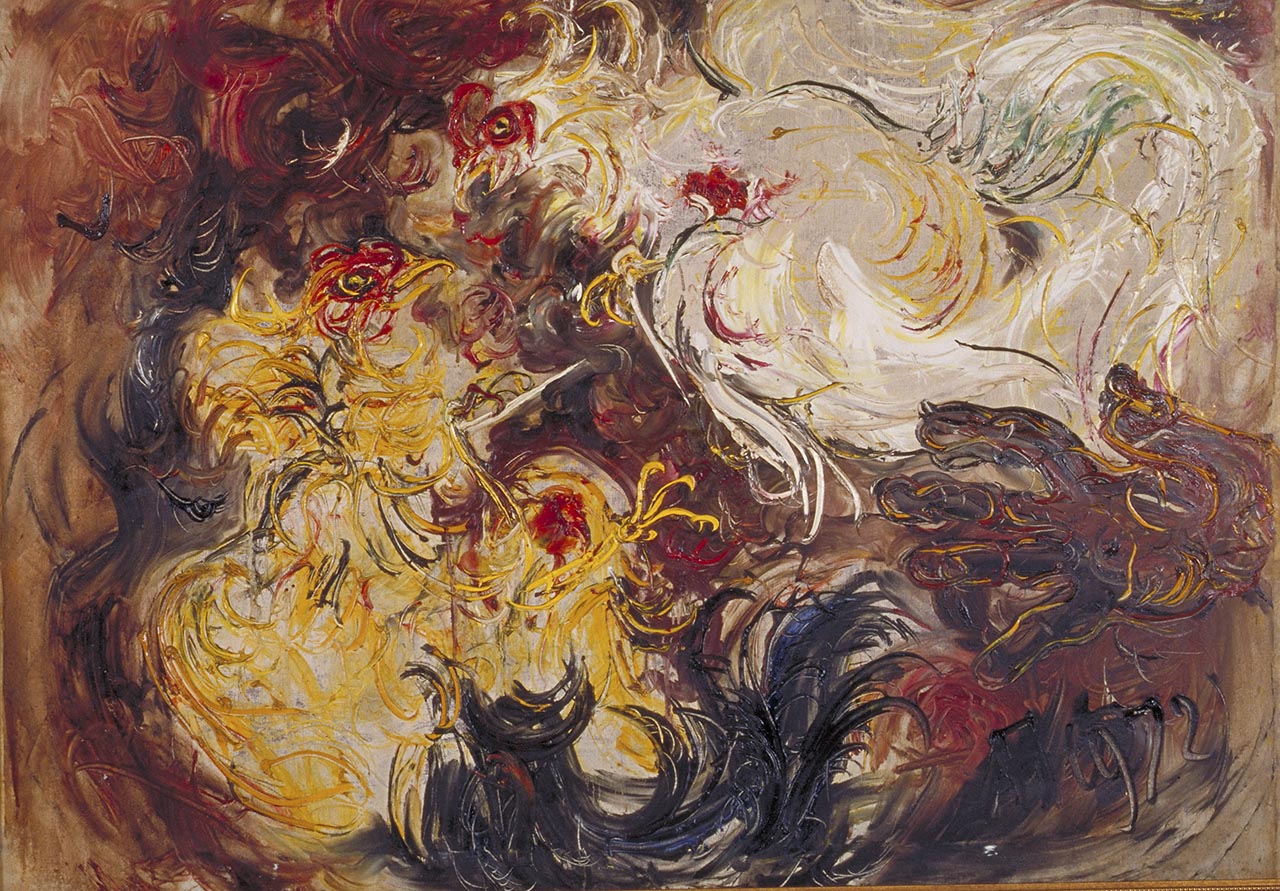 #100
#100Affandi
Cockfight
Affandi brings the birds together until feathers, legs and trajectories become almost inseparable. The brief violence of the fight suits his direct method: the painting records the impact before the scene regains its balance.
See the institution's notice →Sources and links
Two collections to extend the visit
Galeri Nasional Indonesia and the National Gallery Singapore retain a major part of this journey. Their notices allow us to follow the works, artists and aesthetic debates which accompanied the birth of modern painting in the archipelago.
0 comments