

Monet's Garden at Giverny • Art & Decoration Guide
Monet's Garden at Giverny: Flowers, Reflections, and Very Colorful Discipline
Dive into the heart of the Impressionist plant laboratory, between the Clos Normand and the water lily pond, to understand how a painter sculpted living light.
We often imagine Monet's garden as a gentle escape, a rustic resting place where the master came to relax between brushstrokes. It's quite the opposite: Giverny was first and foremost a permanent construction site, a pattern factory where every tulip had its assigned place in a life-size composition. When he moved into this Normandy house in 1883, Claude Monet didn't just buy walls and a roof; he acquired a vacant lot that he would transform over forty years into a total, moving, and perishable work of art. It's not nature that dictates the law here, but the painter's eye that bends the plant to its chromatic requirements. Understanding this garden means grasping that for Monet, planting was another way of painting, with the earth as canvas and the seasons as a changing varnish.
 Free Image
This high-resolution Water Lilies retains all the density of the pond: the flowers float, the reflections converse, the perspective takes on water with elegance.
Reading Method
Reading the Garden as a Visual Score
To fully appreciate the genius loci of Giverny, you must abandon the idea of the amateur gardener leaving things to chance. Instead, observe the architectural rigor of the paths, the calculated violence of color contrasts, and the way water becomes a distorting mirror. Each section of this space tells a stage of Monet's artistic thinking, from the earthly structure of the Clos Normand to the total dissolution of forms in the water lily pond.
Context Before Prestige
We place Monet's Garden at Giverny in its era, its studios, its exhibitions, and its small revolts. A work without context is sometimes just a very beautiful person who forgot their history.
The Signs That Betray the Style
We spot the Clos Normand, flower-lined path, Japanese bridge. These clues often say more than grand speeches, especially when they carry gold or nervous brushstrokes.
The Work in a Real Room
We end with the useful question: does this image breathe in your home, or is it just posing like a poster that has read two books?
Historical Context
Giverny: Monet Finds a Garden, Then Decides He Can Do Better Than Nature Alone

In April 1883, Claude Monet arrived in Giverny with his large family and piled his paint boxes into a house surrounded by a rather sad orchard and a utilitarian vegetable garden. Nothing predestined this ordinary place to become the temple of Impressionism, except the painter's stubbornness, who immediately saw the luminous potential of the Epte valley. He first rented the property, but his obsession was such that he negotiated fiercely to buy it in 1890, flatly refusing to remain a tenant of a landscape he intended to modify down to the last twig. This acquisition marked the beginning of a radical transformation where the pink house with green shutters became the central pivot of a spatial organization conceived as a three-dimensional painting.
From then on, the garden was no longer a passive backdrop but an outdoor studio where Monet worked with the same fever as in his glassed-in studio. He had trees that blocked the view cut down, created forced perspectives, and imported thousands of exotic plants to densify the plant matter. Neighbors, sometimes scandalized by this horticultural frenzy, saw a man spending fortunes on rare plants while they cultivated their cabbages. For Monet, each shrub was a pigment, each path a vanishing line, and he spent his days monitoring the growth of his subjects with the authority of a demanding director, ready to uproot without pity anything that did not match the visual harmony he pursued.
Artistic Style
The Clos Normand: Flowers at Liberty, But Under Quite Firm Artistic Direction

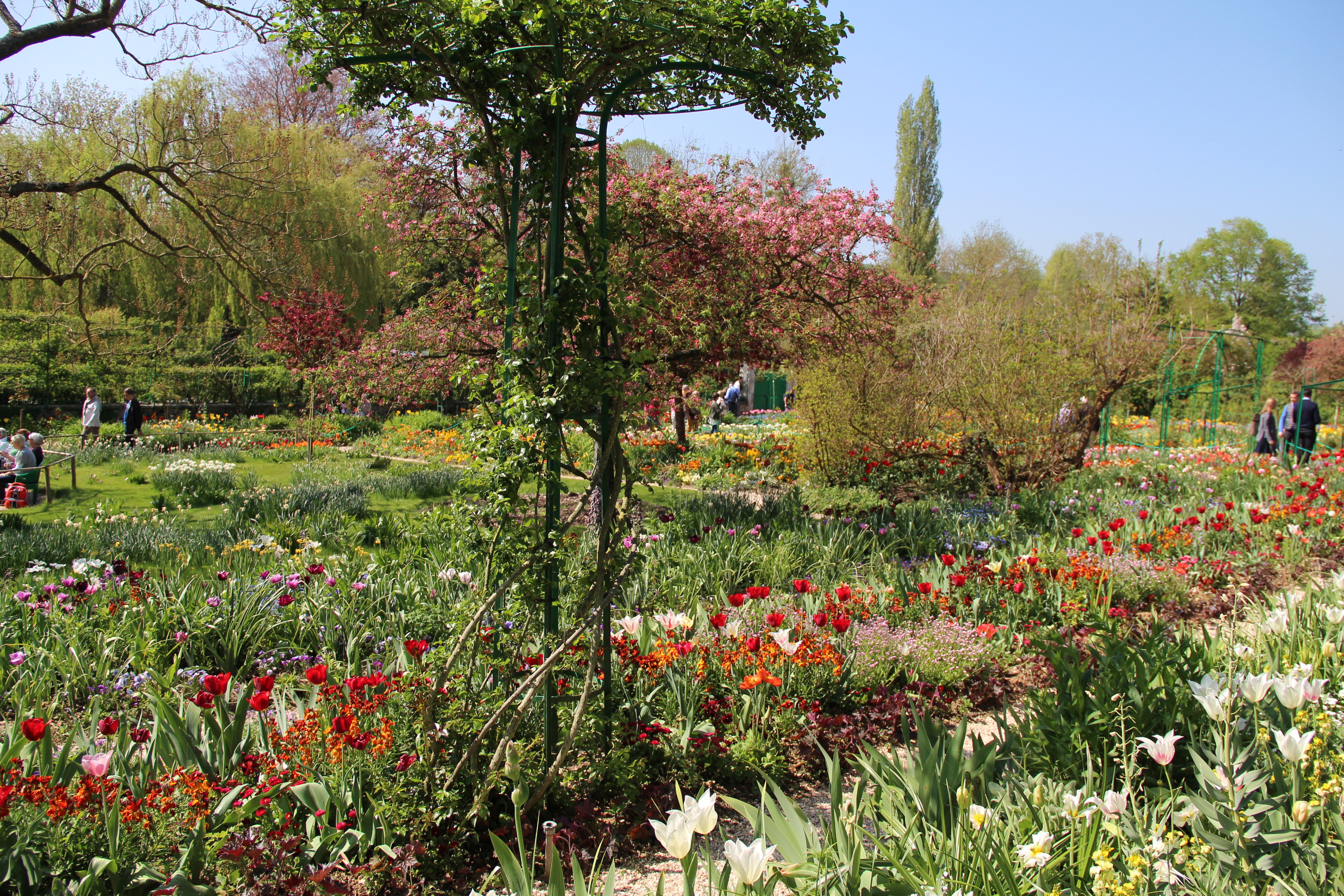
In front of the house stretches the Clos Normand, a perfect rectangle of nearly one hectare that Monet structured with rigorous geometry hidden under an apparent wild profusion. He traced a north-south central path that serves as an axis of symmetry, around which he arranged rounded flower beds overflowing with nasturtiums, climbing roses, and foxgloves. Far from romantic disorder, this layout obeys a precise color logic: Monet juxtaposed complementary hues to create optical vibrations, marrying the violet of irises with the yellow of marigolds or the red of geraniums with the tender green of foliage. It is a sophisticated orchestration where no flower is left to chance, each one contributing to the overall brilliance of the seasonal composition.
The magic of the Clos Normand lies in its ability to change face according to the months, offering a succession of living paintings that evolve from flamboyant spring to golden autumn. Monet planted in industrial quantities, ordering bulbs by the thousands from Dutch horticulturists to ensure an almost abstract density of color. He refused neat borders and manicured lawns, preferring to let plants mingle boldly to create effects of texture and moving light. Walking through these paths, one understands that the painter sought here to capture the ephemeral moment of flowering, transforming solid ground into an explosive palette where the eye can never rest long on a single point.
Art & Details
Planting Like Painting: Monet Composes with Flowers That Haven't Always Read the Program

Treating the garden as a canvas involves a permanent confrontation with the biological reality of plants, which sometimes have the annoying tendency not to bloom exactly when the artist would like. Monet had to anticipate floral successions with the precision of a conductor, overlapping early and late-blooming species to maintain constant chromatic saturation. He experimented constantly, moving clumps of peonies or daylilies from one bed to another according to the intensity of their glow, seeking the perfect harmony between the shape of the petal and the quality of light at a given hour. This empirical method transformed the gardener into a painter forced to compose with living, capricious pigments subject to the most fickle meteorological whims.
This revolutionary approach shook the codes of traditional horticulture of the time, which was more concerned with botanical rarity than overall visual effects. Monet often favored common varieties but planted them in compact masses to create powerful blocks of color, reminiscent of his juxtaposed brushstrokes on canvas. He used silver or purple foliage as contrast notes to bring out warm tones, applying here the same principles of color theory he developed in his series of haystacks or cathedrals. The garden thus became the site of a practical application of Impressionism, where nature was forced to become art by the sole will of an obsessive gaze.
Art & Details
The Pond: When Monet Also Buys the Reflection, That Very Useful Little Luxury

In 1893, dissatisfied with solid ground alone, Monet crossed the road and acquired a marsh crossed by a branch of the Epte to create his famous water garden. This extension required complex administrative procedures, as the painter had to obtain permission to divert the watercourse and import exotic aquatic plants, arousing the mistrust of neighbors fearing contamination of their own crops. He had the kidney-shaped pond dug, surrounded it with weeping willows and bamboos to isolate the place from the outside world, thus creating a closed microcosm dedicated exclusively to the observation of reflections. It was no longer a garden for strolling, but an optical laboratory where the water surface became the true subject, absorbing the sky and dissolving contours.
The development of this pond marked a decisive turning point in Monet's work, as he gradually abandoned classical perspective to focus on the inverted verticality of the liquid mirror. He introduced water lilies, those floating flowers that would become his exclusive models for the last thirty years of his life, as well as wisteria whose clusters brushed the surface. The still water, carefully maintained to prevent the proliferation of unwanted algae, offered a changing texture depending on the wind and the hour, allowing the painter to study the decomposition of light on a moving support. It was here that the idea of a painting without horizon was born, where top and bottom exchange in a deliberate and fascinating confusion.
Art & Details
The Japanese Bridge: Not an Exotic Decoration, Rather a Machine for Framing Reflections

At the heart of the water garden stands the Japanese bridge, painted bright green and topped with a wisteria trellis, an architectural element that might seem like a simple Orientalist whim if one ignored its functional role. Inspired by the Japanese prints that Monet passionately collected, especially those of Hiroshige and Hokusai, this bridge is not there to be frequently crossed but to structure the space and offer an elevated viewpoint. Its elegant curve breaks the linearity of the horizon and frames the water surface like a painting within the painting, forcing the gaze to focus on the complex interplay between real vegetation and its inverted image. It is a seeing machine, designed to isolate a fragment of nature and transform it into pure composition.
Monet depicted this bridge in nearly seventeen paintings, exploring in all lights and all seasons the way the structure dialogues with the water lilies and the reflections of the surrounding trees. The green of the bridge, chosen to contrast with the red of autumn leaves or the pink of wisteria in bloom, acts as a strong graphic note amidst the aqueous fluidity. By integrating this artificial element into a natural setting, the painter highlights the tension between human order and vegetal chaos, while paying homage to the Japanese aesthetic of wabi-sabi that finds beauty in impermanence. The bridge thus becomes the silent guardian of this floating world, lightly anchoring the dream before it dissolves entirely.
Art & Details
The Water Lilies: The Flowers Float, the Horizon Starts Looking for the Exit
As the years passed and Monet's eyesight declined, the water garden became the painter's sole universe, as he shut himself away in his large circular studio to capture the infinity of the water lilies. The flowers were no longer objects placed on the water, but patches of color emerging from a liquid background where the sky, clouds, and trees had completely merged. This dissolution of form heralds modern abstraction, for Monet no longer painted what he objectively saw, but the pure sensation of vibrating light on the surface of the pond. The canvases grew enormously, some exceeding several meters in width, to envelop the viewer and give the illusion of floating in the middle of the pond, without top or bottom, without visible shore.
This work culminated in the Grandes Décorations offered to the French state and installed in the oval rooms of the Musée de l'Orangerie in Paris, creating a unique immersive experience in the world. In these late works, the garden of Giverny has completely disappeared as a geographical place to become a mental space, a meditation on the passage of time and the cyclical nature of life. The water lilies, repainted thousands of times, lose their precise botanical identity to become archetypes of the flower, floating in a bath of pure colors where green, blue, and pink intermingle endlessly. It is the logical culmination of forty years of work on the motif, where the real garden was eventually entirely swallowed by painting.
Art & Details
Looking at Giverny Without Falling Asleep in the Postcard

Visiting the Fondation Claude Monet at Giverny today requires going beyond the cliché image of the flower-filled village to rediscover the master's experimental approach. You must observe how the paths of the Clos Normand guide the step toward precise viewpoints, how the masses of flowers create visual rhythms rather than simple decorations, and how the water of the pond acts as a natural projection screen. Beware of summer crowds that sometimes turn the place into a theme park: to grasp Monet's spirit, it is better to imagine the silence of the artist alone facing his canvases, tracking the minute when the light hits just right. Every corner of the garden reveals an intention, whether it is the alignment of the bamboos or the curve of a path; nothing was left to the sole whim of spontaneous growth.
The seasons offer radically different readings of this place: spring explodes with a thousand vivid colors while autumn brings more muted and melancholic tones, close to the painter's later palettes. Observing the reflections in the water at different times helps understand why Monet could paint the same subject dozens of times; the changing surface profoundly alters the perception of forms and colors. Do not seek the static perfection of a French formal garden, but appreciate this overflowing, almost wild vitality that makes Giverny remain alive and unpredictable. It is in this tension between artistic control and natural freedom that the true genius of the place lies, far from the overly smooth postcards.
Interior Decoration
Choosing an Image of Giverny: Apparent Calm, Very Active Luminous Work

To choose a reproduction from this fruitful period, it is essential to determine which facet of Giverny you want to welcome into your home: the floral structure of the Clos Normand or the aquatic contemplation of the pond. A scene of the Japanese bridge under the wisteria will bring a graphic and colorful touch ideal for energizing a modern living room, thanks to its elegant curves and contrasts of greens and violets. Conversely, a study of water lilies, often more abstract and dominated by deep blues or water greens, will suit a relaxation space like a bedroom or office, promoting calm and reverie. The size of the work also matters: panoramic formats recall the immersion of the Grandes Décorations, while square or vertical formats focus the gaze on a precise detail of the plant composition.
Pay attention to the quality of color reproduction, because Monet's subtlety relies on infinite nuances that poor prints often reduce to garish blocks. A good reproduction must convey the vibration of light and the transparency of water, avoiding the flat effect of an ordinary photograph. Whether it is a hand-painted copy or a high-definition print, the goal is to rediscover that impression of movement and life that characterizes the original garden. By integrating such a work into your home, you are not simply hanging an image of flowers, but a fragment of that luminous laboratory where Monet spent half his life questioning the mystery of vision.
| Room | Suggestion | Decorative Effect |
|---|---|---|
| Living Room | A work related to Monet's Garden at Giverny with a strong composition | Cultivated focal point, warm, and easy to comment on without reciting a label. |
| Bedroom | A soft palette or a more intimate scene | Calm atmosphere, visual presence without unnecessary agitation. |
| Office | A structured, colorful, or graphically sharp image | Creative energy and a small reminder that the wall can also work. |
| Entryway | A vertical format or an immediately readable work | Clear, elegant first impression, and decidedly less timid than a blank white space. |
To Continue the Visit
Sources, Collections, and Paths Truly Related to the Subject
A few useful references to verify information, compare free images, and extend the reading without going to a museum that didn't ask for anything.
Related Articles to Read Next
Useful Blog Hubs
Useful Sources on This Subject
- Fondation Claude Monet - Giverny
- Wikimedia Commons - Claude Monet's garden at Giverny
- Wikipedia - Fondation Monet in Giverny
- Musée d'Orsay - The Artist's Garden at Giverny
- Musée de l'Orangerie - The Water Lilies
- Musée Marmottan Monet
- The Met - Water Lilies
- Wikipedia - Claude Monet
- Wikidata - Claude Monet
- Wikimedia Commons - Claude Monet
FAQ
Frequently Asked Questions about Monet's Garden at Giverny
What is Monet's Garden at Giverny in painting?
Monet's garden at Giverny is a living studio: Clos Normand, water garden, Japanese bridge, water lilies, and seasons are composed there like a painting that the painter can water.
How to quickly recognize this style?
Observe especially the Clos Normand, flower-lined path, Japanese bridge, water garden, and water lilies, then the way the composition organizes the gaze. If the work holds you longer than expected, it's probably not an accident.
Which artists should you know?
The main references are Claude Monet, Alice Hoschedé Monet, Blanche Hoschedé Monet, Georges Clemenceau, and Gustave Caillebotte.
Is this style suitable for modern decoration?
Yes, provided you choose the right format, a palette consistent with the room, and a work whose presence remains pleasant on a daily basis.
Should you choose the most famous work?
Not necessarily. The most famous work can be perfect, but the right choice depends above all on the room, the format, the palette, and the desired atmosphere.
Where to verify the information?
Start with museum notes, Wikipedia/Wikidata for general orientation, then Wikimedia Commons when a free image is needed.
A Living Legacy Between Earth and Water
Monet's garden at Giverny remains much more than a popular tourist site; it is the physical testimony of an uncompromising artistic quest, where nature was shaped to meet the demands of the Impressionist eye. From the geometric rigor of the Clos Normand to the dreamlike dissolution of the water lilies, every square meter of this estate tells the story of a man who refused to choose between gardening and painting, making both a single vital activity. Even today, walking through these paths or contemplating a canvas born from this place means accepting to see the world not as it is fixed, but as it trembles under the light, ephemeral and magnificent. Giverny reminds us that art can take root in the earth and that beauty sometimes requires as much sweat as inspiration.
0 comments