

Claude Monet's House in Giverny: Garden, Colors, and Genius in Boots
A deep dive into the Giverny estate, where domestic life, botanical obsession, and pictorial revolution merge to create the greatest open-air studio in history.
We often picture great painters patiently waiting for the world to offer them a spectacle worthy of their brushes, but Claude Monet took the lead with rare boldness. By settling in this corner of Normandy in 1883, he wasn't simply seeking a rural refuge; he decided to sculpt nature itself so that it would respond exactly to his chromatic demands. The house at Giverny is not a setting frozen in the amber of the past, but the vibrant laboratory where the master invented a new way of seeing time, light, and water. Understanding this place means grasping how a man transformed his property into a total work of art, where every tulip planted and every wall color obeyed an implacable visual logic.
_(48744281997).jpg) Free image
Free imageThe Giverny house gives the subject its real address: pink walls, green shutters, garden at the forefront, and light already at work.
Reading method
Reading the landscape like a painted score
To fully appreciate Giverny, you need to abandon the idea of a simple tourist stroll and adopt the artist's eye: observe how the garden's composition precedes the canvas. Every path, every reflection, and every cast shadow has been calculated to serve as a living model, transforming the visitor into a witness of an alchemy between botany and painting.
Context before prestige
We place Claude Monet's House at Giverny back in its time, its workshops, its exhibitions, and its small revolts. A work without context is sometimes just a very beautiful person who has forgotten their story.
The signs that betray the style
We spot the pink house, Clos Normand, water garden. These clues often say more than grand speeches, especially when they carry gold or nervous brushstrokes.
The work in a real room
We end with the useful question: does this image breathe in your home, or does it merely pose like a poster that has read two books?
Historical context
Giverny: Monet finds a house, then politely decides to redo the nature around it

When Claude Monet arrived in Giverny in April 1883 with his blended family and children, the Norman village was far from the flowery paradise we know today. He first rented a small house surrounded by a rather sad orchard, dominated by tall poplars that filtered the light with an annoying parsimony for an Impressionist. Yet the artist immediately saw the potential of this flat, well-exposed land, ideal for capturing the atmospheric variations of the Epte valley. His determination was such that he persuaded his patron, Ernest Hoschedé, to support this project, quickly transforming this modest rental into a permanent anchor. From those first years, one senses that Monet would not be content merely to live in the place: he intended to bend it to his vision, even if it displeased the neighbors who found his horticultural ambitions somewhat eccentric.
The transformation accelerates considerably in 1890, the year when Monet, finally assured of his income thanks to the success of his series, buys the property outright. This acquisition marks the beginning of a phase of titanic work in which the artist becomes a landscape architect, having tons of earth moved to shape the terrain to his needs. He has the overly invasive poplars cut down to open up the sky and traces geometric paths that structure the space with surprising rigor. It is no longer just a country house, it is a permanent construction site where every decision, from soil drainage to the orientation of the flower beds, aims to optimize the quality of the light. Monet understood that to paint nature freely, he first had to tame it with watchmaker's precision, thus creating the first act of his great living work.
Artistic style
The pink house: when the interior refuses to stay beige out of politeness

The facade of the house, with its vivid green shutters contrasting against the pink walls and climbing ivy, acts as a first canvas before even crossing the threshold. But it is inside that Monet's decorative genius bursts forth with a freedom that would have scandalized the conservative bourgeoisie of the time. The dining room, the true gem of the place, is painted entirely in saturated yellow, a color then reserved for exteriors or service rooms, but which Monet imposes here as a permanent backdrop to enhance natural light. The walls are covered with an impressive collection of Japanese prints, carefully framed and arranged with maniacal symmetry, testifying to the major influence of Japonisme on his aesthetic. Every object, from the blue tableware to the printed fabrics, was chosen to create a total chromatic harmony where nothing is left to the chance of conventional taste.
Pushing open the kitchen door, the visitor discovers another surprise: cobalt blue ceramic tiles covering the walls from floor to ceiling, creating an unexpected marine atmosphere in the heart of Normandy. This boldness in the use of pure color shows that for Monet, the boundary between living space and creative space is porous, even nonexistent. He lives surrounded by his favorite motifs, bathing in an environment that constantly stimulates his retina and nources his pictorial work. Even the furniture and spatial arrangements seem designed to facilitate the circulation of light and offer multiple vantage points onto the garden. This interior is not a frozen museum, but living proof that the artist's eye never takes a vacation, transforming the everyday into a continuous and refined visual experience.
The Clos Normand: the flowers line up, but with panache

In front of the house stretches the Clos Normand, an ornamental garden where the apparent floral profusion hides a rigorous military organization designed by Monet himself. The artist drew rectilinear paths that guide the eye toward receding perspectives, while the flowerbeds are organized by color gradients rather than by botanical species, a revolution in the garden art of the time. In spring, thousands of tulips and narcissi create vibrant carpets, giving way in summer to orange nasturtiums and purple dahlias that literally explode under the sun. Monet gardened with the same passion as he painted, spending hours selecting varieties, sometimes even importing rare seeds from Japan or elsewhere to obtain the exact shade he desired. This is not a garden of rest, but a living palette in perpetual mutation, where each flower plays the role of a brushstroke in a life-size composition.
What strikes one about the Clos Normand is this ability to make hundreds of different species coexist without ever falling into visual chaos, thanks to an exceptional mastery of heights and textures. Climbing plants dress the arches and arbors, adding verticality to a space that is nonetheless very horizontal, while silvery foliage soothes the ardor of the most vivid blooms. Monet personally supervised the work of his seven gardeners, giving precise instructions so that the colors would echo one another from one end of the park to the other. He sought to create effects of optical vibration directly in the landscape, anticipating on the canvas the plays of light he would later capture. Visiting this garden today means understanding that every petal was placed there with a precise aesthetic intention, making this Norman plot of land one of the most ephemeral and renewed works of art in the world.
The water garden: Monet fabricates the motif before painting it, which is very organized for a dream

On the other side of the departmental road, separated from the automobile tumult by an underground passage added later, stretches the water garden, the intimate sanctuary where the famous Water Lilies will be born. In 1893, Monet bought a marshy plot adjacent to his property and obtained, not without difficulty, the prefectural authorization to divert a branch of the Epte to feed his future ponds. The neighbors, worried about seeing potentially toxic exotic plants pollute their drinking water, did everything in their power to block the project, but the artist's stubbornness overcame their administrative reluctance. He had ponds dug with irregular outlines, bordered by weeping willows and bamboos, creating a microcosm isolated from the rest of the world where only the play of reflections mattered. This place was not meant for strolling, but for contemplation and the obsessive study of the liquid surface and its infinite transformations.
At the heart of this aquatic garden stands the famous green Japanese bridge, covered with purple wisterias that, in May, transform the passage into a floral tunnel of striking beauty. Inspired by the Japanese prints he collected, this bridge is not a simple decorative element but an essential framing tool for the painter, allowing him to structure his compositions and guide the eye toward the horizon or toward the mirror of the water. Monet introduced water lilies from Egypt and South America, exotic plants with spectacular flowers that became the main protagonists of his late canvases. He spent entire days sitting at the water's edge, observing how the light changed the color of the leaves and the depth of the pond minute by minute. This garden was his ultimate laboratory, a place where he could control every variable to capture the elusive dance between sky, water, and vegetation.
The Japanese bridge: small bridge, great international career

The Japanese bridge at Giverny is undoubtedly one of the most reproduced motifs in art history, having served as the subject of dozens of paintings and prints that traveled far beyond French borders. For Monet, this small curved wooden structure represented far more than a practical crossing; it embodied the aesthetic ideal of Japan as he dreamed it, a blend of structural simplicity and perfect integration with the surrounding nature. Influenced by masters like Hokusai and Hiroshige, whose prints he owned by the hundreds, Monet imported this Asian spirit to Normandy, creating a fascinating dialogue between two cultures through the architecture of his garden. The specific green of the bridge, carefully chosen to contrast with the pink of the water lilies and the blue of the sky, becomes an instantly recognizable visual signature, almost as famous as the Eiffel Tower in its own way.
This bridge allowed Monet to explore new ways of composing pictorial space, using its curve to break the linearity of the horizon and create bold plunging perspectives. In his paintings, the bridge often serves as a stable visual anchor amid the moving fluidity of water and reflections, offering a fixed point of reference in a universe in perpetual transformation. It appears in every season, under every kind of light, sometimes wrapped in mist, sometimes blazing with sun, proving the infinite capacity of a single motif to generate varied emotions. Even today, when visitors cross this bridge at Giverny, they literally walk in the master's footsteps, taking in the same viewpoint that inspired so many masterpieces. It is a moving testament to how a modest architectural object can acquire a mythical dimension through the eye of a genius.
The studios: where flowers become very large painting problems

To carry out his increasingly ambitious projects, Monet had several studios built at Giverny, the last of which, erected in 1901, was a true cathedral of glass and light specifically designed to accommodate monumental formats. These workspaces had nothing in common with the small cabinets of amateurs; they were industrial places of creation, equipped with movable easels and pulley systems allowing canvases several meters wide to be handled. The artist worked standing up, walking around his works like a sculptor, applying layer after layer of paint to capture the complexity of aquatic reflections. The northern light, constant and soft, was filtered through vast windows, guaranteeing ideal conditions for working from sunrise to sunset without being disturbed by sudden changes in lighting.
It was in these studios that Monet faced his greatest technical challenges, particularly during the creation of the large Water Lilies decorations, where he had to maintain visual coherence across immense panoramic surfaces. He would tirelessly retouch his canvases, sometimes for years, seeking to render not the precise shape of a flower, but the overall impression of a fluid, encompassing environment. The walls were covered with sketches, fragments of studies, and canvases in progress, creating an organized chaos where each element contributed to the progress of the final work. These places were the stage of a fierce struggle between the artist and the material, where patience and stubbornness transformed a fleeting vision into lasting pictorial reality. Today, visiting these studios means measuring the physical scale of Monet's work and understanding that his seemingly spontaneous paintings are the fruit of a long and meticulous elaboration.
Clemenceau and the Water Lilies: friendship, stubbornness, and panels much too large for simple décor
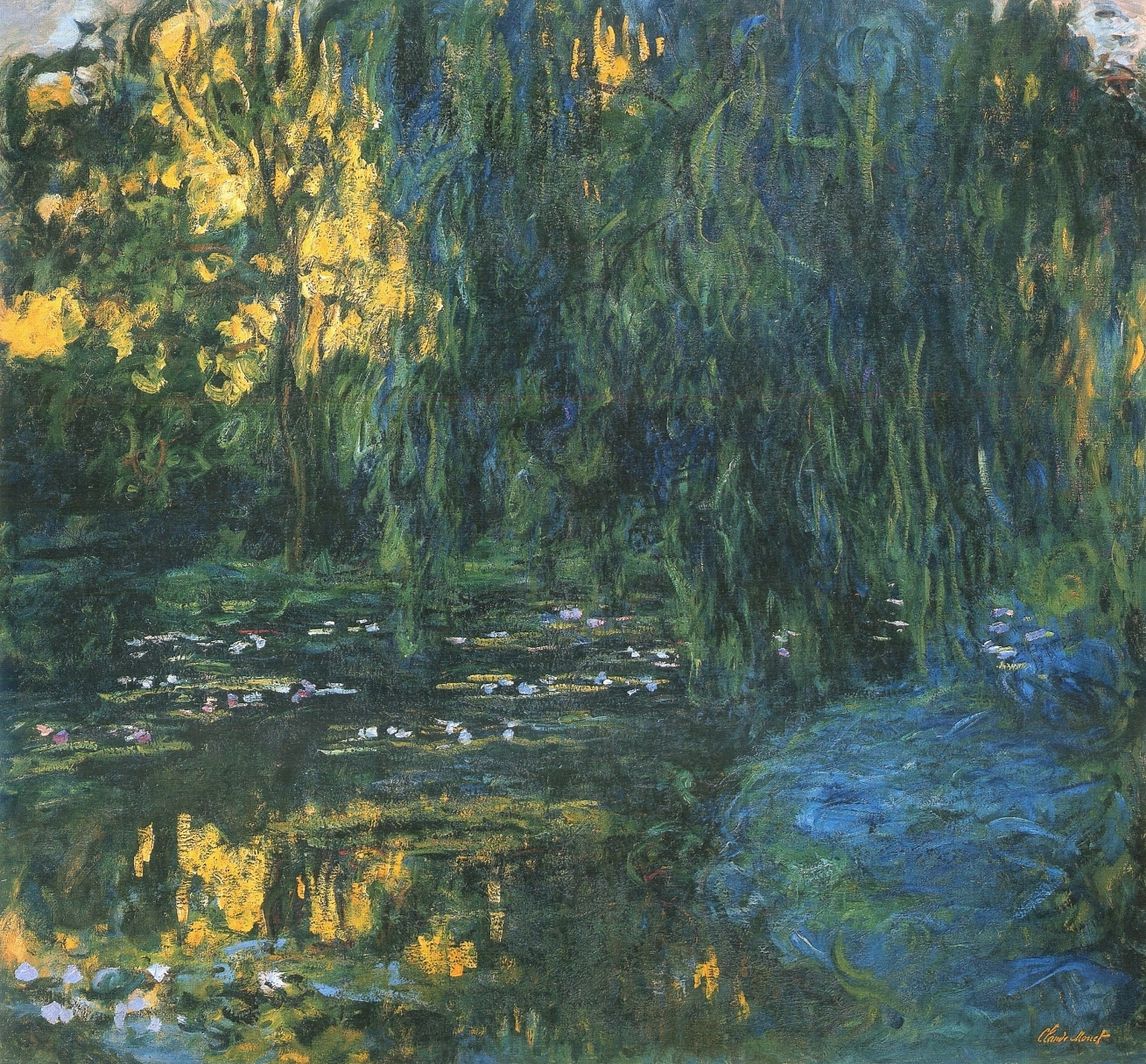
The culmination of Monet's work at Giverny is inseparable from his deep and tumultuous friendship with Georges Clemenceau, the politician nicknamed the Tiger, who was also a confidant and unwavering support in his final years. It was to Clemenceau that Monet confided his mad project of the Grandes Décorrations, those curved panels intended to adorn a building specially designed to immerse viewers in a 360-degree water lily landscape. Despite the artist's doubts, overwhelmed by cataracts and successive bereavements, Clemenceau pushed him with fierce energy to carry this pharaonic endeavor through to completion, refusing to let this artistic sum remain unfinished. Their correspondence reveals passionate exchanges about colors, dimensions, and installation, showing how important this legacy was to both men, far beyond a simple official commission.
In 1918, on the morrow of the Armistice, Monet offered these works to the French State as a symbol of peace and rebirth, a gesture laden with meaning after the horrors of World War I. The Musée de l'Orangerie in Paris was then redesigned to accommodate these immersive cycles, creating a unique experience where the viewer finds themselves enveloped by the painting, as if floating in the middle of the Giverny pond. This revolutionary installation, inaugurated shortly after the painter's death in 1926, marks the pinnacle of his career and already foreshadows certain concerns of contemporary abstract art. Thanks to Clemenceau's stubbornness and Monet's vision, these gigantic panels have become a place of world pilgrimage, proving that perseverance can transform a bold idea into a timeless universal legacy.
Interior decoration
Visiting Giverny: looking at the garden without chasing the photo that has already won Instagram

Today, the Fondation Claude Monet welcomes visitors from around the world, drawn by the promise of walking in the master's footsteps, but it is easy to get lost in the frantic race for perfect selfies. To truly enjoy Giverny, one must accept slowing down, sitting for a while at the edge of the pond and letting the eyes adapt to the slowness of vegetative time, far from digital immediacy. Observe how the light changes on the lily pads, how the wind makes the willows tremble, and try to find in reality the vibrations Monet fixed on canvas. Each season offers a different face to the estate, from the fireworks of spring tulips to the golden melancholy of autumn, reminding us that this garden is a living entity in perpetual evolution. Don't try to see everything at once, but let yourself be steeped in the unique atmosphere of this place where nature has been sublimated by the human eye.
If you wish to bring a souvenir of this visit home with you, favor a hand-painted reproduction or a quality craft piece that captures the spirit of the colors rather than a simple printed image. A beautiful canvas inspired by the water lilies or a detail of the Japanese bridge can bring a touch of serenity and light to a modern interior, provided you choose shades true to the artist's palette. Avoid kitschy gadgets and focus on pieces that pay homage to the chromatic complexity of Giverny, such as those deep blues and emerald greens that seem to change with the lighting of your room. By integrating a fragment of this universe into your home, you extend the experience of the visit and keep alive the dialogue between art and nature that Monet initiated more than a century ago.
| Room | Suggestion | Decorative effect |
|---|---|---|
| Living room | A piece connected to Maison de Claude Monet in Giverny with a strong composition | Cultivated, warm focal point that's easy to comment on without reciting a label. |
| Bedroom | A soft palette or a more intimate scene | Calm atmosphere, visual presence without unnecessary clutter. |
| Office | A structured, colorful, or graphically sharp image | Creative energy and a small reminder that the wall can work too. |
| Entryway | A vertical format or a piece that's immediately readable | Clear, elegant first impression, and decidedly less shy than a blank white space. |
To continue the visit
Sources, collections and paths truly related to the subject
A few useful references for verifying information, comparing free images, and extending your reading without ending up in a museum that never asked for it.
Related articles to read next
Useful blog hubs
FAQ
Frequently asked questions about Claude Monet's House in Giverny
What is Claude Monet's House in Giverny in painting?
Claude Monet's house in Giverny is more than a charming setting: it is a place of living, of working, of gardening, and of crafting the very motifs that led to the Water Lilies.
How can you recognize this style quickly?
Pay particular attention to the pink house, the Clos Normand, the water garden, the Japanese bridge and the water lilies, then the way the composition guides the eye. If the work holds your gaze longer than expected, it is probably no accident.
Which artists should you know?
The key figures are Claude Monet, Alice Hoschedé Monet, Blanche Hoschedé Monet, Georges Clemenceau, and Gustave Caillebotte.
Does this style suit a modern interior?
Yes, provided you choose the right format, a palette that harmonizes with the room, and a work whose presence remains a pleasure day after day.
Should you pick the most famous work?
Not necessarily. The best-known piece can be perfect, but the right choice depends above all on the room, the format, the palette, and the atmosphere you are after.
Where can you verify the information?
Start with museum records, Wikipedia/Wikidata for general guidance, and turn to Wikimedia Commons when you need a freely usable image.
A living legacy where nature meets the brushstroke
Claude Monet's house in Giverny remains far more than a popular tourist site; it is striking proof that an artist can shape his surroundings until they become a direct extension of his creative thinking. From the pink facade to the mysterious ponds, every element of this estate tells a story of passion, technique, and aesthetic boldness that continues to inspire future generations. In visiting these places, we discover not only where Monet lived, but how he lived, with a rare intensity and consistency that turned a corner of Normandy into a universal temple of beauty. Whether you are an art lover, a passionate gardener, or simply curious, Giverny invites us to look at the world with greater attention, to seek out the light in the smallest details, and to understand that creation is a continuous act engaging the whole being.
0 comments