

Vincent van Gogh · Arles · December 23, 1888
Van Gogh's severed ear: what we really know
An argument, a crisis, a razor and two self-portraits that have become famous: the most told episode in Van Gogh's life is also one of the most distorted.
Here are the facts established by letters, medical archives and museums - then gray areas. Without remote diagnosis, without reducing the painter to "mad genius", and without confusing Gauguin's story with a surveillance camera.

The short answer
Van Gogh was injured during an acute attack
On the evening of December 23, 1888, after a period of tension with Paul Gauguin, Van Gogh suffered a serious mental crisis in Arles. Returning alone to the Yellow House, he mutilated his left ear with a razor. He then wraps the fragment in paper and gives it to a woman called "Rachel" in a brothel. The police then discovered him the next morning, almost unconscious, and had him taken to hospital.
This plot is based on contemporary documents: correspondence from Theo, medical notes, local newspaper and letters from relatives. The most theatrical details are less certain. Gauguin writes his own story later; Van Gogh remembers little of the crisis and avoids telling it. There is therefore no neutral and complete account of each minute.
The precise medical cause remains unknown. Many retrospective hypotheses have been proposed, sometimes with an assurance that sources do not allow. The Van Gogh Museum recalls that there is no consensus on any global diagnosis today. It is more honest to talk about recurring attacks, with confusion, hallucinations and severe anxiety, than to put a definitive label.
Before the crisis
The Yellow House was to be a beginning, not a news item
Van Gogh arrived in Arles in February 1888. He wanted to work in a light that he brought closer to the Japan he dreamed of through prints and above all to found an "Atelier du Midi" where artists would live and paint together. He rented part of the Maison jaune, Place Lamartine, furnished the rooms and prepared Gauguin's visit with considerable energy.
Gauguin arrives on October 23. For nine weeks, the two painters worked, visited the same places and debated tirelessly. Their disagreement is fertile but deep: Van Gogh stubbornly returns to the motif, Gauguin pushes towards memory, synthesis and imagination. Added to this are money, promiscuity, winter and Van Gogh's fear of seeing his collective project collapse.

Productive and impossible cohabitation
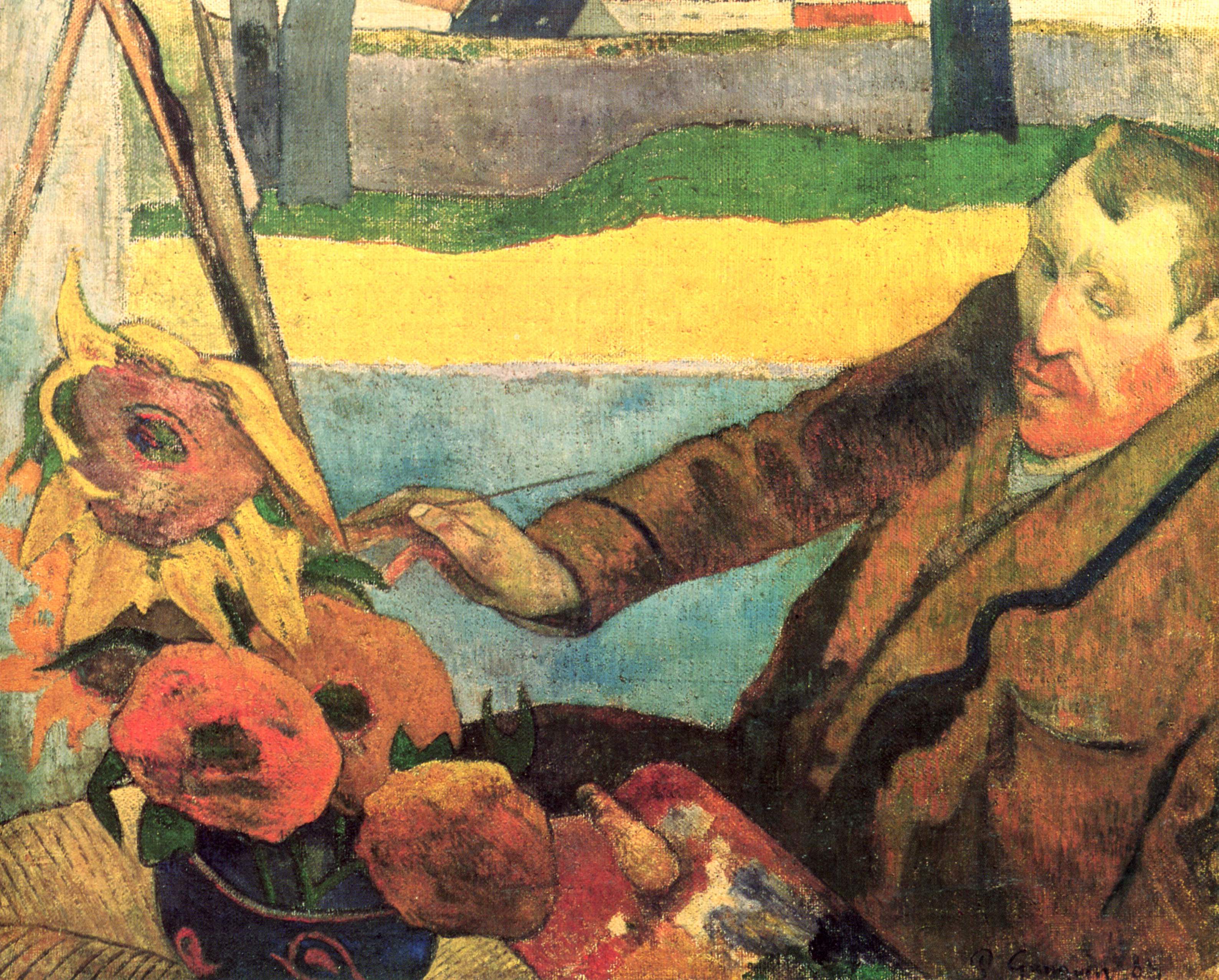
The days are not a long quarrel. The two artists paint a lot, compare their works and stimulate each other. Gauguin even represents Van Gogh in front of an easel, busy painting sunflowers. But their mutual admiration erases neither the difference in temperament nor the complex material relationship: Theo largely finances the stay and expects paintings by Gauguin.
At the beginning of December, Gauguin openly considered his departure. In a letter to Theo, he summarizes the situation with a clear formula: the two men cannot live side by side without disturbance. For Vincent, this announced departure does not only mean the loss of a companion; it threatens all the emotional and artistic architecture built around the Yellow House.
From December 23 to January 7
Cut ear night, hour by hour when possible
Not all exact times are known. The following chronology only retains what the documents allow to be placed with relative solidity.
The argument
Van Gogh and Gauguin quarrel. Gauguin leaves the house and sleeps at the hotel. His later account adds a razor chase, not confirmed by an independent witness.
The deposit
After mutilating at home, Van Gogh brings a keen ear to a brothel and asks for a woman known as Rachel.
The hospital
The police found him in bed, very weakened. He is urgently admitted to the Hôtel-Dieu in Arles. Gauguin warns Theo by telegram.
The return
After about two weeks of hospitalization, Van Gogh returned to the Yellow House and quickly returned to work.
What Gauguin says
According to Gauguin, Van Gogh followed him outside with a razor before turning back. This scene has fueled countless films and biographies. However, it remains his personal testimony, formulated after the fact, and not independent proof. Conflict and separation are certain; the precise course of the confrontation is not.
Some modern authors have even proposed that Gauguin injured Van Gogh during a confrontation, and then that the two men remained silent. This hypothesis is spectacular but in the minority: it is not confirmed by contemporary archives and has not replaced the explanation retained by major museums.
Caution doesn't blur the story. It simply allows us to say where the facts end and where the reconstruction begins.
Certainties, debates, legends
What the sources really allow us to say
The left ear
The injury dates from December 23, 1888. Van Gogh mutilated himself with a razor, was discovered the next day and hospitalized. Self-portraits show the bandage on the right side because they are painted in front of a mirror.
The exact trigger
Gauguin's departure, Van Gogh's tension, exhaustion and fragility form the context. No document can reduce the crisis to a single sentence or a single argument.
The madness that creates
Crises interrupt his work and frighten him. Van Gogh paints when he regains enough stability, not because illness would miraculously dictate masterpieces to him.
| Question | What the sources say | Prudent conclusion |
|---|---|---|
| The lobe or the whole ear? | Old formulations vary. The Courtauld speaks of most of the ear; the Van Gogh Museum holds the left ear, and the drawing attributed to Doctor Rey shows a very significant loss. | The simple "tip of the lobe" probably minimizes injury. Talking about most of the ear is fairer. |
| Gauguin attacked him? | Gauguin says he was threatened and then moved away. Medical and police documents describe self-harm. The hypothesis of a saber strike is late. | It must be presented as a minority theory, not a historical revelation. |
| Who was Rachel? | The local newspaper uses this first name and places the shed in a brothel. His civil identity and exact relationship with Van Gogh remain debated. | We can say "a woman called Rachel in a brothel" without inventing a sentimental story. |
| Why did he? | Van Gogh does not provide a coherent explanation after the crisis and remembers little. Retrospective diagnoses multiply without global consensus. | This is an act committed in a state of acute confusion, the precise medical cause of which remains unknown. |
January 1889
The Self-Portrait with Bandaged Ear: Six Details to Look at
Van Gogh painted this image about a week after his release from the hospital. The painting does not reconstruct the night of December 23. It shows a painter returning to his easel, physically fragile but professionally active.
 123456
The bandage
It covers the cheek and ear. In the mirror, the left wound appears to the right of the image.
The hat
Purchased during the winter, it holds the bandage and protects Van Gogh from the January cold in the workshop.
The look
The eyes seek neither heroism nor self-pity. They build a tense, attentive and tired presence.
The easel
A barely started painting affirms the main identity of the model: he is still and first of all a painter.
The print
The Japanese image of Sato Torakiyo recalls a fundamental visual source for its contours and colors.
The contrasts
Green of the coat, orange of the skin, red of the background and white of the bandage give the figure an intensity without dramatic decoration.
Two images, not just one
Van Gogh also painted a self-portrait with a pipe
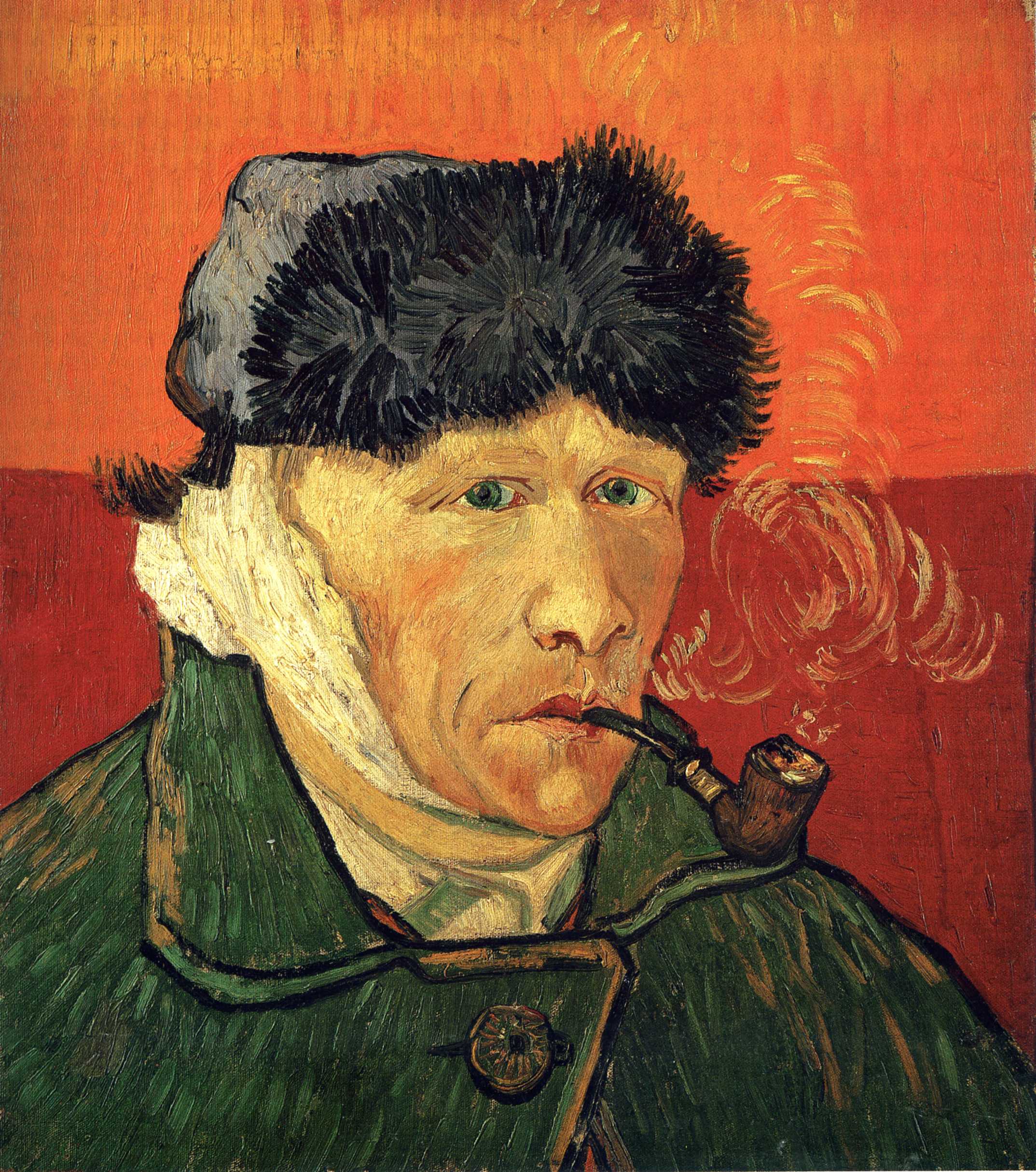
A tighter framing, a more interior atmosphere
The second version eliminates the easel and the print. The pipe, smoke and red tones concentrate the image on the face. The bandage remains central, but the familiar object introduces a daily gesture. Van Gogh does not replay the mutilation: he represents himself after it.
The two paintings are sometimes confused. The Courtauld's version measures 60.5 × 50 cm and places the painter in front of a Japanese print and an easel. The smaller version with the pipe belongs to a private collection and has long been shown on loan at the Kunsthaus Zürich.
Together, they show the speed of his return to work. The self-portrait becomes a method of verifying one's appearance, reconstructing continuity and regaining possession of one's identity.
The archives speak differently
In his letters, Van Gogh above all asks that we not worry

January 2, 1889: a letter from Doctor Rey's office
Van Gogh writes to Theo from the hospital to reassure him. He plans to return home, asks his brother not to add his worry to his and still wonders about Gauguin. Doctor Félix Rey adds a few lines to the same letter, believing that the overexcitement could be temporary.
This letter does not mean that everything is resolved. Van Gogh came out on January 7, picked up his brushes and painted his self-portraits, but new attacks led to other hospitalizations in February. In the spring, he accepted the idea of a voluntary stay in Saint-Paul-de-Mausole, near Saint-Rémy.
The letters give a more complex image than the myth: a man sometimes lucid, sometimes deprived of memories, who talks about money, painting, his friend Roulin and the fear of relapse. They do not contain the unique key to the crisis, but they prevent us from making a brilliant anecdote about it.
From the hospital, Van Gogh first seeks to reassure Theo and is already considering his return home and work.
Paraphrase of letter 728, written with a note from Doctor Félix Rey on January 2, 1889.
Art and disease
Why "he painted like that because he was crazy" doesn’t hold up
Painting is a discipline
Van Gogh studied prints, read reviews, compared Delacroix, Millet and the Impressionists, methodically ordered his colors and described his compositions to Theo. The expressive touch does not replace this culture: it is the result.
During acute crisis phases, he generally does not work. It resumes when it regains enough stability. Art offers him structure and horizon, but it constitutes neither proof of diagnosis nor automatic healing.
The myth erases the work
The ear has become a biographical logo because it is told in one sentence. A year in Arles, with its hundreds of drawings and paintings, requires more attention. The shortcut transforms suffering into spectacle and method into miracle.
Looking at the works forces us to reverse the perspective: the crisis does not explain the paintings. It is the paintings, letters and technical choices that show how Van Gogh continues to create despite illness.
Arles beyond the drama
The Yellow House also contains chairs, bedrooms and light
To understand the winter of 1888, we must look at the works surrounding the crisis. They speak of home, friendship, color and ordinary objects much more often than of catastrophe.


Choose a reproduction
How to install Bandaged Ear Self-Portrait at home
This portrait has a strong psychological presence, but its composition remains luminous and very constructed. The green of the coat, the oranges of the face and the reds of the background allow it to be integrated without transforming the room into a biographical setting.
Respect the portrait
The vertical format should leave enough space for the cap, bust and workshop elements surrounding the face.
Preserve the key
An oil reproduction restores the brush directions and contrasts that the print tends to smooth.
Give air
The look is intense. A lightly loaded wall and a comfortable distance avoid putting the portrait in competition with other images.
Choose the light
Warm, side light brings out the material without producing frontal reflection on dark areas.
Recommended palette
The off-white, sand, greige or sage green walls interact with the coat and the hat. A deep petroleum blue creates a more museum effect; a clay tone extends the reds and oranges.
A frame in walnut, smoked oak or black wood underlines the seriousness of the portrait. Matte gilding can work in a classic interior, as long as you stay sober.
Discover reproductionLounge
Medium or large format, placed as a focal point on a quiet wall.
Office
The frontal gaze and the bridge give a concentrated presence.
Library
Dark wood, books and soft light create a natural context.
Wall gallery
Associate it with another self-portrait rather than decorative accumulation.
Continue the visit
The Bandaged Ear Self-Portrait and Related Collections
Find the work presented, the other self-portraits, the entire Van Gogh catalog and the major post-impressionist landmarks.
Bandaged ear
Hand painted reproduction from Courtauld's self-portrait.
31 worksSelf-portraits of Van Gogh
Compare the painter's faces, palettes and periods.
788 worksVincent van Gogh
Portraits, landscapes, flowers, interiors and nights.
The movementPost-impressionism
Expressive color, structure and personal visions.
IconsFamous paintings
Explore instantly recognizable works.
Complete catalogAll works
Browse all available reproductions.
Frequently asked questions
Understanding everything about Van Gogh's severed ear
Which ear did Van Gogh cut off?
Van Gogh mutilated his left ear. In self-portraits, the bandage appears on the right side of the image because it is painted by observing its reflection in a mirror.
Did Van Gogh cut off his entire ear or just the lobe?
Ancient sources use different formulations. Recent research and institutions have a very significant injury: Courtauld speaks of most of the left ear. Saying that he only cut the lobe probably downplays the facts.
Why did Van Gogh cut off his ear?
He acts during a serious mental crisis after a period of tension and an argument with Gauguin. The precise trigger and the complete medical cause remain unknown; there is no consensus on any retrospective diagnosis.
Did Gauguin cut off Van Gogh's ear?
This modern theory exists, but it remains in the minority and unconfirmed. Contemporary archives, medical documents and museums describe self-harm after Gauguin's departure.
Who did Van Gogh give his ear to?
A local newspaper reports that he handed it over, wrapped in paper, to a woman named Rachel in a brothel in Arles. His precise identity and the nature of their relationship remain debated.
When did Van Gogh paint the Bandaged Ear Self-Portrait?
He painted it in January 1889, about a week after his release from the hospital. Courtauld's painting measures 60.5 × 50 cm.
Why does the self-portrait contain a Japanese print?
Van Gogh collects and studies Japanese prints. Their framing, contours and flat areas of color profoundly influence his painting. The print therefore affirms an artistic filiation, not a simple exotic decor.
How many self-portraits are there with bandaged ears?
Van Gogh painted two self-portraits with a bandage in January 1889: that of the Courtauld, with an easel and a print, and a tighter version where he smoked a pipe.
Main sources: incident file and timeline Van Gogh Museum ; notice of theSelf-portrait with bandaged ears at Courtauld ; letter 728 to Theo, accompanied by a note from Doctor Rey, and documentary apparatus of Vincent van Gogh - The Letters. Accessed July 2026.
0 comments