

Post-Impressionism: definition, artists and paintings, or the art of not stopping halfway
A journey to the heart of an era when Impressionist light gave way to structure, to symbol, and to a freedom of tone that still resonates in our interiors today.
Picture for a moment the Parisian scene of 1886: Impressionism has just held its last collective exhibition and the public is beginning to tire of those blurry patches that capture the moment but forget duration. It is precisely at this pivotal moment that what would later be called Post-Impressionism emerges — not as a movement united under a common banner, but as a constellation of free minds refusing to let painting dissolve into mere atmosphere. These artists, whose names today echo like monuments, decided that color had to serve something other than the retina alone: it had to construct, move, symbolize, and sometimes even shock. For the art lover hoping to hang a reproduction in their living room, understanding this break is essential, because it turns a pretty image into a visual manifesto capable of dialoguing with modern architecture.
 Free image
The red poppies echo Van Gogh's Parisian period of flowers: learning color is sometimes a matter of putting a bouquet on the table and letting it answer back.
Reading method
Reading the canvas like an architect reads a plan
Approaching these works requires setting aside the quest for photographic realism in order to observe how the painterly material itself becomes the very subject of the painting. Look at the brushstroke, follow the line, question color no longer as a description of the world, but as the expression of an inner truth or a hidden structure.
Context before prestige
We situate Post-Impressionism within its era, its studios, its exhibitions, and its small rebellions. A work without context is sometimes just a very beautiful person who has forgotten their story.
The signs that betray the style
We identify expressive color, structured composition, simplified forms. These clues often say more than grand speeches, especially when they carry gold or nervous brushstrokes.
The work in a real room
We end with the useful question: does this image breathe in your home, or is it merely posing like a poster that has read two books?
Historical context
Post-Impressionism: when light is no longer enough and everyone complicates the matter
If Impressionism had achieved the remarkable feat of capturing the vibration of light on water or snow, it nevertheless left a sense of incompleteness for those seeking the permanence of forms. The term post-impressionism, coined retrospectively by the critic Roger Fry in 1910 for a London exhibition, actually brings together radically different approaches born from the same observation: one must stop copying nature in order to begin reinventing it. Between 1886 and the early twentieth century, no single manifesto united these painters, yet they all shared a fierce determination to move beyond the luminous anecdote in order to reach what truly matters. Some turned toward optical science, others toward mysticism or geometry, creating a fertile ground where each artist became his own theorist, far from the society dinners of the previous generation.
This period marks a decisive turning point in which painting ceases to be a window opened onto the world and becomes an autonomous object possessing its own internal logic. Where Monet painted the Rouen Cathedral to display the changing hours, his successors would paint the cathedral to explore the solidity of the stone or the spiritual weight of the place. This diversification of intentions makes the movement fascinating to study, because it imposes not a style but an attitude: that of intellectual rigor coupled with total technical freedom. For today's collector, this means that a post-impressionist work can bring either architectural rigor or an emotional explosion, depending on the chosen artist, offering a decorative palette of extraordinary richness for our contemporary walls.
Artistic style
Cézanne builds the mountain as if nature had a hidden framework

Paul Cézanne, that brooding man from Aix-en-Provence, spent his life trying to make impressionism into something solid and enduring, like the arts of museums. His revolutionary method consisted of treating nature through the cylinder, the sphere, and the cone, reducing complex landscapes to an underlying geometric architecture that the naked eye does not immediately perceive. Looking at his inexhaustible series of the Mont Sainte-Victoire, one quickly understands that he is not seeking to reproduce the mountain as it appears at noon or at dusk, but to reveal its permanent, almost mineral structure. Every brushstroke, carefully applied like a brick, contributes to this mental construction where sky and earth interlock with a precision that directly prefigures the cubism of Picasso and Braque.
The influence of Cézanne on modern interior decoration is immense, as his compositions bring a calm, structuring order without ever falling into abstract coldness. A reproduction of The Card Players, with its simplified volumes and earthy colors modulated with extreme subtlety, acts as a visual stabilizer in a living space. He teaches us that beauty does not lie in superficial detail but in the balance of masses and the accuracy of color relationships. Hanging a Cézanne, even as a reproduction, is to invite a form of geometric meditation into the room, reminding us that behind the apparent chaos of everyday life there exists a secret harmony that the artist managed to capture and freeze for eternity.

Where Do We Come From? What Are We? Where Are We Going?
A reproduction linked to Post-Impressionism, useful for comparing mood, palette, and wall presence.

The Card Players
A reproduction linked to Post-Impressionism, useful for comparing mood, palette, and wall presence.

Vision After the Sermon
A reproduction linked to Post-Impressionism, useful for comparing mood, palette, and wall presence.
Van Gogh puts emotion into the brushstroke, and the brushstroke does not pretend

Vincent van Gogh took the complete opposite approach to Cézanne's structural quest by making the brushstroke the direct seismograph of his tormented and passionate soul. His canvases, often produced in the fever of creation in Arles or during his stay at the asylum of Saint-Rémy-de-Provence, vibrate with a kinetic energy where every brushstroke seems to have been laid down in the urgency of expression. The famous The Starry Night is not a faithful astronomical representation, but a visual translation of an inner state where the sky swirls with a lyrical violence that only the thick matter of paint, the impasto, can convey. Van Gogh uses pure color, straight from the tube, to create violent complementary contrasts, such as cobalt blue against chrome yellow, generating a luminosity that seems to emanate from the canvas itself.
In a contemporary interior, a work by Van Gogh acts as an injection of vital energy, capable of instantly warming a room that is too tidy or too minimalist. The expressive power of his sunflowers or his wheat fields under the Provençal sun brings a human warmth and dramatic intensity that few other styles can match. However, this strength requires a certain respect in how it is hung: the work must be given space to breathe, because its visual agitation asks the eye to settle and follow the movement of the lines. Choosing Van Gogh means accepting that the wall is no longer a neutral surface but becomes the stage of raw emotion, reminding us daily that life is made of intense passions and fleeting beauties.
Gauguin prefers symbol to reportage: color goes on a mission

While his contemporaries were still searching for anchors in visible reality, Paul Gauguin decided to cut the moorings and sail toward the troubled and fascinating waters of symbolism and the imaginary. His departure for Brittany, followed by his voluntary exile in Tahiti, mark a definitive break with naturalistic observation in favor of a painting where color is used for its suggestive and emotional value rather than its descriptive one. In masterpieces like The Vision After the Sermon or Where Do We Come From? What Are We? Where Are We Going?, Gauguin outlines forms with dark contours—the cloisonnism—and applies broad areas of vivid color that ignore the rules of classical perspective. He does not paint what he sees, but what he feels and imagines, transforming the canvas into a dreamlike space where Polynesian myths and Christian mysticism coexist.
Gauguin's contribution to decoration lies in this ability to create immersive, exotic atmospheres that carry the viewer far from the ordinary. His palettes, rich in ochres, deep greens, and vibrant reds, bring an enveloping warmth and a strong narrative dimension to a wall. A Gauguin reproduction works particularly well in spaces dedicated to relaxation or daydreaming, as it naturally invites mental escape. Unlike Cézanne's rigor or Van Gogh's turbulence, Gauguin's world offers a stylized refuge, an open door to an ideal elsewhere where nature is tamed by dream. It is a bold choice for those who wish to assert a taste for mystery and exoticism without falling into kitsch folklore.
Dots, science, and patience: color begins to count its steps

In contrast to Van Gogh's brute instinct, Georges Seurat and Paul Signac developed an almost scientific approach to painting, called pointillism or divisionism, based on the optical theories of their time. Their method consisted of applying tiny dots of pure color to the canvas, juxtaposed with mathematical rigor, leaving the viewer's eye to perform the optical blending from a distance. A work like Bathers at Asnières by Seurat demonstrates how this technique achieves an exceptional luminosity and formal stability that traditional mixing on the palette could not attain. Each dot acts as an atom of light, and the entire composition emerges from this patient accumulation, creating urban or harbor scenes that seem suspended in a still, silent time.
For the decorative art enthusiast, pointillism offers a unique visual texture that changes with the viewing distance, adding a subtle interactive dimension to the room. Up close, the canvas reveals a fascinating granular abstraction, while from a few meters away, the forms sharpen with crystalline clarity. This duality makes Seurat or Signac reproductions particularly interesting for transitional or reception spaces where the gaze constantly shifts. Moreover, the freshness of the colors, preserved by the absence of physical mixing, brings a soft, steady luminosity that adapts wonderfully to modern interiors seeking to maximize natural light. It is the art of patience elevated to a method, proving that science and poetry can perfectly coexist on the same surface.
Works to know
Famous Post-Impressionism works to look at before choosing
For a hand-painted Post-Impressionism reproduction, a Post-Impressionism oil painting, or a Post-Impressionism copy of a painting, the most useful thing is to compare several images: the gilding, the faces, the density of the patterns, and the way each work holds the wall.
- Bathers at AsnièresA visual entry point for understanding Post-Impressionism without turning the article into an inventory.
- Where Do We Come From? What Are We? Where Are We Going?A reproduction related to Post-Impressionism, useful for comparing atmosphere, palette, and wall presence.
- The Card PlayersA reproduction related to Post-Impressionism, useful for comparing atmosphere, palette, and wall presence.
- The Vision After the SermonA reproduction linked to Post-Impressionism, useful for comparing mood, palette, and wall presence.
- At the Moulin RougeA reproduction linked to Post-Impressionism, useful for comparing mood, palette, and wall presence.
The Nabis, symbols, and walls: painting begins to think decor

The Nabis group, formed around figures such as Pierre Bonnard, Édouard Vuillard, and Maurice Denis, pushed post-impressionist logic to the point of erasing the boundary between easel painting and the decorative arts. Influenced by Gauguin and Japanese printmaking, these artists considered that a painting was above all a flat surface covered with colors arranged in a certain order, meant to harmoniously integrate into its architectural environment. Their works, often characterized by repetitive motifs, flowing arabesques, and flattened perspectives, transform bourgeois interior scenes into living tapestries where figures blend into the floral or textile decor. Maurice Denis would go so far as to theorize this approach, asserting that painting must embellish the wall rather than seek to pierce through it as an illusion of depth.
This philosophy makes the Nabis natural allies for contemporary interior design, since their paintings are conceived from the outset to engage in dialogue with the space that hosts them. Vuillard's intimate interiors, with their complex patterns and muted yet rich colors, bring a hushed warmth and a discreet elegance that pair perfectly with design or vintage furniture. Choosing a Nabi means opting for a work that does not aggressively dominate the room but weaves a subtle connection with the textiles, wallpapers, and overall atmosphere. They understood before anyone else that art should not only be looked at, but lived, becoming a natural extension of our everyday living environment.
From Post-Impressionism to the 20th century: the heirs found the door wide open

The impact of Post-Impressionism on the history of art that followed is so significant that it can be considered the true birth of 20th-century artistic modernity. By freeing color from its descriptive function and form from its realistic obligation, these pioneers paved the way for all subsequent avant-gardes, from Matisse's wild Fauvism to Picasso's analytical Cubism, and German Expressionism. Without Cézanne's geometric structuring, Cubism would have been unthinkable; without Van Gogh's chromatic expressiveness, Fauvism would never have dared its bold gestures; and without Gauguin's symbolism, abstraction would have been slow to emerge. This movement acted as a powerful catalyst, demonstrating that painting could explore uncharted territories far from the simple imitation of the visible world.
Today, this legacy continues to nourish not only museums such as the Musée d'Orsay or MoMA, but also contemporary decorative creation, which draws from this period an inexhaustible source of inspiration. Graphic designers, illustrators, and even interior designers constantly revisit the visual codes of Post-Impressionism to create modern atmospheres. Understanding this lineage allows us to appreciate a reproduction not as a simple souvenir of the past, but as a living element in an uninterrupted aesthetic chain. When you hang a work from this period, you connect your space to that precise moment when art tipped over into total freedom, asserting that human creativity has no limits other than those it imposes on itself.
Interior design
Choosing Post-Impressionism: bold color, solid wall, diplomatic neighbors
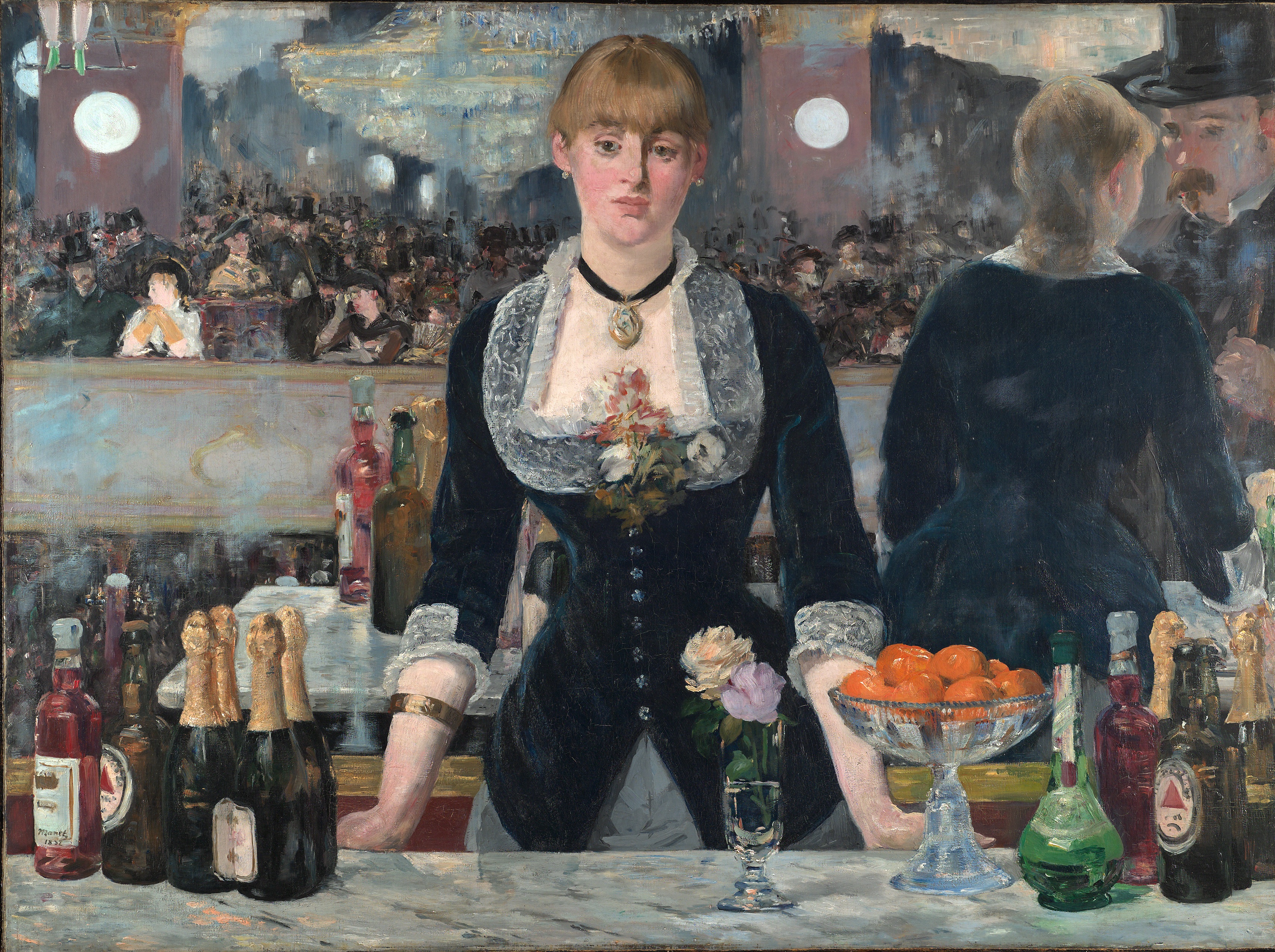
Selecting a Post-Impressionist reproduction for your interior requires taking into account the specific energy of each artist in order to avoid visual dissonance with your existing furniture. If your space lacks light or warmth, the vibrant yellows and deep blues of Van Gogh or the golden ochres of Gauguin will be precious allies in energizing the atmosphere instantly. Conversely, if you're looking to bring calm and structure to a busy room, the balanced compositions and natural tones of Cézanne will offer a restful vanishing point for the eye. It is also crucial to consider the scale of the work: the large formats of Seurat require distance to reveal their magic, while the intimate scenes of the Nabis thrive in more confined spaces such as an office or a reading nook.
Finally, don't forget that the quality of the reproduction plays a major role in restoring the pictorial texture, a central element of Post-Impressionist aesthetics. A good print must convey the thickness of Van Gogh's brushstroke or the delicacy of Signac's point, otherwise the work loses a great part of its expressive power. Don't hesitate to test the work in situ, perhaps using digital tools or temporary prints, to check how the palette dialogues with your walls and lighting. The goal is not to turn your living room into a museum, but to create a coherent visual ecosystem where the chosen art resonates with your own sensibility, making every glance at the painting a small, renewed aesthetic experience.
| Room | Suggestion | Decorative effect |
|---|---|---|
| Living room | A work related to Post-Impressionism with a strong composition | A cultivated, warm focal point that's easy to talk about without reciting a wall label. |
| Bedroom | A soft palette or a more intimate scene | A calm atmosphere, visual presence without unnecessary agitation. |
| Office | A structured, colorful, or graphically sharp image | Creative energy and a little reminder that the wall can work too. |
| Entryway | A vertical format or an immediately readable work | A clear, elegant first impression, and far less shy than a blank void. |

At the Moulin Rouge
A reproduction linked to Post-Impressionism, useful for comparing atmosphere, palette, and wall presence.
To continue the visit
Sources, collections and paths truly linked to the subject
A few useful references to verify information, compare open-access images, and extend reading without straying into a museum that never asked for it.
Useful collections
Artists to explore
Related reproductions
FAQ
Frequently asked questions about Post-Impressionism
What is Post-Impressionism in painting?
Post-Impressionism takes the free color of the Impressionists, then gives it more structure, symbolism, and temperament.
How can you quickly recognize this style?
Look especially for expressive color, structured composition, simplified forms, a personal touch and latent symbolism, then the way the composition guides the eye. If the work holds your attention longer than expected, it is probably not an accident.
Which artists should you know?
The key references are Vincent van Gogh, Paul Cézanne, Paul Gauguin, Georges Seurat, and Paul Signac.
Is this style suitable for modern décor?
Yes, provided you choose the right format, a palette that harmonizes with the room, and a work whose presence remains enjoyable day after day.
Should you choose the most famous work?
Not necessarily. The best-known work may be perfect, but the right choice depends above all on the room, the format, the palette, and the atmosphere you are looking for.
Where to check the information?
Start with museum records, Wikipedia/Wikidata for general orientation, then Wikimedia Commons when a rights-free image is needed.
An invitation to see the world differently
More than a century after its emergence, Post-Impressionism remains an inexhaustible source of wonder and inspiration for anyone who loves observing the world with attention. It reminds us that reality is never singular, but rather bends to the multiple visions of artists who dare to reinterpret it with courage and sincerity. Whether you are drawn to geometric rigor, emotional explosion, or symbolic dream, this movement offers a work capable of answering your personal aesthetic quest. Hanging one of these images in your home ultimately means accepting to live surrounded by intelligent beauty—beauty that is content not merely to decorate the wall, but that elevates the mind and colors the everyday with a new depth.
0 comments