

1913 -1919 · The painting takes shape
Renoir and sculpture
At the end of his life, Renoir did not give up creating: he changed scale, material and above all method. With Richard Guino then Louis Morel, his painted figures became earth, plaster and bronze.
A late ambition
Why did Renoir turn to sculpture?
Because his late work seeks less the fleeting moment than the permanence of bodies. Sculpture allows him to experience in three dimensions what his paintings already explore: weight, roundness, balance and continuity of gesture.
Renoir had observed sculpture from his youth and attempted a few family portraits. However, it was not until 1913, under the leadership of the merchant Ambroise Vollard, that the experiment became a coherent program. The painter was then over seventy years old. His rheumatism distorts and paralyzes his hands, but it does not interrupt his gaze or his activity.
To say that he "becomes a sculptor" therefore requires precision. Renoir designs, chooses the patterns, draws, corrects the profiles and directs the sessions. The materialization is ensured by another artist. This collective method is not a practical detail: it is at the very heart of the identity of the works.
Sponsor, painter, sculptor
A three-voice workshop
Ambroise Vollard
The merchant wishes to extend Renoir's work to sculpture. He solicited Aristide Maillol, who recommended the young Catalan Richard Guino, then organized and financed production and editions.
Auguste Renoir
He brings paintings, drawings, models and a precise vision of the volume. He follows the work, requests modifications and judges the silhouettes from several angles.
Richard Guino
Trained in Barcelona and working in Maillol's workshop, he invented plastic solutions. His hands do not copy mechanically: they interpret color and touch it in mass, surface and rhythm.
From image to object
How does a painting become a sculpture?
Choose a pattern
An old painting, a recent study or a living model provides the core of the composition.
Recompose
Switching to volume requires resolving the back, profiles, supports and gaps absent from the plane image.
Model
Guino works the earth or plaster under the gaze of Renoir, who corrects the pose and proportions.
Edit
The model can be translated into terracotta, plaster, polychrome cement or bronze by a founder.
1914 - 1917
Three summits of the Renoir-Guino cycle
1916 - 1917
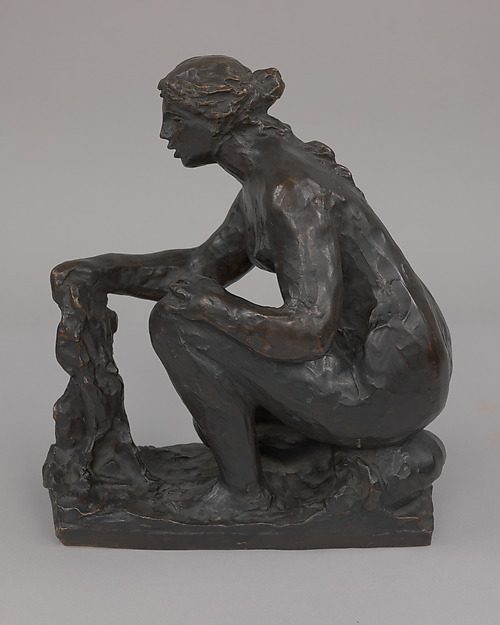
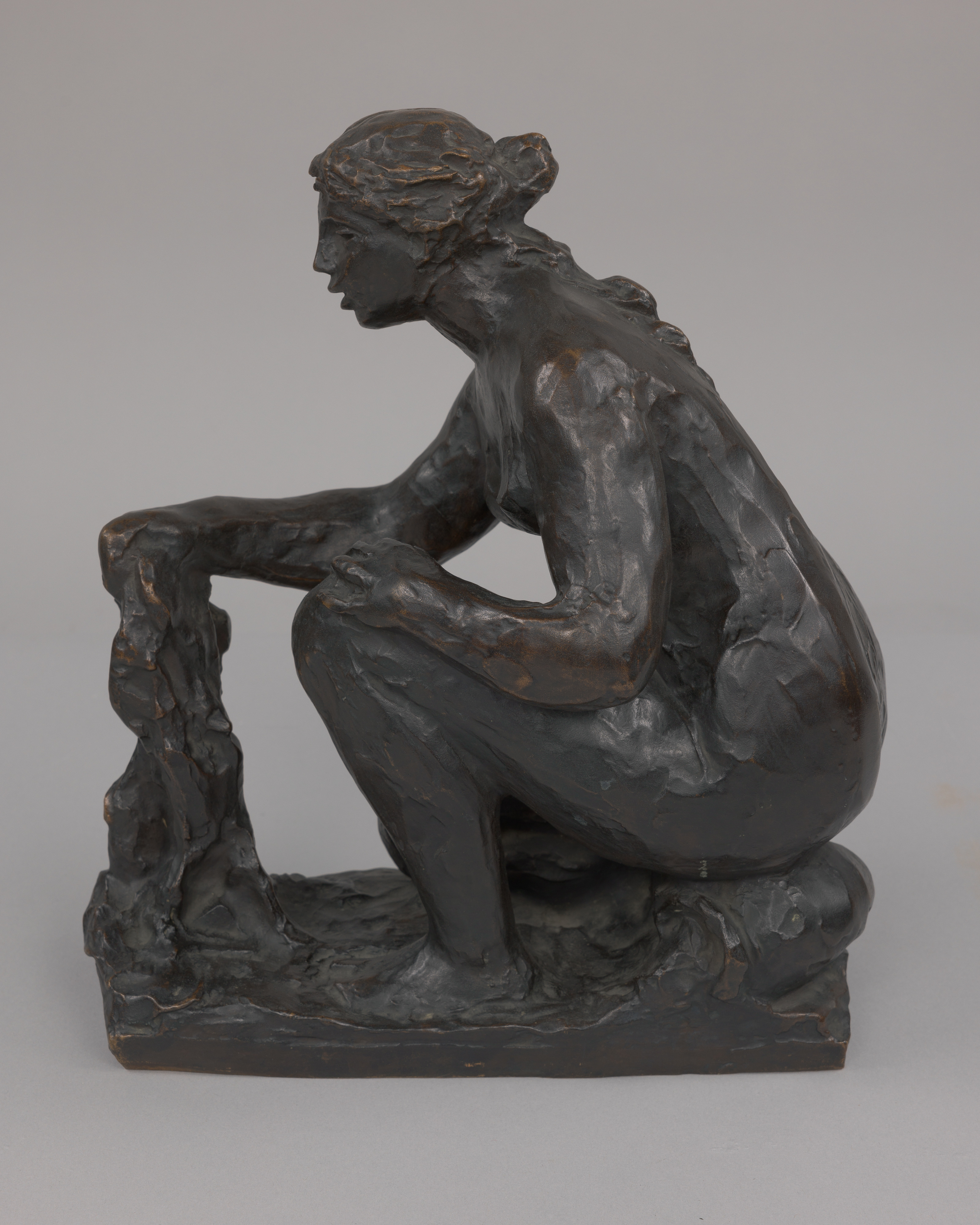
The Washer/Water
The squatting body forms a compact architecture. The stretched linen transforms a daily gesture into an elementary allegory.

1914 - 1916
Venus Victrix
Nearly two meters high in its plaster version kept at the Musée d'Orsay, Venus holds the apple of the Paris judgment. Its calm frontality combines antiquity, modern flesh and decorative breadth.

1914
The Judgment of Paris
The mythological scene exists in painting and relief. The group forces us to think of the three goddesses as a series of volumes, linked by looks and intervals.
Family memory
Maternity : an old image reinvented
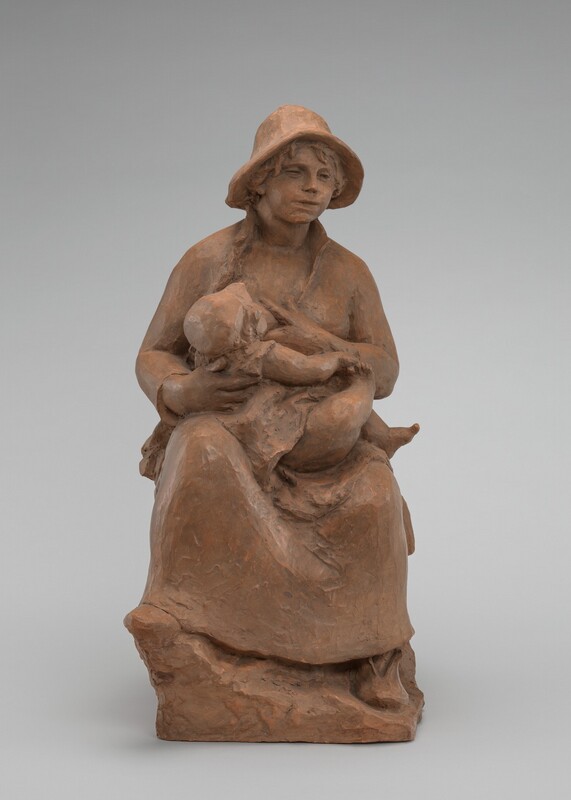
After the death of Aline Renoir in 1915, the painter returned to the portrait of his wife breastfeeding their son Pierre, made in 1885. Guino modeled around 1916 a terracotta group based on this composition. The intimate scene then takes on the stability of a monument.
The change of medium shifts the meaning. In the painting, the garden, light and color surround the mother and child. In the sculpture, everything focuses on the supports, the weight of the small body and the protective curve of Aline. Renoir and Guino not only illustrate a memory: they give it a physical presence.
The initial funeral project did not come to fruition in this form. Aline's enlarged bust is nevertheless placed on her grave in Essoyes, while a version of the Maternity is installed in the Collettes garden.
Painting ↔ volume
Two revealing passages

An attribution story
Richard Guino is not a simple "hand"
For decades, the market and numerous catalogs presented these sculptures under the sole name of Renoir. However, the transition from image to volume requires decisions specific to sculpture: constructing the reverse sides, adjusting the balances, animating the surfaces and inventing what the painting does not show.
French justice recognized Richard Guino as co-author in 1971. This decision, definitively confirmed in 1973, did not diminish Renoir. It more accurately describes a work born from two artistic intelligences, in a context orchestrated by Vollard.
1918 -1919 · Last chapter
Louis Morel and the reliefs at the end
After the end of the collaboration with Guino in 1918, Renoir entrusted the modeling of his latest sculptures to Louis Fernand Morel, a young sculptor from Essoyes. Together, they created three reliefs, including tambourine dancers and a flute player.
The choice of bas-relief is significant. It is located between drawing and sculpture: the figures stand out from the background without becoming entirely autonomous. The themes of dance and music evoke a joyful antiquity, close to the frescoes of Pompeii and the Mediterranean ideal which runs through Renoir's late work.
These works not only extend the Guino cycle. Their more linear and decorative rhythm shows a new adaptation to the sensitivity of Morel and the weakening of the painter, who died in December 1919.
An experimental end to his career
The sculpture illuminates the last paintings
Renoir settled in Les Collettes, in Cagnes-sur-Mer, in a landscape of olive trees which nourishes his Mediterranean ideal.
Work with Guino begins. The painted figures are now designed to rotate in space.
Aline's death and the war darken family life, while creation continues with intensity.
Morel's reliefs and large bathers bring the late ideal to its culmination.
Renoir died at Les Collettes on December 3, leaving painting and sculpture in an unfinished dialogue.
In The Bathers from 1918 -1919, the bodies seem modeled in layers. The contours no longer cut out light silhouettes: they construct masses linked to the landscape. Sculpture helps to understand this new density.
Conversely, color remains present in the sculptures through the patina, the polychromy of the cement and the vibration of the surfaces. Guino translates Renoir's touch without trying to freeze it. Thus, the end of her career does not oppose painting and sculpture: she makes them work one by the other.

Looking guide
How to look at the sculptures of Renoir and Guino?
Turn around
A good point of view is not enough. Compare face, profiles and back: the gaps reveal Guino's decisions.
Follow the surface
Hollows, bumps and indentations capture light like the painted touch, but change as you move.
Locate the supports
Knee bent, draped, base or relief background: each support organizes the weight and prevents the shape from dissolving.
Extend with paint
Eight works to rediscover the meaning of volume
These reproductions allow us to observe the motifs that the sculpture amplifies: grouped bodies, motherhood, mythology, curves and Mediterranean light.
The Judgment of Paris
The pattern directly transposed into relief.
The Bathers
The painted manifesto of the last period.
Maternity
Aline and Pierre, from canvas to monument.

Landscape at Collettes
The Mediterranean decor of the last workshop.

Portrait of Coco
A childish head thought of as a volume.

Bather drying
The drape and the body construct the same movement.

The Great Bathers
An ancient milestone towards late monumentality.

Three Crab Bathers
Bodies fit together like a sculpted whole.
Pierre-Auguste Renoir
Find portraits, landscapes, family scenes and bathers.
CollectionImpressionist
Compare Renoir's touch to Monet, Pissarro, Degas and their contemporaries.
Related articleGabrielle Renard and Renoir
Model, nurse and muse of late work.
Related articleRenoir's children
Pierre, Jean, Claude and the painter's family memory.
Museum sources
To deepen
Frequently asked questions
Renoir sculptor in eight answers
When did Renoir really start sculpting?
After a few older attempts, he undertook a coherent sculpted program in 1913, on the initiative of Ambroise Vollard and with Richard Guino.
Did Renoir model the earth himself?
His arthritis made this work almost impossible. He designed the works, provided drawings and paintings, followed the sessions and corrected the shapes; Guino then Morel provided the modeling.
Who was Richard Guino?
Richard Guino was a Catalan sculptor trained in Barcelona and collaborator of Aristide Maillol. He worked with Renoir from 1913 to 1918 and is legally recognized as co-author of the joint sculptures.
What are Renoir and Guino's best-known sculptures?
Venus Victrix, The Judgment of Paris, Water or The Great Washer, Maternity and several portraits or medallions are among the major ensembles.
Why do we talk about co-creation?
Renoir brought vision, patterns and direction, while Guino invented their three-dimensional existence. Volume required choices that painting could not provide directly.
What role does Ambroise Vollard play?
The merchant initiates the project, finds the collaborator through Maillol, finances the production and organizes the edition of the sculptures.
Who replaces Guino at the end of Renoir's life?
Louis Fernand Morel modeled around 1918 -1919 three bas-reliefs devoted to dance and music, including the Flute player.
What link exists between the sculptures and the last Bathers?
The two mediums share a search for monumentality, continuous curves and bodies integrated into the landscape. The sculpture makes the weight of the late figures particularly legible.
0 comments