

Van Gogh Museum Amsterdam: must-see works and detours to understand the light
A lively guide to exploring the Amsterdam collection, decoding the brushstrokes, and choosing a reproduction wisely, far from the tourist clichés.
Stepping into the Van Gogh Museum Amsterdam means accepting the risk of getting lost in the whirlwind of a life that burned too fast but with rare intensity. Located on Museumplein in Amsterdam, this modern building designed by Kisho Kurokawa houses the world's largest collection dedicated to the Dutch painter. Far from being a simple sanctuary for admirers, the museum offers a chronological journey that reveals the dazzling evolution of an artist moving from the dark realism of the Belgian mines to the chromatic explosions of Provence. Each room tells a stage of this metamorphosis, where technique sharpens while the vision of the world grows more acute, almost painful. Understanding these works demands slowing down, observing the pictorial matter, and grasping how Vincent turned his everyday life into a visual epic.
 Free image
The Van Gogh Museum in Amsterdam keeps the artwork close to his letters, his sketches, and his palette reversals: practical for looking without simplifying.
Reading method
Read the brushstroke before naming the subject
To truly appreciate these paintings, you have to forget the primary subject—a field, a face, a vase—and look at how the painting is built. The method consists of following the movement of the brush, feeling the thickness of the impasto, and understanding that every stroke carries a precise emotional intention. It is this physical energy, visible even through a quality reproduction, that brings the work to life long after the visit.
Context before prestige
We place Musée Van Gogh Amsterdam in its era, its studios, its exhibitions and its small revolts. A work without context is sometimes just a very beautiful person who has forgotten their story.
The signs that betray the style
We spot composition, palette, texture. These clues often say more than grand speeches, especially when they bear gold or nervous brushstrokes.
The work in a real room
We end with the useful question: does this image breathe in your home, or does it just pose like a poster that has read two books?
Historical context
Musée Van Gogh Amsterdam: entering Vincent's world without treading on the legend

The museum does not merely exhibit famous canvases; it plunges the visitor into the intimacy of an obsessive creator thanks to an exceptional collection of drawings and letters. Unlike other institutions that strictly separate genres, here a quick sketch in black pencil engages in direct dialogue with a monumental oil, revealing the artist's perseverance. We discover that Van Gogh produced more than a thousand drawings, often made outdoors in wind or rain, serving as a laboratory for his future painted compositions. These sheets of paper, sometimes stained or crumpled, bear witness to an unceasing search for the right form, long before color entered his artistic vocabulary.
The current display allows visitors to follow the artist year by year, thus avoiding the trap of knowing only his final, tragic months. Walking through the galleries, one realizes that his career spans only a decade, which makes the density of his output all the more staggering to the human mind. The museum also preserves personal objects and archival documents that contextualize his work without falling into morbid voyeurism. This educational approach invites us to consider Vincent not as an isolated madman, but as an art professional who was extremely well-informed and aware of the aesthetic stakes of his time.
Artistic style
The dark beginnings: before superstar yellow, the lamp in Nuenen works late

Before reaching the blinding luminosity of Arles, Vincent extensively explored the earthy tones of Brabant, as evidenced by the famous painting The Potato Eaters housed here. Created in 1885, this major work uses a palette of grays, olive greens, and deep browns to capture the harshness of peasant life under the flickering glow of a petroleum lamp. The artist wanted his figures to look as though they had tilled the earth themselves, using their hands to eat, thereby creating a visual unity between the wrinkled faces and the plowed soil. This Dutch period is often overshadowed by his later colorful output, yet it already reveals his mastery of composition and his deep empathy for the underprivileged.
During his stay in Nuenen, between 1883 and 1885, he produced hundreds of studies of weavers and thatched cottages, seeking to capture social truth rather than conventional beauty. The skies are heavy, the interiors cramped, and the light always seems to struggle against the surrounding darkness, foreshadowing his future violent contrasts. Looking at these works today helps us understand that his later colorful explosion was not a sudden whim, but the logical outcome of a long-contained quest for light. It was in this initial dimness that the structural solidity of his drawing was forged, essential to later support the madness of his vivid colors.
The Sunflowers: a famous bouquet, but not a decorative vase on autopilot

The Sunflowers series, of which several versions are displayed or evoked throughout the tour, goes far beyond a simple still-life exercise to become a manifesto of pure color. Painted in Arles in 1888 and 1889, these bouquets use exclusively shades of yellow, from pale lemon to deep chrome, defying the academic rules of traditional shadow and light. Vincent wanted to decorate the Yellow House to welcome Paul Gauguin, transforming these wilted or radiant flowers into symbols of hospitality and artistic gratitude. The thick texture of the paint, sometimes applied straight from the tube, gives the petals a sculptural presence that seems to vibrate even today under the museum's spotlights.
What strikes one most in these compositions is their ability to occupy space with quiet authority, without needing a complex background or dramatic narrative. Each sunflower has a distinct personality, some standing proudly upright, others bent under the weight of their seeds, creating a living rhythm within the vase. For anyone wishing to hang a reproduction of these works, it is crucial to understand that they bring immediate warmth to an interior, but require an uncluttered wall to breathe. They are not simple floral patterns, but concentrations of solar energy that transform the atmosphere of an entire room through their chromatic presence alone.
The letters: when Van Gogh explains well enough to annoy shortcuts
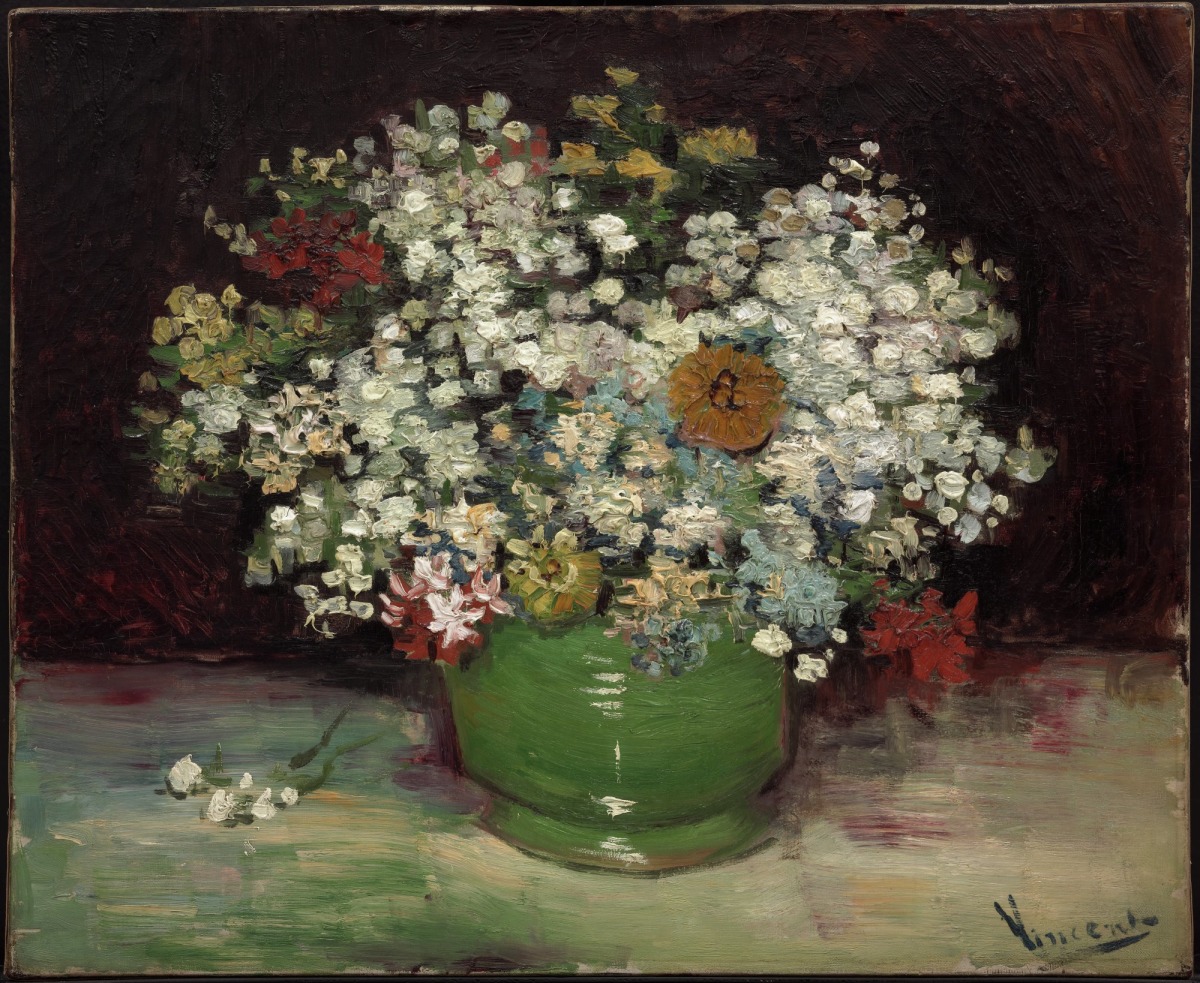
The museum gives a central place to Vincent's correspondence, notably the hundreds of letters addressed to his brother Theo, which constitute one of the richest sources on 19th-century artistic creation. These handwritten documents, often illustrated with quick ink sketches, reveal an analytical and cultivated mind, far from the image of the cursed painter acting on pure impulse. In them he details his readings, quotes Delacroix or Millet, and theorizes at length on the complementary use of colors, proving that every brushstroke was considered. Reading these displayed excerpts radically changes the way we look at the paintings, because we understand that behind the apparent spontaneity lies an intense intellectual effort.
These letters also show a man concerned about his financial future and the reception of his work, constantly seeking to justify his bold choices to his main supporter. They humanize the genius by revealing his doubts, his illnesses, and his fragile hopes, while confirming his outsized ambition to create a new art. For the contemporary visitor, these texts offer valuable keys to interpretation: knowing that such and such a blue was chosen to express infinity, or that such and such a green aims to convey anguish, adds a narrative depth to the visual experience. It is an invitation to slow down and listen to the artist's voice resonating across the century.
Amsterdam also reminds us that Van Gogh looked at Japan with new eyes

The influence of Japonisme on Van Gogh's work is palpable from the moment he arrived in Paris, where he discovered the ukiyo-e prints that would upend his way of composing space. The museum presents several of these Japanese prints collected by the artist, highlighting how he adopted their bold outlines, flat areas of color, and daring asymmetrical framings. Paintings like La Courtisane or the blossoming plum trees clearly show this assimilation, in which traditional Western perspective is abandoned in favor of a more decorative, frontal vision. This opening toward the East allowed him to liberate his palette and simplify his forms in order to reach a more direct expressiveness.
Vincent did not content himself with copying; he reinterpreted these images with his own fire, transforming Japanese serenity into a typically European electric vibration. We often notice the absence of cast shadows and the use of pure colors juxtaposed without transition, techniques borrowed from masters like Hiroshige or Hokusai. Understanding this contribution is essential to grasp why his Provençal landscapes sometimes resemble life-size prints, with cypress trees cut out against stormy skies. This cultural fusion makes him a pioneer of modernity, capable of digesting distant influences to create a visual language that is universal and instantly recognizable.
Wheat fields and crows: the landscape still has much to say

The wheat landscapes, omnipresent in the collection, are not simple picturesque views but rhythmic constructions in which the ground and the sky clash with violence. In late works such as Wheatfield with Crows, painted in July 1890, the paths lead nowhere, creating a sense of confinement and urgency that unsettles the modern viewer. The brushstroke becomes hatched, almost feverish, following the direction of the wind or the flight of the birds, turning the canvas into a visual musical score. These paintings demonstrate that for Vincent, nature was never static, but a living force in perpetual mutation, demanding an immediate physical response from the painter.
Observing these canvases up close reveals an unsuspected technical complexity, with superimposed layers of color that create a vibrant depth rather than an illusion of photographic reality. The cobalt blues of the skies contrast with the cadmium yellows of the ears, generating an optical tension that makes the painted surface shimmer. For interior decoration, choosing a reproduction of these landscapes brings an exceptional dynamism, ideal for enlivening a large living-room or office wall. However, one must be careful with the lighting, because these works play so much on pigment saturation that they require natural or warm light to reveal their full dramatic intensity.
Almond trees and orchards: even softness has muscles

In contrast to the inner storms, the blossoming paintings, like the famous Almond Blossom offered for the birth of his nephew, unfold a mastered serenity tinged with contained joy. Painted in 1890 under the renewed influence of the Japanese print, this masterpiece uses a clear sky blue in the background to make the delicate whiteness of the gnarled branches stand out. Here, the brushstroke is more controlled, drawing each flower with precision while maintaining the vital energy characteristic of the artist. This work proves that Van Gogh also knew how to sing of tenderness and hope, far from the torments often associated with his tragic biography.
The blossoming orchards of Arles, painted a little earlier, show an explosion of pinks, whites, and tender greens, celebrating the renewal of spring with a rediscovered innocence. These compositions are particularly suited to decorative use in bedrooms or relaxation spaces, because they bring a soothing luminosity without being mawkish. The strong structure of the trunks and branches reminds us that even in softness, Vincent's painting retains a solid framework and a rigorous discipline. Hanging such an image at home is to invite a promise of rebirth and calm, while honoring the finesse of execution of an undisputed master.
Interior decoration
After the visit: choose a reproduction without buying only the memory of the ticket

Leaving with a reproduction of a work seen at the Van Gogh Museum in Amsterdam should not be a banal act of consumption, but the continuation of an emotion felt before the original. It is best to choose a piece that truly resonated in you, perhaps for its specific palette or the energy it gives off, rather than the one everyone knows. A hand-painted reproduction or a high-definition canvas print allows you to rediscover the texture and relief that form the soul of these paintings, unlike a simple paper poster. The goal is to integrate art into your daily life in a coherent way, by harmonizing the colors of the work with the general atmosphere of the room intended to receive it.
Also think about format: a small landscape study may be enough to brighten a reading nook, while a large self-portrait or a wheat field will impose its presence in a vast space. Don't hesitate to mix styles, associating for example the softness of an almond tree with the strength of a sunflower to create a personal wall dialogue. What matters is that the chosen work continues to tell a story and to inspire, keeping alive the spirit of curiosity and boldness proper to Vincent. Thus, your interior itself becomes a personal gallery, testifying to your fine understanding of art history and your aesthetic sensitivity.
| Room | Suggestion | Decorative effect |
|---|---|---|
| Living room | A work related to the Van Gogh Museum Amsterdam with a strong composition | Cultivated, warm focal point that's easy to comment on without reciting a label. |
| Bedroom | A soft palette or a more intimate scene | Calm atmosphere, visual presence without unnecessary fuss. |
| Office | A structured, colorful, or graphically clean image | Creative energy and a gentle reminder that the wall can work too. |
| Entryway | A vertical format or a work that's instantly readable | A clear, elegant first impression—and far less shy than an empty white wall. |
To continue the visit
Sources, collections, and paths truly tied to the subject
A few useful references to verify information, compare free-to-use images, and keep reading without wandering into a museum that never asked for the visit.
Useful collections
FAQ
Frequently asked questions about the Van Gogh Museum Amsterdam
What is the Van Gogh Museum Amsterdam in painting?
The Van Gogh Museum Amsterdam deserves a full article because this style engages a whole era, a way of painting, and a very concrete way of living with images.
How to recognize this style quickly?
Focus above all on composition, palette, texture, light, and atmosphere, then on the way the composition guides the eye. If the work holds your attention longer than expected, it's probably not an accident.
Which artists should you know?
You need to cross-reference the movement's central artists with museums and reliable sources to avoid hasty attributions.
Does this style suit modern décor?
Yes, provided you choose the right format, a palette consistent with the room, and a work whose presence remains pleasant day after day.
Should you pick the artist's most famous work?
Not necessarily. The best-known piece can be perfect, but the right choice depends above all on the room, the format, the palette, and the atmosphere you're after.
Where can you verify the information?
Start with museum records, Wikipedia/Wikidata for general orientation, then turn to Wikimedia Commons when a rights-free image is needed.
The living legacy of a unique vision
The Van Gogh Museum Amsterdam remains far more than a place of conservation; it is a space of permanent dialogue between the past and our contemporary gaze. Walking through its galleries, you understand that Vincent's art cannot be reduced to a biographical anecdote—it is a visual revolution that continues to shape our perception of color and light. Whether you are a history enthusiast, a decorator looking for inspiration, or simply curious, this collection offers inexhaustible resources to enrich your everyday environment. Bringing a fragment of that light into your home, through a carefully chosen reproduction, ultimately means choosing to live with greater intensity and truth—in the image of the man who gave everything to paint the world as he felt it.
0 comments