

Van Gogh at the Metropolitan Museum of Art
From the cypresses of Saint-Rémy to the orchards of Arles, from worn shoes to the portraits of the Roulin family: here are the works to look for, the ideal room order, and what to observe in front of each painting.


The Met allows you to follow Van Gogh almost year after year
Start in gallery 825 to see the transition from the browns of Nuenen to the color of Paris and Arles. Continue to gallery 822 for the landscapes of Saint-Rémy, the portraits, and the late bouquets.
The Metropolitan Museum of Art does not possess either The Starry Night — which is at MoMA — nor the vase version of the famous Sunflowers. Yet its collection is exceptional: it brings together two large cypresses, flowers whose pigments have changed, a self-portrait painted on the back of a peasant study, portraits linked to the Arles circle, and several scenes from 1889–1890.
The real interest, therefore, is not to check off a single icon. It is to see how, in five years, the material lightens, the brushstroke becomes rhythmic, and the landscape ceases to be a backdrop and becomes an inner experience.
Five stages, from the young Dutch painter to the final flowers
From the Great Hall, proceed to the second floor and the galleries of European paintings. Save the detours to galleries 099 and 961 for the end: this keeps the chronological narrative clear.
gallery 825
Nuenen, Paris and Arles: self-portrait, cut sunflowers, orchard, oleanders, and Madame Ginoux.
45 to 55 minutesCypresses and Millet
In the same room, pause before Cypress and First Steps, two very different visions from 1889–1890.
15 minutesgallery 822
Wheat field, olive trees, women picking, shoes, Augustine Roulin, and late bouquets.
45 to 55 minutesGallery 099
The Iris Vase: a painting whose unstable reds altered the chromatic balance.
10 minutesGallery 961
In the Robert Lehman Collection, find Madame Roulin with her baby.
10 to 15 minutesDo not start with the most famous works. The contrast between the Peasant Woman Cooking from 1885 and the flowers of Arles make visible the Parisian revolution: Van Gogh discovers complementary colors, lightens his palette, and gradually builds that touch which today we recognize at first glance.

From the Great Hall to the European Galleries
The vast entrance hall can feel like a labyrinth. Once through security, ask directly for the European Paintings, Galleries 822–825. The Met's app and map make the final stretch easier.
Photography without flash is generally allowed in the permanent collection galleries, but follow the signage specific to each space. To view the impasto without disturbing others, approach briefly then step back several meters.
Plan on the Met websiteFrom Nuenen to Arles: Color Breaks Free
Cypress : The Tree as a Black Flame
Van Gogh enlarges the cypress until it takes on the presence of a monument. Its dark silhouette cuts the sky in two; the curves of the vegetation, clouds, and hills seem animated by the same thrust. Observe the painting from afar: the tree anchors the composition. Then approach: each shape is built with thick brushstrokes that never fully merge.
This is not just a botanical study. In a letter to Theo, Van Gogh explains wanting to treat cypresses the way he treated sunflowers. At the Met, this ambition is immediately evident thanks to the second cypress landscape kept in the adjacent room.
See the official record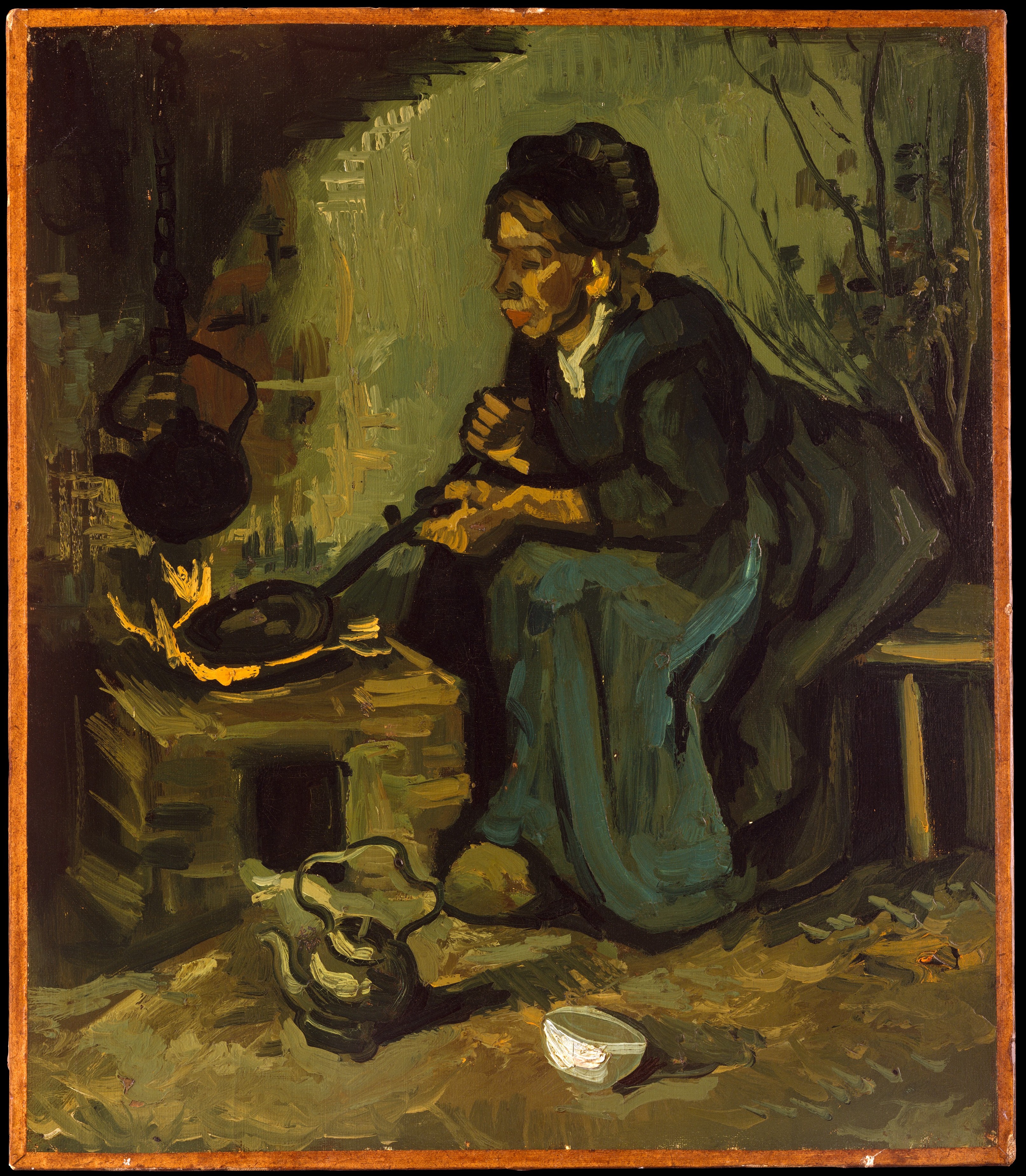
Peasant Woman Cooking by a Fireplace
The earthy browns, the low light, and the monumentality of the gesture belong to the world of the The Potato Eaters. Start here: everything that follows becomes spectacular.
Met's page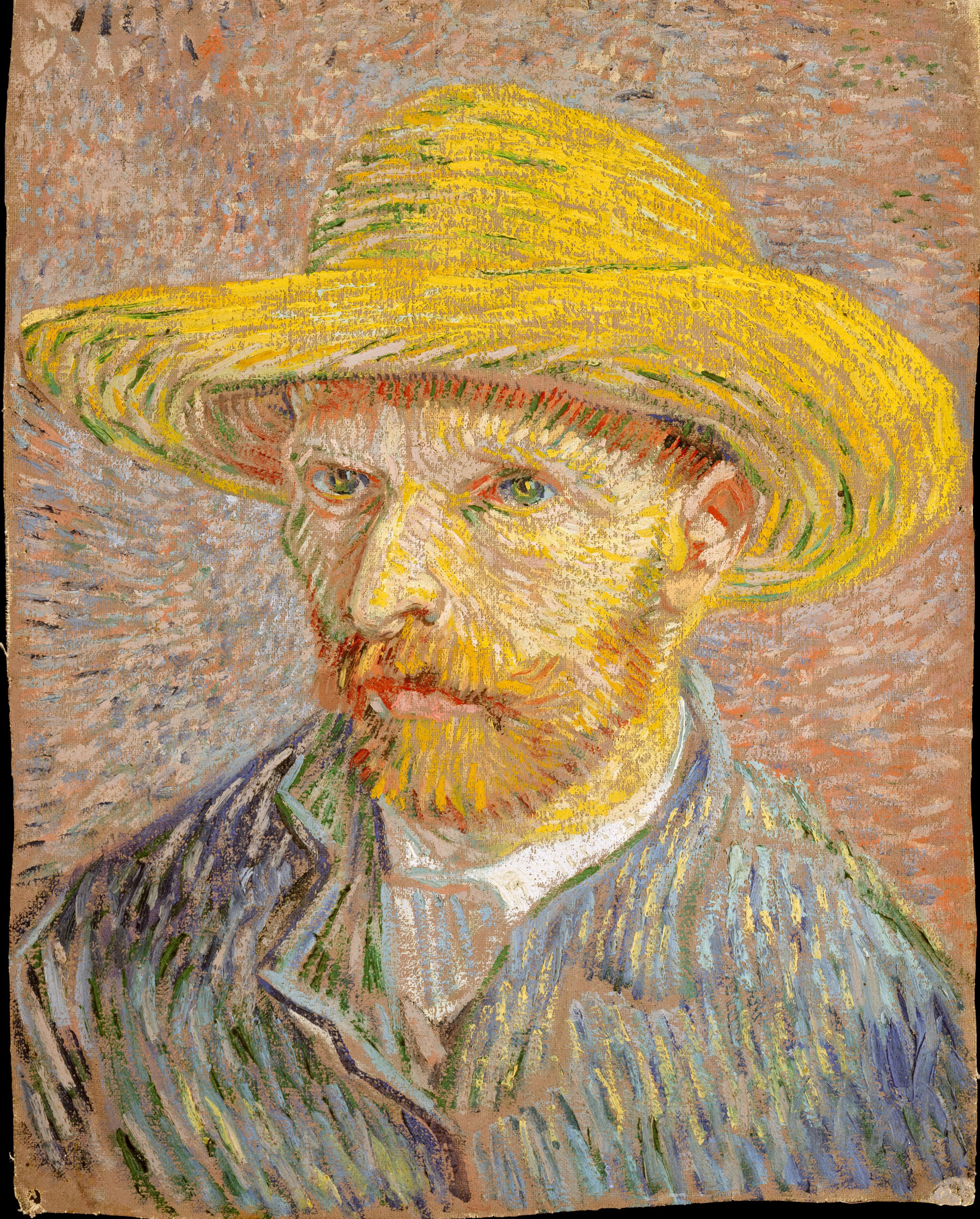
Self-portrait with straw hat
The short brushstrokes radiate around the face while blue and orange reinforce each other. The canvas is expensive: Van Gogh reused on the back an older study of a potato peeler.
View the object front and back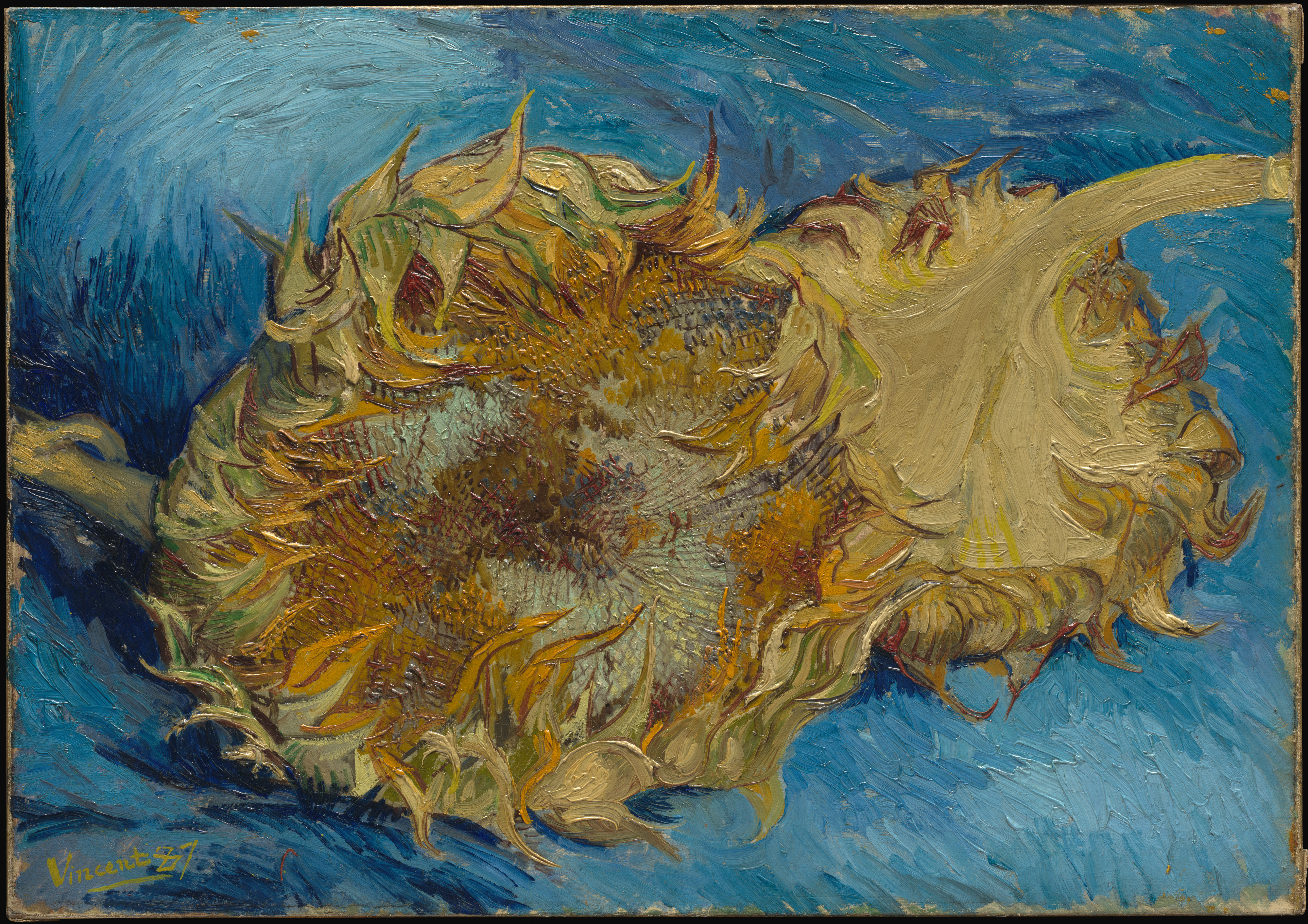
Sunflowers, two cut flowers
These are not the bouquets in vases from Arles. The flower heads are placed on a blue background, almost like bodies. Van Gogh is already exploring the yellow-blue contrast and the materiality of seeds and petals.
Met's page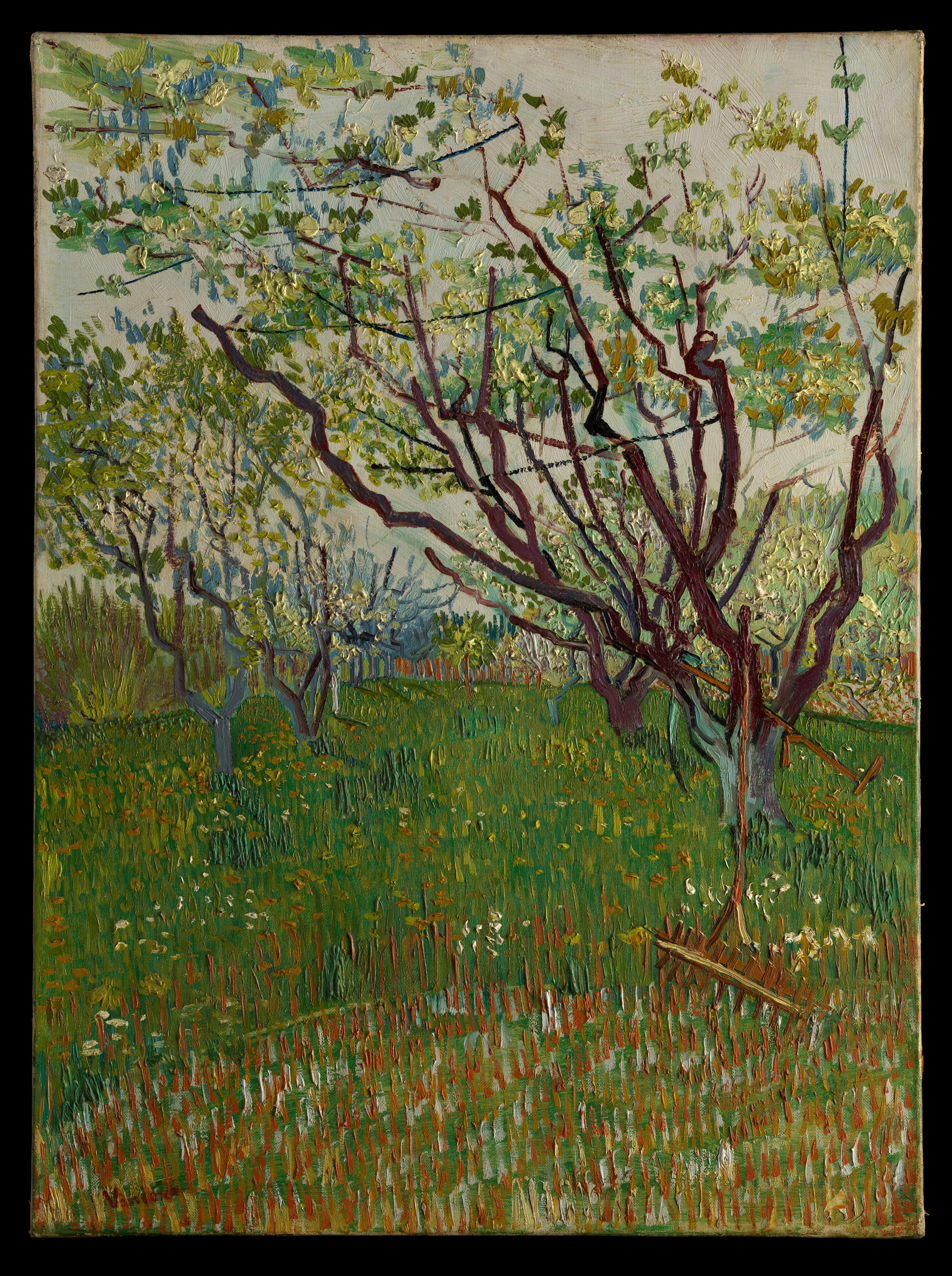
The Flowering Orchard
In Arles, Van Gogh painted the orchards as a promise of renewal. The main trunk organizes depth, but the flowering dissolves the branches into small white, green, and blue notes. Compare this rhythm to the Japanese prints that the artist collected.
The painting is an excellent transition between the naturalism of the subject and an increasingly decorative surface.
See reproduction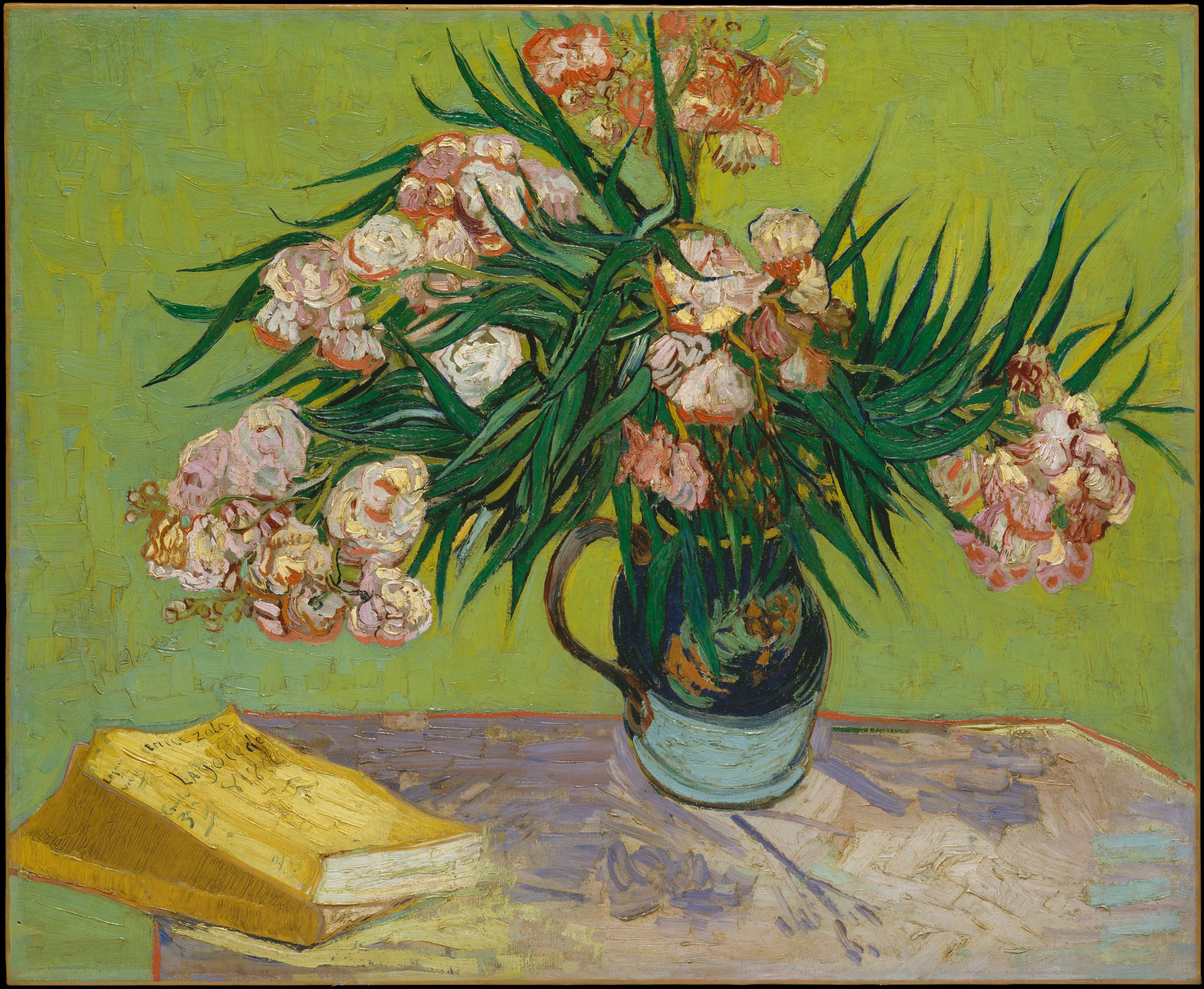
Lauriers-roses
The bouquet overflows from its glazed vase. On the table, a copy of La Joie de vivre by Émile Zola associates the flowers with vitality, modern literature, and the South of France.
Met's page
The Arlésienne: Madame Ginoux
The landlady of the Café de la Gare is seated in front of books. The firm outline, the flat plane of the table, and the face treated with colored areas give the portrait an almost printed clarity.
See reproduction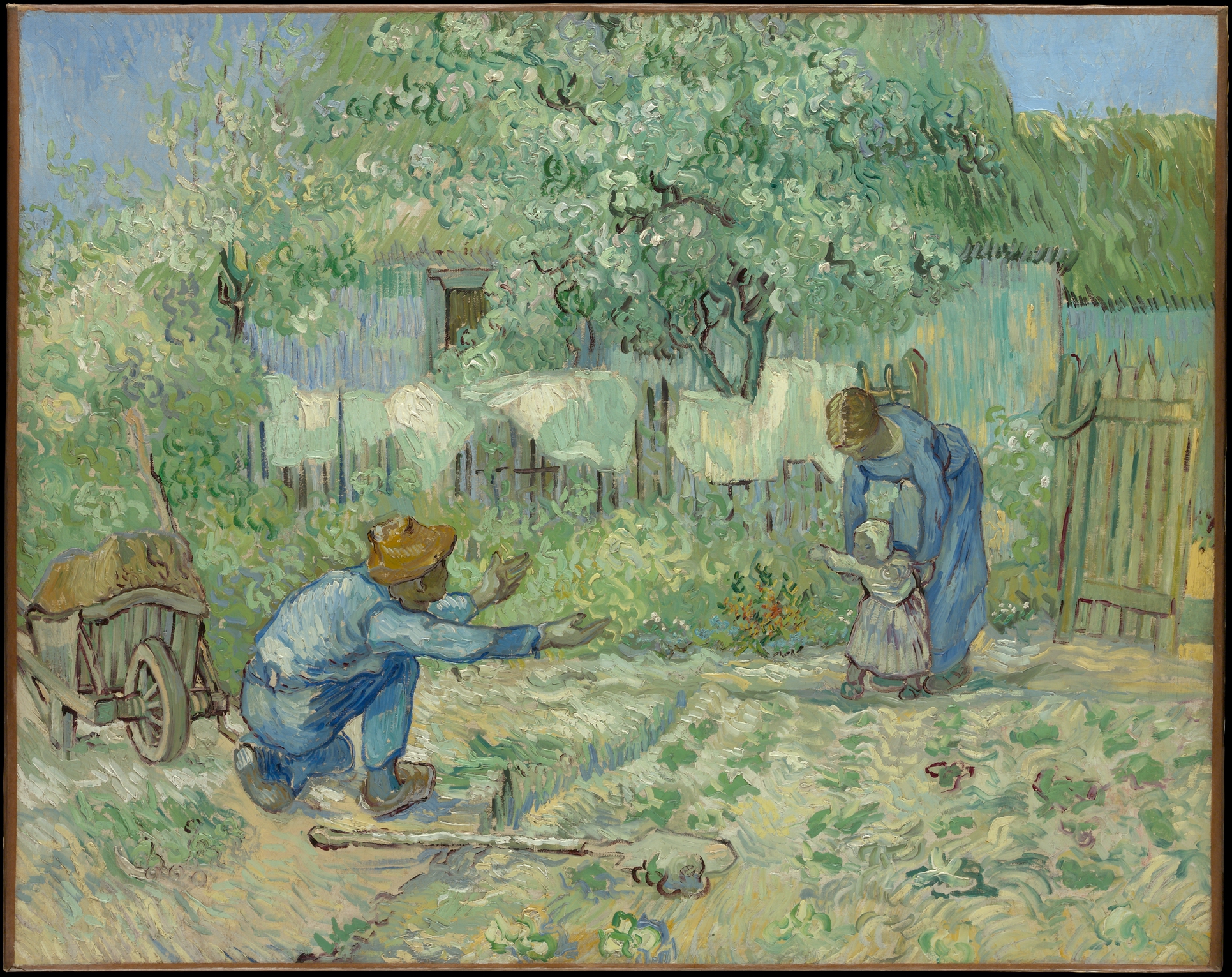
First Steps, after Millet
Van Gogh does not mechanically copy Jean-François Millet: he translates a black-and-white image into his own colorful language. The blue of the clothing, the greens of the garden, and the yellows of the ground transform the family scene into a luminous vibration.
Look at the distance between the father's open arms and the child. All the emotion is organized in that interval.
Met's pageThe self-portrait hides a peasant woman
Comparing the recto and verso sums up Van Gogh's material economy and his palette change. The museum obviously cannot show both sides simultaneously in a wall display; digital images make visible this story of the support.

Saint-Rémy: the landscape becomes motion
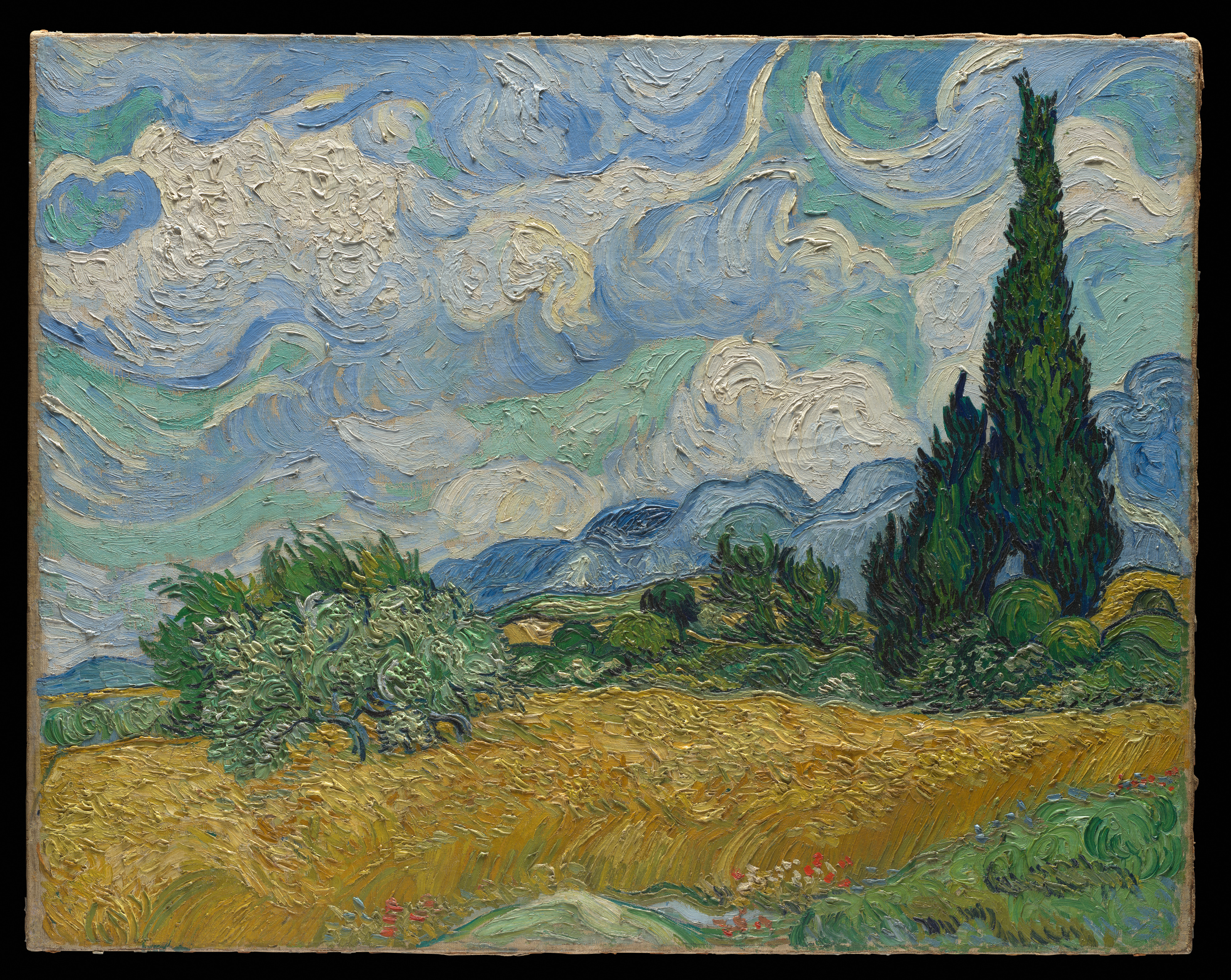
Wheat Field with Cypresses
The subject is horizontal, but nothing remains still. The wheat, bushes, mountains, and clouds follow different curves that interlock like the voices of a musical score. The large cypress connects earth to sky; its smaller neighbors build depth.
Compare it with Cypress in gallery 825. In the vertical painting, the tree dominates the world. Here, it belongs to a vast system of forces. Comparing the two works is one of the great privileges of a visit to the Met.
See reproduction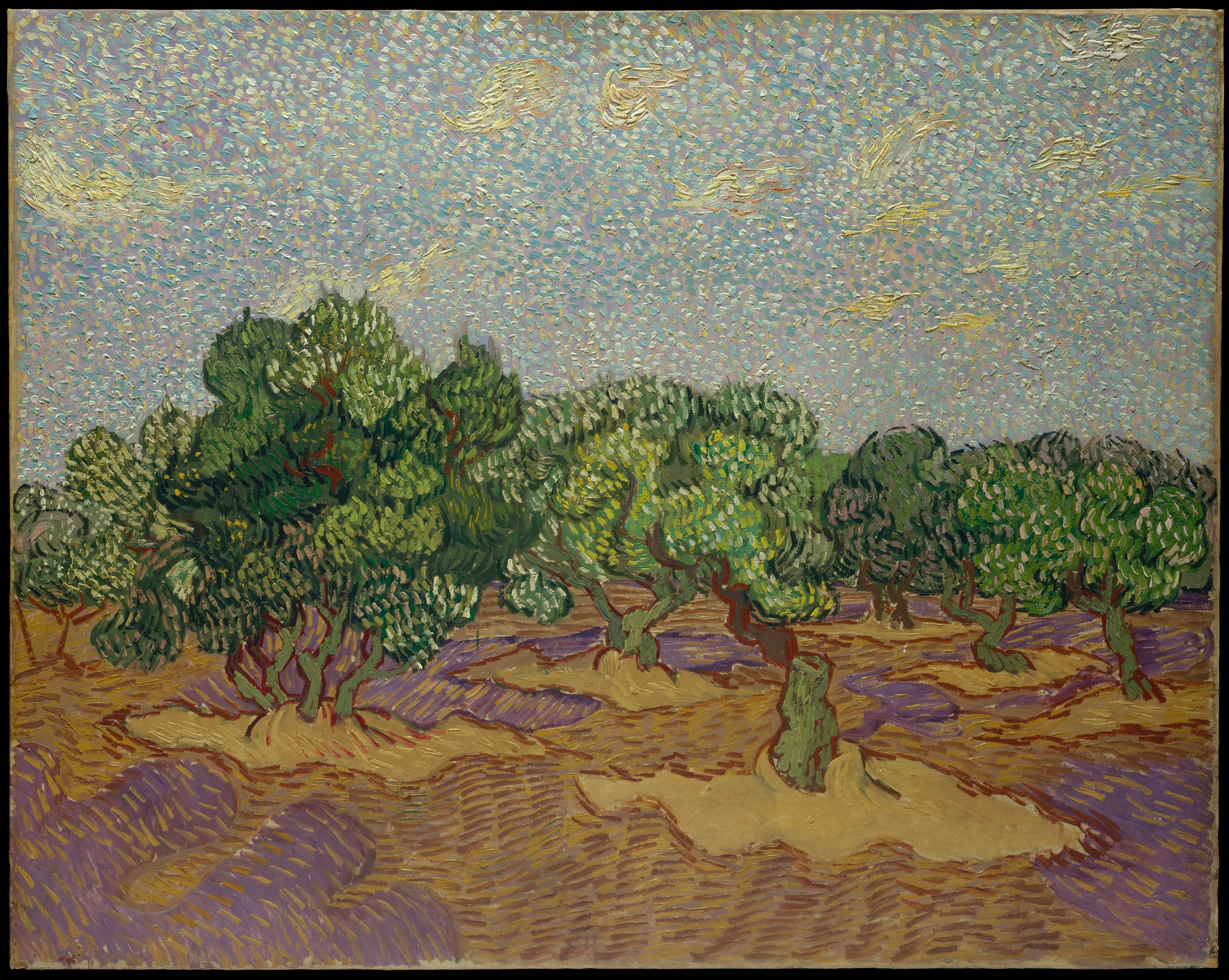
Olive trees
The gnarled trunks, the earth, and the sky are painted with a shared vocabulary of commas and undulations. The olive trees are not described leaf by leaf: they condense the wind, the heat, and the relief.
Met's page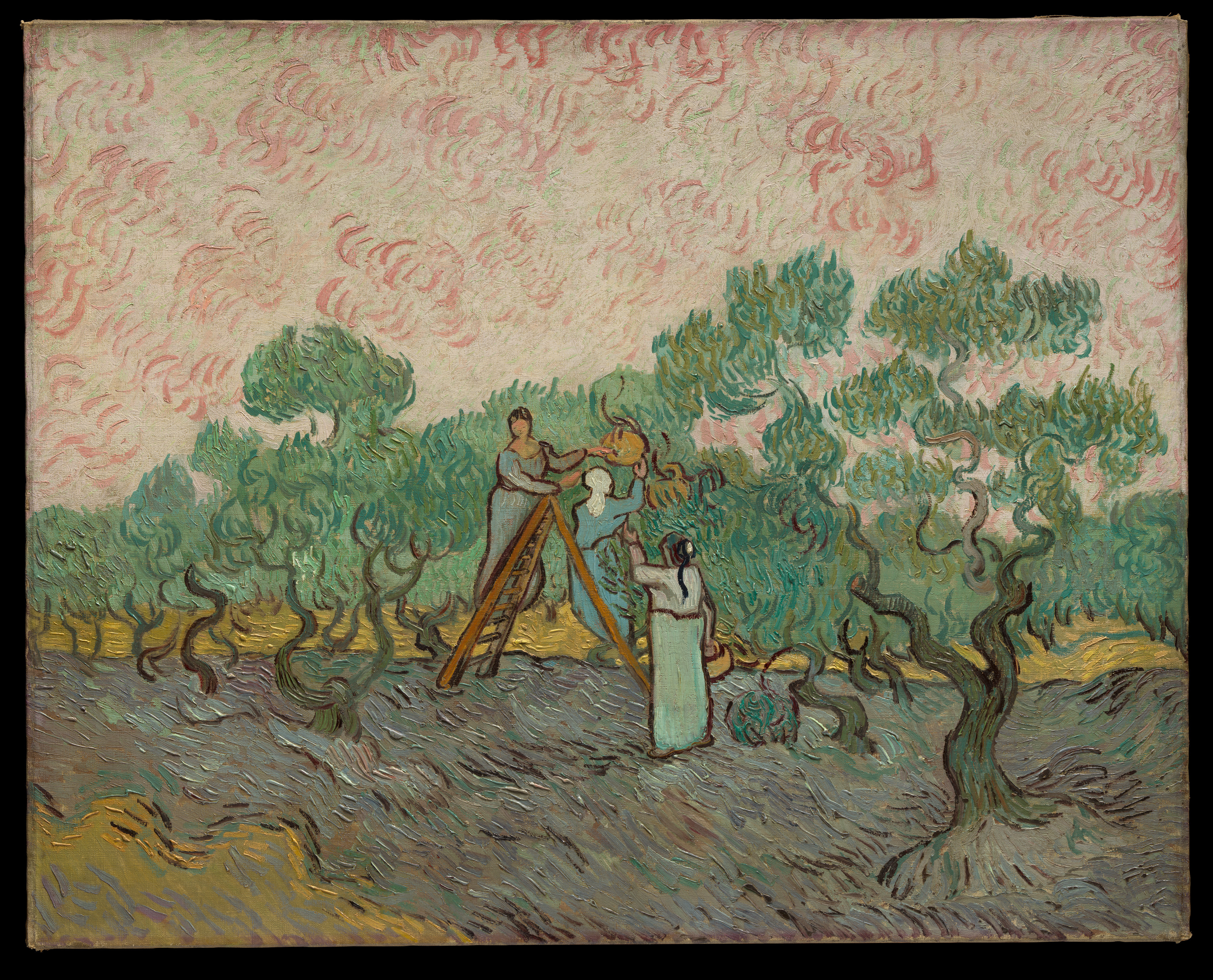
Women Picking Olives
The figures almost blend into the trees. Van Gogh does not tell an anecdote; he organizes the harvest as a collective rhythm, made of diagonals, curves, and muted colors.
Met's page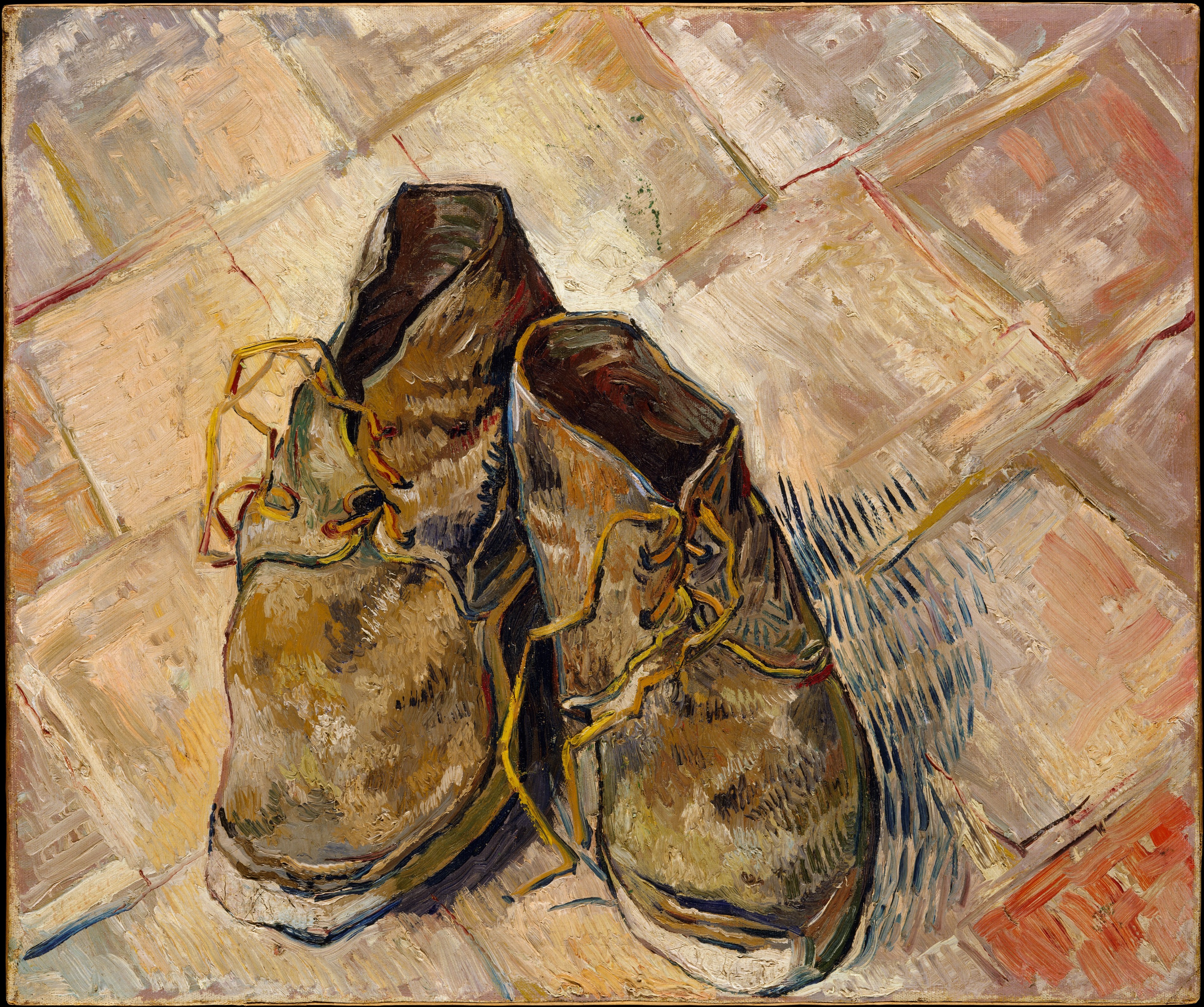
Shoes
Two worn shoes fill the entire canvas. The laces, soles, and leather bear the traces of an absent body. After the agitated landscapes, this still life imposes a silent gravity.
Met's page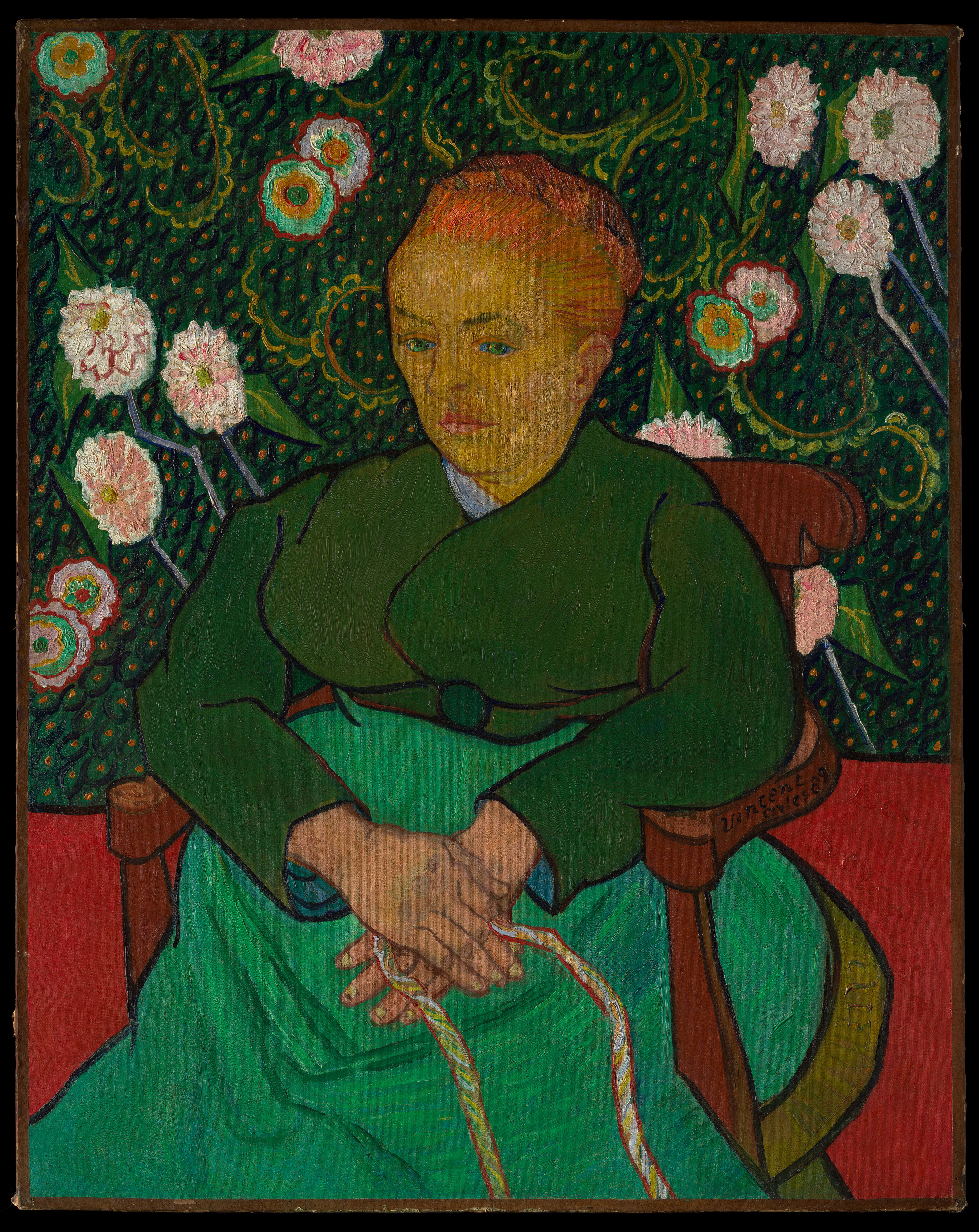
La Berceuse, Augustine Roulin
The rope held by the model joins a cradle located off-screen. The floral wallpaper envelops the figure in a dense decor while the face remains calm and frontal. Van Gogh imagined this maternal image at the center of a composition flanked by sunflowers.
The Met keeps the version that Augustine Roulin herself may have chosen. Look at the hand and the rope before the face: they reveal the gesture that gives the portrait its title.
See reproduction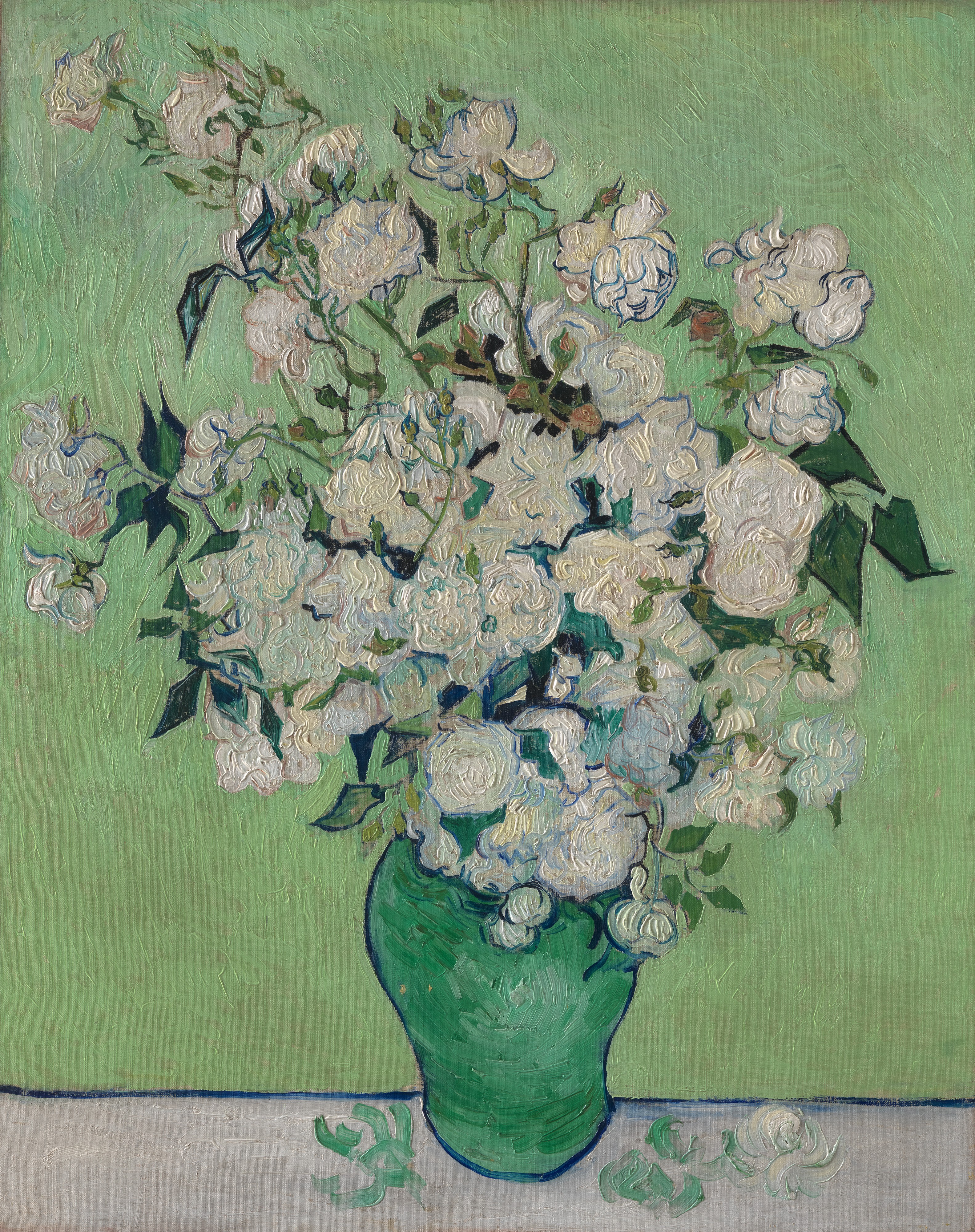
Roses
Today white and green, several flowers were originally more pink. The red pigments sensitive to light have faded: the painting we admire is no longer exactly the one Van Gogh left.
Met's page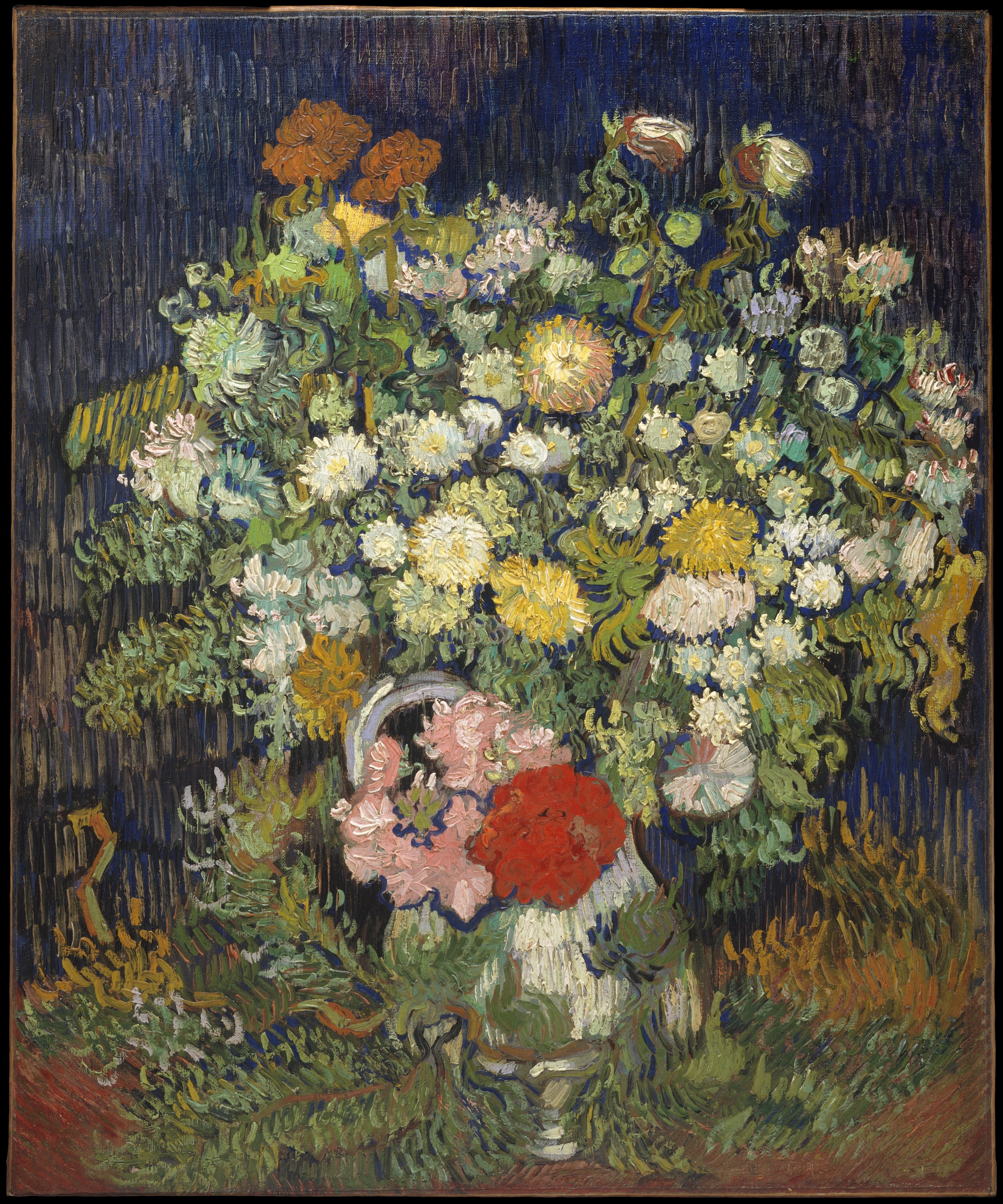
Bouquet of flowers in a vase
The late bouquet accumulates leaves, flowers, and impasto in an almost unstable architecture. It constitutes a beautiful final point: the still life has become a laboratory of speed and color.
Met's pageThree detours that complete the story
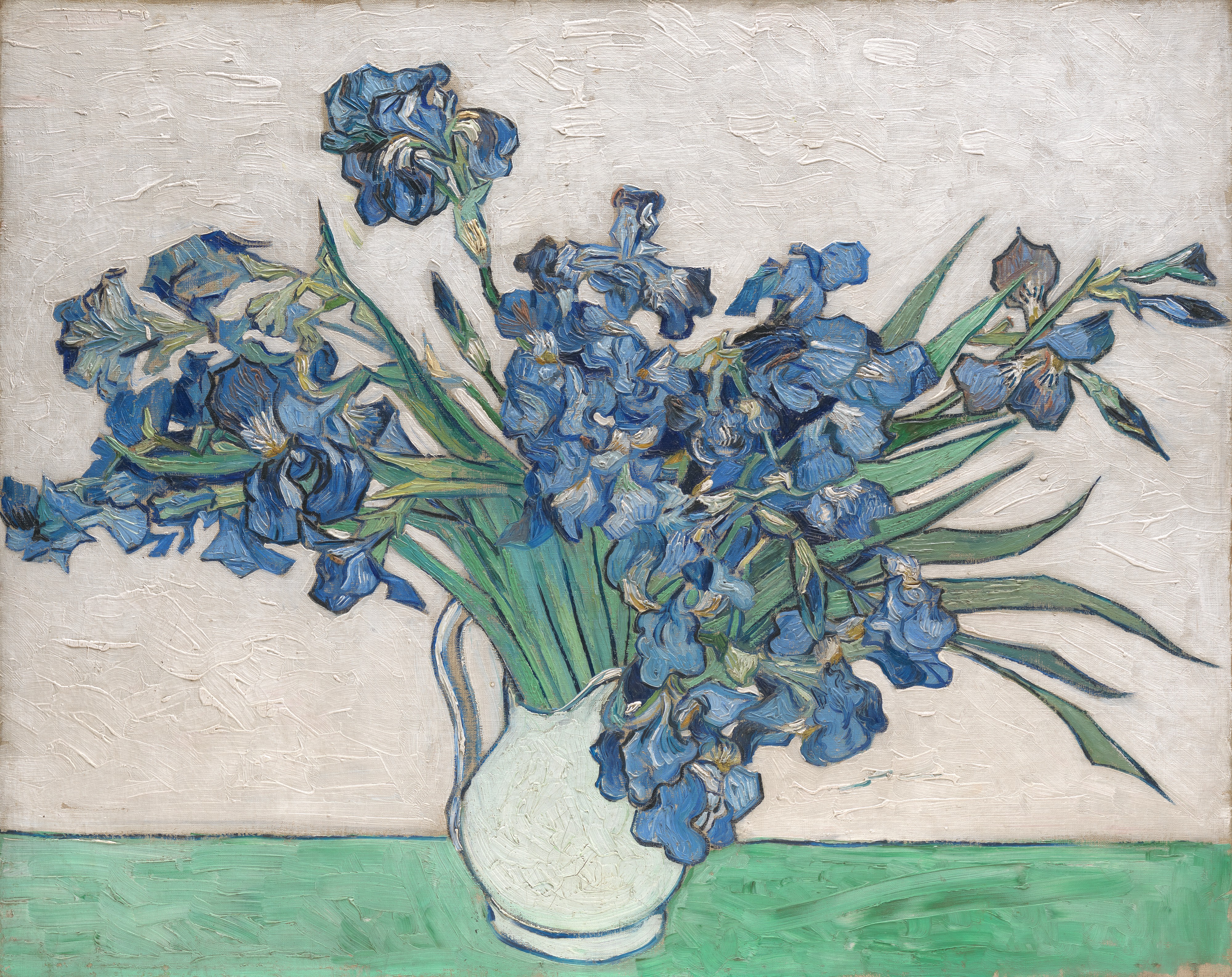
Iris, 1890
This bouquet was a pendant to the Roses. The violet petals and the pink background have lost some of their red components: what we perceive today as blue and almost white was more contrasted.
See reproduction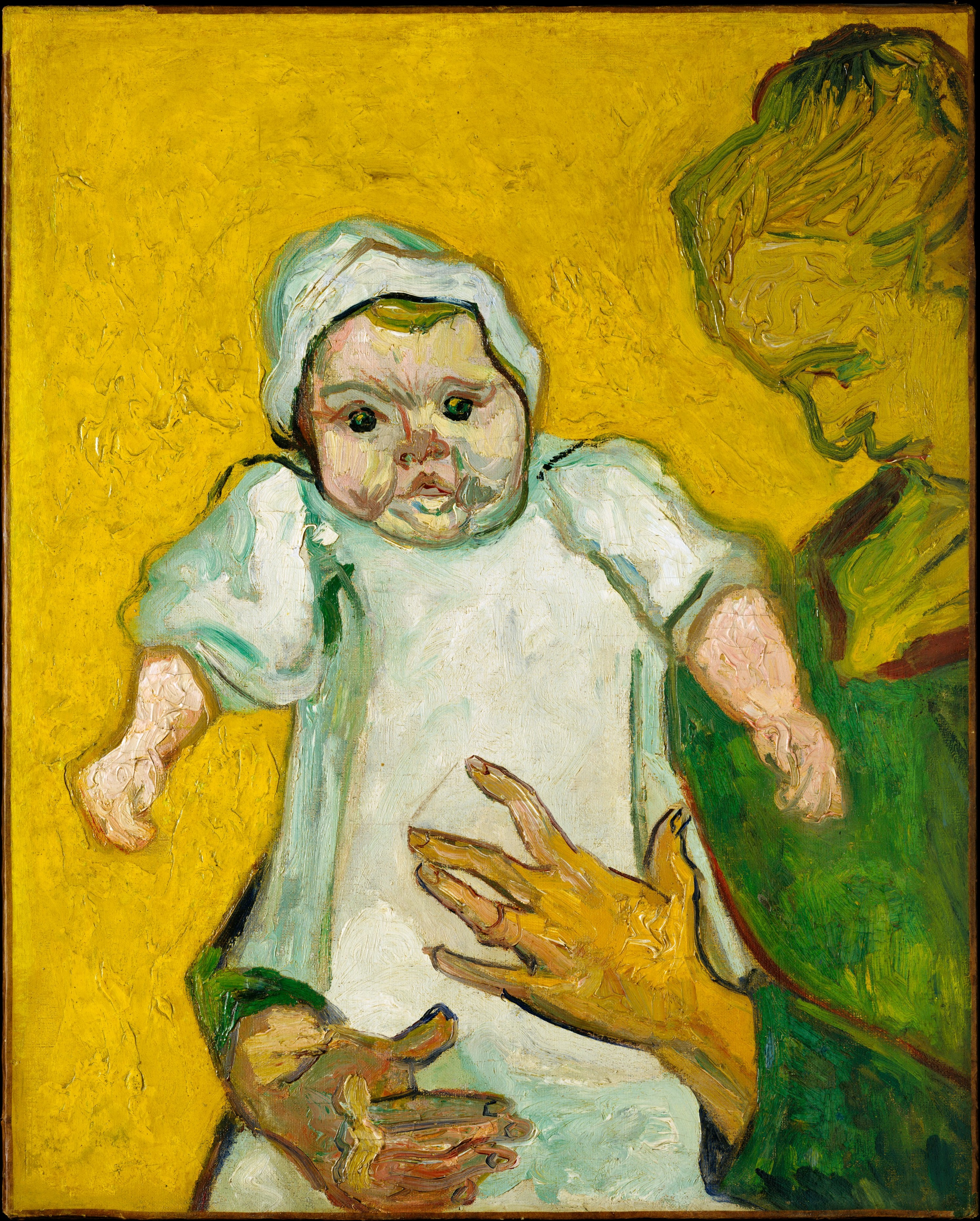
Madame Roulin and Her Baby
In the Robert Lehman Collection, motherhood appears without worldly idealization. The baby is swaddled, the mother very close to the pictorial plane; colors and contours give both figures a direct strength.
Met's page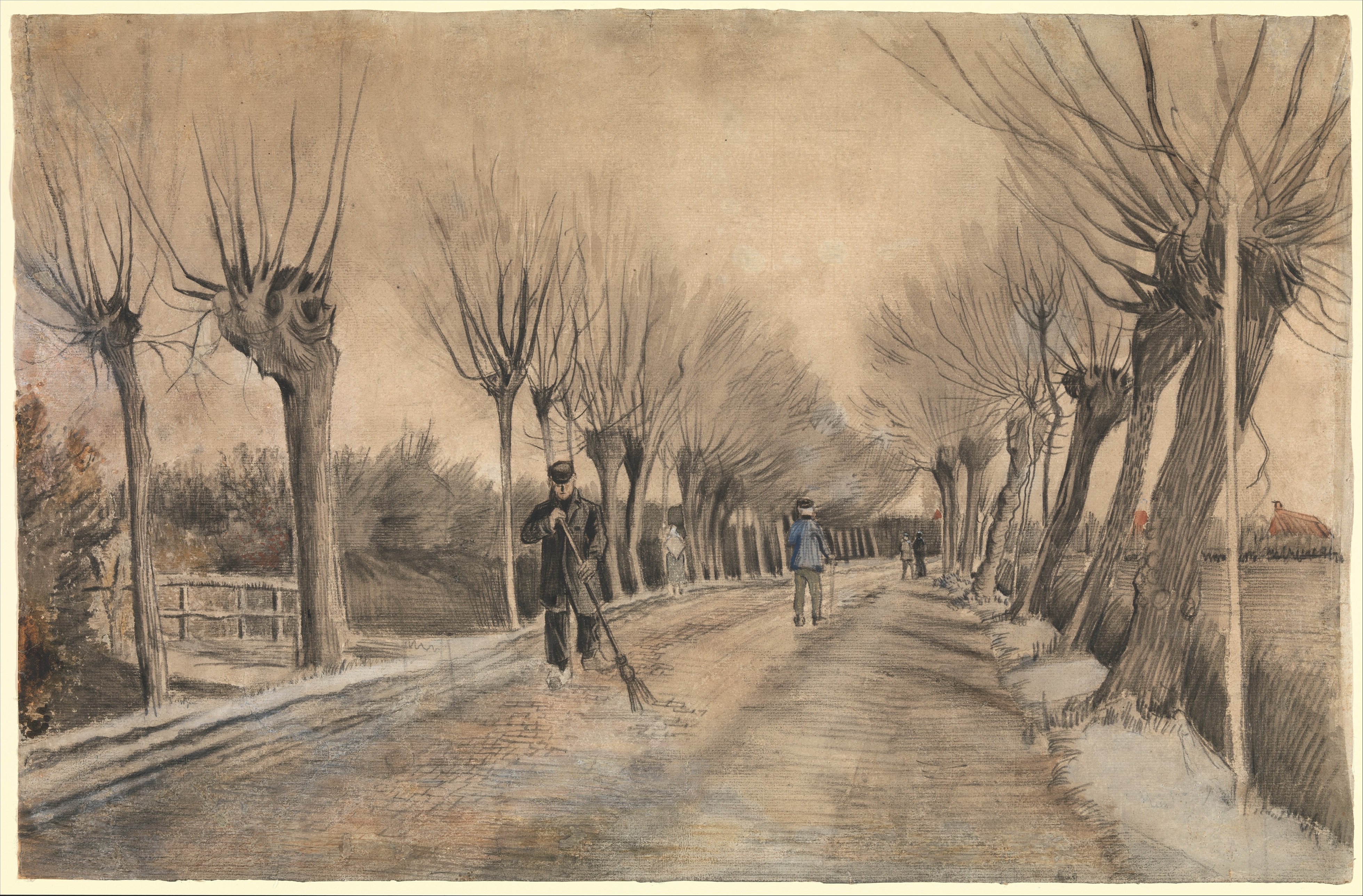
Road at Etten, 1881
This sheet reminds us that the Met's Van Gogh collection is not limited to the sixteen paintings. Works on paper are fragile and often kept out of the galleries: always check the "on view" status.
See the drawing onlineOption for drawing enthusiasts: The Kneeling Peasant Woman Pulling Carrots from 1885 was announced in gallery 690. Its display may change faster than that of oil paintings, due to the sensitivity of paper to light.
The Met's colors are not all those of 1890
Iris and Roses : two transformed bouquets
Van Gogh conceived these two large still lifes as a pair: a violet bouquet on a pink background and pink roses on a green background. However, certain red lacquers from the 19th century are fugitive. With light and time, they have lost their intensity.
This alteration does not make the paintings false. It reminds us that a painting is a material object that ages. At the museum, compare the areas protected by the edges or the impasto, then imagine a much more vivid complementarity between red and green.
This scientific perspective enriches stylistic analysis: with Van Gogh, color is not a simple filler. It organizes the tension of the entire surface.
Read the notice of IrisPrepare for your visit to the Met without wasting an hour
| Address | 1000 Fifth Avenue, New York, NY 10028, on the edge of Central Park. |
|---|---|
| Hours | Sunday–Tuesday and Thursday: 10 a.m.–5 p.m. Friday and Saturday: 10 a.m.–9 p.m. Closed on Wednesday. Check holidays. |
| General Admission | $30 adult, $22 senior, $17 student; free for children 12 and under. The "pay what you wish" policy applies to certain residents and students with ID. |
| Subway | Lines 4, 5, or 6 to 86th Street, then about a ten-minute walk to Fifth Avenue. |
| Accessibility | Accessible entrance at 81st Street and Fifth Avenue. The garage is located near 80th Street. |
| Ticket | General admission grants same-day access to Met locations included in the current policy. Check the official terms at the time of booking. |
Great Hall
Security check, map, then head to the European paintings on the second floor.
gallery 825
Follow the chronology from Nuenen to Arles before stopping in front of Cypress.
gallery 822
Compare the two cypresses, then the olive trees, portraits, shoes and bouquets.
099 + 961
End with the Iris and Madame Roulin. Keep a twenty-minute buffer.
Hanging verified on July 18, 2026: A loan, restoration, or reinstallation may move a work without notice. Open the Met's notes a few hours before your visit and look for the gallery mention.
Find the Met's works in reproduction


Van Gogh at the Met: Preparing the Essentials
How many paintings by Van Gogh does the Metropolitan Museum have?
The Met's official visitor guide presents sixteen paintings by Van Gogh to see in the collection. A broader search in the database returns more objects, as it also includes drawings, works on paper, and related items. Not all works are displayed simultaneously.
Which galleries can you see Van Gogh at the Met?
The majority of the paintings are grouped on the second floor, in galleries 825 and 822. The Iris are indicated in gallery 099 and Madame Roulin and Her Baby in gallery 961, within the Robert Lehman Collection. These numbers were verified on July 18, 2026 and may change.
What is the most famous Van Gogh artwork at the Met?
Wheat Field with Cypresses and the large vertical painting Cypress are among the most famous images. The museum also owns theSelf-portrait with straw hat, the Iris, The Berceuse and several major still lifes.
Is The Starry Night at the Metropolitan Museum of Art?
No. The Starry Night belongs to the Museum of Modern Art, the MoMA, also in New York. The Met, however, holds two large paintings of cypresses from the same Saint-Rémy period, which help to understand the vocabulary of swirling forms from 1889.
Are the Met's Sunflowers the famous bouquet in a vase?
No. The Met's painting shows two cut sunflower heads, painted in Paris in 1887. It precedes the series of bouquets in a vase made in Arles and shows Van Gogh experimenting with yellow, blue, and the texture of the flower heads.
Why have the Irises and the Roses changed color?
Certain red pigments used by Van Gogh were sensitive to light and have faded. The Iris had a pinker background and more violet petals; the flowers of the Roses were also more pinkish. The Met's labels explain this material evolution.
How much time to allow to see the Van Goghs at the Met?
Allow about two hours for a focused visit, and two and a half hours if you wish to read the labels, take detours to galleries 099 and 961, and observe the artworks without rushing. Add extra time for moving through the museum.
Can I photograph Van Gogh’s paintings at the Met?
Personal photography without flash is generally allowed in the permanent collection, subject to local signage and current rules. Tripods and bulky equipment are regulated. Check the official policy before your visit.
What day should I visit the Met to avoid crowds?
Arriving at opening time remains the most reliable strategy. The museum is closed on Wednesdays and closes later on Fridays and Saturdays. Crowd levels depend on holidays, temporary exhibitions, and tourist season.
Are Van Gogh’s artworks always on display?
No. A loan, restoration, or rehanging can temporarily move a painting. Works on paper rotate even more frequently for conservation reasons. Check each official record and look for the gallery listing on the day of your visit.
An itinerary verified on July 18, 2026
- The Met — A Guide to Van Gogh at The Met, visitor inventory of the sixteen paintings.
- The Met — Plan Your Visit, address, hours, prices, transportation, and accessibility.
- The Met — Cypresses, gallery and description of the work.
- The Met — Wheat Field with Cypresses, gallery and description.
- The Met — Irises, history of pigments and location.
- The Met — Roses, pendant of the Iris and chromatic alteration.
- The Met — Self-Portrait with a Straw Hat, canvas painted on both sides.
- The Met — The Berceuse, Augustine Roulin and decorative project.
- The Met — Madame Roulin and Her Baby, Robert Lehman Collection.
- Images of the artworks: The Metropolitan Museum of Art, Open Access, public domain/CC0 when indicated on the records.
Façade of the Metropolitan Museum of Art — Flickr photograph, CC BY-SA 2.0.
Great Hall of the Met — Daderot, CC0.
Two cypresses, sixteen paintings, and an entire career to revisit
The Met does not reduce Van Gogh to an icon. It shows how a dark palette becomes light, how a tree becomes rhythm, and how a simple bouquet can still change before our eyes.
Explore the Van Gogh collection
0 comments