

Nymphéas de Monet • Guide art & décoration
Nymphéas de Monet : l'étang où la peinture a appris à respirer
Plongée au cœur du bassin de Giverny, ce laboratoire de lumière où Claude Monet a dissous l'horizon pour inventer une nouvelle manière de voir le monde.
Il y a des jardins que l'on visite et d'autres qui vous visitent, s'installant durablement dans votre rétine bien après avoir quitté le sentier. Le bassin aux nymphéas de Claude Monet à Giverny appartient à cette seconde catégorie, non pas comme un simple décor végétal, mais comme une machine optique conçue par un peintre obsessionnel. Ce n'est pas la nature telle qu'elle se présente au promeneur pressé, mais un écosystème entièrement orchestré pour capturer l'insaisissable : le reflet, la vibration de l'eau et la dissolution des formes. Pendant près de trente ans, Monet a transformé sa propriété en un atelier à ciel ouvert, défiant les administrations locales pour importer des plantes exotiques et creuser un étang artificiel, tout cela dans le seul but de peindre ce qui n'a pas de contour fixe. Comprendre les Nymphéas, c'est accepter de perdre ses repères terrestres pour flotter avec le maître impressionniste dans un espace où le ciel tombe dans l'eau et où la peinture cesse d'être une fenêtre pour devenir un environnement.
 Image libre
Méthode de lecture
How to watch this series without getting lost
To fully appreciate these works, you must let go of the search for precise botanical detail and accept that the true subject is light itself. Notice how the brushstroke creates movement, how the colors collide without fully merging on the canvas, and let your gaze drift like a leaf across water rather than searching for a traditional vanishing point.
Context before prestige
We place Monet's Nymphéas back in their era—their studios, their exhibitions, their little rebellions. A work without context is sometimes just a very beautiful person who has forgotten their story.
The signs that betray your style
We spot water, reflections, water lilies. These clues often say more than grand speeches, especially when they carry gold or nervous brushstrokes.
The artwork in a real room
We end with the useful question: does this image breathe in your space, or does it just pose like a poster that's read two books?
Contexte historique
Giverny: the garden where Monet creates his own motif

When Claude Monet settles in Giverny in 1883, he's not simply looking for a countryside retreat, but an ideal playground for his chromatic obsessions. After acquiring the property in 1890 thanks to the success of his sales, he undertakes, starting in 1893, the radical transformation of the site by purchasing an adjacent marshy plot to dig out his famous water garden. The local authorities, frightened by the idea that a foreigner would introduce exotic plants capable of poisoning the nearby Epte River, initially oppose him with fierce bureaucratic resistance. Monet must multiply persuasive letters and guarantees to obtain the right to install his water lilies, those floating flowers that would become the absolute stars of his late work, proving that even the wildest nature sometimes needs an administrative nudge to blossom.
Once the permits were obtained, the painter transforms into a meticulous landscape architect, diverting an arm of the Epte to feed his pond and building that apple-green Japanese bridge that arches over the water like an invitation to motionless travel. He plants weeping willows whose branches come to caress the surface, irises in vivid colors along the banks, and organizes the vegetation with the rigor of a conductor fine-tuning his score. Each element, from bamboo to wisteria, is chosen for its ability to interact with the shifting light of the Île-de-France region, transforming the garden into a living motif that Monet could observe from every angle. This is no longer a parish garden or a utilitarian kitchen garden—it is a natural theater set where every leaf has been placed in service of painting, making Giverny the only place in the world where one can see nature already painted before the brush has even touched it.
Style artistique
The Early Water Lilies: still a garden, already a floating world
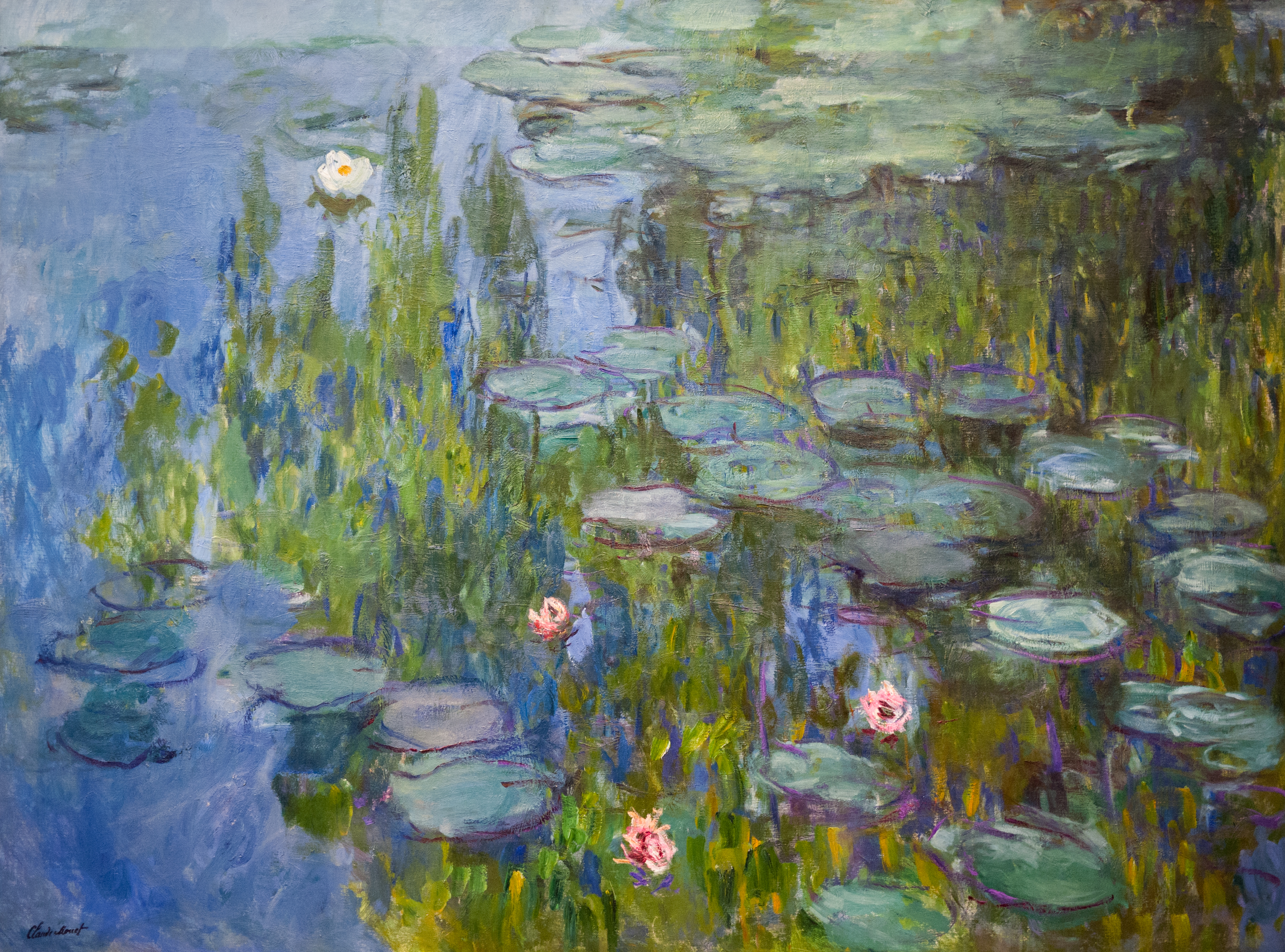
Around 1897, when Monet truly began to isolate the water lilies motif on his canvases, viewers could still hold onto familiar reference points drawn from the landscape tradition. One can clearly make out the shoreline, the structure of the Japanese bridge in the background, and the distinct separation between the deep water and the floating leaves that dot the surface like little islands of greenery. These early works, often more modest in scale compared to the monumental panels that came later, still function as windows opening onto a private corner of paradise, where classical perspective gently draws the eye toward a distant vanishing point. The flowers are rendered with a precision that allows their species to be identified, and the water serves primarily as a reflective surface rather than an autonomous subject—revealing an artist still probing the limits of his new aquatic laboratory before fully surrendering to it.
However, even in these relatively youthful paintings, one can already sense Monet's fascination with the instability of the motif, as he tirelessly paints the same scene at different hours to capture the atmospheric variations. As early as 1903, during an exhibition devoted exclusively to these works, the public begins to feel that something is shifting: the garden becomes less a geographical place than a state of mind, a sensation of floating. The reflections of the trees begin to gain ground over the reality of the plants, slightly blurring the boundary between top and bottom, between sky and pond. Monet is no longer seeking to botanically document his property, but to translate the pure visual experience of contemplation, thus paving the way for that silent revolution in which the subject ultimately dissolves into the very matter of painting, heralding the great hours of the series.
Art & détails
Painting water, or how to make a moving mirror hold still

The true technical and philosophical challenge of the Water Lilies lies in the bold attempt to paint a transparent liquid that possesses substance only through what it reflects. Monet quickly understood that painting water means painting the sky, the clouds, and the trees inverted, creating a delightful confusion where the viewer no longer knows whether they are looking up or down. The surface of the pond becomes a capricious mirror that distorts reality, fragmenting the trunks of the willows into green zigzags and transforming the cumulus clouds into moving white patches that dance among the lily pads. This constant duality forces the painter to work with dazzling speed to capture the moment before the wind rippling the water completely alters the composition, making every brushstroke a race against the meteorological clock.
In this quest, Monet develops a unique pictorial syntax where the distinction between object and its reflection gradually fades until it becomes irrelevant. Water is no longer a passive element containing the flowers, but a living entity that swallows up the surrounding landscape to spit it back out in abstract, vibrant versions. Observing these canvases, one realizes that the painter has achieved the impossible: capturing the perpetual motion of a fluid without rendering it static, giving water a tangible, almost tactile texture. The viewer is invited to plunge their gaze into this illusory depth, where imaginary fish swim among the clouds, creating a total visual experience that transcends the mere representation of a garden to touch the very essence of human visual perception in the face of nature.
Art & détails
When the horizon disappears: perspective quietly gets escorted out

One of the major revolutions of the Water Lilies series, particularly visible in the mature works, is the deliberate and radical removal of the horizon line. By progressively zooming in on the water's surface, Monet eliminates any reference to solid ground or a distinct sky, plunging the viewer into an infinite space without up or down, without foreground or background. This absence of a traditional vanishing point forces the eye to wander freely across the canvas, unable to anchor itself to a reassuring line of perspective, creating a sensation of total immersion comparable to what one might experience floating on one's back in the middle of a calm pond. Linear perspective, the golden rule of Western painting since the Renaissance, is here cast aside in favor of a panoramic, envelopping vision that strangely foreshadows contemporary virtual experiences.
The disappearance of the horizon frees the composition from all narrative or geographical constraints, transforming the canvas into a field of colored forces where only the internal harmony of forms matters. The frame of the painting no longer delimits a partial view of a larger world, but becomes the ultimate boundary of a self-sufficient, autonomous universe. By removing the separate sky and the distant shore, Monet forces the viewer to accept that painting is not a window opened onto the world, but a physical object vibrating with its own energy. This formal audacity brings late Impressionism dangerously close to pure abstraction, proving that to reach the essence of nature, one must sometimes accept losing all conventional landmarks of realistic representation and let color dictate its own spatial logic.
Art & détails
Blues, greens, purples: the pond shifts mood without warning a soul

The palette of the Water Lilies is an emotional barometer of extreme sensitivity, capable of translating the slightest variations of the hour, the season, or the painter's mood with a startling precision. Depending on whether one observes a canvas painted at dawn, beneath a blinding midday, or during an autumnal twilight, the dominant tones shift from deep emerald greens to icy cobalt blues, passing through melancholic mauves and incandescent pinks. Monet does not simply reproduce the local color of the leaves; he captures the colored light that passes through them and alters them, using juxtaposed strokes of pure pigments that vibrate optically when viewed from a distance. This chromatic orchestration makes each painting a personal meteorology, where the atmosphere of Giverny is distilled into a liquid essence that seems to change temperature depending on the visitor's angle of observation.
Over the decades, this use of color became increasingly expressive and subjective, moving away from naturalistic fidelity to enter the realm of pure sensation. The tones grew denser, more saturated, sometimes almost violent, as if Monet were striving to extract from nature all its raw, energetic power. Green was no longer simply the color of chlorophyll—it became a space for breathing, while blue embodied the abyssal depth of water and mauve suggested the mysterious transition between day and night. This colorful symphony demonstrates that for Monet, color was the true subject of painting, far more than the flowers themselves, and that it possessed the power to structure space and evoke complex emotions without the aid of any recognizable form or narrative.
Art & détails
Up close, the Water Lilies aren't still: the paint is still moving

If one has the courage to approach within just a few centimeters of the surface of an original Water Lilies painting, the illusion of aquatic softness immediately shatters to reveal a textured battlefield of astonishing violence. Far from the smooth, serene surface one imagines from a distance, the canvas erupts into thick impastos, nervous scrapings, and layers of paint applied with frenzied energy. Monet works the material like a sculptor, adding, removing, and reworking the colored paste until it acquires an autonomous, almost carnal physical presence. These traces of struggle testify to the painter's determination to capture the fleeting moment, leaving visible the hesitations, reworking, and corrections that make each work an intimate journal of his tumultuous creative process.
This surface roughness plays a crucial role in how light interacts with the work, creating real micro-shadows and reflections that add to the painted ones, further complicating the visual experience. Up close, one no longer sees flowers or water, but a swirling abstraction of gestures and colors that seems animated by a life of its own, independent of the subject depicted. It is in this immediate proximity that Monet's radical modernity reveals itself, anticipating the action painting of the New York abstract expressionists who, fifty years later, would claim this primacy of gesture and matter. The painting of the Water Lilies thus demands this constant back-and-forth of the gaze, oscillating between the distance necessary to reconstruct the overall image and the closeness essential to admire the wild virtuosity of the technical execution.
Art & détails
The Orangerie: Monet invents a room where the water looks back at you too

The crowning achievement of this artistic adventure took shape after World War I, when Monet, supported by his friend Georges Clemenceau, decided to offer the French State a monumental ensemble specifically designed for the oval rooms of the Orangerie des Tuileries. This project, known as the Grandes Décorations, was not a simple accumulation of canvases, but an environmental installation conceived as a sanctuary of peace and contemplation in the aftermath of the horrors of the global conflict. Monet designed the space as an infinite continuum, arranging his panoramic panels so as to surround the viewer, eliminating blind spots and creating an illusion of total immersion in which one feels as though floating at the very center of the Giverny pond. It was an immense gift, both physical and spiritual, intended to offer Parisians a visual escape into a peaceful world, governed solely by natural beauty and light.
The very architecture of the oval rooms, with their zenithal lighting filtered through skylights, was incorporated into the painter's vision, making natural light an active component of the work itself—one that evolves throughout the hours and seasons. Upon entering this space, the visitor is captivated by a horizontal continuity stretching nearly one hundred meters, where the abolished horizons of the various panels echo one another to create an endless cycle of day and night. Monet wanted visitors to sit down, to lose themselves, to meditate, transforming the traditional museum visit into an almost mystical contemplative experience. The posthumous inauguration of this ensemble in 1927 crowned the triumph of his vision: painting is no longer an object to be hung on a wall, but a space to inhabit, an extension of nature at the heart of the city, thereby fulfilling the ultimate dream of Impressionism.
Art & détails
Cataracts, determination and wilder colors: Monet won't let go of his pond

Monet's final creative years were marked by a formidable physical ordeal: cataracts that progressed inexorably, clouding his vision and shifting his color perception toward yellowish, hazy tones. Despite the pain, the delicate surgeries, and periods of profound discouragement during which he considered destroying his unfinished canvases, the painter displayed fierce determination, continuing to work in his Giverny studio with an iron discipline. He taught himself to recognize colors by reading the labels on his paint tubes and corrected his canvases after each operation, striving to recapture the chromatic precision he felt slipping away from him—transforming his physical suffering into a new dramatic intensity in his brushwork. This struggle against darkness gave birth to works of unprecedented expressive power, in which the forms grew larger and more blurred, and color seemed to emerge from visual memory as much as from direct observation.
This late period reveals a Monet who no longer seeks to please or seduce through refinement, but rather to express the raw truth of his inner vision, even at the cost of clashing with the aesthetic conventions of his time. The water lilies from these years possess an exceptional material density, as if the painter were trying to compensate for the loss of optical clarity through an abundance of matter and an increased violence of gesture. He tirelessly reworks his large panels, turning them, cutting them, sometimes burning them, in a perfectionist quest that borders on spiritual obsession. It is perhaps within this adversity that the ultimate greatness of the series resides: proof that an artist can transform his physical limitations into new creative freedoms, pushing painting toward unexplored territories just before departing this world, leaving behind a visual testament of breathtaking modernity.
Art & détails
Why Water Lilies Still Fascinate Modern Painters

The influence of the Nymphéas on 20th-century art is so profound that it has become invisible—so deeply has it nourished the wellsprings of modern and contemporary abstraction. When the New York Abstract Expressionists—Jackson Pollock, Mark Rothko, and Joan Mitchell—discovered the Grandes Décorations after 1945, they saw in them the validation of their own search for an objectless pictorial space, governed solely by the emotion of color and gesture. Joan Mitchell, who settled not far from Giverny, would spend her life in dialogue with Monet's legacy, taking up this idea of an inner landscape where the memory of nature dissolves into the pure energy of paint. The Nymphéas shattered the taboo of mandatory figurative representation, opening the way for a painting that is self-sufficient in itself, where the subject no longer matters and only the sensory experience aroused in the viewer counts.
Beyond abstraction, it is the concept of immersion and total environment developed by Monet at the Orangerie that resonates strongly with current artistic practices, from light installations to interactive digital experiences. His desire to envelop the viewer, to eliminate the critical distance between the work and the public, anticipates by several decades the concerns of contemporary artists who seek to deliver a physical rather than intellectual experience. The Water Lilies have not remained frozen in the Impressionist past; they continue to teach artists how to use monumental scale to create a visual shock, how to play with ambient light, and how to transform an architectural space into an extension of the canvas. Monet thus remains an essential bridge-builder, connecting the tradition of classical landscape to the most radical adventures of modern art, proving that innovation is often born from a deep observation of nature.
Décoration intérieure
Bringing Water Lilies into Your Home: Apparent Calm, Maximum Presence

In terms of color harmony, the Nymphéas feature a remarkable versatility that allows them to blend seamlessly into minimalist settings with white walls just as beautifully as into warmer, wood-toned or plant-filled interiors. Their dominant blues, greens, and soft purples act as serenity regulators, bringing an aquatic freshness that balances the warmth of natural materials like raw wood, rattan, or stone. However, avoid burying them in a visually cluttered environment; give them breathing room around them, like a quiet pause, so the eye can wander without obstruction. Choosing a Nymphéas ultimately means inviting into your home a touch of this philosophy of contemplation—accepting that a wall doesn't merely serve to separate rooms, but to open a window onto a tranquil infinity where time seems suspended.
| Pièce | Suggestion | Effet décoratif |
|---|---|---|
| Salon | Une oeuvre liée à Nymphéas de Monet avec une composition forte | Point focal cultivé, chaleureux et facile à commenter sans réciter un cartel. |
| Chambre | Une palette douce ou une scène plus intime | Atmosphère calme, présence visuelle sans agitation inutile. |
| Bureau | Une image structurée, colorée ou graphiquement nette | Énergie créative et petit rappel que le mur peut aussi travailler. |
| Entrée | Un format vertical ou une oeuvre immédiatement lisible | Première impression claire, élégante, et nettement moins timide qu'un vide blanc. |
Pour continuer la visite
Sources, collections and paths truly relevant to the topic
Some useful references to verify the information, compare free images, and keep reading without dragging a museum into it that didn't ask for anything.
Useful Collections
Useful resources on this topic
FAQ
Frequently Asked Questions about Monet's Water Lilies
What are Monet's Water Lilies in painting?
The Water Lilies are Claude Monet's vast late-period laboratory: a real pond in Giverny becomes a series of hundreds of paintings in which water, flowers, reflections, the sky, and memory ultimately dissolve the horizon.
How to quickly recognize this style?
Pay particular attention to the water, reflections, water lilies, Japanese bridge, and absent horizon, then notice how the composition guides your eye. If the piece holds your gaze longer than expected, it's probably no accident.
Which artists should you know?
The main points of reference are Claude Monet, Georges Clemenceau, Alice Hoschedé, Michel Monet, and Joan Mitchell.
Does this style suit a modern décor?
Yes, as long as you choose the right format, a color palette that fits well with the room, and a piece whose presence feels pleasant in your everyday life.
Should we choose the most famous work?
Not necessarily. The most famous piece might be perfect, but the right choice really depends on the room, the format, the color palette, and the atmosphere you're looking to create.
Where to verify the information?
Start with museum records, Wikipedia/Wikidata for general orientation, then turn to Wikimedia Commons when a royalty-free image is needed.
A liquid legacy that keeps flowing
Claude Monet's Water Lilies remain far more than a series of famous paintings hanging in museums around the world; they constitute an enduring lesson in how art can transcend matter to become a vital experience. From the patience of the gardener at Giverny to the boldness of the visionary at the Orangerie, Monet taught us that beauty often resides in instability—in what slips through the fingers like the water of a pond. By removing the horizon and dissolving form, he did not destroy the landscape; he set it free, offering each new generation the possibility of immersing itself once again with fresh eyes. Whether one is an art historian, a lover of decoration, or simply a curious wanderer, letting oneself be absorbed by these painted ponds means accepting the need to slow down, to breathe at the rhythm of reflections, and to rediscover that the world, seen through the eyes of a genius, is a place of perpetual metamorphosis where painting finally learns to breathe.
0 comments