

Pierre-Auguste Renoir · 1878 · Family portrait
Madame Charpentier and her children
A mother, two children, a huge dog and a Japanese living room: Renoir transforms a family commission into a portrait of taste, influence and Parisian society.

Oil on canvas, 153.7 × 190.2 cm · Metropolitan Museum of Art, New York.
Overall reading
A ceremonial portrait that refuses stiffness
With its format almost two meters wide, the painting has the scale of an official representation. However, Renoir does not tidy up the family in a line in front of a neutral background. Marguerite sits on a couch, Paul gets closer to her, Georgette rests against the dog and the objects fully occupy the room. Everything indicates social rank, but nothing resembles a fixed inventory.
The composition is based on large dark masses. Marguerite's black dress descends diagonally to the right; the black and white dog occupies the left foreground. Between these two poles, the children's blue and white dresses bring light. The carpet, the couch and the table then direct the gaze towards the faces and hands.
The decor is not just a background. Screen, textiles, furniture, vase and flowers describe the taste of the Charpentier fireplace. Renoir uses their patterns to circulate gold, red, blue and black. The space seems rich because the materials respond to each other, not because each object is painted with documentary precision.

The four presences
Who is who in the table?
The zooms isolate the characters and show that each performs a different function in the balance of the composition.

Marguerite Carpenter
Born Marguerite-Louise Lemonnier, salonniere and collector, she governs the composition with her calm pose and her black dress.
Georgette-Berthe
Born in 1872, she leans on the dog and opens the stage towards the spectator with her lower and freer pose.
Paul-Emile-Charles
Three years old, long hair and blue dress, he stands against Marguerite and strengthens the central axis.
The family dog
Its mass balances the black dress, visually carries Georgette and gives the scene immediate familiarity.
The Network Center
Marguerite Charpentier, much more than a married name
The historical title follows a convention which designates Marguerite by the first and last name of her husband. The model is, however, Marguerite-Louise Lemonnier, born in 1848. She collects modern painters, receives writers and artists and uses her living room as a space where taste, influence and orders meet.
Renoir had already painted it before the large family portrait. Here, he combines a personal presence and a social function. Marguerite looks at the viewer without a strong smile. Her hand extends over the couch and her body occupies a wide diagonal. She seems in control of space rather than simply installed in her husband's.
The Metropolitan Museum specifies that her elegant dress is a creation of Charles Frederick Worth. The Musée d'Orsay describes it as a black city dress, low-cut and decorated with velvet and Chantilly lace, suitable for receiving visitors. The garment therefore not only signals wealth: it shows Marguerite in her role as mistress of the house hosting her living room.

Bourgeois childhood
Georgette and Paul: why do the two children wear dresses?
Our contemporary visual habits can lead to Paul being mistaken for a second daughter. The Met notice corrects this reading.
Georgette-Berthe, born in 1872, sits on the left near the dog. Paul-Émile-Charles, born in 1875, stands next to his mother. In 1878, he was three years old. His hair has not yet been cut and his outfit resembles that of Georgette, in accordance with early childhood clothing practices in wealthy families.
This precision changes the way the two children look. Renoir does not seek to accentuate a gender difference with opposing costumes. He connects them with blue, white, supple hair and poses that remain natural. Paul stabilizes the maternal group; Georgette introduces a lateral movement and an almost playful proximity with the animal.
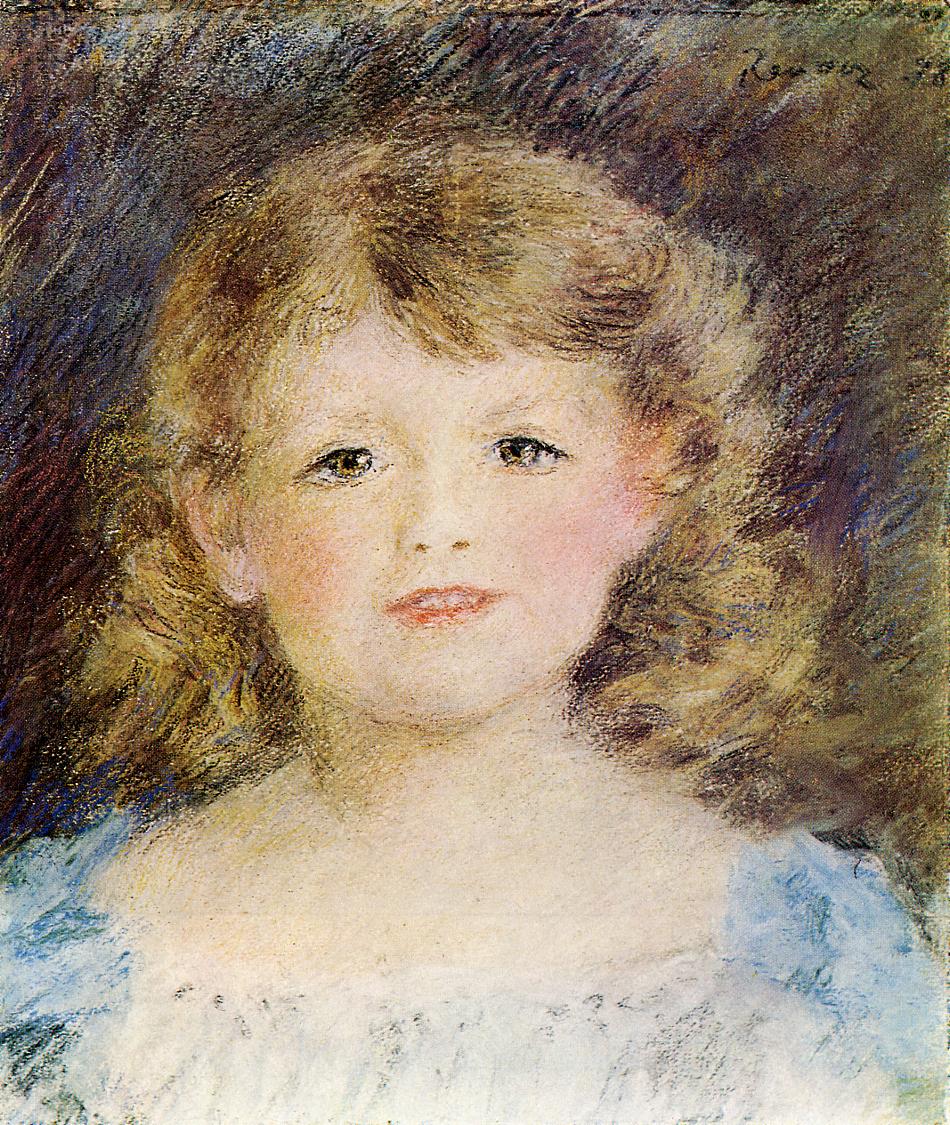
Paul Carpenter
The separate portrait confirms the features of the child placed near Marguerite in the large composition.

Georgette Carpenter
Renoir painted Georgette several times, a sign of an ongoing relationship with the whole family.
Japonism and interior
The living room speaks as much as the faces
Golden screen, plant motifs, vase, table and fabrics place the Charpentiers in the Japanese taste of Paris in the 1870s. These objects do not directly document Japan: they bear witness to the way in which European collectors then selected shapes and patterns to renew their interiors.
Renoir organizes the decor by surfaces. The gold in the background warms the black dress; the flowers are reminiscent of children's blues and roses; the table and armchair create verticals that prevent the large diagonal of the couch from causing the whole group to slide to the right. Luxury can be read overall before being read object by object.
The relationship between the painter and the home goes beyond the portrait. Around 1877-1878, Renoir created a mirror frame for the living room of Madame Charpentier, who had recently entered the Musée d'Orsay. Painting, furniture and decoration therefore contribute to the same modern environment.
Black
Dress and dog form the two masses that support the group.
Blue
The children's outfits create the bright focus of the scene.
Gold
Screen and textiles envelop the figures in decorative warmth.

Literary Paris
A family at the center of a network
The portrait represents three people, but it makes an entire environment visible: publishing, literature, collection and artistic sociability.
Georges Carpenter
Publisher and sponsor of the painting, he notably published naturalist writers and collected modern painters.
Marguerite
She organizes meetings, supports Renoir and gives the works visibility among writers, critics and amateurs.
Flaubert, Goncourt, Zola
These authors are among the personalities associated with the Charpentier show and publishing house.
Renoir
The family's orders provide resources, models and access to new collectors.
Georges Charpentier commissioned the large portrait, but Marguerite actively contributed to its public success. The couple does not just buy works: they create an environment where careers can intersect. Painting becomes both a private commission, a sign of taste and an instrument of visibility.
Renoir continued his relationship with the family after 1879. He painted Georgette again and painted several individual portraits. This continuity shows that the great painting is not an isolated event, but the summit of lasting patronage.
Career
The Salon of 1879 changed Renoir's position
Impressionist exhibitions
Renoir participated in the group's first independent events and built his reputation outside the official show.
The Carpenter order
The large family portrait allows him to bring together worldly ambition, a modern touch and intimate knowledge of models.
Back to the Salon
Renoir presented the fourth impressionist exhibition and presented the painting at the Salon parisien, where the work was critically acclaimed.
Entrance to the Metropolitan Museum
The painting joins the Met thanks to the Catharine Lorillard Wolfe Collection, Wolfe Fund, under number 07.122.

Oil reproduction
Preserve the great horizontal balance
A faithful reproduction must retain the proportions of the horizontal format. Cropbing the canvas would compress Paul against his mother, cut Georgette or reduce the role of the dog and the furniture. The copyist therefore begins by placing the large masses: black dress, light group of children, dog and screen.
Marguerite's dress should not become a flat black. It contains reflections, supple passages and the shine of velvet and lace. Faces and hands require more precision, while decor patterns can keep a freer touch. Painting every detail with the same sharpness would destroy the hierarchy of the gaze.
In an interior, this composition is suitable for a living room, dining room or office with a wide wall. Blacks, golds and blues match walnut, patinated brass, cream, greige, deep green or muffled burgundy walls. A discreet golden frame recalls the spirit of the painting; a dark setting gives it a more contemporary reading.
| Location | Format | Associated colors | Effect |
|---|---|---|---|
| Lounge | Large horizontal | Cream, burgundy, deep green | Narrative center and worldly presence |
| Dining room | Medium or large | Walnut, brass, greige | Warmth and conversation |
| Office | Medium | Dark wood, gray blue | Cultural character and depth |
| Wide entrance | Medium | Light wall, dark setting | Immediate impact and readable details |
Associated portraits
Six works to extend the analysis
Charpentier family, modern women and social portraits show different ways in which Renoir combines people, clothing and social environment.
Madame Charpentier and her children
The large family portrait of 1878, between intimacy, decor and social representation.
Discover →
Mrs. Georges Charpentier
An individual portrait that isolates the calm and assured presence of the salt shaker.
Discover →
Georgette Carpenter seated
Marguerite's daughter in a separate portrait, more intimate and concentrated.
Discover →
The Lodge
Fashion, theater and social visibility condensed into a modern double portrait.
Discover →
The Parisian
A blue dress and an erased background transform a model into a type of modern life.
Discover →
Irene Cahen of Antwerp
Another bourgeois commission where Renoir focuses all the attention on the face.
Discover →Collections
Explore by artist and subject
References
Check facts and objects
Table notice
Identities, date, dimensions, Worth dress, Salon of 1879 and current location.
Metropolitan Museum of Art →Impressionist fashion
Analysis of the black reception dress worn by Marguerite Charpentier.
Musée d'Orsay →Mirror framing
Object painted by Renoir for Madame Charpentier's living room around 1877-1878.
Musée d'Orsay →Salon Archives
Documentary base of the Musée d'Orsay on the works presented by Renoir at the Salons.
Base Salons →Frequently asked questions
Madame Charpentier and her children in eight responses
Who is Madame Georges Charpentier in the painting?
This is Marguerite-Louise Lemonnier, wife of the publisher Georges Charpentier. Salonnière, collector and support of modern artists, she plays an active role in the Parisian cultural network.
Who are the two children represented?
Georgette-Berthe, born in 1872, sits on the left near the dog. Paul-Émile-Charles, born in 1875, stands near his mother.
Why does Paul wear a dress and long hair?
At three years old, Paul followed early childhood clothing practices in wealthy families. His hair has not yet been cut and his clothes resemble those of his sister.
Who created Marguerite Charpentier's dress?
The black dress worn in the portrait is attributed to Charles Frederick Worth. It is an elegant reception dress decorated in particular with velvet and lace.
When was the painting presented at the Salon?
Renoir painted the work in 1878 and presented it at the Official Salon of 1879, where it received a favorable critical reception.
Where are Madame Charpentier and her children today?
The painting is kept at the Metropolitan Museum of Art in New York, where it is currently exhibited in gallery 824 under number 07.122.
What are the dimensions of the table?
The oil on canvas measures 153.7 × 190.2 cm. Its large horizontal format gives the figures and decor an almost life-size presence.
How to choose a faithful reproduction?
Keep the proportions horizontal and choose a hand-painted oil reproduction, attentive to faces, variations of the black dress, blue outfits and living room patterns.
0 comments