

Van Gogh à Arles • Guide art & décoration
Van Gogh à Arles : soleil, Maison jaune et peinture sous haute tension
Une plongée dans l'année la plus lumineuse et tourmentée du peintre, entre rêves d'atelier communautaire et réalités d'une lumière méridionale explosive.
Lorsque Vincent van Gogh débarque à Arles en février 1888, il ne cherche pas simplement un nouveau décor pour ses toiles, mais une régénération totale de sa palette. Fuyant les gris parisiens, il imagine un Japon provençal où la lumière serait si pure qu'elle transformerait la matière même de la peinture. Cette période, souvent réduite à quelques anecdotes tragiques, fut en réalité un laboratoire optique sans précédent où le jaune devint une religion et la touche un geste physique. Comprendre Arles, c'est accepter de voir le monde avec une intensité qui frôle parfois l'insoutenable, là où chaque ombre porte la trace d'une lutte contre la nuit.
 Image libre
La Berceuse transforms Augustine Roulin into a calm, strange presence, closely tied to Van Gogh's Arles gallery.
Méthode de lecture
Reading Arles as a living landscape
To appreciate this period, one must set aside the novelized biography and focus on the technique: how color structures space, how the house becomes a character, and how local faces acquire an ancient monumentality. Here is a journey through the major works to grasp the solar logic of the master.
Context over prestige
We situate Van Gogh in Arles within his era, his studios, his exhibitions, and his small rebellions. A work without context is sometimes just a very beautiful person who has forgotten their story.
The telltale signs of style
We spot The Yellow House, Sunflowers, Café Terrace. These clues often say more than grand speeches, especially when they carry gold or nervous brushstrokes.
The artwork in a real room
Time to ask the real question: does this image actually breathe in your space, or is it just posing like a poster that's read two books?
Contexte historique
Arles: Van Gogh heads south and color turns up the volume
Upon arriving at Arles station, Vincent is struck by a clarity that dissolves the usual outlines of objects, forcing him to rethink his way of capturing reality. In his letters to his brother Theo, he describes this light as the earthly equivalent of the Japanese sky, a natural filter that saturates the blossoming orchards with dazzling whites and acidic greens. He no longer paints the misty atmosphere of the North; instead, he attacks the canvas with direct impasto strokes to capture that constant vibration that seems to make the cypresses and olives dance under the mistral.
This immediate immersion translates into a feverish productivity where each day brings its share of chromatic discoveries along the banks of the Rhône or in the freshly plowed fields. The artist gradually abandons the earthy tones of his Dutch beginnings in favor of a palette where cobalt blue and lemon yellow clash with joyful violence. This is not merely a change of scenery, but a radical stylistic mutation in which the Provençal landscape acts as a chemical catalyst, accelerating the maturation of a style that will soon become universally recognizable.
Style artistique
The Yellow House: A Studio Dream, Solar Walls, and an Artistic Community Project

The famous Yellow House, located on Place Lamartine, was more than just a simple dwelling—it was the physical foundation of an artistic utopia that Vincent called the Atelier du Midi. He rented four rooms and furnished them with spartan economy, painting the walls and furniture himself to create a total visual harmony intended to impress his future colleagues. The ochre façade, bathed in sunlight, became the symbol of this ideal refuge, where communal living was meant to allow painters to share their ideas far from the worldly distractions of the capital.
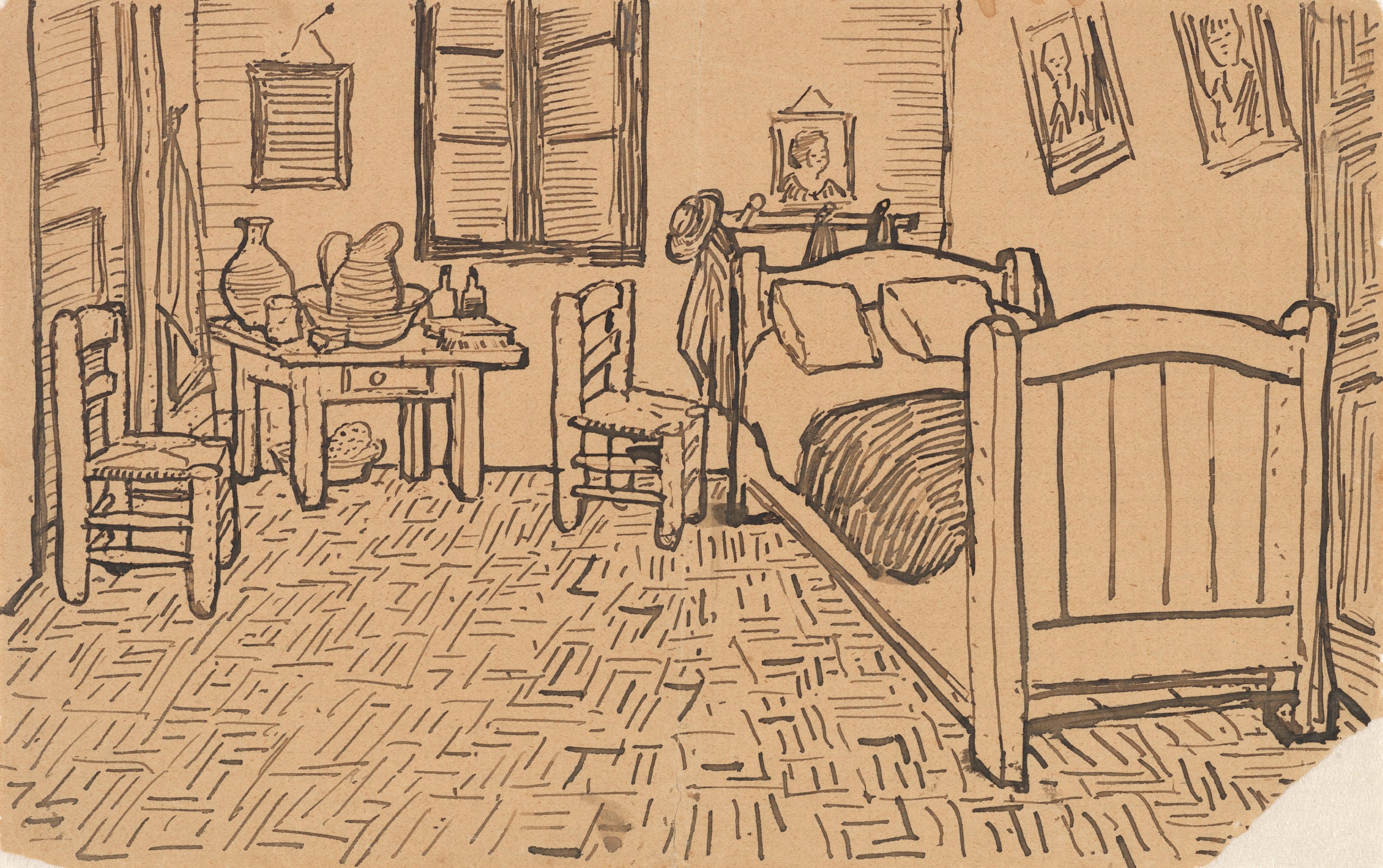
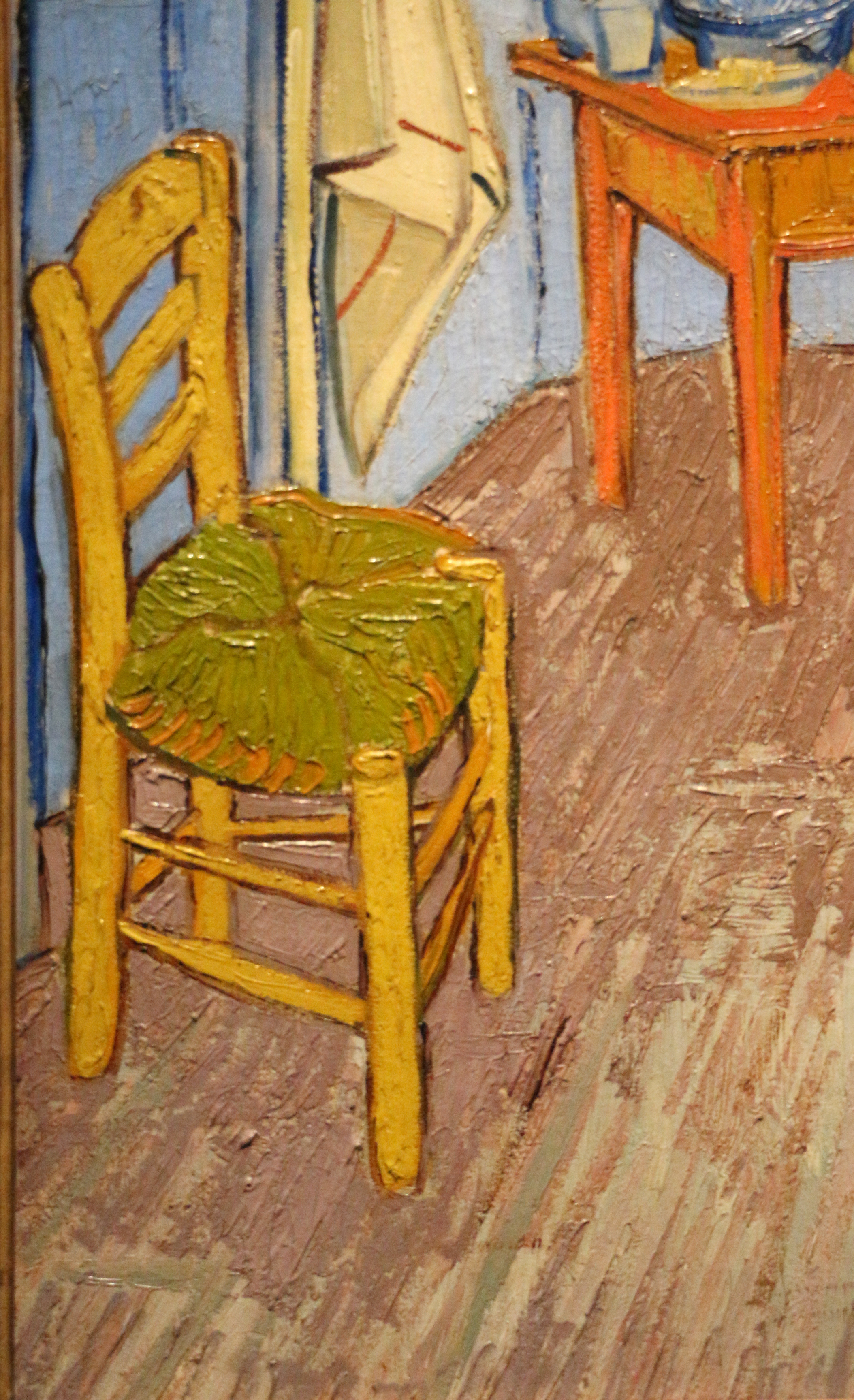
Inside, each object holds its place within a rigorous composition that one finds echoed in the painting depicting his bedroom, with its light wood bed and straw-bottomed chairs arranged facing the emptiness. Vincent saw this sanctuary-like space as the site of a collective rebirth, hoping that the simplicity of the surroundings would foster absolute concentration on the act of painting. Unfortunately, this domestic architecture, however welcoming it may have been, would remain largely unoccupied by the fellow artists he longed to gather, becoming instead the solitary stage for his own decorative experiments.

The Bedroom at Arles
A reproduction connected to Van Gogh in Arles, useful for comparing atmosphere, palette, and wall presence.

The Starry Night
A reproduction related to Van Gogh in Arles, useful for comparing ambiance, palette, and wall presence.
Art & détails
The Sunflowers: Van Gogh prepares for Gauguin's arrival with a bouquet that is anything but shy
To seduce Paul Gauguin and draw him to his Atelier du Midi, Vincent conceived the Sunflowers series as a demonstration of technical and symbolic mastery. He made massive use of chrome yellow, a pigmentation that was new and unstable at the time, to create variations ranging from pale lemon to old gold, defying monochrome through the sheer richness of the brushstroke. These flowers, turned toward their tutelary star, became the guardians of the house—vegetal sentinels meant to signal the arrival of the long-awaited master in the entrance hall.
Beyond their technical prowess, these bouquets embody a gratitude toward the light and a heightened form of artistic hospitality. Vincent works with dizzying speed, layering the paint thickly to give the petals an almost sculptural texture that seems to vibrate beneath the viewer's gaze. When Gauguin finally arrives, he immediately recognizes the power of these works, declaring that these flowers truly belong to him—so perfectly do they capture Vincent's boundless ambition to make painting an act of solar faith.
Art & détails
Evening café terrace: Nuit d'Arles steps out in yellow and blue, brimming with confidence

With the Café Terrace at Night, painted on the Place du Forum, Vincent invented a new way of representing the night—not as a dark veil, but as a colorful, living space. He deliberately sets the deep blue of the starry sky against the orange-yellow glow of the artificial gas lamps, creating a complementary contrast that makes the cobblestones and surrounding façades shimmer. It is the first time he painted a nocturnal sky without using black, proving that darkness can be a symphony of cool tones crossed by human warmth.
The composition guides the eye toward the end of the street, where the receding perspective emphasizes the depth of the scene, while the silhouettes of customers anchor the painting in a tangible social reality. Here, Vincent seeks to capture the electric atmosphere of a modern gathering place, where artificial light transforms urban sociability. This work marks a decisive turning point in his career, heralding the swirling nights to come and affirming his ability to transfigure the mundane into a cosmic vision.
Art & détails
Gauguin arrives: great ambition, great tension, a rather unsettling artistic cohabitation

The arrival of Paul Gauguin on October 23, 1888, marks both the zenith and the beginning of the twilight of the Atelier du Midi dream. The two giants of Post-Impressionist painting work side by side, exchanging ideas about the synthesis of forms and the expressive use of color, yet their methods fundamentally diverge. Where Vincent paints furiously on the spot, capturing the present moment under the pressure of the sun, Gauguin favors working from memory and imagination, recomposing reality in his studio according to more abstract principles.
This intense cohabitation sparks passionate debates that swing between mutual admiration and violent ideological clashes over the very nature of art. Evenings stretch on over glasses of absinthe, fueling a creative fever that leaves visible marks in their respective works from this period—such as the empty chairs symbolizing their absence or conflicting presence. Tension builds gradually, transforming the Yellow House into a psychological pressure cooker where every aesthetic disagreement takes on outsized existential weight.
Œuvres à connaître
Famous Van Gogh works from Arles to look at before choosing
For a hand-painted Van Gogh Arles reproduction, a Van Gogh Arles oil painting, or a Van Gogh Arles copy, the most helpful thing is to compare several images: the gilding, the faces, the density of the patterns, and how each piece holds up on the wall.
- Terrasse du café le soirUne porte d'entrée visuelle pour comprendre Van Gogh à Arles sans transformer l'article en inventaire.
- La Chambre à ArlesUne reproduction liée à Van Gogh à Arles, utile pour comparer ambiance, palette et présence murale.
- La Nuit étoiléeUne reproduction liée à Van Gogh à Arles, utile pour comparer ambiance, palette et présence murale.
Art & détails
December 1888: the ear does not define Arles, even if it tries to capture all the light

The crisis of December 1888, culminating in Vincent's self-mutilation, is often reduced to a sordide news item, obscuring the complexity of the painter's mental and physical collapse. This tragic episode occurs after weeks of overwork, alcoholism, and emotional instability exacerbated by Gauguin's hasty departure, leaving Vincent alone to face his demons in the city he adored. His hospitalization at the Hôtel-Dieu in Arles then becomes a forced interlude, during which he alternates between moments of sharp lucidity and periods of deep confusion.
Yet even through pain and convalescence, Vincent continued to paint, producing notably moving self-portraits in which his face appears bandaged, a silent testament to his suffering. These works are not gratuitous cries of distress, but desperate attempts to reclaim possession of his image and his art in the face of the madness that awaited him. Reducing Arles to this incident means ignoring the artist's extraordinary resilience, who, despite everything, would attempt to rebuild his pictorial universe before leaving the city for the asylum at Saint-Rémy.
Art & détails
Roulin, Ginoux, Rey: Arles gives Van Gogh faces that don't pretend

Lacking professional models, Vincent turns to the people of Arles, finding in their features a raw authenticity reminiscent of the portraits of old masters. The Roulin family, and particularly the postman Joseph with his full beard and blue uniform, becomes his favorite subject, immortalized in several versions where color replaces traditional modeling to express the dignity of the working man. Likewise, Madame Ginoux, the café owner, is depicted with an almost Byzantine solemnity, her folded hands suggesting infinite patience in the face of provincial life.
Dr. Félix Rey, who treated Vincent after his breakdown, is also the subject of a vigorous portrait in which the vivid red background brings out the doctor's youth and energy. Through these local figures, Vincent seeks not photographic likeness, but rather attempts to capture the soul of his models through a calculated exaggeration of color and contour. These portraits form a unique human gallery, transforming ordinary citizens into timeless archetypes, rooted in the Arlesian soil yet elevated by the grace of Van Gogh's style.
Décoration intérieure
Choosing an Arles Van Gogh: sunshine guaranteed, inner peace not included

Selecting a reproduction from this period for your interior requires considering the energetic impact of the palette, as the yellows of Arles tend to dominate the visual space of a room. A canvas like Sunflowers will bring immediate and dynamic warmth, ideal for a living room or dining area where you want to stimulate conversation and appetite. Conversely, Bedroom in Arles, with its more soothing blues and lilacs, could suit a restful space, although the tilted perspective retains a certain intriguing graphic tension.
One should also consider the ambient lighting: these works, created for intense natural light, reveal all their textural complexity under good directional lighting that accentuates the raised quality of the brushwork. Avoid placing them in areas that are too dark, where the richness of contrasts would be lost, reducing the painting to a uniform blot. Choosing Van Gogh means accepting the invitation to bring a telluric force into your home—a presence that doesn't settle for simply decorating the wall, but actively engages in dialogue with the architecture and the mood of its inhabitants.
| Pièce | Suggestion | Effet décoratif |
|---|---|---|
| Salon | Une oeuvre liée à Van Gogh à Arles avec une composition forte | Point focal cultivé, chaleureux et facile à commenter sans réciter un cartel. |
| Chambre | Une palette douce ou une scène plus intime | Atmosphère calme, présence visuelle sans agitation inutile. |
| Bureau | Une image structurée, colorée ou graphiquement nette | Énergie créative et petit rappel que le mur peut aussi travailler. |
| Entrée | Un format vertical ou une oeuvre immédiatement lisible | Première impression claire, élégante, et nettement moins timide qu'un vide blanc. |
Pour continuer la visite
Sources, collections, and paths truly related to the subject
A few useful references to verify information, compare free images, and keep exploring without going off on a tangent no one asked for.
Van Gogh Collections validated
Arles works to compare
Van Gogh References
Useful sources on this topic
- Wikipedia FR - Vincent van Gogh
- Wikidata - Vincent van Gogh
- Wikipedia - Van Gogh's Chair
- Wikipedia - The Yellow House
- Wikipedia - Café Terrace at Night
- Wikipedia - Sunflowers
- Wikipedia - The Painter of Sunflowers
- Wikipedia - The Roulin Family
- Van Gogh Museum - Letters
- Wikimedia Commons - Van Gogh in Arles
FAQ
Frequently Asked Questions about Van Gogh in Arles
What is Van Gogh's Arles period in painting?
Arles is Van Gogh's great solar laboratory of 1888-1889: the Yellow House, Sunflowers, Café Terrace at Night, portraits of Roulin and Gauguin, the December crisis, and the fragile dream of a studio in the South.
How to quickly recognize this style?
Pay special attention to Yellow House, Sunflowers, Café Terrace, the Roulin family, and L'Arlésienne—and to the way the composition guides the eye. If the piece holds your gaze longer than expected, that's probably no accident.
Which artists should you know?
The main figures are Vincent van Gogh, Paul Gauguin, Theo van Gogh, Joseph Roulin, and Augustine Roulin.
Would this style work well with modern décor?
Yes, provided you choose the right format, a palette that harmonizes with the room, and a piece whose presence remains pleasing day after day.
Should you choose the most famous work?
Not necessarily. The most famous piece might be perfect, but the right choice really depends on the room, the format, the color palette, and the atmosphere you're looking for.
Where to check the information?
Start with museum records, Wikipedia/Wikidata for general orientation, then turn to Wikimedia Commons when a royalty-free image is needed.
The incandescent legacy of a unique year
Vincent van Gogh's Arles period remains an absolute pinnacle of art history, not despite the suffering, but thanks to a remarkable capacity to transform reality into pure vision. In less than two years, he redefined the role of color, turned the humble home into a poetic subject, and elevated the everyday portrait to the rank of universal icon. Looking at these works today is still to feel that specific warmth of the Midi, that vital urgency, and that unshakable conviction that painting can save — or at the very least, briefly illuminate — human existence.
0 comments