

Van Gogh au Louvre • Guide art & décoration
Van Gogh au Louvre : maîtres et pinceaux, le guide qui regarde sous le vernis
Van Gogh au Louvre raconté à partir des questions que les lecteurs se posent vraiment : vie, oeuvres, détails, contexte, sources et choix déco, avec un ton cultivé mais pas coincé dans une vitrine.
Imaginez Vincent van Gogh, ce Hollandais têtu aux yeux bleus perçants, errant dans les galeries du Louvre non pas comme un touriste pressé, mais comme un affamé cherchant sa prochaine ration de beauté. Entre 1886 et 1888, Paris devient son école à ciel ouvert où il dévore les leçons des anciens pour mieux les recracher avec une violence toute moderne. Ce musée n'était pas alors la forteresse bondée que nous connaissons, mais un atelier silencieux où les copistes venaient décortiquer la touche de Delacroix ou la lumière de Rembrandt. Comprendre ce dialogue intense entre le génie postimpressionniste et les maîtres du passé éclaire d'un jour nouveau nos propres choix décoratifs. Il ne s'agit pas d'accrocher une image pieuse au mur, mais d'inviter une énergie brute, forgée dans le feu de l'apprentissage et de la révolte.
 Image libre
The Louvre places Van Gogh in the great conversation of the masters: an immense museum, models everywhere, and many walls that hold memory.
Méthode de lecture
The active gaze method
To fully appreciate Van Gogh's legacy from his museum visits, you must abandon passive contemplation. Observe how he transforms an academic lesson into an emotional cry, note the density of the material and the boldness of the contrasts. This approach will guide you toward reproductions that truly live in your space.
Context over prestige
We place Van Gogh back at the Louvre within his era, his studios, his exhibitions, and his small rebellions. A work without context is sometimes just a very beautiful person who has forgotten their story.
The telltale signs of style
We pick up on composition, palette, texture. These clues often say more than grand speeches, especially when they carry gold or bold, nervous brushstrokes.
The piece in a real room
We'll end with the useful question: does this image breathe in your space, or does it just pose like a poster that's read two books?
Contexte historique
Van Gogh at the Louvre: Before the Myth, a Painter Who Studies the Masters Up Close
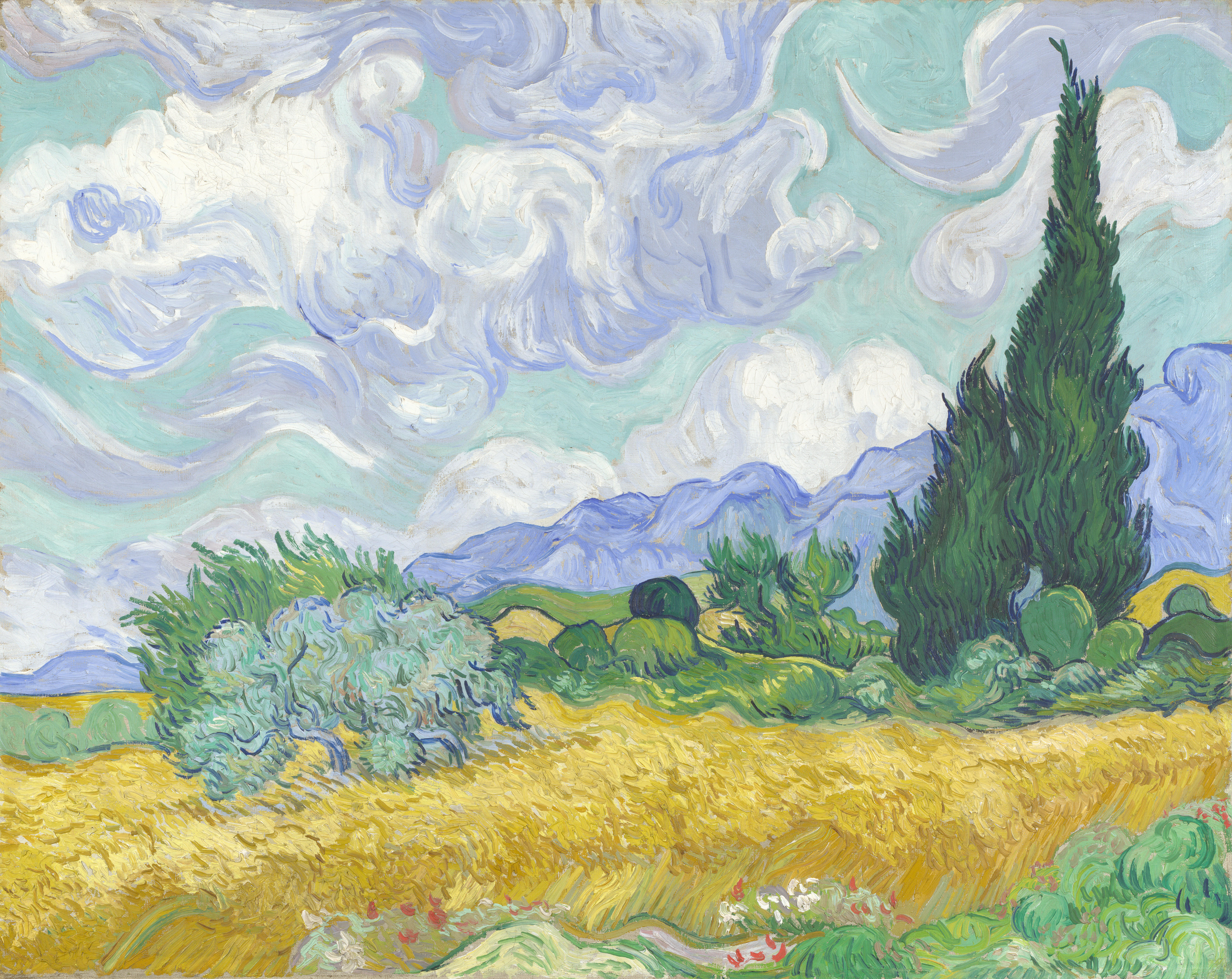
In the 19th century, the Louvre functioned as an immense visual library where every artist came to draw from their pictorial grammar. Vincent, who arrived in Paris in 1886, spent entire days there before the canvases of Eugène Delacroix, whom he considered the absolute master of expressive color. He was not seeking to slavishly imitate historical or mythological scenes, but to understand how red and green clash to create movement without ever neutralizing each other. In his letters to his brother Theo, he described these study sessions as vital, comparing the paintings of the old masters to substantial food of which he had been desperately in need after years of artistic famine in Holland.
This artist's gaze transforms the cultural visit into a grueling technical exercise. Where the modern visitor sees a finished, untouchable work behind glass, Van Gogh saw a construction, an assembly of brushstrokes he could mentally dismantle. He studied particularly how Flemish masters like Frans Hals captured the instantaneousness of a gesture, a lesson he would later apply to his own rapid portraits. This devoted attendance sharpened his eye, allowing him to distinguish the essential from the superfluous and to understand that tradition is not a dead weight, but a springboard to launch his own painting toward new, vibrant horizons.
Style artistique
Before Paris: the dark earth of Nuenen comes to the museum in its big clogs

Before discovering the luminous halls of the Louvre, Vincent's chromatic universe was that of scorched earth and smoke-filled interiors in Nuenen. His masterpiece from this period, The Potato Eaters, painted in 1885, uses skin tones recalling the color of an unpeeled potato—deliberately drab to emphasize the rough dignity of peasant labor. When he arrives in Paris with this palette of bitumen and dark ochre, the clash with French light and museum collections is violent, almost physical. His early Parisian paintings still betray this heaviness, as if he were trying to paint the Seine with the same thick mud he used for the floors of Brabant cottages.
However, it is precisely this austere training that gives such weight to his later transformation. The solidity of the forms learned under Jean-François Millet, whose social realism he deeply admired, remains the framework of his style even when color explodes. Without this dark period, the lemon yellows and cobalt blues of his mature works would not have possessed such dramatic resonance. The museum gave him light, but it was his own history, shaped by mines and harsh winters, that lent that light a vital urgency. He does not reject his past; he transfigures it, using the lessons of the old masters to make sing what was once mute and heavy.
Art & détails
Paris opens its windows: at the Louvre and beyond, color begins to take liberties

His arrival in Paris in 1886 marked a definitive break, accelerated by his discovery of Impressionism through dealers like Père Tanguy and by repeated visits to the Louvre. Vincent quickly understood that color could exist for its own sake, independent of any faithful description of reality. Under the influence of Camille Pissarro and his brother Theo, who kept him informed of the latest trends, his palette lightened dramatically. He began using divided brushstrokes, inspired by Chevreul's theories on the simultaneous contrast of colors, transforming his gray skies into mosaics of vibrant blue and white.
The Louvre plays a catalyst role here rather than serving as a single model. By observing how Rubens used glazes to make flesh shimmer or how Veronese played with silvery reflections, Vincent dares to free his own brushwork. He does not copy their subjects, but steals their boldness. His still lifes of flowers, created during this Parisian period, become laboratories of experimentation where each petal is an opportunity to test a new harmony. The entire city, from its Haussmann boulevards to its Seine quays, becomes an extension of the museum, offering shifting light that compels him to paint faster, more directly, capturing the fleeting moment with contagious fever.
Art & détails
Japanese Prints: The Louvre Isn't the Only One Having Its Eyes Shaken Up
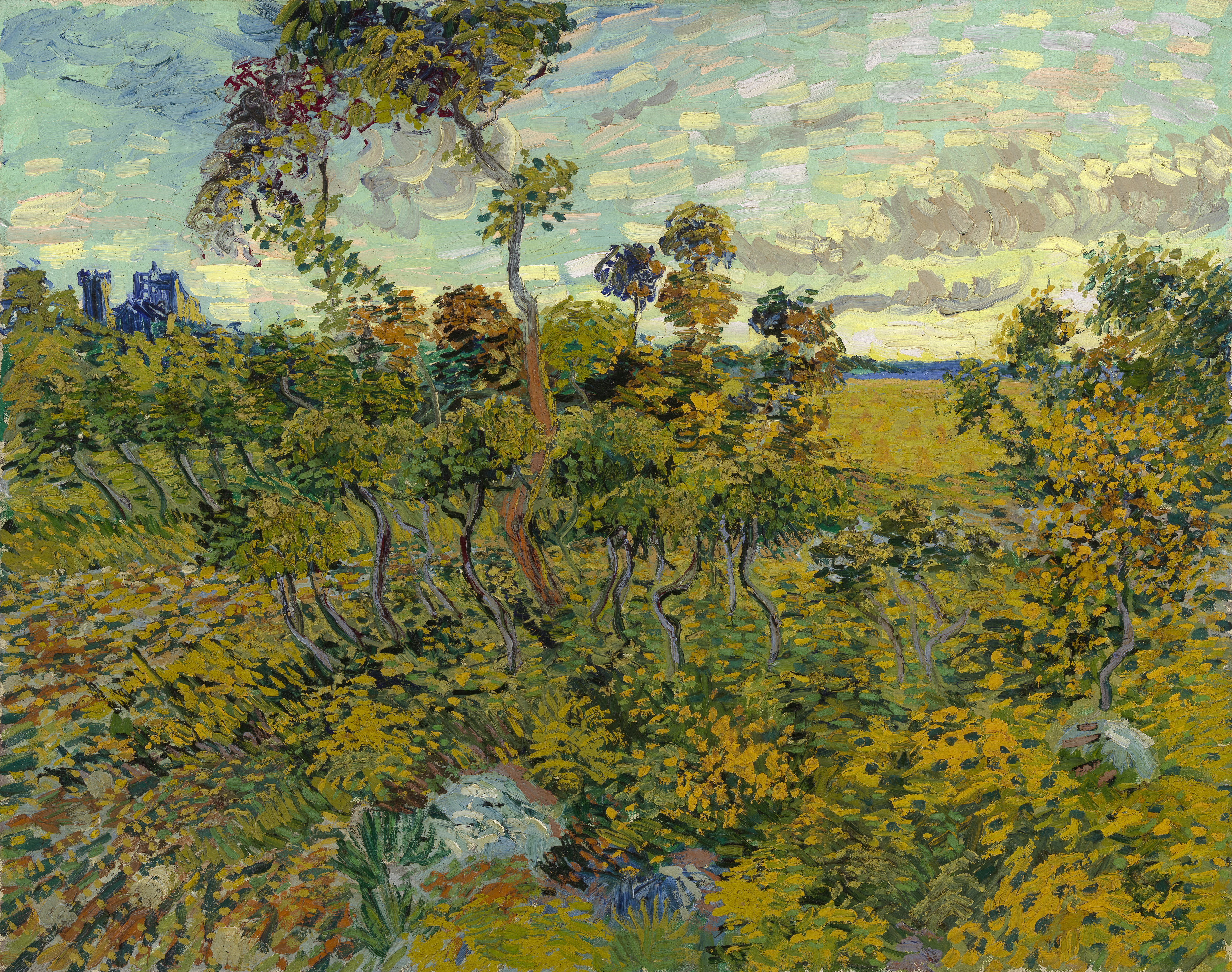
If the Louvre represents the Western tradition, Japanese prints form the other major pillar of Van Gogh's visual revolution. In Paris, he frantically collected these inexpensive prints from overseas, going so far as to decorate the walls of his studio with hundreds of images by Hiroshige and Utamaro. This Japonisme was no passing fad; it gave him a new spatial grammar made up of bold outlines, vivid flat areas of color, and daring compositions that cropped subjects in unexpected ways. He even produced oil-painted copies of these prints, such as the one of the Flowering Plum Tree, translating the black ink into thick, colorful brushstrokes.
This influence combines curiously with his studies at the Louvre to create a hybrid and unique style. Where the old masters taught depth through sfumato and linear perspective, the Japanese taught him to flatten space and make surfaces dialogue with one another. This fusion is found in his Arles landscapes, where cypress trees rise like black flames against backgrounds of pure blue sky, without clouds or subtle gradients. Vincent's gaze then becomes a gigantic sponge, absorbing both the classical nobility of museums and the graphic freshness of popular images, to create an explosive synthesis that redefines modern painting.
Art & détails
The masters are not statues: Van Gogh answers them with his own nerves

Unlike many of his academic contemporaries, Van Gogh does not seek to produce smooth, invisible copies of works from the Louvre. His method is one of nervous, even violent interpretation. When he decides to take up Delacroix's Pietà, he is not content with merely reproducing the composition; he reinvents the very substance of the work, transforming the romantic's flowing draperies into swirls of thick paint where blue and yellow clash. Every brushstroke is an affirmation of his presence—a way of telling the departed masters: "I have heard you, and here is my answer." This approach makes his tributes more alive than many a dusty original.
This freedom from the authority of the old masters is what allows his style to remain so contemporary today. He shows that one can respect tradition without submitting to it, using its codes to express a burning inner truth. In his copies of Millet, he introduces colors that didn't exist in the original black-and-white drawings, projecting an imaginary southern luminosity into these rural scenes. It's a dialogue across time, where Vincent uses the vocabulary of the great masters to tell of his own solitude and hope, proving that art is an endless conversation rather than a series of sacred monologues.
Art & détails
After the museums, Auvers: the lesson becomes a landscape that sways

In the final months of his life, spent in Auvers-sur-Oise under the caring watch of Dr. Gachet, all the lessons gathered at the Louvre and in Paris reach their point of fusion. The landscapes of this period, such as the famous Wheatfield with Crows, reveal total mastery of composition and color, but also an unprecedented dramatic tension. The lines of force of the earth and sky collide with such vigor that the canvas seems to vibrate, on the verge of tearing apart. This is the culmination of his artistic journey: the technique has been so thoroughly absorbed that it nearly vanishes, giving way to a pure, raw, and immediate emotion.
Even in his final portraits, such as that of Doctor Gachet or Mademoiselle Gachet, one senses this perfect synthesis. The background is no longer a mere setting, but an active space, treated with the same care as the face, often inspired by the floral backdrops of the Japanese masters or the rich textures of Dutch portraits. The melancholy that emanates from these works is not a confession of weakness, but the proof of a sensitivity brought to its incandescence. Vincent digested the centuries of painting that preceded him to create a visual language capable of translating the tremors of the human soul in the face of nature.
Art & détails
Portraits and models: looking at others without turning it into a school exercise

The portrait was Van Gogh's preferred experimental ground, where he could apply his museum discoveries to living flesh. Unlike the frozen, official portraits of the academy, his models always seem on the verge of moving, speaking, or blinking. He uses colorful backgrounds, often made up of floral patterns or stripes, to bring out the personality of his subjects—a technique he may have observed in certain Renaissance portraits or among the Impressionists. Each face tells a story, not through anecdotal detail, but through the intensity of the gaze and the vibration of color surrounding the head.
This humanist approach transforms the portrait into an act of compassion and mutual understanding. Whether painting the postman Roulin with his majestic beard or his own likeness in the many self-portraits, Vincent always seeks to capture the moral essence of his subject. He does not flatter—he reveals. For today's interior decorator or art lover, choosing a Van Gogh portrait means opting for a powerful presence in a room. These works do not ask to be admired from afar with deference; instead, they invite a silent exchange, creating an immediate intimacy between the viewer and the subject depicted.
Décoration intérieure
Choosing a Van Gogh after the Louvre: keep the master, skip the dusty reverence

Choosing a Van Gogh reproduction for your home means looking beyond the tourist icon to find the piece that truly resonates with your living space. Rather than defaulting to the ultimate celebrity of the Sunflowers, consider landscapes like the Olive Trees or the Wheat Fields, where the dynamic brushwork creates a visual rhythm capable of bringing a neutral wall to life. Even in reproduction, the texture of the painting should suggest that characteristic relief, that impasto technique that bears witness to the speed and passion of the original gesture. Such a piece brings organic warmth and moving energy that will contrast wonderfully with the clean lines of contemporary interior design.
Also consider scale and palette: a large format with deep blues and vibrant yellows can serve as a focal point in a living room, while a more intimate portrait will suit an office or bedroom better. What matters is preserving that spirit of lively dialogue Vincent maintained with the masters of the Louvre. Your choice should not be static decoration, but a daily invitation to look at the world with greater intensity and color. When you hang a Van Gogh, you are not simply hanging a painting—you are installing a fragment of that visual adventure where tradition and modernity embrace passionately.
| Pièce | Suggestion | Effet décoratif |
|---|---|---|
| Salon | Une oeuvre liée à Van Gogh au Louvre avec une composition forte | Point focal cultivé, chaleureux et facile à commenter sans réciter un cartel. |
| Chambre | Une palette douce ou une scène plus intime | Atmosphère calme, présence visuelle sans agitation inutile. |
| Bureau | Une image structurée, colorée ou graphiquement nette | Énergie créative et petit rappel que le mur peut aussi travailler. |
| Entrée | Un format vertical ou une oeuvre immédiatement lisible | Première impression claire, élégante, et nettement moins timide qu'un vide blanc. |
Pour continuer la visite
Sources, collections, and paths truly related to the topic
A few useful references for verifying information, comparing free images, and continuing the reading without dragging a museum into this that never asked to be involved.
Useful collections
FAQ
Frequently Asked Questions about Van Gogh at the Louvre
What about Van Gogh at the Louvre in painting?
Van Gogh at the Louvre deserves a feature article because this style engages both an era, a way of painting, and a very concrete way of living with images.
How to recognize this style quickly?
Pay close attention to composition, palette, material, light, and atmosphere, then notice how the composition guides your eye. If the piece holds your attention longer than expected, it's probably no accident.
Which artists should you know?
One must cross-reference the central artists of the movement with museums and reliable sources to avoid hasty attributions.
Does this style work for a modern décor?
Yes, provided you choose the right format, a palette that harmonizes with the room, and a piece whose presence remains enjoyable on a daily basis.
Should we choose the most famous work?
Not necessarily. The most well-known piece may be perfect, but the right choice mainly depends on the room, the format, the palette, and the atmosphere you're going for.
Where to check the information?
Start with museum records, Wikipedia/Wikidata for general background, then Wikimedia Commons when a royalty-free image is needed.
A living heritage for your walls
Van Gogh's journey through the Louvre and through the influences of his time reminds us that art is a continuous adventure, shaped by borrowings, struggles, and transformations. Choosing one of his works for your home means welcoming this spirit of freedom and this thirst for beauty that have traveled through the centuries. Whether through the force of a stormy landscape or the gentleness of a penetrating portrait, these images continue to speak to us, not as relics of the past, but as living companions for our daily lives. So let these famous brushes transform your walls into spaces of reflection and wonder, in the image of this great traveler of light.
0 comments