

Vincent van Gogh · 1853 -1890 · The essential guide
van Gogh FAQ: life, works, style and reliable answers
Why do his paintings vibrate? Did he really sell a single work? Where to see Starry Night ? Here are the clear, nuanced and visual answers to the questions that his immense legend sometimes ends up confusing.
This FAQ does not reduce Van Gogh to the severed ear or the "mad genius". She follows her late learning, her workplaces, her letters, her color and her masterpieces, then translates these benchmarks into concrete advice for choosing a reproduction.

Before the myth
Who was Vincent van Gogh really?
Vincent Willem van Gogh was born on March 30, 1853 in Zundert, the Netherlands. He was not immediately destined for painting. He first worked for the art dealer Goupil, passed through London and Paris, attempted teaching then preaching in the Belgian Borinage. This dispersed journey nourished a deep visual and literary culture, but the artist only truly chose drawing around 1880, at the age of twenty-seven.
His learning is stubborn. He copies engravings, studies anatomy, draws peasants, weavers, trees and shoes. In Nuenen he looks for a dark and serious painting, culminating with Potato Eaters. In Paris, contact with impressionism, neo-impressionism and Japanese prints clarified his palette. In Arles, Saint-Rémy then Auvers-sur-Oise, he developed this language of lines, colors and materials that we recognize immediately today.
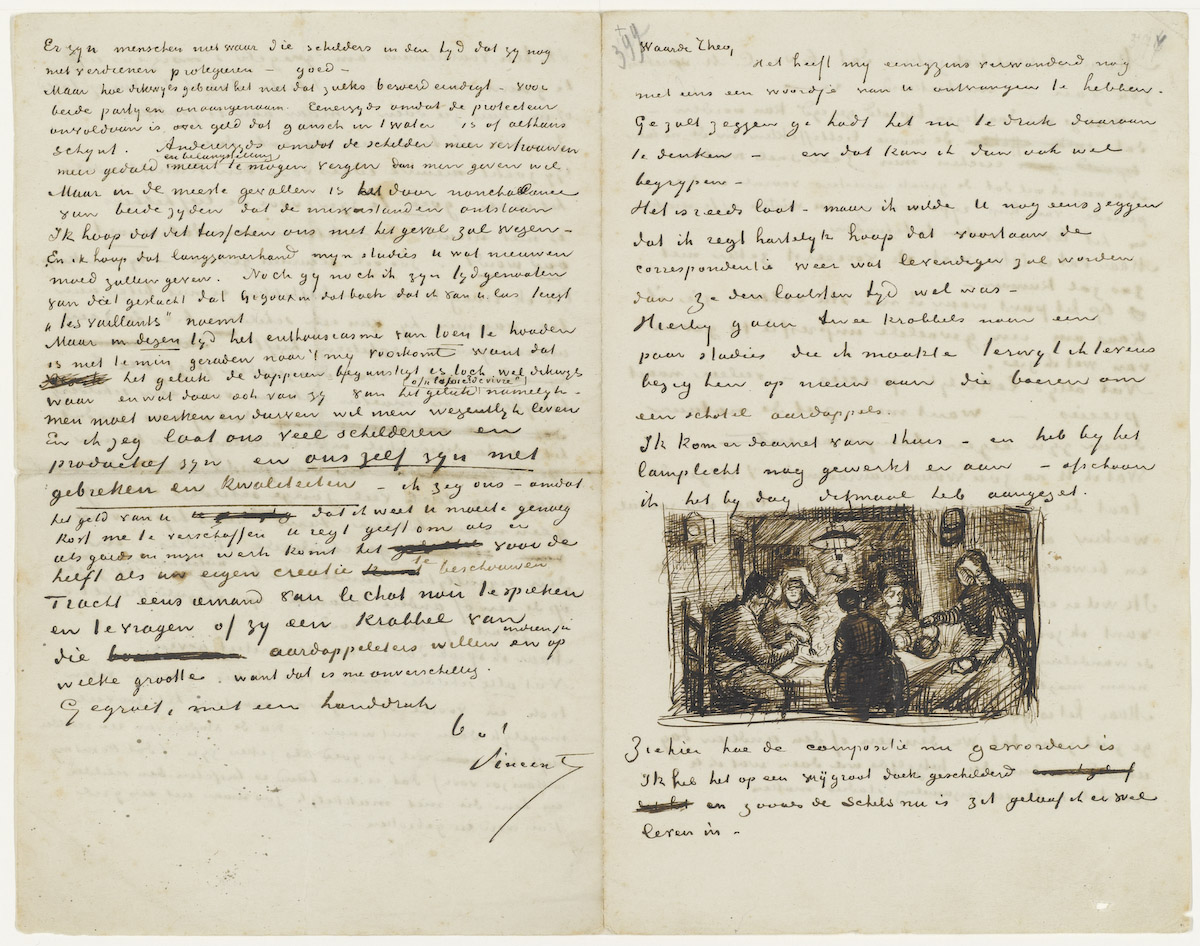
The relationship with his brother Theo is decisive. Theo provides financial assistance, materials, news from the artistic world and a demanding interlocutor. Their letters are not only the diary of suffering: they detail Vincent's readings, his choices of pigments, his paintings in progress, his decorative ambitions and his doubts. They show an informed, methodical painter capable of analyzing his work with precision.
Six steps to understanding evolution
From the brown earth of Brabant to the blue sky of Saint-Rémy
Van Gogh's style changes with the place. Each move brings new subjects, new encounters and another light. The chronology avoids confusing the dark palette of the beginnings with the chromatic intensity of the South.
Before art
Art trade, England, religion and Borinage. Drawing ultimately becomes a vocation.
Netherlands
Popular figures, weavers and peasants. Tones of land and ambition of Eaters.
Paris
Impressionists, Signac, Toulouse-Lautrec and Japanese prints release color and touch.
Arles
Orchards, nights, portraits, Sunflowers and Yellow House. The style achieves a new clarity.
Saint-Rémy
Asylum garden, olive trees, cypresses, irises and landscapes recomposed from the bedroom.
Auvers
Seventy very productive days, portraits of Doctor Gachet and vast fields.
True, false or more complicated
Eight quick responses to preconceived ideas about Van Gogh
Van Gogh's biography has been simplified by novels, cinema and the market. The fairest answers are often less spectacular, but much more interesting.
Did he sell a single painting?
The formula is too categorical. The Red Vineyard is the most famous documented sale, but Van Gogh also exchanged or sold drawings and other works. His recognition nevertheless remained very limited during his lifetime.
Was he self-taught?
Largely, but not isolated. He took classes, received advice from Anton Mauve, studied textbooks, frequented artists and methodically copied Millet, Delacroix and Japanese prints.
Was he only painting in crisis?
No. His periods of illness often interrupt work. Many paintings require observation, preparation, drying and rework. Discipline, not crisis, explains the continuity of the work.
Did he paint Starry Night outside?
The canvas is made in the Saint-Rémy workshop from sight, drawings, memories and invention. The village and several elements of the sky are recomposed.
Why does he sign "Vincent"?
His Dutch name was difficult to pronounce in France. He signs certain works with his first name, but many bear no signature. The absence of a name therefore proves nothing in itself.
Did he cut off his entire ear?
Sources speak of part of the left ear, but the exact extent remains debated. The event of December 1888 should not become the summary of his career.
Does yellow come from vision disorder?
No single medical explanation is enough. Yellow responds to aesthetic choices, Provence, Monticelli, complementary and available pigments.
Was he unknown to everyone?
He remained poor and sold little, but artists and critics followed his work. In 1890, Albert Aurier published a laudatory article and several paintings were exhibited in Brussels and Paris.
Look before you recognize
How can we recognize Van Gogh's style without trusting the subject?
A vase, cafe or field does not become "Van Gogh" because they are yellow. The visual signature arises from several coordinated decisions: direction of the key, color ratios, simplification of shapes and movement of the composition.

The key follows the shape and sets the air in motion
Van Gogh often leaves brushstrokes visible. They circle around a face, rise with a cypress tree, undulate in a field or radiate around a star. The key functions like a colorful drawing. It describes the material while giving the surface autonomous energy.
Impasto also matters. The reliefs catch the real light of the room and make the yellows, whites or greens more physical. However, not all areas are thick. Van Gogh alternates dense material, sometimes visible canvas and fluid lines. Successful reproduction must retain these variations, without uniformly transforming every centimeter into decorative paste.
The composition is often more constructed than it appears. The diagonals of a room, the verticals of the trees, the curves of the sky and the dark contours organize the reading. Japanese influence can be seen in the flat areas, cut frames, sharp lines and high viewpoints, but Van Gogh adapts them to his own language.
Van Gogh's color is not a neutral copy of reality. It organizes a sensation: blue can make yellow breathe, green make a red more violent, and a sky becomes more present than the landscape it dominates.
Principle of reading based on his works and his explanations in letters.A geography of style
Paris, Arles, Saint-Rémy, Auvers: what does each place change?
Following Van Gogh on a map means following the evolution of his painting. The motifs are never interchangeable: the city, the light, the encounters and even the format of the canvases modify his way of working.


See, read and check
Which museums and sources allow you to get to know Van Gogh better?
Van Gogh's fame produced a considerable amount of anecdotes. To distinguish a documented fact from an attractive interpretation, one must cross paintings, letters and museum research. None of these elements alone is enough: a letter illuminates an intention at a given moment, a material analysis reveals the state of the pigments, and direct confrontation with the canvas shows what the reproductions flatten.

Amsterdam is the starting point, not the only place to visit
The Van Gogh Museum preserves the artist's largest collection of works and letters. His journey allows us to follow the periods in order and observe the transitions: the drawings of Borinage and The Hague, the earthy tones of Nuenen, the Parisian light, Arles, Saint-Rémy and Auvers. This continuity is essential, because the isolated icons give the misleading impression of a suddenly appearing style.
The Kroeller-Müller Museum, in the heart of the De Hoge Veluwe National Park, is the other major Dutch destination. In Paris, the Musée d'Orsay brings together several major paintings, including portraits and landscapes of Auvers. London, New York, Los Angeles, Munich, Tokyo and other cities each retain a piece of the puzzle. Starry Night located at MoMA; THE Sunflowers from 1888 the best known are distributed between several institutions.
Seeing an original brings information that is impossible to reduce to your photography: the scale, the uneven thickness, the dullness of certain areas and the accidents of the support. The gaze moves with the light of the room. This is precisely what a good reproduction must translate honestly, without claiming to replace the historical object.


Nine entry doors into the work
Which Van Gogh paintings should you know first?
There is no definitive ranking. This selection covers the periods, genres and color experiences most useful for understanding its evolution instead of repeating only the three most famous titles.
Starry Night
The sky, the cypress and the recomposed village show how observation and imagination can form a unity.

Sunflowers
A decoration for the Yellow House that has become manifest with yellow, impasto and the flower cycle.

The Room in Arles
Deliberately simplified perspective, flat colors and desire for rest.

The Iris
Outlines, floral rhythm and purple versus green in the Saint-Rémy garden.
Potato Eaters
His first large painting of figures and the best response to the cliché of the purely solar painter.

Starry night on the Rhône
Reflections of gas, deep blue and discreet torque in the foreground.
Café terrace in the evening
A bright urban night, very different from the oppressive interior of the Night cafe.
Bandaged ear
An important visual document, but above all a refined construction of greens, oranges and lines.
Almond tree in bloom
A gift for his nephew where the branch, the sky and Japanese influence announce renewal.

Two sunflowers cut
Before the Arles vases, reclining flower heads become almost tactile studies of matter.
Art history on the wall
Which reproduction of Van Gogh to choose depending on the piece?
Good work is not necessarily the most famous. You have to match your energy, format and palette to the real light of the room. A painting viewed daily must continue to breathe when the immediate recognition effect has dissipated.
| Room or atmosphere | Recommended works | Why it works | Preferred format |
|---|---|---|---|
| Bright living room | Sunflowers, orchards, wheat fields | The yellows respond to natural light and create a warm focal point. | Large vertical or wide landscape above a sofa. |
| Quiet room | Almond tree in bloom, The room, iris | Blues, greens and more spaced rhythms offer a clear presence without excessive agitation. | Medium format, light frame or natural wood. |
| Creative Office | Starry Night, self-portraits, cypresses | The visible touch and diagonals maintain the energy of the gaze. | A strong work or a coherent diptych. |
| Dining room | Café terrace, Night on the Rhône | The night scenes bring depth, light and conversation. | Horizontal landscape at eye level seated. |
| Narrow entrance | Flowering branches, portraits, vases | A vertical composition can be read quickly without reducing circulation. | Narrow vertical, sufficient margin around. |
Browse the store differently
Choose by period, pattern or atmosphere
These collections allow you to extend a specific question: follow Van Gogh in a city, compare several versions of a pattern or find a palette adapted to your interior.
Vincent van Gogh
The complete catalog to compare portraits, landscapes, flowers, night scenes and still lifes.
Essential selection100 popular works
A narrow journey among the artist's most sought-after images.
1888 - 1889Van Gogh in Arles
Yellow house, portraits, cafes, orchards and nights.
1889 - 1890Saint-Rémy
Cypress trees, olive trees, irises and asylum landscapes.
Last monthsAuvers-sur-Oise
Houses, portraits and fields in panoramic format.
Blues and yellowsStarry nights
Van Gogh's great nocturnes reunited.
Iconic patternSunflowers
Arles vases and Parisian studies.
FlowersIris
Violets, greens and gardens of Saint-Rémy.
SpringAlmond trees
Flowering branches and light blue sky.
FacesSelf-portraits
Transforming a model that is always available.
HorizonsLandscapes
Fields, roads, gardens, hills and villages.
InfluencesVan Gogh and Japan
Frames, contours and flat areas inspired by prints.
Frequently asked questions
Answers to keep on hand
When was Vincent van Gogh born and dead?
He was born on March 30, 1853 in Zundert, the Netherlands, and died on July 29, 1890 in Auvers-sur-Oise, at the age of thirty-seven, two days after being shot and wounded.
How long was Van Gogh a painter?
His active artistic career lasted approximately ten years, from 1880 to 1890. This short period included several thousand drawings, paintings, studies and letters which documented extremely rapid evolution.
What is Van Gogh's most famous painting?
Starry Night, kept at the Museum of Modern Art in New York, is probably the best-known image today. THE Sunflowers, The Room in Arles and several self-portraits, however, share this worldwide notoriety.
Was Van Gogh an impressionist?
He is generally classified among the post-impressionists. He learned a lot from the Impressionists in Paris, but gave color, outline and touch a more expressive and personal function.
Why did Van Gogh paint so many self-portraits?
A model was expensive. His own face was available and allowed us to study color, expression, light and manner. Self-portraits therefore do not form a simple psychological diary: they are also painting exercises.
Why are Sunflowers important?
The large vases of Arles were designed in 1888 to decorate the Yellow House before the arrival of Gauguin. They become an ambitious research on yellow, the material, the cycles of the flower and the idea of a decorative ensemble.
Where to see Van Gogh's works?
The Van Gogh Museum in Amsterdam preserves the largest collection. Masterpieces can also be found at the Kroeller-Müller Museum, the Musée d'Orsay, the National Gallery in London, the MoMA in New York, the Getty and numerous international collections.
Are the current colors exactly those seen by Van Gogh?
Not always. Certain pigments, notably some red and yellow, have changed or faded. Scientific research allows us to better understand these developments. Serious reproduction must avoid artificially oversaturating the whole.
How to distinguish a quality reproduction?
Check color fidelity, sharpness without plastic effect, respect for proportions, quality of the support and, for a painted copy, the direction of the keys and the variation of the impastos.
Which work should you choose to start a collection?
First choose an atmosphere. For the heat, the Sunflowers ; for depth, a starry night; for calm, theAlmond tree ; for a human presence, a portrait. The room and your daily look matter more than popularity rankings.
Main sources: Van Gogh Museum - life of Vincent · Vincent van Gogh, The Letters · MoMA - The Starry Night · National Gallery - Sunflowers. Dates, locations and interpretations are presented with caution when sources do not allow an absolutely definitive answer.
0 comments