

Giverny · 1893–1926 · Water Landscapes
The Water Lilies
when the water breathes
Monet did not merely paint a pond. He invented a garden, erased the horizon and turned reflections into a boundless space. From the first basins to the monumental cycle at the Orangerie, here is how to approach this vast work without losing yourself.

Far more than flowers
Why do the Water Lilies matter so much?
At first glance, the subject seems simple: water lilies floating on a pond. Yet Monet shifts one of the oldest conventions of landscape painting. He lowers his gaze, cuts off the banks, lets the sky exist only through its reflection, and progressively removes the horizon. The painting is no longer a window opened onto a distant view; it becomes a surface in which depth and proximity constantly exchange their places.
The Water Lilies do not depict an immobile place. They show what happens to a place when light, water, air, and time continually reshape it.
A user's guide to looking
Four movements to enter the pond
There is no single point to fix on. The pleasure comes precisely from the passage between what we recognize and what dissolves.

Look for the three layers
The water lilies rest on the surface, the plants seem to rise from the depths, and the clouds reflect above. Three incompatible spaces coexist on the same canvas.
Follow the brushstroke
From a distance, the pond comes together. Up close, the flowers become impasto, commas, and scumbling. The image and its making remain visible at once.
Watch the edges
When the bank and the horizon disappear, the framing seems to extend beyond the canvas. The fragment then takes on an almost unlimited dimension.
Let time do its work
Cold blue, dense green, misty mauve or evening rose: colour does not dress the motif — it indicates an atmospheric moment and a sensation.

Giverny: shaping his motif
Before painting the pond, Monet had already imagined it
Monet settled in Giverny in 1883. Ten years later, he acquired a plot of land beyond the railway line and diverted a small branch of the Epte to create a pond. This gesture sums up the originality of the project: the Water Lilies landscape was not simply found, it was composed. The collectionClaude Monet's Gardenlets us follow this motif through its various metamorphoses.
The painter had a Japanese-inspired bridge built, painted green, then combined plants chosen for their shapes, blooms, and reflections. Bamboos, maples, wisterias, peonies, lilies, and weeping willows frame the water. Water lilies cover its surface. The whole changes with the hour and the season, offering hundreds of possible paintings within a few metres of pond.
Gardening and painting thus work together. The gardeners maintain the motif; Monet observes it, frames it, and begins again. This carefully tended nature still appears spontaneous, because the water continually redistributes its forms.
One work, many metamorphoses
From the early ponds to horizonless landscapes
The Water Lilies do not form a single block. For nearly three decades, the framing tightens, the canvases grow larger, and the paint itself gains autonomy.
The bridge
In the earliest views, the Japanese bridge and the vegetation still organize a legible landscape. The eye can locate the banks and measure the depth.
A constructed gardenThe flowers
The framing tightens on the water. The water lily discs punctuate the composition while the sky's reflections shift the depth.
The pond becomes a worldThe series
An important presentation at Durand-Ruel affirms the coherence of the water landscapes. Repetition reveals the variations rather than erasing them.
See the differencesThe Large Format
Monet resumes the motif in monumental canvases. The panels impose a physical relationship: the viewer no longer dominates the view, but faces it.
A Painting to InhabitDissolution
The brushstroke widens, contrasts intensify, and certain forms become difficult to name. The garden persists as impulse rather than description.
At the threshold of abstractionThe rediscovery
The large scale and the composition without a center speak to abstract artists of the postwar era. The late Monet suddenly appears strikingly modern.
A future in the pondUseful reference:speaking of "the Water Lilies" refers to a vast body of work, not a single painting. Dates, dimensions, framings, and collections vary considerably from one work to another.
An infinity of atmospheres
Four ways to make color float
Water allows Monet to paint at once what lies below, what rests upon, and what reflects from the sky.
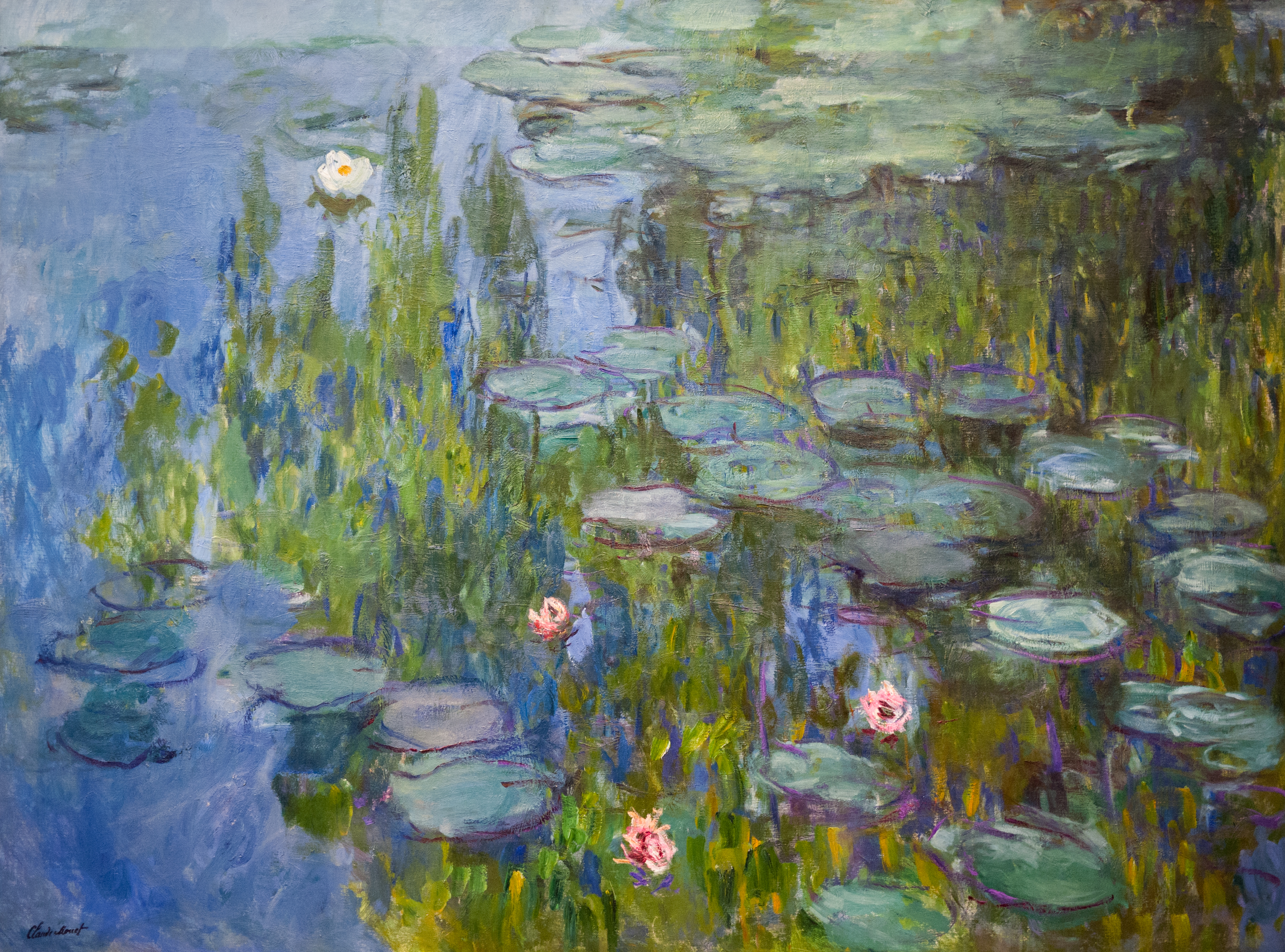
Blue as space
It can denote water, the reflected sky, or simply the freshness of a moment.

A surface in motion
Short brushstrokes move the flowers and blur their contours.

The flowers as punctuation
The light discs prevent the reflection from becoming a uniform space.

Facing the painting
The dimension transforms contemplation into bodily experience.
A life around the pond
The Essential Chronology
The cycle emerges slowly, between gardening, mourning, war, studio research, and the fight against failing vision.
The immersive masterpiece
The Orangerie: entering into duration
In Paris, the Water Lilies are no longer paintings lined up on a wall. Eight compositions, made of assembled panels, unfold across the curved walls of two oval rooms. They stand about 1.97 meters tall and total 91 meters in length.
Monet conceives the whole with the architect Camille Lefèvre and the support of Georges Clemenceau. He fine-tunes the panel layout, the intervals, the openings between the rooms, and the role of zenithal light. Aligned with the sun's course, the two ovals organize a passage from morning to evening.
The viewer can step forward, return, turn, and choose their distance. Up close, the matter dominates; from afar, the reflections recompose themselves. This freedom of movement is essential: the work does not impose a main scene, it establishes a continuity.

Cataract and late painting
What can be said — without reducing the work to a diagnosis
Monet's eyesight matters in the history of the late Water Lilies, but it is not enough to explain them.
A complex relationship between the eye, memory and gesture
Cataracts were diagnosed in 1912. Monet then experienced a significant decline in vision and underwent surgery in 1923, which partially restored sight in one eye. These difficulties coincide with visible changes in some of his late works: warmer or more jarring colors, less stable outlines, denser paint.
Yet it would be misleading to turn every boldness into a symptom. The large formats, the removal of the horizon and the pursuit of an enveloping painting are choices worked on over time. Monet compares, returns, scrapes, adds layers, and also draws on his intimate knowledge of the garden. The illness alters his working conditions; it abolishes neither his will nor the coherence of his project.
Bringing the Water Lilies into your home
Choosing a reproduction without losing the atmosphere
A Monet work acts less like an illustration than like an extra light in the room. The right choice depends on the format, the dominant color, and the viewing distance.
Which Water Lilies for which atmosphere?
| Bright room | A deep blue or strong green provides grounding and balances very light walls. |
|---|---|
| Darker room | Favor light waters, pale pinks and lilac touches that diffuse the light. |
| Large wall | A panoramic format restores the horizontal movement and the enveloping effect of the cycle. |
| Calm space | A low-contrast composition, without bridge or bank, favors a meditative presence. |
| Contemporary decor | The late works, freer and more gestural, naturally dialogue with clean lines. |
| Framing | A discreet floater frame lets the canvas breathe; a classic frame reinforces its historical grounding. |
Proportion tip:above a sofa or sideboard, aim for a width of about two-thirds of the furniture's width so the work structures the wall without seeming isolated.
Explore the shop
Continue the journey through our collections
From the Giverny pond to the great impressionist landscapes, discover the selections closest to Monet's luminous universe.
The Water Lilies
The pond, the Japanese bridge, the floating flowers and the variations of light.
The artist · 1,023 worksClaude Monet
Giverny, Argenteuil, London, the haystacks, the cathedrals and the sea.
Great masterpiecesFamous paintings
The must-see images of art history gathered in one collection.
Nature & lightImpressionist landscapes
Atmospheric moments painted en plein air.
For the interiorDecorative paintings
Works chosen for their presence and harmony.
PaletteBlue paintings
Depth, calm, and visual freshness.
PaletteGreen paintings
Gardens, foliage, and soothing landscapes.
The number of works reflects the collections available at the time of this article's update.
Further reading
Institutional sources
The dates, dimensions and historical elements in this guide have been verified with museums and the Monet Foundation.
Musée de l'Orangerie
The history of the series, the gift to France and the display designed by Monet.
Consulter l'histoire du cycleFondation Claude Monet
The creation of the water garden, the Japanese bridge and the plantings at Giverny.
Découvrir le bassinMusée d'Orsay
Analysis of the Blue Nymphéas, the horizonless framing, and the free brushwork.
View the artwork's detailsMoMA
The large decorations project, the 1915 studio, and the modern legacy of late Monet.
Explore Claude Monet at MoMAFrequently Asked Questions
Understanding Monet's Nymphéas
A few short answers to place the series, Giverny, and the Orangerie in their context.
Why did Monet paint so many Water Lilies?
The pond changed hour by hour with the light, wind, seasons, and reflections. Monet was therefore not repeating the same image: he was exploring the nearly infinite transformations of a single motif.
How many Water Lilies paintings did Monet create?
Institutions give varying counts depending on which works are included, but the National Gallery of Art cites more than 250 paintings devoted to the water lilies. This body of work should be distinguished from the eight monumental compositions installed at the Orangerie.
Where is the Water Lilies garden located?
The water garden sits at Giverny, in Normandie, on the property where Monet settled in 1883. The Maison et Jardins de Claude Monet today allows visitors to discover the pond and the Japanese bridge.
Where to see the great Water Lilies in Paris?
The monumental cycle is displayed at the Musée de l'Orangerie, in the Tuileries Garden. Eight compositions fill the curved walls of two oval rooms bathed in daylight.
Are the Nymphéas impressionist or abstract?
They begin with an impressionist observation of light and landscape, but the late works push the disappearance of landmarks and the autonomy of the brushstroke so far that they deeply fascinated abstract painters after the Second World War.
Does the cataract explain the colors of Monet's late works?
It altered his conditions of perception and may have influenced certain palettes, but it alone does not explain his choices. The formats, the reworkings and the immersion stem from a conscious artistic project developed over many years.
What is the difference between nénuphar and nymphéa?
In everyday usage, « nénuphar » refers to the aquatic plant. « Nymphéa » comes from the botanical name of the genusNymphaeaand became the title of Monet's series.
What format should you choose for a Nymphéas reproduction?
A large horizontal format best captures the expanse of the pond and suits wide walls. A square or vertical format favors a more contemplative fragment, easy to integrate into a room of modest dimensions.
0 comments