

Van Gogh and The Scream • Art & Decoration Guide
Van Gogh and The Scream: Untangling Fact from Fiction in the Expressive Storm
A cultured and mischievous deep dive to distinguish Vincent van Gogh from Edvard Munch, understand their respective universes, and choose your reproduction with full knowledge.
There is a persistent confusion circulating on social media and in some dimly lit living rooms: attributing The Scream to Vincent van Gogh. This error, as surprising as it may be, reveals a common fascination with inner turmoil and liberated color. Yet, confusing the sunny and tormented Dutchman with the icy and anguished Norwegian is like mixing a sunset in Provence with a misty fjord under the northern lights. This article aims to set the record straight, not with the severity of a grumpy professor, but with the curiosity of an art lover who likes to see clearly through the chaos of famous images.
 Free image
A cultured and mischievous deep dive to distinguish Vincent van Gogh from Edvard Munch, understand their respective universes, and choose your reproduction with full knowledge.
Reading method
How to read this article without getting lost in the nuances
We will navigate between biographies, visual analyses, and decorative tips following a simple thread: historical truth serves as a compass, while artistic emotion guides our gaze. Each section provides precise facts about dates, places, and techniques, while explaining why these works continue to move us today.
Context before prestige
We place Van Gogh and The Scream back in their era, studios, exhibitions, and small rebellions. A work without context is sometimes just a very beautiful person who forgot their history.
The signs that betray the style
We identify composition, palette, texture. These clues often say more than grand speeches, especially when they carry gold or nervous brushstrokes.
The work in a real room
We end with the useful question: does this image breathe in your home, or does it just pose like a poster that has read two books?
Historical context
Where does the confusion between Van Gogh and The Scream come from, and why is it not just a label?

The error is common because the Internet tends to compress art history into a few viral keywords, turning Edvard Munch into a mere accessory of the Van Gogh legend. The Scream, first painted in 1893, belongs to the Frieze of Life, a monumental project conceived by Munch in Oslo, far from Vincent's Arles wheat fields. While Van Gogh died in July 1890, three years before the official birth of The Scream, their paths never physically crossed, although they shared an era of major artistic upheaval in Europe.
This misconception is also rooted in a superficial similarity: both painted human suffering with rare intensity, using violent colors to convey states of mind. However, where Van Gogh sought consolation in nature and divine light, even on the brink of madness, Munch explored the abysses of modern existential anguish without hope of immediate redemption. Understanding this fundamental distinction makes it clear that The Scream is not a distant cousin of The Starry Night, but the manifesto of an entirely different movement, the nascent Nordic Expressionism.
Artistic style
Why does the association between Van Gogh and The Scream still fascinate so much?

The persistence of this confusion stems from the fact that each artist embodies, in the collective imagination, the archetype of the cursed genius whose tragic life illuminates the work. Van Gogh, with his severed ear and poignant letters to Theo, and Munch, haunted by illness and death since his Norwegian childhood, offer a biographical narrative that captivates as much as their canvases. The public loves these figures as novel heroes, and the idea that they could have created the same iconic image of modern horror flatters our desire for simplicity in a complex world.
Moreover, the massive circulation of famous images on the web has leveled stylistic differences in favor of instant recognition based on raw emotion. When we see a blood-red sky or swirling lines, the reflex is to shout "Van Gogh!" out of cultural habit, forgetting that Munch developed a unique graphic language made of ghostly silhouettes and distorted perspectives. This shared notoriety creates a false artistic neighborhood, while their spiritual and aesthetic quests diverge radically on the question of humanity's place in the universe.
Art & details
The visual signs that immediately betray each artist's style

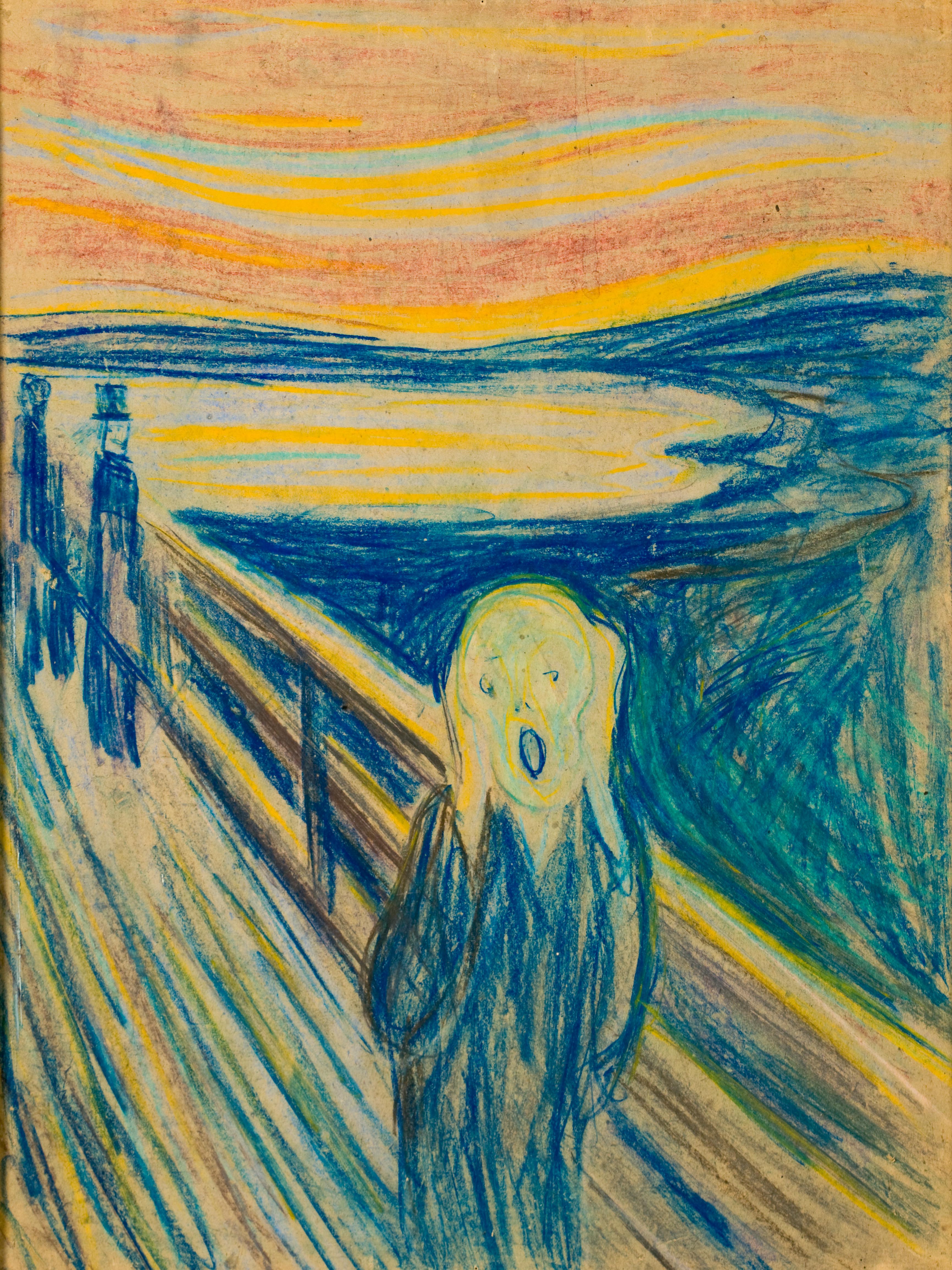
Observing the texture is often enough to dispel doubt: Van Gogh's touch is thick, impasto, built by rhythmic brushstrokes that seem to sculpt light, as in his sunflowers or cypresses. In contrast, Munch often uses more fluid layers, marked outlines, and sinuous lines that envelop forms rather than building them through pigment accumulation. In The Scream, the sky is not made of small juxtaposed touches but of large undulating bands of color that recall the sound of a visual soundwave crossing the Oslo fjord landscape.
The color palette also offers an unmistakable clue to distinguish the two masters without needing to read the museum label. Van Gogh favors contrasts of vibrant complementary colors, chrome yellow against cobalt blue, creating an almost blinding optical vibration of vitality. Munch, on the other hand, works in more spectral ranges, mixing blood reds, acid greens, and deep blacks to create an atmosphere of waking nightmare, where color serves less to describe reality than to project an inner fear onto the external world.
Art & details
The works to look at to understand the divergence of geniuses

To grasp Van Gogh's universe, one must contemplate The Starry Night painted in Saint-Rémy-de-Provence in 1889, where the sky becomes a cosmic whirlwind filled with hope and divine movement. In parallel, Wheatfield with Crows, created shortly before his death, shows dramatic tension but remains anchored in the earth and nature, even when it becomes threatening. These paintings reveal an artist desperately trying to capture the vital energy of the world, transforming each landscape into a pictorial prayer addressed to the infinite.
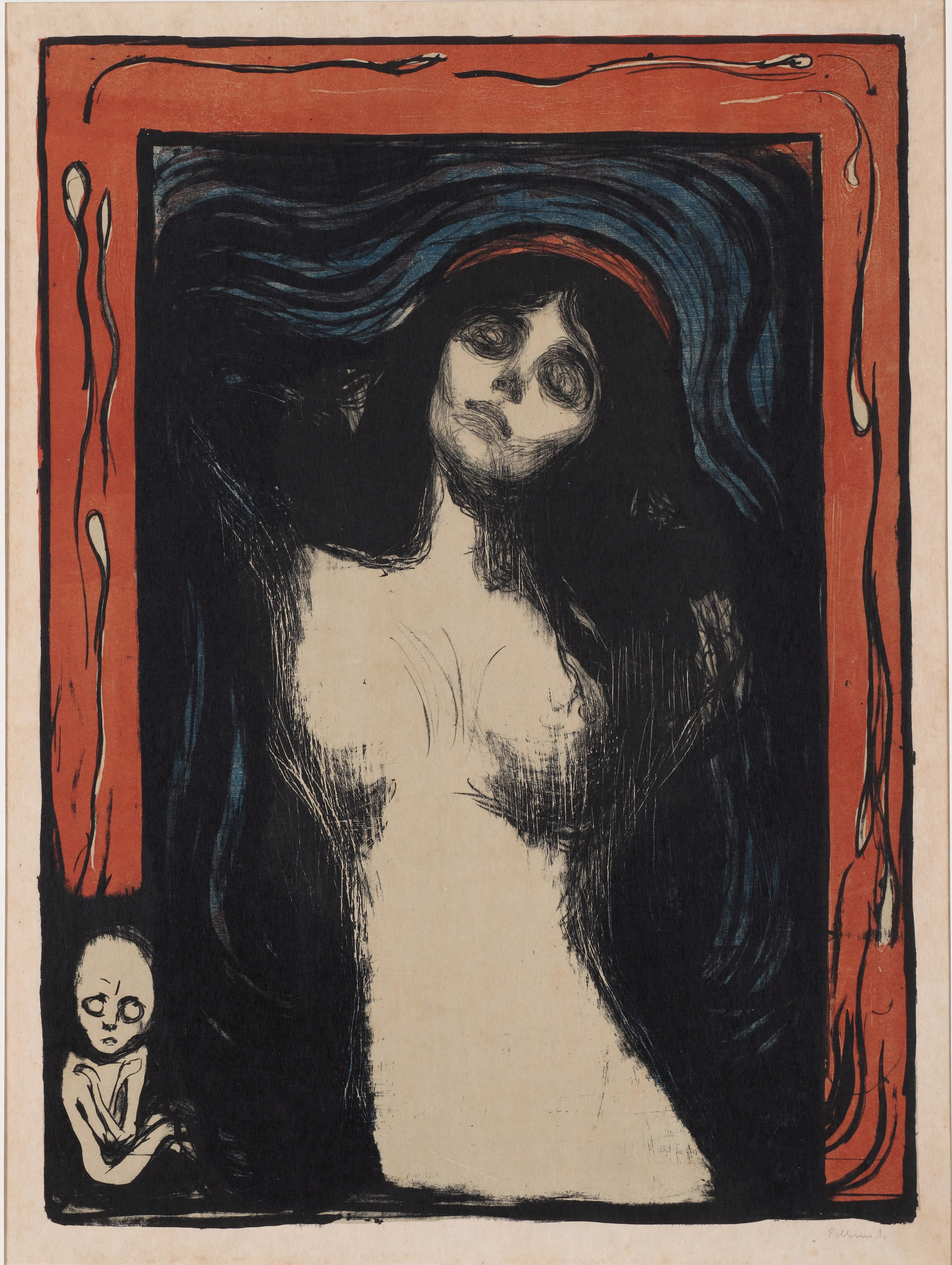
On Munch's side, it is essential to study not only The Scream, but also Madonna or Anxiety, where human figures seem to merge with their psychological environment. In these works, faces become masks, bodies dissolve into liquid shadows, and space loses all perspective logic in favor of emotional coherence. Unlike Van Gogh, who sublimates reality through color, Munch distorts it until it becomes unrecognizable to better express the absolute solitude of the modern individual facing death and love.
Art & details
Symbols, details, and small visual quirks unique to each master
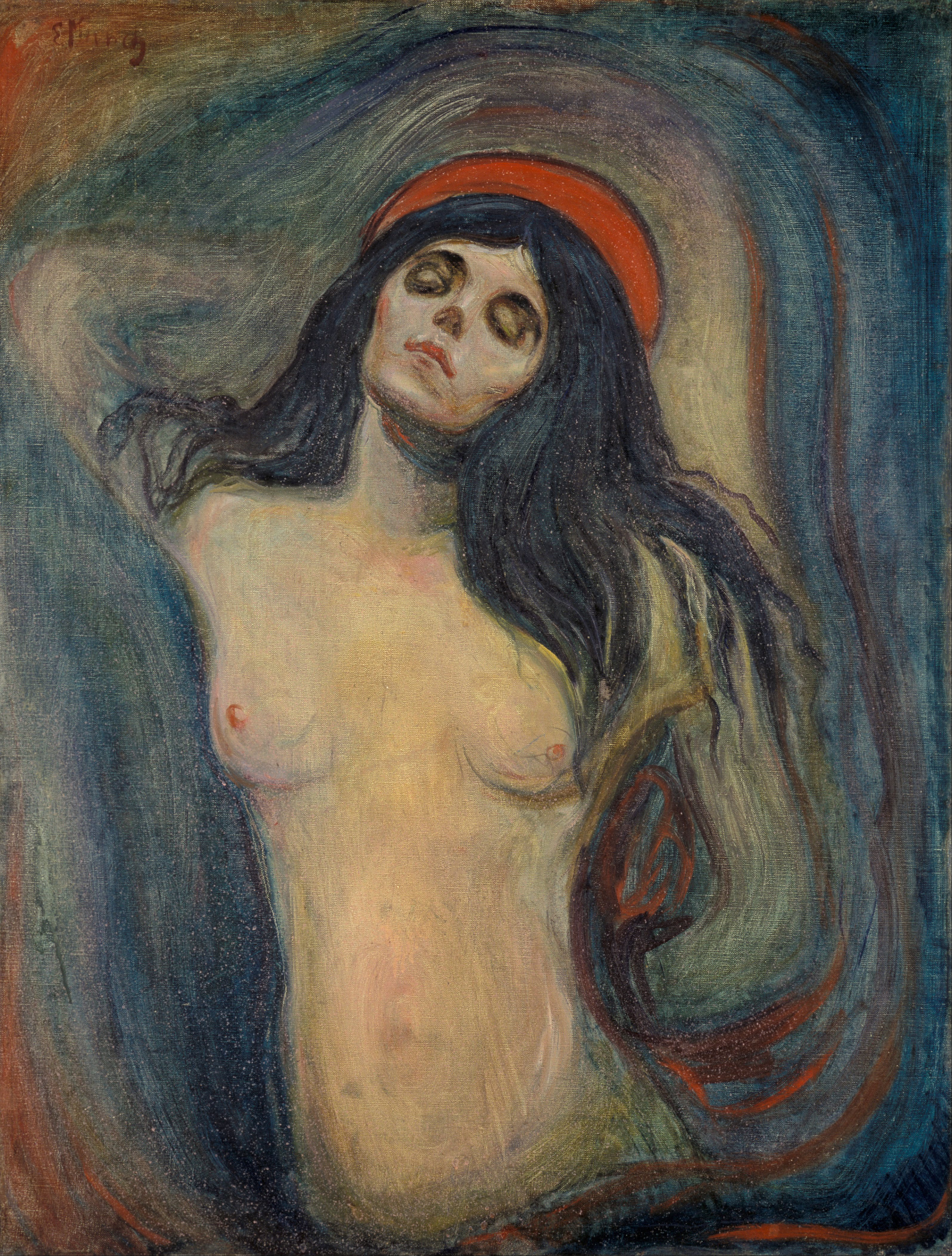
The hidden details in Van Gogh's works often tell a story of resilience and meticulous observation, like the small figures in the harvests or the botanical precision of his irises. Each painted object in his work has a tangible presence, a material density that testifies to his love for the concrete, even when sublimated by a mystical vision. His symbolism is that of life persisting, of the grain germinating and the light piercing the clouds, reflecting a pantheistic spirituality deeply rooted in the soil.
In Munch, the symbols are much more direct and sometimes cruel, using the curved line as a constant threat that embraces the characters without protecting them. The bridge in The Scream is not a banal passageway but a border between the world of the living and that of terror, while the androgynous figure screams without emitting sound, capturing the very essence of modern anguish. These recurring motifs, like the vampire woman or the sick child, form a dark personal mythology where psychoanalysis seems to have preceded Freud by several decades in the exploration of traumas.
Art & details
Neighbors, allies, and turbulent cousins in art history

Although distinct, Van Gogh and Munch share a spiritual kinship with the precursors of Expressionism, a movement that would prioritize raw emotion over realistic fidelity. Van Gogh can be seen as an isolated prophet whose chromatic freedom paved the way for the Fauves and German Expressionists, even though he never theorized his approach as a manifesto. His posthumous influence is immense, acting as a catalyst for an entire generation of artists seeking to liberate color from its traditional descriptive function.
Munch, on the other hand, was fully integrated into the Symbolist and bohemian circles of Berlin and Paris, mingling with intellectuals who shaped modern thought of the time. He is not a student of Van Gogh, but rather a contemporary who absorbed certain stylistic freedoms to apply them to his own Nordic and existentialist vision. Their relationship is that of two meteors crossing the same artistic sky without ever colliding, leaving behind a trail of powder that still illuminates our museums today with undiminished intensity.
Art & details
What museums confirm when shortcuts go too fast
Prestigious institutions like the Musée d'Orsay in Paris or the MoMA in New York take great care to clearly separate collections to avoid any historical ambiguity. The Munch Museum in Oslo preserves the majority of versions of The Scream, including the famous 1893 version on cardboard, constantly reminding us of the artist's geographical and cultural roots in Scandinavia. These conservation sites serve as guardians of memory, contextualizing each canvas in its original environment so that visitors understand the specificity of each artistic approach.
Similarly, the Van Gogh Museum in Amsterdam presents Vincent's work in all its complexity, far from reductive clichés, showing the evolution of his style from his dark beginnings in the Netherlands to his colorful explosion in France. Visiting these temples of art makes one realize that reducing these giants to a single image or a popular confusion is an injustice to the richness of their respective output. The catalogues raisonnés and scientific research conducted in these institutions confirm year after year the uniqueness of each hand and each vision of the world.
Art & details
How to choose a reproduction without making the wall panic?
If you wish to acquire a hand-painted reproduction, it is crucial to choose the artist who truly resonates with the atmosphere of your room rather than following a passing trend. A Van Gogh, with its vibrant yellows and deep blues, will bring warmth and dynamic energy to a living room or kitchen, acting as a source of natural artificial light. In contrast, a Munch, with its cooler tones and psychological intensity, will be better suited to an office, library, or reflection space where a certain dramatic tension is welcome.
Format also plays a decisive role in visual impact: The Scream requires a certain distance to allow its undulating lines to work their hypnotic effect without becoming oppressive at close range. A large reproduction in a small hallway could transform the space into an involuntary anxiety chamber, while a detail of sunflowers or a wheat field can illuminate a dark corner without invading the entire visual field. Always consider the balance between the power of the image and the volume of the room to create lasting harmony.
Interior decoration
Mistakes to avoid before hanging the painting at home

The first classic mistake is buying a reproduction solely because the artist's name is famous, without checking if the work truly matches your personal sensibility. Hanging The Scream in a child's room or a pure relaxation space can create a subtle but persistent unease, as the image carries a very heavy emotional charge linked to existential terror. It is better to opt for soothing landscapes by Van Gogh or gentler portraits by Munch if you are primarily seeking a reassuring and aesthetic decorative function.
Finally, neglecting the quality of the reproduction and the technique used can betray the artist's original intention, especially when it comes to rendering the texture and vibration of the brushstroke. A low-end digital print will tend to flatten Van Gogh's impasto or smooth out Munch's nervous contours, stripping the work of all its living force. Always prioritize high-definition prints or hand-painted copies by skilled artisans who know how to respect the grain and depth of the original colors to honor these masterpieces.
| Room | Suggestion | Decorative effect |
|---|---|---|
| Living room | A work related to Van Gogh and The Scream with a strong composition | Focal point that is cultured, warm, and easy to comment on without reciting a label. |
| Bedroom | A soft palette or a more intimate scene | Calm atmosphere, visual presence without unnecessary agitation. |
| Office | A structured, colorful, or graphically sharp image | Creative energy and a small reminder that the wall can also work. |
| Entrance | A vertical format or an immediately readable work | Clear, elegant first impression, and decidedly less timid than a white void. |
To continue the visit
Sources, collections, and paths truly related to the subject
A few useful references to verify information, compare free images, and extend the reading without heading to a museum that didn't ask for it.
Related articles to read next
Verified collections
Useful blog hubs
FAQ
Frequently asked questions about Van Gogh and The Scream
What is Van Gogh and The Scream in painting?
Van Gogh and The Scream deserves an in-depth article because this style engages both an era, a way of painting, and a very concrete way of living with images.
How to quickly recognize this style?
Observe especially composition, palette, texture, light, and atmosphere, then how the composition organizes the gaze. If the work holds your attention longer than expected, it is probably not an accident.
Which artists should you know?
You need to cross-reference the central artists of the movement with museums and reliable sources to avoid too hasty attributions.
Does this style suit modern decoration?
Yes, provided you choose the right format, a palette consistent with the room, and a work whose presence remains pleasant on a daily basis.
Should you choose the most famous work?
Not necessarily. The most famous work can be perfect, but the right choice depends above all on the room, format, palette, and desired atmosphere.
Where to verify the information?
Start with museum notices, Wikipedia/Wikidata for general orientation, then Wikimedia Commons when a free image is needed.
End by looking justly
Ultimately, distinguishing Van Gogh from Munch and correctly attributing The Scream to its true father, Edvard Munch, is not an exercise in pedantry but a key to accessing the richness of modern art. Each of these giants offers us a different mirror of the human condition: one through the devouring flame of life, the other through the icy cold of terror. Whether you choose to hang a starry sky or a silent scream on your wall, do it consciously, knowing which story you are inviting into your daily life. Art is not just about filling an empty space, but about dialoguing with ourselves, and this dialogue can only be fruitful if it is based on the truth of the works and the sincerity of our gaze.
0 comments