

Painting, testifying, contesting · 1793 -today
Committed and social painting: 100 works that have taken a stand
Revolutions, work, wars, civil rights, feminisms and consumer society: a hundred works where painting not only represents the world, but intervenes in the way we understand it.
An image is never neutral
What's a committed painting?
A committed painting intervenes in a conflict of values, memory or representation. It can denounce violence, make visible existences kept apart, defend a community, shift the norms of the gaze or reveal the mechanisms of power. Commitment therefore does not correspond to a style: it runs through history painting, realism, muralism, expressionism, pop art and abstraction.
The artist's intention matters, but it does not exhaust the work. Some images are explicit positions; others become political by their subject, their scale, their place of exhibition or the way in which they redistribute dignity. Courbet disrupts the Salon by giving the inhabitants of Ornans the format reserved for heroes. Manet confronts the viewer with Olympia and the social relationships that the academic nude concealed. Johns, Warhol or Rosenquist questions symbols and media rather than delivering a slogan.
We must also look at the ambiguities. A painting can serve propaganda, transform suffering into a spectacle or speak in place of those it represents. This classification therefore does not distribute certificates of virtue. He brings together one hundred works whose form, context and reception require us to think about the relationship between aesthetics and responsibility.
Taking a position in painting is not adding a slogan to an image: it is deciding who will be visible, from what point of view and with what power of presence.
Give lasting form to the event when those in power prefer erasure, forgetting or the official version.
Make violence, exploitation and the social structures that produce them perceptible.
Grant ordinary, minoritized or relegated lives the scale and attention denied by dominant hierarchies.
Construct a symbol, a memory or a common space capable of circulating beyond the painting.
One hundred works where looking already becomes a position
Editorial selectionWhen history enters painting
Revolutions, power and state violence
Pablo Picasso
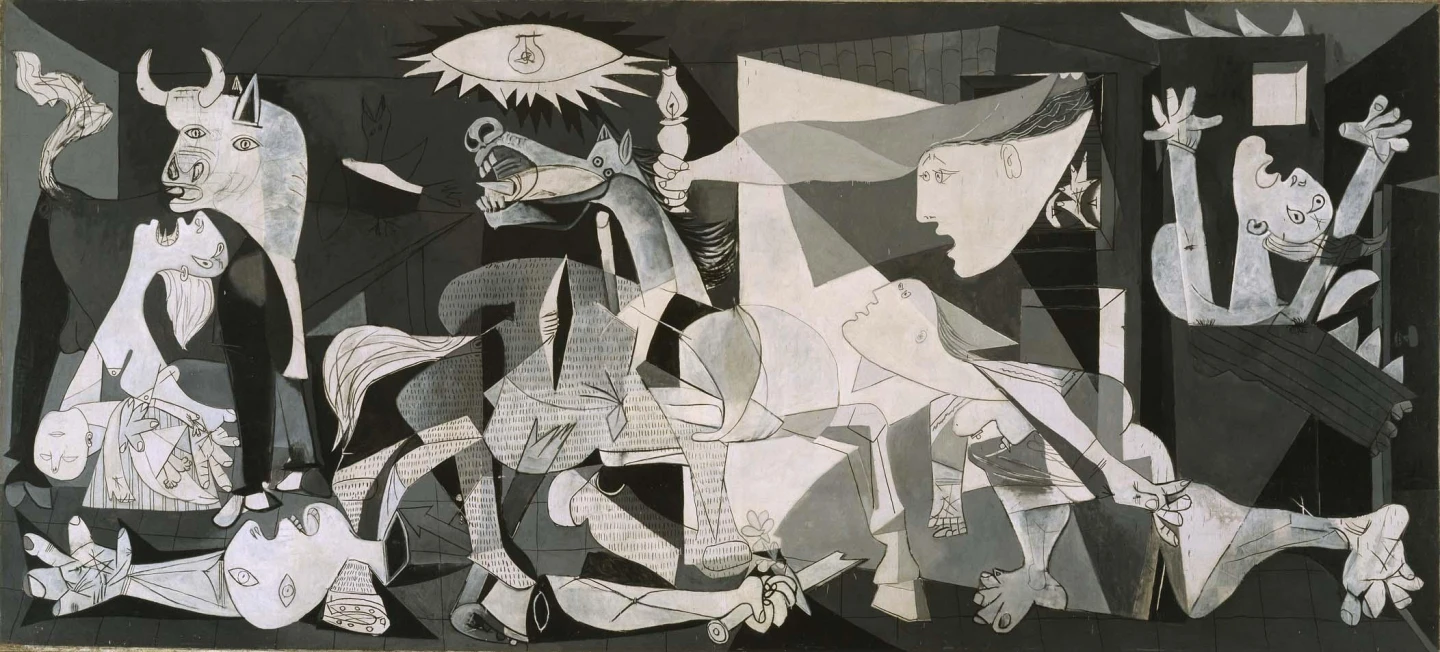
Guernica
The bombing of the Basque city becomes a scene without winner or heroic depth. Dislocated bodies, electric light and animal cry make painting a universal accusation against the war against civilians.
Museo Nacional Centro de Arte Reina Sofía, Madrid
View work at source →
Eugene Delacroix
Freedom guiding the people
Delacroix mixes allegory with the dust of barricades: Liberty advances among very real dead, surrounded by insurgents from several classes. The work not only documents 1830; she invents the modern image of the popular uprising.
Alpha Reproduction
See reproduction →
Francisco de Goya
May 3, 1808 in Madrid
The lantern illuminates the victims while the platoon remains anonymous, reduced to a killing machine. Goya overturns military painting: the moral center is no longer the winner but the unarmed man who faces the guns.
Alpha Reproduction
See reproduction →
Théodore Géricault
The Raft of the Medusa
From a shipwreck that became a state scandal, Géricault builds a pyramid of hope and despair. The raft exposes the incompetence of power, the abandonment of bodies and the fragility of a society that prefers to look the other way.
Alpha Reproduction
See reproduction →
JMW Turner
The Slave Ship
Turner dissolves the slave ship in a glowing sunset, but leaves the chains and bodies thrown into the sea in the foreground. Atmospheric beauty becomes uncomfortable: it catches the eye before revealing the crime to it.
Alpha Reproduction
See reproduction →
Eugene Delacroix
Scenes from the Scio massacres
There is no central hero or deliverance here: only Greek civilians exhausted under Ottoman threat. Delacroix makes forced passivity, hunger and waiting a more disturbing political denunciation than a spectacular battle.
Alpha Reproduction
See reproduction →
Édouard Manet
Execution of Emperor Maximilian of Mexico
Manet takes up Goya's frontality to show a contemporary execution for which Napoleon III's France bears some responsibility. The shooters' uniform blurs guilt and transforms diplomatic news into an indictment.
Alpha Reproduction
See reproduction →
Jacques-Louis David
The Death of Marat
David transforms the assassination of the revolutionary deputy into a secular icon. The counting of the room, the letter still kept and the visible wound organize an image of a martyr which also shows how painting creates a political memory.
Alpha Reproduction
See reproduction →
Francisco de Goya
May 2, 1808
The Madrid crowd and the Mamluks clash in a knot of gestures without a stable front line. Goya refuses triumphant readability: popular violence and imperial repression merge in a melee without grandeur.
Museo del Prado, Madrid
View work at source →
Ernest Meissonier
The barricade, rue de la Mortellerie, June 1848
Meissonier paints the aftermath of the repression of June 1848: cobblestones, bodies and ordinary clothing occupy the entire street. The small format and cold precision prohibit easy pathos and give the testimony an almost documentary harshness.
Alpha Reproduction
See reproduction →
Honoré Daumier
The Family on the Barricades
Daumier places an entire family in the insurrection movement, far from the isolated heroic fighter. The compact thrust of the figures reminds us that revolutions also involve homes, children and those that official stories relegate to the background.
Alpha Reproduction
See reproduction →
Peter paul rubens
The Consequences of War
Mars drags Europe away despite Venus' efforts, while the arts, motherhood and abundance are overturned. Rubens condenses the Thirty Years' War into a political allegory: violence first destroys the very conditions of civilization.
Alpha Reproduction
See reproduction →
Pieter Bruegel the Elder
The Massacre of the Innocents
Bruegel transposes the biblical story into a village in the occupied Netherlands. Under the snow, military terror takes on the features of the present: sacred history becomes a means of speaking about imperial violence without directly naming it.
Alpha Reproduction
See reproduction →
Antoine Caron
The Triumvirate Massacres
The disproportionate architecture frames a multitude of tortures inspired by Antiquity but readable through the Wars of Religion. Caron shows a power that transforms the entire city into a theater of execution.
Alpha Reproduction
See reproduction →
Henri Rousseau
The war
A black rider crosses a ravaged landscape where the dead accumulate under the crows. Rousseau adopts a voluntary simplicity which brings the image closer to the fable, but the fable offers no consoling morality.
Alpha Reproduction
See reproduction →
Luigi Russolo
The Revolt
Compact silhouettes hit a city transformed into beams of force. Russolo's futurism gives an abstract form to the collective energy, while leaving open the question of whether this surge heralds emancipation or new violence.
Alpha Reproduction
See reproduction →
Diego Rivera
Man, controller of the universe
After the destruction of his New York mural, Rivera reconstructs the image around a worker who masters the machine and observes two future opposites. Science, class struggle and world history meet in a composition designed for the public.
Alpha Reproduction
See reproduction →
Diego Rivera
Man and Machine
Rivera represents the automobile factory as a productive totality where human gestures, minerals and machines follow one another. Admiration for industrial power remains inseparable from a political question: who controls this collective energy?
Alpha Reproduction
See reproduction →
Grant Wood
Daughters of Revolution
Three members of a patriotic association pose in front of a reproduction of Washington crossing Delaware. Wood uses stiffness, domestic detail and irony to crack the complacency of an elite who claim to possess national history.
Alpha Reproduction
See reproduction →
Alphonse Mucha
The Apotheosis of the Slavs
The last panel of the Slavic Epic, this vision brings together memory, suffering and the aspiration for unity. Mucha puts his decorative language at the service of a collective political narrative rather than the advertising that made him famous.
Alpha Reproduction
See reproduction →Make visible those whom art forgot
Work, poverty and dignity

Jean-Francois Millet
Gleaners
Three bent women collect the remains of the harvest while the abundant harvests rise in the distance. Millet gives a silent monumentality to precarious work and reveals, in the same landscape, the separation between wealth and survival.
Alpha Reproduction
See reproduction →
Jean-Francois Millet
The Man with the Hoe
The worker stops, leaning on his tool, his face marked by exhaustion. By refusing the idealization of the peasant, Millet forces the bourgeois public to look at the physical cost of agricultural production.
Alpha Reproduction
See reproduction →
Jean-Francois Millet
The Sower
The broad gesture of the sower gives a repetitive task the strength of a founding act. The dark slope, stride and light from afar make rural work a historical power rather than a picturesque setting.
Alpha Reproduction
See reproduction →
Gustave Courbet
The stone breakers
Courbet shows two ages of work without horizon of mobility: the child wears, the man breaks. Worn clothes and closed framing give the cycle of poverty a materiality that the Salon could not reduce to anecdote.
Alpha Reproduction
See reproduction →
Gustave Courbet
A funeral in Ornans
By giving a provincial burial the dimensions of history painting, Courbet asserts that ordinary inhabitants deserve the same scale as kings and saints. The democracy of the subject becomes a revolution of format.
Alpha Reproduction
See reproduction →
Gustave Courbet
The Painter's Workshop
In the center, Courbet paints; around him society, supporters, the exploited and the powerful are distributed. This "real allegory" transforms the workshop into a political map of the social world and the place that the artist intends to occupy there.
Alpha Reproduction
See reproduction →
Vincent van Gogh
Potato Eaters
The hands that take the potatoes are the same ones that worked the land. Van Gogh chooses poor light and rough faces to defend a truth of labor against rural sentimentality.
Alpha Reproduction
See reproduction →
Honoré Daumier
A third class wagon
In the compartment, modest travelers share a dense space but each maintain their fatigue. Daumier builds an unemphasized community, attentive to age, the care of children and the dignity of anonymous people.
Alpha Reproduction
See reproduction →
Henri de Toulouse-Lautrec
The Laundress
Seen from behind, the worker looks out the window without knowing if she is taking a break or measuring the extent of her day. Toulouse-Lautrec recreates the solitude of a female profession rarely represented without folklore.
Alpha Reproduction
See reproduction →
Adolph Menzel
The Iron Rolling Mill (Modern Cyclops)
Heat, bodies and machines make up an industrial space that is almost impossible to breathe. Menzel admires the technical coordination while showing the physical intensity and hierarchy that structures modern work.
Alpha Reproduction
See reproduction →
JMW Turner
Keelmen Heavy in Coals by Moonlight
The moon and harbor lights transform the coal load into a light show, but the small silhouettes recall the human strength that fuels the industrial economy. The splendor of commerce is based on almost invisible nocturnal work.
Alpha Reproduction
See reproduction →Jane Sutherland
Numb fingers working while the eye of morn is yet bedimmed with tears
Sutherland paints women collecting wood in the cold dawn, far from the pastoral myth of colonial prosperity. The title emphasizes numb fingers and makes the Australian landscape the setting for an economy of necessity.
National Gallery of Victoria, Melbourne Gift of Dr Margaret Sutherland, 1972
View work at source →
Ramkinkar Baij
Workers
The figures advance as a group rather than as separate portraits. Baij gives the labor movement a sculptural structure and affirms the presence of the working classes in Indian modernism.
National Gallery of Modern Art, New Delhi
View work at source →
Pablo Picasso
The Old Guitarist
The stretched body of the blind musician almost follows the shape of the instrument. The blue period does not transform poverty into a setting: it makes one feel isolation, physical fragility and the persistence of creative activity.
Art Institute of Chicago
View work at source →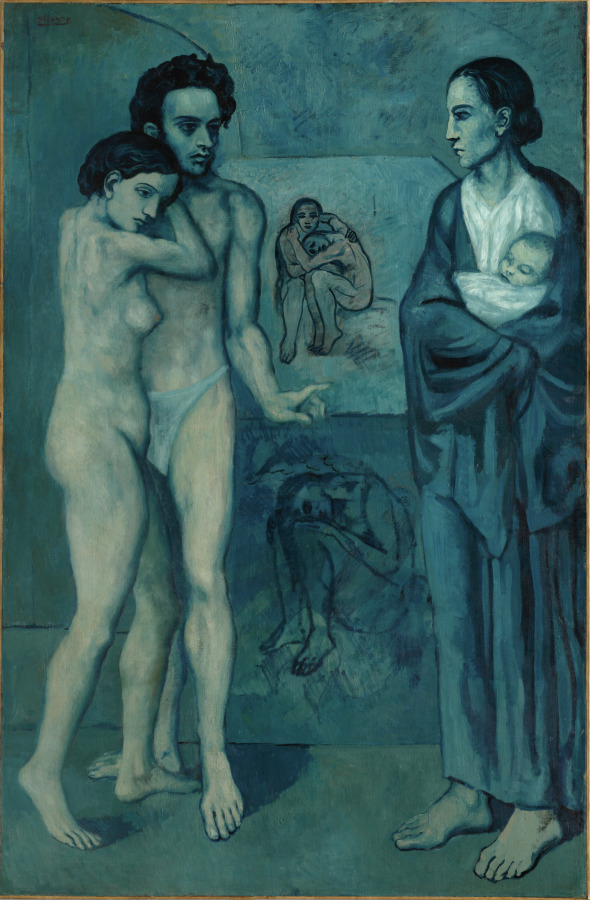
Pablo Picasso
Life
Picasso brings together motherhood, couples, desire and destitution in a deliberately enigmatic scene. Blue bodies seem locked in a cycle where intimacy remains crossed by precariousness and loss.
Cleveland Museum of Art
View work at source →
Amrita Sher-Gil
Group of Three Girls
Three young women are gathered but do not look at each other. Sher-Gil refuses the smiling exoticism expected of Indian women and paints expectation, social constraint and silent interiority.
Alpha Reproduction
See reproduction →
Amrita Sher-Gil
Mother India
The national allegory here takes the form of a dark and vulnerable woman, far from the triumphant icon. Sher-Gil associates the nation with the fatigue of its inhabitants and gives patriotism a social gravity.
Alpha Reproduction
See reproduction →
Pierre Puvis de Chavannes
The Poor Fisherman
The fisherman, the woman and the child are separated by large empty intervals. This formal economy distances the scene from the charitable anecdote and gives poverty an immobile, almost monumental presence.
Alpha Reproduction
See reproduction →
Édouard Manet
A bar at Folies-Bergère
The waitress occupies the center of a world of leisure that she does not share. The mirror, the bottles and the fragmented customer put spectacle, commerce and solitude of women's work in tension.
Alpha Reproduction
See reproduction →
Édouard Manet
A beggar
Manet isolates the figure without miserabilist decor or redemption story. Frontality, the sobriety of colors and the scale of the body oppose an individual presence to the social categories which reduce it.
Alpha Reproduction
See reproduction →Painting after the disaster
Wars, fascisms and societies under tension
Otto Dix
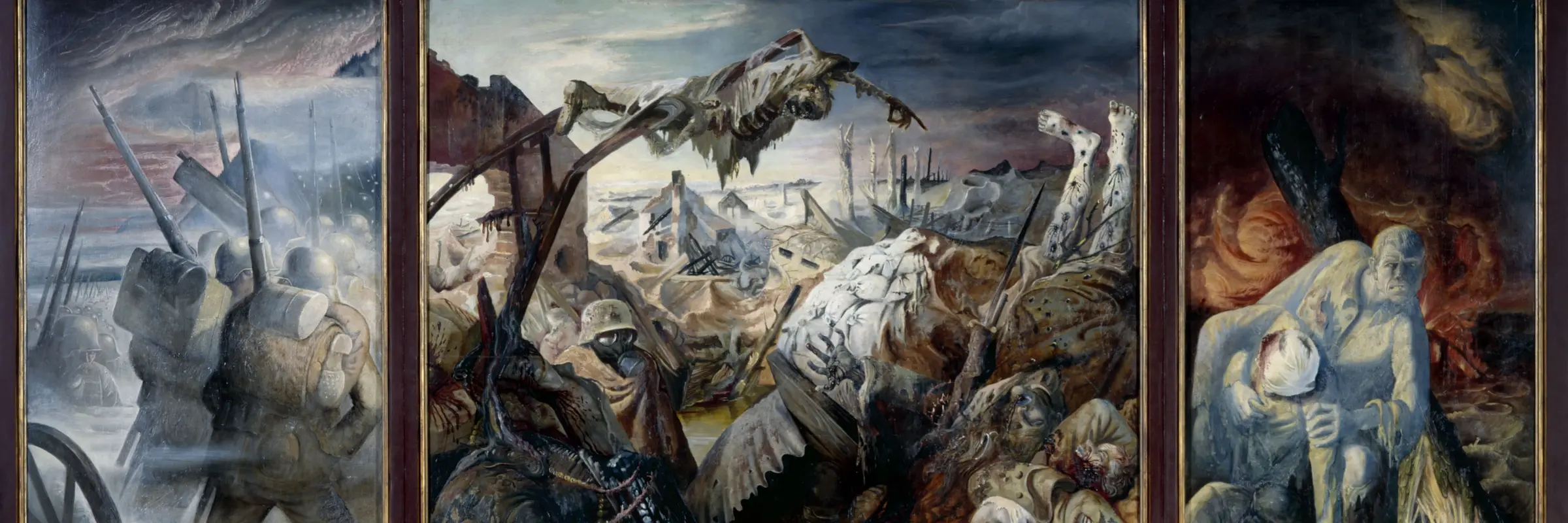
The War (Triptych)
Dix takes up the structure of an altarpiece to show the departure, carnage, return and sleep of the soldiers. Religious language offers no salvation: it gives the experience of the trenches the gravity of a passion without redemption.
Albertinum, Staatliche Kunstsammlungen Dresden
View work at source →
Max Beckmann
The Night
A family is attacked in a room that has become a trap. The broken corners and compressed space reflect the political violence of post-war Germany, as public brutality passes through the door of the home.
Alpha Reproduction
See reproduction →
Max Beckmann
Departure
The side panels accumulate torture and captivity while in the center a boat moves away in strange solemnity. Beckmann refuses the direct illustration of Nazism but constructs an allegory of oppression, departure and inner freedom.
Alpha Reproduction
See reproduction →
George Grosz
God of War
The god of war appears as a grotesque creature nourished by weapons and flags. Grosz replaces mythological majesty with monstrous caricature and attacks political fascination with military power.
Art Institute of Chicago, Chicago
View work at source →
Salvador Dali
Soft Construction with Boiled Beans (Premonition of Civil War)
A gigantic body tears itself apart over an almost empty landscape. Dalí anticipates the Spanish Civil War with an impossible anatomy where the enemy is not external: the nation mutilates itself with its own hands.
Philadelphia Museum of Art
View work at source →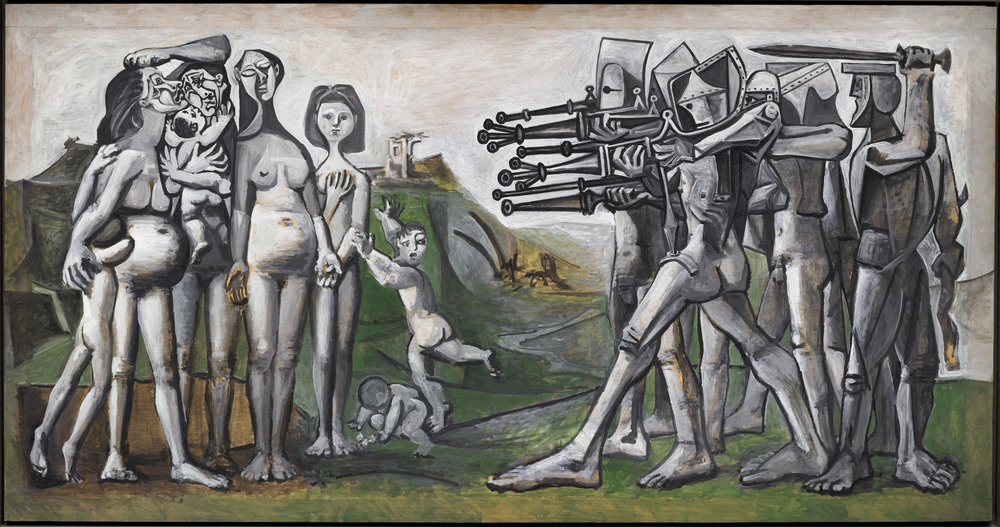
Pablo Picasso
Massacre in Korea
Mechanical soldiers target naked women and children. Picasso reactivates Goya and Manet to denounce violence against civilians, removing any sign that would confine the scene to a single conflict.
Picasso National Museum-Paris
View work at source →
Pablo Picasso
The Weeping Woman
Dora Maar's face becomes an architecture of pain where tears, teeth, handkerchiefs and acidic colors collide. Coming from the work around Guernica, the image concentrates the collective catastrophe in a face impossible to soothe.
Picasso National Museum-Paris
View work at source →
Jackson Pollock
War
Before drippings, Pollock condenses heads, limbs and totemic signs into a compact mass. War is not described as an identifiable event but as a psychic pressure which distorts all figures.
Alpha Reproduction
See reproduction →
Edvard Munch
War
Munch represents war with a dark presence that contaminates the landscape and bodies. The absence of heroism and the unstable touch shift the conflict towards the diffuse fear that it installs in civilian life.
Alpha Reproduction
See reproduction →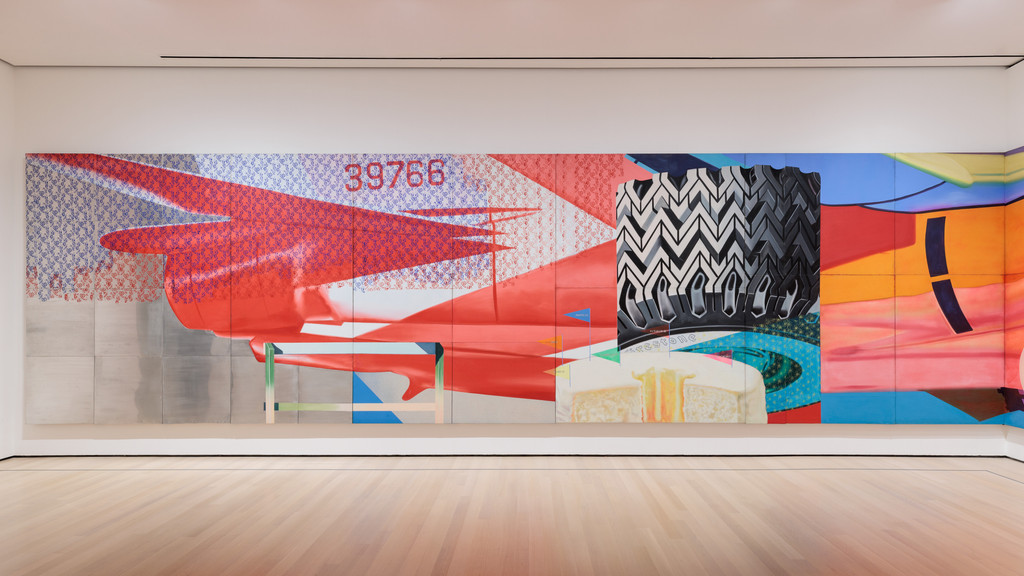
James Rosenquist
F-111
The bomber passes through a succession of advertising images, food, children and mushroom clouds. Rosenquist shows how the military economy, consumption and media belong to the same visual environment.
Museum of Modern Art (MoMA), New York
View work at source →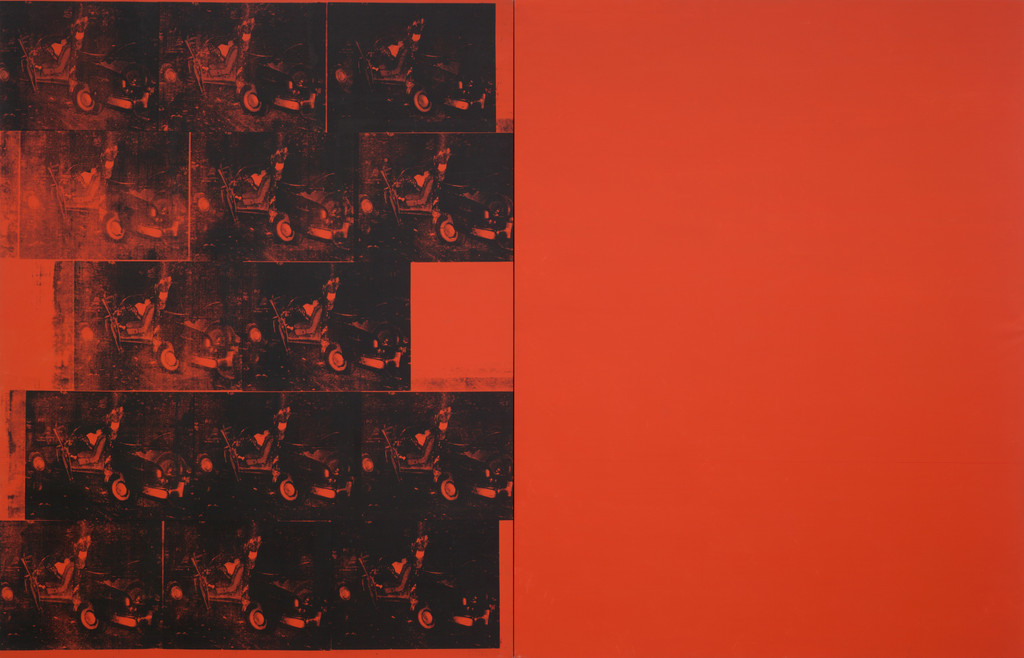
Andy Warhol
Orange Car Crash Fourteen Times
The photograph of an accident is repeated until it loses and then regains its violence. Warhol confronts the viewer with the ambivalence of the media: repetition anesthetizes, but it also reveals the industrial consumption of the disaster.
Museum of Modern Art (MoMA), New York
View work at source →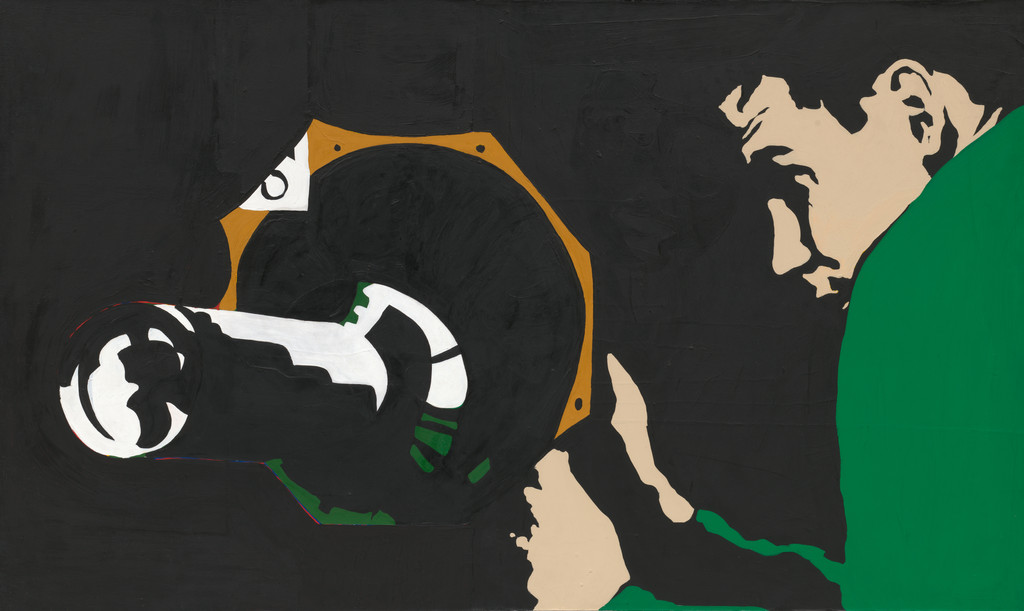
Rosalyn Drexler
Hold your Fire (Men and Machines)
Drexler transforms an action image into a dry scene where male body, weapon and machine seem to belong to the same mechanism. Pop vocabulary becomes a spectacular critique of virility.
Museum of Modern Art (MoMA), New York
View work at source →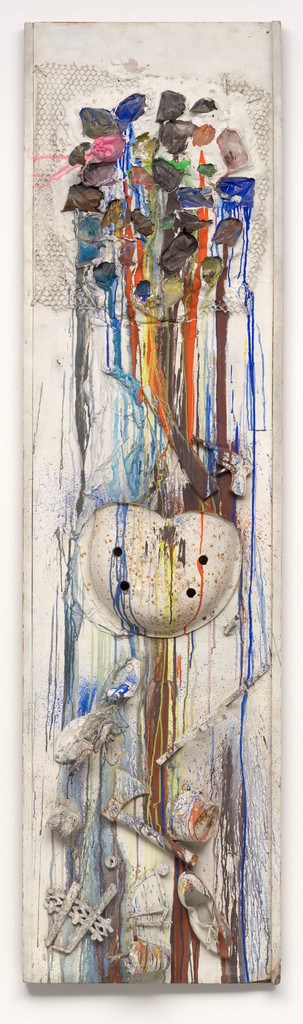
Niki de Saint Phalle
Shooting Painting American Embassy
The artist shoots at pockets of paint hidden in the relief; the drips are at the same time injury, chance and production of the work. The title links this performed violence to American power and the imagination of the target.
Museum of Modern Art (MoMA), New York
View work at source →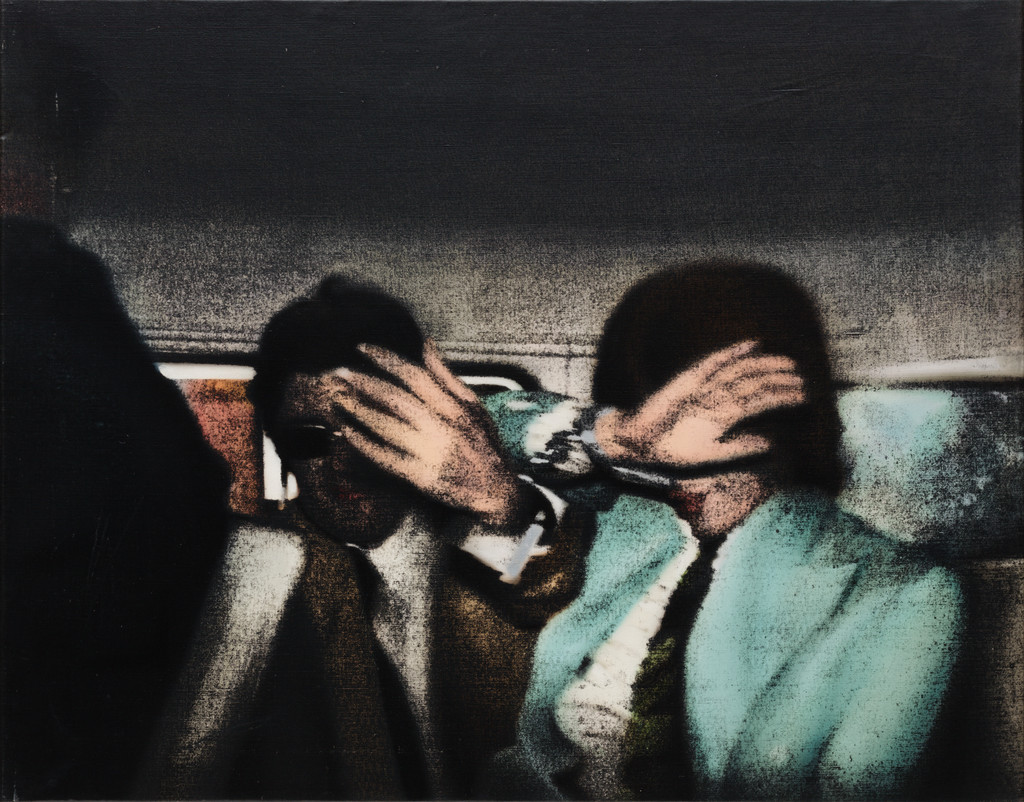
Richard Hamilton
Swinging London 67 (c)
Using a press photograph showing Mick Jagger handcuffed, Hamilton analyzes the punitive spectacle organized by the tabloids. Repetition, colors and framing make information an object of social control.
Museum of Modern Art (MoMA), New York
View work at source →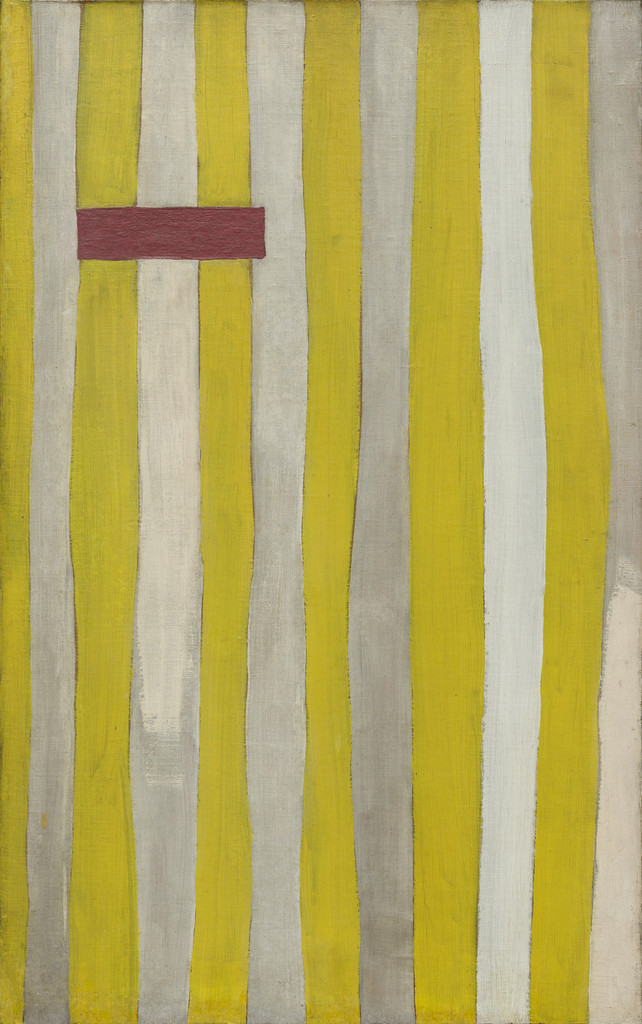
Robert Motherwell
The Little Spanish Prison
A light vertical band seems enclosed between dark masses. Motherwell transforms the memory of the Spanish Civil War into an abstract structure where space itself becomes an experience of captivity.
Museum of Modern Art (MoMA), New York
View work at source →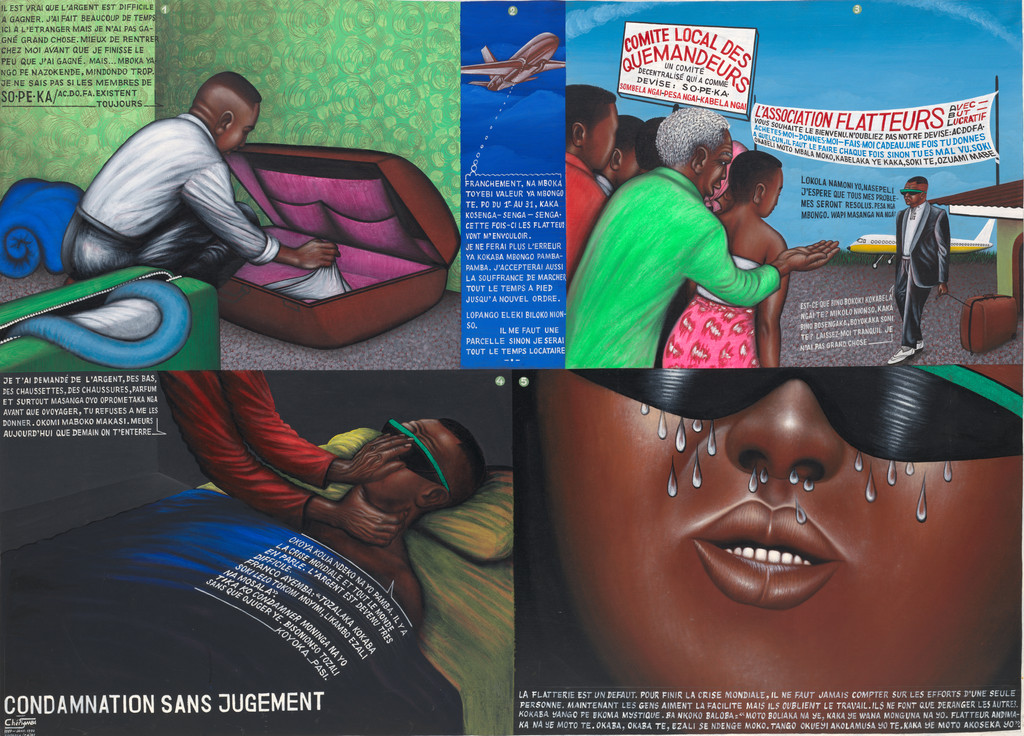
Darling Samba
Condemnation without Trial
Samba combines text, narrative scene and direct address to denounce a conviction deprived of procedure. The work refuses the prestigious silence of great painting: it argues, accuses and asks the public to read.
Gift of Evan and Vanessa Tawil
View work at source →Michael Armitage
Necklacing
Armitage addresses a form of collective killing without transforming violence into an immediately readable image. The irregular surface and unstable composition make the rumor, fear and ambiguity of the witness perceptible.
The Metropolitan Museum of Art, New York
View work at source →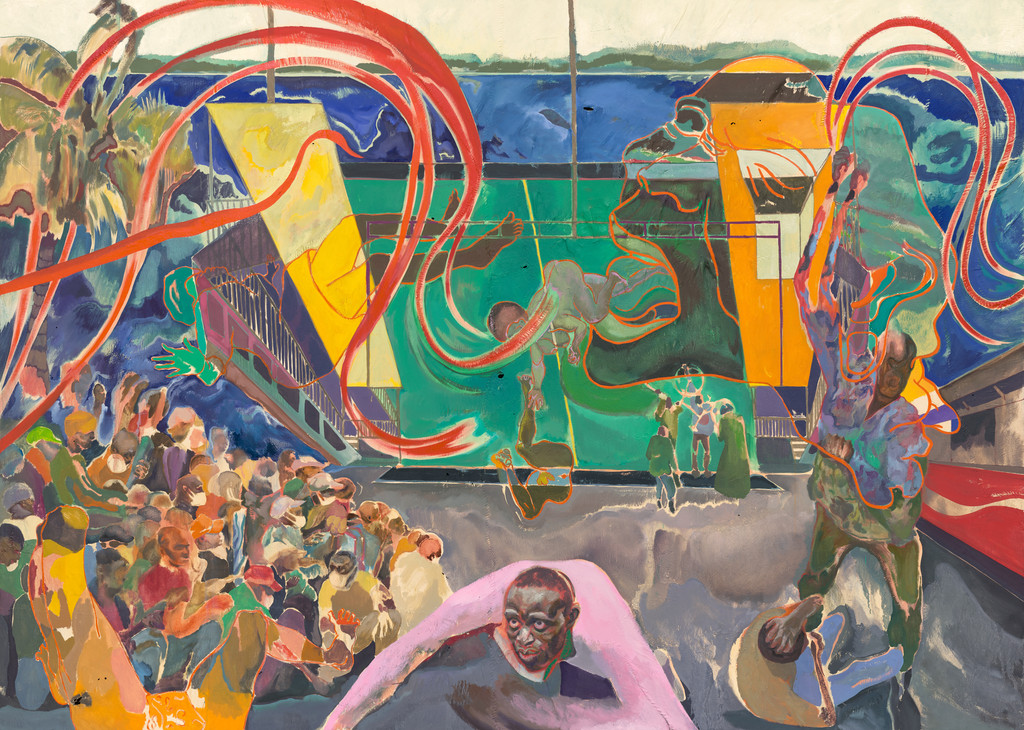
Michael Armitage
Curfew (Likoni March 27, 2020)
The dispersal of a crowd during a curfew becomes a choreography of constraint. Armitage connects health emergency, police authority and economic vulnerability in a painting where beauty never neutralizes the event.
Gift of Ronnie Heyman in honor of Ann Temkin
View work at source →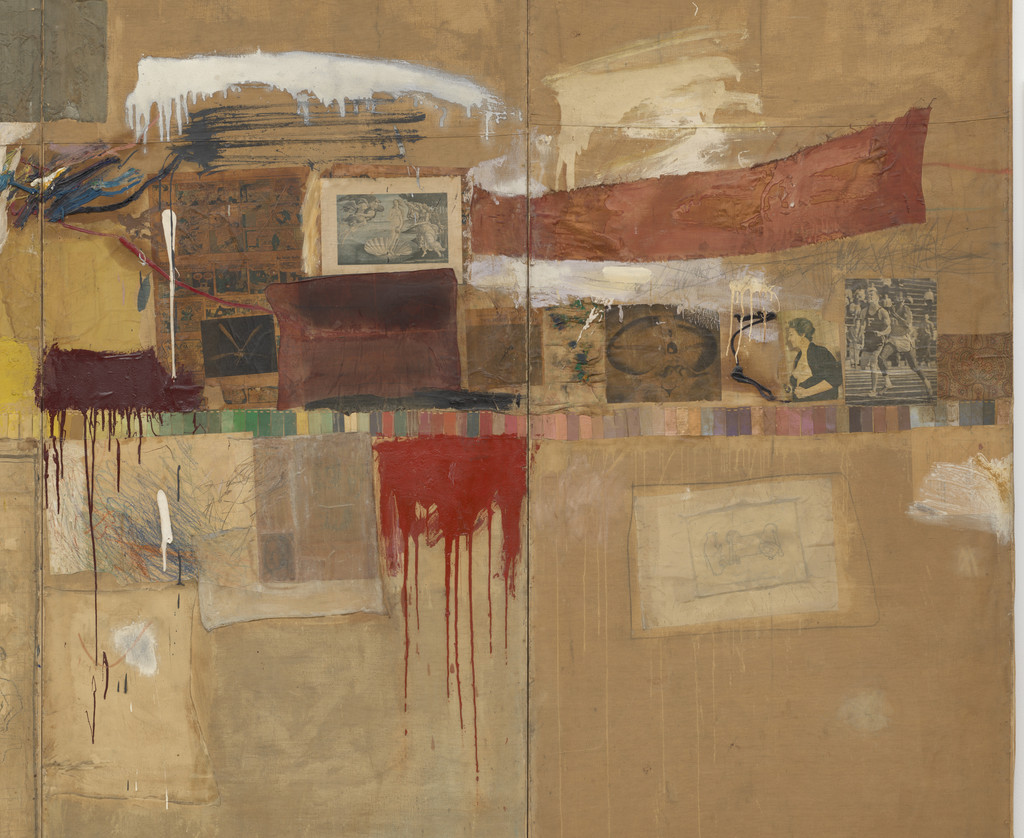
Robert rauschenberg
Rebus
Press fragments, fabrics and painted traces intersect like incompatible information from a post-war world. The painting does not deliver a slogan; it shows how political experience is constructed in a flow of signs and goods.
Museum of Modern Art (MoMA), New York
View work at source →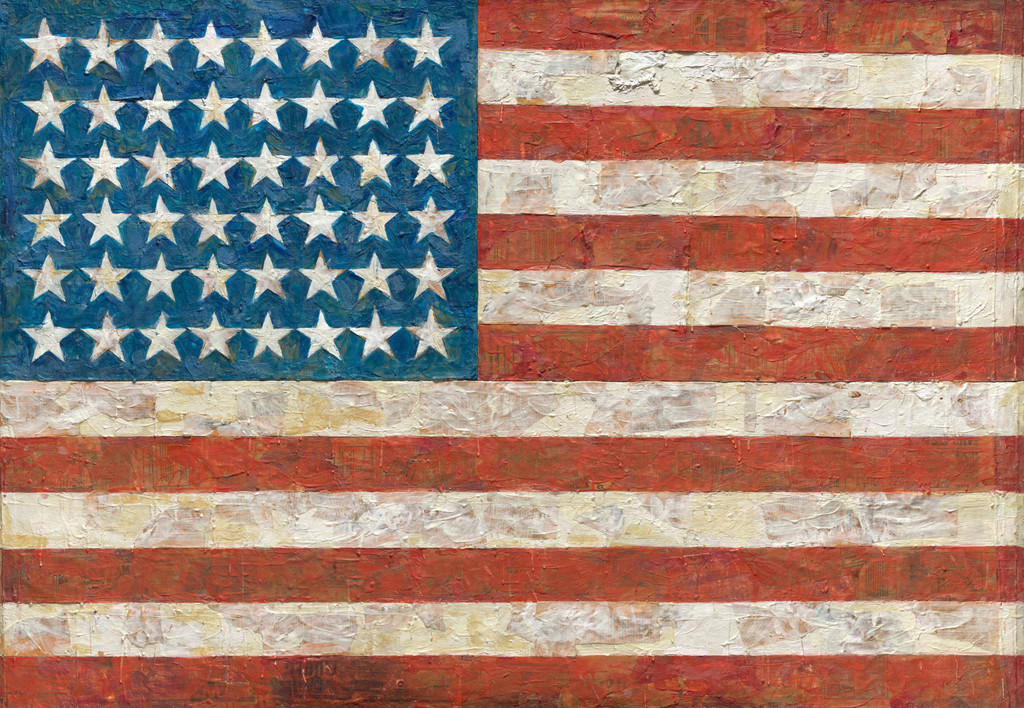
Jasper Johns
Flag
By painting a flag rather than a flag image, Johns transforms an obvious national symbol into a material object to examine. Newspaper layers, wax and visible invoice reopen what the emblem seemed to have definitively fixed.
Museum of Modern Art (MoMA), New York
View work at source →Resume the story and the representation
Racism, colonialism and civil rights
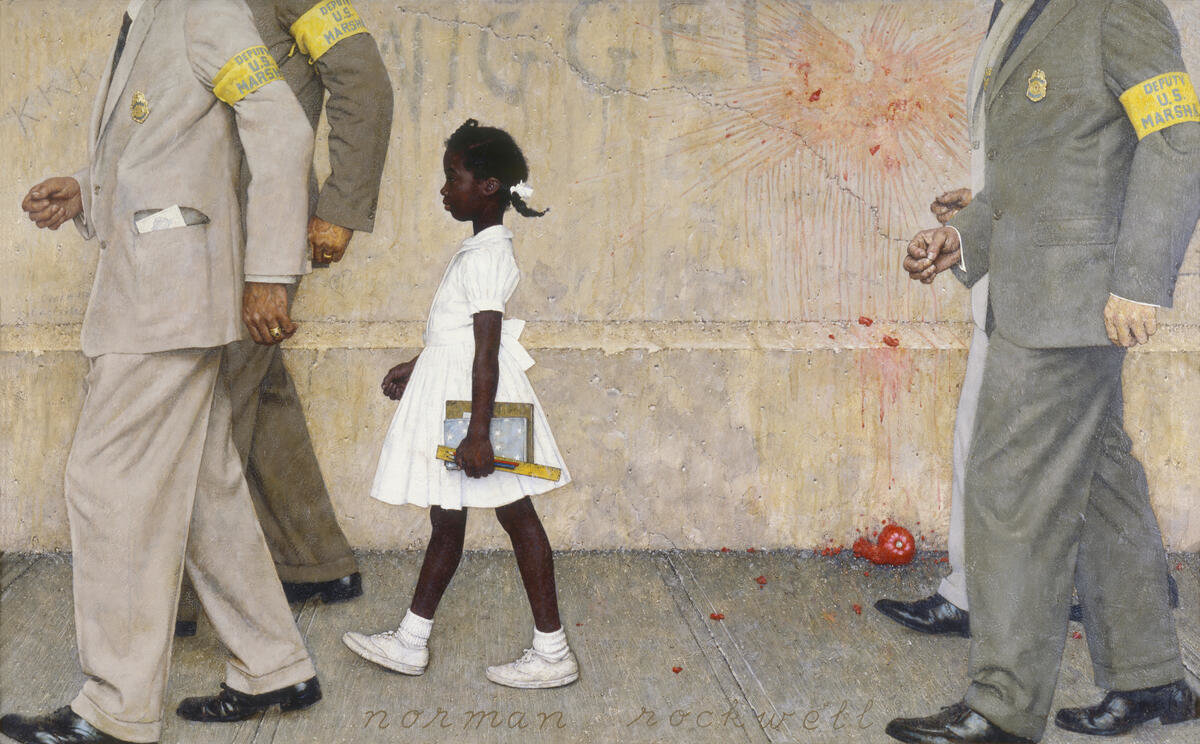
Norman Rockwell
The Problem We All Live With
Ruby Bridges walks between marshals whose framing cuts faces. Her white dress, the racist insult and the crushed tomato are enough to make desegregation a concrete ordeal endured by a child.
Norman Rockwell Museum
View work at source →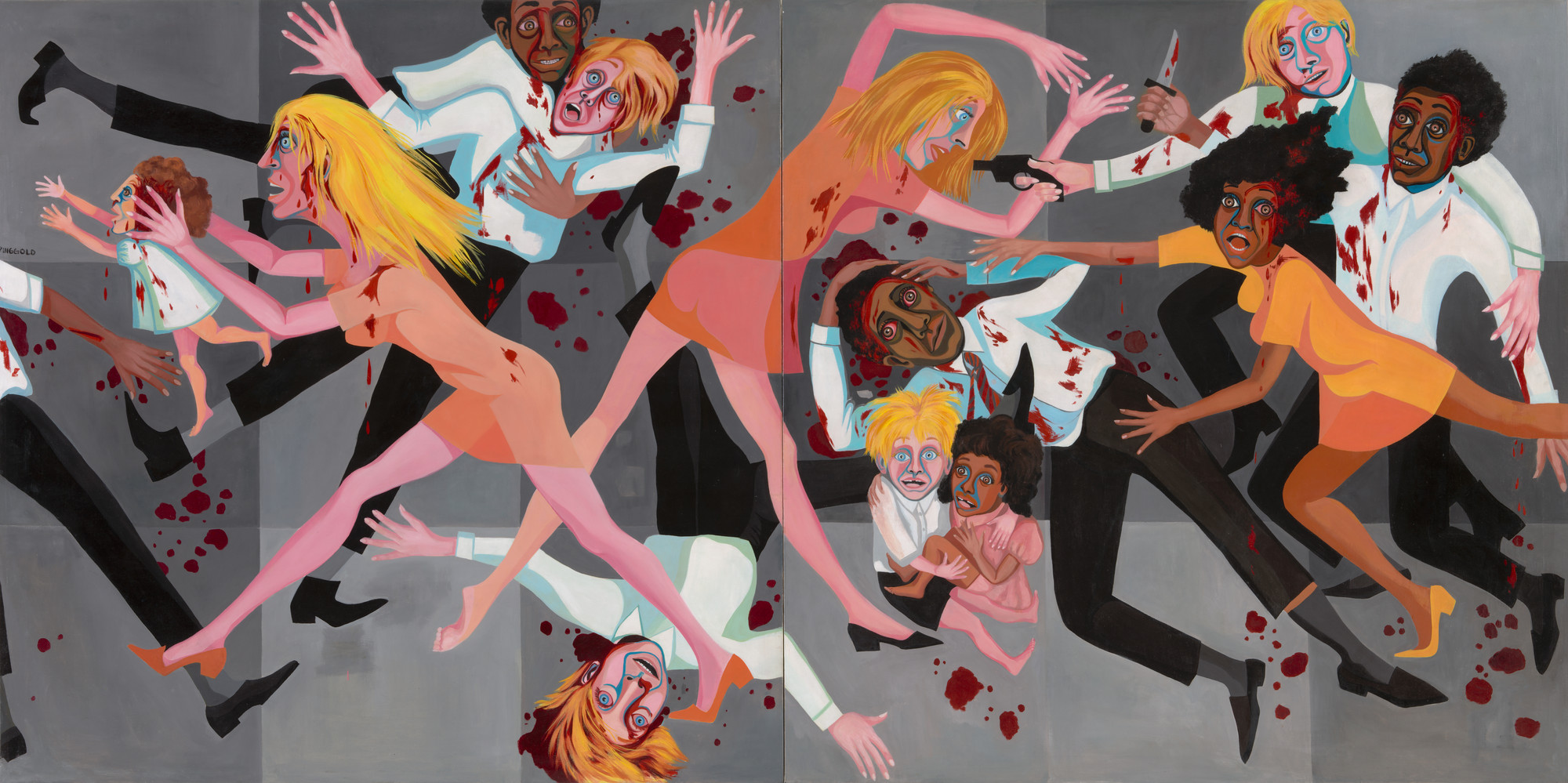
Faith Ringgold
American People Series #20: Die
Ringgold responds to race riots with a composition where black and white adults kill each other while two children cling to the center. The grid and elegant clothing show that violence runs through society as a whole.
Museum of Modern Art, New York
View work at source →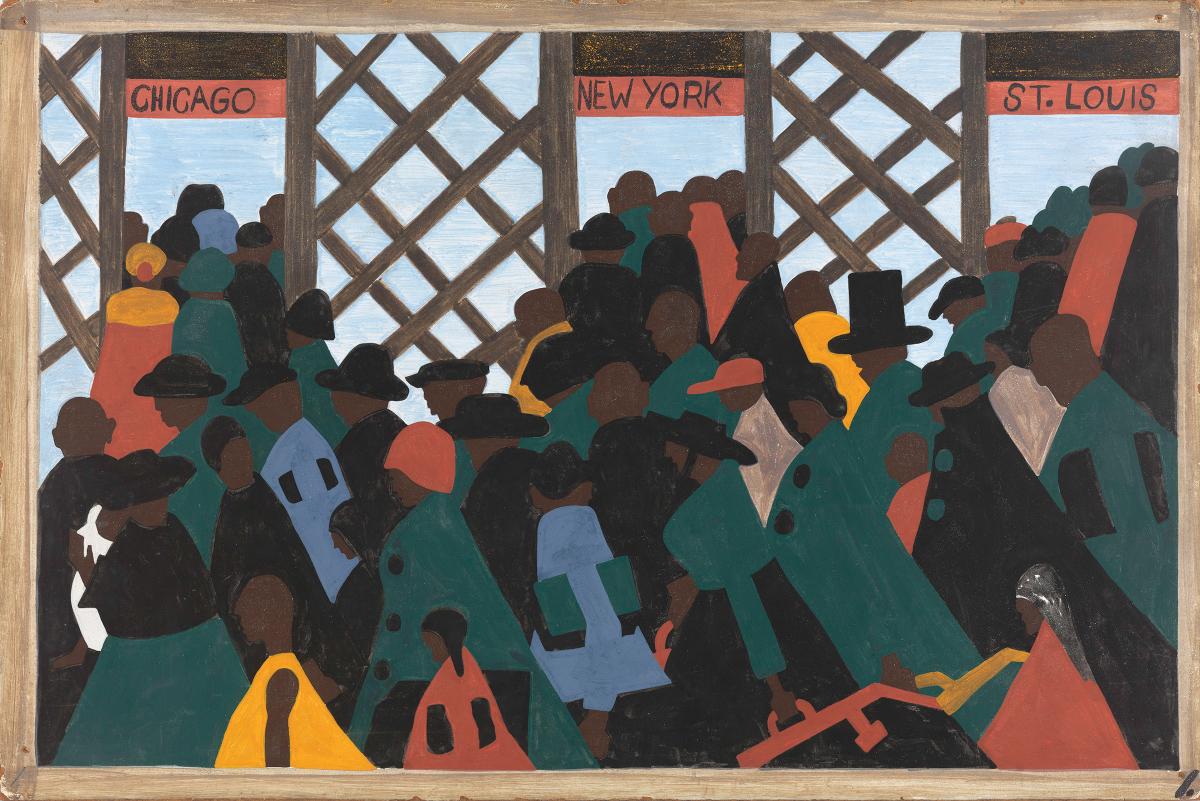
Jacob Lawrence
The Migration Series, Panel no. 1
Under signs pointing to Chicago, New York and Saint Louis, a crowd marches towards the stations. Lawrence transforms the Great Migration into a collective narrative: no single hero, but a historical movement made up of thousands of decisions.
The Phillips Collection, Washington
View work at source →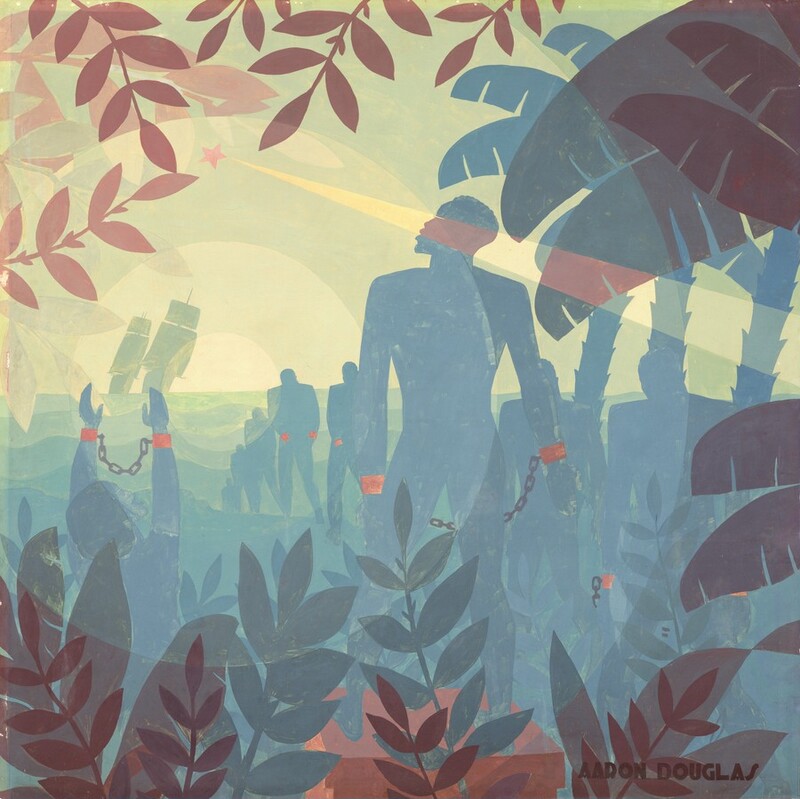
Aaron Douglas
Into Bondage
Chained silhouettes advance towards the ships while a star rises in the distance. Circles of light and modernist language connect the violence of the Atlantic slave trade to a story of resistance and hope.
National Gallery of Art, Washington
View work at source →Palmer Hayden
The Janitor Who Paints
Hayden paints an artist whom society only recognizes as a janitor. The cramped apartment brings together household tools and painting equipment, making the stage a protest against professional and racial subpoena.
Smithsonian American Art Museum
View work at source →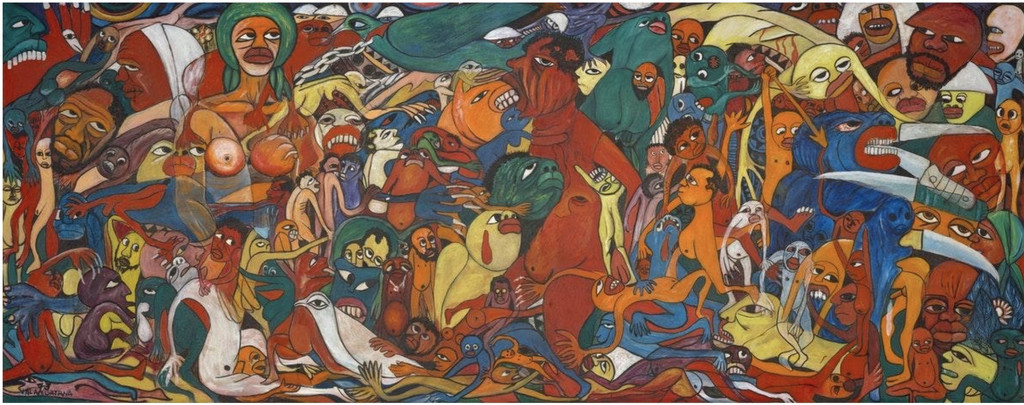
Malangatana Valente Ngwenya
Cry for Freedom
Tight faces, open eyes and animal faces make up a crowd under pressure. After prison and the anti-colonial struggle in Mozambique, Malangatana paints freedom as a shared cry rather than as a victory already acquired.
Gift of Eva and Glenn Dubin
View work at source →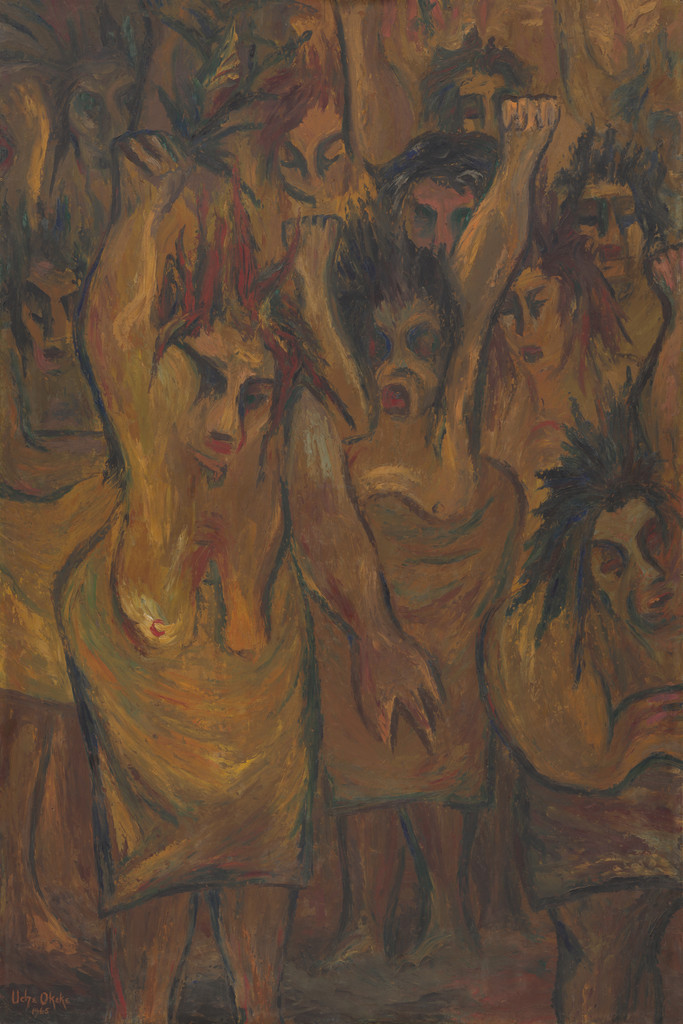
Uche Okeke
Women Riot
Okeke looks back on the Aba Women's War of 1929, a major mobilization against the British colonial administration. The tense lines and collective movement give demonstrators an active place in Nigerian political history.
Enid A. Haupt Fund
View work at source →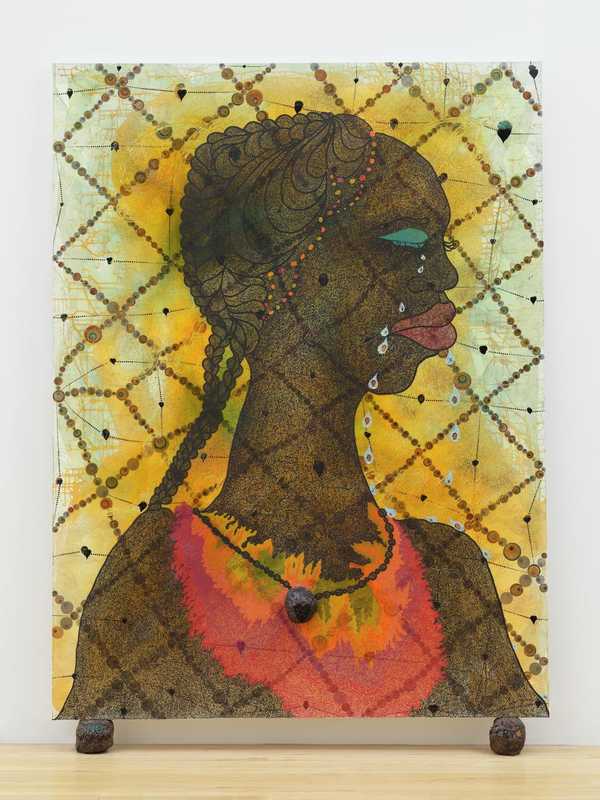
Chris Ofili
No Woman, No Cry
Each tear contains the portrait of Stephen Lawrence, a black teenager murdered in London. Ofili combines intimate mourning, public memory and anger at institutional failures without reducing the depicted mother to her grief alone.
Purchased 1999
View work at source →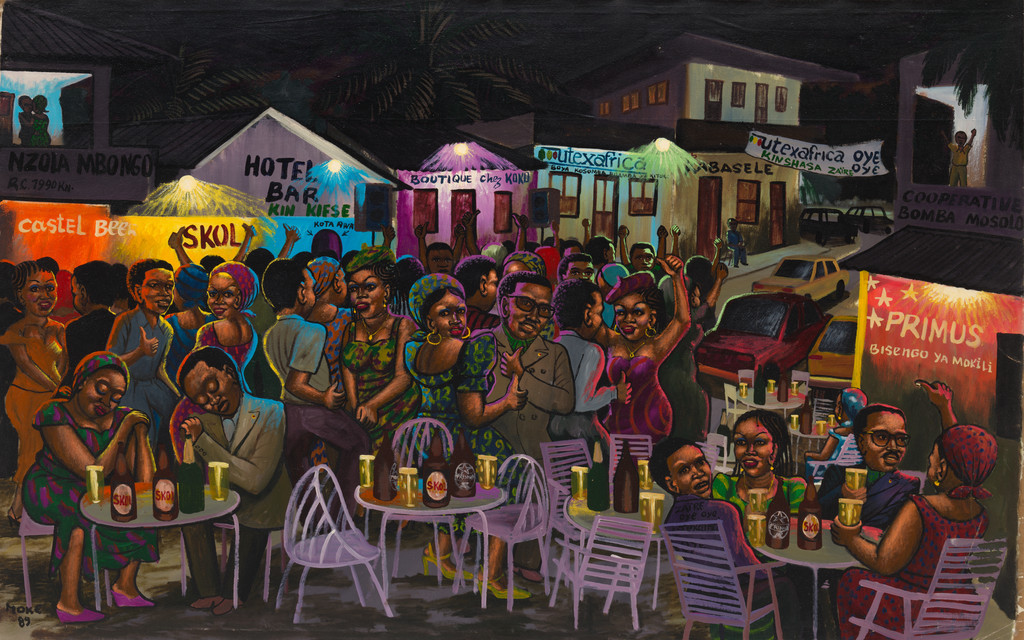
Moke
Long Live Utex Africa
Moké paints Kinshasa urban life by inscribing slogans, crowds and industry in the same area. The enthusiasm displayed does not erase the relationships between work, business and politics in Mobutu's Zaire.
The Jean Pigozzi African Art Collection. Gift of Jean Pigozzi
View work at source →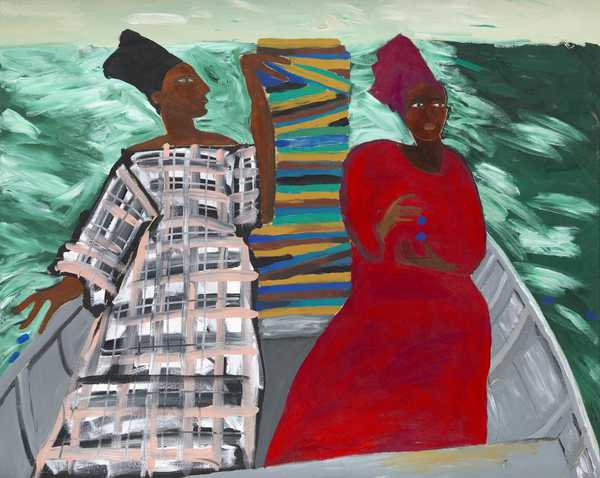
Lubaina Himid
Between the Two my Heart is Balanced
Two black women occupy a boat and tear up maps rather than being guided by them. Himid turns the colonial imagery of travel around and makes navigation a choice, a conversation and a resumption of power.
Presented by the Patrons of New Art (Special Purchase Fund) through the Tate Gallery Foundation 1995
View work at source →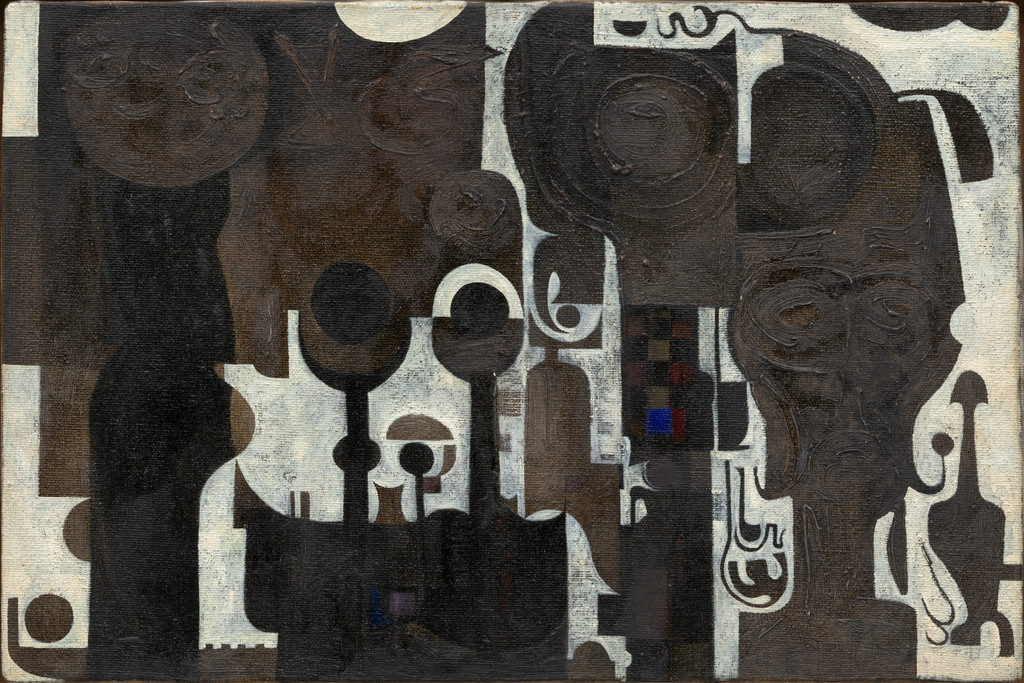
Ibrahim El-Salahi
The Mosque
El-Salahi combines calligraphy, architecture and abstraction without submitting to each other. The work asserts that Sudanese modernism can dialogue with the international while starting from its own spiritual and political forms.
Elizabeth Bliss Parkinson Fund
View work at source →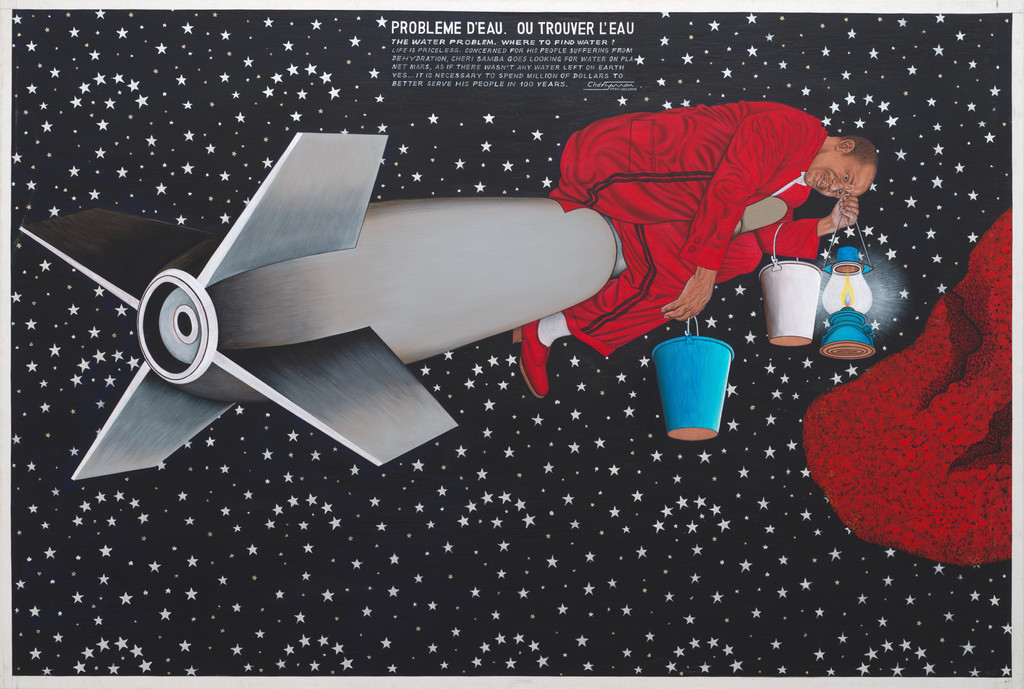
Darling Samba
Water Problem
Text and daily scene expose inequality of access to water as a political fact. Samba adopts the clarity of the poster and the precision of the testimony to prevent the urban crisis from being reduced to a statistic.
The Jean Pigozzi African Art Collection. Gift of Jean Pigozzi
View work at source →Uzo Egonu
The Arts
Egonu combines Igbo references, diaspora experience and modernist fragmentation. The painting defends the ability of an African artist based in Europe to construct a complex identity without becoming the illustrator of a fixed origin.
The Metropolitan Museum of Art, New York
View work at source →Gazbia Sirry
The Kite
Color, play and crowds condense the momentum of an Egyptian society in transformation after the revolution. Behind the apparent lightness of the kite lies the desire for a common public space and a still open future.
The Metropolitan Museum of Art, New York
View work at source →
Amrita Sher-Gil
Brahmacharis
The sobriety of the young novices, their thin bodies and the rhythm of the fabrics refuse the picturesque colonial. Sher-Gil constructs a modern painting from an Indian experience observed from the inside.
Alpha Reproduction
See reproduction →
Amrita Sher-Gil
Haldi Grinders
The collective work of women is organized by large areas of color which make gestures readable and dignified. The daily scene becomes an affirmation of social presence rather than an ethnographic image.
Alpha Reproduction
See reproduction →
Amrita Sher-Gil
The Potato Peeler
The concentration of the character and the weight of the volumes give a domestic task a monumental density. Sher-Gil refuses the hierarchy that separates the major subjects from the ordinary lives of women.
Alpha Reproduction
See reproduction →
Vo Xuong
The War at the Border of Southeast
The border landscape and figures are captured in the instability of a conflict that prolongs the Vietnam Wars. History painting becomes immediate national memory, but retains the anxiety of the terrain experienced.
Vietnam National Fine Arts Museum, Hanoi
View work at source →
Ramkinkar Baij
Homeward
The return is neither parade nor sentimental scene: it is pace of steps, load carried and fatigue. Baij makes the mobility of rural workers a modern subject in its own right.
National Gallery of Modern Art, New Delhi
View work at source →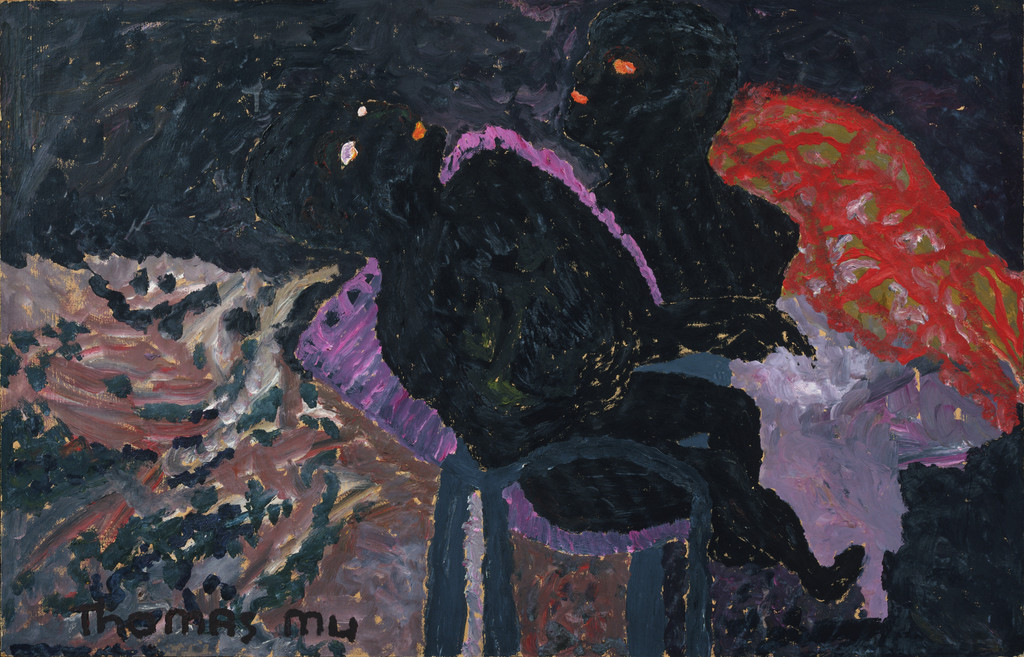
Thomas Mukarobgwa
Dying People in the Bush
The frontal title and the simplification of forms place human vulnerability at the center of the Rhodesian landscape. Mukarobgwa opposes the colonial order with a vision where local experience produces its own signs and its own gravity.
Gift of Mr. and Mrs. Walter Hochschild
View work at source →From private to political
Bodies, identities and consumer society

Édouard Manet
Olympia
Olympia holds the viewer's gaze and refuses the mythological detour that made the nude acceptable. The painting exposes the relationships of sex, class, race and money that academic painting preferred to envelop in allegory.
Alpha Reproduction
See reproduction →
Frida Kahlo
The Broken Column
Kahlo makes visible a pain that the traditional portrait would have concealed: the corset, the nails and the fractured spine describe a medicalized body without taking away its ability to look.
Alpha Reproduction
See reproduction →
Frida Kahlo
Self-portrait on the border between Mexico and the United States
Standing between pre-Columbian ruins, vegetation, chimneys and machines, Kahlo opposes two models of modernity. His body forms a border and refuses to choose a simplified identity between nationalism and industrialization.
Alpha Reproduction
See reproduction →
Frida Kahlo
The wounded deer
The artist's face appears on a deer pierced with arrows which nevertheless continues to advance. Kahlo transforms the self-portrait into a bodily fable where vulnerability, identity and resistance coexist.
Alpha Reproduction
See reproduction →
Frida Kahlo
Self-portrait with a necklace of thorns and hummingbird
The collar injures the neck while the monkey, cat and hummingbird charge the image with ambivalent signs. Kahlo depicts an identity that is never expressed as a transparent confession but as an active construction.
Alpha Reproduction
See reproduction →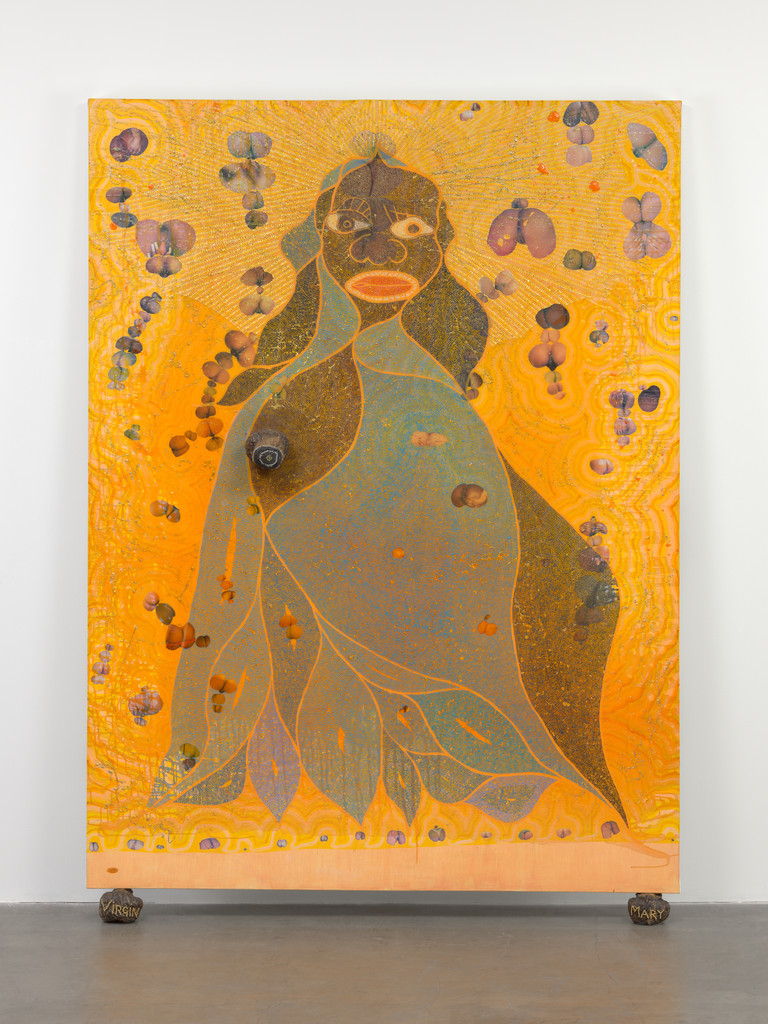
Chris Ofili
The Holy Virgin Mary
Ofili brings together Marian iconography, popular culture and devalued materials to challenge the codes of Western holiness. The scandal caused by the work reveals its irreverence less than the racial and cultural boundaries imposed on the sacred.
Gift of Steven and Alexandra Cohen
View work at source →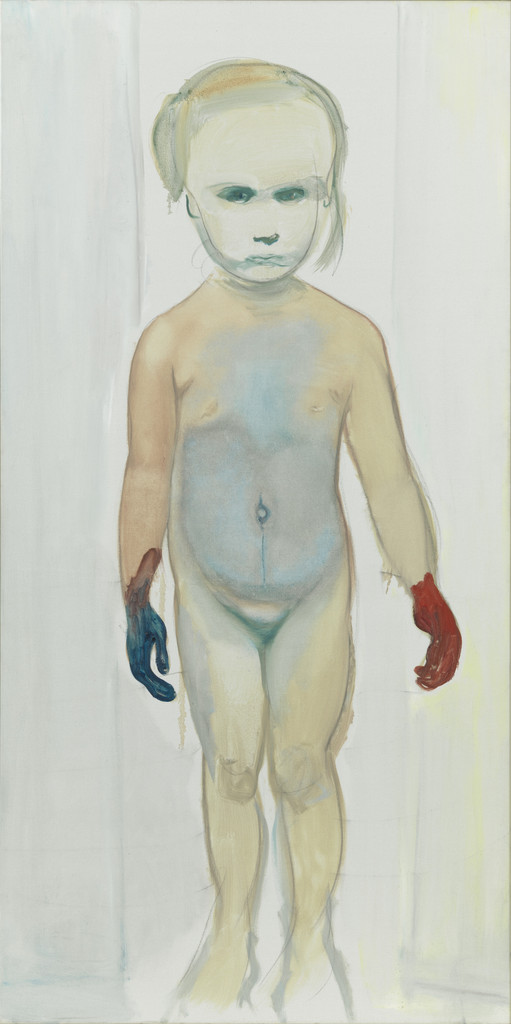
Marlene Dumas
The Painter
A child covered in paint looks at the viewer with disturbing frontality. Dumas blurs innocence, creation and exhibition of the female body, and reverses the traditional relationship between active painter and passive model.
Fractional and promised gift of Martin and Rebecca Eisenberg
View work at source →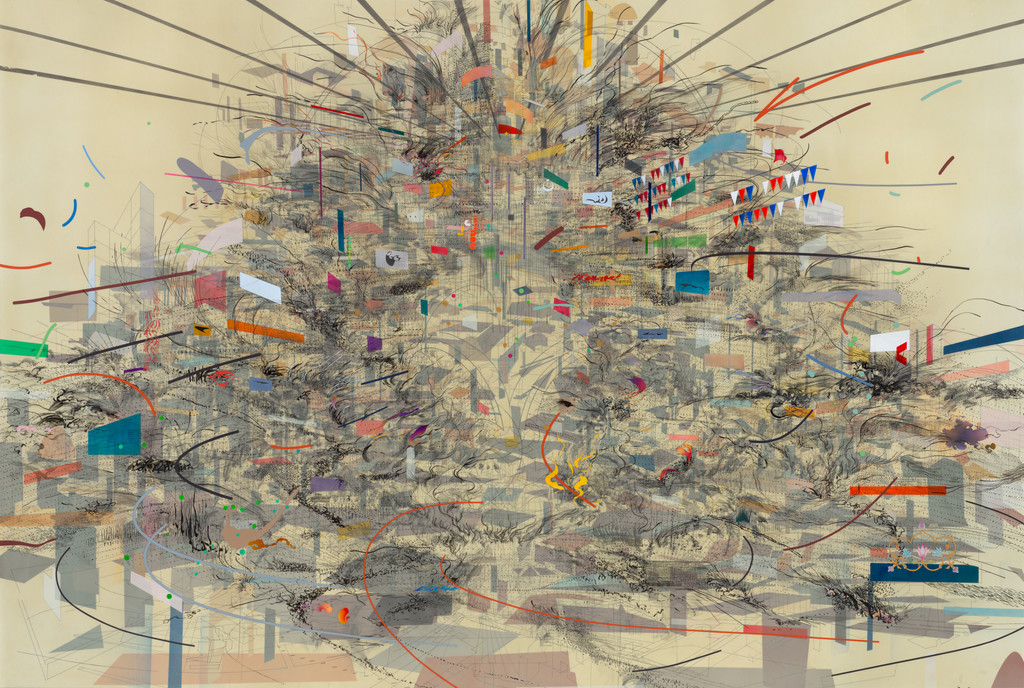
Julie Mehretu
Empirical Construction, Istanbul
Architectural plans, trajectories and signs overlap without producing a stable city. Mehretu paints urban space as a field of power, migration and memory where no point of view can claim to be neutral.
Fund for the Twenty-First Century
View work at source →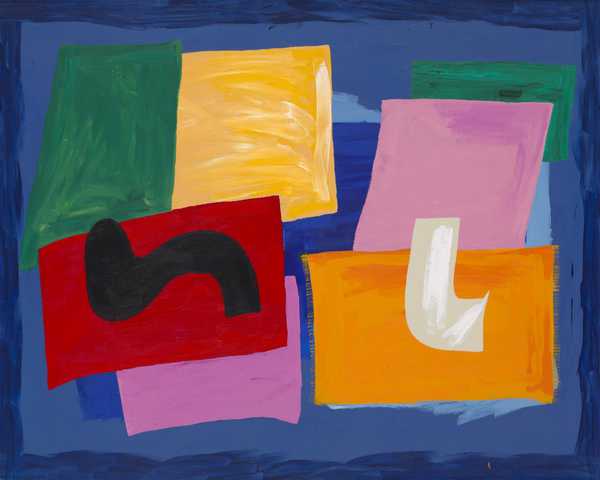
Lubaina Himid
Carpet
The decorative motif becomes an archive of circulation, commerce and colonial history. Himid uses ornament as critical language and moves stories that the museum has long kept at bay to the domestic surface.
Presented by the artist 2009
View work at source →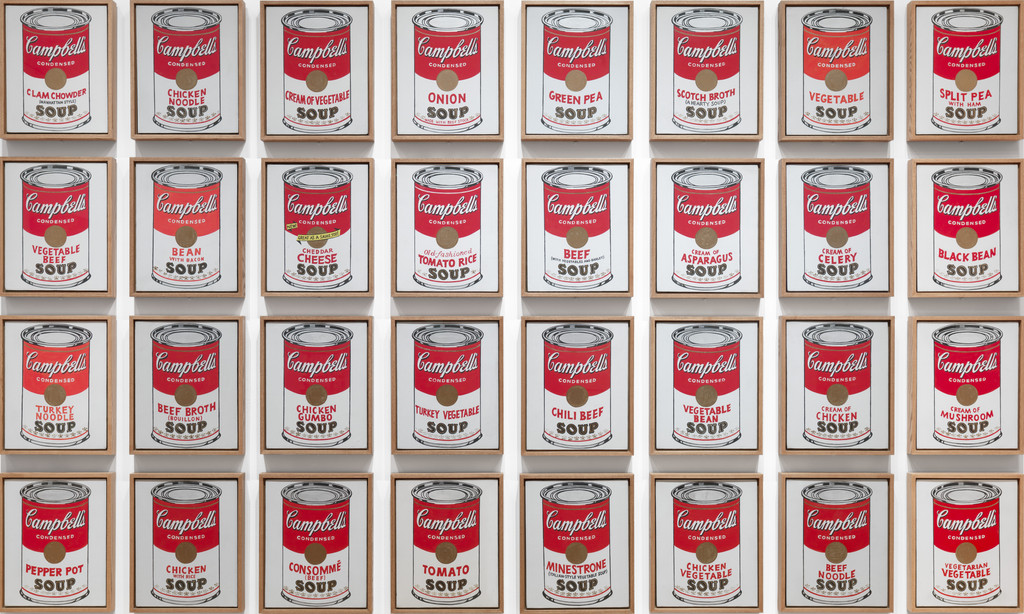
Andy Warhol
Campbell's Soup Cans
Thirty-two almost identical products occupy the wall like the shelves of a store. Warhol does not decide between celebration and criticism: he shows that mass consumption has become one of the great common landscapes of American life.
Museum of Modern Art (MoMA), New York
View work at source →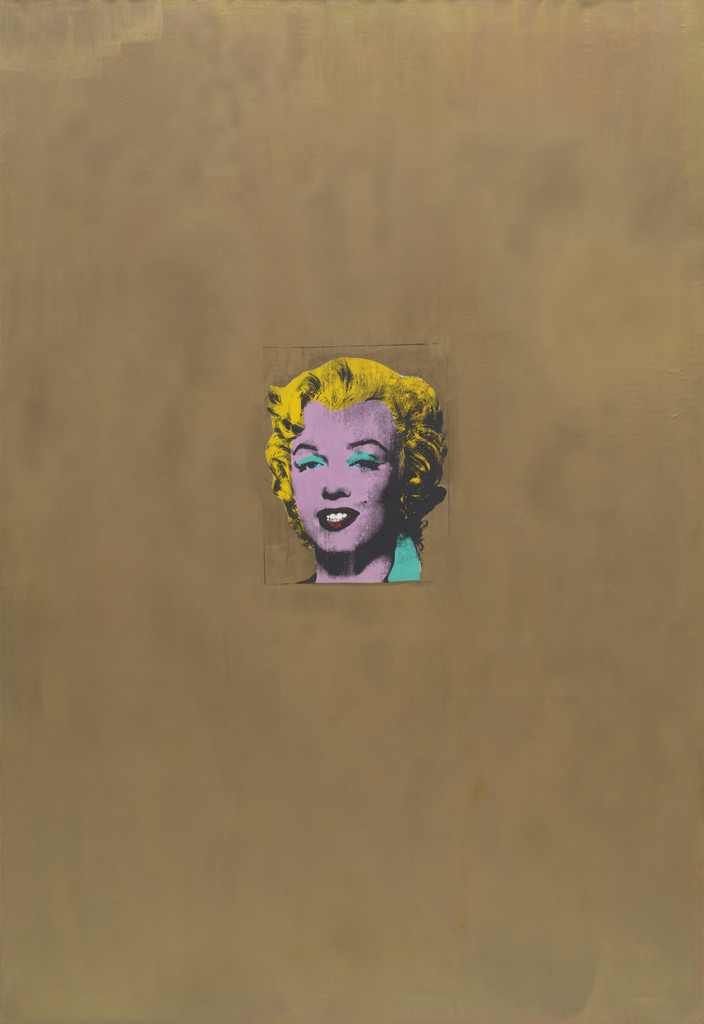
Andy Warhol
Gold Marilyn Monroe
After Marilyn Monroe's death, Warhol isolates her reproduced face on a vast golden field. The media icon borrows from the altarpiece, but the imperfect impression reminds us that a celebrity is also an image produced, consumed and replaceable.
Museum of Modern Art (MoMA), New York
View work at source →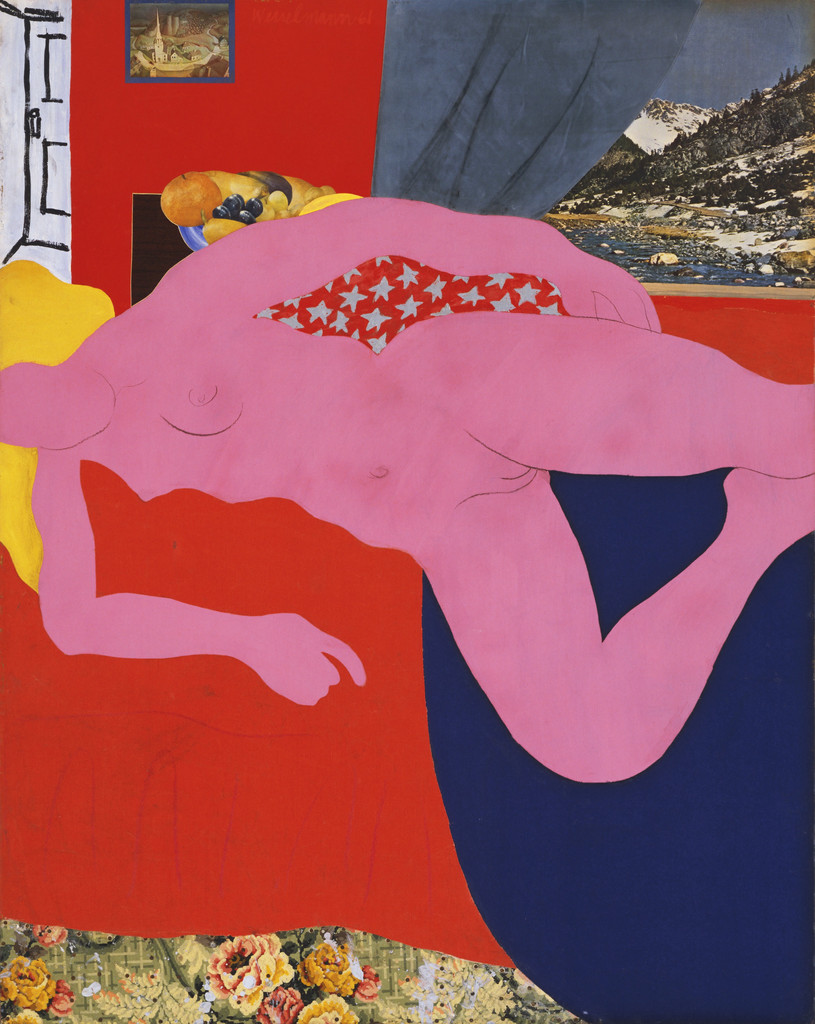
Tom Wesselmann
Great American Nude, 2
The female body is reduced to a few advertising signs in an interior saturated with national colors. Wesselmann condenses desire, consumption and American identity, by exposing the commercial manufacturing of the gaze.
Museum of Modern Art (MoMA), New York
View work at source →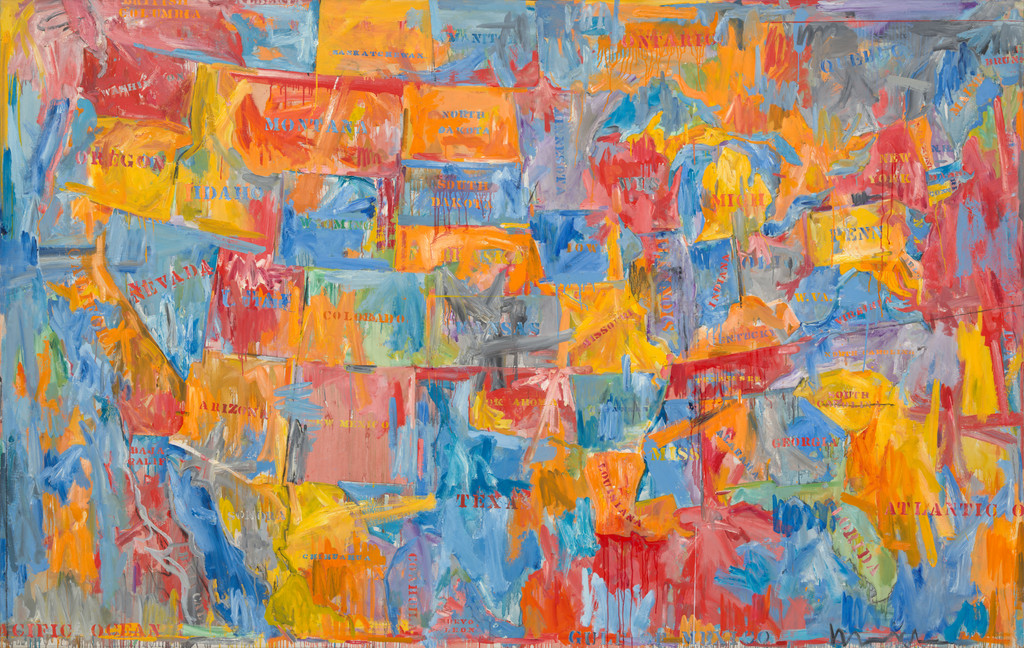
Jasper Johns
Map
The borders of the United States remain recognizable but dissolve in matter and brushstrokes. Johns transforms the map, a tool of authority and teaching, into an unstable surface where the territory ceases to be self-evident.
Museum of Modern Art (MoMA), New York
View work at source →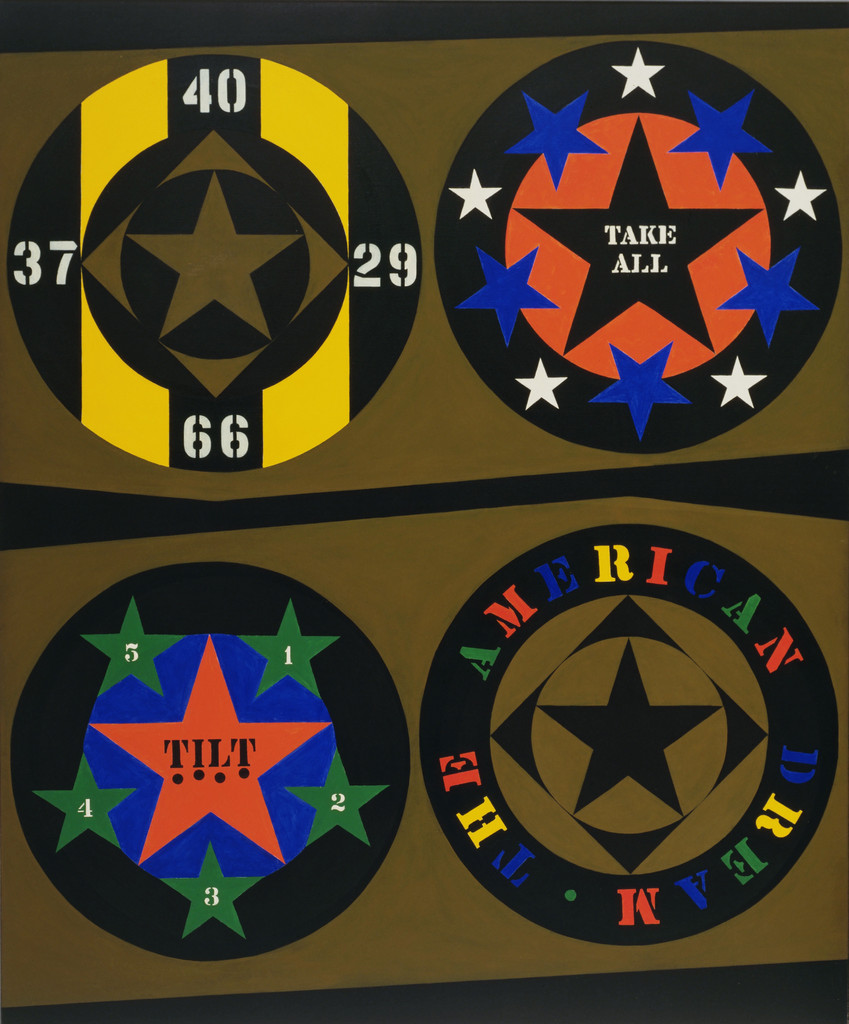
Robert Indiana
The American Dream, I
Numbers, stars, circles and words make up a target as much as an emblem. Indiana takes the visual language of roads, games and advertising to show a national dream already converted into a system of signs.
Museum of Modern Art (MoMA), New York
View work at source →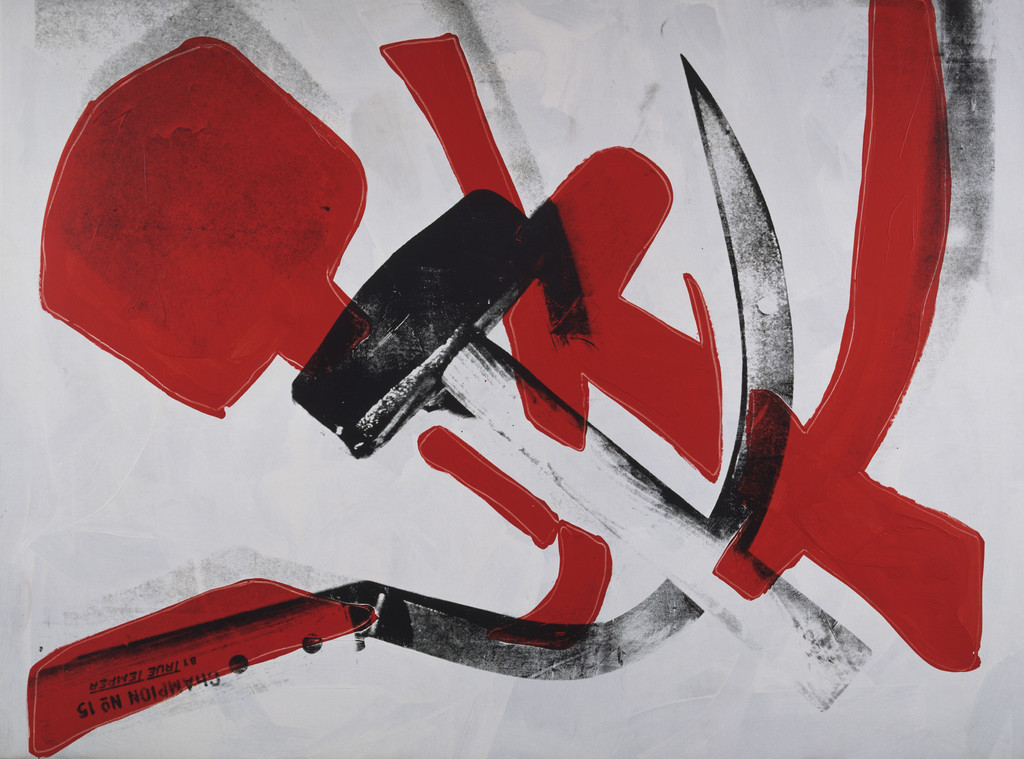
Andy Warhol
Hammer and Sickle
Warhol photographs real tools purchased from a hardware store then transforms them into an emblem. The communist symbol once again becomes merchandise and still life, revealing the ease with which ideology circulates as an image.
Museum of Modern Art (MoMA), New York
View work at source →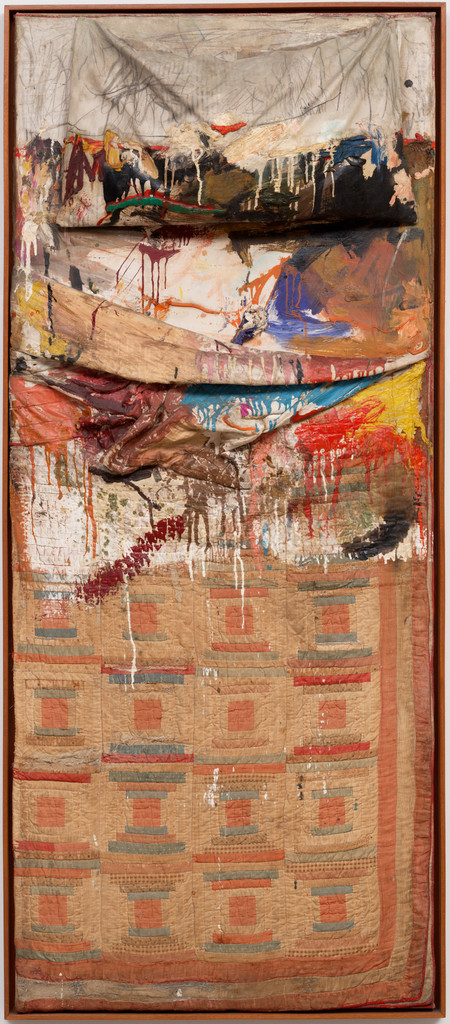
Robert rauschenberg
Bed
Blanket, sheet and pillow leave the private space to stand like a painting. Rauschenberg blurs the lines between everyday life, absent body and great artistic gesture, contesting what the museum deems worthy of its wall.
Museum of Modern Art (MoMA), New York
View work at source →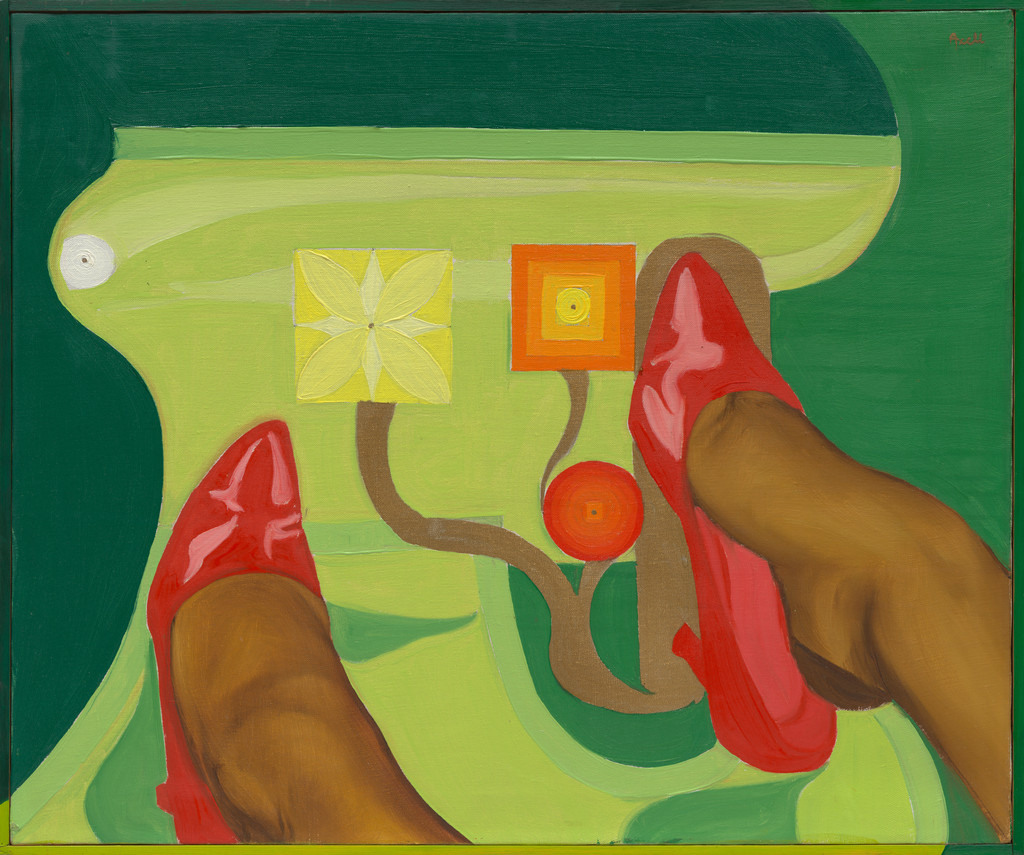
Evelyne Axell
Axell-eration
Axell appropriates speed, eroticism and pop codes from a feminine position. The body is no longer just a product looked at: it becomes visual energy and an agent of one's own desire.
Museum of Modern Art (MoMA), New York
View work at source →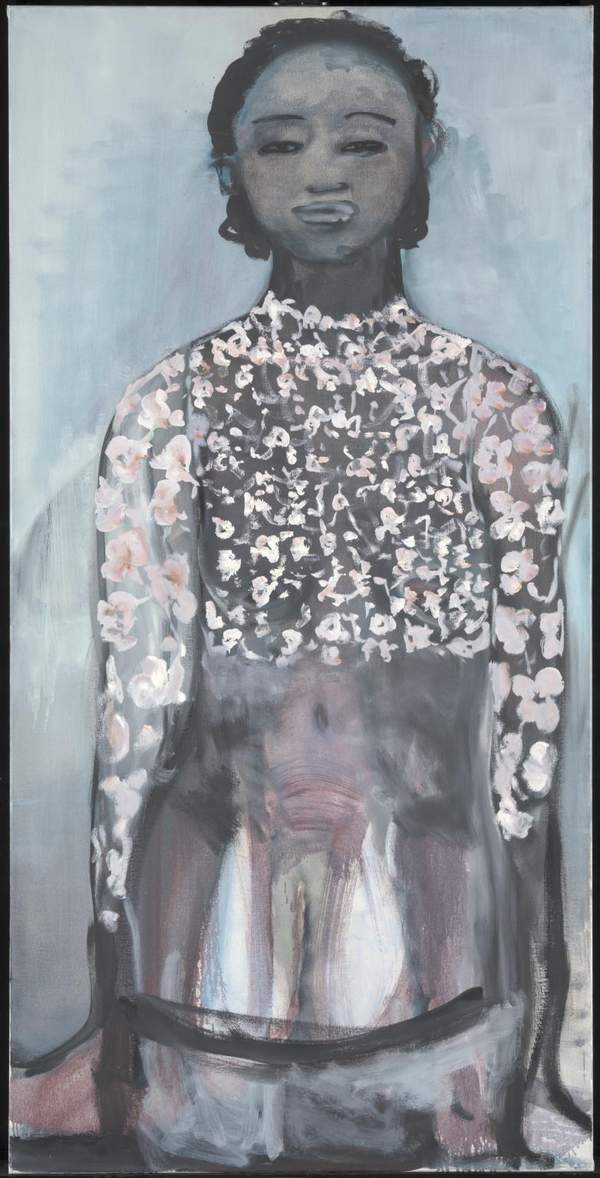
Marlene Dumas
Ivory Black
The title borrows the paradoxical name of a pigment and immediately places color in the language of the race. Dumas uses portraiture to show that chromatic categories are never mere descriptions.
Purchased 1998
View work at source →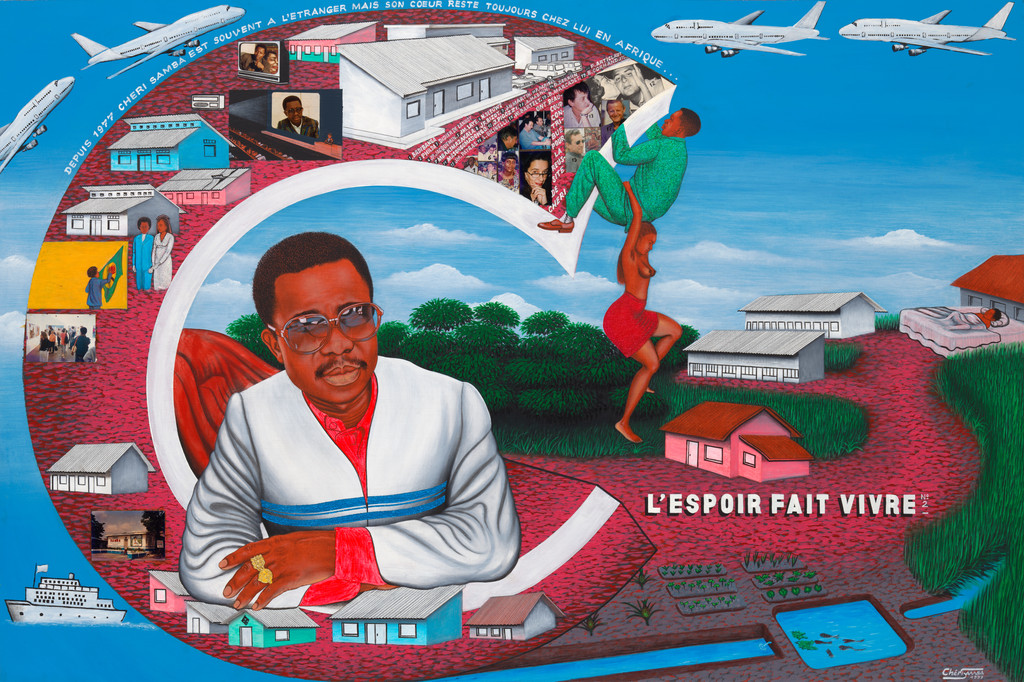
Darling Samba
Hope Keeps You Going #2
Samba combines self-portrait, text and brilliance to talk about perseverance in a social space crossed by inequalities. The artist becomes a public commentator, without separating humor, seduction and argument.
The Jean Pigozzi African Art Collection. Gift of Jean Pigozzi
View work at source →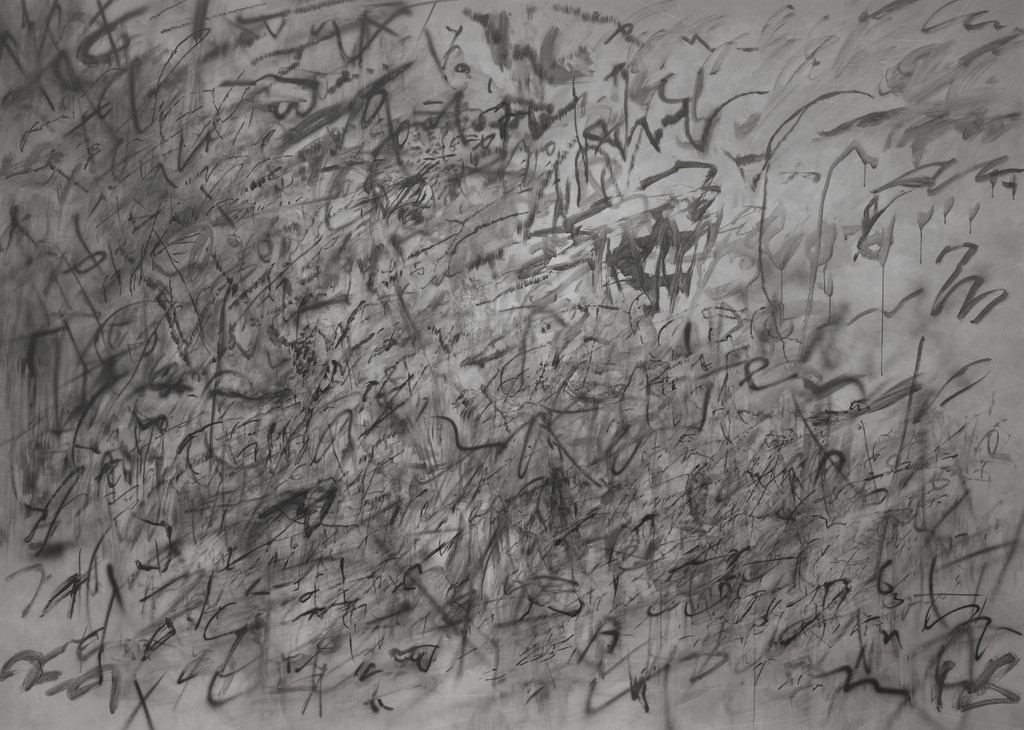
Julie Mehretu
Invisible Sun (algorithm 5, second letter form)
Strata of lines, erasures and signs seem to map a political energy impossible to fix. Mehretu gives shape to the movement, the speed of information and the invisible forces that structure the present.
Gift of the Steven and Alexandra Cohen Foundation, Eugenio Lopez Alonso, and Committee on Painting and Sculpture Funds
View work at source →From revolutionary icon to global struggles
Two centuries of conflicting images
At the end of the 18th century, the French Revolution gave painting a new civic function. David organizes Marat's memory as that of a republican martyr. A few years later, Goya destroyed the heroic ideal of the battle: in "May 3, 1808", the story can be read from the place of the condemned.
The 19th century then shifted politics towards social life. Géricault transforms a shipwreck into a state scandal; Turner confronts British trade with trafficking; Courbet, Millet and Daumier impose workers on great art, poor travelers and ordinary residents. The question is no longer just which event to paint, but to whom to grant a monumental presence.
In the 20th century, world wars, fascism, decolonization, anti-racist struggles and mass culture further broadened the field. Picasso, Dix and Beckmann distort the body to express the catastrophe. Rivera takes over the public wall. Lawrence, Douglas, Ringgold and Rockwell compete for the national narrative. Pop art finally reveals that flags, products, stars and accident images also shape political consciousness.
David transforms Marat's death into a republican icon and shows the political power of the staging.
Goya places the victim at the center of war painting and announces the modern critical eye.
Courbet and realism give ordinary classes the dimensions once reserved for official history.
"Guernica" makes local bombing an international language against violence against civilians.
Faith Ringgold connects painting, civil rights, race, class and feminism in a monumental image of the present.
Form carries argument
Four ways to take a stand
Political content is not enough to produce strong work. What remains is the way in which the composition organizes our place: are we witnesses, judges, accomplices, consumers or members of the crowd? Manet's frontality, géricault's diagonals, Warhol's repetition and Mehretu's maps are already ways of arguing.
Engaged painting can aim for clarity or preserve ambiguity. Muralism seeks collective reading in public space; expressionism distorts to make a psychic truth perceptible; social realism restores them material conditions; pop editing exposes the industrial circulation of images. None of these languages is politically pure by nature: it all depends on the use made of them.
Frequently asked questions
Watch without simplifying
Is a committed work necessarily militant?
No. Some explicitly defend a cause, while others shift the gaze by choosing a subject, scale or form. Commitment can be manifest, critical, memorial or linked to the reception of the work.
What is the difference between committed painting and propaganda?
Propaganda generally seeks to impose reading and mobilize in the service of a power or a doctrine. A committed work can be persuasive, but it often retains a complexity, tensions or contradictions that resist the single message.
Why include pop art and consumer images?
Because products, stars, flags and press photographs structure social life. Warhol, Rosenquist, Johns and Axell question the way in which desire, violence and identity circulate as visual commodities.
Can a painting really change society?
Rarely on its own. However, it can fix a memory, shift a sensitivity, make a conflict visible and provide a common image for a movement. Its effectiveness is measured in the duration, uses and debates it provokes.
How were the hundred works chosen?
The selection favors the strength of the position, historical importance, formal invention, geographical diversity and the possibility of verifying the work and its image. Photographs, sculptures and posters without a pictorial component have been ruled out.
0 comments