

One hundred works · between myth and vision
The 100known paintings that tell the storyGustave Moreau
From the enigmas of the Sphinx to the jewels of Salome, Moreau transforms myths into painted dreams - with enough gold, monsters and silence to furnish many Olympus.
Jupiter and Semele1894-1895 · Musée national Gustave-Moreau, Paris
Gustave Moreau made his Parisian studio a factory of myths where ancient heroes, biblical figures and fabulous creatures are covered with colors and signs. This journey follows a painter who preferred enigma to anecdote and who, faced with a surface that was still free, he rarely resisted the urge to add a gem.

Gustave Moreau
Jupiter and Semele
Moreau worked for almost twenty years on this vision, completed in 1895, where Semele died of having contemplated Jupiter in all its brilliance. The god sits in the middle of a world saturated with stones, idols and symbolic figures: Olympus resembles less a palace than a thought that has become architecture.
See the work
Gustave Moreau
the Apparition
"the Apparition" condenses an autonomous vision populated by signs. In the "Apparition", color gently transforms the story. Thus, the "Apparition" leaves the myth voluntarily open.
See the work
Gustave Moreau
Oedipus and the Sphinx
Exhibited at the Salon of 1864, the painting marked Moreau's notable return after several years of withdrawal. The Sphinx clings to Oedipus' body and fixes it a few centimeters from his face: the enigma becomes a physical duel, tight as a trap.
See the work
Gustave Moreau
Orpheus
At the Salon of 1866, Moreau showed a young Thracian collecting the head and lyre of Orpheus after the poet's murder. The face of the dead person reflects that of the young woman, so much so that poetry seems to survive in the gaze that welcomes it.
See the work
Gustave Moreau
Salome dancing in front of Herod
Moreau exhibited this Salomé at the Salon of 1876, in an imaginary room where architecture borrows from several civilizations. The dancer advances almost motionless, transformed into a precious idol; the movement is played out less in her feet than in the nervous brilliance of the decor.
See the work
Gustave Moreau
Salome tattooed
In this variation, the arabesques appear to float on the body and the palate like a network of luminous tattoos. Moreau pushes the ornament so far that Salomé seems at once woman, icon and painted surface, three roles difficult to play in the same dance.
See the work
Gustave Moreau
Galatea
Cyclops Polyphemus spies on Galatea from the shadows while the nymph stands out against a seabed encrusted with flowers and corals. Brutal desire remains relegated to the background; in the foreground, the whiteness of Galatea imposes an almost mineral silence.
See the work
Gustave Moreau
The Unicorns
Inspired by the tapestries of The Lady and the Unicorn, Moreau invents an island populated by hieratic women and fabulous animals. Jewelry, flowers and fabrics abolish depth in favor of a closed world where even unicorns seem to know protocol.
See the work
Gustave Moreau
Hercules and the Lernaean Hydra
At the Salon of 1876, Hercules confronts a hydra lurking on a pile of victims. Moreau suspends the action just before the fight: the immobility of the hero and the dark mass of the monster make the ancient episode a moral confrontation.
See the work
Gustave Moreau
Prometheus
Exhibited at the Salon of 1869, Prometheus remains upright despite the eagle which devours his side. Moreau gives the tortured person the serenity of a martyr, transforming the fire thief into an emblem of the spirit that resists.
See the work
Gustave Moreau
Jason
Medea dominates Jason just as the hero has just conquered the Golden Fleece. Their proximity already announces dependence and disaster: Moreau paints a triumph whose victory has, discreetly, the keys to catastrophe.
See the work
Gustave Moreau
Triumph of Alexander the Great
This vast unfinished composition accumulates palaces, peoples and deities around Alexander, almost tiny at the center of his own glory. Moreau treats the conquest as an encyclopedic vision where the empire threatens at any moment to disappear beneath its ornaments.
See the work
Gustave Moreau
The Pretenders
Moreau repeated for decades this scene of the massacre of the suitors by Ulysses without ever declaring it completed. The hero strikes in the middle of monumental architecture while Athena overlooks the tumult: the epic becomes a lifelong project.
See the work
Gustave Moreau
Saint George and the Dragon
Saint George remains perfectly calm in front of the dragon, as if the fight had already been decided in his mind. The distant princess, the white horse and the vertical landscape transform the chivalrous feat into a spiritual apparition.
See the work
Gustave Moreau
Phaethon
Phaethon loses control of the solar chariot after wanting to prove his divine ancestry. Moreau condenses the fall into a whirlwind of horses and fire: asking his father for the keys to the Sun remains one of the worst ideas in mythology.
See the work
Gustave Moreau
The Life of Humanity
This suite of nine watercolors organizes human history according to the ages of gold, silver and iron, each shared between morning, noon and evening. Moreau constructs less of a chronology than a cyclical poem on childhood, inspiration and loss.
See the work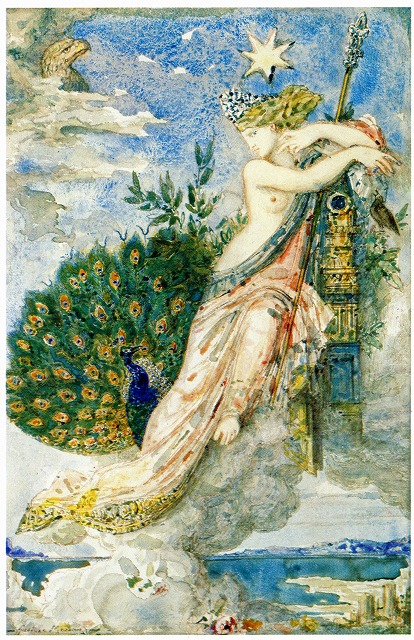
Gustave Moreau
The Peacock complaining to Juno
Moreau borrows from La Fontaine the peacock who came to complain to Juno in his unsightly voice. The goddess replies that everyone receives their gift: the bird therefore retains its splendid feathers, but no singing teacher.
See the work
Gustave Moreau
The Mermaids
Moreau's sirens are not only attractive through their song: they emerge from a rocky landscape like the very forms of desire and danger. The sailor becomes a spectator of an immobile beauty whose silence seems more disturbing than the music.
See the work,_36.7_x_19.8_cm.,_Ephrussi_de_Rothschild_Foundation.jpg)
Gustave Moreau
Evening and Pain
Two entwined figures give a body to the evening and to pain, themes that Moreau treats like the characters in a poem. The small format concentrates the emotion in a dark harmony, without narrative accessories to soften its gravity.
See the work
Gustave Moreau
The Inspiration
"Inspiration" condenses an autonomous vision populated by signs. In "Inspiration", the light disrupts the entire scene. Thus, "Inspiration" lets the narration give way to the vision.
See the work
Gustave Moreau
Eve
"Eve" condenses an autonomous vision populated with signs. In "Eve", the ornament discreetly leads the reading. Thus, "Eve" lets the narration give way to the vision.
See the work
Gustave Moreau
Adam
"Adam" condenses an autonomous vision populated by signs. In "Adam", the gaze slows down in front of the signs. Thus, "Adam" lets the silence retain its brilliance.
See the work
Gustave Moreau
Salomé with the head of Jean-Baptiste
"Salome with the Head of John the Baptist" condenses a biblical drama of desire and power. In "Salome with the Head of John the Baptist", color gently transforms the story. Thus, "Salomé with the head of John the Baptist" lets the silence maintain its brilliance.
See the work
Gustave Moreau
Salome at the prison
"Salomé in Prison" condenses a biblical drama of desire and power. In "Salomé in Prison", the setting becomes a thought. Thus, "Salomé in Prison" lets the silence retain its brilliance.
See the work
Gustave Moreau
The death of Sapho
"The death of Sapho" condenses a myth captured before its changeover. In "The Death of Sapho", the figure imposes its enigma. Thus, "The Death of Sapho" lets the silence retain its brilliance.
See the work
Gustave Moreau
Hesiod and the Muse
"Hesiod and the Muse" condenses a myth captured before its changeover. In "Hesiod and the Muse", the gesture seems to hold back time. Thus, "Hesiod and the Muse" lets the silence maintain its brilliance.
See the work
Gustave Moreau
Arion
"Arion" condenses a myth captured before its shift. In "Arion", the light disrupts the entire scene. Thus, "Arion" lets the silence maintain its brilliance.
See the work
Gustave Moreau
Mystical flower
"Mystical Flower" condenses an autonomous vision populated by signs. In "Mystical Flower", the ornament discreetly leads the reading. Thus, "Mystical Flower" lets the silence retain its brilliance.
See the work
Gustave Moreau
The Poet and the Mermaid
"The Poet and the Mermaid" condenses an autonomous vision populated by signs. In "The Poet and the Mermaid", the gaze slows down in front of the signs. Thus, "The Poet and the Mermaid" lets the detail prolong the emotion.
See the work
Gustave Moreau
The Chimera
"La Chimère" condenses an autonomous vision populated by signs. In "La Chimère", color gently transforms the story. Thus, "La Chimère" lets the detail prolong the emotion.
See the work
Gustave Moreau
The Chimeras
"Les Chimères" condenses an autonomous vision populated by signs. In "Les Chimères", the decor becomes a thought. Thus, "Les Chimères" lets the detail prolong the emotion.
See the work
Gustave Moreau
Hélène at the Scée gate
"Hélène at the Scée door" condenses an autonomous vision populated by signs. In "Hélène at the Scée door", the figure imposes its enigma. Thus, "Hélène at the Scée door" lets the detail prolong the emotion.
See the work
Gustave Moreau
Samson and Delilah
"Samson and Delilah" condenses an autonomous vision populated by signs. In "Samson and Delilah", the gesture seems to hold back time. Thus, "Samson and Delilah" lets the detail prolong the emotion.
See the work
Gustave Moreau
Delilah
"Dalila" condenses an autonomous vision populated by signs. In "Dalila", the light disrupts the entire scene. Thus, "Dalila" lets the detail prolong the emotion.
See the work
Gustave Moreau
Perseus and Andromeda
"Persaeus and Andromeda" condenses a myth captured before its shift. In "Persaeus and Andromeda", the ornament discreetly leads the reading. Thus, "Persaeus and Andromeda" lets the detail prolong the emotion.
See the work
Gustave Moreau
Apollo and the Nine Muses
"Apollo and the Nine Muses" condenses a myth captured before its change. In "Apollo and the Nine Muses", the gaze slows down in front of the signs. Thus, "Apollo and the Nine Muses" lets beauty retain its threat.
See the work
Gustave Moreau
Apollo victorious over the serpent Python
"Apollo victorious over the serpent Python" condenses a myth captured before its changeover. In "Apollo victorious over the serpent Python", color gently transforms the story. Thus, "Apollo victorious over the serpent Python" lets beauty retain its threat.
See the work
Gustave Moreau
Apollo and Daphne
"Apollo and Daphne" condenses a myth captured before its shift. In "Apollo and Daphne", the setting becomes a thought. Thus, "Apollo and Daphne" lets beauty retain its threat.
See the work
Gustave Moreau
Leda
"Leda" condenses a myth captured before its changeover. In "Leda", the figure imposes its enigma. Thus, "Leda" lets beauty retain its threat.
See the work
Gustave Moreau
Danae
"Danaé" condenses a myth captured before its shift. In "Danaé", the gesture seems to hold back time. Thus, "Danaé" lets beauty retain its threat.
See the work
Gustave Moreau
Pasiphae
"Pasiphaé" condenses a myth captured before its shift. In "Pasiphaé", the light disrupts the entire scene. Thus, "Pasiphaé" lets beauty retain its threat.
See the work
Gustave Moreau
Ariadne and Theseus
"Ariane and Theseus" condenses a myth captured before its shift. In "Ariane and Theseus", the ornament discreetly leads the reading. Thus, "Ariane and Theseus" lets beauty retain its threat.
See the work
Gustave Moreau
The Return of the Argonauts
"The Return of the Argonauts" condenses a myth captured before its shift. In "The Return of the Argonauts", the gaze slows down at the signs. Thus, "The Return of the Argonauts" lets the dream prevail over the anecdote.
See the work
Gustave Moreau
The Daughters of Thespius
"The Daughters of Thespius" condenses an autonomous vision populated by signs. In "The Daughters of Thespius", color gently transforms the story. Thus, "The Daughters of Thespius" lets the dream prevail over the anecdote.
See the work
Gustave Moreau
Hercules and the birds of Lake Stymphale
"Hercules and the Birds of Lake Stymphale" condenses a myth captured before its changeover. In "Hercules and the Birds of Lake Stymphale", the setting becomes a thought. Thus, "Hercules and the Birds of Lake Stymphale" lets the dream prevail over the anecdote.
See the work
Gustave Moreau
Diomedes devoured by his horses
"Diomedes devoured by his horses" condenses a myth captured before his change. In "Diomedes devoured by his horses", the figure imposes his enigma. Thus, "Diomedes devoured by his horses" lets the dream prevail over the anecdote.
See the work
Gustave Moreau
The Departure from Briseis
"The Departure of Briseis" condenses a myth captured before its changeover. In "The Departure of Briseis", the gesture seems to hold back time. Thus, "The Departure of Briseis" lets the dream prevail over the anecdote.
See the work
Gustave Moreau
Erigone
"Erigone" condenses an autonomous vision populated by signs. In "Erigone", the light disrupts the entire scene. Thus, "Erigone" lets the dream prevail over the anecdote.
See the work
Gustave Moreau
Déjanire (Autumn)
"Déjanire (Autumn)" condenses a myth captured before its changeover. In "Déjanire (Autumn)", the ornament discreetly leads the reading. Thus, "Déjanire (Autumn)" lets the dream prevail over the anecdote.
See the work
Gustave Moreau
Kidnapping of Dejanira
"Removal of Dejanire" condenses a myth captured before its changeover. In "Removal of Dejanire", the gaze slows down at the signs. Thus, "Removal of Dejanire" leaves the myth voluntarily open.
See the work
Gustave Moreau
Birth of Venus
"Birth of Venus" condenses a myth captured before its shift. In "Birth of Venus", color gently transforms the story. Thus, "Birth of Venus" leaves the myth voluntarily open.
See the work
Gustave Moreau
The Rapture of Europe
"The Rapture of Europe" condenses a myth captured before its shift. In "The Rapture of Europe", the setting becomes a thought. Thus, "The Rapture of Europe" leaves the myth voluntarily open.
See the work
Gustave Moreau
Venus emerging from the wave
"Venus emerging from the wave" condenses a myth captured before its shift. In "Venus emerging from the wave", the figure imposes its enigma. Thus, "Venus emerging from the wave" leaves the myth voluntarily open.
See the work
Gustave Moreau
The fairy
"The Fairy" condenses an autonomous vision populated by signs. In "The Fairy", the gesture seems to hold back time. Thus, "The Fairy" leaves the myth deliberately open.
See the work
Gustave Moreau
The voices
"The voices" condenses an autonomous vision populated by signs. In "The Voices", the light disrupts the entire scene. Thus, "The Voices" leaves the myth deliberately open.
See the work
Gustave Moreau
The Young Man and Death
"The Young Man and Death" condenses an autonomous vision populated by signs. In "The Young Man and Death", the ornament discreetly leads the reading. Thus, "The Young Man and Death" leaves the myth deliberately open.
See the work
Gustave Moreau
The Song of Songs
"The Song of Songs" condenses an autonomous vision populated by signs. In "The Song of Songs", the gaze slows down at the signs. Thus, "The Song of Songs" leaves the symbol without a definitive answer.
See the work
Gustave Moreau
The toilet
"The Toilet" condenses an autonomous vision populated by signs. In "The Toilet", color gently transforms the story. Thus, "The Toilet" leaves the symbol without a definitive answer.
See the work
Gustave Moreau
Messaline
"Messaline" condenses an autonomous vision populated by signs. In "Messaline", the setting becomes a thought. Thus, "Messaline" leaves the symbol without a definitive answer.
See the work
Gustave Moreau
Suzanne and the old men
"Suzanne and the old men" condenses an autonomous vision populated by signs. In "Suzanne and the old men", the figure imposes its enigma. Thus, "Suzanne and the old men" leaves the symbol without a definitive answer.
See the work
Gustave Moreau
Lucretia and Tarquin
"Lucretius and Tarquin" condenses an autonomous vision populated by signs. In "Lucretius and Tarquin", the gesture seems to hold back time. Thus, "Lucretius and Tarquin" leaves the symbol without a definitive answer.
See the work
Gustave Moreau
The Fates and the Angel of Death
"The Fates and the Angel of Death" condenses an autonomous vision populated with signs. In "The Fates and the Angel of Death", the light disrupts the entire scene. Thus, "The Fates and the Angel of Death" leaves the symbol without a definitive answer.
See the work
Gustave Moreau
Victim
"Victim" condenses an autonomous vision populated by signs. In "Victim", the ornament discreetly leads the reading. Thus, "Victim" leaves the symbol without a definitive answer.
See the work
Gustave Moreau
Martyr
"Martyrdom" condenses an autonomous vision populated by signs. In "Martyrdom", the gaze slows down in front of the signs. Thus, "Martyrdom" lets the narration give way to the vision.
See the work
Gustave Moreau
Tyrtea
"Tyrtaeus" condenses an autonomous vision populated by signs. In "Tyrtaeus", color gently transforms the story. Thus, "Tyrtaeus" lets the narration give way to the vision.
See the work
Gustave Moreau
Scottish rider
"Scottish Rider" condenses an autonomous vision populated by signs. In "Scottish Rider", the setting becomes a thought. Thus, "Scottish Rider" lets the narrative give way to the vision.
See the work
Gustave Moreau
Rider
"Rider" condenses an autonomous vision populated by signs. In "Rider", the figure imposes its enigma. Thus, "Rider" lets the narration give way to the vision.
See the work
Gustave Moreau
Darius, fleeing after the battle of Arbelles, stops, exhausted with fatigue, to drink from a pond
"Darius, fleeing after the battle of Arbelles, stops, exhausted with fatigue, to drink from a pond" condenses an autonomous vision populated by signs. In "Darius, fleeing after the battle of Arbelles, stops, exhausted with fatigue, for drinking from a pond", the gesture seems to hold back time. Thus, "Darius, fleeing after the battle of Arbelles, stops, exhausted with fatigue, to drink from a pond" lets the narration give way to the vision.
See the work
Gustave Moreau
The Athenians delivered to the Minotaur in the labyrinth of Crete
"The Athenians delivered to the Minotaur in the labyrinth of Crete" condenses an autonomous vision populated with signs. In "The Athenians delivered to the Minotaur in the labyrinth of Crete", the light disrupts the entire scene. Thus, "The Athenians delivered to the Minotaur in the labyrinth of Crete" lets the narration give way to the vision.
See the work
Gustave Moreau
Traveling Oedipus
"Traveling Oedipus" condenses a myth captured before its shift. In "Traveling Oedipus", the ornament discreetly leads the reading. Thus, "Traveling Oedipus" lets the narration give way to the vision.
See the work
Gustave Moreau
Hesiod and the Muses
"Hesiod and the Muses" condenses a myth captured before its shift. In "Hesiod and the Muses", the gaze slows down in front of the signs. Thus, "Hesiod and the Muses" lets the silence maintain its brilliance.
See the work
Gustave Moreau
The Muses leave Apollo, their father, to enlighten the world
"The Muses leave Apollo, their father, to go and enlighten the world" condenses a myth captured before its change. In "The Muses leave Apollo, their father, to go and enlighten the world", color slowly transforms the story. Thus, "The Muses leave Apollo, their father, to go and enlighten the world" lets the silence retain its brilliance.
See the work
Gustave Moreau
The Traveling Poet
"The Traveling Poet" condenses an autonomous vision populated by signs. In "The Traveling Poet", the setting becomes a thought. Thus, "The Traveling Poet" lets the silence maintain its brilliance.
See the work
Gustave Moreau
King David
"King David" condenses an autonomous vision populated by signs. In "King David", the figure imposes its enigma. Thus, "King David" lets the silence maintain its brilliance.
See the work
Gustave Moreau
Jacob and the Angel
"Jacob and the Angel" condenses an autonomous vision populated by signs. In "Jacob and the Angel", the gesture seems to hold back time. Thus, "Jacob and the Angel" lets the silence retain its brilliance.
See the work
Gustave Moreau
The Good Samaritan
"The Good Samaritan" condenses a sacred episode made deeply interior. In "The Good Samaritan", the light disrupts the entire scene. Thus, "The Good Samaritan" lets the silence maintain its brilliance.
See the work
Gustave Moreau
Christ in the garden of olive trees
"Christ in the Garden of Olives" condenses a sacred episode made deeply interior. In "Christ in the Garden of Olives", the ornament discreetly leads the reading. Thus, "Christ in the Garden of Olives" lets the silence retain its brilliance.
See the work
Gustave Moreau
Christ and Madeleine (Noli me Tangere)
"Christ and Madeleine (Noli me Tangere)" condenses a sacred episode made deeply interior. In "Christ and Madeleine (Noli me Tangere)", the gaze slows down in front of the signs. Thus, "Christ and Madeleine (Noli me Tangere)", the gaze slows down in front of the signs. Thus, "Christ and Madeleine (Noli me Tangere)" lets the detail prolong the emotion.
See the work
Gustave Moreau
The Coronation of Thorns
"The Coronation of Thorns" condenses an autonomous vision populated by signs. In "The Coronation of Thorns", color gently transforms the story. Thus, "The Coronation of Thorns" lets the detail prolong the emotion.
See the work
Gustave Moreau
Calvary
"Calvary" condenses a sacred episode made deeply interior. In "Calvary", the setting becomes a thought. Thus, "Calvary" lets the detail prolong the emotion.
See the work
Gustave Moreau
Madeleine at Calvary
"Madeleine at Calvary" condenses a sacred episode made deeply interior. In "Madeleine at Calvary", the figure imposes its enigma. Thus, "Madeleine at Calvary" lets the detail prolong the emotion.
See the work
Gustave Moreau
The Pietà
"La Pietà" condenses a sacred episode made deeply interior. In "La Pietà", the gesture seems to hold back time. Thus, "La Pietà" lets the detail prolong the emotion.
See the work
Gustave Moreau
Pietà
"Pietà" condenses a sacred episode made deeply interior. In "Pietà", the light disrupts the entire scene. Thus, "Pietà" lets the detail prolong the emotion.
See the work
Gustave Moreau
Saint Sebastian cared for by the holy women
"Saint Sebastian cared for by the holy women" condenses a sacred episode made deeply interior. In "Saint Sebastian cared for by the holy women", the ornament discreetly leads the reading. Thus, "Saint Sebastian cared for by the holy women" lets the detail prolong the emotion.
See the work
Gustave Moreau
San Sebastian and the angel
"San Sebastian and the Angel" condenses a sacred episode made deeply interior. In "San Sebastian and the Angel", the gaze slows down at the signs. Thus, "San Sebastian and the Angel" lets beauty retain its threat.
See the work
Gustave Moreau
A Saint in the desert
"A Saint in the Desert" condenses a sacred episode made deeply interior. In "A Saint in the Desert", color gently transforms the story. Thus, "A Saint in the Desert" lets beauty retain its threat.
See the work
Gustave Moreau
The Three Wise Men
"The Three Wise Men" condenses a sacred episode made deeply interior. In "The Three Wise Men", the setting becomes a thought. Thus, "The Three Wise Men" lets beauty retain its threat.
See the work
Gustave Moreau
Angels following the Three Wise Men
"Angels following the Three Kings" condenses a sacred episode made deeply interior. In "Angels following the Three Kings", the figure imposes its enigma. Thus, "Angels following the Three Kings" lets beauty retain its threat.
See the work
Gustave Moreau
Moses exposed on the Nile
"Moses exposed on the Nile" condenses a sacred episode made deeply interior. In "Moses exposed on the Nile", the gesture seems to hold back time. Thus, "Moses exposed on the Nile" lets beauty retain its threat.
See the work
Gustave Moreau
Moses saved from the waters
"Moses saved from the waters" condenses a sacred episode made deeply interior. In "Moses Saved from the Waters", the light disrupts the entire scene. Thus, "Moses saved from the waters" lets beauty retain its threat.
See the work
Gustave Moreau
Moses, in sight of the Promised Land, takes off his sandals
"Moses, in view of the Promised Land, takes off his sandals" condenses a sacred episode made deeply interior. In "Moses, in view of the Promised Land, takes off his sandals", the ornament discreetly leads the reading. Thus, "Moses, in sight from the Promised Land, take off your sandals" lets beauty retain its threat.
See the work
Gustave Moreau
The Prodigal Son
"The Prodigal Son" condenses a sacred episode made deeply interior. In "The Prodigal Son", the gaze slows down at the signs. Thus, "The Prodigal Son" lets the dream prevail over the anecdote.
See the work
Gustave Moreau
The Childhood of Sixtus V
"The Childhood of Sixtus V" condenses an autonomous vision populated by signs. In "The Childhood of Sixtus V", color gently transforms the story. Thus, "The Childhood of Sixtus V" lets the dream prevail over the anecdote.
See the work
Gustave Moreau
Éléonore de Gonzague, Duchess of Urbin
"Éléonore de Gonzague, Duchess of Urbin" condenses a historical presence without anecdote. In "Éléonore de Gonzague, Duchess of Urbin", the setting becomes a thought. Thus, "Éléonore de Gonzague, Duchess of Urbin", the setting becomes a thought. Thus, "Éléonore de Gonzague, Duchess of Urbin" lets the dream prevail over the anecdote.
See the work
Gustave Moreau
Francesco Maria delle Rovere, Duke of Urbino
"Francesco Maria delle Rovere, Duke of Urbino" condenses a historical presence without anecdote. In "Francesco Maria delle Rovere, Duke of Urbino", the figure imposes its enigma. Thus, "Francesco Maria delle Rovere, Duke of Urbino" lets the dream prevail over the anecdote.
See the work
Gustave Moreau
Portrait of Gustave Moreau by himself
"Portrait of Gustave Moreau by himself" condenses a historical presence without anecdote. In "Portrait of Gustave Moreau by himself", the gesture seems to hold back time. Thus, "Portrait of Gustave Moreau by himself" lets the dream prevail over the anecdote.
See the work
Gustave Moreau
Landscape
"Landscape" condenses an autonomous vision populated by signs. In "Landscape", the light disrupts the entire scene. Thus, "Landscape" lets the dream prevail over the anecdote.
See the work
Gustave Moreau
Prometheus, variant
"Prometheus, variant" condenses a myth captured before its shift. In "Prometheus, variant", the ornament discreetly leads the reading. Thus, "Prometheus, variant" lets the dream prevail over the anecdote.
See the work
Gustave Moreau
Death of Sapho
"Death of Sapho" condenses a myth captured before its changeover. In "Death of Sapho", the gaze slows down at the signs. Thus, "Death of Sapho" leaves the myth deliberately open.
See the work
Gustave Moreau
Diane in the bath
"Diane in the bath" condenses an autonomous vision populated by signs. In "Diane in the Bath", color gently transforms the story. Thus, "Diane in the Bath" leaves the myth deliberately open.
See the work
0 comments