

100 works - scale as experience
The 100 monumental paintings that impress with their format
Of Guernica at Paradise from Tintoretto, from the great machines of the 19th century to modern color fields: a hundred paintings that force the eye to move.
The classification is based on verified dimensions and the actual effect of the format. It excludes frescoes in order to compare paintings on canvas or panel, including large open altarpieces.
When size changes everything
A monumental painting is not just about its centimeters
The large format transforms the relationship with the image. In front of a canvas several meters long, the viewer no longer sees just a composition: he must choose a distance, move his gaze and reconstruct the whole.
Monumentality begins when the painting ceases to be a window and becomes a physical space to be explored.
Store images and their Alpha links are used when they exactly match the work. Other visuals refer directly to institutions. Modern works under copyright are not offered for reproduction.
The 100 monumental paintings in pictures
Works whose scale has become inseparable from their legend and their physical experience.
#1
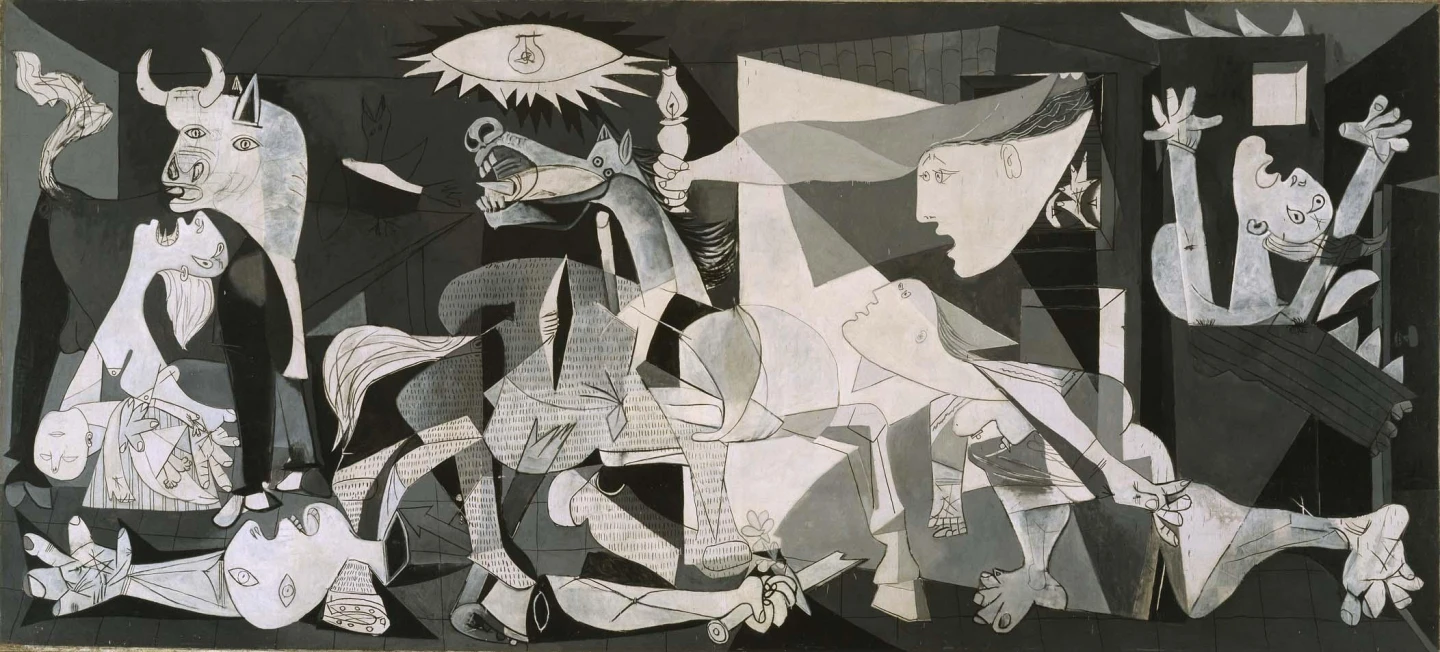
Guernica
Guernica, painted by Pablo Picasso, measures 349.3 × 776.6 cm. At this scale, color and gesture are no longer read as simple motifs: they directly engage the spectator's body. Preserved at Museo Reina Sofía, Madrid, this oil on canvas makes the format an essential part of the composition, and not a simple surface record. Its high rank is due to the rare combination of one exceptional scale, lasting fame and decisive influence on history painting or public decor. Presented here for documentary purposes, this work is not offered for reproduction; the image and the button directly open the museum notice.
Image and link: Museo Reina Sofía.
See the museum notice → #2
#2
Paradise
Le Paradis, painted by Le Tintoretto, measures 700 × 2,200 cm. Its length transforms painting into a continuous horizon: the gaze cannot embrace it at once and must travel through it. Preserved at the Doge's Palace, Venice, this oil on canvas makes the format an essential part of the composition, and not a simple surface record. Its high rank is due to the rare combination of a ladder exceptional, lastingly famous and decisively influential on history painting or public decor. The link associated with the image leads to the existing Alpha sheet or the official notice of the institution which preserves the work.
Image and link: Alpha Reproduction.
See this reproduction → #3
#3
The Wedding at Cana
The Wedding at Cana, painted by Paul Veronese, measures 677 × 994 cm. The width and height not only serve the spectacular effect: they regulate the rhythm, distances and circulation of the gaze. Preserved at the Louvre Museum, Paris, this oil on canvas makes the format an essential part of the composition, and not a simple surface record. Its high rank is due to the combination rare of exceptional scale, lasting fame and decisive influence on history painting or public decor. Monumentality here is physical as much as visual: it is measured, but it is felt above all in the movement of the gaze.
Image and link: Alpha Reproduction.
See this reproduction → #4
#4
The Rite of Napoleon
The Rite of Napoleon, painted by Jacques-Louis David, measures 621 × 979 cm. The format gives the event an almost theatrical presence, where each group retains its readability despite the crowd and depth. Preserved at the Louvre Museum, Paris, this oil on canvas makes the format an essential part of the composition, and not a simple surface record. Its high rank is due to the combination rare of exceptional scale, lasting fame and decisive influence on history painting or public decor. The image allows the composition to be identified; only the confrontation with the original fully restores the scale and the material. The dimensions indicated correspond to the preserved work or, for a set with shutters, to its documented open state.
Image and link: Alpha Reproduction.
See this reproduction → #5
#5
The Taking of the Smala by Abd-el-Kader
The Taking of the Smala by Abd-el-Kader, painted by Horace Vernet, measures 489 × 2,139 cm. Its length transforms painting into a continuous horizon: the gaze cannot embrace it at once and must travel through it. Preserved at the National Museum of the Palace of Versailles, this oil on canvas makes the format an essential part of the composition, and not a simple surface record. Its high rank is due to the rare combination of exceptional scale, enduring fame and decisive influence on history painting or public decor. The dimensions shown correspond to the preserved work or, for a shuttered set, to its documented open state.
Image and link: Alpha Reproduction.
See this reproduction → #6
#6
The Meal at Levi's
Le Repas chez Lévi, painted by Paul Veronese, measures 560 × 1,309 cm. Its length transforms painting into a continuous horizon: the gaze cannot embrace it at once and must travel through it. Preserved at Gallerie dell'Accademia, Venice, this oil on canvas makes the format an essential part of the composition, and not a simple surface record. Its high rank is due to the rare combination of one exceptional scale, lasting fame and decisive influence on history painting or public decor. The link associated with the image leads to the existing Alpha sheet or the official notice of the institution which preserves the work.
Image and link: Alpha Reproduction.
See this reproduction → #7
#7
The Crucifixion
The Crucifixion, painted by Le Tintoretto, measures 536 × 1,224 cm. Its length transforms painting into a continuous horizon: the gaze cannot embrace it at once and must travel through it. Preserved in Scuola Grande di San Rocco, Venice, this oil on canvas makes the format an essential part of the composition, and not a simple surface record. Its high rank is due to the rare combination of one exceptional scale, lasting fame and decisive influence on history painting or public decor. Monumentality here is physical as much as visual: it is measured, but it is felt above all in the movement of the gaze.
Image and link: Alpha Reproduction.
See this reproduction → #8
#8
The Raft of the Medusa
The Raft of the Medusa, painted by Théodore Géricault, measures 491 × 716 cm. The width and height not only serve the spectacular effect: they regulate the rhythm, distances and circulation of the gaze. Preserved at the Louvre Museum, Paris, this oil on canvas makes the format an essential part of the composition, and not a simple surface record. Its high rank is due to the rare combination of exceptional scale, enduring fame and decisive influence on history painting or public decor. The image allows the composition to be identified; only the confrontation with the original fully restores scale and material.
Image and link: Alpha Reproduction.
See this reproduction → #9
#9
The Appearance of Christ to the People
The Apparition of Christ to the People, painted by Alexander Ivanov, measures 540 × 750 cm. Designed for a solemn place or a large room, the composition prioritizes the figures in order to remain readable from a distance. Preserved at Tretyakov Gallery, Moscow, this oil on canvas makes the format an essential part of the composition, and not a simple surface record. Its high rank is due to combination rare of exceptional scale, lasting fame and decisive influence on history painting or public decor. The dimensions indicated correspond to the preserved work or, for a shuttered ensemble, to its documented open state. The link associated with the image leads to the existing Alpha sheet or the official notice of the institution which preserves the work.
Image and link: Alpha Reproduction.
See this reproduction → #10
#10
Bonaparte visiting the plague victims of Jaffa
Bonaparte visiting the plague victims of Jaffa, painted by Antoine-Jean Gros, measures 532 × 720 cm. The width and height not only serve the spectacular effect: they regulate the rhythm, distances and circulation of the gaze. Preserved at the Louvre Museum, Paris, this oil on canvas makes the format an essential part of the composition, and not a simple surface record. His rank high is due to the rare combination of exceptional scale, lasting fame and decisive influence on history painting or public decor. The link associated with the image leads to the existing Alpha sheet or the official notice of the institution which preserves the work.
Image and link: Alpha Reproduction.
See this reproduction → #11
#11
Napoleon on the battlefield of Eylau
Napoleon on the battlefield of Eylau, painted by Antoine-Jean Gros, measures 521 × 784 cm. The format gives the event an almost theatrical presence, where each group retains its readability despite the crowd and depth. Preserved at the Louvre Museum, Paris, this oil on canvas makes the format an essential part of the composition, and not a simple surface record. Its high rank due to the rare combination of exceptional scale, lasting fame and decisive influence on history painting or public decor. Monumentality here is physical as much as visual: it is measured, but it is felt above all in the movement of the gaze.
Image and link: Alpha Reproduction.
See this reproduction → #12
#12
The Battle of Aboukir
The Battle of Aboukir, painted by Antoine-Jean Gros, measures 578 × 968 cm. The format gives the event an almost theatrical presence, where each group retains its readability despite the crowds and depth. Preserved at the National Museum of the Palace of Versailles, this oil on canvas makes the format an essential part of the composition, and not a simple surface record. Its high rank is due to the rare combination of exceptional scale, lasting fame and decisive influence on history painting or public decor. The image helps identify the composition; only the confrontation with the original fully restores the scale and the material. The dimensions indicated correspond to the preserved work or, for a set with shutters, to its documented open state.
Image and link: Alpha Reproduction.
See this reproduction → #13
#13
The Last Day of Pompeii
The Last Day of Pompeii, painted by Karl Brioullov, measures 456.5 × 651 cm. The width and height not only serve the spectacular effect: they regulate the rhythm, distances and circulation of the gaze. Preserved at the Russian Museum, Saint Petersburg, this oil on canvas makes the format an essential part of the composition, and not a simple surface record. Its high rank is due to the rare combination of exceptional scale, enduring fame and decisive influence on history painting or public decor. The dimensions shown correspond to the preserved work or, for a shuttered set, to its documented open state.
Image and link: Alpha Reproduction.
See this reproduction → #14
#14
The solemn session of the Council of State
The Solemn Session of the Council of State, painted by Ilia Repin, measures 400 × 877 cm. The format gives the event an almost theatrical presence, where each group retains its readability despite the crowds and depth. Preserved at the Russian Museum, Saint Petersburg, this oil on canvas makes the format an essential part of the composition, and not a simple surface record. Its high rank holds to the rare combination of exceptional scale, lasting fame and decisive influence on history painting or public decor. The link associated with the image leads to the existing Alpha sheet or the official notice of the institution that preserves the work.
Image and link: Alpha Reproduction.
See this reproduction → #15
#15
The Romans of decadence
The Romans of Decadence, painted by Thomas Couture, measures 472 × 772 cm. The width and height not only serve the spectacular effect: they regulate the rhythm, distances and circulation of the gaze. Preserved at Musée d'Orsay, Paris, this oil on canvas makes the format an essential part of the composition, and not a simple surface record. Its high rank is due to the rare combination of exceptional scale, enduring fame and decisive influence on history painting or public decor. Monumentality here is physical as much as visual: it is measured, but it is felt above all in the movement of the gaze.
Image and link: Alpha Reproduction.
See this reproduction → #16
#16
Gassed
Gazés, painted by John Singer Sargent, measures 231 × 611 cm. Width and height not only serve the spectacular effect: they regulate rhythm, distances and circulation of the gaze. Preserved at Imperial War Museum, London, this oil on canvas makes the format an essential part of the composition, and not a simple surface record. Its high rank is due to the combination rare of exceptional scale, lasting fame and decisive influence on history painting or public decor. The image allows the composition to be identified; only the confrontation with the original fully restores the scale and the material. The dimensions indicated correspond to the preserved work or, for a set with shutters, to its documented open state.
Image and link: Alpha Reproduction.
See this reproduction → #17
#17
Washington crossing Delaware
Washington crossing Delaware, painted by Emanuel Leutze, measures 378.5 × 647.7 cm. The format gives the event an almost theatrical presence, where each group retains its readability despite the crowd and depth. Preserved at the Metropolitan Museum of Art, New York, this oil on canvas makes the format an essential part of the composition, and not a simple surface record. His rank high is due to the rare combination of exceptional scale, enduring fame and decisive influence on history painting or public decor. The dimensions shown correspond to the preserved work or, for a shuttered set, to its documented open state.
Image and link: Alpha Reproduction.
See this reproduction → #18
#18
The Response of the Zaporozhian Cossacks
The Response of the Zaporozhian Cossacks, painted by Ilia Repin, measures 203 × 358 cm. The format gives the event an almost theatrical presence, where each group retains its readability despite the crowd and depth. Preserved at the Russian Museum, Saint Petersburg, this oil on canvas makes the format an essential part of the composition, and not a simple surface record. Its high rank is due to the rare combination of exceptional scale, enduring fame and decisive influence on history painting or public decor. The link associated with the image leads to the existing Alpha sheet or the official notice of the institution that preserves the work.
Image and link: Alpha Reproduction.
See this reproduction → #19
#19
Christ before Pilate
Christ before Pilate, painted by Mihály Munkácsy, measures 417 × 636 cm. Designed for a solemn place or a large room, the composition prioritizes the figures in order to remain readable from a distance. Preserved in Déri Múzeum, Debrecen, this oil on canvas makes the format an essential part of the composition, and not a simple surface record. Its high rank is due to the rare combination of one exceptional scale, lasting fame and decisive influence on history painting or public decor. Monumentality here is physical as much as visual: it is measured, but it is felt above all in the movement of the gaze.
Image and link: Alpha Reproduction.
See this reproduction → #20
#20
Golgotha
Golgotha, painted by Mihály Munkácsy, measures 460 × 712 cm. Width and height not only serve the spectacular effect: they regulate rhythm, distances and circulation of the gaze. Preserved in Déri Múzeum, Debrecen, this oil on canvas makes the format an essential part of the composition, and not a simple surface record. Its high rank is due to the rare combination of one exceptional scale, lasting fame and decisive influence on history painting or public decor. The image allows the composition to be identified; only the confrontation with the original fully restores the scale and the material. The dimensions indicated correspond to the preserved work or, for a set with shutters, to its documented open state.
Image and link: Alpha Reproduction.
See this reproduction → #21
#21
Ecce Homo
Ecce Homo, painted by Mihály Munkácsy, measures 403 × 650 cm. The width and height not only serve the spectacular effect: they regulate the rhythm, distances and circulation of the gaze. Preserved in Déri Múzeum, Debrecen, this oil on canvas makes the format an essential part of the composition, and not a simple surface record. The work belongs to the great landmarks of the european painting: its narrative ambition and its location explain both its notoriety and its dimensions. The dimensions indicated correspond to the preserved work or, for a shuttered set, to its documented open state. The link associated with the image leads to the existing Alpha sheet or the official notice of the institution which preserves the work.
Image and link: Alpha Reproduction.
See this reproduction → #22
#22
The Boyarine Morozova
The Boyarine Morozova, painted by Vasily Surikov, measures 304 × 587.5 cm. The format gives the event an almost theatrical presence, where each group retains its readability despite the crowd and depth. Preserved at Tretyakov Gallery, Moscow, this oil on canvas makes the format an essential part of the composition, and not a simple surface record. The work belongs to the greats benchmarks of European painting: its narrative ambition and its location explain both its notoriety and its dimensions. The link associated with the image leads to the existing Alpha sheet or to the official notice of the institution which preserves the work. Monumentality here is physical as much as visual: it is measured, but it is felt above all in the movement of the gaze.
Image and link: Alpha Reproduction.
See this reproduction → #23
#23
The Conquest of Siberia by Ermak
The Conquest of Siberia by Ermak, painted by Vasily Surikov, measures 285 × 599 cm. The format gives the event an almost theatrical presence, where each group retains its readability despite the crowds and depth. Preserved at the Russian Museum, Saint Petersburg, this oil on canvas makes the format an essential part of the composition, and not a simple surface record. The work belongs to the great landmarks of European painting: its narrative ambition and its location explain both its notoriety and its dimensions. Monumentality here is physical as much as visual: it is measured, but it is felt above all in the movement of the gaze.
Image and link: Alpha Reproduction.
See this reproduction → #24
#24
Cain fleeing from Jehovah’s curse
Cain fleeing from the curse of Jehovah, painted by Fernand Cormon, measures 400 × 700 cm. The width and height not only serve the spectacular effect: they regulate the rhythm, distances and circulation of the gaze. Preserved at Musée d'Orsay, Paris, this oil on canvas makes the format an essential part of the composition, and not a simple surface record. The work belongs to the great landmarks of European painting: its narrative ambition and its location explain both its notoriety and its dimensions. The image allows the composition to be identified; only the confrontation with the original fully restores the scale and the material. The dimensions indicated correspond to the preserved work or, for a set with shutters, to its documented open state.
Image and link: Alpha Reproduction.
See this reproduction → #25
#25
The Call of the Last Victims of Terror
The Call of the Last Victims of Terror, painted by Charles-Louis Müller, measures 505 × 890 cm. The width and height not only serve the spectacular effect: they regulate the rhythm, distances and circulation of the gaze. Preserved at the National Museum of the Palace of Versailles, this oil on canvas makes the format an essential part of the composition, and not a simple record surface. The work belongs to the great landmarks of European painting: its narrative ambition and its location explain both its notoriety and its dimensions. The dimensions indicated correspond to the preserved work or, for a set with shutters, to its documented open state.
Image and link: Alpha Reproduction.
See this reproduction →Revolutions, ceremonies, dramas and crowds: the large canvas brings the viewer into the event.
 #26
#26
The Entry of Christ into Brussels
The Entry of Christ into Brussels, painted by James Ensor, measures 252.5 × 430.5 cm. Designed for a solemn place or a large room, the composition prioritizes the figures in order to remain readable from a distance. Preserved at J. Paul Getty Museum, Los Angeles, this oil on canvas makes the format an essential part of the composition, and not a simple surface record. The work belongs to the greats benchmarks of European painting: its narrative ambition and its location explain both its notoriety and its dimensions. The link associated with the image leads to the existing Alpha sheet or the official notice of the institution which preserves the work.
Image and link: Alpha Reproduction.
See this reproduction → #27
#27
The Painter's Workshop
The Painter's Workshop, painted by Gustave Courbet, measures 361 × 598 cm. Width and height not only serve the spectacular effect: they regulate rhythm, distances and circulation of the gaze. Preserved at Musée d'Orsay, Paris, this oil on canvas makes the format an essential part of the composition, and not a simple surface record. The work belongs to the great landmarks european painting: its narrative ambition and its location explain both its notoriety and its dimensions. Monumentality here is physical as much as visual: it is measured, but it is felt above all in the movement of the gaze.
Image and link: Alpha Reproduction.
See this reproduction → #28
#28
A funeral in Ornans
A funeral in Ornans, painted by Gustave Courbet, measures 315 × 668 cm. The width and height not only serve the spectacular effect: they regulate the rhythm, distances and circulation of the gaze. Preserved at Musée d'Orsay, Paris, this oil on canvas makes the format an essential part of the composition, and not a simple surface record. The work belongs to the greats benchmarks of European painting: its narrative ambition and its location explain both its notoriety and its dimensions. The image allows the composition to be identified; only the confrontation with the original fully restores the scale and the material. The dimensions indicated correspond to the preserved work or, for a set with shutters, to its documented open state.
Image and link: Alpha Reproduction.
See this reproduction → #29
#29
The Death of Sardanapalus
The Death of Sardanapalus, painted by Eugène Delacroix, measures 392 × 496 cm. The width and height not only serve the spectacular effect: they regulate the rhythm, distances and circulation of the gaze. Preserved at the Louvre Museum, Paris, this oil on canvas makes the format an essential part of the composition, and not a simple surface record. The work belongs to the greats benchmarks of European painting: its narrative ambition and its location explain both its notoriety and its dimensions. The dimensions indicated correspond to the preserved work or, for a set with shutters, to its documented open state. The link associated with the image leads to the existing Alpha sheet or the official notice of the institution which preserves the work.
Image and link: Alpha Reproduction.
See this reproduction → #30
#30
Scenes from the Scio massacres
Scenes from the Scio massacres, painted by Eugène Delacroix, measures 419 × 354 cm. The format gives the event an almost theatrical presence, where each group retains its readability despite the crowds and depth. Preserved at the Louvre Museum, Paris, this oil on canvas makes the format an essential part of the composition, and not a simple surface record. The work belongs to the greats benchmarks of European painting: its narrative ambition and its location explain both its notoriety and its dimensions. The link associated with the image leads to the existing Alpha sheet or the official notice of the institution which preserves the work.
Image and link: Alpha Reproduction.
See this reproduction → #31
#31
The Entry of the Crusaders into Constantinople
The Entry of the Crusaders into Constantinople, painted by Eugène Delacroix, measures 411 × 497 cm. The width and height not only serve the spectacular effect: they regulate the rhythm, distances and circulation of the gaze. Preserved at the Louvre Museum, Paris, this oil on canvas makes the format an essential part of the composition, and not a simple surface record. The work belongs to the great landmarks of European painting: its narrative ambition and its location explain both its notoriety and its dimensions. Monumentality here is physical as much as visual: it is measured, but it is felt above all in the movement of the gaze.
Image and link: Alpha Reproduction.
See this reproduction → #32
#32
Freedom guiding the people
Liberty Leading the People, painted by Eugène Delacroix, measures 260 × 325 cm. The width and height not only serve the spectacular effect: they regulate the rhythm, distances and circulation of the gaze. Preserved at the Louvre Museum, Paris, this oil on canvas makes the format an essential part of the composition, and not a simple surface record. The work belongs to the major landmarks of European painting: its narrative ambition and its location explain both its notoriety and its dimensions. The image allows the composition to be identified; only the confrontation with the original fully restores the scale and the material. The dimensions indicated correspond to the preserved work or, for a set with shutters, to its documented open state.
Image and link: Alpha Reproduction.
See this reproduction → #33
#33
Leonidas at Thermopylae
Léonidas at Thermopylae, painted by Jacques-Louis David, measures 395 × 531 cm. Width and height not only serve the spectacular effect: they regulate rhythm, distances and circulation of the gaze. Preserved at the Louvre Museum, Paris, this oil on canvas makes the format an essential part of the composition, and not a simple surface record. The work belongs to the major landmarks of European painting: its narrative ambition and its location explain both its notoriety and its dimensions. The dimensions indicated correspond to the preserved work or, for a set with shutters, to its documented open state. The link associated with the image leads to the existing Alpha sheet or the official notice of the institution which preserves the work.
Image and link: Alpha Reproduction.
See this reproduction → #34
#34
The Distribution of Eagles
The Distribution of Eagles, painted by Jacques-Louis David, measures 610 × 970 cm. The width and height not only serve the spectacular effect: they regulate the rhythm, distances and circulation of the gaze. Preserved at the National Museum of the Palace of Versailles, this oil on canvas makes the format an essential part of the composition, and not a simple surface record. The work belongs to the great benchmarks of European painting: its narrative ambition and its location explain both its notoriety and its dimensions. The link associated with the image leads to the existing Alpha sheet or the official notice of the institution which preserves the work.
Image and link: Alpha Reproduction.
See this reproduction → #35
#35
The Sabines
Les Sabines, painted by Jacques-Louis David, measures 385 × 522 cm. The width and height not only serve the spectacular effect: they regulate the rhythm, distances and circulation of the gaze. Preserved at the Louvre Museum, Paris, this oil on canvas makes the format an essential part of the composition, and not a simple surface record. The work belongs to the great landmarks of european painting: its narrative ambition and its location explain both its notoriety and its dimensions. Monumentality here is physical as much as visual: it is measured, but it is felt above all in the movement of the gaze.
Image and link: Alpha Reproduction.
See this reproduction → #36
#36
The Oath of the Horatii
The Oath of the Horaces, painted by Jacques-Louis David, measures 330 × 425 cm. The width and height not only serve the spectacular effect: they regulate the rhythm, distances and circulation of the gaze. Preserved at the Louvre Museum, Paris, this oil on canvas makes the format an essential part of the composition, and not a simple surface record. The work belongs to the greats benchmarks of European painting: its narrative ambition and its location explain both its notoriety and its dimensions. The image allows the composition to be identified; only the confrontation with the original fully restores the scale and the material. The dimensions indicated correspond to the preserved work or, for a set with shutters, to its documented open state.
Image and link: Alpha Reproduction.
See this reproduction → #37
#37
Homer's Apotheosis
Homer's Apotheosis, painted by Jean-Auguste-Dominique Ingres, measures 386 × 512 cm. The width and height not only serve the spectacular effect: they regulate the rhythm, distances and circulation of the gaze. Preserved at the Louvre Museum, Paris, this oil on canvas makes the format an essential part of the composition, and not a simple surface record. The work belongs to the major landmarks of European painting: its narrative ambition and its location explain both its notoriety and its dimensions. The dimensions indicated correspond to the preserved work or, for a set with shutters, to its documented open state. The link associated with the image leads to the existing Alpha sheet or the official notice of the institution which preserves the work.
Image and link: Alpha Reproduction.
See this reproduction → #38
#38
The Horse Market
The Horse Market, painted by Rosa Bonheur, measures 244.5 × 506.7 cm. Width and height not only serve the spectacular effect: they regulate rhythm, distances and circulation of the gaze. Preserved at the Metropolitan Museum of Art, New York, this oil on canvas makes the format an essential part of the composition, and not a simple surface record. The work belongs the major landmarks of European painting: its narrative ambition and its location explain both its notoriety and its dimensions. The link associated with the image leads to the existing Alpha sheet or the official notice of the institution which preserves the work.
Image and link: Alpha Reproduction.
See this reproduction → #39
#39
The Assumption of the Virgin
The Assumption of the Virgin, painted by Titian, measures 690 × 360 cm. Designed for a solemn place or a large room, the composition prioritizes the figures in order to remain readable from a distance. Preserved at Basilica of Santa Maria Gloriosa dei Frari, Venice, this oil on wood makes the format an essential part of the composition, and not a simple surface record. The work belongs to the greats benchmarks of European painting: its narrative ambition and its location explain both its notoriety and its dimensions. Monumentality here is physical as much as visual: it is measured, but it is felt above all in the movement of the gaze.
Image and link: Alpha Reproduction.
See this reproduction → #40
#40
Saint Mark preaching in Alexandria
Saint Mark preaching in Alexandria, painted by Gentile and Giovanni Bellini, measures 347 × 770 cm. The width and height not only serve the spectacular effect: they regulate the rhythm, distances and circulation of the gaze. Preserved at Pinacoteca di Brera, Milan, this oil on canvas makes the format an essential part of the composition, and not a simple surface record. The work belongs to the great benchmarks of European painting: its narrative ambition and its location explain both its notoriety and its dimensions. The image allows the composition to be identified; only the confrontation with the original fully restores scale and material.
Image and link: Alpha Reproduction.
See this reproduction → #41
#41
The Procession in St. Mark's Square
The Procession in St. Mark's Square, painted by Gentile Bellini, measures 367 × 745 cm. The width and height not only serve the spectacular effect: they regulate the rhythm, distances and circulation of the gaze. Preserved at Gallerie dell'Accademia, Venice, this tempera on canvas makes the format an essential part of the composition, and not a simple surface record. The work belongs to the great landmarks of European painting: its narrative ambition and its location explain both its notoriety and its dimensions. The dimensions indicated correspond to the preserved work or, for a set with shutters, to its documented open state. The link associated with the image leads to the existing Alpha sheet or the official notice of the institution which preserves the work.
Image and link: Alpha Reproduction.
See this reproduction → #42
#42
The Slave Miracle
The Miracle of the Slave, painted by Le Tintoretto, measures 415 × 541 cm. The width and height not only serve the spectacular effect: they regulate the rhythm, distances and circulation of the gaze. Preserved at Gallerie dell'Accademia, Venice, this oil on canvas makes the format an essential part of the composition, and not a simple surface record. The work belongs to the major landmarks of European painting: its narrative ambition and its location explain both its notoriety and its dimensions. The link associated with the image leads to the existing Alpha sheet or the official notice of the institution which preserves the work.
Image and link: Alpha Reproduction.
See this reproduction → #43
#43
The Elevation of the Cross
The Elevation of the Cross, painted by Peter Paul Rubens, measures 462 × 640 cm, shutters open. The amplitude is revealed with the opening of the panels, which makes the altarpiece a true painted architecture. Preserved at Notre-Dame Cathedral, Antwerp, this oil on panels makes the format an essential part of the composition, and not a simple surface record. The work belongs to the great landmarks european painting: its narrative ambition and its location explain both its notoriety and its dimensions. Monumentality here is physical as much as visual: it is measured, but it is felt above all in the movement of the gaze. The image allows us to identify the composition; only the confrontation with the original fully restores scale and material.
Image and link: Alpha Reproduction.
See this reproduction → #44
#44
The Descent from the Cross
The Descent from the Cross, painted by Peter Paul Rubens, measures 421 × 617 cm, shutters open. The amplitude is revealed with the opening of the panels, which makes the altarpiece a true painted architecture. Preserved at Notre-Dame Cathedral, Antwerp, this oil on panels makes the format an essential part of the composition, and not a simple surface record. The work belongs to the great landmarks of european painting: its narrative ambition and its location explain both its notoriety and its dimensions. The image allows the composition to be identified; only the confrontation with the original fully restores the scale and the material. The dimensions indicated correspond to the preserved work or, for a set with shutters, to its documented open state.
Image and link: Alpha Reproduction.
See this reproduction → #45
#45
The Adoration of the Magi
The Adoration of the Magi, painted by Peter Paul Rubens, measures 355.5 × 493 cm. Designed for a solemn place or a large room, the composition prioritizes the figures in order to remain readable from a distance. Preserved at the Prado Museum, Madrid, this oil on canvas makes the format an essential part of the composition, and not a simple surface record. The work belongs to the great landmarks of the european painting: its narrative ambition and its location explain both its notoriety and its dimensions. The dimensions indicated correspond to the preserved work or, for a set with shutters, to its documented open state. The link associated with the image leads to the existing Alpha sheet or the official notice of the institution which preserves the work.
Image and link: Alpha Reproduction.
See this reproduction → #46
#46
The Night Watch
The Night Watch, painted by Rembrandt, measures 363 × 437 cm. The width and height not only serve the spectacular effect: they regulate the rhythm, distances and circulation of the gaze. Preserved at Rijksmuseum, Amsterdam, this oil on canvas makes the format an essential part of the composition, and not a simple surface record. The work belongs to the great landmarks of the european painting: its narrative ambition and its location explain both its notoriety and its dimensions. The link associated with the image leads to the existing Alpha sheet or to the official notice of the institution which preserves the work. Monumentality here is physical as much as visual: it is measured, but it is felt above all in the movement of the gaze.
Image and link: Alpha Reproduction.
See this reproduction → #47
#47
The Meninas
Les Ménines, painted by Diego Velázquez, measures 318 × 276 cm. Width and height not only serve the spectacular effect: they regulate rhythm, distances and circulation of the gaze. Preserved at the Prado Museum, Madrid, this oil on canvas makes the format an essential part of the composition, and not a simple surface record. The work belongs to the great landmarks of the european painting: its narrative ambition and its location explain both its notoriety and its dimensions. Monumentality here is physical as much as visual: it is measured, but it is felt above all in the movement of the gaze.
Image and link: Alpha Reproduction.
See this reproduction → #48
#48
The Surrender of Breda
The Surrender of Breda, painted by Diego Velázquez, measures 307 × 367 cm. The width and height not only serve the spectacular effect: they regulate the rhythm, distances and circulation of the gaze. Preserved at the Prado Museum, Madrid, this oil on canvas makes the format an essential part of the composition, and not a simple surface record. The work belongs to the greats benchmarks of European painting: its narrative ambition and its location explain both its notoriety and its dimensions. The image allows the composition to be identified; only the confrontation with the original fully restores the scale and the material. The dimensions indicated correspond to the preserved work or, for a set with shutters, to its documented open state.
Image and link: Alpha Reproduction.
See this reproduction → #49
#49
The Spinners
Les Fileuses, painted by Diego Velázquez, measures 220 × 289 cm. Width and height not only serve the spectacular effect: they regulate rhythm, distances and circulation of the gaze. Preserved at the Prado Museum, Madrid, this oil on canvas makes the format an essential part of the composition, and not a simple surface record. The work belongs to the great landmarks of the european painting: its narrative ambition and its location explain both its notoriety and its dimensions. The dimensions indicated correspond to the preserved work or, for a shuttered set, to its documented open state. The link associated with the image leads to the existing Alpha sheet or the official notice of the institution which preserves the work.
Image and link: Alpha Reproduction.
See this reproduction → #50
#50
The Family of Charles IV
The Family of Charles IV, painted by Francisco de Goya, measures 280 × 336 cm. Width and height not only serve the spectacular effect: they regulate rhythm, distances and circulation of the gaze. Preserved at the Prado Museum, Madrid, this oil on canvas makes the format an essential part of the composition, and not a simple surface record. The work belongs to the greats benchmarks of European painting: its narrative ambition and its location explain both its notoriety and its dimensions. The link associated with the image leads to the existing Alpha sheet or the official notice of the institution which preserves the work.
Image and link: Alpha Reproduction.
See this reproduction →Panels, altars and public controls use size to govern distance and light.
 #51
#51
May 2, 1808 in Madrid
May 2, 1808 in Madrid, painted by Francisco de Goya, measures 266 × 345 cm. Width and height not only serve the spectacular effect: they regulate rhythm, distances and circulation of the gaze. Preserved at the Prado Museum, Madrid, this oil on canvas makes the format an essential part of the composition, and not a simple surface record. It broadens the panorama to altarpieces, landscapes and historical scenes whose format profoundly modifies the relationship between image, wall and viewer. Monumentality here is physical as much as visual: it is measured, but it is felt above all in the movement of the gaze.
Image and link: Alpha Reproduction.
See this reproduction → #52
#52
May 3, 1808 in Madrid
May 3, 1808 in Madrid, painted by Francisco de Goya, measures 268 × 347 cm. The width and height not only serve the spectacular effect: they regulate the rhythm, distances and circulation of the gaze. Preserved at the Prado Museum, Madrid, this oil on canvas makes the format an essential part of the composition, and not a simple surface record. It broadens the panorama to altarpieces, landscapes and historical scenes whose format profoundly modifies the relationship between image, wall and viewer. The image allows the composition to be identified; only the confrontation with the original fully restores the scale and the material. The dimensions indicated correspond to the preserved work or, for a set with shutters, to its documented open state.
Image and link: Alpha Reproduction.
See this reproduction → #53
#53
The Burial of Count Orgaz
The Burial of Count d'Orgaz, painted by El Greco, measures 480 × 360 cm. The width and height not only serve the spectacular effect: they regulate the rhythm, distances and circulation of the gaze. Preserved at Santo Tomé Church, Toledo, this oil on canvas makes the format an essential part of the composition, and not a simple surface record. It broadens the panorama to altarpieces, landscapes and historical scenes whose format profoundly modifies the relationship between image, wall and viewer. The dimensions indicated correspond to the preserved work or, for a shuttered set, to its documented open state. The link associated with the image leads to the existing Alpha sheet or the official notice of the institution which preserves the work.
Image and link: Alpha Reproduction.
See this reproduction → #54
#54
The Martyrdom of Saint Maurice
The Martyrdom of Saint Maurice, painted by El Greco, measures 448 × 301 cm. Designed for a solemn place or a large room, the composition prioritizes the figures in order to remain readable from a distance. Preserved at Monastère de l'Escurial, this oil on canvas makes the format an essential part of the composition, and not a simple surface record. It broadens the panorama to altarpieces, landscapes and historical scenes whose format profoundly modifies the relationship between image, wall and viewer. The link associated with the image leads to the existing Alpha sheet or to the official notice of the institution which preserves the work. Monumentality here is physical as much as visual: it is measured, but it is felt above all in the movement of the gaze.
Image and link: Alpha Reproduction.
See this reproduction → #55
#55
The Beheading of Saint John the Baptist
The Beheading of Saint John the Baptist, painted by Caravaggio, measures 361 × 520 cm. The width and height not only serve the spectacular effect: they regulate the rhythm, distances and circulation of the gaze. Preserved at Saint John Co-Cathedral, Valletta, this oil on canvas makes the format an essential part of the composition, and not a simple surface record. She expands the panorama to altarpieces, landscapes and historical scenes whose format profoundly modifies the relationship between image, wall and spectator. Monumentality here is physical as much as visual: it is measured, but it is felt above all in the movement of the gaze.
Image and link: Alpha Reproduction.
See this reproduction → #56
#56
The Vocation of Saint Matthew
The Vocation of Saint Matthew, painted by Caravaggio, measures 322 × 340 cm. Designed for a solemn place or a large room, the composition prioritizes the figures in order to remain readable from a distance. Preserved at Saint-Louis-des-Français Church, Rome, this oil on canvas makes the format an essential part of the composition, and not a simple surface record. It broadens the panorama to altarpieces, landscapes and historical scenes whose format profoundly modifies the relationship between image, wall and viewer. The image allows the composition to be identified; only the confrontation with the original fully restores the scale and the material. The dimensions indicated correspond to the preserved work or, for a set with shutters, to its documented open state.
Image and link: Alpha Reproduction.
See this reproduction → #57
#57
The Garden of Delights
The Garden of Delights, painted by Hieronymus Bosch, measures 205.5 × 384.9 cm, open. The amplitude is revealed with the opening of the panels, which makes the altarpiece a true painted architecture. Preserved at the Prado Museum, Madrid, this oil on panels makes the format an essential part of the composition, and not a simple surface record. It extends the panorama to altarpieces, landscapes and scenes histories whose format profoundly modifies the relationship between image, wall and viewer. The dimensions indicated correspond to the preserved work or, for a shuttered assembly, to its documented open state. The link associated with the image leads to the existing Alpha sheet or the official notice of the institution which preserves the work.
Image and link: Alpha Reproduction.
See this reproduction → #58
#58
The Mystic Lamb
The Mystic Lamb, painted by Hubert and Jan van Eyck, measures 350 × 461 cm, open. The amplitude is revealed with the opening of the panels, which makes the altarpiece a true painted architecture. Preserved at Saint Bavo's Cathedral, Ghent, this oil on panels makes the format an essential part of the composition, and not a simple surface record. It extends the panorama to altarpieces and landscapes and historical scenes whose format profoundly modifies the relationship between image, wall and viewer. The link associated with the image leads to the existing Alpha sheet or to the official notice of the institution which preserves the work. Monumentality here is physical as much as visual: it is measured, but it is felt above all in the movement of the gaze.
Image and link: Alpha Reproduction.
See this reproduction → #59
#59
The Isenheim Altarpiece
The Isenheim Altarpiece, painted by Matthias Grünewald, measures approximately 376 × 668 cm, first opening. The amplitude is revealed with the opening of the panels, which makes the altarpiece a true painted architecture. Preserved at the Unterlinden Museum, Colmar, this oil and tempera on panels makes the format an essential part of the composition, and not a simple surface record. It expands the panorama with altarpieces, landscapes and historical scenes whose format profoundly modifies the relationship between image, wall and spectator. Monumentality here is physical as much as visual: it is measured, but it is felt above all in the movement of the gaze. The image allows us to identify the composition; only the confrontation with the original fully restores scale and material.
Image and link: Alpha Reproduction.
See this reproduction → #60
#60
The Triptych of the Last Judgment
The Triptych of the Last Judgment, painted by Hans Memling, measures 242 × 360 cm, open. The amplitude is revealed with the opening of the panels, which makes the altarpiece a true painted architecture. Preserved at the National Museum, Gdaÿrsk, this oil on panels makes the format an essential part of the composition, and not a simple surface record. It extends the panorama to altarpieces, landscapes and historical scenes whose format profoundly modifies the relationship between image, wall and viewer. The image allows the composition to be identified; only the confrontation with the original fully restores the scale and the material. The dimensions indicated correspond to the preserved work or, for a set with shutters, to its documented open state.
Image and link: Alpha Reproduction.
See this reproduction → #61
#61
The Madonna of Pesaro
The Madonna of Pesaro, painted by Titian, measures 478 × 268 cm. The width and height not only serve the spectacular effect: they regulate the rhythm, distances and circulation of the gaze. Preserved at Basilica of Santa Maria Gloriosa dei Frari, Venice, this oil on canvas makes the format an essential part of the composition, and not a simple surface record. It expands the panorama with altarpieces, landscapes and historical scenes whose format profoundly modifies the relationship between image, wall and spectator. The dimensions indicated correspond to the preserved work or, for a shuttered ensemble, to its documented open state. The link associated with the image leads to the existing Alpha sheet or the official notice of the institution which preserves the work.
Image and link: Alpha Reproduction.
See this reproduction → #62
#62
Spring
Spring, painted by Sandro Botticelli, measures 203 × 314 cm. The width and height not only serve the spectacular effect: they regulate the rhythm, distances and circulation of the gaze. Preserved at the Uffizi Gallery, Florence, this tempera on wood makes the format an essential part of the composition, and not a simple surface record. It broadens the panorama to altarpieces, landscapes and historical scenes whose format profoundly modifies the relationship between image, wall and viewer. The link associated with the image leads to the existing Alpha sheet or to the official notice of the institution which preserves the work. Monumentality here is physical as much as visual: it is measured, but it is felt above all in the movement of the gaze.
Image and link: Alpha Reproduction.
See this reproduction → #63
#63
The Birth of Venus
The Birth of Venus, painted by Sandro Botticelli, measures 172.5 × 278.9 cm. Designed for a solemn place or a large room, the composition prioritizes the figures in order to remain readable from a distance. Preserved at the Uffizi Gallery, Florence, this tempera on canvas makes the format an essential part of the composition, and not a simple surface record. It extends the panorama to the altarpieces, landscapes and historical scenes whose format profoundly modifies the relationship between image, wall and viewer. Monumentality here is physical as much as visual: it is measured, but it is felt above all in the movement of the gaze. The image allows us to identify the composition; only the confrontation with the original fully restores scale and material.
Image and link: Alpha Reproduction.
See this reproduction → #64
#64
The Birth of Venus
The Birth of Venus, painted by William Bouguereau, measures 300 × 218 cm. Designed for a solemn place or a large room, the composition prioritizes the figures in order to remain readable from a distance. Preserved at Musée d'Orsay, Paris, this oil on canvas makes the format an essential part of the composition, and not a simple surface record. It broadens the panorama to altarpieces, landscapes and historical scenes whose format profoundly modifies the relationship between image, wall and viewer. The image allows the composition to be identified; only the confrontation with the original fully restores the scale and the material. The dimensions indicated correspond to the preserved work or, for a set with shutters, to its documented open state.
Image and link: Alpha Reproduction.
See this reproduction → #65
#65
The Death of Major Peirson
The Death of Major Peirson, painted by John Singleton Copley, measures 251 × 365 cm. The width and height not only serve the spectacular effect: they regulate the rhythm, distances and circulation of the gaze. Preserved in Tate Britain, London, this oil on canvas makes the format an essential part of the composition, and not a simple surface record. It broadens the panorama to altarpieces, landscapes and historical scenes whose format profoundly modifies the relationship between image, wall and spectator. The dimensions indicated correspond to the preserved work or, for a shuttered set, to its documented open state. The link associated with the image leads to the existing Alpha sheet or the official notice of the institution which preserves the work.
Image and link: Alpha Reproduction.
See this reproduction → #66
#66
The Heart of the Andes
The Heart of the Andes, painted by Frederic Edwin Church, measures 168 × 302.9 cm. Width and height not only serve the spectacular effect: they regulate rhythm, distances and circulation of the gaze. Preserved at the Metropolitan Museum of Art, New York, this oil on canvas makes the format an essential part of the composition, and not a simple surface record. It expands the panorama with altarpieces, landscapes and historical scenes whose format profoundly modifies the relationship between image, wall and spectator. The link associated with the image leads to the existing Alpha sheet or the official notice of the institution which preserves the work.
Image and link: Alpha Reproduction.
See this reproduction → #67
#67
The Rocky Mountains, Lander Peak
The Rocky Mountains, Lander Peak, painted by Albert Bierstadt, measures 186.7 × 306.7 cm. Width and height not only serve the spectacular effect: they regulate rhythm, distances and circulation of the gaze. Preserved at the Metropolitan Museum of Art, New York, this oil on canvas makes the format an essential part of the composition, and not a simple surface record. It broadens the panorama to altarpieces, landscapes and historical scenes whose format profoundly modifies the relationship between image, wall and spectator. Monumentality here is physical as much as visual: it is measured, but it is felt above all in the movement of the gaze.
Image and link: Alpha Reproduction.
See this reproduction → #68
#68
Among the Sierra Nevada, California
Among the Sierra Nevada, California, painted by Albert Bierstadt, measures 183 × 305 cm. Width and height not only serve the spectacular effect: they regulate rhythm, distances and circulation of the gaze. Preserved at the Smithsonian American Art Museum, Washington, this oil on canvas makes the format an essential part of the composition, and not a simple surface record. It broadens the panorama to altarpieces, landscapes and historical scenes whose format profoundly modifies the relationship between image, wall and spectator. The image allows the composition to be identified; only the confrontation with the original fully restores the scale and the material. The dimensions indicated correspond to the preserved work or, for a set with shutters, to its documented open state.
Image and link: Alpha Reproduction.
See this reproduction → #69
#69
The Grand Canyon of Yellowstone
The Grand Canyon of Yellowstone, painted by Thomas Moran, measures 213 × 366 cm. Width and height not only serve the spectacular effect: they regulate rhythm, distances and circulation of the gaze. Preserved at the Smithsonian American Art Museum, Washington, this oil on canvas makes the format an essential part of the composition, and not a simple surface record. She expands the panorama to altarpieces, landscapes and historical scenes whose format profoundly modifies the relationship between image, wall and spectator. The dimensions indicated correspond to the preserved work or, for a shuttered set, to its documented open state. The link associated with the image leads to the existing Alpha sheet or the official notice of the institution which preserves the work.
Image and link: Alpha Reproduction.
See this reproduction → #70
#70
The Colorado Deep
The Colorado Chasm, painted by Thomas Moran, measures 214 × 367 cm. Width and height not only serve the spectacular effect: they regulate rhythm, distances and circulation of the gaze. Preserved at the Smithsonian American Art Museum, Washington, this oil on canvas makes the format an essential part of the composition, and not a simple surface record. It expands the panorama with altarpieces, landscapes and historical scenes whose format profoundly modifies the relationship between image, wall and spectator. The link associated with the image leads to the existing Alpha sheet or the official notice of the institution which preserves the work.
Image and link: Alpha Reproduction.
See this reproduction → #71
#71
The Ninth Wave
The Ninth Wave, painted by Ivan Aivazovsky, measures 221 × 332 cm. Width and height not only serve the spectacular effect: they regulate rhythm, distances and circulation of the gaze. Preserved at the Russian Museum, Saint Petersburg, this oil on canvas makes the format an essential part of the composition, and not a simple surface record. It broadens the panorama to altarpieces, landscapes and historical scenes whose format profoundly modifies the relationship between image, wall and viewer. Monumentality here is physical as much as visual: it is measured, but it is felt above all in the movement of the gaze. The image allows us to identify the composition; only the confrontation with the original fully restores scale and material.
Image and link: Alpha Reproduction.
See this reproduction → #72
#72
Among the waves
Among the waves, painted by Ivan Aivazovsky, measures 285 × 429 cm. The width and height not only serve the spectacular effect: they regulate the rhythm, distances and circulation of the gaze. Preserved at Aivazovsky Gallery, Theodosia, this oil on canvas makes the format an essential part of the composition, and not a simple surface record. It broadens the panorama to altarpieces, landscapes and historical scenes whose format profoundly modifies the relationship between image, wall and viewer. The image allows the composition to be identified; only the confrontation with the original fully restores the scale and the material. The dimensions indicated correspond to the preserved work or, for a set with shutters, to its documented open state.
Image and link: Alpha Reproduction.
See this reproduction → #73
#73
The Brass Snake
The Brazen Serpent, painted by Fyodor Bruni, measures 565 × 852 cm. The width and height not only serve the spectacular effect: they regulate the rhythm, distances and circulation of the gaze. Preserved at the Russian Museum, Saint Petersburg, this oil on canvas makes the format an essential part of the composition, and not a simple surface record. It broadens the panorama to altarpieces, landscapes and historical scenes whose format profoundly modifies the relationship between image, wall and viewer. The dimensions indicated correspond to the preserved work or, for a shuttered set, to its documented open state. The link associated with the image leads to the existing Alpha sheet or the official notice of the institution which preserves the work.
Image and link: Alpha Reproduction.
See this reproduction → #74
#74
Christ and the Adulterous Woman
Christ and the Adulterous Woman, painted by Vasily Polenov, measures 325 × 611 cm. Designed for a solemn place or a large room, the composition prioritizes the figures in order to remain readable from a distance. Preserved at the Russian Museum, Saint Petersburg, this oil on canvas makes the format an essential part of the composition, and not a simple surface record. It broadens the panorama to altarpieces, landscapes and historical scenes whose format profoundly modifies the relationship between image, wall and viewer. The link associated with the image leads to the existing Alpha sheet or to the official notice of the institution which preserves the work. Monumentality here is physical as much as visual: it is measured, but it is felt above all in the movement of the gaze.
Image and link: Alpha Reproduction.
See this reproduction → #75
#75
The Bogatyrs
The Bogatyrs, painted by Viktor Vasnetsov, measures 295.3 × 446 cm. The width and height not only serve the spectacular effect: they regulate the rhythm, distances and circulation of the gaze. Preserved at Tretyakov Gallery, Moscow, this oil on canvas makes the format an essential part of the composition, and not a simple surface record. It broadens the panorama to altarpieces, landscapes and historical scenes whose format profoundly modifies the relationship between image, wall and viewer. Monumentality here is physical as much as visual: it is measured, but it is felt above all in the movement of the gaze. The image allows us to identify the composition; only the confrontation with the original fully restores scale and material.
Image and link: Alpha Reproduction.
See this reproduction →From the decorative cycle to abstraction, painting becomes field, horizon and environment.
 #76
#76
The Morning of the Streltsy Execution
The Morning of the Streltsy Execution, painted by Vasily Surikov, measures 218 × 379 cm. The format gives the event an almost theatrical presence, where each group retains its readability despite the crowd and depth. Preserved at Tretyakov Gallery, Moscow, this oil on canvas makes the format an essential part of the composition, and not a simple surface record. It completes the classification by another monumental way of being: enveloping the gaze, stretching a pattern or giving the painted surface the presence of an environment. The image allows the composition to be identified; only the confrontation with the original fully restores scale and material.
Image and link: Alpha Reproduction.
See this reproduction → #77
#77
The Sun
The Sun, painted by Edvard Munch, measures 455 × 780 cm. Width and height not only serve the spectacular effect: they regulate rhythm, distances and circulation of the gaze. Preserved at the University of Oslo, this oil on canvas makes the format an essential part of the composition, and not a simple surface record. It completes the classification in another way to be monumental: to envelop the gaze, stretch a pattern or give the painted surface the presence of an environment. The dimensions indicated correspond to the preserved work or, for a shuttered assembly, to its documented open state. The link associated with the image leads to the existing Alpha sheet or the official notice of the institution which preserves the work.
Image and link: Alpha Reproduction.
See this reproduction → #78
#78
Alma Mater
Alma Mater, painted by Edvard Munch, measures 450 × 1,160 cm. Its length transforms the painting into a continuous horizon: the gaze cannot embrace it all at once and must travel through it. Preserved at the University of Oslo, this oil on canvas makes the format an essential part of the composition, and not a simple surface record. It completes the classification with another monumental way of being: wrap the gaze, stretch a pattern or give the painted surface the presence of an environment. The link associated with the image leads to the existing Alpha sheet or the official notice of the institution which preserves the work.
Image and link: Alpha Reproduction.
See this reproduction → #79
#79
The researchers
The Researchers, painted by Edvard Munch, measures 480 × 1,100 cm. Its length transforms the painting into a continuous horizon: the gaze cannot embrace it at once and must travel through it. Preserved at the University of Oslo, this oil on canvas makes the format an essential part of the composition, and not a simple surface record. It completes the classification with another monumental way of being : envelop the gaze, stretch a pattern or give the painted surface the presence of an environment. Monumentality here is physical as much as visual: it is measured, but it is felt above all in the movement of the gaze.
Image and link: Alpha Reproduction.
See this reproduction → #80
#80
Water Lilies: Green reflections
Water Lilies: Green reflections, painted by Claude Monet, measures 200 × 850 cm. The width and height not only serve the spectacular effect: they regulate the rhythm, distances and circulation of the gaze. Preserved at Musée de l'Orangerie, Paris, this oil on canvas makes the format an essential part of the composition, and not a simple surface record. It completes the ranking by another way of being monumental: enveloping the gaze, stretching a pattern or giving the painted surface the presence of an environment. The image allows the composition to be identified; only the confrontation with the original fully restores scale and material.
Image and link: Alpha Reproduction.
See this reproduction → #81
#81
Dance (I)
The Dance (I), painted by Henri Matisse, measures 259.7 × 390.1 cm. At this scale, color and gesture are no longer read as simple motifs: they directly engage the spectator's body. Preserved at the Museum of Modern Art, New York, this oil on canvas makes the format an essential part of the composition, and not a simple surface record. It completes the classification with another monumental way of being: enveloping the gaze, stretching a pattern or giving the painted surface the presence of an environment. The dimensions indicated correspond to the preserved work or, for a shuttered set, to its documented open state.
Image and link: Alpha Reproduction.
See this reproduction → #82
#82
Music
Music, painted by Henri Matisse, measures 260 × 389 cm. At this scale, color and gesture are no longer read as simple motifs: they directly engage the spectator's body. Preserved at the Hermitage Museum, Saint Petersburg, this oil on canvas makes the format an essential part of the composition, and not a simple surface record. It completes the classification with another monumental way of being: enveloping the gaze, stretching a pattern or giving the painted surface the presence of an environment. The link associated with the image leads to the existing Alpha sheet or the official notice of the institution which preserves the work.
Image and link: Alpha Reproduction.
See this reproduction → #83
#83
Bathers at the river
The Bathers at the River, painted by Henri Matisse, measures 262 × 391 cm. At this scale, color and gesture are no longer read as simple motifs: they directly engage the spectator's body. Preserved at the Art Institute of Chicago, this oil on canvas makes the format an essential part of the composition, and not a simple surface record. It completes the classification with one another way of being monumental: enveloping the gaze, stretching a pattern or giving the painted surface the presence of an environment. Monumentality here is physical as much as visual: it is measured, but it is felt above all in the movement of the gaze.
Image and link: Alpha Reproduction.
See this reproduction → #84
#84
The City of Paris
The City of Paris, painted by Robert Delaunay, measures 267 × 406 cm. At this scale, color and gesture are no longer read as simple motifs: they directly engage the spectator's body. Preserved at the Museum of Modern Art in Paris, this oil on canvas makes the format an essential part of the composition, and not a simple surface record. It completes the classification with another monumental way of being: enveloping the gaze, stretching a pattern or giving the painted surface the presence of an environment. The image allows the composition to be identified; only the confrontation with the original fully restores scale and material.
Image and link: Alpha Reproduction.
See this reproduction → #85
#85
Composition VII
Composition VII, painted by Wassily Kandinsky, measures 200 × 300 cm. At this scale, color and gesture are no longer read as simple motifs: they directly engage the spectator's body. Preserved at Tretyakov Gallery, Moscow, this oil on canvas makes the format an essential part of the composition, and not a simple surface record. It completes the classification with another monumental way of being: enveloping the gaze, stretching a pattern or giving the painted surface the presence of an environment. The dimensions indicated correspond to the preserved work or, for a shuttered set, to its documented open state.
Image and link: Alpha Reproduction.
See this reproduction → #86
#86
Udnie
Udnie, painted by Francis Picabia, measures 290 × 300 cm. At this scale, color and gesture are no longer read as simple motifs: they directly engage the spectator's body. Preserved at the National Museum of Modern Art, Paris, this oil on canvas makes the format an essential part of the composition, and not a simple surface record. It completes the classification with another monumental way of being: enveloping the gaze, stretching a pattern or giving the painted surface the presence of an environment. The link associated with the image leads to the existing Alpha sheet or the official notice of the institution which preserves the work.
Image and link: Alpha Reproduction.
See this reproduction → #87
#87
A Sunday afternoon on Grande Jatte Island
A Sunday afternoon on the Île de la Grande Jatte, painted by Georges Seurat, measures 207.5 × 308.1 cm. Width and height not only serve the spectacular effect: they regulate rhythm, distances and circulation of the gaze. Preserved at the Art Institute of Chicago, this oil on canvas makes the format an essential part of the composition, and not a simple surface record. It completes the classification with another way of being monumental: enveloping the gaze, stretching a pattern or giving the painted surface the presence of an environment. Monumentality here is physical as much as visual: it is measured, but it is felt above all in the movement of the gaze.
Image and link: Alpha Reproduction.
See this reproduction → #88
#88
A swim in Asnières
A swim in Asnières, painted by Georges Seurat, measures 201 × 301.5 cm. The width and height not only serve the spectacular effect: they regulate the rhythm, distances and circulation of the gaze. Preserved at National Gallery, London, this oil on canvas makes the format an essential part of the composition, and not a simple surface record. It completes the ranking by another way of being monumental: enveloping the gaze, stretching a pattern or giving the painted surface the presence of an environment. The image allows the composition to be identified; only the confrontation with the original fully restores scale and material.
Image and link: Alpha Reproduction.
See this reproduction → #89
#89
Where do we come from? What are we? Where are we going?
Where do we come from? What are we? Where are we going?, painted by Paul Gauguin, measures 139.1 × 374.6 cm. Width and height not only serve the spectacular effect: they regulate rhythm, distances and circulation of the gaze. Preserved at the Museum of Fine Arts, Boston, this oil on canvas makes the format an essential part of the composition, and not a simple record of surface. It completes the classification with another monumental way of being: enveloping the eye, stretching a pattern or giving the painted surface the presence of an environment. The dimensions indicated correspond to the preserved work or, for a shuttered assembly, to its documented open state.
Image and link: Alpha Reproduction.
See this reproduction → #90
#90
Lunch on the Grass
Le Déjeuner sur l'herbe, painted by Édouard Manet, measures 208 × 264.5 cm. The width and height not only serve the spectacular effect: they regulate the rhythm, distances and circulation of the gaze. Preserved at Musée d'Orsay, Paris, this oil on canvas makes the format an essential part of the composition, and not a simple surface record. It completes the classification with one another way of being monumental: enveloping the gaze, stretching a pattern or giving the painted surface the presence of an environment. The link associated with the image leads to the existing Alpha sheet or the official notice of the institution which preserves the work.
Image and link: Alpha Reproduction.
See this reproduction → #91
#91
The Great Bathers
Les Grandes Baigneuses, painted by Paul Cézanne, measures 208.3 × 249 cm. The width and height not only serve the spectacular effect: they regulate the rhythm, distances and circulation of the gaze. Preserved at the Philadelphia Museum of Art, this oil on canvas makes the format an essential part of the composition, and not a simple surface record. It completes the classification with another way of being monumental: enveloping the gaze, stretching a pattern or giving the painted surface the presence of an environment. Monumentality here is physical as much as visual: it is measured, but it is felt above all in the movement of the gaze.
Image and link: Alpha Reproduction.
See this reproduction →.jpg?width=1600) #92
#92
The Demoiselles d'Avignon
Les Demoiselles d'Avignon, painted by Pablo Picasso, measures 243.9 × 233.7 cm. At this scale, color and gesture are no longer read as simple motifs: they directly engage the spectator's body. Preserved at the Museum of Modern Art, New York, this oil on canvas makes the format an essential part of the composition, and not a simple surface record. It completes the ranking by another way of being monumental: enveloping the gaze, stretching a pattern or giving the painted surface the presence of an environment. Presented here for documentary purposes, this work is not offered for reproduction; the image and the button directly open the museum notice.
Image and link: Museum of Modern Art.
See the museum notice → #93
#93
Mural
Mural, painted by Jackson Pollock, measures 242.9 × 603.9 cm. At this scale, color and gesture are no longer read as simple motifs: they directly engage the viewer's body. Preserved at Stanley Museum of Art, Iowa City, this oil and water-based painting on canvas makes the format an essential part of the composition, and not a simple surface record. It completes the classification by another way of being monumental: enveloping the gaze, stretching a pattern or giving the painted surface the presence of an environment. Presented here for documentary purposes, this work is not offered for reproduction; the image and the button directly open the museum notice.
Image and link: Stanley Museum of Art.
See the museum notice →Autumn rhythm (number 30)
Autumn rhythm (number 30), painted by Jackson Pollock, measures 269.9 × 528.3 cm. At this scale, color and gesture are no longer read as simple motifs: they directly engage the viewer's body. Preserved at the Metropolitan Museum of Art, New York, this alkyd resin modified with oil on canvas makes the format an essential part of the composition, and not a simple record of surface. It completes the classification with another way of being monumental: enveloping the gaze, stretching a pattern or giving the painted surface the presence of an environment. Presented here for documentary purposes, this work is not offered for reproduction; the image and the button directly open the museum notice.
Image and link: Metropolitan Museum of Art.
See the museum notice → #95
#95
A: number 31, 1950
A: number 31, 1950, painted by Jackson Pollock, measures 269.5 × 530.8 cm. At this scale, color and gesture are no longer read as simple motifs: they directly engage the viewer's body. Preserved at the Museum of Modern Art, New York, this oil and enamel painting on canvas makes the format an essential part of the composition, and not a simple surface record. It completes classification by another way of being monumental: enveloping the gaze, stretching a pattern or giving the painted surface the presence of an environment. Presented here for documentary purposes, this work is not offered for reproduction; the image and the button directly open the museum notice.
Image and link: Museum of Modern Art.
See the museum notice →%20(cropped).jpg?width=1600) #96
#96
Vir Heroicus Sublimis
Vir Heroicus Sublimis, painted by Barnett Newman, measures 242.2 × 541.7 cm. At this scale, color and gesture are no longer read as simple motifs: they directly engage the spectator's body. Preserved at the Museum of Modern Art, New York, this oil on canvas makes the format an essential part of the composition, and not a simple surface record. It completes the classification with another way of being monumental: enveloping the gaze, stretching a pattern or giving the painted surface the presence of an environment. Presented here for documentary purposes, this work is not offered for reproduction; the image and the button directly open the museum notice.
Image and link: Museum of Modern Art.
See the museum notice → #97
#97
Sky above the clouds IV
Sky Above the Clouds IV, painted by Georgia O'Keeffe, measures 243.8 × 731.5 cm. At this scale, color and gesture are no longer read as simple motifs: they directly engage the viewer's body. Preserved at the Art Institute of Chicago, this oil on canvas makes the format an essential part of the composition, and not a simple surface record. It completes the ranking by another way of being monumental: enveloping the gaze, stretching a pattern or giving the painted surface the presence of an environment. Presented here for documentary purposes, this work is not offered for reproduction; the image and the button directly open the museum notice.
Image and link: Art Institute of Chicago.
See the museum notice → #98
#98
Women in the garden
Women in the Garden, painted by Claude Monet, measures 255 × 205 cm. The width and height not only serve the spectacular effect: they regulate the rhythm, distances and circulation of the gaze. Preserved at Musée d'Orsay, Paris, this oil on canvas makes the format an essential part of the composition, and not a simple surface record. It completes the classification with another monumental way of being: enveloping the gaze, stretching a pattern or giving the painted surface the presence of an environment. The link associated with the image leads to the existing Alpha sheet or the official notice of the institution which preserves the work.
Image and link: Alpha Reproduction.
See this reproduction → #99
#99
The Execution of Maximilian
The Execution of Maximilien, painted by Édouard Manet, measures 195.9 × 259.7 cm. The format gives the event an almost theatrical presence, where each group retains its readability despite the crowd and depth. Preserved at Kunsthalle in Mannheim, this oil on canvas makes the format an essential part of the composition, and not a simple surface record. It completes the classification with one another way of being monumental: enveloping the gaze, stretching a pattern or giving the painted surface the presence of an environment. Monumentality here is physical as much as visual: it is measured, but it is felt above all in the movement of the gaze.
Image and link: Alpha Reproduction.
See this reproduction → #100
#100
The Battle of San Romano
The Battle of San Romano, painted by Paolo Uccello, measures 182 × 320 cm. The format gives the event an almost theatrical presence, where each group retains its readability despite the crowd and depth. Preserved at National Gallery, London, this tempera on wood makes the format an essential part of the composition, and not a simple surface record. It completes the classification with one another way of being monumental: enveloping the gaze, stretching a pattern or giving the painted surface the presence of an environment. The image helps identify the composition; only the confrontation with the original fully restores the scale and the material. The dimensions indicated correspond to the preserved work or, for a set with shutters, to its documented open state.
Image and link: Alpha Reproduction.
See this reproduction →Editorial method
Three ranking criteria
Surface matters, but it is not enough: each rank confronts measure, historical importance and spectator experience.
Dimensions checked
Height and width are cross-checked with institutional records; the decimal places and the open state of the altarpieces are preserved.
Impact of format
Size must act on narration, distance, color or immersion, beyond a simple digital record.
Exact image
Each visual corresponds to the title and the artist; the image opens the exact Alpha sheet or museum notice.
A history of large format
From altar to modern wall
During the Renaissance and Baroque periods, large canvases responded to the architecture of churches, palaces and brotherhood rooms. They must remain readable despite the distance.
In the 19th century, history painting adopted show dimensions. Battles, ceremonies and crowds rival the theater and panoramas.
In the 20th century, the large format changed function: Picasso, Pollock, Newman, Matisse and O'Keeffe used the surface to envelop the gaze and engage the body.
Sources and collections
Measure and view works
Institutional records are the priority references for dimensions, techniques and places of conservation.
Frequently asked questions
Understand the monumental format
Measurements, supports, classification, images and links: the necessary benchmarks to browse the hundred works.
What does "monumental painting" mean?
The classification includes paintings whose dimensions really modify perception: vast canvases, panels, open altarpieces and cycles painted on transportable supports.
Are frescoes included?
No. This top 100 is dedicated to paintings on canvas or panel. Frescoes and murals directly executed on architecture fall under a separate classification.
How are works classified?
Rank combines physical dimensions, fame, historical importance, influence, ambition of composition and intensity of experience in front of the original.
Why is Guernica first?
Its panoramic format, its global fame and the way in which scale amplifies the fragmentation of bodies make it the most immediately identifiable landmark of this selection.
Are all works offered for reproduction?
No. Modern works under copyright are only documented and refer to the museum. Others use an Alpha sheet when an exact match exists.
Where do the images lead?
Each image is clickable. It opens the corresponding Alpha file or, when the work is not offered, the page of the institution which preserves it.
Do dimensions include frame?
No, unless otherwise indicated by institutions. The measurements relate to the painted surface; for altarpieces, the open width is specified.
Why include less gigantic formats towards the end?
Monumentality also depends on the relationship between scale, pattern and exhibition space. The last rows remain significantly larger than ordinary easel formats.
0 comments