

Athens · Munich · Aegean · Generation of the 1930s
100 masterpieces of modern Greek painting
From the War of Independence to the cafes of Omonia, one hundred paintings tell how Greek artists transformed history, the sea, daily life and Antiquity into modern language.

A modernity between memory and light
Greece after Antiquity
Modern Greek painting was born with a State that seeks its images. Vryzakis gave faces to the revolution of 1821, while Volanakis and Altamouras made the sea a theater of history, commerce and light.
In Munich, Lytras, Gyzis and Iakovidis learned great academic painting before adapting it to families, bereavements and Greek customs. Then Maleas, Parthenis and Theophilos liberate landscape, line and color.
The Generation of the Thirties continues this dialogue without choosing between tradition and avant-garde. Tsarouchis looks at the sailors and cafes of Athens, Moralis geometrizes love and death, Engonopoulos invites surrealism to the ruins antiques. The conversation sometimes becomes strange, but never boring.
Modern Greece does not paint in the shadow of its past: it moves this shadow to better see the present light.
Three lines of force
A story that has become an image
The Revolution of 1821 is not only commemorated: it establishes gestures, costumes and heroes which lastingly structure the collective imagination.
Light as a method
From seascapes to island landscapes, the atmosphere forces painters to simplify volumes, lighten palette and rethink depth.
Legacy made active
Antiquity, popular art and Byzantine tradition do not serve as refuge. Reinterpreted by Parthenis, Kontoglou, Tsarouchis or Engonopoulos, they become critical instruments of modernity.
Chapter 01
Independence and memory
The founding images of the new Greek state.
Theodoros Vryzakis
Grateful Greece
Greece personified, crowned and dressed in the antique style, receives the homage of the fighters of 1821. Vryzakis brings together dead and surviving heroes in a votive image where the new State gives itself a common memory.
See the painting →
Theodoros Vryzakis
Missolonghi's Exit
Vryzakis shows the inhabitants of Missolonghi leaving the besieged city on the night of April 1826. The procession advances towards combat and massacre with a solemnity that transforms military failure into national sacrifice.
See the painting →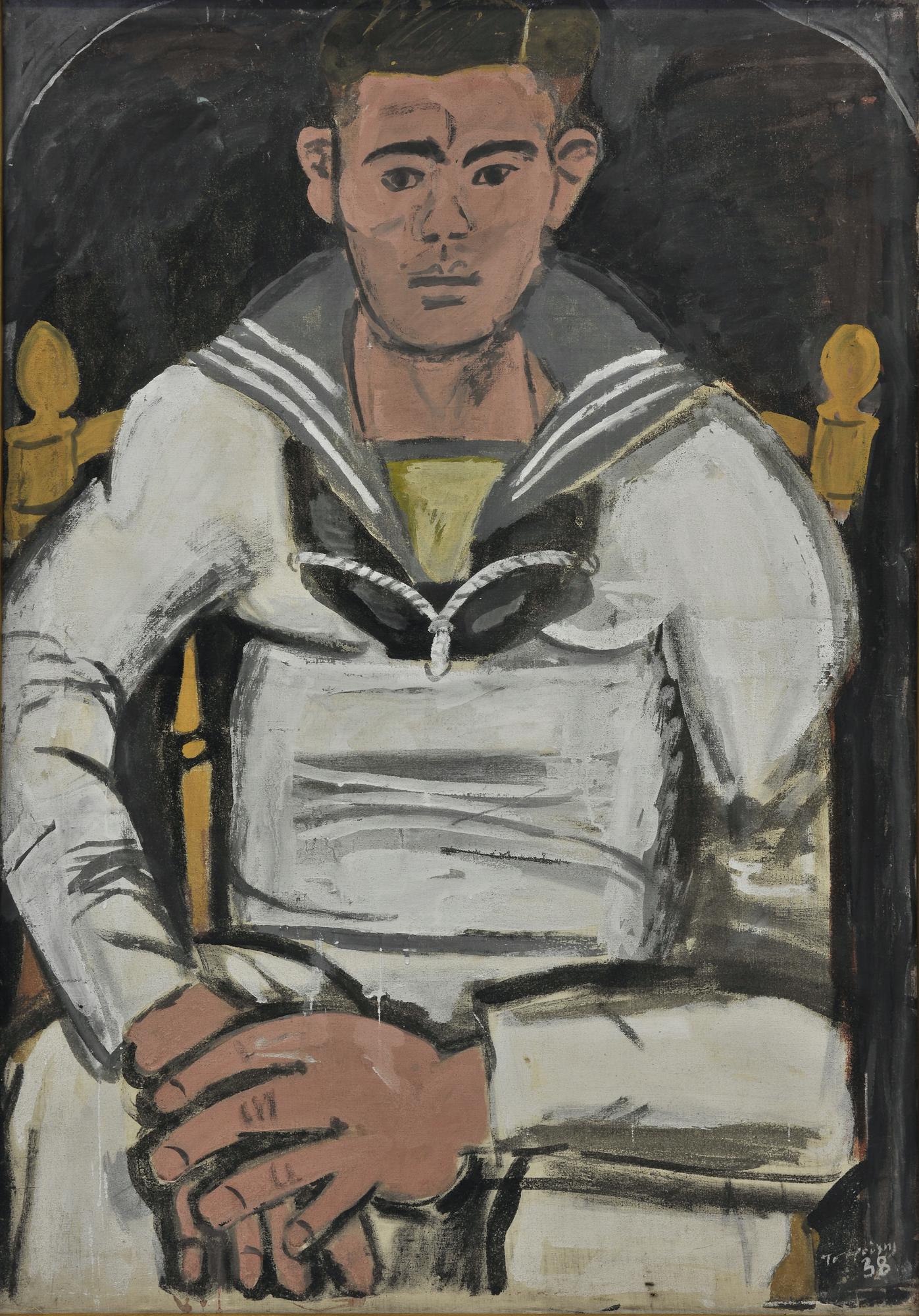
Yannis Tsarouchis
Sitting sailor
Painted in 1938, this seated sailor brings together Byzantine frontality, popular painting and the lesson of Matisse. Tsarouchis uses only a few tones to give the young man a monumental presence, without theatrical uniform or heroic pose.
See the instructions →
Yannis Moralis
Funeral composition I
Inspired by Attic funerary steles, Funerary Composition I brings together three young women in a calculated space of fullness and emptiness. Moralis associates ancient melancholy with post-cubist geometry.
See the instructions →
Yannis Tsarouchis
Café Néon, at night
The nighttime version of Café Néon enlivens the facade gate with white, yellow and orange lamps. The silhouettes of the customers become secondary to this unexpected meeting between Omonia and Mondrian.
See the instructions →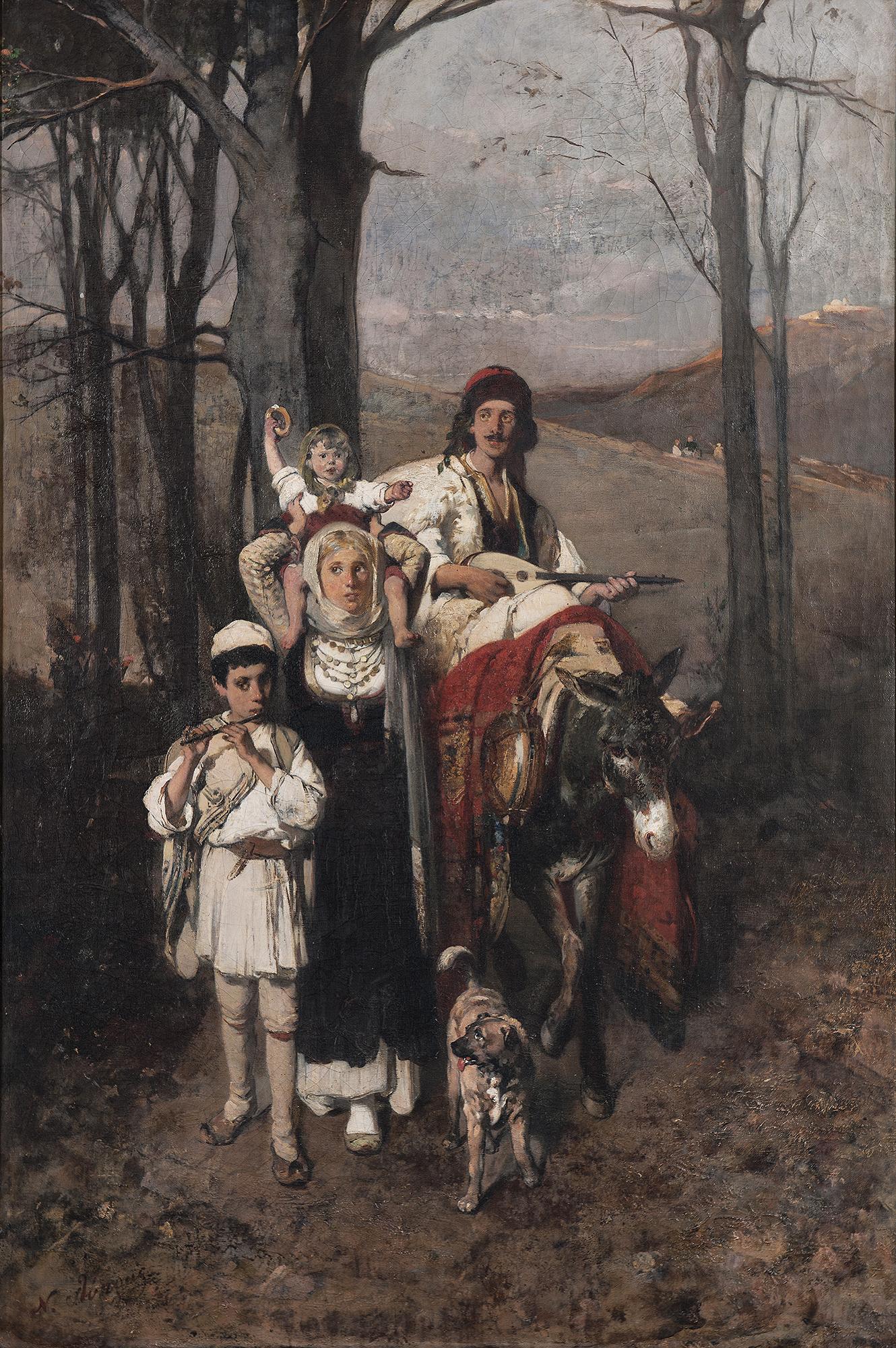
Nikiforos Lytras
Return from the party
A family comes down from Mount Pentelicus after a party, accompanied by a decorated donkey, a lute, a flute and a highly motivated dog. Lytras transforms this daily procession into a warm manifesto of Greek genre painting.
See the instructions →
Nikolaos Gyzis
After the destruction of Psara
Gyzis does not show the destruction of Psara, but the survivors collected after the massacre of 1824. The restrained pain of the figures and the dark light move the history painting from heroism to mourning.
See the painting →
Nikolaos Gyzis
The New Century
The New Century is one of Gyzis' great symbolist visions, conceived in the run-up to 1900. An almost apocalyptic light heralds less quiet progress than a future full of hope and worry.
See the painting →
Georgios Iakovidis
The first steps
A child hesitates in the arms of adults who encourage him to walk. Iakovidis transforms this family stage into a small dramatic scene, regulated by looks, outstretched hands and the light of the fireplace.
See the painting →
Konstantinos Volanakis
The Fire of the Turkish flagship by Kanaris
Konstantinos Volanakis depicts Kanaris burning the Ottoman flagship off the coast of Chios in 1822. The small Greek boat and huge burning ship give the ruse an epic scale.
See the painting →
Theodoros Vryzakis
Lord Byron's Reception in Missolonghi
Lord Byron arrived in Missolonghi in 1824 to support the Greek insurrection and died there a few months later. Vryzakis paints his welcome as the ceremonial encounter between European Philhellenism and the revolution.
See the painting →
Theodoros Vryzakis
Bishop Germanos blessing the flag of the Revolution
National tradition associates Bishop Germanos with the blessing of the revolutionary flag at the monastery of Agia Lavra. Vryzakis establishes this founding legend by bringing together Orthodox religion, arms and collective oath.
See the painting →
Nikiforos Lytras
Funeral flowers
Lytras paints crowns and bouquets intended for the dead with a gravity unusual for a still life. Flowers simultaneously carry the freshness of life and the certainty of their disappearance.
See the painting →
Nikolaos Gyzis
Spring Symphony
Winged figures and flowers make Spring Symphony painted music. Gyzis moves away from the realism of Munich to invent a fluid symbolism, close to European research at the end of the century.
See the painting →
Konstantinos Maleas
Missolonghi Lagoon
Maleas paints Missolonghi as an expanse of almost equivalent land, water and sky. In 1921, this place full of revolutionary memory became above all a laboratory of color and modern simplification.
See the painting →
Theophilos Chatzimichael
The Beautiful Adriana of Athens
Adriana plays guitar under a cherry tree, surrounded by flowers and a peacock. Theophilos ignores scholarly perspective, but the unity of its colors transforms the garden into a wonderfully coherent scene.
See the painting →
Konstantinos Parthenis
The Annunciation
The Annunciation of Parthenis unites Orthodox iconography, Viennese symbolism and modern drawing. The angel and the Virgin seem less to occupy a room than to appear in a space of silent music.
See the instructions →
Fotis Kontoglou
The Three Epochs of Hellenism
Kontoglou brings together Antiquity, Byzantium and modern Greece in a vision of cultural continuity. Painted in 1933, the ensemble affirms the return to tradition which marks the Generation of the 1930s.
See the instructions →
Yannis Tsarouchis
Café Néon, during the day
The Café Néon d'Omonia is presented from the front, with its doors and windows transformed into a modern grille. By day, Tsarouchis brings the popular architecture of Athens closer to an almost abstract composition.
See the instructions →
Theophilos Chatzimichael
Athena and Artemis
Athena and Artemis coexist in the frontal space of Theophilos as popular heroines still present. Antiquity is not a museum: it enters modern life with its weapons and its colors.
See the painting →Chapter 02
Sea, families and society
The 19th century looks at ports and daily life.

Theodoros Vryzakis
The Arkadi Monastery
The drama in Arkadi, Crete, ended in 1866 with the explosion of the powder magazine where combatants and civilians had taken refuge. Vryzakis paints the almost contemporary event as a new episode in the national martyrology.
See the painting →
Konstantinos Volanakis
The Exit from the Arès
In 1825, the brig Ares forced the Ottoman blockade of Navarino to save its garrison. Volanakis stretches the chase on the sea and makes smoke, sails and distance the real actors in the story.
See the painting →
Ioannis Altamouras
The Naval Battle of Rion-Antirrion
Altamouras looks back on the 1603 confrontation in the Gulf of Patras by combining historical documentation and modern atmosphere. The foam and clouds prevent the battle from freezing in a simple reconstruction.
See the painting →
Konstantinos Volanakis
The Raising of the Nets
Fishermen raise their nets in a light that almost dissolves the boundary between work and landscape. Volanakis abandons the naval battle here to observe the ordinary gestures on which coastal life depends.
See the painting →
Nikolaos Gyzis
After memorial service
After the service, a family leaves the cemetery in heavy silence. Gyzis avoids spectacular pathos and lets black clothes, the distance between figures and winter carry the work of mourning.
See the painting →
Nikolaos Gyzis
Le Bréchet
Two children each pull on a forked branch while making a wish. Gyzis transforms this little game into a scene of domestic suspense, with a disproportionate gravity which gives it all its charm.
See the painting →
Nikolaos Gyzis
The Mother Nurturer
A nanny breastfeeds a child under the gaze of the family. Gyzis gives this ordinary scene a central place and reveals the bonds of care often left on the periphery of the bourgeois portrait.
See the painting →
Georgios Iakovidis
Grandma's Favorite
The grandmother and child respond to each other in an exchange of tenderness and authority. Iakovidis excels at making age differences without reducing either the old woman or the little girl to a simple anecdote.
See the painting →
Georgios Iakovidis
The Children's Concert
The children improvise a concert whose energy visibly exceeds musical mastery. Iakovidis orchestrates gestures, expressions and disorder with benevolent humor, without losing the precision of genre painting.
See the painting →
Georgios Iakovidis
The Cold Shower
The Cold Shower captures the moment when a child protests against his toilet. Iakovidis makes the little family drama a study of movement, wet skin and domestic comedy.
See the painting →
Konstantinos Maleas
The Olives
Maleas olive trees are reduced to trunks, masses of foliage and luminous intervals. The Greek landscape ceases to be a picturesque sight and becomes a construction of color.
See the painting →
Theophilos Chatzimichael
Adam and Eve
Theophilos tells Adam and Eve with the narrative frankness of an image of a café or chapel. Paradise fits into a few trees, two bodies and a story that everyone already knows.
See the painting →
Konstantinos Maleas
Moon landscape, Lebanon
In Lebanon, Maleas paints the moon as a presence that simplifies mountains and vegetation. The night allows him to push the Mediterranean landscape towards large, almost abstract masses.
See the painting →
Konstantinos Maleas
The Monemvasia Ramparts
The ramparts of Monemvasia become for Maleas a stack of stone and color facing the sea. Medieval architecture is integrated into the relief to the point of seeming geological.
See the painting →
Konstantinos Maleas
Santorini
Santorini offers Maleas its oppositions of white, dark rock and sea. It simplifies the island into tense shapes which explain why this landscape was essential to Greek modernity.
See the painting →
Konstantinos Parthenis
Big Nude
Parthenis treats the nude as a luminous, elongated and almost immaterial form. The study of the body moves away from academic modeling to join its universe of musical lines.
See the instructions →
Konstantinos Parthenis
Allegorical scene
In this late allegory, Parthenis superimposes figures and signs in a weightless space. Mythology becomes a personal grammar where the visible and the spiritual share the same contours.
See the instructions →
Konstantinos Parthenis
Landscape with cypresses and pines on a rocky coast
Cypresses and pines punctuate a rocky coast that Parthenis paints like a vertical score. The real landscape fades behind the harmony of lines and an almost mystical light.
See the instructions →
Konstantinos Parthenis
Epidaurus
In Epidaurus, Parthenis transforms the ancient site into an interior landscape. Ruins matter less than the rhythm of the trees and the transparency of a light charged with memory.
See the instructions →
Konstantinos Parthenis
The Virgin Mary
The Virgin Mary of Parthenis retains the frontality of the icon while lightening bodies and draperies. The Orthodox tradition is extended by a modern line, not copied as a relic.
See the instructions →Chapter 03
Towards a modern light
Landscape and color emancipate themselves from the academy.

Yannis Moralis
Self-portrait
Moralis is painted at twenty-two with a restraint that announces his modern classicism. The frontal face and sober background refuse the virtuoso effect in favor of a concentrated identity.
See the instructions →
Yannis Moralis
The Artist with his wife
Moralis represents himself with his wife in a vertical format which brings the couple closer to ancient funerary portraits. Intimacy remains contained by a rigorous architecture of poses and colors.
See the instructions →
Yannis Moralis
The Painter with Nikos Nikolaou
In Paris in 1937, Moralis painted his friend Nikos Nikolaou and placed himself at his side. The double portrait becomes the testimony of a generation seeking a Greek modernity open to Europe.
See the instructions →
Konstantinos Parthenis
Christ
The Christ of Parthenis belongs to his first synthesis between religious painting and symbolism. The sacred face emerges from a muffled material, far from naturalism as well as from the strict copy of the icon.
See the instructions →
Konstantinos Parthenis
Music, decoration of a piano
Designed to decorate a piano, La Musique allows Parthenis to literally bring painting and sound into dialogue. The allegorical figures follow the curves of the instrument like a visible melody.
See the instructions →
Fotis Kontoglou
Don Diego de Covarrubias
Kontoglou takes the portrait of the Spanish scholar painted by El Greco and translates it into his Byzantine language. This creative copy connects Crete, Spain and Athens rather than seeking servile imitation.
See the instructions →
Yannis Tsarouchis
Landscape of Olympia
Tsarouchis paints Olympia without archaeological pomp, like a landscape crossed by heat and memory. The simple masses reveal his dialogue with Theophilos, Matisse and ancient painting.
See the instructions →
Yannis Tsarouchis
Sunrise in the port of Chios
At the port of Chios, Tsarouchis paints the sunrise as a silent work scene. Mediterranean light organizes the docks and boats without erasing their daily simplicity.
See the instructions →
Yannis Tsarouchis
Sailor
The 1962 sailor belongs to the male figures who populate the world of Tsarouchis. The white uniform, frontality and restraint of the model combine popular culture, desire and classical dignity.
See the instructions →
Yannis Tsarouchis
Head of a young man
This young man's head painted in 1941 reduces the portrait to a few firm shots. Tsarouchis associates attention to the living model with the frontality of Fayoum portraits.
See the instructions →
Yannis Tsarouchis
View from a park
In View from a Park, Tsarouchis frames the city through a green space. The late landscape retains its taste for ordinary architecture and light which makes their geometry sensitive.
See the instructions →
Yannis Tsarouchis
Portrait with paper flowers
The portrait with paper flowers combines a restrained face with an assumed artificial decor. Tsarouchis makes these modest flowers a colorful counterpoint, halfway between theater and intimacy.
See the instructions →
Nikos Engonopoulos
Anthemius of Tralles and Isidore of Miletus
Engonopoulos brings together the architects of Hagia Sophia in a space where eras and proportions no longer follow ordinary logic. Greek surrealism transforms Byzantine history into a poetic encounter.
See the instructions →
Nikos Engonopoulos
Theatre
In Theater, Engonopoulos treats costumes, curtains and figures as accessories to a dream. The scene explains no plot; rather, it reminds us that any identity can become a role.
See the instructions →
Nikos Engonopoulos
The Poet and the Muse
The Poet and the Muse, painted in 1938, announces Engonopoulos' personal surrealism. Faceless bodies and isolated objects give inspiration a strangeness far removed from academic allegory.
See the instructions →
Nikos Engonopoulos
Delos
Delos becomes for Engonopoulos a mental island where ancient fragments and modern silhouettes meet. The sacred site serves as the setting for a story that the painting deliciously refuses to tell until the end.
See the instructions →
Yannis Moralis
Female nude
The female nude of Moralis belongs to his formative years, before the geometrization of his figures. The sober pose already shows his interest in the body as architecture rather than as a decorative pretext.
See the instructions →
Yannis Moralis
At the outdoor photographer's
The outdoor photographer's home evokes improvised studios where the fabricated decor met the street. Young Moralis observes this little machine for producing memories with tenderness and social precision.
See the instructions →
Theodoros Vryzakis
The Karaiskakis Camp
Georgios Karaiskakis' camp becomes a gallery of fighters for Vryzakis rather than a confused melee. Costumes, weapons and attitudes give a face to the irregular army which participated in the siege of Athens.
See the painting →
Theodoros Vryzakis
The Battle of the Dervenakia Parades
Dervenakia's victory, won in 1822 by Kolokotronis' forces, broke Dramali's army. Vryzakis organizes mountain parades as a visual trap where the terrain itself becomes the ally of the insurgents.
See the painting →Chapter 04
Tradition and avant-garde
The Generation of the Thirties brings together Byzantium, Antiquity and modernism.

Theodoros Vryzakis
The Defense of the Fatherland above all
This allegory of Vryzakis places duty to the homeland above private interests. Academic language gives the revolutionary ideal a monument gravity, while retaining the color of Greek costumes.
See the painting →
Theodoros Vryzakis
The Sacrifice of Kapsali
In Kapsali, near Missolonghi, Christos Kapsalis blew up his house rather than hand over his companions to the Ottomans. Vryzakis transforms this desperate gesture into an image of the tragic choice between captivity and death.
See the painting →
Konstantinos Volanakis
The Austrian training ship Kaiser
The Kaiser was painted before Volanakis became the great marinist of independent Greece. The precision of the rigging reveals its experience of European ports and its interest in the ship as a mobile architecture.
See the painting →
Konstantinos Volanakis
Ships at anchor
These motionless ships allow Volanakis to paint waiting: folded sails, calm water and changing skies. The port becomes a breathing space where the sea nevertheless retains the promise of departure.
See the painting →
Ioannis Altamouras
The Naval Battle of Lepanto
The Battle of Lepanto of 1571 is seen here as a mass of sails, smoke and hulls caught in the wind. Altamouras gives the historical event the instability of a sea actually experienced.
See the painting →
Georgios Iakovidis
The Young Refugee asleep
Iakovidis paints a young refugee dozing off without turning her fatigue into a spectacle. Worn clothes, abandoned pose and soft light make the forced movement behind the touching image noticeable.
See the painting →
Theophilos Chatzimichael
Man in fustanelle
Theophilos takes up the fustanelle, a costume associated with independence fighters, in his frontal language as a popular painter. The character exists without a scholarly perspective, but with an identity that nothing seems to be able to move.
See the painting →
Nikiforos Lytras
Little Arab Boy
Created after the oriental journey of Lytras and Gyzis, this child's portrait avoids the cumbersome exotic setting. The face, skin and gaze reflect the encounter with a specific model rather than an imaginary type.
See the painting →
Nikiforos Lytras
Smoking sailor
The sailor from Lytras smokes in a moment of rest, far from the great battles which populate national painting. His clothing and posture tell the story of the daily dignity of a seafarer.
See the painting →
Nikiforos Lytras
Domestic interior
In this 1879 interior, Lytras observes familiar furniture, fabrics and gestures as signs of a transforming Greek society. Domestic life becomes a subject of history on a human scale.
See the painting →
Nikiforos Lytras
Young girl
Lytras' young daughter plays no allegorical role: her expression and costume are enough. This simplicity reveals the growing place of intimate portraiture in Greek painting at the end of the 19th century.
See the painting →
Nikiforos Lytras
Portrait of Georgios Proveleggios
Georgios Proveleggios, a Cycladic politician and poet, posed for Lytras in 1867. The sobriety of the background focuses attention on a face linked to the intellectual life of the young Greek kingdom.
See the work at the museum →
Nikiforos Lytras
Self-portrait
In his self-portrait, Lytras presents himself less as a notable than as an observer. The direct gaze recalls the double position of the painter: author of a major work and professor of several generations at the School of Fine Arts in Athens.
See the work at the museum →
Nikiforos Lytras
Portrait of Madame Serpieri
Madame Serpieri belonged to the industrial environment which developed around the Laurion mines. Lytras combines the elegance of bourgeois portraiture with precise attention to the character of the model.
See the work at the museum →
Nikolaos Gyzis
Girl's head
This young girl's face belongs to the period when Gyzis deepened portraiture and genre painting after his trip to the Orient. The warm light brings out an individual presence without weighing it down with a story.
See the work at the museum →
Nikolaos Gyzis
Artemis Gyzi
Artemis, daughter of the painter, appears in a portrait where affection remains contained by the discipline of drawing. Gyzis combines family proximity with maintaining an image destined to last.
See the work at the museum →
Nikolaos Gyzis
The Liberal Arts and their geniuses
Commissioned for a ceiling, this composition personifies the liberal arts around moving geniuses. Gyzis adapts academic allegory to a decorative space where figures actually appear to float above the viewer.
See the work at the museum →
Konstantinos Volanakis
Boats and children on the beach
On the beach, children and boats give the scale of a peaceful seascape. Volanakis observes the shore as a place for play and work, not as the setting for a battle.
See the work at the museum →
Konstantinos Volanakis
The Corinth Isthmus Passage
The opening of the Corinth Canal in 1893 radically transformed Greek navigation. Volanakis represents the narrow passage as a modern feat where the ship slides between two rock walls.
See the work at the museum →
Konstantinos Volanakis
The Port of Volos
Volos stretches out in front of Mount Pelion in a port light that brings together commerce and landscape. Volanakis gives docks and sailboats the dignity of a city facing the sea.
See the work at the museum →Chapter 05
Athens, body and poetry
Tsarouchis, Moralis and Engonopoulos give the present a personal mythology.

Konstantinos Volanakis
The Port of Volos at night
The night transforms the port of Volos into a constellation of reflections and silhouettes. Volanakis reduces the details to let the artificial lighting and dark depth organize the scene.
See the work at the museum →
Konstantinos Volanakis
Pelion Village
The village of Pelion appears between mountains and sea, far from heroic panoramas. Volanakis retains the white architecture, vegetation and atmosphere of an inhabited territory.
See the work at the museum →
Ioannis Altamouras
Danish Coast Navy
Trained in Copenhagen, Altamouras painted the Danish coast with an atmospheric freshness rare in the Munich school. The Nordic sky broadens the gaze of a Greek artist who died at only twenty-six years old.
See the work at the museum →
Ioannis Altamouras
The Port of Helsingør
In Helsingør, Altamouras observes the ships in a moving light reminiscent of his Scandinavian learning. Nautical accuracy remains, but air and water matter more than rigging inventory.
See the work at the museum →
Ioannis Altamouras
Caique in Spetses
This caique painted in Spetses brings together the traditional Greek boat and an almost impressionistic approach to the outdoors. Altamouras makes the hull vibrate in a sea whose light changes with each touch.
See the work at the museum →
Ioannis Altamouras
The Port of Copenhagen
The port of Copenhagen provides Altamouras with a subject of work, masts and low horizons. The Danish study enriches its Greek navy with a colder palette and direct observation of the climate.
See the work at the museum →
Pericles Pantazis
The Areopagus
Based in Belgium, Pantazis paints the Areopagus with the freedom of touch discovered among Brussels realists and impressionists. The Athenian rock becomes color and light rather than an archaeological emblem.
See the work at the museum →
Pericles Pantazis
Still life with flowers
Pantazi flowers are placed with a lively material that refuses the academic finish. Each petal counts less as a botanical detail than as a colorful touch in the balance of the bouquet.
See the work at the museum →
Pericles Pantazis
The Hare
The dead hare belongs to the tradition of still life hunting, but Pantazis alleviates its solemnity. The fur, flesh and background are captured by a quick and tactile painting.
See the work at the museum →
Pericles Pantazis
Marine
In this navy, Pantazis applies to the sky and water the free touch developed in Belgium. The coast is no longer a specific place to recognize, but an atmosphere to experience.
See the work at the museum →
Pericles Pantazis
Still life with quinces
The massive quinces of Pantazis occupy the table like small volumes of light. Their dense yellow allows the painter to construct the space with color rather than with drawing.
See the work at the museum →
Georgios Iakovidis
The Little Trumpeter
The little trumpeter transforms an instrument that is too large into a playing partner. Iakovidis contrasts the child's seriousness with the comic situation and almost makes the effort behind the image heard.
See the work at the museum →
Georgios Iakovidis
Family scene
This family scene in Iakovidis is based on exchanges of glances more than on action. The painter observes the house as a theater where generations negotiate affection, authority and patience.
See the work at the museum →
Georgios Iakovidis
Church in a flowery field in Bavaria
During his Munich years, Iakovidis painted this Bavarian church among the flowers. The motif testifies to its European formation while announcing its taste for clear and descriptive light.
See the work at the museum →
Georgios Iakovidis
The Gourmand
The Gourmand surprises a child absorbed in his food with heroic seriousness. Iakovidis constructs humor from expression and hands, never from a cruel caricature.
See the work at the museum →
Theophilos Chatzimichael
Ayia Anna, Chalcis
Ayia Anna is represented with the affectionate precision of a lived place. Theophilos stacks houses, roads and vegetation according to their narrative importance rather than according to the rules of perspective.
See the work at the museum →
Konstantinos Maleas
Landscape of Egypt
The trip to Egypt broadens Maleas' palette and his taste for stripped-down forms. Under the dry light, the landscape is composed like an architecture of colorful planes.
See the work at the museum →
Konstantinos Maleas
Aswan landscape on the Nile
In Aswan, the Nile becomes a band of color between desert and sky. Maleas dismisses anecdotal exoticism to retain the calm monumentality of the river.
See the work at the museum →
Konstantinos Maleas
Landscape of Attica
The landscape of Attica is built by Maleas with flat areas that condense rock, vegetation and light. Modern Greece finds its pictorial language here without having to borrow the costume of Antiquity.
See the work at the museum →
Konstantinos Maleas
Landscape of Olympia
In Olympia, Maleas does not reconstruct ancient games: he paints the earth, the trees and the air of the site. Historical memory remains beneath a resolutely modern surface.
See the work at the museum →
0 comments