

Great route of modern art from Pakistan
100 masterpieces pakistani painting
From Chughtai and Allah Bakhsh to the modernists of Lahore and Karachi, one hundred paintings tell the story of a country through its stories, its bodies, its landscapes and its signs.
Painting a country without erasing its memories
Even before the creation of Pakistan in 1947, Abdur Rahman Chughtai invented a line in Lahore that brought together Mughal miniatures, Persian poetry, Art Nouveau and Japanese wash. Allah Bakhsh, for his part, gives a monumental scale to the legends and campaigns of Punjab.
After the Partition, the workshops of Lahore and Karachi are looking for forms capable of speaking of a new territory. Shakir Ali, Zubeida Agha, Ahmed Parvez, Anwar Jalal Shemza and Anna Molka Ahmed do not copy the European avant-gardes: they translate them into contact with Islamic architecture, urban life and the wounds of displacement.
Sadequain and Gulgee then transform calligraphy into a pictorial gesture, while Jamil Naqsh, Bashir Mirza, Lubna Agha or Raja Changez Sultan pursue very different paths. The result is less like a tidy school than a passionate conversation where everyone fortunately wants to keep their accent.
Foundations: Chughtai, Allah Bakhsh and Sadequain
The works that gave Pakistan its first major pictorial languages.
Abdur rahman chughtai
Dream
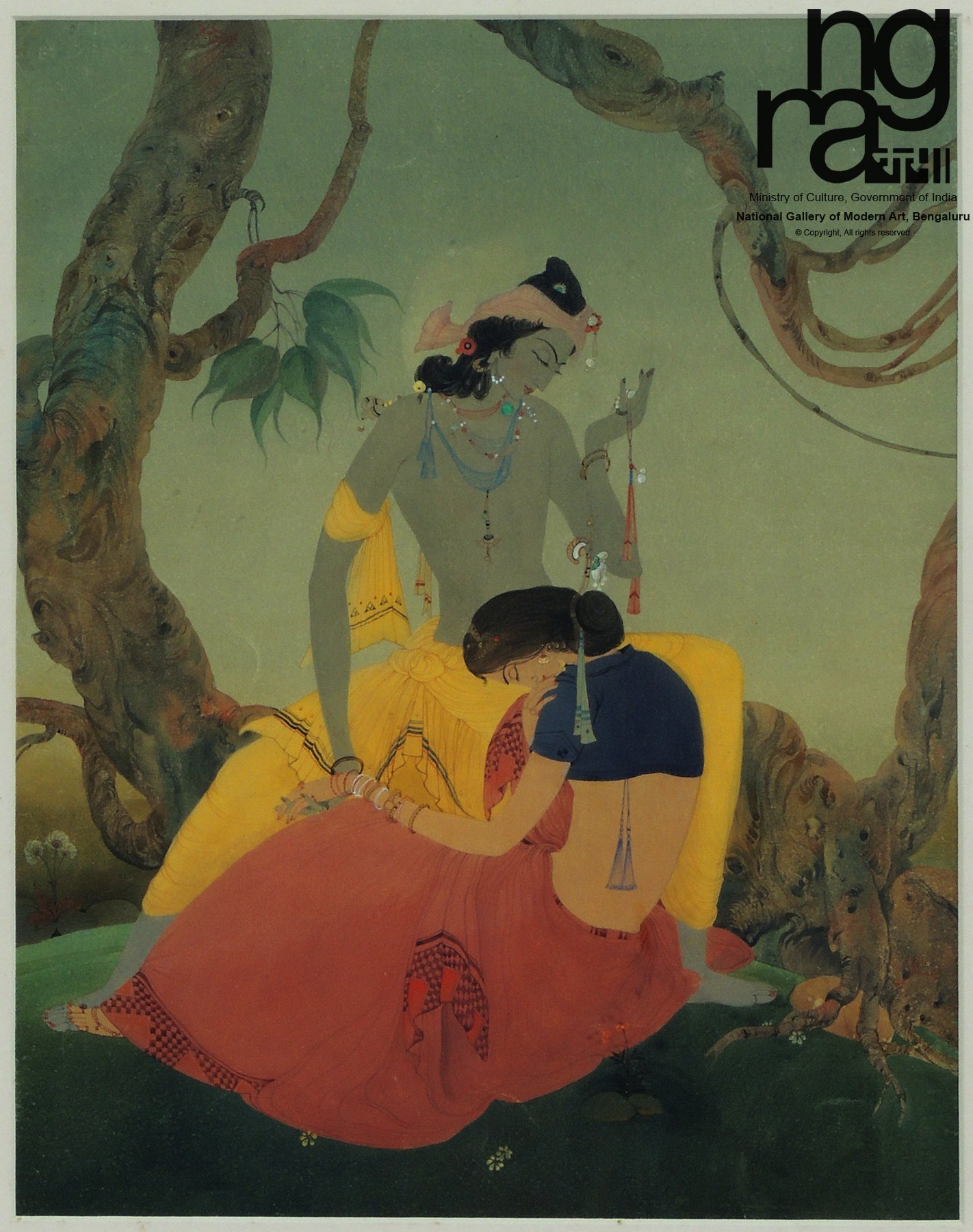
In Dream, Chughtai stretches the figures with a line that owes as much to the Mughal miniature as to Art Nouveau and Ajanta's frescoes. The love scene seems to float between wakefulness and sleep, as if time had forgotten to pass.
View work at source →
Ustad Allah Bakhsh
Heer and Ranjha
Allah Bakhsh paints Heer and Ranjha, the tragic lovers of Waris Shah's poem, in a bright and populated Punjab. Folklore becomes a collective story rather than an isolated idyll.
View work at source →
Sadequain
Group of standing figures
Sadequain's stretched bodies stand like human cacti, a motif born from his stay in the Sindh desert. Their thinness expresses weakness less than resistance.
View work at source →
Abdur rahman chughtai
Hiraman Tota
Hiraman Tota takes up the learned parrot of Padmavat, messenger between Princess Padmavati and King Ratansen. Chughtai transforms the medieval story into an arabesque of looks, feathers and transparent colors.
View work at source →
Anwar Jalal Shemza
Chess pieces
Shemza's chess pieces are reduced to tricks, squares and signs. The game becomes a meditation on order, repetition and Islamic graphic heritage.
View work at source →
Zubeida Agha
Karachi in flames
Karachi in flames condenses the city in red architecture, squeezed between heat and threat. Zubeida Agha transforms the fire into a colorful structure rather than a spectacular report.
View work at source →
Ismail Gulgee
Untitled (Allah)
Gulgee brings the word Allah out of a whirlwind of gold, ocher and black. Calligraphy ceases to be readable only: it becomes gesture, rhythm and matter.
View work at source →
Shakir Ali
The Musician
The Musician reflects Shakir Ali's interest in cubism without destroying the character's presence. Body, instrument and pale background fit together like the measures of a calm score.
View work at source →
Anna Molka Ahmed
Last goodbyes II
Last Farewells He evokes the separation linked to the movements of the Partition. Anna Molka Ahmed presses the figures in a blue space where the embrace contains as much pain as movement.
View work at source →
Jamil Naqsh
Untitled (La Pietà)
Jamil Naqsh takes up the Pietà without copying Michelangelo: the mother and the body become an earthy, almost fossil mass. Mourning can be read in the material as much as in the pose.
View work at source →
Laila Shahzada
Corrosion
Corrosion causes blue and gold shapes to proliferate like an attacked metal or a floor seen up close. Laila Shahzada transforms wear and tear into an abstract landscape.
View work at source →
Bashir Mirza
Lonely girl
Bashir Mirza's Lonely Young Girl advances in large flat areas of pink, green and black. His isolation is less due to the decor than to the absent face and the body cut by color.
View work at source →Lahore and Karachi invent their modernisms
The figure, the city and abstraction are transformed after the Partition.

Ahmed Parvez
Untitled (The Game)
Painted in 1954, The Game shows Ahmed Parvez as his organic forms begin to free themselves from the subject. The lines clash without any one definitively winning the game.
View work at source →
Ali Imam
Untitled (Horse figure)
Ali Imam's Rider crosses a landscape that is less narrative than mental. The animal and the figure recall the miniature, but the thick touch brings them back to modern painting.
View work at source →
Zubeida Agha
The evening
The Evening brings together red and dark shapes in a receding light. Zubeida Agha paints the transition from day to night as a transformation of color itself.
View work at source →
Zubeida Agha
Female composition
Painted in 1945, this female composition is one of the early assertions of Zubeida Agha's modernism. The bodies fit together without losing their individual presence.
View work at source →
Anna Molka Ahmed
Untitled (Landscape)
In this landscape, Anna Molka Ahmed winds the path between trees and light. The countryside is not a decorative rest: it advances in quick touches and vibrant colors.
View work at source →
Ustad Allah Bakhsh
Untitled (Potato harvest)
Workers harvest potatoes in dark, damp soil. Allah Bakhsh grants agricultural work a collective scale, without transforming the effort into a rural postcard.
View work at source →
Ismail Gulgee
Untitled (Polo players)
Polo players are nothing more than a race of horses and riders traced with nervousness. Gulgee restores the sport's speed by willingly sacrificing a few saddle details.
View work at source →
Sadequain
Acrobats
Sadequain's acrobats stretch their limbs into impossible architectures. Their precarious balance reminds us that the human body, in him, is at once spectacle, suffering and challenge.
View work at source →
Sadequain
Calligraphy
In this calligraphy, Sadequain raises the letters like thorny stems. The text and the cactus share the same ability to survive on a hostile surface.
View work at source →
Sadequain
Crucifixion
The Crucifixion of 1968 brings together gaunt figures and sharp lines. Painted during Sadequain's Parisian years, it combines spirituality, pain and modern condition.
View work at source →
Sadequain
Untitled (Rubaiyat-e-Sadequain)
Rubaiyat-e-Sadequain connects the poetry composed by the artist to his painting. Signs and figures illustrate verses less than they extend their meditation on existence.
View work at source →
Bashir Mirza
The Moon Art
The Art of the Moon places a pale disk above an almost abstract landscape. Bashir Mirza transforms the night into a mental space where colors seem to speak in low voices.
View work at source →
Jamil Naqsh
Plate 277
Plate 277 presents a fragmented figure like a study page turned painting. Jamil Naqsh mixes the discipline of drawing, classical memory and deliberately unfinished surface.
View work at source →
Jamil Naqsh
Untitled (Pigeons)
Naqsh's pigeons cross the canvas like familiar companions. The artist, who observed them all his life, painted their wings as carefully as the human body.
View work at source →
Jamil Naqsh
Untitled (Woman seated)
The seated woman from 1981 is built by large red masses. Naqsh gives the body a calm monumentality, without decoration or narrative to soften it.
View work at source →Lands, villages and ordinary lives
Punjab and landscapes become stories of work, memory and color.

Lubna Agha
Untitled - composition 1
At Lubna Agha, a central square is surrounded by patterns inspired by Islamic architecture. The painting makes the decor a field of meditation, rigorous but intensely colorful.
View work at source →
Mansur Aye
Untitled - composition 1
Mansur Aye reduces the female face to a continuous line, an eye and some curves. This economy gives the figure an immediately recognizable softness.
View work at source →
Masood Kohari
Song to the moon
Song of the Moon bathes Masood Kohari's forms in a deep blue. The nocturnal landscape slides towards abstraction, like a melody of which only the tone remains.
View work at source →
Nahid Raza
Untitled (Three Women)
Three women by Nahid Raza are divided into angular faces and bold colors. The group evokes solidarity, expectation and tension without imposing a single story.
View work at source →
Raja Change Sultan
Himalayan Odyssey
Raja Changez Sultan's Himalayan Odyssey reduces the mountain to a blue, almost immaterial mist. The landscape becomes a memory of height rather than a topographical survey.
View work at source →
Tassaduq Sohail
Untitled (Rider gathering horses)
Tassaduq Sohail's rider brings horses together in a storybook landscape. The deliberately unstable perspective gives the scene the energy of a popular moving story.
View work at source →
Anna Molka Ahmed
Living waste
Living Waste is a dense painting where shapes appear to struggle to emerge from a cluttered floor. Anna Molka Ahmed gives an almost organic energy to what society rejects.
View work at source →
Anna Molka Ahmed
Portrait of a boy
This boy poses without the official portrait pageantry. Anna Molka Ahmed's visible touches keep the model nervous and refuse to smooth her face into a suitable image.
View work at source →
Anna Molka Ahmed
Portrait of Habib Burkee
Habib Burkee is painted frontally, with heavy arms and a direct gaze. Anna Molka Ahmed builds character with frank contrasts rather than flattering decor.
View work at source →
Anna Molka Ahmed
The traveler
The Traveler appears seated, absorbed by a wait whose destination remains unknown. The colored paste gives the tired body more weight than the journey anecdote.
View work at source →
Anna Molka Ahmed
Untitled (Portrait of a Man)
The portrait of a man preserves the accidents of the brush and the changes of tone. Anna Molka Ahmed favors a living presence, a little rough, with a polite resemblance.
View work at source →
Ghulam Rasul
Untitled (Landscape)
Ghulam Rasul stretches fields, trees and walls in a panoramic format. The Punjab landscape becomes a series of strips where agricultural work measures space.
View work at source →
Ghulam Rasul
Untitled (The Wall)
The Wall isolates a long construction under an almost empty sky. Ghulam Rasul makes this banal limit the center of a silent landscape, observed without picturesqueness.
View work at source →
Ustad Allah Bakhsh
Untitled - composition 1
This first composition by Allah Bakhsh brings together villagers, animals and vegetation in a large scene. The popular story continues in every small gesture of rural life.
View work at source →
Ustad Allah Bakhsh
Untitled - composition 2
Around the containers and stalls, Allah Bakhsh paints the daily exchange as a ceremony. The characters occupy the space with the precision of an open-air theater.
View work at source →
Ustad Allah Bakhsh
Untitled - composition 3
Dated 1963, this composition brings together several generations within the same domestic space. Allah Bakhsh makes the family group a social chronicle of Punjab.
View work at source →
Ustad Allah Bakhsh
Untitled (Family scene)
The family scene is held together by the looks and gestures that circulate between adults and children. Allah Bakhsh paints the house as a complete world, with its alliances and its small distances.
View work at source →
Ustad Allah Bakhsh
Untitled (Young Shepherdess)
The young shepherdess stands with her animals in a clear landscape. Allah Bakhsh associates the individual with the pastoral rhythm without erasing his personality behind folklore.
View work at source →
Ustad Allah Bakhsh
Untitled (Tree)
This solitary tree occupies almost the entire panel, like a plant portrait. Allah Bakhsh observes branches and foliage with the same narrative attention as his characters.
View work at source →Body, letter and matter
Calligraphy, expressionism and pictorial gesture share the same energy.

Ahmed Parvez
Beer mug
Ahmed Parvez paints a mug of beer from which letters, flowers and signs spring. Still life loses all discipline and seems to have ordered a tour for the entire abstraction.
View work at source →
Ahmed Parvez
Untitled - composition 1
In this composition, red, blue and yellow lines wrap around an unstable core. Parvez transforms the surface into an organism where each shape appears to breathe against its neighbor.
View work at source →
Ahmed Parvez
Untitled (The Man of Sorrows)
The Man of Sorrows takes up a figure of Christian suffering in the nervous language of Parvez. The face and body fragment under the pressure of the lines.
View work at source →
Ahmed Parvez
Untitled (Vase)
Parvez's vase contains less of a bouquet than an explosion of signs. The daily object serves as a starting point for a circulation of color which quickly overflows its outline.
View work at source →
Ali Imam
Roosters
Ali Imam's roosters collide in dark, angular matter. The animal scene becomes a duel of energy, closer to the memory of combat than to naturalistic illustration.
View work at source →
Ali Imam
Untitled - composition 1
This composition by Ali Imam brings together figures, animals and fragments of architecture. The story remains open, like a miniature of which several pages have been superimposed.
View work at source →
Ali Imam
Untitled (City, night)
The night city is reduced to a few red facades under a dense sky. Ali Imam uses darkness to bring houses together and give the neighborhood an uneasy intimacy.
View work at source →
Ali Imam
Untitled (City, day)
By day, the same city opens in white, pink and turquoise volumes. Ali Imam simplifies streets and roofs to the point of making urban space an almost cubist construction.
View work at source →
Ali Imam
Untitled (Winter Landscape)
The winter landscape is made of black branches, clear snow and silent buildings. Ali Imam adopts a restrained palette that makes the cold without adding the slightest theatrical snowflake.
View work at source →
Anwar Jalal Shemza
Blue vase
The Blue Vase summarizes Shemza's vocabulary: geometric outline, flat color and repeated sign. The object becomes an emblem placed between calligraphy and modern abstraction.
View work at source →
Zubeida Agha
The deserted Village
The Deserted Village organizes houses and streets around a central void. Zubeida Agha makes human absence felt through geometry, without resorting to an explanatory narrative.
View work at source →
Zubeida Agha
Tennis Players
Tennis players are reduced to a rhythm of silhouettes and rackets. Zubeida Agha grasps the sport as a line exchange, with the ball becoming almost superfluous.
View work at source →
Zubeida Agha
Untitled (Urban view)
This urban view stacks facades and passages in an earthy palette. Zubeida Agha looks at the city as a system of shapes where perspective can take a day off.
View work at source →
Zubeida Agha
Untitled (Flowers in a Vase)
The red flowers stand in a very thin blue vase. Zubeida Agha contrasts the fragility of the stems with a loose background, transforming the bouquet into vertical architecture.
View work at source →
Zubeida Agha
Untitled (Self-portrait)
In this self-portrait, Zubeida Agha's face emerges between blue, green and black. She represents herself with the same colorful construction as her cities, without flattery or anecdote.
View work at source →
Zubeida Agha
Untitled (Vase on colored background)
The vase placed on a bright background allows Zubeida Agha to confront object and surface. The flowers, the table and the wall become three intensities rather than three depths.
View work at source →
Zubeida Agha
Untitled (Village scene)
The village scene advances in ocher houses and scattered silhouettes. Zubeida Agha simplifies rural daily life to retain its relationships of color and scale.
View work at source →
Ismail Gulgee
Allah
In Allah, Gulgee runs the golden letters through dark matter. The sacred name retains its readability while becoming an energy that runs through the entire web.
View work at source →
Ismail Gulgee
Nathia
Nathia evokes the wooded reliefs of Nathia Gali with large green and brown curves. Gulgee translates the mountain into movement rather than a descriptive panorama.
View work at source →
Ismail Gulgee
Untitled - composition 1
This first abstraction of Gulgee superimposes orange, white and yellow arcs. The calligraphic touch remains present even when the word disappears completely.
View work at source →
Ismail Gulgee
Untitled - composition 2
A light vertical shape splits the dark canvas like a surge of light. Gulgee uses the speed of gesture to maintain the composition between appearance and erasure.
View work at source →
Ismail Gulgee
Untitled - composition 3
In this third composition, orange wraps around a black center. Gulgee's painting keeps the memory of the calligraphic brush without asking the eye to read.
View work at source →
Ismail Gulgee
Untitled (Abstraction)
This abstraction of Gulgee makes two long green and purple shapes grow against a dark background. Their momentum retains the flexibility of an enlarged letter until it becomes landscape.
View work at source →
Ismail Gulgee
Untitled (Abstraction) - variant 3
The 2004 canvas combines long pink, green and white curves on a grainy background. At Gulgee, late abstraction remains physical, almost choreographic.
View work at source →
Ismail Gulgee
Untitled (Two Abstractions)
Two neighboring abstractions show how the same gesture changes with color and scale. Gulgee treats the series as a musical variation rather than an industrial repetition.
View work at source →
Ismail Gulgee
Untitled (Allah calligraphed)
The word Allah arises in the middle of black, white and saffron lines. Gulgee's calligraphy transforms writing into a pictorial event without separating fervor and experimentation.
View work at source →
Ismail Gulgee
Untitled (Calligraphy)
Dated 1998, this calligraphy constructs the text in layers of gold and shadow. The sign seems old, but its energy fully belongs to 20th century gestural painting.
View work at source →Intimacies and horizons
Women, doves, mountains and inner worlds extend the story until the end of the century.

Sadequain
Crucifix
The Crucifix reduces the body to a dark, almost mineral vertical. Sadequain adopts the Christian symbol to speak of universal suffering rather than a particular confession.
View work at source →
Sadequain
Figures
These 1966 figures form a tight crowd where each body resembles a sign. Sadquain makes humanity a collective alphabet, difficult to read but impossible to ignore.
View work at source →
Sadequain
Four musicians
Four musicians play on the verge of dissolution. The instruments structure the scene while Sadequain's angular bodies seem to produce rhythm as much as sound.
View work at source →
Sadequain
Painter in Paris
Painter in Paris shows the artist in an environment that nourishes his expressionism without erasing Karachi. Sadequain transforms the self-portrait into a reflection on exile and work.
View work at source →
Sadequain
Seated figure
This seated figure from 1959 belongs to the period when Sadequain discovered his cactus silhouettes. The body folds but retains a fierce presence, carved out of the material.
View work at source →
Sadequain
Sunrise
Under a red sun, a black crowd stands like a forest. Sunrise refuses easy optimism: light arrives, but it must pass through a thorny humanity.
View work at source →
Sadequain
Untitled (Figurative form in red)
The red shape stands alone in a brown field, between body, letter and wound. Sadequain voluntarily lets these readings coexist without providing instructions.
View work at source →
Sadequain
Untitled (Portrait of a Woman)
The first portrait of a woman is constructed by a few dark shots and a frontal gaze. Sadequain retains the presence of the model while bringing it closer to its alphabet of shapes.
View work at source →
Sadequain
Untitled (Portrait of a Woman) - variant 2
In the second variant, the female face dissolves further in matter. The portrait becomes a fragile apparition, suspended between resemblance and memory.
View work at source →
Sadequain
Untitled (Sitting nude)
The seated nude is treated with heavy contours and earthy material. Sadequain avoids the classic ideal and makes the body a place of fatigue, desire and resistance.
View work at source →
Bashir Mirza
Compromise 6
Compromise 6 belongs to a series on the arrangements imposed by society. Bashir Mirza constructs the tension between face, body and frame with an irony that is not conciliatory.
View work at source →
Colin David
King David
Colin David takes up the biblical king with a dark academic style. The implicit self-portrait and the religious subject transform the historical figure into meditation on the artist and power.
View work at source →
Colin David
Portrait of Colonel Colin Campbell
Colonel Colin Campbell poses in the language of British portraiture. Colin David reactivates this tradition in Pakistan, discreetly questioning the colonial heritage it carries.
View work at source →
Colin David
Untitled (Nude)
This nude by Colin David isolates the female body in a deep green setting. The realistic modeling contrasts with the austerity of the decor, giving room for the vulnerability of the pose.
View work at source →
Jamil Naqsh
Untitled (Back)
The female back appears in layers of brown and white, like a rediscovered fresco. Naqsh transforms anatomy into tactile memory rather than academic demonstration.
View work at source →
Jamil Naqsh
Untitled (Calligraphy)
The calligraphy of 1974 organizes the letters into a long architectural strip. Jamil Naqsh unites the rigor of writing with a modern color, without reducing one to the other.
View work at source →
Jamil Naqsh
Untitled (Pigeons) - variant 2
In this second variant, the pigeons get closer to the woman. The silent dialogue between skin, pen and gaze becomes the real subject of the painting.
View work at source →
Jamil Naqsh
Untitled (Woman and Dove)
A dove lands near the woman as an intimate attribute. Naqsh brings the model closer to the bird without transforming their relationship into a tidy symbol.
View work at source →
Jamil Naqsh
Untitled (Woman with the Dove)
The woman with the dove is drawn in tones of earth and chalk. The bird introduces a light movement in the face of the almost sculptural stability of the body.
View work at source →
Jamil Naqsh
Untitled (Woman with a Dove)
In this third encounter, the woman and the bird seem to share the same space of silence. Naqsh makes the dove a familiar presence rather than a symbol placed next to the model.
View work at source →
Lubna Agha
Untitled - composition 2
This second composition by Lubna Agha superimposes blue, red and geometric signs. Ornament does not adorn the surface: it constitutes its deep logic.
View work at source →
Lubna Agha
Untitled - composition 3
In the third composition, the motifs seem to float in a blue nocturnal space. Lubna Agha transforms repetition into visual rhythm rather than just traditional quotation.
View work at source →
Mansur Aye
Untitled - composition 2
Mansur Aye's second composition brings together two profiles and colorful shots. The figures appear to remember each other rather than actually meet.
View work at source →
Masood Kohari
Untitled (Two young girls)
Two young girls stand side by side in clear and fragile material. Kohari avoids the worldly portrait and insists on the silent proximity of the two presences.
View work at source →
Raja Change Sultan
Himalayan Odyssey - Sunrise
At sunrise, a red glow passes through the dark masses of the Himalayas. Sultan paints dawn as a slow apparition, without transforming the peaks into a tourist setting.
View work at source →
Tassaduq Sohail
Untitled (Figures fleeing a boat)
Figures flee a boat through water and bright colors. Sohail mixes danger, humor and imagination with this particular logic where dreams refuse all maritime insurance.
View work at source →
Tassaduq Sohail
Untitled (Three figures and a horse)
Three figures and a horse share a dense clearing. Sohail constructs a narrative world where proportions change according to emotional importance, not according to distance.
View work at source →
0 comments