

HORIZON · FRIEZE · IMMERSION PROCEDURE
The 100 most famous panoramic paintings
When the width forces the eye to travel in the painting
From the Chinese scroll that we discover section after section to Monet's Water Lilies, from the Venetian processions to Pollock's fields, the panoramic format is not reduced to a proportion. It organizes a duration, sets the groups in motion and transforms the painting into a space to explore.
See beyond a single frame
The panorama is a way of constructing time
Each work selected has a width-to-height ratio of at least 1.5:1 or belongs to a painted assembly whose deployment is essential. Simple artificial cropping, drawings, prints and photographs have been discarded. Ink scrolls are included when it comes to paintings.
In a panoramic painting, the eye does not receive everything at the same time: it advances, compares, returns and reconstructs the whole.
Alpha Reproduction images and links are used when an exact file already exists in the store. Modern works missing from the catalog are presented for documentary purposes only; their image and button lead to the corresponding institution.
Enter the ranking100 paintings that extend the gaze
Guernica, Water Lilies, large Chinese scrolls and abstract fields have made width part of their legend.
#1
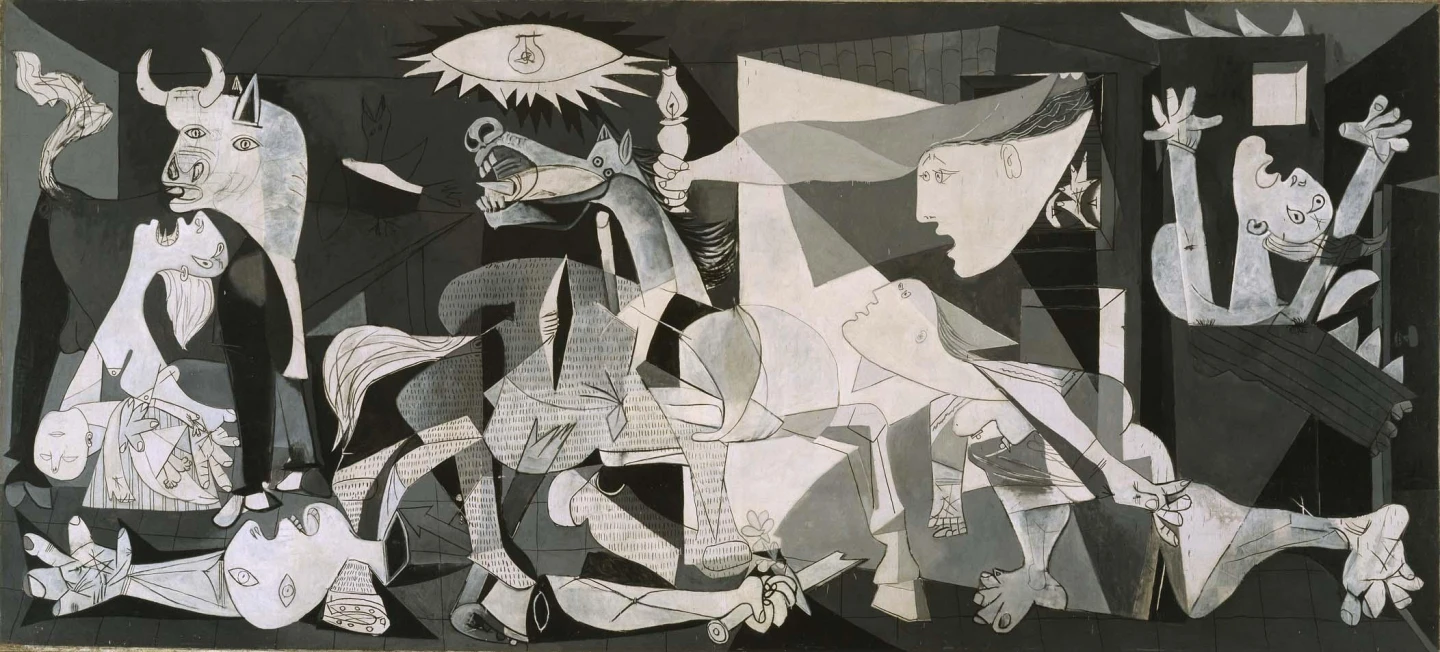
Guernica
Picasso stretches the bombardment of Guernica for nearly eight meters, like a frieze of dislocated bodies. The wounded horse, the bull, the screaming mother and the lamp do not compose a literal report: they condense the violence against civilians. The grayness recalls the press photographs and unifies the fragments into a collective complaint.
Documentary image and instructions: Museo Reina Sofia. This work is not offered for reproduction by Alpha Reproduction.
See the institution's notice → #2
#2
Water Lilies, panoramic panel
Monet almost completely removes the bank and the horizon to make the gaze float on the surface of the Giverny pond. The islets of water lilies interrupt the reflections of the sky and the willows without fixing a single point of view. The elongated panel cannot be contemplated all at once: it requires slow reading, comparable to a walk.
Image and link: Alpha Reproduction.
See this reproduction → #3
#3
Resides in the Fuchun Mountains
Huang Gongwang painted this long scroll for a Taoist friend and brought together years of observation of the Fuchun Mountains. Mountains, sandbanks, villages and waters appear to the rhythm of the unfolding, like a journey rather than a fixed view. Burned in the 17th century then separated into two fragments, the work became an emblem of Chinese literate painting.
Image and link: Alpha Reproduction.
See this reproduction → #4
#4
Autumn colors on the Qiao and Hua Mountains
Zhao Mengfu represents Mounts Qiao and Hua for his friend Zhou Mi, who knew his family region without being able to return there. The two massifs respond to each other on either side of a plain covered with water, houses and groves. The scroll combines archaic colors and deliberately constructed space: real geography becomes a landscape of memory.
Image and link: Alpha Reproduction.
See this reproduction → #5
#5
Paradise
Intended for the Grand Council room of the Doge's Palace, Paradise populates twenty-two meters of canvas of angels, saints and chosen ones organized around Christ and the Virgin. Tintoretto avoids the inventory effect thanks to large currents of light. The width responds directly to the architecture and transforms the celestial assembly into an ideal image of the Venetian government.
Image and link: Alpha Reproduction.
See this reproduction → #6
#6
The Taking of the Smala by Abd-el-Kader
Horace Vernet deploys the capture of Abd el-Kader's camp for more than twenty meters in the Battles of Versailles gallery. Horsemen, tents, animals, captives and loot follow one another without a real center, like a military panorama. The spectacular continuity also masks the political function of the order: celebrating the conquest of Algeria under Louis-Philippe.
Image and link: Alpha Reproduction.
See this reproduction → #7
#7
Gassed
Sargent saw British soldiers blinded by gas advance in line to a aid station in 1918. He transforms this vision into a horizontal procession: each man places his hand on the shoulder of the previous one while a football match continues in the distance. The width contrasts the vulnerability of the bodies with the strange indifference of the war landscape.
Image and link: Alpha Reproduction.
See this reproduction → #8
#8
The Garden of Delights
Open, the triptych leads from Eden to a world given over to pleasures then to a nocturnal hell. Bosch multiplies impossible architectures, giant fruits, hybrid animals and tortures without providing a single key. The vast central panel seems euphoric at first, but the continuity with the side shutters transforms the panoramic route into a worried meditation on desire and its consequences.
Image and link: Alpha Reproduction.
See this reproduction → #9
#9
The Horse Market
Rosa Bonheur studied horses at the slaughterhouses and at the Parisian market on Boulevard de l'Hôpital, wearing pants to work more freely. The swirling frieze of the Percherons transformed a commercial scene into an epic of the movement and imposed the painter on the international scene.
Image and link: Alpha Reproduction.
See this reproduction → #10
#10
Where do we come from? What are we? Where are we going?
Gauguin inscribes his title in the corners of this Tahitian canvas designed like a testament. The reading progresses from right to left, from the infant to the old woman, while a blue idol dominates the stage. The groups do not tell of a continuous action: they condense the ages of life and the spiritual questions that the painter considered unanswered.
Image and link: Alpha Reproduction.
See this reproduction →Autumn rhythm (number 30)
Pollock places the canvas on the ground and circulates black, white and brown threads around it. The very large format removes any stable center: the eye follows rhythms which cross, interrupt then leave. The title was given afterwards, but it describes precisely this surface where the gesture becomes duration, density and displacement.
Documentary image and instructions: The Metropolitan Museum of Art. This work is not offered for reproduction by Alpha Reproduction.
See the institution's notice → #12
#12
A: number 31, 1950
Over more than five meters, the black, white, gray and brown drips form a continuous field without a privileged edge. Pollock seeks neither horizon nor central figure: the different speeds of the gesture remain visible in the filaments, drops and knots. The width requires reading the painting in sequences while feeling its unity.
Image and link: Alpha Reproduction.
See this reproduction → #13
#13
Mural
Commissioned for Peggy Guggenheim's New York apartment, this painting precedes Pollock's large drippings. A succession of vertical shapes seems to advance like a crowd, animals or enlarged writing. The rhythm unfolds over six meters and transforms the domestic wall into a space of passage, announcing the physical scale of its maturity.
Documentary image and instructions: Stanley Museum of Art. This work is not offered for reproduction by Alpha Reproduction.
See the institution's notice →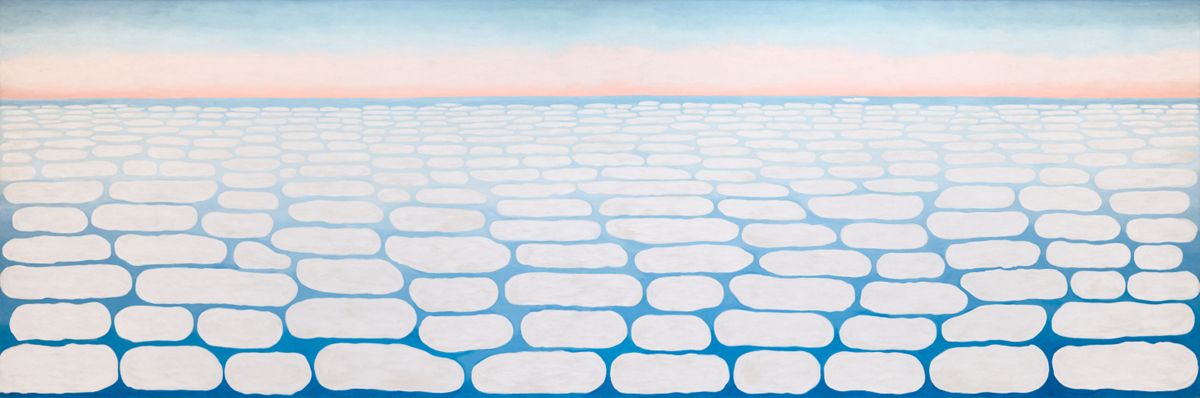 #14
#14
Sky above the clouds IV
After observing the clouds from an airplane, O'Keeffe transforms their repetition into an almost abstract landscape. The white shapes diminish towards a band of pink and blue horizon, giving the canvas more than seven meters a calm depth. The immensity comes not from a spectacular detail, but from the regular cadence of an endless pattern.
Documentary image and instructions: Art Institute of Chicago. This work is not offered for reproduction by Alpha Reproduction.
See the institution's notice →%20(cropped).jpg?width=1600) #15
#15
Vir Heroicus Sublimis
Newman covers more than five meters of intense red, interrupted by five vertical stripes he called "zips". Seen up close, they do not simply divide the canvas: they measure the presence of the viewer in front of the colored field. The Latin title, "heroic and sublime man", announces a physical experience rather than a story.
Documentary image and instructions: Museum of Modern Art. This work is not offered for reproduction by Alpha Reproduction.
See the institution's notice → #16
#16
A Sunday afternoon on the island of Grande Jatte
Painted between 1884 and 1886, La Grande Jatte transforms the Sunday leisure activities of Parisians into an almost immobile frieze. Seurat juxtaposes small touches of unmixed colors so that the eye recomposes the light from a distance. Profiles, verticals and calculated intervals create an orderly but strangely silent society. The profiles, verticals and calculated intervals create an orderly but strangely silent society. The artist then added a dotted border which extends the contrasts of the scene.
Image and link: Alpha Reproduction.
See this reproduction → #17
#17
The Birth of Venus
Venus has just reached the shore of Cyprus, pushed by Zephyr and greeted by a spring figure who holds out a flowery coat. Botticelli does not paint a birth in the narrative sense, but an apparition whose long silhouette, golden hair and continuous outline seem to resist the ordinary laws of weight. The canvas, a then common support for domestic decorations, probably belonged to the Medici universe. Around 1485, this silent arrival transformed ancient mythology into an image of ideal, fragile and immediately recognizable beauty.
Image and link: Alpha Reproduction.
See this reproduction → #18
#18
Spring
Nine mythological figures advance into a grove of orange trees where Botticelli painted dozens of identifiable plant species. On the right, Zephyr captures Chloris, who becomes Flora; in the center, Venus presides over the scene; on the left, the three Graces dance while Mercury spreads the clouds. The exact meaning remains debated, but love, fertility, peace and humanist culture meet there with sovereign visual coherence. The exact meaning remains debated, but love, fertility, peace and humanist culture meet there with sovereign visual coherence. The exact meaning remains debated, but love, fertility, peace and humanist culture meet there with sovereign visual coherence. The exact meaning remains debated, but love, fertility, peace and humanist culture meet there with sovereign visual coherence. Around 1480, the line connects each gesture to the vegetation and makes the painting a choreography before making it an enigma.
Image and link: Alpha Reproduction.
See this reproduction → #19
#19
Venus and Mars
Venus, awake and perfectly in control of herself, watches Mars sleep after love while four little satyrs play with her armor. The composition contrasts the vigilance of the goddess with the comic abandonment of the warrior god: love literally disarms war. The elongated format suggests a panel intended for the decor of a Florentine bridal chamber, and the myrtle reinforces this matrimonial reading. Around 1485, Botticelli mixes ancient culture, worldly elegance and humor with a precision that the imminent din of the conch cannot disturb.
Image and link: Alpha Reproduction.
See this reproduction → #20
#20
The Meal at Levi's
Commissioned as a Last Supper for a Dominican refectory, the painting was questioned by the Inquisition because of its jesters, soldiers, animals and guests considered inappropriate. Veronese chose to change the title rather than the painting, which became Le Repas chez Lévi. The immense loggia distributes the crowd like a Venetian stage and makes the sacred story a public spectacle.
Image and link: Alpha Reproduction.
See this reproduction →Processions, battles, ceremonies and narrative cycles organize time by moving the gaze from one group to another.
 #21
#21
Procession on St. Mark's Square
Gentile Bellini represents the procession of the relic of the True Cross in St. Mark's Square. The basilica, procuraties, banners and brotherhoods are described with a precision that transforms the image into a document on Venice at the end of the 15th century. However, the panoramic view does not just record a place: it orders the city around a civic miracle.
Image and link: Alpha Reproduction.
See this reproduction → #22
#22
The Beethoven Friesland
On three walls, floating figures lead the gaze of a suffering humanity towards the knight, the hostile powers and finally the embrace accompanied by the choir of the Ninth Symphony. Klimt created the frieze in 1902 for the fourteenth Secession exhibition, designed as a collective tribute to Beethoven. Destined to disappear, the work was saved, cut out then reinstalled. Its expressive lines and gold already announce the artist's most famous period.
Image and link: Alpha Reproduction.
See this reproduction → #23
#23
The Isenheim Altarpiece
Designed for the Antonines hospital in Issenheim, the altarpiece combined several openings with different feasts and liturgical needs. In the Crucifixion, the convulsed body of Christ and his bruised skin spoke directly to patients suffering from ardent illness. The panels deployed alternate pain, angelic music and resurrection: the panoramic format becomes a healing journey.
Image and link: Alpha Reproduction.
See this reproduction → #24
#24
The Rite of Napoleon
David paints Josephine's coronation at Notre-Dame rather than the gesture by which Napoleon himself crowned himself. The long gallery brings together the imperial family, dignitaries, clergy and artist, each carefully identifiable. Certain presences were reorganized to serve the official image: the painting transforms a recent ceremony into an already monumental dynastic history.
Image and link: Alpha Reproduction.
See this reproduction → #25
#25
Washington crossing Delaware
Leutze imagines Washington leading its troops across Delaware before the attack on Trenton in 1776. The light focuses heroism on the central boat, while the icy river stretches the danger across the width. Several details are anachronistic, including the flag, but this romantic reconstruction has permanently fixed the popular image of the American Revolution.
Image and link: Alpha Reproduction.
See this reproduction → #26
#26
The solemn session of the Council of State
For the centenary of the Council of State, Repin brings together more than eighty portraits in the circular room of the Palais Marie. The uniforms, files, armchairs and attitudes individualize the members without breaking the unity of the assembly. The width allows us to read the institution as a collective body, but also to observe the distances, hierarchies and tensions of imperial power.
Image and link: Alpha Reproduction.
See this reproduction → #27
#27
The Conquest of Siberia by Ermak
Sourikov represents the battle between the Ermak Cossacks and the forces of Khan Kuchoum during the conquest of Siberia. The two armies converge in the center, compressed between the river and the steep bank. The composition gives epic energy to the confrontation while revealing how Russian history painting transformed territorial expansion into a national narrative.
Image and link: Alpha Reproduction.
See this reproduction → #28
#28
The Boyarine Morozova
Old believer Feodossia Morozova, arrested for her opposition to religious reforms, crosses Moscow on a sleigh. Her raised arm forms the two-fingered sign of the ancient faith, to which the gestures and looks of the crowd respond. The long diagonal of the procession cuts through the snow and transforms a political defeat into an image of stubborn resistance.
Image and link: Alpha Reproduction.
See this reproduction → #29
#29
Zaporozhian Cossacks writing a letter to the Sultan of Türkiye
Repin brings together the Cossacks around an insulting letter addressed, according to legend, to the Ottoman sultan. Each face offers a different way of laughing, thinking or outbidding, while the scribe tries to follow the collective improvisation. The panoramic composition circulates group energy and replaces the unique hero with an irreverent community.
Image and link: Alpha Reproduction.
See this reproduction → #30
#30
A funeral in Ornans
Courbet gives a provincial burial the format previously reserved for battles and state ceremonies. The inhabitants of Ornans are aligned without idealization around a pit which opens in the foreground. This almost obstinate horizontality scandalized the Salon of 1850 -1851: ordinary life, local faces and collective ritual suddenly entered the great history painting.
Image and link: Alpha Reproduction.
See this reproduction → #31
#31
The Painter's Workshop
Courbet places himself at the center of his studio, painting a landscape under the gaze of a child and a naked model. On the left are the figures of ordinary society; on the right appear friends, collectors and writers, including Baudelaire. The subtitle, "real allegory determining a phase of seven years", explains this vast political and artistic assessment without closing its meaning.
Image and link: Alpha Reproduction.
See this reproduction → #32
#32
The Romans of decadence
Around a statue of the emperor, Couture displays the languid bodies of a Roman banquet while a few philosophers observe the scene. The painting claims to denounce ancient decadence, but the public of 1847 also recognized it as a critique of the July Monarchy. The frieze of figures transforms archeology into a moral mirror of the present.
Image and link: Alpha Reproduction.
See this reproduction → #33
#33
The Battle of Aboukir
Gros grabs Murat at the heart of the battle of Aboukir, saber raised on a horse thrown into the fray. The diagonals of the riders, weapons and overturned bodies draw the gaze from one end of the canvas to the other. The real violence of the confrontation is subjected to a heroic staging which announces the visual propaganda of the Empire.
Image and link: Alpha Reproduction.
See this reproduction → #34
#34
The Call of the Last Victims of Terror
Müller sets the stage at the Conciergerie, when the prisoners hear the call of those who will leave for the guillotine. Light dresses, dark clothes and hanging gestures organize a series of individual reactions: resignation, fear, prayer or challenge. The frieze format gives the wait a theatrical intensity without directly representing the execution.
Image and link: Alpha Reproduction.
See this reproduction → #35
#35
Cain fleeing from Jehovah’s curse
Cormon imagines Cain and his tribe wandering a mineral landscape after Abel's murder. The patriarch is carried into the middle of a group of hunters, women, children and beasts who advance like a prehistoric migration. The width allows us to mix biblical stories, contemporary fascination with human origins and spectacular crowd painting.
Image and link: Alpha Reproduction.
See this reproduction → #36
#36
Saint Mark preaching in Alexandria
Begun by Gentile Bellini and completed by his brother Giovanni, this vast canvas transposes the preaching of Saint Mark into a dream Alexandria based on Venice and travel stories. Orientalizing architecture, costumes, animals and crowds converge on the central stand. The image combines Christian mission, ethnographic curiosity and the maritime ambition of the Republic.
Image and link: Alpha Reproduction.
See this reproduction → #37
#37
The Tragedy of Lucretia
Three moments in Roman history unfold around a triumphal arch: the rape of Lucretia, her suicide in front of her family and the uprising led by Brutus. Painted around 1500 for a Florentine interior, the panel transforms private virtue into a political event. The architecture connects the episodes while the repetition of the characters forces us to read the image as a story whose violence founded the Republic.
Image and link: Alpha Reproduction.
See this reproduction → #38
#38
The Last Miracle and the Death of Saint Zenobius
The last panel of the cycle of Saint Zenobius shows the bishop performing a final miracle then dying, surrounded by clerics and faithful. Several moments follow one another in the same Florentine architecture, according to a narrative method inherited from the predella. Around 1500 -1505, Botticelli confronts healing and mortality: the power of the saint still acts in the city, but his own body must join the funeral ritual and civic memory.
Image and link: Alpha Reproduction.
See this reproduction → #39
#39
Three Miracles of Saint Zenobius
Three miracles of Zenobius follow one another in the streets of Florence: he exorcises two young men, resurrects the son of a widow and restores sight to a blind man. The urban setting, probably recognizable to contemporaries, makes holiness an action in the heart of the city. Around 1500, each group had its own emotion, but the architecture united them. The panel thus constructs a visual biography based on the repair of bodies and social bonds.
Image and link: Alpha Reproduction.
See this reproduction → #40
#40
The Story of Nastagio degli Onesti
In the pine forest of Ravenna, Nastagio witnesses the infernal pursuit of a young woman by a knight and his dogs. Boccaccio's story unfolds in several moments in the same landscape, a process which allows the gaze to follow the action like a sequence. Commissioned in 1483 for the wedding of Giannozzo Pucci and Lucrezia Bini, the cycle combined moral warning, family prestige and narrative entertainment. The Prado underlines Botticelli's conception while recognizing the active participation of his assistants.
Image and link: Alpha Reproduction.
See this reproduction → #41
#41
Story by Nastagio degli Onesti, fourth episode
The fourth panel of Nastagio's cycle no longer shows the punitive forest, but the banquet where the hero reveals the apparition to the one who refused his love. The table, the guests and the architecture order the social outcome of a story based on a cruel vision. Designed in 1483 for a Pucci wedding, the painting remains in the private collection of the family palace in Florence. As in the three panels of the Prado, the design remains in the private collection of the family palace in Florence. As in the three panels of the Prado, the painting remains in the private collection of the family palace in Florence. As in the three panels of the Prado, the design remains in Botticelli's private collection while the execution closely associates the workshop.
Image and link: Alpha Reproduction.
See this reproduction →The panoramic landscape measures distance, while ports and streets transform real space into a visual journey.
 #42
#42
The Monk by the sea
A tiny monk stands before a dark sea under a sky that occupies most of the canvas. Friedrich removed ships initially planned, accentuating the absence of landmarks and the difficulty in measuring space. Presented in Berlin in 1810 with The Abbey in an Oak Forest, the painting sparked Kleist's famous comment on the impression of having his eyelids cut off. Solitude, infinity and the impossibility of grasping the world become the real subject.
Image and link: Alpha Reproduction.
See this reproduction → #43
#43
The Rocky Mountains, Lander Peak
Bierstadt composed this landscape after the 1859 expedition to the Rocky Mountains. The shoshone camp in the foreground, the lake and the peak bathed in light bring together direct observations and workshop recomposition. The panoramic expanse promises the Eastern public a grandiose nature, but it also participates in the story of conquest which would upset the peoples and territories represented.
Image and link: Alpha Reproduction.
See this reproduction → #44
#44
Night Birds
Hopper opens the glass corner of a dinner on an almost empty New York street. The electric light isolates the waiter and three customers, physically close but separated by their attitudes and the visible absence of a door. Painted during World War II, the stage has become an icon of urban solitude because its long framing leaves as much room for silence as for the characters.
Image and link: Alpha Reproduction.
See this reproduction → #45
#45
The Gulf Stream
A black sailor drifts on a dismasted boat, surrounded by sharks while a distant ship crosses the horizon. Homer refuses a reassuring conclusion: sugar canes, rough seas and downpours transform waiting into a continuous threat. The width of the canvas increases the character's isolation and has fueled readings about race, empire and human vulnerability.
Image and link: Alpha Reproduction.
See this reproduction → #46
#46
Among the waves
In Among the Waves, completed in 1898, Aivazovsky removes almost all human cues to make water the exclusive subject. A green clearing crosses the dark swell and reveals the transparency of the ridges. This late work does not describe a precise coast: it condenses decades of observation into an imaginary sea, built from memory in Theodosia's workshop.
Image and link: Alpha Reproduction.
See this reproduction → #47
#47
Breaking wave
In Wave Surge, the coast and the ship are almost absorbed by a black sky and a succession of white blades. The foam traces diagonals which lead towards the boat inclined to the horizon. The painting is less interested in an identified event than when the sea crosses its own limit, invades the shore and makes all navigation precarious.
Image and link: Alpha Reproduction.
See this reproduction → #48
#48
Shipwreck near the cliffs
In Shipwreck, a dismasted vessel struggles at the foot of steep cliffs while a small boat tries to move away. The coast, normally a promise of safety, becomes a second danger here. The rocks close the horizon and force the eye to follow the uncertain trajectory of the survivors. The navy therefore tells less about the loss of the ship than the difficulty of reaching land.
Image and link: Alpha Reproduction.
See this reproduction → #49
#49
Battle of Sinope
The Battle of Sinope represents the confrontation of November 30, 1853 where the Russian squadron destroyed an Ottoman fleet at anchor. Official painter of the Imperial Navy, Aivazovsky organizes ships, smoke and deep shots. The image celebrates a victory, but the fire that erases the port also gives the scene the indistinct violence of a catastrophe.
Image and link: Alpha Reproduction.
See this reproduction → #50
#50
Moonlit view of Constantinople
View of Constantinople in the moonlight places a mosque and its minarets in line with a setting sun or a very low moon. The dark caiques cross the orange reflection which connects the city to the water. Aivazovsky, invited several times to the Ottoman capital, makes the Bosphorus a way of approach: architecture can be discovered from the sea, before the streets and palaces.
Image and link: Alpha Reproduction.
See this reproduction → #51
#51
Ancient Theodosia
Ancient Theodosia reconstructs the port before modern transformations, with its quays, fortifications and sails. Aivazovsky is not content with a contemporary panorama: he creates a visual memory of his hometown. The small figures and boats bring the historical evocation to life, while the evening light unites the different eras in the same atmosphere.
Image and link: Alpha Reproduction.
See this reproduction → #52
#52
Sunset in Constantinople
Sunset in Constantinople takes a high viewpoint, shaded by tall trees, to look at the Bosphorus and urban silhouettes. Characters in the foreground contemplate the same spectacle as the visitor. This human relay transforms the view into a travel memory. The distant city matters as much as the light which seems momentarily to dissolve it.
Image and link: Alpha Reproduction.
See this reproduction → #53
#53
The Grand Canal, Venice
Canaletto constructs the Grand Canal as a stage where palaces, boats and reflections gradually lead towards depth. The precision of the facades does not exclude perspective adjustments: the buildings are spaced and oriented to make the route more readable. The horizontal format thus restores less of an instant than an ideal experience of the city from the water.
Image and link: Alpha Reproduction.
See this reproduction → #54
#54
St. Mark's Square, Venice
St. Mark's Square becomes a theater of stone and light for Canaletto. The long lines of procuraties lead towards the basilica, while walkers, merchants and silhouettes give the scale of the space. The view combines observation, optical chamber and workshop corrections: Venice seems accurate, but its panoramic order is carefully reconstructed.
Image and link: Alpha Reproduction.
See this reproduction → #55
#55
The Riva degli Schiavoni, Venice
From the Riva degli Schiavoni, Canaletto unfolds the maritime front of Venice between quays, palaces, churches and port activity. The masts cut through the sky and slow down the escape from perspective, while the boats animate the foreground. This width transforms the veduta into a visual walk along a city whose identity depends on its relationship to the lagoon.
Image and link: Alpha Reproduction.
See this reproduction → #56
#56
View of the small port of Lorient
In Lorient, in 1869, Morisot placed his sister Edma in the foreground of a small port punctuated with boats and masts. The young woman does not pose in front of an autonomous landscape: her light dress, the quay and the water make up the same network of keys. This view is one of the works where the artist abandons the academic finish in favor of a moving light, already close to impressionism.
Image and link: Alpha Reproduction.
See this reproduction → #57
#57
The Pier
On a pier swept by sea air, figures and boats are distributed along a strong horizontal line. Morisot lets the sky and water occupy a large part of the canvas, giving the characters a fragile scale. This economy of means reflects the sensation of a place exposed to the wind, where each silhouette is only a passage through the port expanse.
Image and link: Alpha Reproduction.
See this reproduction → #58
#58
Return from fishing: hauling the boat
Two oxen pull a boat out of the water while the fishermen guide the effort. The inflated sail, the mass of animals and the reflections of the shore organize a powerful composition where the work becomes a spectacle of light. Sorolla unites the realism of the gestures with a decorative scale which earned him international recognition. Acquired by the French State for the Luxembourg Museum, the painting dedicated Sorolla to Paris before its entry into the Orsay collections.
Image and link: Alpha Reproduction.
See this reproduction → #59
#59
Oxen pulling a boat on Valencia beach
The oxen advance into the shallow water, pulling the boat towards the shore. Their dark mass opposes the rapid bursts of foam and sky. Sorolla takes up an old theme from his career with a freer touch: the work remains readable, but the atmosphere almost dissolves the shapes. The animals take up an already monumental traditional hauling method in Return of Fishing, but here the study focuses on the raw and immediate effort.
Image and link: Alpha Reproduction.
See this reproduction → #60
#60
Running along the beach, Valencia
The children run across the beach, caught in a succession of unstable gestures. The wide framing gives the sand and the sea the space necessary to amplify their speed. The oblique shadows extend the bodies, and the nervous touch transforms the race into a pure luminous rhythm. The parallel shore race allows Sorolla to juxtapose the speed of bodies, surf and brush trails in the same horizontal impulse.
Image and link: Alpha Reproduction.
See this reproduction → #61
#61
Castile: the bread festival
Residents of several Castilian provinces present breads, costumes and ceremonial objects in front of the walls of Avila. Sorolla brings together groups studied separately in a frieze of exceptional scale. Regional diversity is transformed into a luminous procession, designed for the monumental cycle "Vision of Spain". The regional diversity is transformed into a luminous procession, designed for the monumental cycle "Vision of Spain". The first panel completed in the Vision of Spain cycle, The Bread Festival associates Castile with food, costumes and ceremonial rhythms.
Image and link: Alpha Reproduction.
See this reproduction →Myths, banquets, nudes and intimate scenes use horizontality to regulate relationships between bodies.
 #62
#62
Hylas and the Nymphs
Hylas, Heracles' companion, leans over a spring to draw water when seven nymphs draw him towards them. Waterhouse narrows the myth about the exchange of glances and the contact of a hand on the wrist. Almost similar faces, arranged like water lilies, abolish any exit into the dark depth of the pool. Seduction is not illustrated after the fact: it becomes the very mechanism of the composition, calm on the surface and fatal in its movement.
Image and link: Alpha Reproduction.
See this reproduction → #63
#63
Odysseus and the mermaids
Attached to the mast, Ulysses listens to the siren song while his companions, with blocked ears, continue to row. Waterhouse here adopts the ancient form of winged creatures with female heads, and not that of attractive fishwomen which became common in the 19th century. They attack the ship like birds of prey. The hull seen up close, the compressed sea and the repetition of the wings transform an auditory ordeal into a physical, almost claustrophobic seat.
Image and link: Alpha Reproduction.
See this reproduction → #64
#64
Echo and Narcissus
Narcissus only sees his reflection in the spring; Echo, condemned to repeat the words of others, observes him without being able to be loved. Waterhouse separates their two solitudes by a diagonal of water and foliage. The young man forms a closed circle with his own image, while the nymph lies down in the open space of the landscape. The narcissus flowers in the foreground recall the final metamorphosis and give the myth a silent conclusion, already present in nature.
Image and link: Alpha Reproduction.
See this reproduction → #65
#65
The Roses of Heliogabalus
The scene takes up the story, transmitted by Augustan History, of a banquet where the emperor Heliogabalus had his guests buried under an avalanche of petals. Alma-Tadema transforms the episode into a visual trap: the pink abundance initially appears voluptuous, then becomes stifling in the foreground. In "The Roses of Heliogabalus", the architecture serves as a measure for the characters: lines, thresholds and differences in scale lead the gaze before the story becomes clearer. Dated 1888, "The Roses of Heliogabalus" is shown in the Pérez Simon collection.
Image and link: Alpha Reproduction.
See this reproduction → #66
#66
The Discovery of Moses
The pharaoh's daughter returns from the Nile with the child Moses in a richly decorated cradle, carried to the center of a procession. The composition contrasts the smallness of the future prophet with the monumental splendor of Egypt, as if his destiny still remained invisible to the characters. The materials of "The Discovery of Moses" - skin, fabrics, stone, flowers or metal - are not decorative: they give the world represented its physical credibility. Dated 1904, "The Discovery of Moses" - skin, fabrics, stone, flowers or metal - are not decorative: they give the world represented its physical credibility. Dated 1904, "The Discovery of Moses" is noted in private collections.
Image and link: Alpha Reproduction.
See this reproduction → #67
#67
Phidias showing the Parthenon frieze to his friends
Alma-Tadema imagines Phidias presenting the Parthenon frieze to Pericles and his loved ones. The balustrade places spectators almost at the level of the painted reliefs, as if they were attending a private exhibition. The painting reflects as much on Antiquity as on the 19th century: creation, public commission and aesthetic judgment become the true subject of this skillfully archaeological scene.
Image and link: Alpha Reproduction.
See this reproduction → #68
#68
Sappho and Alcée
Alcée sings accompanied by the zither while Sappho, crowned with laurel, listens among her companions. The names engraved on the bench and the scroll of verse make the poetry almost material; the looks, more than the gesture, organize the tension of the scene. With "Sappho and Alcée", Alma-Tadema organizes the light so as to clearly separate the shots while maintaining a continuous atmosphere. Dated 1881, "Sappho and Alcée" is reported to the Walters Art Museum.
Image and link: Alpha Reproduction.
See this reproduction → #69
#69
A reading of Homer
A crowned young poet reads Homer in front of a group seated on a terrace overlooking the sea. The episode does not illustrate a precise passage from the epic: rather it shows the oral transmission of Greek culture, attentive and ceremonial, in a deliberately ideal setting. In "A Reading of Homer", each accessory has a function of rhythm and context; the accumulation remains readable because the figures occupy clearly hierarchical areas. Dated 1885, "A Reading of Homer" is reported to the Philadelphia Museum of Art.
Image and link: Alpha Reproduction.
See this reproduction → #70
#70
Pyrrhic dance
Young warriors perform pyrrhic, an armed dance inherited from ancient Greece. Inclined shields, spears and leaning bodies give the human frieze a lively rhythm; the seated audience, however, transforms the military exercise into a regulated performance. In "The Pyrrhic Dance", the silence of the painting becomes a narrative asset: looks and postures suggest a conversation that the image never fully translates. Dated 1869, "The Pyrrhic Dance" is noted in the collections of Guildhall Art Gallery.
Image and link: Alpha Reproduction.
See this reproduction → #71
#71
An offering to Bacchus
A procession brings flowers, fruits and gifts to Bacchus. The ceremony allows Alma-Tadema to combine ancient religion and collective spectacle; the movement of the figures leads the eye towards the altar while the offerings give the cult a concrete dimension. "An offering to Bacchus" shows how much Alma-Tadema thinks as a director: placement of bodies, openings and furniture determine what the spectator can know. Dated 1889, "An offering to Bacchus" shows how much Alma-Tadema thinks as a director: placement of bodies, openings and furniture determine what the spectator can know. Dated 1889, "An offering to Bacchus" is reported to the Kunsthalle Hamburg.
Image and link: Alpha Reproduction.
See this reproduction → #72
#72
The Great Bathers
Cézanne worked for several years on this meeting of nudes under an arch of trees. The bodies describe neither a real bath nor a precise myth: they form with the trunks, the sky and the bank an architecture of volumes. The width allows the two side groups to converge towards the central void, a construction which will profoundly mark Picasso, Matisse and modern art.
Image and link: Alpha Reproduction.
See this reproduction → #73
#73
The Bus
In this popular bus, passengers of different classes and origins share a seat: worker, peasant, child, bourgeois and young woman. The work precedes the explicit accounts of the 1925 accident, but the vehicle inevitably recalls the one whose collision disrupted Kahlo's life. The composition is also a social summary of urban Mexico. Dated 1929, the painting is today indicated in Museo Dolores Olmedo, Mexico City, Mexico City.
Image and link: Alpha Reproduction.
See this reproduction → #74
#74
Roots
Kahlo's body opens into a plant trunk whose roots reach arid soil. The chest becomes a window towards the earth, but the body remains lying vulnerable, between fertility and immobility. Painted for the decoration project of a restaurant, this small work diverts the theme of "mother earth" towards a very personal physical experience. The catalogs place the work in 1943, with Private collection or location to be verified as current or reference location.
Image and link: Alpha Reproduction.
See this reproduction → #75
#75
The Body of Christ dead in the grave
Holbein paints the corpse of Christ at almost real size, without consoling idealization. The extreme length of the panel locks the body into a disturbing physical presence. Dostoyevsky was upset by this Christ subjected to the ordinary signs of death; the painting tests the very idea of resurrection rather than illustrating it.
Image and link: Alpha Reproduction.
See this reproduction → #76
#76
Naked lying with hair untied
The model turns her face towards the viewer while her black hair spreads over the shoulder and the background. Created in 1917, the work belongs to the nudes financed and distributed by the merchant Léopold Zborowski. The orange skin stands out from a very tight brown and green environment. This voluntary proximity eliminates the traditional distance between the exposed nude and the viewer.
Image and link: Alpha Reproduction.
See this reproduction → #77
#77
Naked lying
In this reclining nude, the head rests on a light cloth and the body stretches diagonally on a dark red blanket. Modigliani takes up an ancient pose, inherited from the reclining Venus, but rules out any mythological pretext. The model remains aware of the outside gaze. The model remains aware of the outside gaze. The black contours, warm range and flattened space give the 1917 image a modern, direct and fully assumed presence.
Image and link: Alpha Reproduction.
See this reproduction → #78
#78
Water Snakes II
Four women stretch out in a length of water where hair, flowers, fish and fabrics merge. The bodies retain their volume, but the decorative current carries them into a surface without horizon. Worked between 1904 and 1907, the work belongs to Klimt's research on a feminine sensuality removed from the masculine gaze represented. Its modern history is darker: dispossession, sales and restitution agreements remind us that the circulation of a masterpiece is also part of his reading.
Image and link: Alpha Reproduction.
See this reproduction → #79
#79
The Tree of Life, Stoclet frieze
A central trunk unfolds in golden spirals laden with flowers, eyes and birds. What is reproduced as a self-contained painting is actually a full-size cardboard work for the mosaic in the dining room of the Stoclet Palace in Brussels. The network of branches connects the panels of Waiting and Accomplishment into a single decorative environment. Designed around 1910-1911, The Tree of Life shows Klimt working on the scale of architecture and total artwork.
Image and link: Alpha Reproduction.
See this reproduction → #80
#80
The Plot
Ensor places in the foreground a masked group whose gazes seem to surround the viewer. Hats, flowers, lace and painted faces make it impossible to distinguish between people and disguises. Inspired in part by the tensions surrounding her engagement, the stage transforms the Ostend carnival into a theater of social hostility, hypocrisy and intimate unease.
Image and link: Alpha Reproduction.
See this reproduction → #81
#81
Caresses
Khnopff takes up the myth of Oedipus facing the Sphinx, but replaces the ancient monster with a creature with a leopard body and an almost androgynous face. The proximity of the two profiles transforms the enigma into a silent attraction. The elongated format, the verticality of the bodies and the arid landscape give this "caress" a sensual and threatening ambiguity.
Image and link: Alpha Reproduction.
See this reproduction → #82
#82
Old trees, flat distance
Attributed to Guo Xi, this horizontal scroll pits gnarled trees in the foreground at a vast misty distance. The viewer does not dominate a unified landscape: he passes from one group of rocks to another following the breaths of the ink. The "flat distance" thus becomes a method of making distance felt without resorting to the Western perspective.
Image and link: Alpha Reproduction.
See this reproduction → #83
#83
Poet on top of a mountain
Shen Zhou reduces the poet to a tiny figure standing atop an escarpment. The mountain, the trees and the void do not serve as a setting: they give a spiritual measure to the solitude of the scholar. The calligraphic inscription completes the image and reminds us that, in Chinese tradition, painting, poetry and writing are part of the same experience of the landscape.
Image and link: Alpha Reproduction.
See this reproduction →From Bruegel to Hopper, panoramic composition remains a laboratory for narrative, rhythm and pictorial space.
 #84
#84
Number 32, 1950
On a canvas left raw, Pollock projects only black paint. The trajectories of the body remain visible and give the painting the magnitude of a centerless cartography. The absence of color reveals differences in pressure, speed and dilution; what might seem chaotic thus preserves the precise memory of the artist's movements.
Image and link: Alpha Reproduction.
See this reproduction → #85
#85
The Adoration of the Magi
The Epiphany here becomes a collective portrait of Medicean Florence. Around Mary and the Child, installed in the center of ruined architecture, visitors adopt a variety of poses which were admired by Vasari. Several members of the Medici family would have lent their features to the Magi and their entourage, while Botticelli would have represented himself on the right edge. Painted around 1470-1475 for the chapel of Gaspare di Zanobi del Lama, the work unites devotion, civic prestige and virtuosity of portraiture without losing the clarity of its sacred center.
Image and link: Alpha Reproduction.
See this reproduction → #86
#86
The Adoration of the Magi (Dürer)
This first Adoration, today in Basel, should not be confused with the famous panel painted in 1504 and kept at the Uffizi. Dürer organizes a horizontal procession here: the kneeling king meets the Child on the left, while the two other Magi advance from the landscape. Contemporary clothing, the succession of profiles and the shallow depth still give the scene the narrative rhythm of a Nordic altar shutter. The painting thus shows the young painter before the more monumental synthesis of his Italian years.
Image and link: Alpha Reproduction.
See this reproduction → #87
#87
The Parable of the Blind
Six blind men advance in a row on a diagonal which inevitably leads them towards the ditch. The first has already fallen, the second tilts and each body announces the next fall, like successive images of the same movement. Bruegel transposes the Gospel parable into a Flemish landscape of great precision and gives each face a distinct ocular attack. In 1568, the lesson on blind guides became an almost physical experience of lost balance, reinforced by the horizontal format of the canvas.
Image and link: Alpha Reproduction.
See this reproduction → #88
#88
Saul's Suicide
Saul throws himself on his sword after the defeat against the Philistines, relegated to a lower angle while the battle invades the valley. The armor, spears and mass of troops give the king's death an almost paltry scale. Dated 1562, the panel shows how Bruegel refuses the isolated hero: individual destiny is lost in a military machine that continues after him.
Image and link: Alpha Reproduction.
See this reproduction → #89
#89
The Preaching of Saint John the Baptist
John the Baptist preaches in the center of a clearing surrounded by a remarkably diverse crowd. Peasants, bourgeois, soldiers, pilgrims and figures identified with different cultural backgrounds listen, discuss or observe without adopting a single reaction. Christ is among them, still discreet before his baptism. Dated 1566, the painting transforms a religious episode into a study of public gathering: the message circulates in a space where social differences, curiosity and momentary attention share the same landscape.
Image and link: Alpha Reproduction.
See this reproduction → #90
#90
The Land of Cocagne
Three men - a soldier, a peasant and a cleric - sleep sated around a tree in the imaginary land of Cocagne. A roof covered with pancakes, a pig already equipped with a knife and an egg walking towards its eater promise food without work. Painted in 1567, the panel transforms the popular dream of abundance into a satire of laziness that crosses social classes.
Image and link: Alpha Reproduction.
See this reproduction → #91
#91
Saint Martin's Wine
On Saint Martin's Day, a crowd rushes around a huge barrel to obtain the new wine, forming a pile of bodies, jugs and containers. On the right, Martin discreetly shares his coat with a poor man. Discovered and attributed to Bruegel in the 21st century, this vast canvas opposes almost invisible charity to the frenzy of consumption. Collective abundance masks the moral gesture that it should make possible.
Image and link: Alpha Reproduction.
See this reproduction → #92
#92
Naval battle in the Gulf of Naples
Galleys and sailboats clash in the Gulf of Naples while Vesuvius, the coast and the city organize the horizon. Bruegel transforms his memories of the trip to Italy into a maritime theater of largely imaginary precision. The smoke, oars and lines of hulls make the eye circulate between battle and topography. The landscape is not a simple setting: it gives human violence an almost geological scale.
Image and link: Alpha Reproduction.
See this reproduction → #93
#93
A Roman emperor (Claudius)
The painting depicts Emperor Claudius discovered behind a hanging after Caligula's assassination in 41. Alma-Tadema chooses the paradoxical moment when a terrified man becomes sovereign; the corpse and soldiers relegate heroism to political chance. In "A Roman Emperor (Claudius)", the silence of the painting becomes a narrative asset: looks and postures suggest a conversation that the image never fully translates. Dated 1871, "A Roman Emperor (Claudius)" is reported to the Walters Art Museum.
Image and link: Alpha Reproduction.
See this reproduction → #94
#94
Roman gardens
Walkers disperse in an orderly garden around a pond and terrace. The silhouettes are secondary facing the space: trees, walls and water make you feel how Alma-Tadema imagines the Roman villa as a habitable leisure setting. "Roman Gardens" shows how Alma-Tadema thinks as a director: placement of bodies, openings and furniture determine what the viewer can know. Dated 1877, "Roman Gardens" is noted in the collections of Collection Mesdag.
Image and link: Alpha Reproduction.
See this reproduction → #95
#95
The Youth of Bacchus
This canvas of more than six meters, painted in 1884, constitutes one of Bouguereau's most ambitious undertakings. Young Bacchus advances at the center of a procession of bacchantes, satyrs, centaurs and musicians. Rather than disorderly intoxication, the painter offers a perfectly regulated frieze: each dance, instrument and drape participates in a scholarly celebration of youth.
Image and link: Alpha Reproduction.
See this reproduction → #96
#96
Gimcrack at Newmarket Heath, with a trainer, groom and jockey
Gimcrack, a famous thoroughbred from the 18th century, is shown at several moments in his sporting life in the same composition. The coach, the jockey and the groom remind us that the glory of the champion rests on an entire system of breeding and work.
Image and link: Alpha Reproduction.
See this reproduction → #97
#97
Hambletonian, Rubbing Down
After his disputed victory against Diamond at Newmarket, Hambletonian is rubbed by two grooms. Stubbs does not celebrate the finish but the exhaustion that follows the effort: veins, sweat and muscular tension give the champion an almost tragic presence.
Image and link: Alpha Reproduction.
See this reproduction → #98
#98
Race to the woods
Cowboys flee an attack by throwing their horses towards a wooden fence. Remington condenses the western into a moment of choice: overcome the obstacle or be caught, while dust and diagonals accelerate the entire surface.
Image and link: Alpha Reproduction.
See this reproduction → #99
#99
Kullervo goes to war
Gallen-Kallela illustrates Kullervo, tragic hero of the Kalevala, riding towards a war whose outcome will be fatal. The horse and its rider cross a landscape of pine and snow animated by powerful colored bands. The lengthening of the canvas initially gives the force of an irreversible march and links the Finnish myth to a modern national vision.
Image and link: Alpha Reproduction.
See this reproduction → #100
#100
Early on a Sunday morning
Hopper stretches a row of businesses on Seventh Avenue under the cold morning light. The street is empty, the blinds lowered and the upper floors seem almost abandoned; the artist even removed an initially planned figure. Horizontality transforms ordinary facades into architectural rhythm and makes human absence the main event of the scene.
Image and link: Alpha Reproduction.
See this reproduction →Sources and links
Reference museums and collections
Institutional notices document modern works presented for informational purposes. The other cards directly open the Alpha Reproduction sheet corresponding to the image.
20th century icons
Museo Reina Sofia - GuernicaThe history, dimensions and presentation of Picasso's painting.The Met - Autumn rhythmThe large field painted by Jackson Pollock in 1950.MoMA - Vir Heroicus SublimisBarnett Newman and color experienced on a body scale.Frequently asked questions
Questions about the panoramic format
Proportions, rolls, friezes, sources and reproductions: useful benchmarks for reading the ranking.
What's a panoramic?
It is a painting whose width organizes a lateral experience of the gaze. It can represent a vast landscape, a frieze of characters, a procession, a battle or an abstract field without a figurative horizon.
What format report was retained?
The corpus applies a minimum ratio of 1.5 units of width to 1 unit of height. Rollers and panel assemblies often far exceed this proportion.
Are frescoes included?
Ordinary architectural frescoes have been discarded. Some painted sets designed as autonomous friezes are preserved when their horizontal unfolding constitutes precisely the subject of the classification.
Why include Chinese rolls?
A painted horizontal scroll is neither a drawing nor a photograph. It even offers one of the oldest panoramic experiences: the image is gradually discovered as it is unfolded.
Are all works offered for reproduction?
No. Existing Alpha files open the store. Modern works absent from the catalog are documentary and refer to their museum; they are not offered for reproduction by Alpha Reproduction.
How were duplicates avoided?
Titles, links and image files were checked separately. Variants or cropping of the same table do not occupy several places in the ranking.
0 comments