


100 paintings - German Renaissance
Albrecht Dürer: 100 essential paintings
Self-portraits, portraits, altarpieces, religious scenes and humanist panels: a hundred paintings to understand Dürer.
This version excludes engravings, engraved wood, watercolors and drawings. Existing files open Alpha Reproduction; three paintings missing from the store redirect to their museum and are not offered for reproduction. The page is static, without a slideshow.
Why Dürer matters
A painter who thinks with line
Albrecht Dürer unites Nordic accuracy, Italian humanism and the science of proportions in panels of exceptional precision.
At Dürer, detail is never decorative: it becomes knowledge.
This tour focuses solely on paintings: self-portraits, portraits, altarpieces, religious scenes, mythology and humanist panels.
Enter the rankingAlbrecht Dürer's 100 Essential Paintings
The paintings that establish Dürer as a major figure of the Renaissance.
#1Self-portrait with fur
Painted at twenty-eight, this self-portrait adopts a frontality then especially associated with the images of Christ. Dürer does not deify himself: he affirms that the creative power of the artist deserves a new intellectual dignity. The direct gaze, the symmetry of the face, the hand placed on the fur and the Latin inscription transform his appearance into an author's declaration. The careful execution of the hair and clothing nevertheless maintains the image in individual observation.
Image and link: Alpha Reproduction.
See this reproduction → #2
#2Self-portrait with gloves
Dürer represents himself here as a gentleman, dressed in a refined doublet and gray kid gloves. These gloves, which precisely hide the painter's hands, signal a high social rank: the artist claims the status of an educated man rather than that of a simple craftsman. The window opening onto an Alpine landscape recalls his Italian experience, while the double focus formed by the face and hands regulates the entire composition.
Image and link: Alpha Reproduction.
See this reproduction → #3
#3Thistle self-portrait
Dürer's first known painted self-portrait, this panel shows the artist at twenty-two holding a panicaut, often called a thistle. The Louvre recalls that the plant could be a symbol of marital fidelity and that the work may have served as an engagement portrait before his marriage to Agnes Frey. The German inscription, which entrusts its destiny to what is decided "up there", gives the worried face a scope that is both intimate and spiritual.
Image and link: Alpha Reproduction.
See this reproduction → #4
#4The Virgin of the Feast of the Rosary
Commissioned in Venice by the brotherhood of German merchants for the San Bartolomeo church, this large composition was to prove that Dürer could compete with Italian painters. The Virgin and Child distribute rose crowns to the pope, the emperor and an assembly that brings together religious power, political power and a community of the faithful. Under the tree, Dürer represented himself holding a cartel which claims to have completed the painting in five months.
Image and link: Alpha Reproduction.
See this reproduction → #5
#5Adam
With its counterpart dedicated to Eve, Adam constitutes one of the first life-size nudes in Northern European painting. Dürer executed it after his second stay in Italy and sought to reconcile the ideal of ancient proportion with Germanic descriptive precision. The half-open mouth and the gaze directed towards Eve give the monumental body a psychological tension: the biblical story also becomes a study of desire, movement and human beauty.
Image and link: Alpha Reproduction.
See this reproduction → #6
#6Eve
Eve forms a pair with Adam designed to be looked at together. The snake hands him the forbidden fruit from the branch, while its supple gesture and unstable balance announce an elegance that the Prado brings closer to mannerism. Dürer contrasts his light complexion with Adam's browner one and inscribes his signature on the cartel hanging from the tree. The religious subject thus serves an ambitious research on proportions and the female nude.
Image and link: Alpha Reproduction.
See this reproduction → #7
#7The worship of the wise men
This first Adoration, today in Basel, should not be confused with the famous panel painted in 1504 and kept at the Uffizi. Dürer organizes a horizontal procession here: the kneeling king meets the Child on the left, while the two other Magi advance from the landscape. Contemporary clothing, the succession of profiles and the shallow depth still give the scene the narrative rhythm of a Nordic altar shutter. The painting thus shows the young painter before the more monumental synthesis of his Italian years.
Image and link: Alpha Reproduction.
See this reproduction → #8
#8Adoration of the Holy Trinity
Also known as the Landauer Altarpiece, the painting was intended for the chapel of a charity house founded in Nuremberg by Matthäus Landauer. God the Father supports Christ crucified under the dove of the Holy Spirit, while saints, martyrs, clerics and laity form an immense celestial community. At the very bottom, Dürer places himself alone in an earthly landscape, holding the cartel of his signature: a clear separation between the living author and the vision of eternity.
Image and link: Alpha Reproduction.
See this reproduction → #9
#9The Martyrdom of Ten Thousand Christians
The painting brings together in a compact space the tortures inflicted, according to legend, on Prince Achatius and his soldiers converted to Christianity. At the center of this violence, Dürer appears as a calm observer, accompanied by the humanist Conrad Celtis, who died shortly before the work was completed. Their anachronistic presence does not tell of martyrdom: it invites the learned spectator to meditate on fidelity, suffering and historical memory.
Image and link: Alpha Reproduction.
See this reproduction → #10
#10The four apostles: Saints John and Peter
John occupies the foreground, absorbed in reading his Gospel, while Peter stands behind him with his large key. Along with Mark and Paul's panel, the work was offered by Dürer to the Nuremberg council. The texts of Luther's Bible inscribed at the bottom of the panels urge authorities to listen to Scripture and be wary of false prophets. John's concentrated calm here embodies a faith based on reading.
Image and link: Alpha Reproduction.
See this reproduction → #11
#11The four apostles: Saints Mark and Paul
On the second panel of the Four Apostles, Mark turns around with almost worried intensity while Paul, monumental, holds the book and the sword which allow him to be identified. Dürer associates the four figures with human temperaments and gives them a presence close to sculpture. The biblical quotes placed under the image send a warning to the leaders of Nuremberg in the context of the Reformation: political authority must remain subject to the divine word.
Image and link: Alpha Reproduction.
See this reproduction → #12
#12Portrait of the artist's father
At the heart of "Portrait of the Artist's Father", the physiognomy, costume and attitude construct the social identity of the model. In "Portrait of the Artist's Father", the Renaissance portrait not only retains features: it depicts the rank, profession, alliances and idea that the model wishes to convey to posterity. For this version of "Portrait of the Artist's Father", the descriptive precision slows down the gaze and gives each accessory a function overall. About "Portrait of the Artist's Father", the descriptive precision slows down the gaze and gives each accessory a function overall. About "Portrait of the Artist's Father", the descriptive precision slows down the gaze and gives each accessory a function overall. About "Portrait of the Artist's Father", preserved at the Uffizi Gallery, Florence and dated 1490, this version must be regarded as an autonomous work, with its own format and material history.
Image and link: Alpha Reproduction.
See this reproduction → #13
#13Portrait of Hieronymus Holzschuher
At the heart of "Portrait of Hieronymus Holzschuher", the physiognomy, costume and attitude construct the social identity of the model. In "Portrait of Hieronymus Holzschuher", the Renaissance portrait not only retains features: it depicts the rank, profession, alliances and idea that the model wishes to convey to posterity. For this version of "Portrait of Hieronymus Holzschuher", the descriptive precision slows down the gaze and gives each accessory a function overall. About "Portrait of Hieronymus Holzschuher", the descriptive precision slows down the gaze and gives each accessory a function overall. About "Portrait of Hieronymus Holzschuher", the descriptive precision slows down the gaze and gives each accessory a function overall. About "Portrait of Hieronymus Holzschuher", the descriptive precision slows down the gaze and gives each accessory a function overall. About "Portrait of Hieronymus Holzschuher", descriptive precision slows down the gaze and gives each accessory a function overall. About "Portrait of Hieronymus Holzschuher", preserved at Gemäldegalerie and dated 1526, this version must be regarded as an autonomous work, with its own format and its own material history.
Image and link: Alpha Reproduction.
See this reproduction → #14
#14Portrait of Michael Wolgemut
"Portrait of Michael Wolgemut" takes as its starting point a scene where physiognomy, costume and attitude construct the social identity of the model. In "Portrait of Michael Wolgemut", the Renaissance portrait not only retains features: it depicts the rank, profession, alliances and idea that the model wishes to convey to posterity. For this version of "Portrait of Michael Wolgemut", the balance of light and dark masses leads the eye towards the narrative core without erasing peripheral details. About "Portrait of Michael Wolgemut", the balance of light and dark masses leads the eye towards the narrative core without erasing peripheral details. About "Portrait of Michael Wolgemut", the balance of light and dark masses leads the eye towards the narrative core without erasing peripheral details. About "Portrait of Michael Wolgemut", the balance of light and dark masses leads the eye towards the narrative core without erasing peripheral details. About "Portrait of Michael Wolgemut", the balance of light and dark masses leads the eye towards the narrative core without erasing peripheral details. About "Portrait of Michael Wolgemut", the balance of light and dark masses leads the eye towards the narrative core without erasing peripheral details. About "Portrait of Michael Wolgemut", the balance of light and dark masses leads the eye towards the narrative core without erasing peripheral details. About "Portrait of Michael Wolgemut", dated 1516, the work is today attached to Collection of Paintings of the State of Bavaria, an essential landmark to distinguish this version from copies and variants.
Image and link: Alpha Reproduction.
See this reproduction → #15
#15Emperor Maximilian I
The subject of "Emperor Maximilian I" is precise: physiognomy, costume and attitude construct the social identity of the model. In "Emperor Maximilian I", the Renaissance portrait not only retains features: it depicts the rank, profession, alliances and idea that the model wishes to transmit to posterity. For this version of "Emperor Maximilian I", the painter brings together concrete observation and symbolic construction without sacrificing readability. For this version of "Emperor Maximilian I", the painter brings together concrete observation and symbolic construction without sacrificing readability. About "Emperor Maximilian I", the painter brings together concrete observation and symbolic construction without sacrificing readability. For this version of "Emperor Maximilian I", the painter brings together concrete observation and symbolic construction without sacrificing readability. About "Emperor Maximilian I", the painter brings together concrete observation and symbolic construction without sacrificing readability. For this version of "Emperor Maximilian I", the painter brings together concrete observation and symbolic construction without sacrificing readability. About "Emperor Maximilian I", the painter brings together concrete observation and symbolic construction without sacrificing readability. About "Emperor Maximilian I", the painter brings together concrete observation and symbolic construction without sacrificing readability. For this version of "Emperor Maximilian I", the painter brings together concrete observation and symbolic construction without sacrificing readability. About "Emperor Maximilian I", the 1519 marker and the conservation at Germanisches Nationalmuseum place this image precisely in the artist's career.
Image and link: Alpha Reproduction.
See this reproduction → #16
#16Portrait of Emperor Maximilian I
With "Portrait of Emperor Maximilian I", Albrecht Dürer shows how physiognomy, costume and attitude construct the social identity of the model. In "Portrait of Emperor Maximilian I", the Renaissance portrait not only retains features: it depicts the rank, profession, alliances and idea that the model wishes to convey to posterity. For this version of "Portrait of Emperor Maximilian I", the composition gives silence, expectation or conflict an immediately perceptible form. About "Portrait of Emperor Maximilian I", the composition gives silence, expectation or conflict an immediately perceptible form. About "Portrait of Emperor Maximilian I", the composition gives silence, expectation or conflict an immediately perceptible form. About "Portrait of Emperor Maximilian I", the composition gives silence, expectation or conflict an immediately perceptible form. About "Portrait of Emperor Maximilian I", the composition gives silence, expectation or conflict an immediately perceptible form. About "Portrait of Emperor Maximilian I", the composition gives silence, expectation or conflict an immediately perceptible form. About "Portrait of Emperor Maximilian I", the 1519 dating and the Kunsthistorisches Museum collection, Vienna here provide more reliable checkpoints than a simple visual resemblance.
Image and link: Alpha Reproduction.
See this reproduction → #17
#17Jakob Fugger
At the heart of "Jakob Fugger", physiognomy, costume and attitude build the social identity of the model. In "Jakob Fugger", the Renaissance portrait not only retains features: it depicts the rank, profession, alliances and idea that the model wishes to transmit to posterity. For this version of "Jakob Fugger", the descriptive precision slows down the gaze and gives each accessory a function overall. About "Jakob Fugger", preserved at Staatsgalerie Altdeutsche Meister and dated 1520, this version must be viewed as an autonomous work, with its own format and material history.
Image and link: Alpha Reproduction.
See this reproduction → #18
#18Barbara Holper
"Barbara Holper" takes as its starting point a scene where physiognomy, costume and attitude construct the social identity of the model. In "Barbara Holper", the Renaissance portrait not only retains features: it depicts the rank, profession, alliances and idea that the model wishes to transmit to posterity. For this version of "Barbara Holper", the balance of light and dark masses leads the eye towards the narrative core without erasing peripheral details. For this version of "Barbara Holper", the balance of light and dark masses leads the eye towards the narrative core without erasing peripheral details. About "Barbara Holper", the balance of light and dark masses leads the eye towards the narrative core without erasing peripheral details. About "Barbara Holper", the balance of light and dark masses leads the eye towards the narrative core without erasing peripheral details. About "Barbara Holper", the balance of light and dark masses leads the eye towards the narrative core without erasing peripheral details. About "Barbara Holper", the balance of light and dark masses leads the eye towards the narrative core without erasing peripheral details. About "Barbara Holper", the balance of light and dark masses leads the eye towards the narrative core without erasing peripheral details. About "Barbara Holper", the balance of light and dark masses leads the eye towards the narrative core without erasing peripheral details. About "Barbara Holper", the balance of light and dark masses leads the eye towards the narrative core without erasing peripheral details. About "Barbara Holper", the balance of light and dark masses leads the eye towards the narrative core without er
Image and link: Alpha Reproduction.
See this reproduction → #19
#19Portrait of Oswolt Krel: Oswolt Krel
"Portrait of Oswolt Krel: Oswolt Krel" represents the physiognomy, costume and attitude construct the social identity of the model. In "Portrait of Oswolt Krel: Oswolt Krel", the Renaissance portrait not only retains features: it depicts the rank, profession, alliances and idea that the model wishes to convey to posterity. For this version of "Portrait of Oswolt Krel: Oswolt Krel", the format imposes a physical relationship on the subject: proximity for the effigy, deployment for the story. About "Portrait of Oswolt Krel: Oswolt Krel", the format imposes a physical relationship on the subject: proximity for the effigy, deployment for the story. About "Portrait of Oswolt Krel: Oswolt Krel", the format imposes a physical relationship on the subject: proximity for the effigy, deployment for the story. About "Portrait of Oswolt Krel: Oswolt Krel", the format imposes a physical relationship on the subject: proximity for the effigy, deployment for the story. About "Portrait of Oswolt Krel: Oswolt Krel", the format imposes a physical relationship on the subject: proximity for the effigy, deployment for the story. About "Portrait of Oswolt Krel: Oswolt Krel", the format imposes a physical relationship on the subject: proximity for the effigy, deployment for the story. About "Portrait of Oswolt Krel: Oswolt Krel", the format imposes a physical relationship on the subject: proximity for the effigy
Image and link: Alpha Reproduction.
See this reproduction → #20
#20Elsbeth Tucher
"Elsbeth Tucher" represents the physiognomy, costume and attitude construct the social identity of the model. In "Elsbeth Tucher", the Renaissance portrait not only retains features: it depicts the rank, profession, alliances and idea that the model wishes to transmit to posterity. For this version of "Elsbeth Tucher", the format imposes a physical relationship on the subject: proximity for the effigy, deployment for the story. About "Elsbeth Tucher", the format imposes a physical relationship on the subject: proximity for the effigy, deployment for the story. About "Elsbeth Tucher", gemäldegalerie Alte Meister preserves this work dated 1499; this documentary context makes it possible to clarify its identity and avoid confusion of title.
Image and link: Alpha Reproduction.
See this reproduction → #21
#21Hans Tucher
With "Hans Tucher", Albrecht Dürer shows how physiognomy, costume and attitude construct the social identity of the model. In "Hans Tucher", the Renaissance portrait not only retains features: it depicts the rank, profession, alliances and idea that the model wishes to transmit to posterity. For this version of "Hans Tucher", the directions of gaze and hands organize the reading even before the title is known. For this version of "Hans Tucher", the directions of gaze and hands organize the reading even before the title is known. For this version of "Hans Tucher", the directions of gaze and hands organize the reading even before the title is known. For this version of "Hans Tucher", the directions of gaze and hands organize the reading even before the title is known. About "Hans Tucher", the directions of gaze and hands organize the reading even before the title is known. For this version of "Hans Tucher", the directions of gaze and hands organize the reading even before the title is known. About "Hans Tucher", the 1499 dating and the Weimar Museums collection here provide more reliable checkpoints than a simple visual resemblance.
Image and link: Alpha Reproduction.
See this reproduction → #22
#22Congratulations Tucher
"Congratulations Tucher" represents the physiognomy, costume and attitude construct the social identity of the model. In "Congratulations Tucher", the Renaissance portrait not only retains features: it depicts the rank, profession, alliances and idea that the model wishes to transmit to posterity. For this version of "Congratulations Tucher", the relationship between foreground and background transforms the story into mental space as much as into a probable place. About "Congratulations Tucher", the Weimar Museums' foreground transforms the story into mental space as much as a probable place. About "Congratulations Tucher", the Weimar Museums preserves this work dated 1499; this documentary context makes it possible to clarify its identity and avoid confusion of title.
Image and link: Alpha Reproduction.
See this reproduction → #23
#23Frederick III of Saxony
The title "Frederick III of Saxony" provides the first clue to reading this composition by Albrecht Dürer. In "Frederick III of Saxony", the meaning arises from the relationship between the announced motif, the way of framing it and the details that Albrecht Dürer chooses to make visible. For this version of "Frederick III of Saxony", the painter brings together concrete observation and symbolic construction without sacrificing readability. For this version of "Frederick III of Saxony", the painter makes concrete observation and symbolic construction coexist without sacrificing readability. About "Frederick III of Saxony", the painter makes concrete observation and symbolic construction coexist without sacrificing readability. About "Frederick III of Saxony", the painter makes concrete observation and symbolic construction coexist without sacrificing readability. About "Frederick III of Saxony", the painter makes concrete observation and symbolic construction coexist without sacrificing readability. About "Frederick III of Saxony", the 1496 marker and the conservation at Gemäldegalerie, Berlin place this image precisely in the artist's journey.
Image and link: Alpha Reproduction.
See this reproduction → #24
#24Altarpiece of the Mater Dolorosa, scene: Christ nailed to the Cross
In "Ateland of the Mater Dolorosa, scene: Christ nailed to the Cross", the choice of pattern determines the structure and rhythm of the image. In "Altarpiece of the Mater Dolorosa, scene: Christ nailed to the Cross", meaning arises from the relationship between the announced motif, the way of framing it and the details that Albrecht Dürer chooses to make visible. For this version of "Ateland of the Mater Dolorosa, scene: Christ nailed to the Cross", light prioritizes faces, hands and meaningful objects. About "Ateland of the Mater Dolorosa, scene: Christ nailed to the Cross", light prioritizes faces, hands and meaningful objects. About "Altarpiece of the Mater Dolorosa, scene: Christ nailed to the Cross", light prioritizes faces, hands and meaningful objects. About "Altarpiece of the Mater Dolorosa, scene: Christ nailed to the Cross", light prioritizes faces, hands and meaningful objects. About "Attable of the Mater Dolorosa, scene: Christ nailed to the Cross", light prioritizes faces, hands and meaningful objects. About "Attable of the Mater Dolorosa, scene: Christ nailed to the Cross", light prioritizes faces, hands and meaningful objects. About "Attable of the Mater Dolorosa, scene: Christ nailed to the Cross", light prioritizes faces, hands and meaningful objects. About "Attable of the Mater Dolorosa, scene: Christ nailed
Image and link: Alpha Reproduction.
See this reproduction → #25
#25Portrait of a young Venetian
With "Portrait of a Young Venetian", Albrecht Dürer shows how physiognomy, costume and attitude construct the social identity of the model. In "Portrait of a Young Venetian", the Renaissance portrait not only retains features: it depicts the rank, profession, alliances and idea that the model wishes to convey to posterity. For this version of "Portrait of a Young Venetian", the composition gives silence, expectation or conflict an immediately perceptible form. For this version of "Portrait of a Young Venetian", the composition gives silence, expectation or conflict an immediately perceptible form. About "Portrait of a Young Venetian", the composition gives silence, expectation or conflict an immediately perceptible form. About "Portrait of a Young Venetian", the composition gives silence, expectation or conflict an immediately perceptible form. About "Portrait of a Young Venetian", the composition gives silence, expectation or conflict an immediately perceptible form. About "Portrait of a Young Venetian", the composition gives silence, expectation or conflict an immediately perceptible form. About "Portrait of a Young Venetian", the composition gives silence, expectation or conflict an immediately perceptible form. About "Portrait of a Young Venetian", the composition gives silence, expectation or conflict an immediately perceptible form. About "Portrait of a Young Venetian", the composition gives silence, expectation or conflict an immediately perceptible form. About "Portrait of a Young Venetian", the composition gives silence, expectation or conflict an immediately perceptible form. About "Portrait of a Young Venetian", the composition gives silence, expectation or conflict an immediately perceptible form. About
Image and link: Alpha Reproduction.
See this reproduction →Sponsors, altar signs and large format religious compositions.
 #26
#26Emperor Charlemagne
"Emperor Charlemagne" represents the physiognomy, costume and attitude construct the social identity of the model. In "Emperor Charlemagne", the Renaissance portrait not only retains features: it depicts the rank, profession, alliances and idea that the model wishes to transmit to posterity. For this version of "Emperor Charlemagne", the relationship between foreground and background transforms the story into mental space as much as into a probable place. About "Emperor Charlemagne", the relationship between foreground and background transforms the story into mental space as much as into a probable place. About "Emperor Charlemagne", germanisches Nationalmuseum preserves this work dated 1511; this documentary context makes it possible to clarify its identity and avoid confusion of title.
Image and link: Alpha Reproduction.
See this reproduction → #27
#27Portrait of Bernhart von Reesen
At the heart of "Portrait of Bernhart von Reesen", the physiognomy, costume and attitude construct the social identity of the model. In "Portrait of Bernhart von Reesen", the Renaissance portrait not only retains features: it depicts the rank, profession, alliances and idea that the model wishes to convey to posterity. For this version of "Portrait of Bernhart von Reesen", the descriptive precision slows down the gaze and gives each accessory a function overall. About "Portrait of Bernhart von Reesen", the descriptive precision slows down the gaze and gives each accessory a function overall. About "Portrait of Bernhart von Reesen", the descriptive precision slows down the gaze and gives each accessory a function overall. About "Portrait of Bernhart von Reesen", descriptive precision slows down the gaze and gives each accessory a function overall. About "Portrait of Bernhart von Reesen", preserved at Gemäldegalerie Alte Meister Dresden and dated 1521, this version must be regarded as an autonomous work, with its own format and material history.
Image and link: Alpha Reproduction.
See this reproduction → #28
#28Emperor Sigismund
The subject of "Emperor Sigismund" is precise: physiognomy, costume and attitude construct the social identity of the model. In "Emperor Sigismund", the Renaissance portrait not only retains features: it depicts the rank, profession, alliances and idea that the model wishes to transmit to posterity. For this version of "Emperor Sigismund", the materials - skin, fabric, wood, metal or stone - serve to distinguish roles and degrees of presence. For this version of "Emperor Sigismund", the materials - skin, fabric, wood, metal or stone - serve to distinguish roles and degrees of presence. For this version of "Emperor Sigismund", the materials - skin, fabric, wood, metal or stone - serve to distinguish roles and degrees of presence. For this version of "Emperor Sigismund", the materials - skin, fabric, wood, metal or stone - serve to distinguish roles and degrees of presence. For this version of "Emperor Sigismund", the materials - skin, fabric, wood, metal or stone - serve to distinguish roles and degrees of presence. For this version of "Emperor Sigismund", the materials - skin, fabric, wood, metal or stone - serve to distinguish roles and degrees of presence. For this version of "Emperor Sigismund", the materials - skin, fabric, wood, metal or stone - serve to distinguish roles and degrees of presence. About "Emperor Sigismund", the marker 1512 and the conservation at Germanisches Nationalmuseum place this image precisely in the artist's journey.
Image and link: Alpha Reproduction.
See this reproduction → #29
#29Heller Altarpiece
"Heller's Altarpiece" must first be regarded as a singular work by Albrecht Dürer. In "Heller's Altarpiece", meaning arises from the relationship between the announced motif, the way of framing it and the details that Albrecht Dürer chooses to make visible. For this version of "Heller's Altarpiece", the composition gives silence, expectation or conflict an immediately perceptible form. For this version of "Heller's Altarpiece", the composition gives silence, expectation or conflict an immediately perceptible form. About "Heller's Altarpiece", the composition gives silence, expectation or conflict an immediately perceptible form. About "Heller's Altarpiece", the composition gives silence, expectation or conflict an immediately perceptible form. About "Heller's Altarpiece", the composition gives silence, expectation or conflict an immediately perceptible form. About "Heller's Altarpiece", the 1500 dating and the Dominikanerkloster collection here provide more reliable checkpoints than a simple visual resemblance.
Image and link: Alpha Reproduction.
See this reproduction →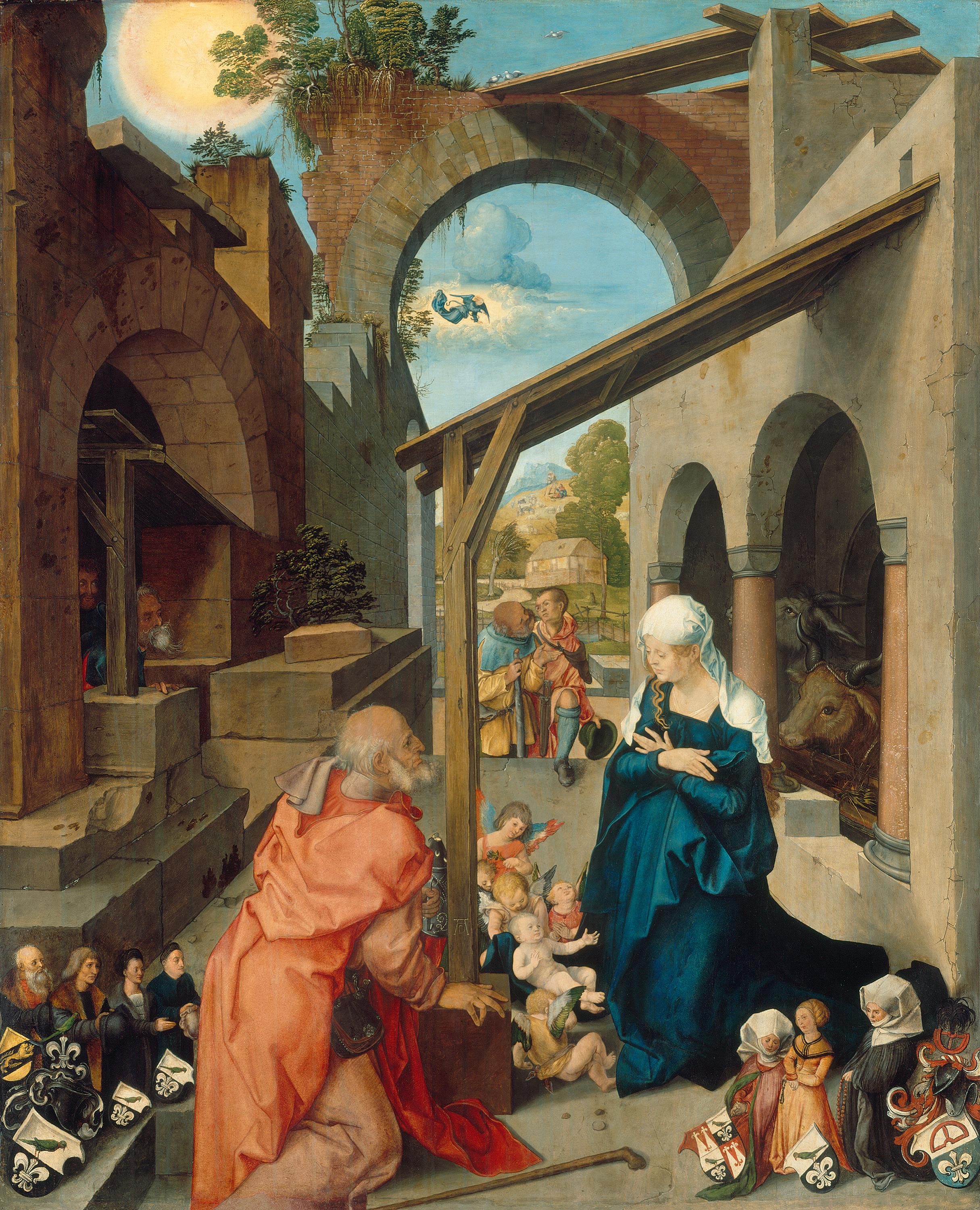 #30
#30The Paumgartner Altarpiece: Nativity
The subject of "The Paumgartner Altarpiece: Nativity" is precise: Mary and Joseph welcome the newborn Child. In "The Paumgartner Altarpiece: Nativity", the poverty of the stable puts in tension the humility of birth and the universal scope of the Christian event. For this version of "The Paumgartner Altarpiece: Nativity", the painter makes concrete observation and symbolic construction coexist without sacrificing readability. For this version of "The Paumgartner Altarpiece: Nativity", the painter makes concrete observation and symbolic construction coexist without sacrificing readability. About "The Paumgartner Altarpiece: Nativity", the painter makes concrete observation and symbolic construction coexist without sacrificing readability. About "The Paumgartner Altarpiece: Nativity", the painter makes concrete observation and symbolic construction coexist without sacrificing readability. About "The Paumgartner Altarpiece: Nativity", the painter makes concrete observation and symbolic construction coexist without sacrificing readability. About "The Paumgartner Altarpiece: Nativity", the painter makes concrete observation and symbolic construction coexist without sacrificing readability. About "The Paumgartner Altarpiece: Nativity", the landmark around 1500 and the conservation at Alte Pinakothek, Munich precisely place this image in the artist's journey.
Image and link: Bayerische Staatsgemäldesammlungen - Alte Pinakothek.
See the museum notice → #31
#31dresden altarpiece
In "Dresden altarpiece", the choice of pattern determines the structure and rhythm of the image. In "Dresden altarpiece", meaning arises from the relationship between the announced motif, the way of framing it and the details that Albrecht Dürer chooses to make visible. For this version of "Dresden altarpiece", the light prioritizes the faces, hands and meaningful objects. About this version of "Dresden altarpiece", the light prioritizes the faces, hands and meaningful objects. About "Dresden altarpiece", the light prioritizes the faces, hands and meaningful objects. About "Dresden altarpiece", the light prioritizes the faces, hands and meaningful objects. About "Dresden altarpiece", the light prioritizes the faces, hands and meaningful objects. About "Dresden altarpiece", the light prioritizes the faces, hands and meaningful objects. About "Dresden altarpiece", the light prioritizes the faces, hands and meaningful objects. About "Dresden altarpiece", the light prioritizes the faces, hands and meaningful objects. About "Dresden altarpiece", dated 1496, the work is today attached to the All Saints' Day church in Wittenberg, an essential reference point for distinguishing this version from the copies and variants.
Image and link: Alpha Reproduction.
See this reproduction → #32
#32Young Venetian woman
At the heart of "Young Venetian Woman", the physiognomy, costume and attitude construct the social identity of the model. In "Young Venetian Woman", the Renaissance portrait not only retains features: it depicts the rank, profession, alliances and idea that the model wishes to convey to posterity. For this version of "Young Venetian Woman", the descriptive precision slows down the gaze and gives each accessory a function overall. About "Young Venetian Woman", the descriptive precision slows down the gaze and gives each accessory a function overall. About "Young Venetian Woman", the descriptive precision slows down the gaze and gives each accessory a function overall. About "Young Venetian Woman", preserved at the Vienna Museum of Art History and dated 1505, this version must be regarded as an autonomous work, with its own format and material history.
Image and link: Alpha Reproduction.
See this reproduction → #33
#33Jean Kleberger painted by A. Dürer
With "Jean Kleberger painted by A. Dürer", Albrecht Dürer shows how physiognomy, costume and attitude construct the social identity of the model. In "Jean Kleberger painted by A. Dürer", the Renaissance portrait not only retains features: it depicts the rank, profession, alliances and idea that the model wishes to transmit to posterity. For this version of "Jean Kleberger painted by A. Dürer", the directions of the gaze and hands organize the reading even before the title is known. For this version of "Jean Kleberger painted by A. Dürer", the directions of the gaze and hands organize the reading even before the title is known. For this version of "Jean Kleberger painted by A. Dürer", the directions of the gaze and hands organize the reading even before the title is known. For this version of "Jean Kleberger painted by A. Dürer", the directions of the gaze and hands organize the reading even before the title is known. For this version of "Jean Kleberger painted by A. Dürer", the directions of the gaze and hands organize the reading even before the title is known. About "Jean Kleberger painted by A. Dürer", the directions of the gaze and hands organize the reading even before the title is known. For this version of "Jean Kleberger painted by A. Dürer", the directions of the gaze and hands organize the reading even before the title is known. For this version of "Jean Kleberger painted by A. Dürer", the directions of the gaze and hands organize the reading even
Image and link: Alpha Reproduction.
See this reproduction → #34
#34Jakob Muffel
"Jakob Muffel" takes as its starting point a scene where physiognomy, costume and attitude construct the social identity of the model. In "Jakob Muffel", the Renaissance portrait not only retains features: it depicts the rank, profession, alliances and idea that the model wishes to transmit to posterity. For this version of "Jakob Muffel", light prioritizes faces, hands and meaningful objects. For this version of "Jakob Muffel", light prioritizes faces, hands and meaningful objects. For this version of "Jakob Muffel", the light prioritizes faces, hands and meaningful objects. For this version of "Jakob Muffel", the light prioritizes faces, hands and meaningful objects. For this version of "Jakob Muffel", the light prioritizes faces, hands and meaningful objects. For this version of "Jakob Muffel", the light prioritizes faces, hands and meaningful objects. For this version of "Jakob Muffel", the light prioritizes faces, hands and meaningful objects. For this version of "Jakob Muffel", the light prioritizes faces, hands and meaningful objects. For this version of "Jakob Muffel", the light prioritizes faces, hands and meaningful objects. For this version of "Jakob Muffel", the light prioritizes faces, hands and meaningful objects. For this version of "Jakob Muffel", the light prioritizes faces, hands and meaningful objects. For this version of "Jakob Muffel",
Image and link: Alpha Reproduction.
See this reproduction → #35
#35Crucifixion
With "Crucifixion", Albrecht Dürer shows how Christ is shown on the cross, at the end of the Passion. In "Crucifixion", the presence of Mary, John, soldiers or donors transforms the biblical event into an image of mourning, salvation and personal participation. For this version of "Crucifixion", the directions of the gaze and hands organize the reading even before the title is known. About "Crucifixion", the directions of the gaze and hands organize the reading even before the title is known. About "Crucifixion", the directions of the gaze and hands organize the reading even before the title is known. About "Crucifixion", the directions of the gaze and hands organize the reading even before the title is known. About "Crucifixion", the directions of the gaze and hands organize the reading even before the title is known. About "Crucifixion", the 1494 dating and the Gemäldegalerie Alte Meister Dresden collection here give more reliable checkpoints than a simple visual resemblance.
Image and link: Alpha Reproduction.
See this reproduction → #36
#36Deposition
"Deposition" takes as its starting point a scene where the body of Christ is taken down from the cross by those close to him. In "Deposition", the gestures which support the body give a human form to mourning and visually prepare for burial. For this version of "Deposition", the light prioritizes faces, hands and meaningful objects. About this version of "Deposition", the light prioritizes faces, hands and meaningful objects. About "Deposition", the light prioritizes faces, hands and meaningful objects. About "Deposition", dated 1494, the work is today attached to Gemäldegalerie Alte Meister Dresden, an essential reference point for distinguishing this version from copies and variants.
Image and link: Alpha Reproduction.
See this reproduction → #37
#37Lamentation of Christ
"Deploration of Christ" depicts Christ's loved ones gathering around his body after the Crucifixion. In "Deploration of Christ", the theme places the pain of Mary and the disciples at the forefront and invites the viewer to meditative compassion. For this version of "Deploration of Christ", the format imposes a physical relationship to the subject: proximity to the effigy, deployment to the story. About "Deploration of Christ", the format imposes a physical relationship to the subject: proximity to the effigy, deployment to the story. About "Deploration of Christ", alte Pinakothek, Munich preserves this work dated around 1500; this documentary context makes it possible to clarify its identity and avoid confusion of title.
Image and link: Alpha Reproduction.
See this reproduction → #38
#38Saint Jerome in the desert
At the heart of "Saint Jerome in the Desert", Saint Jerome is evoked as a translator of the Bible, penitent or retired scholar. In "Saint Jerome in the Desert", the book refers to the Vulgate, the desert to asceticism, and the skull or hourglass to meditation on death. For this version of "Saint Jerome in the Desert", the framing focuses attention on the gestures and signs that allow the scene to be identified. For this version of "Saint Jerome in the Desert", the framing focuses attention on the gestures and signs that allow the scene to be identified. About "Saint Jerome in the Desert", the framing focuses attention on the gestures and signs that allow the scene to be identified. About "Saint Jerome in the Desert", the framing focuses attention on the gestures and signs that allow the scene to be identified. About "Saint Jerome in the Desert", preserved at National Gallery and dated 1496, this version must be regarded as an autonomous work, with its own format and its own material history.
Image and link: Alpha Reproduction.
See this reproduction → #39
#39Jesus among the doctors
With "Jesus Among the Doctors", Albrecht Dürer shows how adolescent Jesus discusses in the Temple with the doctors of the Law. In "Jesus Among the Doctors", the episode contrasts his young age with the authority of his words and gives the painter the opportunity to study debate, listening and surprise. For this version of "Jesus Among the Doctors", the composition gives silence, waiting or conflict an immediately perceptible form. About "Jesus Among the Doctors", the composition gives silence, waiting or conflict an immediately perceptible form. About "Jesus Among the Doctors", the composition gives silence, waiting or conflict an immediately perceptible form. About "Jesus Among the Doctors", the composition gives silence, waiting or conflict an immediately perceptible form. About "Jesus Among the Doctors", the 1506 dating and the Thyssen-Bornemisza National Museum collection, Madrid here provide more reliable checkpoints than a simple visual resemblance.
Image and link: Alpha Reproduction.
See this reproduction → #40
#40Calvary Road
The subject of "Path of Calvary" is precise: Christ carries the cross towards the place of its execution. In "Path of Calvary", the procession condenses the exhaustion of the condemned, the violence of the crowd and Christian meditation on sacrifice. For this version of "Path of Calvary", the painter makes concrete observation and symbolic construction coexist without sacrificing readability. About "Path of Calvary", the painter makes concrete observation and symbolic construction coexist without sacrificing readability. About "Path of Calvary", the painter makes concrete observation and symbolic construction coexist without sacrificing readability. About "Path of Calvary", the marker 1527 and the conservation at Académie Carrara place this image precisely in the artist's journey.
Image and link: Alpha Reproduction.
See this reproduction → #41
#41The circumcision of Jesus
With "The Circumcision of Jesus", Albrecht Dürer shows how the Child Jesus receives, eight days after his birth, the rite and name prescribed by Jewish law. In "The Circumcision of Jesus", the image connects the childhood of Christ, his belonging to the history of Israel and the first announcement of the blood shed during the Passion. For this version of "The Circumcision of Jesus", the directions of the gaze and hands organize the reading even before the title is known. For this version of "The Circumcision of Jesus", the directions of the gaze and hands organize the reading even before the title is known. For this version of "The Circumcision of Jesus", the directions of the gaze and hands organize the reading even before the title is known. About "The Circumcision of Jesus", the directions of the gaze and hands organize the reading even before the title is known. About "The Circumcision of Jesus", the directions of the gaze and hands organize the reading even before the title is known. About "The Circumcision of Jesus", the directions of the gaze and hands organize the reading even before the title is known. About "The Circumcision of Jesus", the directions of the gaze and hands organize the reading even before the title is known. About "The Circumcision of Jesus", the directions of the gaze and hands organize the reading even before the title is known. About "The Circumcision of Jesus", the 1494 dating and the Gemäldegalerie Alte Meister Dresden collection here give more reliable checkpoints than a simple visual resemb
Image and link: Alpha Reproduction.
See this reproduction → #42
#42Stations of the Cross
"Stations of the Cross" represents Christ carrying the cross to the place of his execution. In "Stations of the Cross", the procession condenses the exhaustion of the condemned, the violence of the crowd and Christian meditation on sacrifice. For this version of "Stations of the Cross", the format imposes a physical relationship on the subject: proximity for the effigy, deployment for the story. About "Stations of the Cross", gemäldegalerie Alte Meister Dresden preserves this work dated 1494; this documentary context makes it possible to clarify its identity and avoid confusion of title.
Image and link: Alpha Reproduction.
See this reproduction → #43
#43The Holy Family
The subject of "The Holy Family" is precise: Mary presents or protects the Child Jesus in a local scene. In "The Holy Family", domestic tenderness announces at the same time the future mission of Christ; fruits, flowers, birds and books can specify its symbolic significance. For this version of "The Holy Family", the painter brings together concrete observation and symbolic construction without sacrificing readability. For this version of "The Holy Family", the painter brings together concrete observation and symbolic construction without sacrificing readability. About "The Holy Family", the painter brings together concrete observation and symbolic construction without sacrificing readability. About "The Holy Family", the marker 1509 and the conservation at the Boijmans Van Beuningen museum place this image precisely in the artist's journey.
Image and link: Alpha Reproduction.
See this reproduction → #44
#44The Man of Sorrows
"The Man of Sorrows" represents the tortured Christ is presented to the viewer before or after the Crucifixion. In "The Man of Sorrows", the wounds, the crown of thorns and the frontal gaze make the image a support for meditation on voluntary suffering and redemption. For this version of "The Man of Sorrows", the relationship between foreground and background transforms the story into a mental space as much as a probable place. About "The Man of Sorrows", the relationship between foreground and background transforms the story into a mental space as much as a probable place. About "The Man of Sorrows", staatliche Kunsthalle Karlsruhe preserves this work dated 1493; this documentary context makes it possible to clarify its identity and avoid confusion of title.
Image and link: Alpha Reproduction.
See this reproduction → #45
#45Virgin and Child
With "Virgin and Child", Albrecht Dürer shows how Mary presents or protects the Child Jesus in a close scene. In "Virgin and Child", domestic tenderness at the same time announces the future mission of Christ; fruits, flowers, birds and books can specify its symbolic significance. For this version of "Virgin and Child", the composition gives silence, waiting or conflict an immediately perceptible form. About this version of "Virgin and Child", the composition gives silence, waiting or conflict an immediately perceptible form. About "Virgin and Child", the composition gives silence, waiting or conflict an immediately perceptible form. About "Virgin and Child", the composition gives silence, waiting or conflict an immediately perceptible form. About "Virgin and Child", the composition gives silence, waiting or conflict an immediately perceptible form. About "Virgin and Child", the dating around 1496 -1499 and the National Gallery of Art collection, Washington here give more reliable checkpoints than a simple visual resemblance.
Image and link: Alpha Reproduction.
See this reproduction → #46
#46Salvator Mundi
With "Salvator Mundi", Albrecht Dürer shows how Christ blesses the viewer as Savior of the world. In "Salvator Mundi", the gesture of blessing and the globe, when present, bring together spiritual authority and sovereignty over creation. For this version of "Salvator Mundi", the composition gives silence, expectation or conflict an immediately perceptible form. About "Salvator Mundi", the composition gives silence, expectation or conflict an immediately perceptible form. About "Salvator Mundi", the composition gives silence, expectation or conflict an immediately perceptible form. About "Salvator Mundi", the composition gives silence, expectation or conflict an immediately perceptible form. About "Salvator Mundi", the dating around 1505 and the Metropolitan Museum of Art, New York collection provide more reliable checkpoints here than a simple visual resemblance.
Image and link: Alpha Reproduction.
See this reproduction → #47
#47Virgin with pear
The title "Virgin with the Pear" provides the first clue to reading this composition by Albrecht Dürer. In "Virgin with the Pear", the meaning arises from the relationship between the announced motif, the way of framing it and the details that Albrecht Dürer chooses to make visible. For this version of "Virgin with the Pear", the relationship between foreground and background transforms the story into mental space as much as into a probable place. About "Virgin with the Pear", the relationship between foreground and background transforms the story into mental space as much as into a probable place. About "Virgin with the Pear", Uffizi Gallery, Florence preserves this work dated 1526; this documentary context makes it possible to clarify its identity and avoid confusion of title.
Image and link: Alpha Reproduction.
See this reproduction → #48
#48The Virgin Mary in prayer
"The Virgin Mary in Prayer" belongs to an identifiable moment in Albrecht Dürer's journey. In "The Virgin Mary in Prayer", the meaning is born from the relationship between the announced motif, the way of framing it and the details that Albrecht Dürer chooses to make visible. For this version of "The Virgin Mary in Prayer", the painter brings together concrete observation and symbolic construction without sacrificing readability. For this version of "The Virgin Mary in Prayer", the painter brings together concrete observation and symbolic construction without sacrificing readability. About "The Virgin Mary in Prayer", the painter brings together concrete observation and symbolic construction without sacrificing readability. About "The Virgin Mary in Prayer", the painter brings together concrete observation and symbolic construction without sacrificing readability. About "The Virgin Mary in Prayer", the painter brings together concrete observation and symbolic construction without sacrificing readability. About "The Virgin Mary in Prayer", the 1518 marker and the conservation at Gemäldegalerie precisely place this image in the artist's journey.
Image and link: Alpha Reproduction.
See this reproduction → #49
#49The flight to Egypt
"The Flight into Egypt" depicts Mary, Joseph and the Child leaving Judea to escape the massacre ordered by Herod. In "The Flight into Egypt", the journey transforms the Holy Family into figures of exile, protection and trust in the midst of danger. For this version of "The Flight into Egypt", the relationship between foreground and background transforms the story into mental space as much as into a probable place. About "The Flight into Egypt", gemäldegalerie Alte Meister Dresden preserves this work dated 1494; this documentary context makes it possible to clarify its identity and avoid confusion of title.
Image and link: Alpha Reproduction.
See this reproduction → #50
#50Young woman, flowing hair
"Young woman, flowing hair" represents the physiognomy, costume and attitude construct the social identity of the model. In "Young Woman, Floating Hair", the Renaissance portrait not only retains features: it depicts the rank, profession, alliances and idea that the model wishes to convey to posterity. For this version of "Young Woman, Floating Hair", the relationship between foreground and background transforms the story into mental space as much as into a probable place. About "Young Woman, Floating Hair", the relationship between foreground and background transforms the story into mental space as much as into a probable place. About "Young Woman, Floating Hair", the relationship between foreground and background transforms the story into mental space as much as into a probable place. About "Young Woman, Floating Hair", the Städel Museum preserves this work dated 1497; this documentary context makes it possible to clarify its identity and avoid confusion of title.
Image and link: Alpha Reproduction.
See this reproduction →Nudes, sacred figures and portraits where observation becomes thought.
 #51
#51Young woman, braided hair
"Young woman, braided hair" represents the physiognomy, costume and attitude construct the social identity of the model. In "Young Woman, Braided Hair", the Renaissance portrait not only retains features: it depicts the rank, profession, alliances and idea that the model wishes to convey to posterity. For this version of "Young Woman, Braided Hair", the relationship between foreground and background transforms the story into mental space as much as into a probable place. About "Young Woman, Braided Hair", the relationship between foreground and background transforms the story into mental space as much as into a probable place. About "Young Woman, Braided Hair", gemäldegalerie preserves this work dated 1497; this documentary context makes it possible to clarify its identity and avoid confusion of title.
Image and link: Alpha Reproduction.
See this reproduction → #52
#52The Madonna with the Carnation
"The Madonna with the Carnation" takes as its starting point a scene where Mary presents or protects the Child Jesus in a local scene. In "The Madonna with the Carnation", domestic tenderness announces at the same time the future mission of Christ; fruits, flowers, birds and books can specify its symbolic significance. For this version of "The Madonna with the Carnation", the balance of light and dark masses leads the eye towards the narrative core without erasing peripheral details. About "The Madonna with the Carnation", the balance of light and dark masses leads the eye towards the narrative core without erasing peripheral details. About "The Madonna with the Carnation", the balance of light and dark masses leads the eye towards the narrative core without erasing peripheral details. About "The Madonna with the Carnation", dated 1516, the work is today linked to Alte Pinakothek, Munich, an essential reference point for distinguishing this version from copies and variants.
Image and link: Alpha Reproduction.
See this reproduction → #53
#53Hercules killing the birds of Lake Stymphale
"Hercules Killing the Birds of Lake Stymphale" takes as its starting point a scene where Hercules confronts the monstrous birds of Lake Stymphale during one of his works. In "Hercules Killing the Birds of Lake Stymphale", the fight celebrates the victory of intelligence and force over a nature that has become hostile. For this version of "Hercules Killing the Birds of Lake Stymphale", light prioritizes the faces, hands and meaningful objects. For this version of "Hercules Killing the Birds of Lake Stymphale", light prioritizes faces, hands and meaningful objects. About "Hercules Killing the Birds of Lake Stymphale", light prioritizes faces, hands and meaningful objects. About "Hercules Killing the Birds of Lake Stymphale", light prioritizes faces, hands and meaningful objects. About "Hercules Killing the Birds of Lake Stymphale", light prioritizes faces, hands and meaningful objects. About "Hercules Killing the Birds of Lake Stymphale", light prioritizes faces, hands and meaningful objects. About "Hercules Killing the Birds of Lake Stymphale", light prioritizes faces, hands and meaningful objects. About "Hercules Killing the Birds of Lake Stymphale", light prioritizes faces, hands and meaningful objects. About "Hercules Killing the Birds of Lake Stymphale", light prioritizes faces, hands and meaningful objects. About "Hercules Killing the Birds of Lake Stymphale", light prioritizes faces,
Image and link: Alpha Reproduction.
See this reproduction → #54
#54The Suicide of Lucretia
"The Suicide of Lucretia" represents Lucretia kills herself after the rape committed by Sextus Tarquin. In "The Suicide of Lucretia", since Antiquity, her gesture embodies both the claimed virtue, the violence against women and the legendary event which precipitates the end of Roman royalty. For this version of "The Suicide of Lucretia", the format imposes a physical relationship on the subject: proximity for the effigy, deployment for the story. About "The Suicide of Lucretia", the format imposes a physical relationship on the subject: proximity for the effigy, deployment for the story. About "The Suicide of Lucretia", alte Pinakothek, Munich preserves this work dated 1518; this documentary context makes it possible to clarify its identity and avoid confusion of title.
Image and link: Alpha Reproduction.
See this reproduction → #55
#55Greed
The subject of "Greed" is precise: an elderly figure personifies compulsive attachment to money or property. In "Greed", the deformation of the body and the presence of money transform the portrait into a moral warning about the desire that consumes its owner. For this version of "Greed", the materials - skin, fabric, wood, metal or stone - are used to distinguish roles and degrees of presence. About "Greed", the materials - skin, fabric, wood, metal or stone - are used to distinguish roles and degrees of presence. About "Greed", the materials - skin, fabric, wood, metal or stone - are used to distinguish roles and degrees of presence. About "Greed", the materials - skin, fabric, wood, metal or stone - are used to distinguish roles and degrees of presence. About "Greed", the marker 1507 and the conservation at the Vienna Art History Museum place precisely this image in the artist's journey.
Image and link: Alpha Reproduction.
See this reproduction → #56
#56Young woman in a red beret
At the heart of "Young Woman in the Red Beret", the physiognomy, costume and attitude construct the social identity of the model. In "Young Woman in the Red Beret", the Renaissance portrait not only retains features: it depicts the rank, profession, alliances and idea that the model wishes to transmit to posterity. For this version of "Young Woman in the Red Beret", the descriptive precision slows down the gaze and gives each accessory a function overall. About "Young Woman in the Red Beret", the descriptive precision slows down the gaze and gives each accessory a function overall. About "Young Woman in the Red Beret", the descriptive precision slows down the gaze and gives each accessory a function overall. About "Young Woman in the Red Beret", preserved in Gemäldegalerie and dated 1507, this version must be regarded as an autonomous work, with its own format and its own material history.
Image and link: Alpha Reproduction.
See this reproduction → #57
#57Miraculous rescue of the drowned boy from Bregenz
"Miraculous Rescue of the Drowned Boy by Bregenz" must first be regarded as a singular work by Albrecht Dürer. In "Miraculous Rescue of the Drowned Boy by Bregenz", meaning arises from the relationship between the announced motif, the way of framing it and the details that Albrecht Dürer chooses to make visible. For this version of "Miraculous Rescue of the Drowned Boy by Bregenz", light prioritizes faces, hands and meaningful objects. About this version of "Miraculous Rescue of the Drowned Boy by Bregenz", light prioritizes faces, hands and meaningful objects. About "Miraculous Rescue of the Drowned Boy by Bregenz", light prioritizes faces, hands and meaningful objects. About "Miraculous Rescue of the Drowned Boy by Bregenz", light prioritizes faces, hands and meaningful objects. About "Miraculous Rescue of the Drowned Boy by Bregenz", light prioritizes faces, hands and meaningful objects. About "Miraculous Rescue of the Drowned Boy by Bregenz", light prioritizes faces, hands and meaningful objects. About "Miraculous Rescue of the Drowned Boy by Bregenz", light prioritizes faces, hands and meaningful objects. About "Miraculous Rescue of the Drowned Boy by Bregenz", light prioritizes faces, hands and meaningful objects. About "Miraculous Rescue of the Drowned Boy by Bregenz", light prioritizes faces, hands and
Image and link: Alpha Reproduction.
See this reproduction → #58
#58Portrait of a Man (1497)
With "Portrait of a Man (1497)", Albrecht Dürer shows how physiognomy, costume and attitude construct the social identity of the model. In "Portrait of a Man (1497)", the Renaissance portrait not only retains features: it depicts the rank, profession, alliances and idea that the model wishes to convey to posterity. For this version of "Portrait of a Man (1497)", the directions of the gaze and hands organize the reading even before the title is known. For this version of "Portrait of a Man (1497)", the directions of the gaze and hands organize the reading even before the title is known. For this version of "Portrait of a Man (1497)", the directions of the gaze and hands organize the reading even before the title is known. For this version of "Portrait of a Man (1497)", the directions of the gaze and hands organize the reading even before the title is known. For this version of "Portrait of a Man (1497)", the directions of the gaze and hands organize the reading even before the title is known. For this version of "Portrait of a Man (1497)", the directions of the gaze and hands organize the reading even before the title is known. About "Portrait of a Man (1497)", the directions of the gaze and hands organize the reading even before the title is known. About "Portrait of a Man (1497)", the directions of the gaze and hands organize
Image and link: Alpha Reproduction.
See this reproduction → #59
#59Portrait of a young man
"Portrait of a Young Man" represents the physiognomy, costume and attitude construct the social identity of the model. In "Portrait of a Young Man", the Renaissance portrait not only retains features: it depicts the rank, profession, alliances and idea that the model wishes to convey to posterity. For this version of "Portrait of a Young Man", the format imposes a physical relationship on the subject: proximity for the effigy, deployment for the story. About "Portrait of a Young Man", the format imposes a physical relationship on the subject: proximity for the effigy, deployment for the story. About "Portrait of a Young Man", the format imposes a physical relationship on the subject: proximity for the effigy, deployment for the story. About "Portrait of a Young Man", the Vienna Museum of Art History preserves this work dated 1507; this documentary context makes it possible to clarify its identity and avoid confusion of title.
Image and link: Alpha Reproduction.
See this reproduction → #60
#60Portrait of a man
"Portrait of a Man" takes as its starting point a scene where physiognomy, costume and attitude construct the social identity of the model. In "Portrait of a Man", the Renaissance portrait not only retains features: it depicts the rank, profession, alliances and idea that the model wishes to convey to posterity. For this version of "Portrait of a Man", the balance of light and dark masses leads the eye towards the narrative core without erasing peripheral details. About "Portrait of a Man", the balance of light and dark masses leads the eye towards the narrative core without erasing peripheral details. About "Portrait of a Man", the balance of light and dark masses leads the eye towards the narrative core without erasing peripheral details. About "Portrait of a Man", the balance of light and dark masses leads the eye towards the narrative core without erasing peripheral details. About "Portrait of a Man", the balance of light and dark masses leads the eye towards the narrative core without erasing peripheral details. About "Portrait of a Man", dated 1497, the work is today linked to Skokloster Castle, an essential landmark to distinguish this version from the copies and variants.
Image and link: Alpha Reproduction.
See this reproduction → #61
#61Portrait of a young man
The subject of "Portrait of a Young Man" is precise: the physiognomy, costume and attitude construct the social identity of the model. In "Portrait of a Young Man", the Renaissance portrait not only retains features: it depicts the rank, profession, alliances and idea that the model wishes to transmit to posterity. For this version of "Portrait of a Young Man", the materials - skin, fabric, wood, metal or stone - are used to distinguish roles and degrees of presence. For this version of "Portrait of a Young Man", the materials - skin, fabric, wood, metal or stone - are used to distinguish roles and degrees of presence. For this version of "Portrait of a Young Man", the materials - skin, fabric, wood, metal or stone - are used to distinguish roles and degrees of presence. About "Portrait of a Young Man", the materials - skin, fabric, wood, metal or stone - are used to distinguish roles and degrees of presence. About "Portrait of a Young Man", the materials - skin, fabric, wood, metal or stone - are used to distinguish roles and degrees of presence. About "Portrait of a Young Man", the materials - skin, fabric, wood, metal or stone - are used to distinguish roles and degrees of presence. For this version of "Portrait of a Young Man", the materials - skin, fabric, wood, metal or stone - are used to distinguish roles and degrees of presence. About "Portrait of a Young Man", the materials - skin, fabric, wood, metal or stone - are used to distinguish roles and degrees of presence. About "Portrait of a Young Man", the materials
Image and link: Alpha Reproduction.
See this reproduction → #62
#62Saint Philip
"Saint Philip" must first be regarded as a singular work by Albrecht Dürer. In "Saint Philip", meaning arises from the relationship between the announced motif, the way of framing it and the details that Albrecht Dürer chooses to make visible. For this version of "Saint Philip", the descriptive precision slows down the gaze and gives each accessory a function overall. About "Saint Philip", the descriptive precision slows down the gaze and gives each accessory a function overall. About "Saint Philip", preserved in the Uffizi Gallery, Florence and dated 1516, this version must be regarded as an autonomous work, with its own format and its own material history.
Image and link: Alpha Reproduction.
See this reproduction → #63
#63Portrait of a man with a dark background
The subject of "Portrait of a Man with a Dark Background" is precise: the physiognomy, costume and attitude construct the social identity of the model. In "Portrait of a Man with a Dark Background", the Renaissance portrait not only retains features: it depicts the rank, profession, alliances and idea that the model wishes to convey to posterity. For this version of "Portrait of a Man with a Dark Background", the materials - skin, fabric, wood, metal or stone - are used to distinguish roles and degrees of presence. For this version of "Portrait of a Man with a Dark Background", the materials - skin, fabric, wood, metal or stone - are used to distinguish roles and degrees of presence. For this version of "Portrait of a Man with a Dark Background", the materials - skin, fabric, wood, metal or stone - are used to distinguish roles and degrees of presence. For this version of "Portrait of a Man with a Dark Background", the materials - skin, fabric, wood, metal or stone - are used to distinguish roles and degrees of presence. For this version of "Portrait of a Man with a Dark Background", the materials - skin, fabric, wood, metal or stone - are used to distinguish roles and degrees of presence. For this version of "Portrait of a Man with a Dark Background", the materials - skin, fabric, wood, metal or stone - are used to distinguish roles and degrees of presence. For this version of "Portrait of a Man with a Dark Background", the materials - skin, fabric, wood, metal or stone - are used to distinguish roles and degrees of
Image and link: Alpha Reproduction.
See this reproduction → #64
#64Saint Jacques
The title "Saint Jacques" provides the first clue to read this composition by Albrecht Dürer. In "Saint Jacques", the meaning arises from the relationship between the announced motif, the way of framing it and the details that Albrecht Dürer chooses to make visible. For this version of "Saint Jacques", the balance of light and dark masses leads the eye towards the narrative core without erasing peripheral details. About "Saint Jacques", the balance of light and dark masses leads the eye towards the narrative core without erasing peripheral details. About "Saint Jacques", the balance of light and dark masses leads the eye towards the narrative core without erasing peripheral details. About "Saint Jacques", dated 1516, the work is today attached to the Uffizi Gallery, Florence, an essential landmark for distinguishing this version from copies and variants.
Image and link: Alpha Reproduction.
See this reproduction → #65
#65Portrait of a Man (1524)
"Portrait of a Man (1524)" represents the physiognomy, costume and attitude construct the social identity of the model. In "Portrait of a Man (1524)", the Renaissance portrait not only retains features: it depicts the rank, profession, alliances and idea that the model wishes to convey to posterity. For this version of "Portrait of a Man (1524)", the relationship between foreground and background transforms the story into mental space as much as into a probable place. About "Portrait of a Man (1524)", the relationship between foreground and background transforms the story into mental space as much as into a probable place. About "Portrait of a Man (1524)", the relationship between foreground and background transforms the story into mental space as much as into a probable place. About "Portrait of a Man (1524)", the relationship between foreground and background transforms the story into mental space as much as into a probable place. About "Portrait of a Man (1524)", the relationship between foreground and background transforms the story into mental space as much as into a probable place. About "Portrait of a Man (1524)", the Prado Museum, Madrid preserves this work dated 1524; this documentary context makes it possible to clarify its identity and avoid confusion of title.
Image and link: Alpha Reproduction.
See this reproduction → #66
#66Saint Unuphrius
"Saint Unuphrius" must first be regarded as a singular work by Albrecht Dürer. In "Saint Unuphrius", meaning arises from the relationship between the announced motif, the way of framing it and the details that Albrecht Dürer chooses to make visible. For this version of "Saint Unuphrius", the descriptive precision slows down the gaze and gives each accessory a function overall. About "Saint Unuphrius", the descriptive precision slows down the gaze and gives each accessory a function overall. About "Saint Unuphrius", the descriptive precision slows down the gaze and gives each accessory a function overall. About "Saint Unuphrius", preserved at Kunsthalle Bremen and dated 1505, this version must be regarded as an autonomous work, with its own format and material history.
Image and link: Alpha Reproduction.
See this reproduction → #67
#67Altar of Jabach: Saints Joseph and Joachim
The title "Altar of Jabach: Saints Joseph and Joachim" provides the first clue to reading this composition by Albrecht Dürer. In "Altar of Jabach: Saints Joseph and Joachim", the meaning arises from the relationship between the announced motif, the way of framing it and the details that Albrecht Dürer chooses to make visible. For this version of "Altar of Jabach: Saints Joseph and Joachim", the painter brings together concrete observation and symbolic construction without sacrificing readability. For this version of "Altar of Jabach: Saints Joseph and Joachim", the painter makes concrete observation and symbolic construction coexist without sacrificing readability. About "Altar of Jabach: Saints Joseph and Joachim", the painter makes concrete observation and symbolic construction coexist without sacrificing readability. About "Altar of Jabach: Saints Joseph and Joachim", the painter makes concrete observation and symbolic construction coexist without sacrificing readability. About "Altar of Jabach: Saints Joseph and Joachim", the painter makes concrete observation and symbolic construction coexist without sacrificing readability. About "Altar of Jabach: Saints Joseph and Joachim", the painter makes concrete observation and symbolic construction coexist without sacrificing readability. About "Altar of Jabach: Saints Joseph and Joachim", the painter makes concrete observation and symbolic construction coexist without sacrificing readability. About "Altar of Jabach: Saints Joseph and Joachim", the painter makes concrete observation and symbolic construction coexist without sacrificing readability. About
Image and link: Alpha Reproduction.
See this reproduction → #68
#68Altar of Jabach: Saints Simeon and Lazarus
The title "Altar of Jabach: Saints Simeon and Lazarus" provides the first clue to read this composition by Albrecht Dürer. In "Altar of Jabach: Saints Simeon and Lazarus", the meaning arises from the relationship between the announced motif, the way of framing it and the details that Albrecht Dürer chooses to make visible. For this version of "Altar of Jabach: Saints Simeon and Lazarus", the relationship between foreground and background transforms the story into mental space as much as into a probable place. About "Altar of Jabach: Saints Simeon and Lazarus", the relationship between foreground and background transforms the story into mental space as much as into a probable place. About "Altar of Jabach: Saints Simeon and Lazarus", the relationship between foreground and background transforms the story into mental space as much as into a probable place. About "Altar of Jabach: Saints Simeon and Lazarus", alte Pinakothek preserves this work dated 1500; this documentary context makes it possible to clarify its identity and avoid confusion of title.
Image and link: Alpha Reproduction.
See this reproduction → #69
#69Altar of Jabach: bagpipe player and drummer
"Jabach Altar: Pipe Player and Drummer" belongs to an identifiable moment in Albrecht Dürer's career. In "Jabach Altar: Pipe Player and Drummer", meaning arises from the relationship between the announced motif, the way of framing it and the details that Albrecht Dürer chooses to make visible. For this version of "Jabach Altar: Pipe Player and Drummer", the relationship between foreground and background transforms the story into mental space as much as into a probable place. About "Jabach Altar: Pipe Player and Drummer", the relationship between foreground and background transforms the story into mental space as much as into a probable place. About "Jabach Altar: Pipe Player and Drummer", the relationship between foreground and background transforms the story into mental space as much as into a probable place. About "Jabach Altar: Pipe Player and Drummer", the relationship between foreground and background transforms the story into mental space as much as a probable place. About "Jabach Altar: Pipe Player and Drummer", the Wallraf-Richartz Museum preserves this work dated 1507; this documentary context makes it possible to clarify its identity and avoid confusion of title.
Image and link: Alpha Reproduction.
See this reproduction → #70
#70Portrait of a clergyman (Johann Dorsch?)
"Portrait of an ecclesiastic (Johann Dorsch?)" represents the physiognomy, costume and attitude construct the social identity of the model. In "Portrait of an Ecclesiastic (Johann Dorsch?)", the Renaissance portrait not only retains features: it depicts rank, profession, alliances and the idea that the model wishes to convey to posterity. For this version of "Portrait of an Ecclesiastic (Johann Dorsch?)", the format imposes a physical relationship on the subject: proximity for the effigy, deployment for the story. About "Portrait of an Ecclesiastic (Johann Dorsch?)", the format imposes a physical relationship on the subject: proximity for the effigy, deployment for the story. About "Portrait of an Ecclesiastic (Johann Dorsch?)", the format imposes a physical relationship on the subject: proximity for the effigy, deployment for the story. About "Portrait of an Ecclesiastic (Johann Dorsch?)", the format imposes a physical relationship on the subject: proximity for the effigy, deployment for the story. About "Portrait of an Ecclesiastic (Johann Dorsch?)", the format imposes a physical relationship on the subject: proximity for the effigy, deployment for the story. About "Portrait of an Ecclesiastic (Johann Dorsch?)", the format imposes a physical relationship on the subject: proximity for the effig
Image and link: Alpha Reproduction.
See this reproduction → #71
#71Altar of Jabach: Work on manure
In "Altar of Jabach: Work on the Manure", the choice of pattern determines the structure and rhythm of the image. In "Altar of Jabach: Work on the manure", meaning arises from the relationship between the announced motif, the way of framing it and the details that Albrecht Dürer chooses to make visible. For this version of "Altar of Jabach: Work on the manure", light prioritizes faces, hands and meaningful objects. About this version of "Altar of Jabach: Work on the manure", light prioritizes faces, hands and meaningful objects. About "Altar of Jabach: Work on the manure", light prioritizes faces, hands and meaningful objects. About "Altar of Jabach: Work on the manure", light prioritizes faces, hands and meaningful objects. About "Altar of Jabach: Work on the manure", light prioritizes faces, hands and meaningful objects. About "Altar of Jabach: Work on the manure", light prioritizes faces, hands and meaningful objects. About "Altar of Jabach: Work on the manure", light prioritizes faces, hands and meaningful objects. About "Altar of Jabach: Work on the manure", light prioritizes faces, hands and meaningful objects. About "Altar of Jabach: Work on the manure", light prioritizes faces, hands and meaningful objects. About "Altar of Jabach: Work on the manure", light prioritizes faces,
Image and link: Alpha Reproduction.
See this reproduction → #72
#72Burkard von Speyer
"Burkard von Speyer" represents the physiognomy, costume and attitude construct the social identity of the model. In "Burkard von Speyer", the Renaissance portrait not only retains features: it depicts the rank, profession, alliances and idea that the model wishes to transmit to posterity. For this version of "Burkard von Speyer", the format imposes a physical relationship on the subject: proximity for the effigy, deployment for the story. About "Burkard von Speyer", the format imposes a physical relationship on the subject: proximity for the effigy, deployment for the story. About "Burkard von Speyer", Windsor Castle preserves this work dated 1506; this documentary context makes it possible to clarify its identity and avoid confusion of title.
Image and link: Alpha Reproduction.
See this reproduction → #73
#73Saint Jerome
With "Saint Jerome", Albrecht Dürer shows how Saint Jerome is evoked as a translator of the Bible, penitent or retired scholar. In "Saint Jerome", the book refers to the Vulgate, the desert to asceticism, and the skull or hourglass to meditation on death. For this version of "Saint Jerome", the directions of the gaze and hands organize the reading even before the title is known. For this version of "Saint Jerome", the directions of the gaze and hands organize the reading even before the title is known. About "Saint Jerome", the 1521 dating and the Museu Nacional collection by Arte Antiga, Lisbon here provide more reliable checkpoints than a simple visual resemblance.
Image and link: Alpha Reproduction.
See this reproduction → #74
#74Saint Jerome in the book
"Saint Jerome in the Book" takes as its starting point a scene where Saint Jerome is evoked as a translator of the Bible, penitent or retired scholar. In "Saint Jerome in the Book", the book refers to the Vulgate, the desert to asceticism, and the skull or hourglass to meditation on death. For this version of "Saint Jerome in the Book", the balance of light and dark masses leads the eye towards the narrative core without erasing peripheral details. About "Saint Jerome in the Book", the balance of light and dark masses leads the eye towards the narrative core without erasing peripheral details. About "Saint Jerome in the Book", the balance of light and dark masses leads the eye towards the narrative core without erasing peripheral details. About "Saint Jerome in the Book", the balance of light and dark masses leads the eye towards the narrative core without erasing peripheral details. About "Saint Jerome in the Book", the balance of light and dark masses leads the eye towards the narrative core without erasing peripheral details. About "Saint Jerome in the Book", the balance of light and dark masses leads the eye towards the narrative core without erasing peripheral details. About "Saint Jerome in the Book", the balance of light and dark masses leads the eye towards the narrative core without erasing peripheral details. About "Saint Jerome in the Book", the balance of light and dark masses leads the eye towards the narrative core without erasing peripheral details. About "Saint Jerome in the Book", the balance of light and dark masses leads the eye towards the narrative core without erasing peripheral details. About "Saint Jerome in the Book",
Image and link: Alpha Reproduction.
See this reproduction →![Lot and his daughters [reverse] - Albrecht Dürer image 1 artisanal reproduction of painting](https://cdn.shopify.com/s/files/1/0549/9656/6169/files/lot-et-ses-filles-revers-albrecht-durer-image-1-copie-tableau-huile.jpg?v=1780684929) #75
#75Lot and his daughters [reverse]
The title "Lot and his daughters [reverse]" provides the first clue to reading this composition by Albrecht Dürer. In "Lot and his daughters [reverse]", the meaning arises from the relationship between the announced motif, the way of framing it and the details that Albrecht Dürer chooses to make visible. For this version of "Lot and his daughters [reverse]", the painter brings together concrete observation and symbolic construction without sacrificing readability. For this version of "Lot and his daughters [reverse]", the painter makes concrete observation and symbolic construction coexist without sacrificing readability. About "Lot and his daughters [reverse]", the painter makes concrete observation and symbolic construction coexist without sacrificing readability. About "Lot and his daughters [reverse]", the painter makes concrete observation and symbolic construction coexist without sacrificing readability. About "Lot and his daughters [reverse]", the painter makes concrete observation and symbolic construction coexist without sacrificing readability. About "Lot and his daughters [reverse]", the painter makes concrete observation and symbolic construction coexist without sacrificing readability. About "Lot and his daughters [reverse]", the painter makes concrete observation and symbolic construction coexist without sacrificing readability. About "Lot and his daughters [reverse]", the painter makes concrete observation and symbolic construction coexist without sacrificing readability. About "Lot and his daughters [reverse]", the painter makes concrete observation and symbolic construction coexist without sacrificing readability. About "Lot and his daughters [reverse]",
Image and link: Alpha Reproduction.
See this reproduction →Autonomous works, altarpiece shutters and devotional images preserved in museums.
 #76
#76Heller's altar, first inner wing, Martyrdom of Saint James the Greater
"Heller's Altar, First Inner Wing, Martyrdom of Saint James the Greater" belongs to an identifiable moment in Albrecht Dürer's journey. In "Heller's Altar, First Inner Wing, Martyrdom of Saint James the Greater", meaning arises from the relationship between the announced motif, the way of framing it and the details that Albrecht Dürer chooses to make visible. For this version of "Heller's Altar, First Inner Wing, Martyrdom of Saint James the Greater", the directions of the gaze and hands organize the reading even before the title is known. About "Heller's Altar, First Inner Wing, Martyrdom of Saint James the Greater", the directions of the gaze and hands organize the reading even before the title is known. About "Heller's Altar, First Inner Wing, Martyrdom of Saint James the Greater", the directions of the gaze and hands organize the reading even before the title is known. About "Heller's Altar, First Inner Wing, Martyrdom of Saint James the Greater", the directions of the gaze and hands organize the reading even before the title is known. About "Heller's Altar, First Inner Wing, Martyrdom of Saint James the Greater", the directions of the gaze and hands organize the reading even before the title is known. About "Heller's Altar, First Inner Wing, Martyrdom of Saint James the Greater", the directions of the gaze and hands organize the reading even before the title is known. About "Heller's Altar, First Inner frankfurt Historical Museum Collection here gives more reliable checkpoints than a simple visual resemblance.
Image and link: Alpha Reproduction.
See this reproduction → #77
#77Adoration of the Magi
"Adoration of the Magi" takes as its starting point a scene where the Magi from the East present the Child with gold, incense and myrrh. In "Adoration of the Magi", the episode demonstrates the recognition of Christ by the nations and allows the painter to contrast meditation, richness of gifts and diversity of visitors. For this version of "Adoration of the Magi", the balance of light and dark masses leads the eye towards the narrative core without erasing peripheral details. About "Adoration of the Magi", the balance of light and dark masses leads the eye towards the narrative core without erasing peripheral details. About "Adoration of the Magi", the balance of light and dark masses leads the eye towards the narrative core without erasing peripheral details. About "Adoration of the Magi", the balance of light and dark masses leads the eye towards the narrative core without erasing peripheral details. About "Adoration of the Magi", dated 1504, the work is today attached to the Uffizi Gallery, Florence, an essential landmark for distinguishing this version from copies and variants.
Image and link: Alpha Reproduction.
See this reproduction → #78
#78Marital coat of arms of the Dürer and Holper families. Back of the portrait of Albrecht Dürer the Elder
The subject of "Marital coat of arms of the Dürer and Holper families. Back of the portrait of Albrecht Dürer the Elder" is precise: the physiognomy, costume and attitude construct the social identity of the model. In "Marital coat of arms of the Dürer and Holper families. Back of the portrait of Albrecht Dürer the Elder", the Renaissance portrait not only retains features: it depicts the rank, profession, alliances and idea that the model wishes to transmit to posterity. For this version of "Marital coat of arms of the Dürer and Holper families. Back of the portrait of Albrecht Dürer the Elder", the Renaissance portrait does not only retain features: it depicts the rank, profession, alliances and idea that the model wishes to transmit to posterity. For this version of "Marital coat of arms of the Dürer and Holper families. Back of the portrait of Albrecht Dürer the Elder", the Renaissance portrait does not only retain features: it depicts the rank, profession, alliances and idea that the model wishes to transmit to posterity. For this version of "Marital coat of arms of the Dürer and Holper families. Back of the portrait of Albrecht Dürer the Elder", the Renaissance portrait does not only retain features: it depicts the rank, profession, alliances and idea that the model wishes to transmit to posterity. For this version of "Marital coat of arms of the Dürer and Holper families. Back of the portrait of Albrecht Dürer the Elder", the Renaissance portrait symbolic without sacrificing readability. About "Marital coat of arms of the Dürer and Holper families. Back of the portrait of Albrecht Dürer the Elder", the 1490 marker and the conservation at the Uffizi Gallery, Florence place this image precisely in the artist's career.
Image and link: Alpha Reproduction.
See this reproduction → #79
#79Portrait of Oswolt Krel: "Sylvester Men" with the heraldic shields of Oswolt Krel
"Portrait of Oswolt Krel: "Sylvester men" with the heraldic shields of Oswolt Krel" takes as its starting point a scene where physiognomy, costume and attitude construct the social identity of the model. In "Portrait of Oswolt Krel: "Sylvester Men" with the heraldic shields of Oswolt Krel", the Renaissance portrait not only retains features: it depicts the rank, profession, alliances and idea that the model wishes to transmit to posterity. For this version of "Portrait of Oswolt Krel: "Sylvester Men" with the heraldic shields of Oswolt Krel", the Renaissance portrait not only retains features: it depicts the rank, profession, alliances and idea that the model wishes to transmit to posterity. For this version of "Portrait of Oswolt Krel: "Sylvester Men" with the heraldic shields of Oswolt Krel", the Renaissance portrait not only retains features: it depicts the rank, profession, alliances and idea that the model wishes to transmit to posterity. For this version of "Portrait of Oswolt Krel: "Sylvester Men" with the heraldic shields of Oswolt Krel", the Renaissance portrait not only retains features: it depicts the rank, profession, alliances and idea that the model wishes to transmit to posterity. For this version of "Portrait of Oswolt Krel: "Sylvester Men" with the heraldic shields of Osw meaning. About "Portrait of Oswolt Krel: "Sylvester Men" with the heraldic shields of Oswolt Krel", dated 1499, the work is today attached to Alte Pinakothek, an essential reference point for distinguishing this version from copies and variants.
Image and link: Alpha Reproduction.
See this reproduction → #80
#80Portrait of Oswolt Krel: "Sylvanian Men" with the heraldic shields of Agathe von Esendorf
The subject of "Portrait of Oswolt Krel: "Sylvanian Men" with the heraldic shields of Agathe von Esendorf" is precise: the physiognomy, costume and attitude construct the social identity of the model. In "Portrait of Oswolt Krel: "Sylvanian Men" with the heraldic shields of Agathe von Esendorf", the Renaissance portrait not only retains features: it depicts the rank, profession, alliances and idea that the model wishes to transmit to posterity. For this version of "Portrait of Oswolt Krel: "Sylvanian Men" with the heraldic shields of Agathe von Esendorf", the Renaissance portrait not only retains features: it depicts the rank, profession, alliances and idea that the model wishes to transmit to posterity. For this version of "Portrait of Oswolt Krel: "Sylvanian Men" with the heraldic shields of Agathe von Esendorf", the Renaissance portrait not only retains features: it depicts the rank, profession, alliances and idea that the model wishes to transmit to posterity. For this version of "Portrait of Oswolt Krel: "Sylvanian Men" with the heraldic shields of Agathe von Esendorf", the Renaissance portrait not only retains features: it depicts the rank, profession, alliances and the idea that the model wishes to transmit to posterity. For this version of "Portrait of Oswolt Krel: "Sylvanian Men" with the heraldic distinguish roles and degrees of presence. About "Portrait of Oswolt Krel: "Sylvanian Men" with the heraldic shields of Agathe von Esendorf", the 1499 marker and the conservation at Alte Pinakothek place this image precisely in the artist's journey.
Image and link: Alpha Reproduction.
See this reproduction → #81
#81The Crucifixion with the Virgin, Saint John and a donor
"The Crucifixion with the Virgin, Saint John and a donor" represents Christ is shown on the cross, at the end of the Passion. In "The Crucifixion with the Virgin, Saint John and a donor", the presence of Mary, John, soldiers or donors transforms the biblical event into an image of mourning, salvation and personal participation. For this version of "The Crucifixion with the Virgin, Saint John and a donor", the format imposes a physical relationship on the subject: proximity for the effigy, deployment for the story. About this version of "The Crucifixion with the Virgin, Saint John and a donor", the format imposes a physical relationship on the subject: proximity for the effigy, deployment for the story. About "The Crucifixion with the Virgin, Saint John and a donor", the format imposes a physical relationship on the subject: proximity for the effigy, deployment for the story. About "The Crucifixion with the Virgin, Saint John and a donor", the format imposes a physical relationship on the subject: proximity for the effigy, deployment for the story. About "The Crucifixion with the Virgin, Saint John and a donor", the format imposes a physical relationship on the subject: proximity for the effigy, deployment for the story. About "The Crucifixion with the Virgin, Saint John and a donor", the format imposes a physical relationship on the subject: proximity for the effigy, deployment for the story. About "The Crucifixion with the Virgin, Saint John and a donor",
Image and link: Alpha Reproduction.
See this reproduction → #82
#82Salvator Mundi with the Child Jesus
With "Salvator Mundi with the Child Jesus", Albrecht Dürer shows how Christ blesses the viewer as Savior of the world. In "Salvator Mundi with the Child Jesus", the gesture of blessing and the globe, when present, bring together spiritual authority and sovereignty over creation. For this version of "Salvator Mundi with the Child Jesus", the directions of the gaze and hands organize the reading even before the title is known. For this version of "Salvator Mundi with the Child Jesus", the directions of the gaze and hands organize the reading even before the title is known. About "Salvator Mundi with the Child Jesus", the directions of the gaze and hands organize the reading even before the title is known. About "Salvator Mundi with the Child Jesus", the directions of the gaze and hands organize the reading even before the title is known. About "Salvator Mundi with the Child Jesus", the directions of the gaze and hands organize the reading even before the title is known. About "Salvator Mundi with the Child Jesus", the directions of the gaze and hands organize the reading even before the title is known. About "Salvator Mundi with the Child Jesus", the directions of the gaze and hands organize the reading even before the title is known. About "Salvator Mundi with the Child Jesus", the directions of the gaze and hands organize the reading even before the title is known. About "Salvator Mundi with the Child Jesus", the directions of the
Image and link: Alpha Reproduction.
See this reproduction → #83
#83The Holy Family in the landscape
With "The Holy Family in the Landscape", Albrecht Dürer shows how Mary presents or protects the Child Jesus in a close scene. In "The Holy Family in the Landscape", domestic tenderness announces at the same time the future mission of Christ; fruits, flowers, birds and books can specify its symbolic significance. For this version of "The Holy Family in the Landscape", the composition gives silence, waiting or conflict an immediately perceptible form. About this version of "The Holy Family in the Landscape", the composition gives silence, waiting or conflict an immediately perceptible form. About this version of "The Holy Family in the Landscape", the composition gives silence, waiting or conflict an immediately perceptible form. About this version of "The Holy Family in the Landscape", the composition gives silence, waiting or conflict an immediately perceptible form. About this version of "The Holy Family in the Landscape", the composition gives silence, waiting or conflict an immediately perceptible form. About this version of "The Holy Family in the Landscape", the composition gives silence, waiting or conflict an immediately perceptible form. About this version of "The Holy Family in the Landscape", the composition gives silence, waiting or conflict an immediately perceptible form. About this version of "The Holy Family in the Landscape", the composition gives silence, waiting or conflict an immediately perceptible form. About this version of "The Holy Family in the Landscape", the composition gives silence, waiting or conflict an immediately perceptible form. About this version of "The Holy Family in the Landscape", the composition gives silence, waiting or conflict an immediately perceptible form. About this version
Image and link: Alpha Reproduction.
See this reproduction → #84
#84Polyptych of the Seven Sorrows: Christ among the Doctors
"Polyptych of the Seven Sorrows: Christ among the Doctors" takes as its starting point a scene where adolescent Jesus discusses in the Temple with the doctors of the Law. In "Polyptych of the Seven Sorrows: Christ among the Doctors", the episode contrasts his young age with the authority of his words and gives the painter the opportunity to study debate, listening and surprise. For this version of "Polyptych of the Seven Sorrows: Christ among the Doctors", the balance of light and dark masses leads the eye towards the narrative core without erasing peripheral details. About "Polyptych of the Seven Sorrows: Christ among the Doctors", the balance of light and dark masses leads the eye towards the narrative core without erasing peripheral details. About "Polyptych of the Seven Sorrows: Christ among the Doctors", the balance of light and dark masses leads the eye towards the narrative core without erasing peripheral details. About "Polyptych of the Seven Sorrows: Christ among the Doctors", the balance of light and dark masses leads the eye towards the narrative core without erasing peripheral details. About "Polyptych of the Seven Sorrows: Christ among the Doctors", the balance of light and dark masses leads the eye towards the narrative core without erasing peripheral details. About "Polyptych of the Seven Sorrows: Christ among the Doctors", the balance of light and dark masses leads the eye towards the narrative core without erasing peripheral details. About "Polyptych of the Seven Sorrows: Christ among the Doctors", the balance of light and dark masses leads attached to Gemäldegalerie Alte Meister Dresden, an essential reference point for distinguishing this version from copies and variants.
Image and link: Alpha Reproduction.
See this reproduction → #85
#85Virgin and Child seated
With "Sitting Virgin and Child", Albrecht Dürer shows how Mary presents or protects the Child Jesus in a close scene. In "Sitting Virgin and Child", domestic tenderness at the same time announces the future mission of Christ; fruits, flowers, birds and books can specify its symbolic significance. For this version of "Sitting Virgin and Child", the directions of the gaze and hands organize the reading even before the title is known. About "Sitting Virgin and Child", the directions of the gaze and hands organize the reading even before the title is known. About "Sitting Virgin and Child", the directions of the gaze and hands organize the reading even before the title is known. About "Sitting Virgin and Child", the directions of the gaze and hands organize the reading even before the title is known. About "Sitting Virgin and Child", the 1495 dating and the Magnani-Rocca Foundation collection here provide more reliable checkpoints than a simple visual resemblance.
Image and link: Alpha Reproduction.
See this reproduction → #86
#86The Seven Sorrows of the Virgin: The Flight into Egypt
At the heart of "The Seven Sorrows of the Virgin: The Flight into Egypt", Mary, Joseph and the Child leave Judea to escape the massacre ordered by Herod. In "The Seven Sorrows of the Virgin: The Flight into Egypt", the journey transforms the Holy Family into figures of exile, protection and confidence in the midst of danger. For this version of "The Seven Sorrows of the Virgin: The Flight into Egypt", the descriptive precision slows down the gaze and gives each accessory a function overall. About "The Seven Sorrows of the Virgin: The Flight into Egypt", the descriptive precision slows down the gaze and gives each accessory a function overall. About "The Seven Sorrows of the Virgin: The Flight into Egypt", the descriptive precision slows down the gaze and gives each accessory a function overall. About "The Seven Sorrows of the Virgin: The Flight into Egypt", the descriptive precision slows down the gaze and gives each accessory a function overall. About "The Seven Sorrows of the Virgin: The Flight into Egypt", the descriptive precision slows down the gaze and gives each accessory a function overall. About "The Seven Sorrows of the Virgin: The Flight into Egypt", descriptive precision slows down the gaze and gives each accessory a function overall. About "The Seven Sorrows of the Virgin: The Flight into Egypt", descriptive precision slows down the gaze and gives each accessory a function overall. About "The Seven Sorrows of the Virgin: The Flight into Egypt", the descriptive precision slows down the gaze and gives each accessory a function overall. About "The Seven Sorrows of the Virgin: The Flight into Egypt", preserved
Image and link: Alpha Reproduction.
See this reproduction → #87
#87Lamentation of Christ (youthful version)
With "Deploration of Christ (youthful version)", Albrecht Dürer shows how those close to Christ gather around his body after the Crucifixion. In "Deploration of Christ (youthful version)", the theme places the pain of Mary and the disciples at the forefront and invites the viewer to meditative compassion. For this version of "Deploration of Christ (youthful version)", the directions of the gaze and hands organize the reading even before the title is known. About this version of "Deploration of Christ (youthful version)", the directions of the gaze and hands organize the reading even before the title is known. About "Deploration of Christ (youthful version)", the directions of the gaze and hands organize the reading even before the title is known. About "Deploration of Christ (youthful version)", the directions of the gaze and hands organize the reading even before the title is known. About "Deploration of Christ (youthful version)", the directions of the gaze and hands organize the reading even before the title is known. About "Deploration of Christ (youthful version)", the directions of the gaze and hands organize the reading even before the title is known. About "Deploration of Christ (youthful version)", the directions of the gaze and hands organize the reading even before the title is known. About "Deploration of Christ (youthful version)", the directions of the gaze and hands organize the reading even before the title is known. About
Image and link: Alpha Reproduction.
See this reproduction → #88
#88Virgin and Child with siskin
"Virgin and Child with a siskin" represents Mary present or protects the Child Jesus in a close scene. In "Virgin and Child with a Siskin", domestic tenderness announces at the same time the future mission of Christ; fruits, flowers, birds and books can specify its symbolic significance. For this version of "Virgin and Child with a Siskin", the relationship between foreground and background transforms the story into a mental space as much as a probable place. About "Virgin and Child with a Siskin", the relationship between foreground and background transforms the story into a mental space as much as a probable place. About "Virgin and Child with a Siskin", gemäldegalerie preserves this work dated 1506; this documentary context makes it possible to clarify its identity and avoid confusion of title.
Image and link: Alpha Reproduction.
See this reproduction → #89
#89Virgin and Child on dark background
With "Virgin and Child on a Dark Background", Albrecht Dürer shows how Mary presents or protects the Child Jesus in a close scene. In "Virgin and Child on a Dark Background", domestic tenderness at the same time announces the future mission of Christ; fruits, flowers, birds and books can specify its symbolic significance. For this version of "Virgin and Child on a Dark Background", the composition gives silence, waiting or conflict an immediately perceptible form. About this version of "Virgin and Child on a Dark Background", the composition gives silence, waiting or conflict an immediately perceptible form. About "Virgin and Child on a Dark Background", the composition gives silence, waiting or conflict an immediately perceptible form. About "Virgin and Child on a Dark Background", the composition gives silence, waiting or conflict an immediately perceptible form. About "Virgin and Child on a Dark Background", the composition gives silence, waiting or conflict an immediately perceptible form. About "Virgin and Child on a Dark Background", the composition gives silence, waiting or conflict an immediately perceptible form. About "Virgin and Child on a Dark Background", the composition gives silence, waiting or conflict an immediately perceptible form. About "Virgin and Child on a Dark Background", the composition gives silence, waiting or conflict an immediately perceptible form. About "Virgin and Child on a Dark Background", the composition gives silence, waiting or conflict an immediately perceptible form. About "Virgin and Child on a Dark Background", the composition gives silence,
Image and link: Alpha Reproduction.
See this reproduction → #90
#90The Virgin, the Child Jesus and Saint Anne
At the heart of "The Virgin, the Child Jesus and Saint Anne", Mary presents or protects the Child Jesus in a local scene. In "The Virgin, the Child Jesus and Saint Anne", domestic tenderness announces at the same time the future mission of Christ; fruits, flowers, birds and books can specify its symbolic significance. For this version of "The Virgin, the Child Jesus and Saint Anne", the framing focuses attention on the gestures and signs which allow the scene to be identified. About "The Virgin, the Child Jesus and Saint Anne", the framing focuses attention on the gestures and signs which allow the scene to be identified. About "The Virgin, the Child Jesus and Saint Anne", the framing focuses attention on the gestures and signs which allow the scene to be identified. About "The Virgin, the Child Jesus and Saint Anne", preserved at the Metropolitan Museum of Art, New York and dated 1519, this version must be regarded as an autonomous work, with its own format and its own material history.
Image and link: Alpha Reproduction.
See this reproduction → #91
#91Late crucifixion
"Late Crucifixion" represents Christ is shown on the cross, at the end of the Passion. In "Late Crucifixion", the presence of Mary, John, soldiers or donors transforms the biblical event into an image of mourning, salvation and personal participation. For this version of "Late Crucifixion", the relationship between foreground and background transforms the story into mental space as much as into a probable place. About "Late Crucifixion", gemäldegalerie Alte Meister Dresden preserves this work dated 1600; this documentary context makes it possible to clarify its identity and avoid confusion of title.
Image and link: Alpha Reproduction.
See this reproduction → #92
#92Young man
"Young man" represents the physiognomy, costume and attitude construct the social identity of the model. In "Young Man", the Renaissance portrait not only retains features: it depicts the rank, profession, alliances and idea that the model wishes to transmit to posterity. For this version of "Young Man", the format imposes a physical relationship on the subject: proximity for the effigy, deployment for the story. About "Young Man", alte Pinakothek, Munich preserves this work dated 1500; this documentary context makes it possible to clarify its identity and avoid confusion of title.
Image and link: Alpha Reproduction.
See this reproduction → #93
#93Celestial view
"Heavenly View" must first be regarded as a singular work by Albrecht Dürer. In "Heavenly View", meaning arises from the relationship between the announced motif, the way of framing it and the details that Albrecht Dürer chooses to make visible. For this version of "Heavenly View", the descriptive precision slows down the gaze and gives each accessory a function overall. About "Heavenly View", the descriptive precision slows down the gaze and gives each accessory a function overall. About "Heavenly View", kept at National Gallery and dated 1496, this version must be viewed as an autonomous work, with its own format and material history.
Image and link: Alpha Reproduction.
See this reproduction → #94
#94Polyptych of Seven Sorrows: Afflicted Mother
"Polyptych of the Seven Sorrows: Afflicted Mother" must first be regarded as a singular work by Albrecht Dürer. In "Polyptych of the Seven Sorrows: Afflicted Mother", the meaning arises from the relationship between the announced motif, the way of framing it and the details that Albrecht Dürer chooses to make visible. For this version of "Polyptych of the Seven Sorrows: Afflicted Mother", the descriptive precision slows down the gaze and gives each accessory a function overall. About "Polyptych of the Seven Sorrows: Afflicted Mother", the descriptive precision slows down the gaze and gives each accessory a function overall. About "Polyptych of the Seven Sorrows: Afflicted Mother", the descriptive precision slows down the gaze and gives each accessory a function overall. About "Polyptych of the Seven Sorrows: Afflicted Mother", the descriptive precision slows down the gaze and gives each accessory a function overall. About "Polyptych of the Seven Sorrows: Afflicted Mother", the descriptive precision slows down the gaze and gives each accessory a function overall. About "Polyptych of the Seven Sorrows: Afflicted Mother", the descriptive precision slows down the gaze and gives each accessory a function overall. About "Polyptych of the Seven Sorrows: Afflicted Mother", the descriptive precision slows down the gaze and gives each accessory a function overall. About "Polyptych of the Seven Sorrows: Afflicted Mother", the descriptive
Image and link: Alpha Reproduction.
See this reproduction → #95
#95Venetian
"Venetian" represents the physiognomy, costume and attitude construct the social identity of the model. In "Venetian", the Renaissance portrait not only retains features: it depicts the rank, profession, alliances and idea that the model wishes to transmit to posterity. For this version of "Venetian", the relationship between foreground and background transforms the story into mental space as much as into a probable place. About "Venetian", gemäldegalerie, Berlin preserves this work dated 1506; this documentary context makes it possible to clarify its identity and avoid confusion of title.
Image and link: Alpha Reproduction.
See this reproduction → #96
#96Madonna
"Madonna" takes as its starting point a scene where Mary presents or protects the Child Jesus in a local scene. In "Madonna", domestic tenderness announces at the same time the future mission of Christ; fruits, flowers, birds and books can specify its symbolic significance. For this version of "Madonna", light prioritizes faces, hands and meaningful objects. About this version of "Madonna", light prioritizes faces, hands and meaningful objects. About "Madonna", light prioritizes faces, hands and meaningful objects. About "Madonna", the light prioritizes faces, hands and meaningful objects. About "Madonna", dated 1516, the work is today attached to the Slovak National Gallery, an essential reference point for distinguishing this version from copies and variants.
Image and link: Alpha Reproduction.
See this reproduction → #97
#97A man in a fur coat
At the heart of "A Man in a Fur Coat", the physiognomy, costume and attitude construct the social identity of the model. In "A Man in a Fur Coat", the Renaissance portrait not only retains features: it depicts the rank, profession, alliances and idea that the model wishes to convey to posterity. For this version of "A Man in a Fur Coat", the framing focuses attention on the gestures and signs that allow the scene to be identified. For this version of "A Man in a Fur Coat", the framing focuses attention on the gestures and signs that allow the scene to be identified. About "A Man in a Fur Coat", kept at the Isabella-Stewart-Gardner Museum and dated 1521, this version must be regarded as an autonomous work, with its own format and its own material history.
Image and link: Alpha Reproduction.
See this reproduction →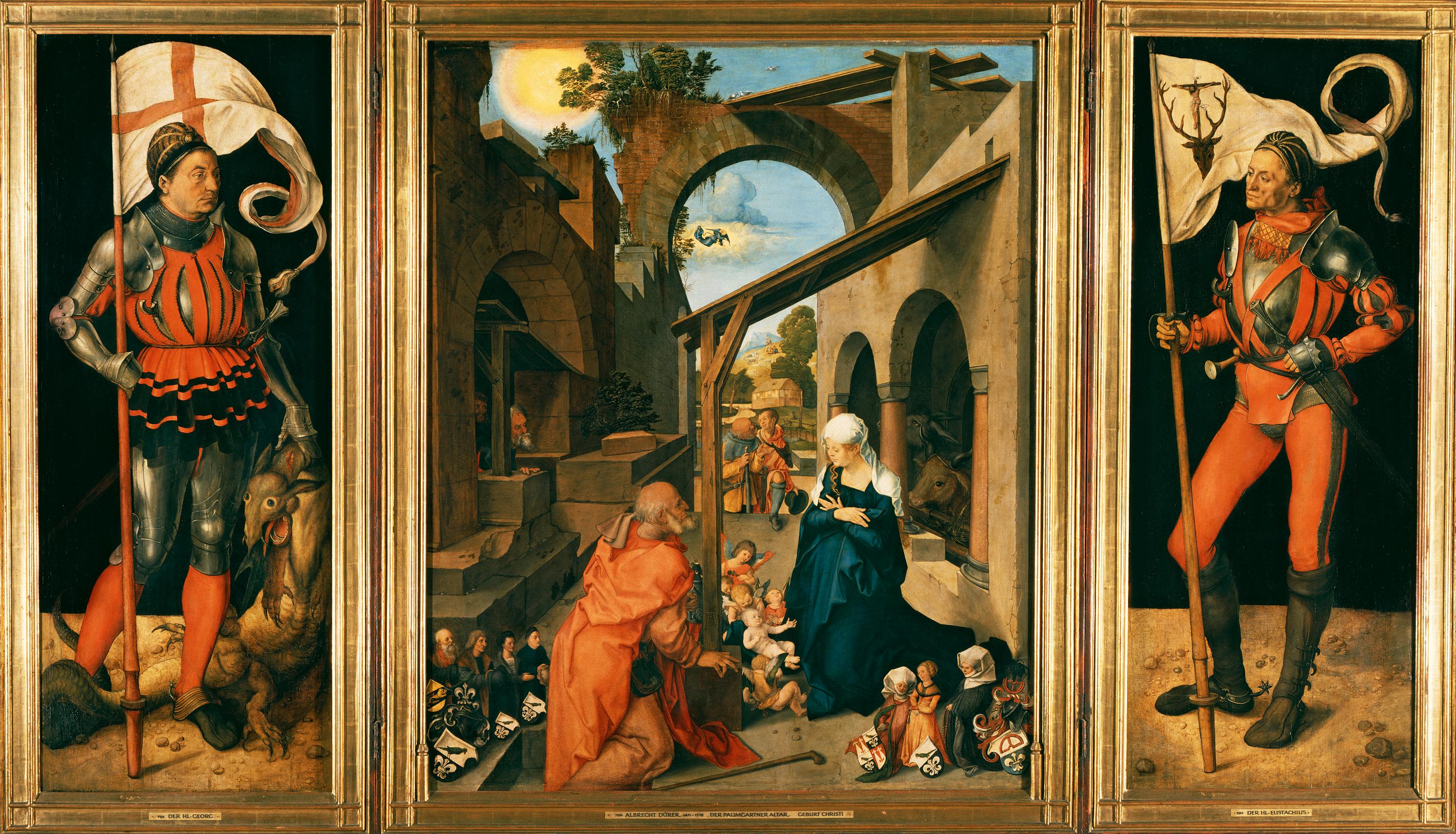 #98
#98Lukas Paumgartner as Saint Eustace
On one of the shutters of the Paumgartner altarpiece, Lukas Paumgartner adopts the armor and attributes of Saint Eustace. Dürer is therefore not looking for a daily portrait: he transforms the donor into a life-size role figure, according to a usage still accepted around 1500. The isolation of the knight on a dark background reinforces his presence and makes the armor a real social language. The museum specifies that the shutters were painted as early as 1498, before or during the completion of the central panel.
Image and link: Bayerische Staatsgemäldesammlungen - Alte Pinakothek.
See the museum notice →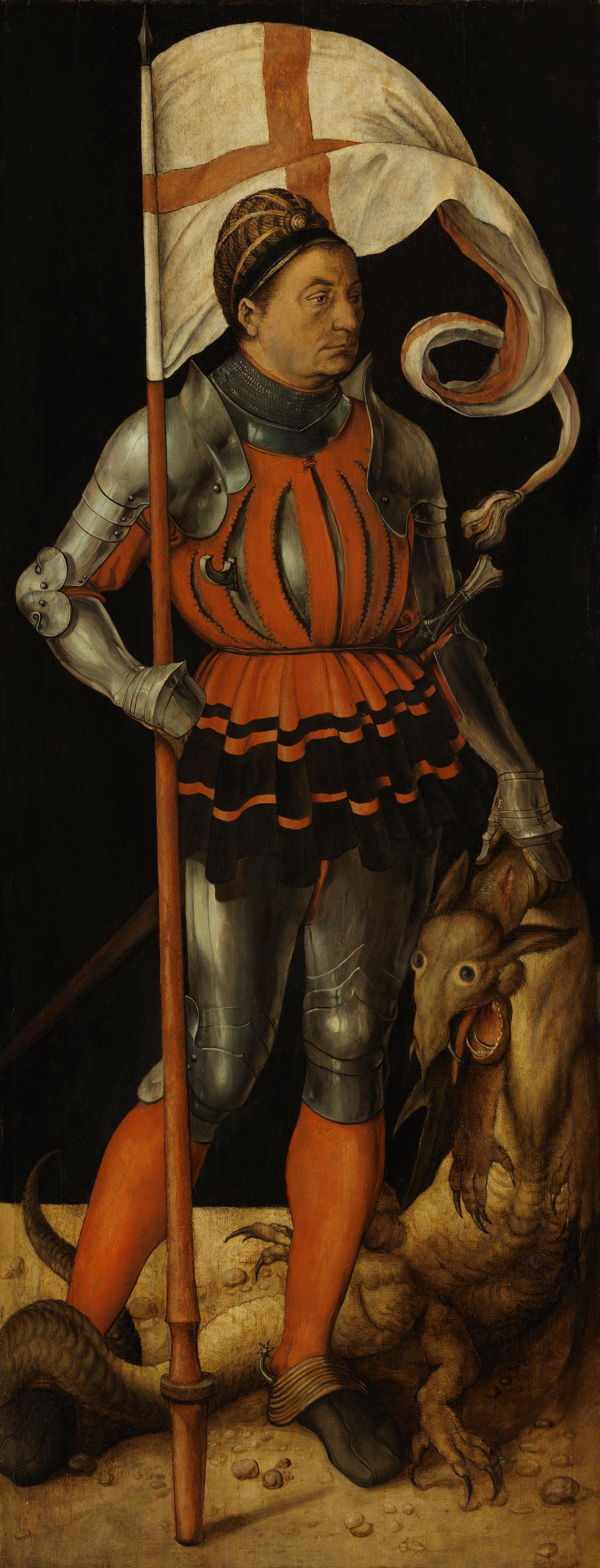 #99
#99Stephan Paumgartner as Saint George
Stephan Paumgartner is represented in the guise of Saint George, as a counterpart to his brother Lukas depicted as Saint Eustace. The shutter thus combines a donor portrait, chivalrous ideal and family devotion without confusing the model with a historical saint. The narrow silhouette, the shiny armor and the almost abstract background give the character the monumentality of a painted statue. The reverse bears an Annunciation, reminding us that this panel had two sides and changed meaning with the opening of the altarpiece.
Image and link: Bayerische Staatsgemäldesammlungen - Alte Pinakothek.
See the museum notice → #100
#100Virgin and Breastfeeding Child
Dürer here reduces the Virgin to a nursing mother, without halo or spectacular attribute: the museum precisely underlines the unusual simplicity and intimacy of this image. The small format suggests a work of private devotion, probably intended for the market rather than for an identified sponsor. The Child's gesture and Mary's inclined face bring the painting closer to several Marian studies and engravings executed around 1503. This sobriety marks a return to Nordic traditions after the monumental effects borrowed from Venetian painting.
Image and link: Kunsthistorisches Museum, Vienna.
See the museum notice →Editorial method
A 100% paint selection
The corpus favors public Alpha sheets corresponding to paintings, panels and altarpieces by Dürer, supplemented by three institutional notices. Engravings, engraved wood, watercolors and drawings were excluded.
Paintings only
Self-portraits, portraits, altarpieces, religious scenes and humanist compositions.
European Renaissance
The route shows the painter Dürer, not the engraver or the watercolorist.
Control
Identical variations spotted in Shopify are discarded to keep 100 separate entries.
Sources and links
Shop and public collections
The images refer either to the existing Alpha Reproduction sheet or to the museum notice when the work is not offered for reproduction.
Frequently asked questions
Read Dürer
Some references on the artist, techniques and method.
Why only keep paintings?
This version excludes engravings, engraved wood, watercolors and drawings to focus only on paintings, panels and altarpieces.
Are the images from Shopify?
Ninety-seven entries use images and links from Alpha Reproduction files. Three missing paintings are documented by their museums and are not offered for reproduction.
Is there a slideshow?
No. The page is static to keep the 100 works visible and controllable.
Have duplicates been checked?
Yes. Identical visual variations spotted in Shopify have been excluded from the ranking.
0 comments