


100 sets - shutters, stories and altarpieces
The 100 most famous triptychs and polyptychs
From The Mystical Lamb to the Garden of Delights, from the Isenheim Altarpiece to the Italian masters: one hundred works where several panels form a single image.
The classification only retains complete and documented sets. No shutter, central panel or fragment is presented as a stand-alone work.
The art of multiple images
Why divide a painting into several panels?
The triptych and the polyptych are not simple juxtaposed frames. They organize a reading time, a hierarchy of figures and sometimes several states of openness.
A large altarpiece is understood as a mobile architecture: each shutter modifies what the viewer can see, connect and tell.
This top 100 favors fame, historical importance and coherence between the parties. Existing Alpha sheets are used as a priority; when a work is not proposed, the image refers directly to the corresponding institution.
The 100 triptychs and polyptychs in images
The sets whose image and influence fixed the memory of the triptych and the polyptych.
#1
The Mystic Lamb
Classified no. 1, The Mystical Lamb by Hubert and Jan van Eyck is retained as a complete polyptych and not as an artificial juxtaposition of panels. Unity comes from light, perspective and gestures that cross the material boundaries between panels. Its place in collections, studies and the great histories of painting makes it a major landmark of the shutter format. THERE dating shown is 1432 and oil on panels technique. The classification considers the whole whole: no isolated shutter is counted as an autonomous work. The image must therefore be read from left to right, but also as a continuous surface made of correspondences.
Image and link: Alpha Reproduction.
See this reproduction → #2
#2
The Garden of Delights
Classified no. 2, Hieronymus Bosch's Garden of Earthly Delights is retained as a complete triptych and not as an artificial juxtaposition of panels. The shutters organize a moral progression where the earthly world, temptation and salvation respond to each other in contrasts. Its place in collections, studies and the great stories of painting makes it a major landmark of the shutter format. Dating indicated is around 1490 -1500 and the oil on panels technique. The image must therefore be read from left to right, but also as a continuous surface made of correspondences. The frame, hinges and order of the panels contribute as much to the meaning as the scenes represented.
Image and link: Alpha Reproduction.
See this reproduction → #3
#3
The Isenheim Altarpiece
Classified no. 3, The Isenheim Altarpiece by Matthias Grünewald is retained as a complete polyptych and not as an artificial juxtaposition of panels. The division into several panels becomes a principle of narration: each part retains its autonomy while depending on the rhythm of the whole. Its place in collections, studies and the great stories of painting makes it a major landmark from the flap format. The dating indicated is 1512 -1516 and the oil and tempera technique on panels. The frame, hinges and order of the panels contribute as much to the meaning as the scenes represented. The link associated with the image opens the existing Alpha sheet or, when reproduction is not offered, the institution's notice.
Image and link: Alpha Reproduction.
See this reproduction → #4
#4
The Portinari Triptych
Classified no. 4, The Portinari Triptych by Hugo van der Goes is retained as a complete triptych and not as an artificial juxtaposition of panels. Unity comes from light, perspective and gestures that cross the material boundaries between panels. Its place in collections, studies and the great histories of painting makes it a major landmark of the shutter format. There dating indicated is around 1475 and the oil on panels technique. The link associated with the image opens the existing Alpha sheet or, when reproduction is not proposed, the institution's notice. The classification considers the whole complete: no isolated part is counted as an independent work.
Image and link: Alpha Reproduction.
See this reproduction → #5
#5
The Triptych of the Last Judgment
Classified no. 5, Hans Memling's Triptych of the Last Judgment is retained as a complete triptych and not as an artificial juxtaposition of panels. Unity comes from light, perspective and gestures that cross the material boundaries between panels. Its place in collections, studies and the great histories of painting makes it a major landmark of the shutter format. The dating shown is 1467 -1471 and the oil on panels technique. The classification considers the whole whole: no isolated shutter is counted as an autonomous work. The image must therefore be read from left to right, but also as a continuous surface made of correspondences.
Image and link: Alpha Reproduction.
See this reproduction → #6
#6
The Hay Cart
Classified no. 6, Hieronymus Bosch's Hay Cart is retained as a complete triptych and not as an artificial juxtaposition of panels. The shutters organize a moral progression where the earthly world, temptation and salvation respond to each other in contrasts. Its place in collections, studies and the great histories of painting makes it a major landmark of the shutter format. Dating indicated is around 1512 -1515 and the oil on panels technique. The image must therefore be read from left to right, but also as a continuous surface made of correspondences. The frame, hinges and order of the panels contribute as much to the meaning as the scenes represented.
Image and link: Alpha Reproduction.
See this reproduction →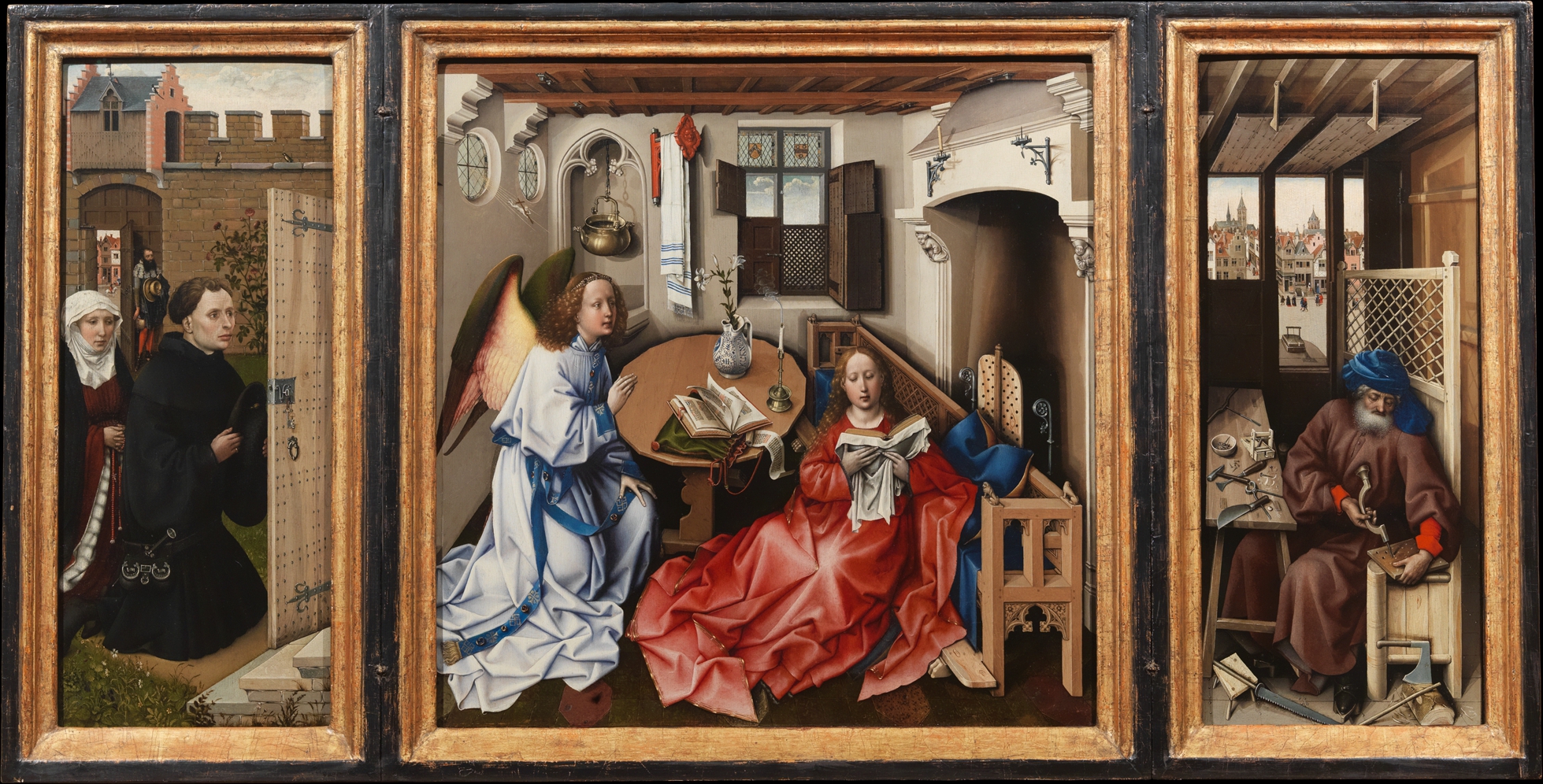 #7
#7
The Merod Triptych
Classified no. 7, Le Triptyque Mérode by Atelier by Robert Campin is retained as a complete triptych and not as an artificial juxtaposition of panels. Unity comes from light, perspective and gestures that cross the material boundaries between panels. Its place in collections, studies and the great histories of painting makes it a major landmark of the shutter format. The dating indicated is around 1427 -1432 and the oil on oak technique. The frame, hinges and order of the panels contribute as much to the meaning as the scenes represented. The link associated with the image opens the existing Alpha sheet or, when reproduction is not proposed, the institution's notice.
Image and link: The Metropolitan Museum of Art.
See the museum notice → #8
#8
The Triptych of the Seven Sacraments
Classified no. 8, The Triptych of the Seven Sacraments by Rogier van der Weyden is retained as a complete triptych and not as an artificial juxtaposition of panels. Unity comes from light, perspective and gestures that cross the material boundaries between panels. Its place in collections, studies and the great histories of painting makes it a major landmark in the format shutters. The dating indicated is around 1445 -1450 and the oil technique on panels. The link associated with the image opens the existing Alpha sheet or, when reproduction is not proposed, the institution's notice. The classification considers the whole complete: no isolated part is counted as an independent work.
Image and link: Alpha Reproduction.
See this reproduction → #9
#9
The Columba Triptych
Classified no. 9, Rogier van der Weyden's Columba Triptych is retained as a complete triptych and not as an artificial juxtaposition of panels. Unity comes from light, perspective and gestures that cross the material boundaries between panels. Its place in collections, studies and the great histories of painting makes it a major landmark of the shutter format. There dating indicated is around 1455 and the oil on panels technique. The classification considers the whole whole: no isolated shutter is counted as an autonomous work. The image must therefore be read from left to right, but also as a continuous surface made of correspondences.
Image and link: Alpha Reproduction.
See this reproduction → #10
#10
The Dresden Triptych
Ranked No. 10, The Dresden Triptych by Jan van Eyck is retained as a complete triptych and not as an artificial juxtaposition of panels. Unity comes from light, perspective and gestures that cross the material boundaries between panels. Its place in collections, studies and the great histories of painting makes it a major landmark of the shutter format. There dating shown is 1437 and the oil on panels technique. The image must therefore be read from left to right, but also as a continuous surface made of correspondences. The frame, hinges and order of the panels contribute as much to the meaning as the scenes represented.
Image and link: Alpha Reproduction.
See this reproduction → #11
#11
The Braque family Triptych
Classified no. 11, The Triptych of the Braque family by Rogier van der Weyden is retained as a complete triptych and not as an artificial juxtaposition of panels. Unity comes from light, perspective and gestures that cross the material boundaries between panels. Its place in collections, studies and the great histories of painting makes it a major landmark of the format flaps. The dating indicated is around 1452 and the oil technique on panels. The frame, hinges and order of the panels contribute as much to the meaning as the scenes represented. The link associated with the image opens the existing Alpha sheet or, when reproduction is not proposed, the institution's notice.
Image and link: Alpha Reproduction.
See this reproduction → #12
#12
The Stefaneschi Triptych
Classified no. 12, Giotto's Stefaneschi Triptych is retained as a complete triptych and not as an artificial juxtaposition of panels. The gold background, vertical rhythms and hierarchy of figures transform the whole into devotional architecture. Its place in collections, studies and the great histories of painting makes it a major landmark of the flap format. Dating indicated is around 1320 and the tempera and gold technique on wood. The link associated with the image opens the existing Alpha sheet or, when reproduction is not offered, the institution's notice. The classification considers the whole complete: no isolated part is counted as an autonomous work.
Image and link: Alpha Reproduction.
See this reproduction → #13
#13
The Triptych of San Giovenale
Classified no. 13, Masaccio's The Triptych of San Giovenale is retained as a complete triptych and not as an artificial juxtaposition of panels. The division into several panels becomes a principle of narration: each part retains its autonomy while depending on the rhythm of the whole. Its place in collections, studies and the great stories of painting makes it a major landmark flap format. The dating indicated is 1422 and the tempera and gold technique on wood. The classification considers the whole whole: no isolated flap is counted as an autonomous work. The image must therefore be read from left to right, but also as a continuous surface made of correspondences.
Image and link: Alpha Reproduction.
See this reproduction → #14
#14
The Uffizi Triptych
Classified no. 14, Andrea Mantegna's Triptych of Offices is retained as a complete triptych and not as an artificial juxtaposition of panels. Frames, floors and vanishing lines connect the compartments and give the whole the coherence of a unique space. Its place in collections, studies and the great histories of painting makes it a major landmark in the shutter format. There dating indicated is around 1460 and the tempera technique on wood. The image must therefore be read from left to right, but also as a continuous surface made of correspondences. The frame, hinges and order of the panels contribute as much to the meaning as the scenes represented.
Image and link: Alpha Reproduction.
See this reproduction → #15
#15
The Polyptych of Mercy
Classified no. 15, The Polyptych of Mercy by Piero della Francesca is retained as a complete polyptych and not as an artificial juxtaposition of panels. Frames, floors and vanishing lines connect the compartments and give the whole the coherence of a unique space. Its place in collections, studies and the great histories of painting makes it a major landmark from format to format shutters. The dating indicated is 1445 -1462 and the tempera and oil on wood technique. The frame, hinges and order of the panels contribute as much to the meaning as the scenes represented. The link associated with the image opens the existing Alpha sheet or, when reproduction is not proposed, the institution's notice.
Image and link: Alpha Reproduction.
See this reproduction → #16
#16
The Averoldi Polyptych
Classified no. 16, Titian's Averoldi Polyptych is retained as a complete polyptych and not as an artificial juxtaposition of panels. The division into several panels becomes a principle of narration: each part retains its autonomy while depending on the rhythm of the whole. Its place in collections, studies and the great stories of painting makes it a major landmark of the format flaps. The dating indicated is 1520 -1522 and the oil technique on panels. The link associated with the image opens the existing Alpha sheet or, when reproduction is not proposed, the institution's notice. The classification considers the whole complete: no isolated part is counted as an independent work.
Image and link: Alpha Reproduction.
See this reproduction → #17
#17
The Frari Triptych
Classified no. 17, Giovanni Bellini's Le Triptyque des Frari is retained as a complete triptych and not as an artificial juxtaposition of panels. Frames, floors and vanishing lines connect the compartments and give the whole the coherence of a unique space. Its place in collections, studies and the great histories of painting makes it a major landmark in the shutter format. There dating indicated is 1488 and the oil on wood technique. The classification considers the whole whole: no isolated shutter is counted as an autonomous work. The image must therefore be read from left to right, but also as a continuous surface made of correspondences.
Image and link: Alpha Reproduction.
See this reproduction → #18
#18
The Polyptych of Saint Vincent Ferrier
Classified no. 18, The Polyptych of Saint Vincent Ferrier by Giovanni Bellini is retained as a complete polyptych and not as an artificial juxtaposition of panels. Frames, floors and vanishing lines connect the compartments and give the whole the coherence of a unique space. Its place in collections, studies and the great histories of painting makes it a major landmark from format to format shutters. The dating indicated is around 1464 -1470 and the tempera technique on panels. The image must therefore be read from left to right, but also as a continuous surface made of correspondences. The frame, hinges and order of the panels contribute as much to the meaning as the scenes represented.
Image and link: Alpha Reproduction.
See this reproduction → #19
#19
The Moulins Triptych
Classified no. 19, Le Triptyque de Moulins by Jean Hey is retained as a complete triptych and not as an artificial juxtaposition of panels. The division into several panels becomes a principle of narration: each part retains its autonomy while depending on the rhythm of the whole. Its place in collections, studies and the great stories of painting makes it a major landmark flap format. The dating indicated is around 1500 and the oil-on-wood technique. The frame, hinges and order of the panels contribute as much to the meaning as the scenes represented. The link associated with the image opens the existing Alpha sheet or, when reproduction is not proposed, the institution's notice.
Image and link: Alpha Reproduction.
See this reproduction → #20
#20
Seilern's Triptych
Classified no. 20, Robert Campin's The Seilern Triptych is retained as a complete triptych and not as an artificial juxtaposition of panels. Unity comes from light, perspective and gestures that cross the material boundaries between panels. Its place in collections, studies and the great histories of painting makes it a major landmark of the shutter format. There dating indicated is around 1415 -1420 and the oil on wood technique. The link associated with the image opens the existing Alpha sheet or, when reproduction is not proposed, the institution's notice. The classification considers the whole complete: no isolated part is counted as an independent work.
Image and link: Alpha Reproduction.
See this reproduction → #21
#21
Triptych of the martyrdom of Saint Hippolytus
Classified no. 21, Triptych of the Martyrdom of Saint Hippolytus by Hugo van der Goes is retained as a complete triptych and not as an artificial juxtaposition of panels. Unity comes from light, perspective and gestures that cross the material boundaries between the panels. The work shows how the European altarpiece articulates devotion, command, architecture and circulation of the gaze. There dating shown is 15th century and panel painting technique. The classification considers the whole whole: no isolated shutter is counted as an autonomous work. The image must therefore be read from left to right, but also as a continuous surface made of correspondences. The frame, hinges and order of the panels contribute as much to the meaning as the scenes represented.
Image and link: Alpha Reproduction.
See this reproduction → #22
#22
Polyptych of the Blessed Sacrament
Classified no. 22, Polyptych of the Blessed Sacrament by Dirk Bouts is retained as a complete polyptych and not as an artificial juxtaposition of panels. Unity comes from light, perspective and gestures that cross the material boundaries between the panels. The work shows how the European altarpiece articulates devotion, command, architecture and circulation of the gaze. Dating indicated is 14th - 20th century and the panel painting technique. The image must therefore be read from left to right, but also as a continuous surface made of correspondences. The frame, hinges and order of the panels contribute as much to the meaning as the scenes represented. The link associated with the image opens the existing Alpha sheet or, when reproduction is not proposed, the instructions from the institution.
Image and link: Alpha Reproduction.
See this reproduction → #23
#23
Triptych of the Sedano family
Classified no. 23, Triptych of the Sedano family by Gérard David is retained as a complete triptych and not as an artificial juxtaposition of panels. Unity comes from light, perspective and gestures that cross the material boundaries between the panels. The work shows how the European altarpiece articulates devotion, command, architecture and circulation of the gaze. Dating indicated is 14th - 20th century and the panel painting technique. The frame, hinges and order of the panels contribute as much to the meaning as the scenes represented. The link associated with the image opens the existing Alpha sheet or, when reproduction is not proposed, the institution's notice.
Image and link: Alpha Reproduction.
See this reproduction → #24
#24
Triptych of the Annunciation
Classified no. 24, Triptych of the Annunciation by Rogier van der Weyden is retained as a complete triptych and not as an artificial juxtaposition of panels. Unity comes from light, perspective and gestures that cross the material boundaries between the panels. The work shows how the European altarpiece articulates devotion, command, architecture and circulation of the gaze. Dating indicated is 15th century and panel painting technique. The link associated with the image opens the existing Alpha sheet or, when reproduction is not proposed, the institution's notice. The classification considers the whole whole: no isolated shutter is counted as an autonomous work. The image must therefore be read from left to right, but also as a continuous surface made of matches.
Image and link: Alpha Reproduction.
See this reproduction → #25
#25
Triptych of the Adoration of the Magi
Classified no. 25, Triptych of the Adoration of the Magi by Hans Memling is retained as a complete triptych and not as an artificial juxtaposition of panels. Unity comes from light, perspective and gestures that cross the material boundaries between the panels. The work shows how the European altarpiece articulates devotion, command, architecture and circulation of the gaze. Dating indicated is 15th century and the painting technique on panels. The classification considers the whole whole: no isolated shutter is counted as an autonomous work. The image must therefore be read from left to right, but also as a continuous surface made of correspondences. The frame, hinges and order of the panels contribute as much to the meaning as the scenes represented.
Image and link: Alpha Reproduction.
See this reproduction →From Italy to the ancient Netherlands, the panels became architecture, story and object of devotion.
 #26
#26
Polyptych Baroncelli
Classified no. 26, Polyptych Baroncelli by Giotto is retained as a complete polyptych and not as an artificial juxtaposition of panels. The gold background, vertical rhythms and hierarchy of figures transform the whole into devotional architecture. The work shows how the European altarpiece articulates devotion, command, architecture and circulation of the gaze. The dating indicated is XIVth century and the panel painting technique. The image must therefore be read from left to right, but also as a continuous surface made of correspondences. The frame, hinges and order of the panels contribute as much to the meaning as the scenes represented. The link associated with the image opens the existing Alpha sheet or, when reproduction is not proposed, the institution's notice.
Image and link: Alpha Reproduction.
See this reproduction → #27
#27
Polyptych of Badia
Classified no. 27, Polyptych of Badia by Giotto is retained as a complete polyptych and not as an artificial juxtaposition of panels. The gold background, the vertical rhythms and the hierarchy of figures transform the whole into devotional architecture. The work shows how the European altarpiece articulates devotion, command, architecture and circulation of the gaze. The dating indicated is XIVth century and panel painting technique. The frame, hinges and order of the panels contribute as much to the meaning as the scenes represented. The link associated with the image opens the existing Alpha sheet or, when reproduction is not proposed, the institution's notice. The classification considers the whole complete: no isolated part is counted as an independent work.
Image and link: Alpha Reproduction.
See this reproduction → #28
#28
Bologna Polyptych
Classified no. 28, Giotto's Bologna Polyptych is retained as a complete polyptych and not as an artificial juxtaposition of panels. The gold background, vertical rhythms and hierarchy of figures transform the whole into devotional architecture. The work shows how the European altarpiece articulates devotion, command, architecture and circulation of the gaze. The dating indicated is XIVth century and panel painting technique. The link associated with the image opens the existing Alpha sheet or, when reproduction is not proposed, the institution's notice. The classification considers the whole whole: no isolated part is counted as an autonomous work. The image must therefore be read from left to right, but also as a continuous surface made of correspondences.
Image and link: Alpha Reproduction.
See this reproduction → #29
#29
Polyptych of San Domenico
Classified no. 29, Polyptych of San Domenico by Simone Martini is retained as a complete polyptych and not as an artificial juxtaposition of panels. The gold background, the vertical rhythms and the hierarchy of figures transform the whole into devotional architecture. The work shows how the European altarpiece articulates devotion, command, architecture and circulation of the gaze. The dating indicated is 14th century and panel painting technique. The classification considers the whole whole: no isolated shutter is counted as an autonomous work. The image must therefore be read from left to right, but also as a continuous surface made of correspondences. The frame, hinges and order of the panels contribute as much to the meaning as the scenes represented.
Image and link: Alpha Reproduction.
See this reproduction → #30
#30
Polyptych of Saint Catherine of Alexandria
Classified no. 30, Polyptych of Saint Catherine of Alexandria by Simone Martini is retained as a complete polyptych and not as an artificial juxtaposition of panels. The gold background, the vertical rhythms and the hierarchy of figures transform the whole into devotional architecture. The work shows how the European altarpiece articulates devotion, command, architecture and circulation of the gaze. There dating shown is 14th century and the technique painting on panels. The image must therefore be read from left to right, but also as a continuous surface made of correspondences. The frame, hinges and order of the panels contribute as much to the meaning as the scenes represented. The link associated with the image opens the existing Alpha sheet or, when reproduction is not proposed, the institution notice.
Image and link: Alpha Reproduction.
See this reproduction → #31
#31
The Arezzo Polyptych
Classified no. 31, The Arezzo Polyptych by Pietro Lorenzetti is retained as a complete polyptych and not as an artificial juxtaposition of panels. The gold background, vertical rhythms and hierarchy of figures transform the whole into devotional architecture. The work shows how the European altarpiece articulates devotion, command, architecture and circulation of the gaze. The dating indicated is 14th century and the panel painting technique. The frame, hinges and order of the panels contribute as much to the meaning as the scenes represented. The link associated with the image opens the existing Alpha sheet or, when reproduction is not proposed, the institution's notice. The classification considers the whole complete: no isolated part is counted as an independent work.
Image and link: Alpha Reproduction.
See this reproduction → #32
#32
Carmelite polyptych
Classified no. 32, Polyptych of the Carmelites by Pietro Lorenzetti is retained as a complete polyptych and not as an artificial juxtaposition of panels. The gold background, vertical rhythms and hierarchy of figures transform the whole into devotional architecture. The work shows how the European altarpiece articulates devotion, command, architecture and circulation of the gaze. The dating indicated is 14th century and the panel painting technique. The link associated with the image opens the existing Alpha sheet or, when reproduction is not proposed, the institution's notice. The classification considers the whole whole: no isolated part is counted as an autonomous work. The image must therefore be read from left to right, but also as a continuous surface made of correspondences.
Image and link: Alpha Reproduction.
See this reproduction → #33
#33
Tarlati polyptych
Classified no. 33, Polyptych Tarlati by Pietro Lorenzetti is retained as a complete polyptych and not as an artificial juxtaposition of panels. The gold background, vertical rhythms and hierarchy of figures transform the whole into devotional architecture. The work shows how the European altarpiece articulates devotion, command, architecture and circulation of the gaze. The dating indicated is 14th century and panel painting technique. The classification considers the whole whole: no isolated shutter is counted as an autonomous work. The image must therefore be read from left to right, but also as a continuous surface made of correspondences. The frame, hinges and order of the panels contribute as much to the meaning as the scenes represented.
Image and link: Alpha Reproduction.
See this reproduction → #34
#34
Triptych of San Michele
Classified no. 34, Triptych of San Michele by Ambrogio Lorenzetti is retained as a complete triptych and not as an artificial juxtaposition of panels. The gold background, the vertical rhythms and the hierarchy of figures transform the whole into devotional architecture. The work shows how the European altarpiece articulates devotion, command, architecture and circulation of the gaze. The dating indicated is 14th century and the panel painting technique. The image must therefore be read from left to right, but also as a continuous surface made of correspondences. The frame, hinges and order of the panels contribute as much to the meaning as the scenes represented. The link associated with the image opens the existing Alpha sheet or, when reproduction is not proposed, the instructions the institution.
Image and link: Alpha Reproduction.
See this reproduction → #35
#35
Cambridge Triptych
Classified no. 35, Simone Martini's Cambridge Triptych is retained as a complete triptych and not as an artificial juxtaposition of panels. The gold background, vertical rhythms and hierarchy of figures transform the whole into devotional architecture. The work shows how the European altarpiece articulates devotion, command, architecture and circulation of the gaze. The dating indicated is 14th century and the panel painting technique. The frame, hinges and order of the panels contribute as much to the meaning as the scenes represented. The link associated with the image opens the existing Alpha sheet or, when reproduction is not proposed, the institution's notice. The classification considers the whole complete: no isolated part is counted as an independent work.
Image and link: Alpha Reproduction.
See this reproduction → #36
#36
Triptych of Saint Laurent
Classified no. 36, Triptych of Saint Laurent by Lorenzo Monaco is retained as a complete triptych and not as an artificial juxtaposition of panels. The division into several panels becomes a principle of narration: each part retains its autonomy while depending on the rhythm of the whole. The work shows how the European altarpiece articulates devotion, command, architecture and circulation of look. The dating indicated is 14th - 20th century and the painting technique on panels. The link associated with the image opens the existing Alpha sheet or, when reproduction is not proposed, the institution's notice. The classification considers the whole complete: no isolated part is counted as an independent work.
Image and link: Alpha Reproduction.
See this reproduction → #37
#37
Triptych of the Annunciation
Classified no. 37, Triptych of the Annunciation by Lorenzo Monaco is retained as a complete triptych and not as an artificial juxtaposition of panels. The division into several panels becomes a principle of narration: each part retains its autonomy while depending on the rhythm of the whole. The work shows how the European altarpiece articulates devotion, command, architecture and circulation of look. The dating indicated is 14th - 20th century and the painting technique on panels. The classification considers the whole whole: no isolated shutter is counted as an autonomous work. The image must therefore be read from left to right, but also as a continuous surface made of correspondences. The frame, hinges and order of the panels contribute as much to the meaning as the scenes represented.
Image and link: Alpha Reproduction.
See this reproduction → #38
#38
Triptych of Saint Peter the Martyr
Classified no. 38, Triptych of Saint Peter Martyr by Fra Angelico is retained as a complete triptych and not as an artificial juxtaposition of panels. The division into several panels becomes a principle of narration: each part retains its autonomy while depending on the rhythm of the whole. The work shows how the European altarpiece articulates devotion, command, architecture and circulation of look. The dating indicated is 15th century and the painting technique on panels. The image must therefore be read from left to right, but also as a continuous surface made of correspondences. The frame, hinges and order of the panels contribute as much to the meaning as the scenes represented.
Image and link: Alpha Reproduction.
See this reproduction → #39
#39
Triptych of the Last Judgment, Ascension and Pentecost
Classified No. 39, Triptych of the Last Judgment, Ascension and Pentecost by Fra Angelico is retained as a complete triptych and not as an artificial juxtaposition of panels. The division into several panels becomes a principle of narration: each part retains its autonomy while depending on the rhythm of the whole. The work shows how the European altarpiece articulates devotion, command, architecture and circulation of the gaze. The dating indicated is 15th century and the painting technique on panels. The frame, hinges and order of the panels contribute as much to the meaning as the scenes represented. The link associated with the image opens the existing Alpha sheet or, when reproduction is not proposed, the institution's notice.
Image and link: Alpha Reproduction.
See this reproduction → #40
#40
The Triptych of the Virgin of Humility with Saints
Classified no. 40, The Triptych of the Virgin of Humility with Saints by Fra Filippo Lippi is retained as a complete triptych and not as an artificial juxtaposition of panels. The division into several panels becomes a principle of narration: each part retains its autonomy while depending on the rhythm of the whole. The work shows how the European altarpiece articulates devotion, command, architecture and circulation of the gaze. The dating indicated is 15th century and the painting technique on panels. The link associated with the image opens the existing Alpha sheet or, when reproduction is not proposed, the institution's notice. The classification considers the whole complete: no isolated part is counted as an autonomous work.
Image and link: Alpha Reproduction.
See this reproduction → #41
#41
Triptych of the Baptism of Christ
Classified no. 41, Triptych of the Baptism of Christ by Gérard David is retained as a complete triptych and not as an artificial juxtaposition of panels. Unity comes from light, perspective and gestures that cross the material boundaries between the panels. The work shows how the European altarpiece articulates devotion, command, architecture and circulation of the gaze. Dating shown is 14th - 20th century and panel painting technique. The classification considers the whole whole: no isolated shutter is counted as an autonomous work. The image must therefore be read from left to right, but also as a continuous surface made of correspondences. The frame, hinges and order of the panels contribute as much to the meaning as the scenes represented.
Image and link: Alpha Reproduction.
See this reproduction → #42
#42
Cervara polyptych
Classified no. 42, Polyptych of the Cervara by Gérard David is retained as a complete polyptych and not as an artificial juxtaposition of panels. Unity comes from light, perspective and gestures that cross the material boundaries between the panels. The work shows how the European altarpiece articulates devotion, command, architecture and circulation of the gaze. The dating indicated is 14th - 20th century and the panel painting technique. The image must therefore be read from left to right, but also as a continuous surface made of correspondences. The frame, hinges and order of the panels contribute as much to the meaning as the scenes represented. The link associated with the image opens the existing Alpha sheet or, when reproduction is not proposed, the instructions the institution.
Image and link: Alpha Reproduction.
See this reproduction → #43
#43
Recanati Polyptych
Classified no. 43, Polyptych of Recanati by Lorenzo Lotto is retained as a complete polyptych and not as an artificial juxtaposition of panels. Frames, floors and vanishing lines connect the compartments and give the whole the coherence of a single space. The work shows how the European altarpiece articulates devotion, control, architecture and circulation of the gaze. The dating indicated is 16th century and the panel painting technique. The frame, hinges and order of the panels contribute as much to the meaning as the scenes represented. The link associated with the image opens the existing Alpha sheet or, when reproduction is not proposed, the institution's notice. The classification considers the whole complete: no isolated part is counted as an independent work.
Image and link: Alpha Reproduction.
See this reproduction → #44
#44
Ponteranica polyptych
Classified no. 44, Polyptych of Ponteranica by Lorenzo Lotto is retained as a complete polyptych and not as an artificial juxtaposition of panels. Frames, floors and vanishing lines connect the compartments and give the whole the coherence of a single space. The work shows how the European altarpiece articulates devotion, control, architecture and circulation of the gaze. The dating indicated is 16th century and the panel painting technique. The link associated with the image opens the existing Alpha sheet or, when reproduction is not proposed, the institution's notice. The classification considers the whole whole: no isolated part is counted as an autonomous work. The image must therefore be read from left to right, but also as a continuous surface made of correspondences.
Image and link: Alpha Reproduction.
See this reproduction → #45
#45
Polyptych of Sant'Agostino
Classified no. 45, Polyptych of Sant'Agostino by Pietro Perugino is retained as a complete polyptych and not as an artificial juxtaposition of panels. Frames, floors and vanishing lines connect the compartments and give the whole the coherence of a single space. The work shows how the European altarpiece articulates devotion, control, architecture and circulation of the gaze. The dating indicated is around 1500 and the panel painting technique. The classification considers the whole whole: no isolated shutter is counted as an autonomous work. The image must therefore be read from left to right, but also as a continuous surface made of correspondences. The frame, hinges and order of the panels contribute as much to the meaning as the scenes represented.
Image and link: Alpha Reproduction.
See this reproduction → #46
#46
Polyptych Albani Torlonia
Classified no. 46, Polyptych Albani Torlonia by Pietro Perugino is retained as a complete polyptych and not as an artificial juxtaposition of panels. Frames, floors and vanishing lines connect the compartments and give the whole the coherence of a single space. The work shows how the European altarpiece articulates devotion, control, architecture and circulation of the gaze. The dating indicated is around 1500 and the panel painting technique. The image must therefore be read from left to right, but also as a continuous surface made of correspondences. The frame, hinges and order of the panels contribute as much to the meaning as the scenes represented. The link associated with the image opens the existing Alpha sheet or, when reproduction is not proposed, the instructions the institution.
Image and link: Alpha Reproduction.
See this reproduction → #47
#47
Galitzin Triptych
Classified no. 47, Galitzin Triptych by Pietro Perugino is retained as a complete triptych and not as an artificial juxtaposition of panels. Frames, floors and vanishing lines connect the compartments and give the whole the coherence of a single space. The work shows how the European altarpiece articulates devotion, command, architecture and circulation of the gaze. The dating indicated is towards 1500 and the panel painting technique. The frame, hinges and order of the panels contribute as much to the meaning as the scenes represented. The link associated with the image opens the existing Alpha sheet or, when reproduction is not proposed, the institution's notice. The classification considers the whole complete: no isolated part is counted as an independent work.
Image and link: Alpha Reproduction.
See this reproduction → #48
#48
Pagagnotti Triptych
Classified no. 48, Hans Memling's Pagagnotti Triptych is retained as a complete triptych and not as an artificial juxtaposition of panels. Unity comes from light, perspective and gestures that cross the material boundaries between the panels. The work shows how the European altarpiece articulates devotion, command, architecture and circulation of the gaze. The dating indicated is 15th century and the panel painting technique. The link associated with the image opens the existing Alpha sheet or, when reproduction is not proposed, the institution's notice. The classification considers the whole whole: no isolated part is counted as an autonomous work. The image must therefore be read from left to right, but also as a continuous surface made of correspondences.
Image and link: Alpha Reproduction.
See this reproduction → #49
#49
Triptych by Benedetto Portinari
Classified no. 49, Triptych by Benedetto Portinari by Hans Memling is retained as a complete triptych and not as an artificial juxtaposition of panels. Unity comes from light, perspective and gestures that cross the material boundaries between the panels. The work shows how the European altarpiece articulates devotion, command, architecture and circulation of the gaze. Dating indicated is 15th century and the painting technique on panels. The classification considers the whole whole: no isolated shutter is counted as an autonomous work. The image must therefore be read from left to right, but also as a continuous surface made of correspondences. The frame, hinges and order of the panels contribute as much to the meaning as the scenes represented.
Image and link: Alpha Reproduction.
See this reproduction → #50
#50
Triptych of Earthly Vanity
Classified no. 50, Triptych of Terrestrial Vanity by Hans Memling is retained as a complete triptych and not as an artificial juxtaposition of panels. Unity comes from light, perspective and gestures that cross the material boundaries between the panels. The work shows how the European altarpiece articulates devotion, command, architecture and circulation of the gaze. Dating indicated is 15th century and the painting technique on panels. The image must therefore be read from left to right, but also as a continuous surface made of correspondences. The frame, hinges and order of the panels contribute as much to the meaning as the scenes represented. The link associated with the image opens the existing Alpha sheet or, when reproduction is not proposed, the instructions the institution.
Image and link: Alpha Reproduction.
See this reproduction →Private orders, churches and corporations multiply formats and programs.
 #51
#51
Triptych with rest during the flight into Egypt
Classified No. 51, Triptych with Rest During the Flight into Egypt by Hans Memling is retained as a complete triptych and not as an artificial juxtaposition of panels. Unity comes from light, perspective and gestures that cross the material boundaries between the panels. It broadens the classification to regional traditions and secular uses without losing the logic of the multiple image. The dating indicated is 15th century and the painting technique on panels. The frame, hinges and order of the panels contribute as much to the meaning as the scenes represented. The link associated with the image opens the existing Alpha sheet or, when reproduction is not proposed, the institution's notice.
Image and link: Alpha Reproduction.
See this reproduction → #52
#52
Triptych of Pietà, Saint John and Saint Mary Magdalene
Classified no. 52, Triptych of the Pietà, Saint John and Saint Mary Magdalene by Luis de Morales is retained as a complete triptych and not as an artificial juxtaposition of panels. The division into several panels becomes a principle of narration: each part retains its autonomy while depending on the rhythm of the whole. It broadens the classification to regional traditions and uses laymen without losing the logic of multiple images. The dating indicated is 14th - 20th century and the painting technique on panels. The link associated with the image opens the existing Alpha sheet or, when reproduction is not proposed, the institution's notice. The classification considers the whole complete: no isolated part is counted as an independent work.
Image and link: Alpha Reproduction.
See this reproduction → #53
#53
Triptych of the Virgin of Montserrat
Classified no. 53, Triptych of the Virgin of Montserrat by Bartolomé Bermejo is retained as a complete triptych and not as an artificial juxtaposition of panels. The division into several panels becomes a principle of narration: each part retains its autonomy while depending on the rhythm of the whole. It broadens the classification to regional traditions and secular uses without losing the logic of multiple images. The dating indicated is 14th - 20th century and the painting technique on panels. The classification considers the whole whole: no isolated shutter is counted as an autonomous work. The image must therefore be read from left to right, but also as a continuous surface made of correspondences.
Image and link: Alpha Reproduction.
See this reproduction → #54
#54
Triptych of the Brotherhood of Saint Anne in Louvain
Classified no. 54, Triptych of the Brotherhood of Saint Anne in Louvain by Quentin Metsys is retained as a complete triptych and not as an artificial juxtaposition of panels. The division into several panels becomes a principle of narration: each part retains its autonomy while depending on the rhythm of the whole. It extends the classification to regional traditions and secular uses without losing the logic of the multiple image. The dating indicated is 14th - 20th century and the painting technique on panels. The image must therefore be read from left to right, but also as a continuous surface made of correspondences. The frame, hinges and order of the panels contribute as much to the meaning as the scenes represented.
Image and link: Alpha Reproduction.
See this reproduction → #55
#55
The Triptych of the Crucifixion
Classified no. 55, The Triptych of the Crucifixion by Joos van Cleve is retained as a complete triptych and not as an artificial juxtaposition of panels. The division into several panels becomes a principle of narration: each part retains its autonomy while depending on the rhythm of the whole. It broadens the classification to regional traditions and secular uses without losing logic from the multiple image. The dating indicated is 14th - 20th century and the painting technique on panels. The frame, hinges and order of the panels contribute as much to the meaning as the scenes represented. The link associated with the image opens the existing Alpha sheet or, when reproduction is not proposed, the institution's notice.
Image and link: Alpha Reproduction.
See this reproduction → #56
#56
Triptych. In the center: the Deposition from the Cross; left: Saint John the Baptist with a donor; right: Saint Margaret of Antioch with a donor.
Classified no. 56, Triptych. In the center: the Deposition from the Cross; left: Saint John the Baptist with a donor; right: Saint Margaret of Antioch with a donor. by Joos van Cleve is retained as a complete triptych and not as an artificial juxtaposition of panels. The division into several panels becomes a principle of narration: each part retains its autonomy while depending from the rhythm of the whole. It broadens the classification to regional traditions and secular uses without losing the logic of the multiple image. The dating indicated is 14th - 20th century and the painting technique on panels. The link associated with the image opens the existing Alpha sheet or, when reproduction is not proposed, the institution's notice.
Image and link: Alpha Reproduction.
See this reproduction → #57
#57
Triptych representing the Adoration of the Three Wise Men
Classified no. 57, Triptych representing the Adoration of the Three Kings by Joos van Cleve is retained as a complete triptych and not as an artificial juxtaposition of panels. The division into several panels becomes a principle of narration: each part retains its autonomy while depending on the rhythm of the whole. It broadens the classification to regional traditions and secular uses without losing the logic of multiple images. The dating indicated is 14th - 20th century and the panel painting technique. The classification considers the whole whole: no isolated shutter is counted as an autonomous work. The image must therefore be read from left to right, but also as a continuous surface made of correspondences.
Image and link: Alpha Reproduction.
See this reproduction → #58
#58
Hanéton Triptych
Classified no. 58, Triptyque Hanéton by Bernard van Orley is retained as a complete triptych and not as an artificial juxtaposition of panels. The division into several panels becomes a principle of narration: each part retains its autonomy while depending on the rhythm of the whole. It broadens the classification to regional traditions and secular uses without losing the logic of the multiple image. The dating indicated is 14th - 20th century and the panel painting technique. The image must therefore be read from left to right, but also as a continuous surface made of correspondences. The frame, hinges and order of the panels contribute as much to the meaning as the scenes represented.
Image and link: Alpha Reproduction.
See this reproduction → #59
#59
Triptych of Our Lady of Seven Sorrows
Classified no. 59, Triptych of Our Lady of Seven Sorrows by Bernard van Orley is retained as a complete triptych and not as an artificial juxtaposition of panels. The division into several panels becomes a principle of narration: each part retains its autonomy while depending on the rhythm of the whole. It broadens the classification to regional traditions and secular uses without lose the logic of multiple images. The dating indicated is 14th - 20th century and the painting technique on panels. The frame, hinges and order of the panels contribute as much to the meaning as the scenes represented. The link associated with the image opens the existing Alpha sheet or, when reproduction is not proposed, the institution's notice.
Image and link: Alpha Reproduction.
See this reproduction → #60
#60
Polyptych of Job and Lazarus
Classified no. 60, Polyptych of Job and Lazarus by Bernard van Orley is retained as a complete polyptych and not as an artificial juxtaposition of panels. The division into several panels becomes a principle of narration: each part retains its autonomy while depending on the rhythm of the whole. It broadens the classification to regional traditions and secular uses without losing the multiple image logic. The dating indicated is 14th - 20th century and the painting technique on panels. The link associated with the image opens the existing Alpha sheet or, when reproduction is not proposed, the institution's notice. The classification considers the whole complete: no isolated part is counted as an independent work.
Image and link: Alpha Reproduction.
See this reproduction → #61
#61
Aino's Triptych
Classified no. 61, The Triptych of Aino by Akseli Gallen-Kallela is retained as a complete triptych and not as an artificial juxtaposition of panels. The division into several panels becomes a principle of narration: each part retains its autonomy while depending on the rhythm of the whole. It broadens the classification to regional traditions and secular uses without losing the logic of the multiple image. The dating indicated is 19th century and the painting technique on panels. The classification considers the whole whole: no isolated shutter is counted as an autonomous work. The image must therefore be read from left to right, but also as a continuous surface made of correspondences.
Image and link: Alpha Reproduction.
See this reproduction → #62
#62
The Trojan Triptych
Classified no. 62, The Trojan Triptych by Edward Burne-Jones is retained as a complete triptych and not as an artificial juxtaposition of panels. The division into several panels becomes a principle of narration: each part retains its autonomy while depending on the rhythm of the whole. It broadens the classification to regional traditions and secular uses without losing the logic of the multiple image. The dating indicated is 19th century and the painting technique on panels. The image must therefore be read from left to right, but also as a continuous surface made of correspondences. The frame, hinges and order of the panels contribute as much to the meaning as the scenes represented.
Image and link: Alpha Reproduction.
See this reproduction → #63
#63
The Triptych with portraits of Lawrence Alma-Tadema and Laura Epps
Classified no. 63, The Triptych with the portraits of Lawrence Alma-Tadema and Laura Epps by Lawrence Alma-Tadema is retained as a complete triptych and not as an artificial juxtaposition of panels. The division into several panels becomes a principle of narration: each part maintains its autonomy while depending on the rhythm of the whole. It broadens the classification to regional traditions and for secular uses without losing the logic of multiple images. The dating indicated is 19th century and the painting technique on panels. The frame, hinges and order of the panels contribute as much to the meaning as the scenes represented. The link associated with the image opens the existing Alpha sheet or, when reproduction is not proposed, the institution's notice.
Image and link: Alpha Reproduction.
See this reproduction → #64
#64
The Great Zoological Garden, triptych
Classified no. 64, The Great Zoological Garden, August Macke's triptych, is retained as a complete triptych and not as an artificial juxtaposition of panels. The shutters organize a moral progression where the earthly world, temptation and salvation respond to each other in contrasts. It broadens the classification to regional traditions and secular uses without losing the logic of the image multiple. The dating indicated is 20th century and the painting technique on panels. The link associated with the image opens the existing Alpha sheet or, when reproduction is not proposed, the institution's notice. The classification considers the whole complete: no isolated part is counted as an independent work.
Image and link: Alpha Reproduction.
See this reproduction → #65
#65
Triptych. Vertical-horizontal composition with reciprocal triangles
Classified no. 65, Triptych. Vertical-horizontal composition with reciprocal triangles by Sophie Taeuber is retained as a complete triptych and not as an artificial juxtaposition of panels. The division into several panels becomes a principle of narration: each part retains its autonomy while depending on the rhythm of the whole. It broadens the classification to regional traditions and secular uses without losing the logic of multiple images. The dating indicated is 20th century and the painting technique on panels. The classification considers the whole whole: no isolated shutter is counted as an autonomous work. The image must therefore be read from left to right, but also as a continuous surface made of correspondences.
Image and link: Alpha Reproduction.
See this reproduction → #66
#66
Adoration of the Magi (Triptych)
Classified no. 66, Adoration of the Magi (Triptych) by Hugo van der Goes is retained as a complete triptych and not as an artificial juxtaposition of panels. Unity comes from light, perspective and gestures that cross the material boundaries between panels. It broadens the classification to regional traditions and secular uses without losing the logic of the image multiple. The dating indicated is 15th century and the painting technique on panels. The image must therefore be read from left to right, but also as a continuous surface made of correspondences. The frame, hinges and order of the panels contribute as much to the meaning as the scenes represented.
Image and link: Alpha Reproduction.
See this reproduction → #67
#67
Polyptych by Massa Fermana
Classified no. 67, Polyptych by Massa Fermana by Carlo Crivelli is retained as a complete polyptych and not as an artificial juxtaposition of panels. Frames, floors and vanishing lines connect the compartments and give the whole the coherence of a single space. It broadens the classification to regional traditions and secular uses without losing the logic of multiple images. There dating indicated is 15th century and the painting technique on panels. The frame, hinges and order of the panels contribute as much to the meaning as the scenes represented. The link associated with the image opens the existing Alpha sheet or, when reproduction is not proposed, the institution's notice.
Image and link: Alpha Reproduction.
See this reproduction → #68
#68
Polyptych of Sant'Emidio
Classified no. 68, Polyptych of Sant'Emidio by Carlo Crivelli is retained as a complete polyptych and not as an artificial juxtaposition of panels. Frames, floors and vanishing lines connect the compartments and give the whole the coherence of a single space. It broadens the classification to regional traditions and secular uses without losing the logic of multiple images. There dating indicated is 15th century and the painting technique on panels. The link associated with the image opens the existing Alpha sheet or, when reproduction is not proposed, the institution's notice. The classification considers the whole complete: no isolated part is counted as an independent work.
Image and link: Alpha Reproduction.
See this reproduction → #69
#69
Polyptych of the Duomo of Camerino
Classified no. 69, Polyptych of Carlo Crivelli's Duomo de Camerino is retained as a complete polyptych and not as an artificial juxtaposition of panels. Frames, floors and vanishing lines connect the compartments and give the whole the coherence of a single space. It broadens the classification to regional traditions and secular uses without losing the logic of multiple images. There dating shown is 15th century and panel painting technique. The classification considers the whole whole: no isolated shutter is counted as an autonomous work. The image must therefore be read from left to right, but also as a continuous surface made of correspondences.
Image and link: Alpha Reproduction.
See this reproduction → #70
#70
Montefiore Triptych
Classified no. 70, Montefiore Triptych by Carlo Crivelli is retained as a complete triptych and not as an artificial juxtaposition of panels. Frames, floors and vanishing lines connect the compartments and give the whole the coherence of a single space. It broadens the classification to regional traditions and secular uses without losing the logic of multiple images. Dating indicated is 15th century and the painting technique on panels. The image must therefore be read from left to right, but also as a continuous surface made of correspondences. The frame, hinges and order of the panels contribute as much to the meaning as the scenes represented.
Image and link: Alpha Reproduction.
See this reproduction → #71
#71
Polyptych
Classified no. 71, Polyptych by Carlo Crivelli is retained as a complete polyptych and not as an artificial juxtaposition of panels. Frames, floors and vanishing lines connect the compartments and give the whole the coherence of a single space. It broadens the classification to regional traditions and secular uses without losing the logic of multiple images. The dating indicated is 15th century and the panel painting technique. The frame, hinges and order of the panels contribute as much to the meaning as the scenes represented. The link associated with the image opens the existing Alpha sheet or, when reproduction is not offered, the institution's notice.
Image and link: Alpha Reproduction.
See this reproduction → #72
#72
Second triptych
Classified no. 72, Carlo Crivelli's Second Triptych is retained as a complete triptych and not as an artificial juxtaposition of panels. Frames, floors and vanishing lines connect the compartments and give the whole the coherence of a single space. It broadens the classification to regional traditions and secular uses without losing the logic of multiple images. Dating indicated is 15th century and panel painting technique. The link associated with the image opens the existing Alpha sheet or, when reproduction is not offered, the institution's notice. The classification considers the whole complete: no isolated part is counted as an independent work.
Image and link: Alpha Reproduction.
See this reproduction → #73
#73
Triptych
Classified no. 73, Triptych by Carlo Crivelli is retained as a complete triptych and not as an artificial juxtaposition of panels. Frames, floors and vanishing lines connect the compartments and give the whole the coherence of a single space. It broadens the classification to regional traditions and secular uses without losing the logic of multiple images. The dating indicated is 15th century and panel painting technique. The classification considers the whole whole: no isolated shutter is counted as an autonomous work. The image must therefore be read from left to right, but also as a continuous surface made of correspondences. The frame, hinges and order of the panels contribute as much to the meaning as the scenes represented.
Image and link: Alpha Reproduction.
See this reproduction → #74
#74
Arcevia Polyptych
Classified no. 74, Polyptych of Arcevia by Luca Signorelli is retained as a complete polyptych and not as an artificial juxtaposition of panels. Frames, floors and vanishing lines connect the compartments and give the whole the coherence of a single space. It broadens the classification to regional traditions and secular uses without losing the logic of multiple images. Dating indicated is 14th - 20th century and the panel painting technique. The image must therefore be read from left to right, but also as a continuous surface made of correspondences. The frame, hinges and order of the panels contribute as much to the meaning as the scenes represented. The link associated with the image opens the existing Alpha sheet or, when reproduction is not proposed, the instructions from the institution.
Image and link: Alpha Reproduction.
See this reproduction → #75
#75
Polyptych of Saint Gregory
Classified no. 75, Polyptych of Saint Gregory of Antonello of Messina is retained as a complete polyptych and not as an artificial juxtaposition of panels. The division into several panels becomes a principle of narration: each part retains its autonomy while depending on the rhythm of the whole. It broadens the classification to regional traditions and secular uses without losing the multiple image logic. The dating indicated is 14th - 20th century and the painting technique on panels. The frame, hinges and order of the panels contribute as much to the meaning as the scenes represented. The link associated with the image opens the existing Alpha sheet or, when reproduction is not proposed, the institution's notice.
Image and link: Alpha Reproduction.
See this reproduction →From medieval gold backgrounds to modern reinventions, the principle of multiple images remains alive.
 #76
#76
Polyptych of San Domenico de Cortona
Classified no. 76, Polyptych of San Domenico de Cortona de Sassetta is retained as a complete polyptych and not as an artificial juxtaposition of panels. The division into several panels becomes a principle of narration: each part retains its autonomy while depending on the rhythm of the whole. Less often reproduced than the first icons of the classification, this set remains essential for understand the variety of formats and workshops. The dating indicated is 14th - 20th century and the painting technique on panels. The link associated with the image opens the existing Alpha sheet or, when reproduction is not offered, the institution's notice. The classification considers the whole complete: no isolated part is counted as an independent work.
Image and link: Alpha Reproduction.
See this reproduction → #77
#77
Polyptych of Santa Chiara
Classified no. 77, Polyptych of Santa Chiara by Paolo Veneziano is retained as a complete polyptych and not as an artificial juxtaposition of panels. The gold background, vertical rhythms and hierarchy of figures transform the whole into devotional architecture. Less often reproduced than the first icons in the classification, this set remains essential for understanding the variety of formats and workshops. The dating indicated is 14th - 20th century and the painting technique on panels. The classification considers the whole whole: no isolated shutter is counted as an autonomous work. The image must therefore be read from left to right, but also as a continuous surface made of correspondences.
Image and link: Alpha Reproduction.
See this reproduction → #78
#78
Intercession Polyptych
Classified no. 78, Polyptych of the Intercession of Gentile da Fabriano is retained as a complete polyptych and not as an artificial juxtaposition of panels. The division into several panels becomes a principle of narration: each part retains its autonomy while depending on the rhythm of the whole. Less often reproduced than the first icons of the classification, this set remains essential for understand the variety of formats and workshops. The dating indicated is 14th - 20th century and the panel painting technique. The image must therefore be read from left to right, but also as a continuous surface made of correspondences. The frame, hinges and order of the panels contribute as much to the meaning as the scenes represented.
Image and link: Alpha Reproduction.
See this reproduction → #79
#79
Polyptych of the Virgin and Child with saints
Classified no. 79, Polyptych of the Virgin and Child with Saints by Duccio di Buoninsegna is retained as a complete polyptych and not as an artificial juxtaposition of panels. The gold background, vertical rhythms and hierarchy of figures transform the whole into devotional architecture. Less often reproduced than the first icons in the classification, this set remains essential for understand the variety of formats and workshops. The dating indicated is 14th century and the painting technique on panels. The frame, hinges and order of the panels contribute as much to the meaning as the scenes represented. The link associated with the image opens the existing Alpha sheet or, when reproduction is not offered, the institution's notice.
Image and link: Alpha Reproduction.
See this reproduction → #80
#80
Triptych: Crucifixion and other scenes
Classified No. 80, Triptych: Crucifixion and other scenes by Duccio di Buoninsegna is retained as a complete triptych and not as an artificial juxtaposition of panels. The gold background, vertical rhythms and hierarchy of figures transform the whole into devotional architecture. Less often reproduced than the first icons in the ranking, this set remains essential for understanding the variety of formats and workshops. The dating indicated is 14th century and the painting technique on panels. The link associated with the image opens the existing Alpha sheet or, when reproduction is not proposed, the institution's notice. The classification considers the whole complete: no isolated part is counted as an independent work.
Image and link: Alpha Reproduction.
See this reproduction → #81
#81
Triptych: the Crucifixion; the Redeemer with the angels; Saint Nicholas; Saint Gregory
Classified No. 81, Triptych: the Crucifixion; the Redeemer with the angels; Saint Nicholas; Saint Gregory of Duccio di Buoninsegna is retained as a complete triptych and not as an artificial juxtaposition of panels. The gold background, vertical rhythms and hierarchy of figures transform the whole into devotional architecture. Less often reproduced than the first icons of the classification, this set remains essential for understanding the variety of formats and workshops. The dating indicated is 14th century and the painting technique on panels. The classification considers the whole whole: no isolated shutter is counted as an autonomous work. The image must therefore be read from left to right, but also as a continuous surface made of correspondences.
Image and link: Alpha Reproduction.
See this reproduction → #82
#82
Bigallo Triptych
Classified no. 82, Bigallo Triptych by Bernardo Daddi is retained as a complete triptych and not as an artificial juxtaposition of panels. The gold background, vertical rhythms and hierarchy of figures transform the whole into devotional architecture. Less often reproduced than the first icons of the classification, this set remains essential for understanding the variety of formats and workshops. The dating indicated is 14th century and the painting technique on panels. The image must therefore be read from left to right, but also as a continuous surface made of correspondences. The frame, hinges and order of the panels contribute as much to the meaning as the scenes represented.
Image and link: Alpha Reproduction.
See this reproduction → #83
#83
Triptych
Classified no. 83, Bernardo Daddi's Triptych is retained as a complete triptych and not as an artificial juxtaposition of panels. The gold background, vertical rhythms and hierarchy of figures transform the whole into devotional architecture. Less often reproduced than the first icons in the ranking, this set remains essential for understanding the variety of formats and workshops. There dating indicated is 14th century and the painting technique on panels. The frame, hinges and order of the panels contribute as much to the meaning as the scenes represented. The link associated with the image opens the existing Alpha sheet or, when reproduction is not proposed, the institution's notice.
Image and link: Alpha Reproduction.
See this reproduction → #84
#84
Triptych
Classified no. 84, Triptych by Agnolo Gaddi is retained as a complete triptych and not as an artificial juxtaposition of panels. The gold background, vertical rhythms and hierarchy of figures transform the whole into devotional architecture. Less often reproduced than the first icons in the ranking, this set remains essential for understanding the variety of formats and workshops. There dating indicated is 14th century and the painting technique on panels. The link associated with the image opens the existing Alpha sheet or, when reproduction is not proposed, the institution's notice. The classification considers the whole complete: no isolated part is counted as an independent work.
Image and link: Alpha Reproduction.
See this reproduction → #85
#85
Triptych
Classified no. 85, Taddeo Gaddi's Triptych is retained as a complete triptych and not as an artificial juxtaposition of panels. The gold background, vertical rhythms and hierarchy of figures transform the whole into devotional architecture. Less often reproduced than the first icons in the ranking, this set remains essential for understanding the variety of formats and workshops. There dating shown is 14th century and panel painting technique. The classification considers the whole whole: no isolated shutter is counted as an autonomous work. The image must therefore be read from left to right, but also as a continuous surface made of correspondences. The frame, hinges and order of the panels contribute as much to the meaning as the scenes represented.
Image and link: Alpha Reproduction.
See this reproduction → #86
#86
Triptych
Classified no. 86, Triptych by Niccolo di Tommaso is retained as a complete triptych and not as an artificial juxtaposition of panels. The division into several panels becomes a principle of narration: each part retains its autonomy while depending on the rhythm of the whole. Less often reproduced than the first icons of the classification, this set remains essential for understanding variety formats and workshops. The dating indicated is 14th - 20th century and the painting technique on panels. The image must therefore be read from left to right, but also as a continuous surface made of correspondences. The frame, hinges and order of the panels contribute as much to the meaning as the scenes represented.
Image and link: Alpha Reproduction.
See this reproduction → #87
#87
Triptych at the Throne of Grace
Classified no. 87, Triptych at the Throne of Grace by Nardo di Cione is retained as a complete triptych and not as an artificial juxtaposition of panels. The division into several panels becomes a principle of narration: each part retains its autonomy while depending on the rhythm of the whole. Less often reproduced than the first icons of the classification, this set remains essential for understand the variety of formats and workshops. The dating indicated is 14th century and the painting technique on panels. The frame, hinges and order of the panels contribute as much to the meaning as the scenes represented. The link associated with the image opens the existing Alpha sheet or, when reproduction is not offered, the institution's notice.
Image and link: Alpha Reproduction.
See this reproduction → #88
#88
Triptych of the Virgin and Child in majesty surrounded by four saints
Classified no. 88, Triptych of the Virgin and Child in Majesty surrounded by four saints by Spinello Aretino is retained as a complete triptych and not as an artificial juxtaposition of panels. The division into several panels becomes a principle of narration: each part retains its autonomy while depending on the rhythm of the whole. Less often reproduced than the first icons of the classification, this set remains essential to understand the variety of formats and workshops. The dating indicated is 14th - 20th century and the painting technique on panels. The link associated with the image opens the existing Alpha sheet or, when reproduction is not offered, the institution's notice.
Image and link: Alpha Reproduction.
See this reproduction → #89
#89
Triptych of the Virgin and Child and Saints Peter and Paul
Classified no. 89, Triptych of the Virgin and Child and Saints Peter and Paul by Ugolino di Nerio is retained as a complete triptych and not as an artificial juxtaposition of panels. The division into several panels becomes a principle of narration: each part retains its autonomy while depending on the rhythm of the whole. Less often reproduced than the first icons of the classification, this together remains essential to understand the variety of formats and workshops. The dating indicated is 14th - 20th century and the panel painting technique. The classification considers the whole whole: no isolated shutter is counted as an autonomous work. The image must therefore be read from left to right, but also as a continuous surface made of correspondences.
Image and link: Alpha Reproduction.
See this reproduction → #90
#90
Triptych of burial
Classified No. 90, Triptych of the Entombment of Maarten van Heemskerck is retained as a complete triptych and not as an artificial juxtaposition of panels. The division into several panels becomes a principle of narration: each part retains its autonomy while depending on the rhythm of the whole. Less often reproduced than the first icons in the ranking, this set remains essential to understand the variety of formats and workshops. The dating indicated is 14th - 20th century and the panel painting technique. The image must therefore be read from left to right, but also as a continuous surface made of correspondences. The frame, hinges and order of the panels contribute as much to the meaning as the scenes represented.
Image and link: Alpha Reproduction.
See this reproduction → #91
#91
Triptych with the Lamentation (central panel), the donor with Saint Peter (left inner wing), the donor's wife with Saint Paul (right inner wing) and the donor coat of arms (outer wings)
Classified No. 91, Triptych with Lamentation (central panel), the donor with Saint Peter (left inner wing), the donor's wife with Saint Paul (right inner wing) and the donor coat of arms (outer wings) by Jan Mostaert is retained as a complete triptych and not as an artificial juxtaposition of panels. The division into several panels becomes a principle of narration: each part maintains its autonomy while depending on the rhythm of the whole. Less often reproduced than the first icons in the ranking, this set remains essential for understanding the variety of formats and workshops. The dating indicated is 14th - 20th century and the painting technique on panels.
Image and link: Alpha Reproduction.
See this reproduction → #92
#92
Triptych: Rest during the flight to Egypt
Classified no. 92, Triptych: Rest during Joachim Patinier's flight to Egypt is retained as a complete triptych and not as an artificial juxtaposition of panels. The division into several panels becomes a principle of narration: each part retains its autonomy while depending on the rhythm of the whole. Less often reproduced than the first icons of the classification, this set remains essential for understanding the variety of formats and workshops. The dating indicated is 14th - 20th century and the panel painting technique. The link associated with the image opens the existing Alpha sheet or, when reproduction is not offered, the institution's notice. The classification considers the whole complete: no isolated part is counted as an independent work.
Image and link: Alpha Reproduction.
See this reproduction → #93
#93
Triptych of the Holy Face
Classified no. 93, Triptych of the Holy Face of Master Bertram is retained as a complete triptych and not as an artificial juxtaposition of panels. The division into several panels becomes a principle of narration: each part retains its autonomy while depending on the rhythm of the whole. Less often reproduced than the first icons of the classification, this set remains essential for understand the variety of formats and workshops. The dating indicated is 14th - 20th century and the panel painting technique. The classification considers the whole whole: no isolated shutter is counted as an autonomous work. The image must therefore be read from left to right, but also as a continuous surface made of correspondences.
Image and link: Alpha Reproduction.
See this reproduction → #94
#94
Triptych
Classified no. 94, Triptych by Annibale Carracci is retained as a complete triptych and not as an artificial juxtaposition of panels. The division into several panels becomes a principle of narration: each part retains its autonomy while depending on the rhythm of the whole. Less often reproduced than the first icons of the classification, this set remains essential for understanding variety formats and workshops. The dating indicated is 14th - 20th century and the painting technique on panels. The image must therefore be read from left to right, but also as a continuous surface made of correspondences. The frame, hinges and order of the panels contribute as much to the meaning as the scenes represented.
Image and link: Alpha Reproduction.
See this reproduction → #95
#95
Triptych representing the Last Supper and the donors
Classified no. 95, Triptych representing the Last Supper and the donors of Jacob Cornelisz van Oostsanen is retained as a complete triptych and not as an artificial juxtaposition of panels. The division into several panels becomes a principle of narration: each part retains its autonomy while depending on the rhythm of the whole. Less often reproduced than the first icons of the classification, this together remains essential to understand the variety of formats and workshops. The dating indicated is 14th - 20th century and the painting technique on panels. The frame, hinges and order of the panels contribute as much to the meaning as the scenes represented. The link associated with the image opens the existing Alpha sheet or, when reproduction is not proposed, the institution's notice.
Image and link: Alpha Reproduction.
See this reproduction → #96
#96
The Triptych of the Adoration of the Magi and the Descent from the Cross
Classified no. 96, The Triptych of the Adoration of the Magi and the Descent from the Cross by Jan Gossaert is retained as a complete triptych and not as an artificial juxtaposition of panels. The division into several panels becomes a principle of narration: each part retains its autonomy while depending on the rhythm of the whole. Less often reproduced than the first icons of the classification, this together remains essential to understand the variety of formats and workshops. The dating indicated is 14th - 20th century and the panel painting technique. The link associated with the image opens the existing Alpha sheet or, when reproduction is not offered, the institution's notice.
Image and link: Alpha Reproduction.
See this reproduction → #97
#97
Triptych: The Virgin of Humility (center); The Nativity (left); The Crucifixion (right); The Annunciation (top left and right)
Classified No. 97, Triptych: The Virgin of Humility (center); The Nativity (left); The Crucifixion (right); The Annunciation (top left and right) by Francescuccio Ghissi is retained as a complete triptych and not as an artificial juxtaposition of panels. The division into several panels becomes a principle of narration: each part retains its autonomy while depending on the rhythm of the whole. Less often reproduced than the first icons of the classification, this set remains essential for understanding the variety of formats and workshops. The dating indicated is 14th - 20th century and the panel painting technique. The classification considers the whole whole: no isolated shutter is counted as an autonomous work.
Image and link: Alpha Reproduction.
See this reproduction → #98
#98
Triptych: The Crucifixion flanked by the kneeling donor and his wife
Classified No. 98, Triptych: The Crucifixion flanked by the kneeling donor and his wife by Joos van Cleve is retained as a complete triptych and not as an artificial juxtaposition of panels. The division into several panels becomes a principle of narration: each part retains its autonomy while depending on the rhythm of the whole. Less often reproduced than the first icons of the classification, this set remains essential to understand the variety of formats and workshops. The dating indicated is 14th - 20th century and the panel painting technique. The image must therefore be read from left to right, but also as a continuous surface made of correspondences.
Image and link: Alpha Reproduction.
See this reproduction → #99
#99
Triptych of the Crucifixion
Classified No. 99, Triptych of the Crucifixion by Rogier van der Weyden is retained as a complete triptych and not as an artificial juxtaposition of panels. Unity comes from light, perspective and gestures that cross the material boundaries between panels. Less often reproduced than the first icons in the ranking, this set remains essential for understanding variety formats and workshops. The dating indicated is 15th century and the painting technique on panels. The frame, hinges and order of the panels contribute as much to the meaning as the scenes represented. The link associated with the image opens the existing Alpha sheet or, when reproduction is not offered, the institution's notice.
Image and link: Alpha Reproduction.
See this reproduction → #100
#100
Triptych of Sant'Agostino
Classified no. 100, Triptych of Sant'Agostino by Simone Martini is retained as a complete triptych and not as an artificial juxtaposition of panels. The gold background, vertical rhythms and hierarchy of figures transform the whole into devotional architecture. Less often reproduced than the first icons in the classification, this set remains essential for understanding the variety of formats and workshops. The dating indicated is 14th century and the painting technique on panels. The link associated with the image opens the existing Alpha sheet or, when reproduction is not proposed, the institution's notice. The classification considers the whole complete: no isolated part is counted as an independent work.
Image and link: Alpha Reproduction.
See this reproduction →Editorial method
Three ranking criteria
Each entry was checked as a complete set before assessing its notoriety and influence.
Real set
The panels must have been designed as a bound work, an altarpiece or a documented articulated program.
Importance
The rank combines celebrity, spatial innovation, pictorial quality, influence and place in collections.
Verified image
The image represents the whole and the link opens the Alpha sheet or the corresponding institutional notice.
A history of the flap image
From gold background to continuous space
Italian masters of the 14th century built real painted architecture, where the size and place of each figure responded to the liturgical function.
Van Eyck, Campin, Rogier van der Weyden and Memling then unify the panels through light, landscapes and symbolic correspondences.
Bosch, Grünewald, Titian and the moderns finally transform the format into a visionary, dramatic or secular space, without renouncing the power of editing.
Sources and collections
Check large sets
The ranking links open existing Alpha files or institutional notices. These collections complete the context of the first ranks.
Frequently asked questions
Understand triptychs and polyptychs
Format, sections, classification, titles and links: the essential benchmarks for browsing the hundred sets.
What is the difference between triptych and polyptych?
A triptych has three main parts. A polyptych brings together more, often on several registers, with fixed or mobile shutters.
Does the classification include insulated panels?
No. Each rank corresponds to a complete documented set. Titles that describe a central panel and its wings designate a single composed work, never several entries.
How was the top 100 established?
Rank combines fame, historical importance, quality of unity between panels, influence and presence in major collections.
Why so many religious altarpieces?
From the 14th to the 16th century, the triptych and the polyptych were first and foremost liturgical and devotional formats linked to the altar, brotherhoods and private commissions.
Are the titles in French?
Yes. The editorial titles have been harmonized in French, while the proper names and historical appellations of the places are preserved.
Where do the images lead?
The works available at Alpha open their reproduction sheet. The Mérode Triptych, documented by the Met, directly opens the official museum notice.
Do closed shutters count as a separate work?
No. The different states of opening belong to the same altarpiece and are not classified separately.
Is this classification that of museums?
No. This is an independent editorial selection, based on public collections, bibliography and the Alpha Reproduction catalog.
0 comments