


100 paintings - Canadian ranking
Canadian painting: 100 paintings from the Group of Seven in Riopelle
An editorial ranking of the most structuring paintings, built from the Alpha Reproduction boutique and three Canadian museum collections.
Tom Thomson, members of the Group of Seven, Emily Carr, David Milne and Jean Paul Riopelle compose a story where territory, climate and color continue to transform.
From icon to extensions
A ranking, not a timeline
Modern Canadian painting is not reduced to the image of intact nature. It is born from work on framing, color and material: painting quickly on the pattern, simplifying a mountain, making a shore vibrate or transforming the canvas into an energy field.
The Gray Pine, The West Wind, the North Shore of Lake Superior and The Wild Garden open a route organized by artistic importance.
Twenty-five paintings use images and active links from Alpha Reproduction. The other seventy-five refer to the pages of the National Gallery of Canada, the McMichael and the Montreal Museum of Fine Arts.
The 100 paintings in pictures
The most decisive works of Tom Thomson, Group of Seven, Emily Carr and Riopelle open the ranking.
#1
The jack pine
With "The Gray Pine", Tom Thomson transforms an observed place into a pictorial construction. Tom Thomson makes landscape a direct experience of color and climate. Its small panels painted on the pattern condense water, trees, wind and seasonal changes into immediately readable rhythms. Trees do not play the role of a simple natural setting. Trunks, branches and foliage form a framework that measures space and makes the thrust of life perceptible. Dated 1916 -1917, this painting is made with oil on panel or canvas. It belongs to a precursor of the group of seven and dialogues with the transformations of Canadian art in the 20th century. The image and button come from the corresponding file in the Alpha Reproduction store, where this painting is offered in reproduction. Its place in this journey is due to this ability to make a territory recognizable while affirming the autonomy of painting.
Image: Alpha Reproduction · Reproduction available.
See this reproduction → #2
#2
The West Wind
"The West Wind" shows how Tom Thomson circulates the gaze between matter, light and territory. Tom Thomson makes landscape a direct experience of color and climate. Its small panels painted on the pattern condense water, trees, wind and seasonal changes into immediately readable rhythms. The pattern is deliberately condensed so that the color touches it and the circulation of forms carries as much meaning as the place represented. Dated 1916 -1917, this painting is made with oil on panel or canvas. It belongs to the precursor of the group of seven and dialogues with the transformations of Canadian art in the 20th century. The image and button come from the corresponding file in the Alpha Reproduction store, where this painting is offered in reproduction. Compared to the other works in the classification, it sheds light on the transition from an observed landscape to a modern language of color.
Image: Alpha Reproduction · Reproduction available.
See this reproduction → #3
#3
North River
In "Rivière du Nord", Tom Thomson favors the rhythm of shapes before descriptive detail. Tom Thomson makes landscape a direct experience of color and climate. His small panels painted on the motif condense water, trees, wind and seasonal changes into immediately readable rhythms. The cold range and bright intervals make climate a separate subject whole. Snow or ice does not cover the composition: it reveals its lines of force. Dated 1914 -1915, this painting is made with oil on panel or canvas. It belongs to the precursor of the group of seven and dialogues with the transformations of Canadian art in the 20th century. The image and button come from the corresponding file in the Alpha Reproduction store, where this painting is offered for reproduction. The painting thus remains a useful reference point for following the continuity between the experience of the North, the Group of Seven and post-war abstractions.
Image: Alpha Reproduction · Reproduction available.
See this reproduction → #4
#4
North shore of Lake Superior
The strength of "North Shore of Lake Superior" lies in the balance between immediate sensation and surface organization. Lawren S. Harris simplifies the shapes to the point of giving the lake, the rock and the sky an almost spiritual presence. The clear volumes and silences between the planes make the landscape monumental. The cold range and luminous intervals make the climate a separate subject whole. Snow or ice does not cover the composition: it reveals its main lines. Dated 1926, this painting is made with oil on canvas. It belongs to a group of seven and dialogues with the transformations of Canadian art in the 20th century. This tension between real place and pictorial order explains why the work retains such a clear presence today.
Image: National Gallery of Canada · Documentary use; rights with the museum.
See the museum notice → #5
#5
The Wild Garden
Beneath its apparent simplicity, "The Wild Garden" focuses a reflection on how to paint Canada. JEH MacDonald organizes the landscape in colorful masses, ascending lines and contrasts of light. His painting links the observation of a specific place to a decorative desire which enlarges the sensation of territory. Trees do not play the role of a simple natural setting. Trunks, branches and foliage form a framework which measures space and makes the growth of life noticeable. Dated 1916, this painting is made with oil on canvas. It belongs to a group of seven and dialogues with the transformations of Canadian art in the 20th century. Its place in this journey is due to this ability to make a territory recognizable while affirming the autonomy of painting.
Image: National Gallery of Canada · Documentary use; rights with the museum.
See the museum notice → #6
#6
Stormy weather, Georgian Bay
With "Stormtime, Georgian Bay", FH Varley transforms an observed place into a pictorial construction. FH Varley treats the landscape as a sensitive state. Modulated colors and flexible contours move the image from geographical description to an interior atmosphere. The water here organizes depth, reflections and the passage from one plane to another. It connects the solidity of the banks with the mobility of sky and light. Dated 1921, this painting is made with oil on canvas. It belongs to the group of seven and dialogues with the transformations of Canadian art in the 20th century. Compared to the other works in the classification, it illuminates the transition from an observed landscape to a modern language of color.
Image: National Gallery of Canada · Documentary use; rights with the museum.
See the museum notice → #7
#7
The Red Maple
"The Red Maple" shows how AY Jackson circulates the gaze between matter, light and territory. AY Jackson travels the country and transforms its roads, villages, snows and reliefs into flexible compositions. Diagonals and curves lead the gaze without freezing space into a simple panorama. Trees do not play the role of a simple natural setting. Trunks, branches and foliage form a framework that measures space and makes the surge of life perceptible. Dated 1914, this painting is made with oil on canvas. It belongs to the group of seven and dialogues with the transformations of Canadian art in the 20th century. The painting thus remains a useful reference point for following the continuity between the experience of the North, the Group of Seven and post-war abstractions.
Image: National Gallery of Canada · Documentary use; rights with the museum.
See the museum notice → #8
#8
The White Pine
In "Le Pin blanc", AJ Casson favors the rhythm of shapes before descriptive detail. AJ Casson simplifies villages, hills and lakes into large, ordered shapes. This calm geometry extends the heritage of the Group of Seven while asserting a quieter sensitivity. Trees do not play the role of a simple natural setting. Trees do not play the role of a simple natural setting. Trees do not play the role of a simple natural setting. Trees do not play the role of a simple natural setting. Trees do not play the role of a simple natural setting. Trees do not play the role of a simple natural setting. Trees do not play the role of a simple natural setting. Trees do not play measures space and makes the surge of life noticeable. Dated around 1957, this painting is made with oil on canvas. It belongs to a group of seven and dialogues with the transformations of Canadian art in the 20th century. This tension between real place and pictorial order explains why the work retains such a clear presence today.
Image: National Gallery of Canada · Documentary use; rights with the museum.
See the museum notice → #9
#9
The Guide's House, Algonquin
The strength of "The Guide's House, Algonquin" lies in the balance between immediate sensation and surface organization. Arthur Lismer favors robust shores, dense forests and ground movements. His energetic touch gives the Canadian landscape a lively materiality, made up of accidents, recoveries and tensions. Architecture and the path introduce a human presence without interrupt the rhythm of the territory. The built volumes become markers of color and scale. Dated 1914, this painting is made with oil on canvas. It belongs to a group of seven and dialogues with the transformations of Canadian art in the 20th century. Its place in this journey is due to this ability to make a territory recognizable while affirming the autonomy of painting.
Image: National Gallery of Canada · Documentary use; rights with the museum.
See the museum notice → #10
#10
Mount Lefroy
Beneath its apparent simplicity, "Mont Lefroy" focuses a reflection on how to paint Canada. Lawren S. Harris simplifies the shapes to the point of giving the lake, the rock and the sky an almost spiritual presence. The clear volumes and silences between the planes make the landscape monumental. The pattern is deliberately condensed so that the color, touch and circulation of shapes carry as much meaning as the place represented. Dated 1930, this painting is made with oil on canvas. It belongs to the group of seven and dialogues with the transformations of Canadian art in the 20th century. Compared to the other works in the classification, it sheds light on the transition from an observed landscape to a modern language of color.
Image: National Gallery of Canada · Documentary use; rights with the museum.
See the museum notice → #11
#11
Pic Island
With "Pic Island", Lawren S. Harris transforms an observed place into a pictorial construction. Lawren S. Harris simplifies the shapes to the point of giving the lake, the rock and the sky an almost spiritual presence. The clear volumes and silences between the shots make the landscape monumental. The pattern is deliberately condensed so that the color, touch and circulation of shapes carry so much meaning that the place represented. Dated around 1924, this painting is made with oil on canvas. It belongs to the group of seven and dialogues with the transformations of Canadian art in the 20th century. The painting thus remains a useful reference point for following the continuity between the experience of the North, the Group of Seven and post-war abstractions.
Image: National Gallery of Canada · Documentary use; rights with the museum.
See the museum notice → #12
#12
A Haida village
"A Haida Village" shows how Emily Carr moves the gaze between matter, light and territory. Emily Carr builds the forest and the shore of the West Coast like moving organisms. Rising curves, dark masses and light create a feeling of continuous growth. The pattern is deliberately condensed so that the color, touch and circulation of shapes carry as much meaning as the place represented. Dated around 1929, this painting is made with oil on canvas. It belongs to the modernity of the west coast and dialogues with the transformations of Canadian art in the 20th century. This tension between real place and pictorial order explains why the work retains such a clear presence today.
Image: McMichael Canadian Art Collection · Documentary use; rights with the museum.
See the museum notice → #13
#13
October Gold
In "October Gold", Franklin Carmichael favors the rhythm of shapes before descriptive detail. Franklin Carmichael seeks a clarity of structure where trunks, hills and reflections fit together precisely. The luminous color not only describes the season: it regulates the entire architecture of the image. The pattern is deliberately condensed so that the color, touch and the circulation of forms carries as much meaning as the place represented. Dated 1922, this painting is made with oil on canvas. It belongs to a group of seven and entourage and dialogues with the transformations of Canadian art in the 20th century. Its place in this journey is due to this ability to make a territory recognizable while affirming the autonomy of painting.
Image: McMichael Canadian Art Collection · Documentary use; rights with the museum.
See the museum notice → #14
#14
Black
The strength of "Black" lies in the balance between immediate sensation and surface organization. David Milne often reduces the scene to a few nerve lines, reserves and spaced color chords. This economy transforms a house, a valley or a flower into an autonomous pictorial balance. The pattern is deliberately condensed so that the color, touch and circulation of shapes carry as much meaning as the place represented. Dated 1914, this painting is made with oil on canvas. It belongs to Canadian modernity and dialogues with the transformations of Canadian art in the 20th century. Compared to the other works in the classification, it sheds light on the transition from an observed landscape to a modern language of color.
Image: McMichael Canadian Art Collection · Documentary use; rights with the museum.
See the museum notice → #15
#15
Austria III
Beneath its apparent simplicity, "Austria III" focuses a reflection on how to paint Canada. Jean Paul Riopelle pushes Canadian painting towards a dense and mobile abstraction. Color applied with a knife or by broad gestures becomes a living material where the landscape remains present without being literally described. The pattern is deliberately condensed so that the color, the touch and the circulation of forms carry as much meaning as the place represented. Dated 1954, this painting is made with oil on canvas. It belongs to lyrical abstraction and automatism and dialogues with the transformations of Canadian art in the 20th century. The painting thus remains a useful reference point for following the continuity between the experience of the North, the Group of Seven and abstractions postwar.
Image: Montreal Museum of Fine Arts · Documentary use; rights with the museum.
See the museum notice →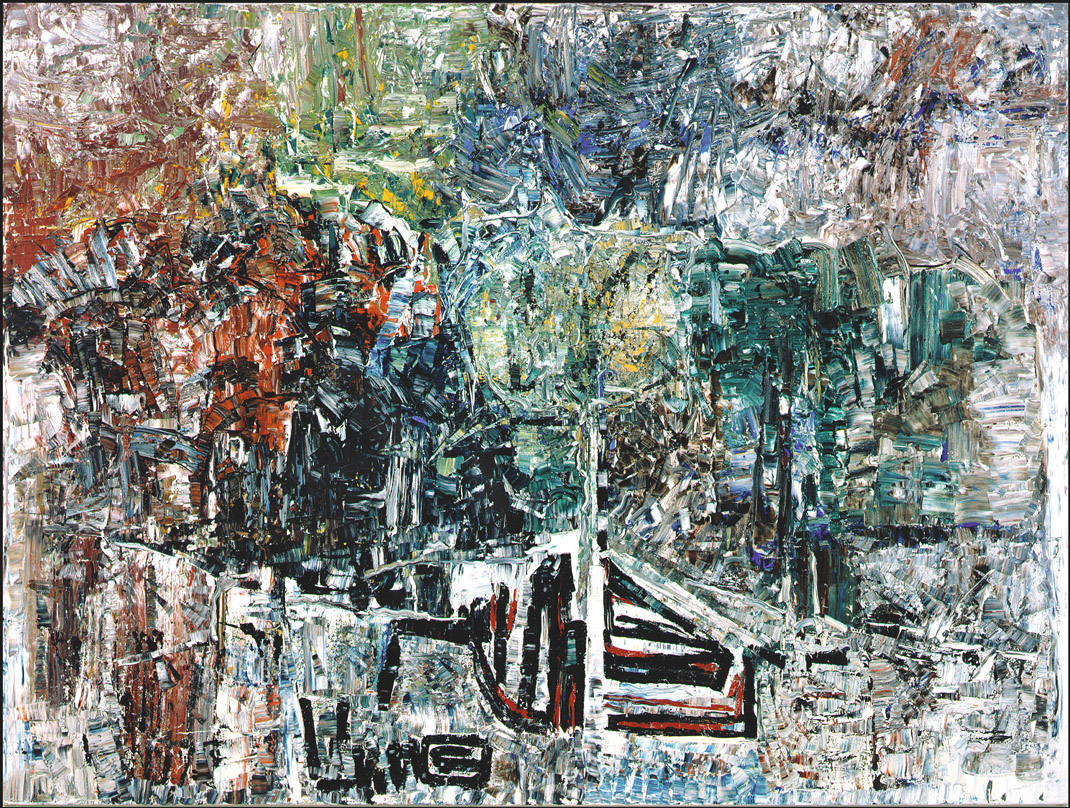 #16
#16
The Pond - Tribute to Gray Owl
With "The Pond - Homage to Gray Owl", Jean Paul Riopelle transforms an observed place into a pictorial construction. Jean Paul Riopelle pushes Canadian painting towards a dense and mobile abstraction. Color applied with a knife or by broad gestures becomes a living material where the landscape remains present without being literally described. The water here organizes depth, reflections and transition from one plane to another. It relates the solidity of the banks to the mobility of the sky and light. Dated 1970, this painting is made with oil on canvas. It belongs to abstract landscape and dialogues with the transformations of Canadian art in the 20th century. This tension between real place and pictorial order explains why the work retains such a clear presence today.
Image: Montreal Museum of Fine Arts · Documentary use; rights with the museum.
See the museum notice → #17
#17
Eclipse Sound and Bylot Island
"Eclipse Sound and Bylot Island" shows how Lawren S. Harris circulates the gaze between matter, light and territory. Lawren S. Harris simplifies the shapes to the point of giving the lake, the rock and the sky an almost spiritual presence. The clear volumes and silences between the planes make the landscape monumental. The pattern is deliberately condensed so that the color, touch and circulation of forms carries as much meaning as the place represented. Dated 1930, this painting is made with oil on a wooden panel. It belongs to a group of seven and entourage and dialogues with the transformations of Canadian art in the 20th century. Its place in this journey is due to this ability to make a territory recognizable while affirming the autonomy of painting.
Image: McMichael Canadian Art Collection · Documentary use; rights with the museum.
See the museum notice → #18
#18
Miners' houses, Glacier Bay
In "Miners' Houses, Glacier Bay", Lawren S. Harris favors the rhythm of forms before descriptive detail. Lawren S. Harris simplifies the shapes to the point of giving the lake, the rock and the sky an almost spiritual presence. The clear volumes and silences between the planes make the landscape monumental. The water here organizes the depth, the reflections and the passage from a plane to the other. It relates the solidity of the banks to the mobility of the sky and light. Dated around 1925, this painting is made with oil on panel or canvas. It belongs to a group of seven and dialogues with the transformations of Canadian art in the 20th century. The image and button come from the corresponding file in the Alpha Reproduction store, where this painting is offered for reproduction. Compared to the other works in the classification, it sheds light on the transition from an observed landscape to a modern language of color.
Image: Alpha Reproduction · Reproduction available.
See this reproduction → #19
#19
Lake and mountains
The strength of "Lake and Mountains" lies in the balance between immediate sensation and surface organization. Lawren S. Harris simplifies the shapes to the point of giving the lake, the rock and the sky an almost spiritual presence. The clear volumes and silences between the planes make the landscape monumental. The water here organizes the depth, the reflections and the passage from one plane to another. She puts in relation to the solidity of the banks with the mobility of sky and light. Dated 1928, this painting is made with oil on canvas. It belongs to the group of seven and dialogues with the transformations of Canadian art in the 20th century. The painting thus remains a useful reference point for following the continuity between the experience of the North, the Group of Seven and post-war abstractions.
Image: National Gallery of Canada · Documentary use; rights with the museum.
See the museum notice → #20
#20
Maligne Lake, Jasper Park
Beneath its apparent simplicity, "Maligne Lake, Jasper Park" focuses a reflection on how to paint Canada. Lawren S. Harris simplifies the shapes to the point of giving the lake, the rock and the sky an almost spiritual presence. The clear volumes and silences between the planes make the landscape monumental. The water here organizes the depth, the reflections and the passage from one plane to another. It connects the solidity of the banks with the mobility of sky and light. Dated 1924, this painting is made with oil on canvas. It belongs to the group of seven and dialogues with the transformations of Canadian art in the 20th century. This tension between real place and pictorial order explains why the work retains such a clear presence today.
Image: National Gallery of Canada · Documentary use; rights with the museum.
See the museum notice → #21
#21
Montreal River
With "Rivière Montréal", Lawren S. Harris transforms an observed place into a pictorial construction. Lawren S. Harris simplifies the shapes to the point of giving the lake, the rock and the sky an almost spiritual presence. The clear volumes and silences between the planes make the landscape monumental. The water here organizes the depth, the reflections and the passage from one plane to another. She connects the solidity of the banks with the mobility of sky and light. Dated around 1920, this painting is made with oil on cardboard. It belongs to a group of seven and entourage and dialogues with the transformations of Canadian art in the 20th century. Its place in this journey is due to this ability to make a territory recognizable while affirming the autonomy of painting.
Image: McMichael Canadian Art Collection · Documentary use; rights with the museum.
See the museum notice → #22
#22
Canadian jungle
"Canadian Jungle" shows how Arthur Lismer circulates the gaze between matter, light and territory. Arthur Lismer favors robust shores, dense forests and ground movements. His energetic touch gives the Canadian landscape a lively materiality, made up of accidents, recoveries and tensions. The pattern is deliberately condensed so that the color, touch and circulation of forms carries as much meaning as the place represented. Dated 1946, this painting is made with oil on canvas. It belongs to the group of seven and entourage and dialogues with the transformations of Canadian art in the 20th century. Compared to the other works in the classification, it sheds light on the transition from an observed landscape to a modern language of color.
Image: McMichael Canadian Art Collection · Documentary use; rights with the museum.
See the museum notice → #23
#23
Flamboyant autumn
In "Flamboyant Autumn", AJ Casson favors the rhythm of shapes before descriptive detail. AJ Casson simplifies villages, hills and lakes into large, ordered shapes. This calm geometry extends the heritage of the Group of Seven while asserting a quieter sensitivity. The pattern is deliberately condensed so that the color, touch and circulation of shapes carry as much meaning as the place represented. Dated 1936, this painting is made in oil on canvas mounted on cardboard. It belongs to the group of seven and entourage and dialogues with the transformations of Canadian art in the 20th century. The painting thus remains a useful reference point for following the continuity between the experience of the North, the Group of Seven and post-war abstractions.
Image: McMichael Canadian Art Collection · Documentary use; rights with the museum.
See the museum notice → #24
#24
Algoma Forest
The strength of "Algoma Forest" lies in the balance between immediate sensation and surface organization. JEH MacDonald organizes the landscape in colored masses, ascending lines and contrasts of light. His painting links the observation of a specific place to a decorative desire which enlarges the sensation of territory. Trees do not play the role of a simple natural setting. Trunks, branches and foliage form a framework which measures space and makes the thrust of life perceptible. Dated 1919, this painting is made with oil on panel. It belongs to a group of seven and entourage and dialogues with the transformations of Canadian art in the 20th century. This tension between real place and pictorial order explains why the work retains such a clear presence today.
Image: McMichael Canadian Art Collection · Documentary use; rights with the museum.
See the museum notice → #25
#25
Iceberg
Beneath its apparent simplicity, "Iceberg" focuses a reflection on how to paint Canada. FH Varley treats the landscape as a sensitive state. Modulated colors and soft contours move the image from geographical description to an interior atmosphere. The cold range and light intervals make the climate a subject in its own right. Snow or ice does not does not cover the composition: it reveals its main lines. Dated around 1938, this painting is made with oil on a wooden panel. It belongs to a group of seven and entourage and dialogues with the transformations of Canadian art in the 20th century. Its place in this journey is due to this ability to make a territory recognizable while affirming the autonomy of painting.
Image: McMichael Canadian Art Collection · Documentary use; rights with the museum.
See the museum notice →Algoma, Algonquin Park, Lake Superior and Georgian Bay become the laboratories of modern national painting.
 #26
#26
Blue waters, Georgian Bay
With "Blue Waters, Georgian Bay", AY Jackson transforms an observed place into a pictorial construction. AY Jackson travels the country and transforms its roads, villages, snows and reliefs into flexible compositions. Diagonals and curves lead the eye without freezing space into a simple panorama. The water here organizes the depth, the reflections and the passage from one plane to another. She puts in relationship the solidity of the banks with the mobility of the sky and light. Dated around 1932, this painting is made with oil on a wooden panel. It belongs to the group of seven and entourage and dialogues with the transformations of Canadian art in the 20th century. Compared to the other works in the classification, it illuminates the transition from an observed landscape to a modern language of color.
Image: McMichael Canadian Art Collection · Documentary use; rights with the museum.
See the museum notice → #27
#27
In the North
"In the North" shows how Tom Thomson circulates the gaze between matter, light and territory. Tom Thomson makes landscape a direct experience of color and climate. Its small panels painted on the pattern condense water, trees, wind and seasonal changes into immediately readable rhythms. The cold range and bright intervals make the climate a subject to full part. Snow or ice does not cover the composition: it reveals its lines of force. Dated 1915, this painting is made with oil on panel or canvas. It belongs to a precursor of the group of seven and dialogues with the transformations of Canadian art in the 20th century. The image and button come from the corresponding file in the Alpha Reproduction store, where this painting is offered for reproduction. The painting thus remains a useful reference point for following the continuity between the experience of the North, the Group of Seven and post-war abstractions.
Image: Alpha Reproduction · Reproduction available.
See this reproduction → #28
#28
First snow, Algoma
In "First Snow, Algoma", AY Jackson favors the rhythm of shapes before descriptive detail. AY Jackson travels the country and transforms its roads, villages, snows and reliefs into flexible compositions. Diagonals and curves lead the gaze without freezing space in a simple panorama. The cold range and luminous intervals make the climate a subject in its own right. Snow or the ice does not cover the composition: it reveals its main lines. Dated between 1919 and 1920, this painting is made with oil on canvas. It belongs to a group of seven and entourage and dialogues with the transformations of Canadian art in the 20th century. This tension between real place and pictorial order explains why the work retains such a clear presence today.
Image: McMichael Canadian Art Collection · Documentary use; rights with the museum.
See the museum notice → #29
#29
The Thunders
The strength of "Les Tonnerres" lies in the balance between immediate sensation and surface organization. Frank Johnston intensifies the light and contrasts of the North. Its colorful accords give the waters, drowned lands and forests an almost theatrical clarity. The pattern is deliberately condensed so that the color, touch and circulation of shapes carry as much meaning as the place represented. Dated around 1922, this painting is made with oil on panel. It belongs to a group of seven and entourage and dialogues with the transformations of Canadian art in the 20th century. Its place in this journey is due to this ability to make a territory recognizable while affirming the autonomy of painting.
Image: McMichael Canadian Art Collection · Documentary use; rights with the museum.
See the museum notice → #30
#30
The Cellist
Beneath its apparent simplicity, "The Cellist" focuses a reflection on how to paint Canada. Edwin Holgate combines rigorous observation and solid construction. The relief, trees and snow are ordered into clear planes which give the landscape its stability and depth. The pattern is deliberately condensed so that the color, touch and circulation of shapes carry as much meaning as the place represented. Dated 1923, this painting is made with oil on canvas. It belongs to Canadian modernity and dialogues with the transformations of Canadian art in the 20th century. Compared to the other works in the classification, it sheds light on the transition from an observed landscape to a modern language of color.
Image: McMichael Canadian Art Collection · Documentary use; rights with the museum.
See the museum notice → #31
#31
Old tree at dusk
With "Old Tree at Dusk", Emily Carr transforms an observed place into a pictorial construction. Emily Carr builds the forest and shoreline of the West Coast like moving organisms. Rising curves, dark masses and light create a feeling of continuous growth. Trees do not play the role of a simple natural setting. Trees do not play the role of a simple natural setting. Trunks, branches and foliage form one a framework that measures space and makes the surge of life perceptible. Dated around 1932, this painting is made with oil on canvas. It belongs to the modernity of the west coast and dialogues with the transformations of Canadian art in the 20th century. The painting thus remains a useful reference point for following the continuity between the experience of the North, the Group of Seven and post-war abstractions.
Image: McMichael Canadian Art Collection · Documentary use; rights with the museum.
See the museum notice → #32
#32
The Ravine II
"The Ravine II" shows how David Milne circulates the gaze between matter, light and territory. David Milne often reduces the scene to a few nerve lines, reserves and spaced color chords. This economy transforms a house, a valley or a flower into an autonomous pictorial balance. The pattern is deliberately condensed so that color, touch and circulation shapes carry as much meaning as the place represented. Dated 1920, this painting is made with oil on canvas. It belongs to Canadian modernity and dialogues with the transformations of Canadian art in the 20th century. This tension between real place and pictorial order explains why the work retains such a clear presence today.
Image: McMichael Canadian Art Collection · Documentary use; rights with the museum.
See the museum notice → #33
#33
Panorama of La Cloche
In "Panorama de La Cloche", Franklin Carmichael favors the rhythm of shapes before descriptive detail. Franklin Carmichael seeks a clarity of structure where trunks, hills and reflections fit together precisely. The luminous color not only describes the season: it regulates the entire architecture of the image. The pattern is deliberately condensed so that the color, the touch and the circulation of forms carry as much meaning as the place represented. Dated 1939, this painting is made with oil on plywood. It belongs to a group of seven and entourage and dialogues with the transformations of Canadian art in the 20th century. Its place in this journey is due to this ability to make a territory recognizable while affirming the autonomy of painting.
Image: McMichael Canadian Art Collection · Documentary use; rights with the museum.
See the museum notice → #34
#34
Go-home Bay
The strength of "Baie Go-Home" lies in the balance between immediate sensation and organization of the surface. AY Jackson travels the country and transforms its roads, villages, snows and reliefs into flexible compositions. Diagonals and curves lead the gaze without freezing space into a simple panorama. The water here organizes the depth, the reflections and the passage from one plane to another. She puts in relationship the solidity of the banks with the mobility of the sky and light. Dated 1920, this painting is made with oil on a wooden panel. It belongs to the group of seven and entourage and dialogues with the transformations of Canadian art in the 20th century. Compared to the other works in the classification, it illuminates the transition from an observed landscape to a modern language of color.
Image: McMichael Canadian Art Collection · Documentary use; rights with the museum.
See the museum notice → #35
#35
Cathedral Peak and Lake O'Hara
Beneath its apparent simplicity, "Cathedral Peak and Lake O'Hara" focuses a reflection on how to paint Canada. JEH MacDonald organizes the landscape by colored masses, ascending lines and contrasts of light. His painting links the observation of a specific place to a decorative desire which enlarges the sensation of territory. The water here organizes depth, reflections and transition from one plane to another. It relates the solidity of the banks to the mobility of the sky and light. Dated 1927, this painting is made with oil on cardboard. It belongs to the group of seven and entourage and dialogues with the transformations of Canadian art in the 20th century. The painting thus remains a useful reference point for following the continuity between the experience of the North, the Group of the Seven and post-war abstractions.
Image: McMichael Canadian Art Collection · Documentary use; rights with the museum.
See the museum notice → #36
#36
Scorched earth
With "Scorched Earth", Tom Thomson transforms an observed place into a pictorial construction. Tom Thomson makes landscape a direct experience of color and climate. Its small panels painted on the pattern condense water, trees, wind and seasonal changes into immediately readable rhythms. The pattern is deliberately condensed so that the color, touch and circulation of shapes carry as much meaning as the place represented. Dated 1915, this painting is made with oil on panel or canvas. It belongs to the precursor of the group of seven and dialogues with the transformations of Canadian art in the 20th century. The image and button come from the corresponding file in the Alpha Reproduction store, where this painting is offered for reproduction. This tension between real place and pictorial order explains why the work retains such a clear presence today.
Image: Alpha Reproduction · Reproduction available.
See this reproduction → #37
#37
Aurora borealis
"Aurore boréale" shows how Tom Thomson circulates the gaze between matter, light and territory. Tom Thomson makes landscape a direct experience of color and climate. Its small panels painted on the pattern condense water, trees, wind and seasonal changes into immediately readable rhythms. The cold range and bright intervals make the climate a subject to full part. Snow or ice does not cover the composition: it reveals its lines of force. Dated 1917, this painting is made with oil on panel or canvas. It belongs to a precursor of the group of seven and dialogues with the transformations of Canadian art in the 20th century. The image and button come from the corresponding file in the Alpha Reproduction store, where this painting is offered for reproduction. Its place in this journey is due to this ability to make a territory recognizable while affirming the autonomy of painting.
Image: Alpha Reproduction · Reproduction available.
See this reproduction → #38
#38
West Coast Cove
In "Anse de la Côte Ouest", FH Varley favors the rhythm of shapes before descriptive detail. FH Varley treats the landscape as a sensitive state. The modulated colors and flexible contours move the image from geographical description to an interior atmosphere. The pattern is deliberately condensed so that the color, touch and circulation of shapes carry as much meaning that the place represented. Dated around 1933, this painting is made with oil on plywood. It belongs to the group of seven and entourage and dialogues with the transformations of Canadian art in the 20th century. Compared to the other works in the classification, it sheds light on the transition from an observed landscape to a modern language of color.
Image: McMichael Canadian Art Collection · Documentary use; rights with the museum.
See the museum notice → #39
#39
Dark Earth, Lake Superior
The strength of "Dark Earth, Lake Superior" lies in the balance between immediate sensation and surface organization. AJ Casson simplifies villages, hills and lakes into large, ordered shapes. This calm geometry extends the heritage of the Group of Seven while asserting a quieter sensitivity. The water here organizes depth, reflections and the passage from one plane to another. She relates the solidity of the banks to the mobility of sky and light. Dated around 1928, this painting is made with oil on cardboard. It belongs to the group of seven and entourage and dialogues with the transformations of Canadian art in the 20th century. The painting thus remains a useful reference point for following the continuity between the experience of the North, the Group of Seven and abstractions postwar.
Image: McMichael Canadian Art Collection · Documentary use; rights with the museum.
See the museum notice → #40
#40
Forest
Beneath its apparent simplicity, "Forest" focuses a reflection on how to paint Canada. Emily Carr builds the forest and the West Coast shoreline like moving organisms. Rising curves, dark masses and light create a feeling of continuous growth. Trees do not play the role of a simple natural setting. Trunks, branches and foliage form a framework that measures space and makes the surge of life noticeable. Dated between 1932 and 1933, this painting is made with oil on paper. It belongs to the modernity of the west coast and dialogues with the transformations of Canadian art in the 20th century. This tension between real place and pictorial order explains why the work retains such a clear presence today.
Image: McMichael Canadian Art Collection · Documentary use; rights with the museum.
See the museum notice → #41
#41
Winter beauty
With "Winter Beauty", Frank Johnston transforms an observed place into a pictorial construction. Frank Johnston intensifies the light and contrasts of the North. Its colorful accords give the waters, drowned lands and forests an almost theatrical clarity. The cold range and luminous intervals make the climate a subject in its own right. Snow or ice does not cover the composition: it reveals its main lines. Dated around 1935, this painting is made with oil on panel. It belongs to a group of seven and entourage and dialogues with the transformations of Canadian art in the 20th century. Its place in this journey is due to this ability to make a territory recognizable while affirming the autonomy of painting.
Image: McMichael Canadian Art Collection · Documentary use; rights with the museum.
See the museum notice → #42
#42
Blue Church
"Blue Church" shows how David Milne circulates the gaze between matter, light and territory. David Milne often reduces the scene to a few nerve lines, reservations and spaced color agreements. This economy transforms a house, a valley or a flower into an autonomous pictorial balance. Architecture and the path introduce a human presence without interrupting the rhythm of the territory. The built volumes become markers of color and scale. Dated around 1920, this painting is made with oil on canvas adhered to hard panel. It belongs to Canadian modernity and dialogues with the transformations of Canadian art in the 20th century. Compared to the other works in the classification, it sheds light on the transition from an observed landscape to a modern language of the color.
Image: McMichael Canadian Art Collection · Documentary use; rights with the museum.
See the museum notice → #43
#43
Young red tree
In "Young Red Tree", Arthur Lismer favors the rhythm of shapes before descriptive detail. Arthur Lismer favors robust shores, dense forests and ground movements. His energetic touch gives the Canadian landscape a lively materiality, made up of accidents, recoveries and tensions. Trees do not play the role of a simple natural setting. Trunks, branches and foliage forms a framework which measures space and makes the thrust of life perceptible. Dated 1929, this painting is made with oil on a wooden panel. It belongs to the group of seven and entourage and dialogues with the transformations of Canadian art in the 20th century. The painting thus remains a useful reference point for following the continuity between the experience of the North, the Group of Seven and the postwar abstractions.
Image: McMichael Canadian Art Collection · Documentary use; rights with the museum.
See the museum notice → #44
#44
Young girl in red
The strength of "Young Girl in Red" lies in the balance between immediate sensation and surface organization. FH Varley treats the landscape as a sensitive state. The modulated colors and soft contours move the image from geographical description to an interior atmosphere. The pattern is deliberately condensed so that the color, touch and circulation of shapes carry as much meaning as the place represented. Dated between 1920 and 1921, this painting is made with oil on canvas. It belongs to a group of seven and entourage and dialogues with the transformations of Canadian art in the 20th century. This tension between real place and pictorial order explains why the work retains such a clear presence today.
Image: McMichael Canadian Art Collection · Documentary use; rights with the museum.
See the museum notice → #45
#45
Norval
Beneath its apparent simplicity, "Norval" focuses a reflection on how to paint Canada. AJ Casson simplifies villages, hills and lakes into large, ordered shapes. This calm geometry extends the heritage of the Group of Seven while asserting a quieter sensitivity. The pattern is deliberately condensed so that the color, touch and circulation of shapes carry as much meaning as the place represented. Dated around 1929, this painting is made with oil on cardboard. It belongs to a group of seven and entourage and dialogues with the transformations of Canadian art in the 20th century. Its place in this journey is due to this ability to make a territory recognizable while affirming the autonomy of painting.
Image: McMichael Canadian Art Collection · Documentary use; rights with the museum.
See the museum notice → #46
#46
Aurore, Georgian Bay, Pointe-au-Baril
With "Aurore, Georgian Bay, Pointe-au-Baril", JEH MacDonald transforms an observed place into a pictorial construction. JEH MacDonald organizes the landscape by colored masses, ascending lines and contrasts of light. His painting links the observation of a specific place to a decorative desire which enlarges the sensation of territory. The cold range and the luminous intervals make the climate a subject in its own right. Snow or ice does not cover the composition: it reveals its main lines. Dated 1931, this painting is made with oil on cardboard. It belongs to a group of seven and entourage and dialogues with the transformations of Canadian art in the 20th century. Compared to the other works in the classification, it sheds light on the transition from an observed landscape to a modern language color.
Image: McMichael Canadian Art Collection · Documentary use; rights with the museum.
See the museum notice → #47
#47
White waters
"White Waters" shows how Franklin Carmichael circulates the gaze between matter, light and territory. Franklin Carmichael seeks a clarity of structure where trunks, hills and reflections fit together precisely. The luminous color not only describes the season: it regulates the entire architecture of the image. The water here organizes depth, reflections and transition from one plane to another. It relates the solidity of the banks to the mobility of the sky and light. Dated 1943, this painting is made in tempera on panel. It belongs to the group of seven and entourage and dialogues with the transformations of Canadian art in the 20th century. The painting thus remains a useful reference point for following the continuity between the experience of the North, the Group of the Seven and post-war abstractions.
Image: McMichael Canadian Art Collection · Documentary use; rights with the museum.
See the museum notice → #48
#48
Debacle
In "Debacle", Tom Thomson favors the rhythm of shapes before descriptive detail. Tom Thomson makes landscape a direct experience of color and climate. Its small panels painted on the pattern condense water, trees, wind and seasonal changes into immediately readable rhythms. The pattern is deliberately condensed so that color, touch and circulation shapes carry as much meaning as the place represented. Dated 1915, this painting is made with oil on panel or canvas. It belongs to the precursor of the group of seven and dialogues with the transformations of Canadian art in the 20th century. The image and button come from the corresponding file in the Alpha Reproduction store, where this painting is offered for reproduction. This tension between real place and pictorial order explains why the work retains such a clear presence today.
Image: Alpha Reproduction · Reproduction available.
See this reproduction → #49
#49
Thaw: snow banks
The strength of "Thaw: Snow Banks" lies in the balance between immediate sensation and surface organization. Tom Thomson makes the landscape a direct experience of color and climate. Its small panels painted on the pattern condense water, trees, wind and seasonal changes into immediately readable rhythms. The cold range and bright intervals make the climate one subject in its own right. Snow or ice does not cover the composition: it reveals its main lines. Dated 1916, this painting is made with oil on panel or canvas. It belongs to a precursor of the group of seven and dialogues with the transformations of Canadian art in the 20th century. The image and button come from the corresponding file in the Alpha Reproduction store, where this painting is offered for reproduction. Its place in this journey is due to this ability to make a territory recognizable while affirming the autonomy of painting.
Image: Alpha Reproduction · Reproduction available.
See this reproduction → #50
#50
Moose pond
Beneath its apparent simplicity, "Moose Pond" focuses a reflection on how to paint Canada. Frank Johnston intensifies the light and contrasts of the North. Its colorful accords give the waters, drowned lands and forests an almost theatrical clarity. The water here organizes depth, reflections and the passage from one plane to another. It connects the solidity of shores with the mobility of sky and light. Dated 1918, this painting is made with oil on cardboard. It belongs to the group of seven and entourage and dialogues with the transformations of Canadian art in the 20th century. Compared to the other works in the classification, it illuminates the transition from an observed landscape to a modern language of color.
Image: McMichael Canadian Art Collection · Documentary use; rights with the museum.
See the museum notice →Portraits, coasts, villages, mountains and forests show that Canadian modernity is not just a single landscape.
 #51
#51
Storm, Georgian Bay
With "Tempête, Georgian Bay", AY Jackson transforms an observed place into a pictorial construction. AY Jackson travels the country and transforms its roads, villages, snows and reliefs into flexible compositions. Diagonals and curves lead the gaze without freezing space into a simple panorama. The water here organizes the depth, the reflections and the passage from one plane to another. She puts in relationship the solidity of the banks with the mobility of the sky and light. Dated around 1920, this painting is made with oil on a wooden panel. It belongs to the group of seven and entourage and dialogues with the transformations of Canadian art in the 20th century. The painting thus remains a useful reference point for following the continuity between the experience of the North, the Group of Seven and abstractions postwar.
Image: McMichael Canadian Art Collection · Documentary use; rights with the museum.
See the museum notice → #52
#52
Mount Cathedral
"Mount Cathedral" shows how JEH MacDonald circulates the gaze between matter, light and territory. JEH MacDonald organizes the landscape by colored masses, ascending lines and contrasts of light. His painting connects the observation of a specific place to a decorative desire which enlarges the sensation of territory. The pattern is deliberately condensed so that the color touches it and the circulation of forms carries as much meaning as the place represented. Dated 1927, this painting is made with oil on cardboard. It belongs to a group of seven and entourage and dialogues with the transformations of Canadian art in the 20th century. This tension between real place and pictorial order explains why the work retains such a clear presence today.
Image: McMichael Canadian Art Collection · Documentary use; rights with the museum.
See the museum notice → #53
#53
Shore
In "Shore", Emily Carr favors the rhythm of shapes before descriptive detail. Emily Carr builds the forest and the shore of the West Coast like moving organisms. Rising curves, dark masses and light create a feeling of continuous growth. The water here organizes depth, reflections and the passage from one plane to another. It connects solidity banks with the mobility of sky and light. Dated 1936, this painting is made with oil on canvas. It belongs to the modernity of the west coast and dialogues with the transformations of Canadian art in the 20th century. Its place in this journey is due to this ability to make a territory recognizable while affirming the autonomy of painting.
Image: McMichael Canadian Art Collection · Documentary use; rights with the museum.
See the museum notice → #54
#54
Bright river
The strength of "Luminous River" lies in the balance between immediate sensation and surface organization. David Milne often reduces the scene to a few nerve lines, reserves and spaced color agreements. This economy transforms a house, a valley or a flower into an autonomous pictorial balance. The water here organizes depth, reflections and the passage from one plane to another. It connects the solidity of the banks with the mobility of the sky and light. Dated 1933, this painting is made with oil on canvas. It belongs to Canadian modernity and dialogues with the transformations of Canadian art in the 20th century. Compared to the other works in the classification, it illuminates the transition from an observed landscape to a modern language of color.
Image: McMichael Canadian Art Collection · Documentary use; rights with the museum.
See the museum notice → #55
#55
Lake Superior
Beneath its apparent simplicity, "Lake Superior" focuses a reflection on how to paint Canada. Arthur Lismer favors robust shores, dense forests and ground movements. His energetic touch gives the Canadian landscape a lively materiality, made up of accidents, recoveries and tensions. The water here organizes the depth, the reflections and the passage from a plane to the other. It relates the solidity of the banks to the mobility of the sky and light. Dated 1927, this painting is made with oil on a wooden panel. It belongs to the group of seven and entourage and dialogues with the transformations of Canadian art in the 20th century. The painting thus remains a useful reference point for following the continuity between the experience of the North, the Group of Seven and post-war abstractions.
Image: McMichael Canadian Art Collection · Documentary use; rights with the museum.
See the museum notice →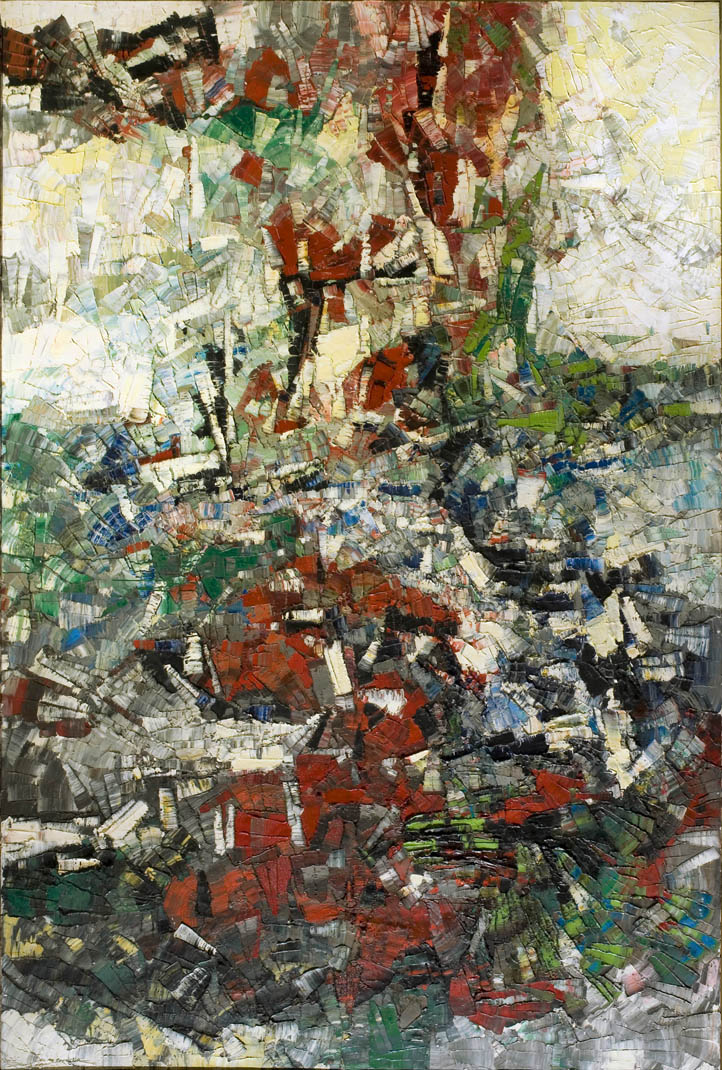 #56
#56
Gravity
With "Gravity", Jean Paul Riopelle transforms an observed place into a pictorial construction. Jean Paul Riopelle pushes Canadian painting towards a dense and mobile abstraction. Color applied with a knife or by broad gestures becomes a living material where the landscape remains present without being literally described. The pattern is deliberately condensed so that the color, the touch and the circulation of forms carries as much meaning as the place represented. Dated 1956, this painting is made with oil on canvas. It belongs to lyrical abstraction and automatism and dialogues with the transformations of Canadian art in the 20th century. This tension between real place and pictorial order explains why the work retains such a clear presence today.
Image: Montreal Museum of Fine Arts · Documentary use; rights with the museum.
See the museum notice → #57
#57
Undergrowth stream, Algoma
"Underwood stream, Algoma" shows how JEH MacDonald circulates the gaze between matter, light and territory. JEH MacDonald organizes the landscape by colored masses, ascending lines and contrasts of light. His painting links the observation of a specific place to a decorative desire which enlarges the sensation of territory. Water here organizes depth, reflections and transition from one plane to another. It relates the solidity of the banks to the mobility of the sky and light. Dated 1918, this painting is made with oil on cardboard. It belongs to a group of seven and entourage and dialogues with the transformations of Canadian art in the 20th century. Its place in this journey is due to this ability to make a territory recognizable while affirming the autonomy of the painting.
Image: McMichael Canadian Art Collection · Documentary use; rights with the museum.
See the museum notice → #58
#58
Autumn, Orillia
In "Autumn, Orillia", Franklin Carmichael favors the rhythm of shapes before descriptive detail. Franklin Carmichael seeks a clarity of structure where trunks, hills and reflections fit together precisely. The luminous color not only describes the season: it regulates the entire architecture of the image. The pattern is deliberately condensed so that the color, the touch and the circulation of forms carry as much meaning as the place represented. Dated 1926, this painting is made with oil on cardboard. It belongs to the group of seven and entourage and dialogues with the transformations of Canadian art in the 20th century. Compared to the other works in the classification, it sheds light on the transition from an observed landscape to a modern language of color.
Image: McMichael Canadian Art Collection · Documentary use; rights with the museum.
See the museum notice → #59
#59
Dead tree, Garibaldi park
The strength of "Dead Tree, Garibaldi Park" lies in the balance between immediate sensation and surface organization. FH Varley treats the landscape as a sensitive state. The modulated colors and soft contours move the image from geographical description to an interior atmosphere. Trees do not play the role of a simple natural setting. Trees do not play the role of a simple natural setting. Trunks, branches and foliage form a framework that measures space and makes the thrust of life noticeable. Dated 1927, this painting is made with oil on a wooden panel mounted on plywood. It belongs to the group of seven and entourage and dialogues with the transformations of Canadian art in the 20th century. The painting thus remains a useful reference point for following the continuity between the experience of the North, the Group of Seven and postwar abstractions.
Image: McMichael Canadian Art Collection · Documentary use; rights with the museum.
See the museum notice → #60
#60
Kleinburg
Beneath its apparent simplicity, "Kleinburg" focuses a reflection on how to paint Canada. AJ Casson simplifies villages, hills and lakes into large, ordered shapes. This calm geometry extends the heritage of the Group of Seven while asserting a quieter sensitivity. The pattern is deliberately condensed so that the color, touch and circulation of shapes carry as much meaning as the place represented. Dated around 1929, this painting is made with oil on cardboard. It belongs to a group of seven and entourage and dialogues with the transformations of Canadian art in the 20th century. This tension between real place and pictorial order explains why the work retains such a clear presence today.
Image: McMichael Canadian Art Collection · Documentary use; rights with the museum.
See the museum notice → #61
#61
Tea Lake Dam
With "The Tea Lake Dam", Tom Thomson transforms an observed place into a pictorial construction. Tom Thomson makes landscape a direct experience of color and climate. Its small panels painted on the motif condense water, trees, wind and seasonal changes into immediately readable rhythms. The water here organizes depth, reflections and the passage from one plane to another. It connects the solidity of the banks with the mobility of sky and light. Dated 1914, this painting is made with oil on panel or canvas. It belongs to a precursor of the group of seven and dialogues with the transformations of Canadian art in the 20th century. The image and button come from the corresponding file in the Alpha Reproduction store, where this painting is offered for reproduction. Its place in this journey is due to this ability to make a territory recognizable while affirming the autonomy of painting.
Image: Alpha Reproduction · Reproduction available.
See this reproduction → #62
#62
Old wooden dam, Algonquin Park
"Old wooden dam, Algonquin Park" shows how Tom Thomson moves the gaze between matter, light and territory. Tom Thomson makes landscape a direct experience of color and climate. Its small panels painted on the pattern condense water, trees, wind and seasonal changes into immediately readable rhythms. Trees do not play the role of a simple natural setting. Trunks, branches and foliage form a framework which measures space and makes the growth of life noticeable. Dated 1912, this painting is made with oil on panel or canvas. It belongs to a precursor of the group of seven and dialogues with the transformations of Canadian art in the 20th century. The image and button come from the corresponding file in the Alpha store Reproduction, where this painting is offered for reproduction. Compared to the other works in the classification, it sheds light on the transition from an observed landscape to a modern language of color.
Image: Alpha Reproduction · Reproduction available.
See this reproduction → #63
#63
Kispiox
In "Kispiox", Emily Carr favors the rhythm of shapes before descriptive detail. Emily Carr builds the forest and shore of the West Coast like moving organisms. Rising curves, dark masses and light create a feeling of continuous growth. The pattern is deliberately condensed so that the color, touch and circulation of shapes carry as much meaning that the place represented. Dated 1912, this painting is made in oil on canvas. It belongs to the modernity of the west coast and dialogues with the transformations of Canadian art in the 20th century. The painting thus remains a useful reference point for following the continuity between the experience of the North, the Group of Seven and post-war abstractions.
Image: McMichael Canadian Art Collection · Documentary use; rights with the museum.
See the museum notice → #64
#64
Station, silo and cloud
The strength of "Station, Silo and Cloud" lies in the balance between immediate sensation and surface organization. David Milne often reduces the scene to a few nerve lines, reserves and spaced color chords. This economy transforms a house, a valley or a flower into an autonomous pictorial balance. The pattern is deliberately condensed so that the color, touch and circulation of forms carries as much meaning as the place represented. Dated 1932, this painting is made with oil on canvas. It belongs to Canadian modernity and dialogues with the transformations of Canadian art in the 20th century. This tension between real place and pictorial order explains why the work retains such a clear presence today.
Image: McMichael Canadian Art Collection · Documentary use; rights with the museum.
See the museum notice → #65
#65
Algoma Bush, Sept.
Beneath its apparent simplicity, "Algoma Bush, September" focuses a reflection on how to paint Canada. JEH MacDonald organizes the landscape by colored masses, ascending lines and contrasts of light. His painting links the observation of a specific place to a decorative desire which enlarges the sensation of territory. The pattern is deliberately condensed so that the color, the touch and the circulation of forms carry as much meaning as the place represented. Dated 1920, this painting is made with oil on cardboard. It belongs to a group of seven and entourage and dialogues with the transformations of Canadian art in the 20th century. Its place in this journey is due to this ability to make a territory recognizable while affirming the autonomy of painting.
Image: McMichael Canadian Art Collection · Documentary use; rights with the museum.
See the museum notice → #66
#66
The Bell, silhouette
With "The Bell, Silhouette", Franklin Carmichael transforms an observed place into a pictorial construction. Franklin Carmichael seeks structural clarity where trunks, hills and reflections fit together precisely. The luminous color not only describes the season: it regulates the entire architecture of the image. The pattern is deliberately condensed so that the color touches it and the circulation of forms carries as much meaning as the place represented. Dated 1939, this painting is made with oil on plywood. It belongs to the group of seven and entourage and dialogues with the transformations of Canadian art in the 20th century. Compared to the other works in the classification, it sheds light on the transition from an observed landscape to a modern language of color.
Image: McMichael Canadian Art Collection · Documentary use; rights with the museum.
See the museum notice → #67
#67
The Lions
"The Lions" shows how FH Varley circulates the gaze between matter, light and territory. FH Varley treats the landscape as a sensitive state. The modulated colors and flexible contours move the image from geographical description to an interior atmosphere. The pattern is deliberately condensed so that the color, touch and circulation of shapes carry as much meaning that the place represented. Dated around 1931, this painting is made in oil on wooden panel. It belongs to the group of seven and entourage and dialogues with the transformations of Canadian art in the 20th century. The painting thus remains a useful reference point for following the continuity between the experience of the North, the Group of Seven and post-war abstractions.
Image: McMichael Canadian Art Collection · Documentary use; rights with the museum.
See the museum notice → #68
#68
Old house, Parry Sound
In "Old House, Parry Sound", AJ Casson favors the rhythm of forms before descriptive detail. AJ Casson simplifies villages, hills and lakes into large, ordered shapes. This calm geometry extends the heritage of the Group of Seven while asserting a quieter sensitivity. Architecture and path introduce a human presence without interrupting the rhythm of territory. Built volumes become markers of color and scale. Dated around 1932, this painting is made with oil on canvas mounted on cardboard. It belongs to a group of seven and entourage and dialogues with the transformations of Canadian art in the 20th century. This tension between real place and pictorial order explains why the work retains such a clear presence today.
Image: McMichael Canadian Art Collection · Documentary use; rights with the museum.
See the museum notice → #69
#69
Spring at the French River
The strength of "Spring at the French River" lies in the balance between immediate sensation and surface organization. Tom Thomson makes the landscape a direct experience of color and climate. Its small panels painted on the pattern condense water, trees, wind and seasonal changes into immediately readable rhythms. The water here organizes depth, reflections and the transition from one plane to another. It relates the solidity of the banks to the mobility of the sky and light. Dated 1915, this painting is made with oil on panel or canvas. It belongs to a precursor of the group of seven and dialogues with the transformations of Canadian art in the 20th century. The image and button come from the corresponding file in the Alpha store Reproduction, where this painting is offered for reproduction. Its place in this journey is due to this ability to make a territory recognizable while affirming the autonomy of painting.
Image: Alpha Reproduction · Reproduction available.
See this reproduction → #70
#70
Dark waters
Beneath its apparent simplicity, "Dark Waters" focuses a reflection on how to paint Canada. Tom Thomson makes landscape a direct experience of color and climate. His small panels painted on the motif condense water, trees, wind and seasonal changes into immediately readable rhythms. The water here organizes the depth, reflections and passage of a plane to the other. It connects the solidity of the banks with the mobility of the sky and light. Dated 1916, this painting is made with oil on panel or canvas. It belongs to a precursor of the group of seven and dialogues with the transformations of Canadian art in the 20th century. The image and button come from the corresponding file in the Alpha Reproduction store, where this painting is offered for reproduction. Compared to the other works in the classification, it sheds light on the transition from an observed landscape to a modern language of color.
Image: Alpha Reproduction · Reproduction available.
See this reproduction → #71
#71
Melting snow
With "Smelting Snow", Edwin Holgate transforms an observed place into a pictorial construction. Edwin Holgate combines rigorous observation and solid construction. The relief, trees and snow are ordered into clear planes which give the landscape its stability and depth. The cold range and luminous intervals make the climate a subject in its own right. Snow or ice does not cover the composition: it reveals its main lines. Dated 1948, this painting is made with oil on a wooden panel. It belongs to Canadian modernity and dialogues with the transformations of Canadian art in the 20th century. The painting thus remains a useful reference point for following the continuity between the experience of the North, the Group of Seven and post-war abstractions.
Image: McMichael Canadian Art Collection · Documentary use; rights with the museum.
See the museum notice → #72
#72
New growth
"New Growth" shows how Emily Carr moves the gaze between matter, light and territory. Emily Carr builds the forest and the shore of the West Coast as moving organisms. Rising curves, dark masses and light create a feeling of continuous growth. The pattern is deliberately condensed so that the color, touch and circulation of shapes carry as much meaning as the place represented. Dated around 1936, this painting is made with oil on canvas. It belongs to the modernity of the west coast and dialogues with the transformations of Canadian art in the 20th century. This tension between real place and pictorial order explains why the work retains such a clear presence today.
Image: McMichael Canadian Art Collection · Documentary use; rights with the museum.
See the museum notice → #73
#73
Boat sheds, Glenmore Hotel
In "Boat sheds, Glenmore Hotel", David Milne favors the rhythm of shapes before descriptive detail. David Milne often reduces the scene to a few nervous lines, reserves and spaced color agreements. This economy transforms a house, a valley or a flower into an autonomous pictorial balance. The water here organizes the depth, the reflections and the transition from a plane to the other. It connects the solidity of the banks with the mobility of the sky and light. Dated 1926, this painting is made with oil on canvas. It belongs to Canadian modernity and dialogues with the transformations of Canadian art in the 20th century. Its place in this journey is due to this ability to make a territory recognizable while affirming the autonomy of painting.
Image: McMichael Canadian Art Collection · Documentary use; rights with the museum.
See the museum notice → #74
#74
Agawa River, Algoma
The strength of "Agawa River, Algoma" lies in the balance between immediate sensation and surface organization. JEH MacDonald organizes the landscape by colored masses, ascending lines and contrasts of light. His painting links the observation of a specific place to a decorative desire which enlarges the sensation of territory. The water here organizes the depth, the reflections and the passage of a plan to another. It relates the solidity of the banks to the mobility of the sky and light. Dated 1919, this painting is made with oil on cardboard. It belongs to the group of seven and entourage and dialogues with the transformations of Canadian art in the 20th century. Compared to the other works in the classification, it illuminates the transition from an observed landscape to a modern language of color.
Image: McMichael Canadian Art Collection · Documentary use; rights with the museum.
See the museum notice → #75
#75
Twisted pine
Beneath its apparent simplicity, "Twisted Pine" focuses a reflection on how to paint Canada. Franklin Carmichael seeks structural clarity where trunks, hills and reflections fit together precisely. The luminous color not only describes the season: it regulates the entire architecture of the image. Trees do not play the role of a simple natural setting. Trunks, branches and foliage form a framework which measures space and makes the growth of life noticeable. Dated 1939, this painting is made with oil on plywood. It belongs to the group of seven and entourage and dialogues with the transformations of Canadian art in the 20th century. The painting thus remains a useful reference point for following the continuity between the experience of the North, the Group of Seven and post-war abstractions.
Image: McMichael Canadian Art Collection · Documentary use; rights with the museum.
See the museum notice →Riopelle's late studies, West Coast experiences, and abstraction complete the story all the way to the Icebergs.
 #76
#76
Naked in the Laurentians
With "Nus dans les Laurentides", Edwin Holgate transforms an observed place into a pictorial construction. Edwin Holgate combines rigorous observation and solid construction. The relief, trees and snow are ordered into clear planes which give the landscape its stability and depth. The pattern is deliberately condensed so that the color, touch and circulation of shapes carry so much meaning that the place represented. Dated 1930s, this painting is made with oil on canvas. It belongs to Canadian modernity and dialogues with the transformations of Canadian art in the 20th century. This tension between real place and pictorial order explains why the work retains such a clear presence today.
Image: McMichael Canadian Art Collection · Documentary use; rights with the museum.
See the museum notice → #77
#77
Lake Canoe
"Canoe Lake" shows how Tom Thomson circulates the gaze between matter, light and territory. Tom Thomson makes landscape a direct experience of color and climate. Its small panels painted on the pattern condense water, trees, wind and seasonal changes into immediately readable rhythms. The water here organizes the depth, the reflections and the transition from a plane to the other. It relates the solidity of the banks to the mobility of the sky and light. Dated 1914, this painting is made with oil on panel or canvas. It belongs to a precursor of the group of seven and dialogues with the transformations of Canadian art in the 20th century. The image and button come from the corresponding file in the Alpha Reproduction store, where this painting is offered for reproduction. Its place in this journey is due to this ability to make a territory recognizable while affirming the autonomy of painting.
Image: Alpha Reproduction · Reproduction available.
See this reproduction → #78
#78
Split Rock, Georgian Bay
In "Split Rock, Georgian Bay", Tom Thomson favors the rhythm of shapes before descriptive detail. Tom Thomson makes landscape a direct experience of color and climate. Its small panels painted on the pattern condense water, trees, wind and seasonal changes into immediately readable rhythms. The water here organizes the depth, reflections and passage of a plan to another. It relates the solidity of the banks to the mobility of the sky and light. Dated 1914, this painting is made with oil on panel or canvas. It belongs to a precursor of the group of seven and dialogues with the transformations of Canadian art in the 20th century. The image and button come from the corresponding file in the Alpha Reproduction store, where this painting is offered for reproduction. Compared to the other works in the classification, it sheds light on the transition from an observed landscape to a modern language of color.
Image: Alpha Reproduction · Reproduction available.
See this reproduction → #79
#79
Swinging
The force of "Swing" lies in the balance between immediate sensation and surface organization. Emily Carr builds the forest and the West Coast shoreline as moving organisms. Rising curves, dark masses and light create a feeling of continuous growth. The pattern is deliberately condensed so that the color, touch and circulation of shapes carry as much meaning as the place represented. Dated around 1936, this painting is made with oil on canvas. It belongs to the modernity of the west coast and dialogues with the transformations of Canadian art in the 20th century. The painting thus remains a useful reference point for following the continuity between the experience of the North, the Group of Seven and post-war abstractions.
Image: McMichael Canadian Art Collection · Documentary use; rights with the museum.
See the museum notice → #80
#80
Algoma Landscape
Beneath its apparent simplicity, "Landscape of Algoma" focuses a reflection on how to paint Canada. Frank Johnston intensifies the light and contrasts of the North. Its colorful accords give the waters, drowned lands and forests an almost theatrical clarity. The pattern is deliberately condensed so that the color, touch and circulation of shapes carry so much meaning that the place represented. Dated 1918, this painting is made in gouache on cardboard mounted on canvas. It belongs to a group of seven and entourage and dialogues with the transformations of Canadian art in the 20th century. This tension between real place and pictorial order explains why the work retains such a clear presence today.
Image: McMichael Canadian Art Collection · Documentary use; rights with the museum.
See the museum notice → #81
#81
McGregor Bay
With "McGregor Bay", Franklin Carmichael transforms an observed place into a pictorial construction. Franklin Carmichael seeks structural clarity where trunks, hills and reflections fit together precisely. The luminous color not only describes the season: it regulates the entire architecture of the image. The water here organizes the depth, the reflections and the transition from a plane to the other. It connects the solidity of the banks with the mobility of the sky and light. Dated 1931, this painting is made with oil on canvas. It belongs to a group of seven and entourage and dialogues with the transformations of Canadian art in the 20th century. Its place in this journey is due to this ability to make a territory recognizable while affirming the autonomy of the painting.
Image: McMichael Canadian Art Collection · Documentary use; rights with the museum.
See the museum notice → #82
#82
Naked
"Nude" shows how Edwin Holgate circulates the gaze between matter, light and territory. Edwin Holgate combines rigorous observation and solid construction. The relief, trees and snow are ordered into clear planes which give the landscape its stability and depth. The pattern is deliberately condensed so that the color, touch and circulation of shapes carry as much meaning that the place represented. Dated around 1922, this painting is made with oil on a wooden panel. It belongs to Canadian modernity and dialogues with the transformations of Canadian art in the 20th century. Compared to the other works in the classification, it sheds light on the transition from an observed landscape to a modern language of color.
Image: McMichael Canadian Art Collection · Documentary use; rights with the museum.
See the museum notice → #83
#83
November in Algoma
In "November in Algoma", AY Jackson favors the rhythm of shapes before descriptive detail. AY Jackson travels the country and transforms its roads, villages, snows and reliefs into flexible compositions. Diagonals and curves lead the gaze without freezing space into a simple panorama. The pattern is deliberately condensed so that the color, touch and circulation of shapes carry as much meaning as the place represented. Dated 1934, this painting is made in oil on a wooden panel. It belongs to the group of seven and entourage and dialogues with the transformations of Canadian art in the 20th century. The painting thus remains a useful reference point for following the continuity between the experience of the North, the Group of Seven and post-war abstractions.
Image: McMichael Canadian Art Collection · Documentary use; rights with the museum.
See the museum notice → #84
#84
Giant's Tomb, Georgian Bay
The strength of "Giant's Tomb, Georgian Bay" lies in the balance between immediate sensation and surface organization. Tom Thomson makes the landscape a direct experience of color and climate. Its small panels painted on the pattern condense water, trees, wind and seasonal changes into immediately readable rhythms. The water here organizes depth, reflections and switching from one plane to another. It relates the solidity of the banks to the mobility of sky and light. Dated 1914 -1915, this painting is made with oil on panel or canvas. It belongs to a precursor of the group of seven and dialogues with the transformations of Canadian art in the 20th century. The image and button come from the corresponding file in the Alpha store Reproduction, where this painting is offered for reproduction. This tension between real place and pictorial order explains why the work retains such a clear presence today.
Image: Alpha Reproduction · Reproduction available.
See this reproduction → #85
#85
Gray day, Tomb of the giant
Beneath its apparent simplicity, "Gray Day, Tomb of the Giant" focuses a reflection on how to paint Canada. Tom Thomson makes landscape a direct experience of color and climate. His small panels painted on the motif condense water, trees, wind and seasonal changes into immediately readable rhythms. The water here organizes depth, reflections and switching from one plane to another. It relates the solidity of the banks to the mobility of sky and light. Dated 1914 -1915, this painting is made with oil on panel or canvas. It belongs to a precursor of the group of seven and dialogues with the transformations of Canadian art in the 20th century. The image and button come from the corresponding file in the Alpha store Reproduction, where this painting is offered for reproduction. Its place in this journey is due to this ability to make a territory recognizable while affirming the autonomy of painting.
Image: Alpha Reproduction · Reproduction available.
See this reproduction → #86
#86
Rain in the North
With "Rain in the North", Arthur Lismer transforms an observed place into a pictorial construction. Arthur Lismer favors robust shores, dense forests and ground movements. His energetic touch gives the Canadian landscape a lively materiality, made up of accidents, recoveries and tensions. The cold range and luminous intervals make the climate a subject in its own right. Snow or the ice does not cover the composition: it reveals its main lines. Dated around 1920, this painting is made with oil on a wooden panel. It belongs to the group of seven and entourage and dialogues with the transformations of Canadian art in the 20th century. Compared to the other works in the classification, it sheds light on the transition from an observed landscape to a modern language of color.
Image: McMichael Canadian Art Collection · Documentary use; rights with the museum.
See the museum notice → #87
#87
Drowned Earth, Algoma
"Drowned Earth, Algoma" shows how Frank Johnston circulates the gaze between matter, light and territory. Frank Johnston intensifies the light and contrasts of the North. Its colorful accords give the waters, drowned lands and forests an almost theatrical clarity. The pattern is deliberately condensed so that the color, touch and circulation of shapes carry as much meaning that the place represented. Dated 1918, this painting is made in gouache with watercolor undercoat on paper. It belongs to the group of seven and entourage and dialogues with the transformations of Canadian art in the 20th century. The painting thus remains a useful reference point for following the continuity between the experience of the North, the Group of Seven and post-war abstractions.
Image: McMichael Canadian Art Collection · Documentary use; rights with the museum.
See the museum notice → #88
#88
Small Cauchon lake
In "Petit lac Cauchon", Tom Thomson favors the rhythm of shapes before descriptive detail. Tom Thomson makes landscape a direct experience of color and climate. Its small panels painted on the pattern condense water, trees, wind and seasonal changes into immediately readable rhythms. The water here organizes the depth, the reflections and the transition from a plane to the other. It relates the solidity of the banks to the mobility of the sky and light. Dated 1916, this painting is made with oil on panel or canvas. It belongs to a precursor of the group of seven and dialogues with the transformations of Canadian art in the 20th century. The image and button come from the corresponding file in the Alpha Reproduction store, where this painting is offered for reproduction. This tension between real place and pictorial order explains why the work retains such a clear presence today.
Image: Alpha Reproduction · Reproduction available.
See this reproduction → #89
#89
Hill, Smoke Lake
The strength of "Coteau, Lac Smoke" lies in the balance between immediate sensation and surface organization. Tom Thomson makes the landscape a direct experience of color and climate. Its small panels painted on the pattern condense water, trees, wind and seasonal changes into immediately readable rhythms. The water here organizes the depth, reflections and passage of a plan to another. It relates the solidity of the banks to the mobility of the sky and light. Dated 1914, this painting is made with oil on panel or canvas. It belongs to a precursor of the group of seven and dialogues with the transformations of Canadian art in the 20th century. The image and button come from the corresponding file in the Alpha Reproduction store, where this painting is offered for reproduction. Its place in this journey is due to this ability to make a territory recognizable while affirming the autonomy of painting.
Image: Alpha Reproduction · Reproduction available.
See this reproduction → #90
#90
The Ice Cream Maker
Beneath its apparent simplicity, "La Glacière" focuses a reflection on how to paint Canada. Lawren S. Harris simplifies the shapes to the point of giving the lake, the rock and the sky an almost spiritual presence. The clear volumes and silences between the planes make the landscape monumental. The water here organizes the depth, the reflections and the passage from one plane to another. She puts in relationship the solidity of the banks with the mobility of the sky and light. Dated 1925, this painting is made with oil on cardboard. It belongs to the group of seven and entourage and dialogues with the transformations of Canadian art in the 20th century. Compared to the other works in the classification, it illuminates the transition from an observed landscape to a modern language of color.
Image: McMichael Canadian Art Collection · Documentary use; rights with the museum.
See the museum notice → #91
#91
Snow squalls, Pic Island
With "Snow Squalls, Pic Island", Lawren S. Harris transforms an observed place into a pictorial construction. Lawren S. Harris simplifies the shapes to the point of giving the lake, the rock and the sky an almost spiritual presence. The clear volumes and silences between the planes make the landscape monumental. The cold range and luminous intervals make the climate a subject in its own right. There snow or ice does not cover the composition: it reveals its main lines. Dated around 1924, this painting is made with oil on cardboard. It belongs to the group of seven and entourage and dialogues with the transformations of Canadian art in the 20th century. The painting thus remains a useful reference point for following the continuity between the experience of the North, the Group of Seven and the postwar abstractions.
Image: McMichael Canadian Art Collection · Documentary use; rights with the museum.
See the museum notice → #92
#92
Granges, La Malbaie, Quebec
"Granges, La Malbaie, Quebec" shows how AY Jackson circulates the gaze between matter, light and territory. AY Jackson travels the country and transforms its roads, villages, snows and reliefs into flexible compositions. Diagonals and curves lead the gaze without freezing space into a simple panorama. The water here organizes the depth, the reflections and the passage from a plane to the other. It relates the solidity of the banks to the mobility of the sky and light. Dated 1926, this painting is made with oil on a wooden panel. It belongs to the group of seven and entourage and dialogues with the transformations of Canadian art in the 20th century. This tension between real place and pictorial order explains why the work retains a presence today too net.
Image: McMichael Canadian Art Collection · Documentary use; rights with the museum.
See the museum notice → #93
#93
Forest, Algoma
In "Forest, Algoma", Arthur Lismer favors the rhythm of shapes before descriptive detail. Arthur Lismer favors robust shores, dense forests and ground movements. His energetic touch gives the Canadian landscape a lively materiality, made up of accidents, recoveries and tensions. Trees do not play the role of a simple natural setting. Trunks, branches and foliage form a framework that measures space and makes the surge of life perceptible. Dated 1922, this painting is made with oil on canvas. It belongs to a group of seven and entourage and dialogues with the transformations of Canadian art in the 20th century. Its place in this journey is due to this ability to make a territory recognizable while affirming the autonomy of painting.
Image: McMichael Canadian Art Collection · Documentary use; rights with the museum.
See the museum notice → #94
#94
Petawawa Gorge (early spring)
The strength of "Petawawa Gorge (early spring)" lies in the balance between immediate sensation and surface organization. Tom Thomson makes the landscape a direct experience of color and climate. Its small panels painted on the pattern condense water, trees, wind and seasonal changes into immediately readable rhythms. The pattern is deliberately condensed so that the color, the touch and the circulation of shapes carry as much meaning as the place represented. Dated 1917, this painting is made with oil on panel or canvas. It belongs to the precursor of the group of seven and dialogues with the transformations of Canadian art in the 20th century. The image and button come from the corresponding file in the Alpha Reproduction store, where this painting is offered for reproduction. Compared to the other works in the classification, it sheds light on the transition from an observed landscape to a modern language of color.
Image: Alpha Reproduction · Reproduction available.
See this reproduction → #95
#95
Sunset
Beneath its apparent simplicity, "Sunset" focuses on how to paint Canada. Tom Thomson makes landscape a direct experience of color and climate. His small panels painted on the motif condense water, trees, wind and seasonal changes into immediately readable rhythms. The pattern is deliberately condensed so that the color, the touch and the circulation of forms carry as much meaning as the place represented. Dated 1915, this painting is made with oil on panel or canvas. It belongs to a precursor of the group of seven and dialogues with the transformations of Canadian art in the 20th century. The image and button come from the corresponding file in the Alpha Reproduction store, where this painting is offered in reproduction. The painting thus remains a useful reference point for following the continuity between the experience of the North, the Group of Seven and post-war abstractions.
Image: Alpha Reproduction · Reproduction available.
See this reproduction → #96
#96
Moonlight, early evening
With "Moonlight, Early Evening", Tom Thomson transforms an observed place into a pictorial construction. Tom Thomson makes landscape a direct experience of color and climate. Its small panels painted on the pattern condense water, trees, wind and seasonal changes into immediately readable rhythms. The pattern is deliberately condensed so that the color, touch and the circulation of forms carries as much meaning as the place represented. Dated 1916, this painting is made with oil on panel or canvas. It belongs to a precursor of the group of seven and dialogues with the transformations of Canadian art in the 20th century. The image and button come from the corresponding file in the Alpha Reproduction store, where this painting is offered in reproduction. This tension between real place and pictorial order explains why the work retains such a clear presence today.
Image: Alpha Reproduction · Reproduction available.
See this reproduction → #97
#97
Wooden dam
"Wooden Dam" shows how Tom Thomson moves the gaze between matter, light and territory. Tom Thomson makes landscape a direct experience of color and climate. Its small panels painted on the pattern condense water, trees, wind and seasonal changes into immediately readable rhythms. Trees do not play the role of a simple natural setting. Trunks, branches and foliage form a framework which measures space and makes the growth of life noticeable. Dated 1916, this painting is made with oil on panel or canvas. It belongs to a precursor of the group of seven and dialogues with the transformations of Canadian art in the 20th century. The image and button come from the corresponding file in the Alpha Reproduction store, where this painting is offered for reproduction. Its place in this journey is due to this ability to make a territory recognizable while affirming the autonomy of painting.
Image: Alpha Reproduction · Reproduction available.
See this reproduction → #98
#98
Autumn foliage
In "Autumn Foliage", Tom Thomson favors the rhythm of shapes before descriptive detail. Tom Thomson makes landscape a direct experience of color and climate. His small panels painted on the pattern condense water, trees, wind and seasonal changes into immediately readable rhythms. The pattern is deliberately condensed so that the color, touch and circulation of forms carries as much meaning as the place represented. Dated 1916, this painting is made with oil on panel or canvas. It belongs to a precursor of the group of seven and dialogues with the transformations of Canadian art in the 20th century. The image and button come from the corresponding file in the Alpha Reproduction store, where this painting is offered in reproduction. Compared to the other works in the classification, it sheds light on the transition from an observed landscape to a modern language of color.
Image: Alpha Reproduction · Reproduction available.
See this reproduction → #99
#99
Decorative landscape: birches
The strength of "Decorative Landscape: Birch" lies in the balance between immediate sensation and surface organization. Tom Thomson makes landscape a direct experience of color and climate. Its small panels painted on the pattern condense water, trees, wind and seasonal changes into immediately readable rhythms. The water here organizes depth, reflections and switching from one plane to another. It relates the solidity of the banks to the mobility of sky and light. Dated 1915, this painting is made with oil on panel or canvas. It belongs to a precursor of the group of seven and dialogues with the transformations of Canadian art in the 20th century. The image and button come from the corresponding file in the Alpha Reproduction store, where this painting is offered for reproduction. The painting thus remains a useful reference point for following the continuity between the experience of the North, the Group of Seven and post-war abstractions.
Image: Alpha Reproduction · Reproduction available.
See this reproduction →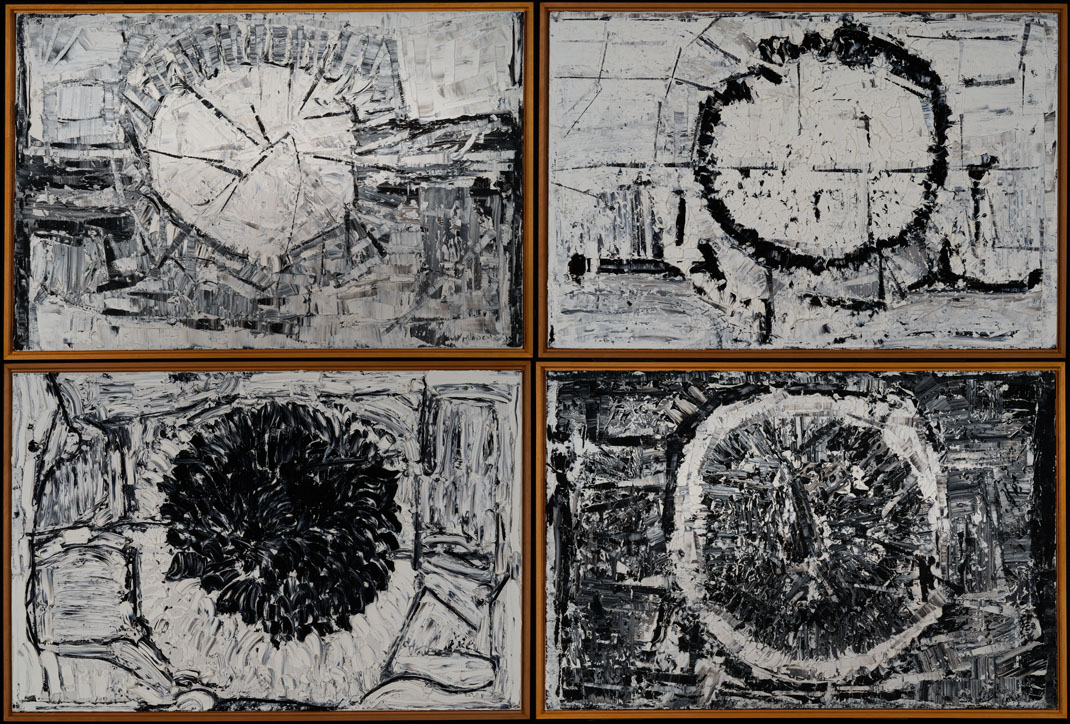 #100
#100
Midnight Sun (Quartet in white)
Beneath its apparent simplicity, "Midnight Sun (Quartet in White)" focuses a reflection on how to paint Canada. Jean Paul Riopelle pushes Canadian painting towards a dense and mobile abstraction. Color applied with a knife or by broad gestures becomes a living material where the landscape remains present without being literally described. The cold range and intervals luminous make the climate a subject in its own right. Snow or ice does not cover the composition: it reveals its main lines. Dated 1977, this painting is made with oil on canvas. It belongs to the iceberg series and dialogues with the transformations of Canadian art in the 20th century. This tension between real place and pictorial order explains why the work preserves today such a clear presence.
Image: Montreal Museum of Fine Arts · Documentary use; rights with the museum.
See the museum notice →What the journey reveals
Three forces of Canadian painting
Pattern, climate and matter connect generations without erasing their differences.
Browse
Artists work on roads, lakes and shores to build a lived geography.
Simplify
Shapes become sharper so that color and rhythm carry the experience of the place.
Transform
With Carr, Milne then Riopelle, the landscape slides towards the autonomy of the painted surface.
A plural modernity
From Algonquin Park to Icebergs
Before the official founding of the Group of Seven in 1920, Tom Thomson and several future members were already experimenting with direct, mobile and colorful painting. The small format allows you to quickly capture a change in light or season.
Algoma, Lake Superior, Georgian Bay and the Rockies then became grounds for invention. The territory is not only documented: it is condensed into lines, masses, rhythms and chromatic chords.
Emily Carr gives the West Coast an organic dynamic, David Milne radicalizes the economy of means and Riopelle transforms the memory of the North into abstract matter. The landscape then survives even in the gesture.
Four reading keys
How to look at these paintings
Observing the format, key, reserves and scale changes helps to understand each table.
See study
Many small panels maintain the speed of an outdoor session.
Read the climate
The chromatic chords make the season as present as the motif.
Follow the masses
Banks, trunks and reliefs order the circulation of the gaze.
Go towards abstraction
At Riopelle, the thickness of the paint itself becomes territory.
Shop and Museums
Continue after the hundredth painting
Alpha sheets open available reproductions; other links lead to the responsible institutions.
Frequently asked questions
Group of Seven, landscape and Riopelle
The essential benchmarks for understanding paintings and their sources.
Who are the painters of the Group of Seven?
The group brings together Lawren Harris, AY Jackson, JEH MacDonald, Arthur Lismer, Franklin Carmichael, FH Varley and Frank Johnston, then AJ Casson. Tom Thomson, who died before its official creation, is the great precursor.
Why is Tom Thomson so important?
His studies of Algonquin Park showed how a quick touch and intense color could translate the direct experience of the Canadian landscape. His work prepares several principles of the Group of Seven.
Was Emily Carr part of the Group of Seven?
No. However, she has maintained important ties with Lawren Harris and shares landscape research with the group, while developing a language specific to the West Coast.
How does Riopelle extend this story?
Riopelle abandons descriptive representation but maintains a deep relationship with the territory, the seasons and the North. The colored material becomes an autonomous landscape for him.
Are the titles presented in French?
Yes. English titles have been translated for the French-speaking route; each button opens the original museum notice, which contains the collection title and complete data.
Are all entrances paintings?
Yes. The classification has been verified by medium and only retains works painted in oil, gouache or watercolor. Graphite studies and ink-only works have been ruled out.
Can we order certain paintings for reproduction?
Yes. Twenty-five paintings use active images and links from the Alpha Reproduction store. The other seventy-five are documentary and open the pages of the corresponding museums.
Where do the images come from?
The ranking combines twenty-five Alpha Reproduction files, ten pages from the National Gallery of Canada, sixty-one McMichael notices and four paintings by Riopelle at the Montreal Museum of Fine Arts.
0 comments