


HORSES · PAINTING · ART HISTORY
The 100 most famous horse paintings
From the royal emblem to the work companion, from the battlefield to the avant-gardes
The horse runs through the entire history of painting. This classification brings together one hundred distinct works chosen for their fame, their influence and the accuracy with which they tell the story of power, speed, war, sport or the relationship between human beings and animals.
Why the horse matters
One animal, several stories from painting
Before the automobile, the horse was at the same time a means of transport, a workforce, a weapon of war, a sign of rank and a sporting partner. Painters have therefore observed it in almost all registers: official portrait, anatomical study, contemporary chronicle, legendary story and modern experimentation.
A credible classification does not repeat the same motif a hundred times: it distinguishes works, contexts and what each horse actually does in the image.
The proposed order combines public notoriety, importance in the artist's career, presence in major collections and role in the history of equestrian representation. Each notice explains a fact, a story or a visual issue specific to the painting.
Enter the ranking100 equestrian paintings, from Whistlejacket to Saint Martin
Ten images that shaped our memory of the painted horse.
#1
Whistlejacket
Stubbs removes the thoroughbred of the Duke of Rockingham from any narrative setting: Whistlejacket rears up alone in front of a neutral, life-size background. This absence of rider and landscape makes the horse a sovereign individual; the anatomical accuracy, nourished by the artist's dissections, prevents neither tension nor majesty.
See this reproduction → #2
#2
The Horse Market
Rosa Bonheur studied horses at the slaughterhouses and at the Parisian market on Boulevard de l'Hôpital, wearing pants to work more freely. The swirling frieze of the Percherons transformed a commercial scene into an epic of the movement and imposed the painter on the international scene.
See this reproduction → #3
#3
Bonaparte crossing the Great Saint Bernard
David does not represent the real passage of the Alps - Bonaparte crosses the pass on a mule - but creates a political image. The prancing horse, the raised cape and the names of Hannibal and Charlemagne engraved in the rock inscribe the general in a heroic genealogy.
See this reproduction → #4
#4
Charles V on horseback in Mühlberg
After his victory at Mühlberg over the Protestant princes, Charles V appeared to Titian as a new Roman emperor and a Christian knight. The spear, armor and twilight landscape transform a country portrait into a symbol of authority, while revealing the fatigue of the sovereign.
See this reproduction → #5
#5
Prince Balthazar Carlos on horseback
Intended for the Salon des Royales at the Buen Retiro Palace, this portrait places the Spanish heir on a pony thrown towards the viewer. Velazquez adapts the monumentality of the equestrian portrait to a child: the pose affirms dynastic continuity, while the face retains a vulnerable gravity.
See this reproduction → #6
#6
Officer of mounted hunters of the Imperial Guard charging
Presented at the Salon of 1812, this first great success of Géricault celebrates less a victory than an energy ready to break. The horse rears in the smoke, the officer turns around and the saber draws an unstable diagonal: Napoleonic heroism becomes fever and danger.
See this reproduction → #7
#7
Blue horse I
For Franz Marc, blue expressed the spiritual and masculine principle; he therefore does not seek the natural color of a foal. The curved silhouette follows the hills and makes the young horse the emblem of a lost harmony between the animal and the world.
See this reproduction → #8
#8
The Red Horse Bath
The naked boy riding a huge red horse was quickly read as an allegory of Russia on the eve of the upheavals of the 20th century. The deliberately strange perspective and the dazzling red give swimming an almost iconic solemnity.
See this reproduction → #9
#9
The Polish Rider
The identity of this young rider remains uncertain, which contributes to his fascination. Rembrandt - or an artist from his circle according to certain attribution debates - mixes oriental costume, twilight landscape and meditative attitude to produce less of a portrait than a suspended story.
See this reproduction → #10
#10
The Epsom Derby
Géricault observes English races but artificially lengthens the horses in an impossible gallop, with all four legs projected. Before chronophotography, this convention made speed readable; the painting has become a major milestone in the modern imagination of sport.
See this reproduction →Kings, queens, ministers and military leaders use mount as a language of authority.
 #11
#11
Equestrian portrait of Charles I
Van Dyck places Charles I at the edge of a wood, as if he had just dismounted, but the horse and the servants prolong the language of sovereignty. The low point of view, relaxed elegance and Latin inscription create the image of a king naturally in control of himself.
See this reproduction → #12
#12
Charles I on horseback with Monsieur de Saint-Antoine
In this vast portrait, riding master Pierre Antoine Bourdon holds the king's helmet while Charles I dominates a massive horse. The triumphal arch, armor and height of the viewpoint make riding a direct metaphor for government.
See this reproduction → #13
#13
Equestrian portrait of the Duke of Lerme
Rubens painted Philip III's powerful favorite early in his Spanish stay. The duke advances head-on on a white horse that appears to be dancing; fins, armor and low perspective renew the equestrian court portrait and lastingly influence Velazquez.
See this reproduction → #14
#14
Gaspar de Guzman, Count-Duke of Olivares, on horseback
Olivares, Philip IV's principal minister, is represented as a victorious commander even though he was not a great warlord. The horse seen from behind, the floating scarf and the smoke of battle make the spectacular shortcut an instrument of propaganda.
See this reproduction → #15
#15
Philip IV on horseback
Designed for the Buen Retiro palace, Philip IV on horseback combines political mastery and equestrian mastery. Velazquez nevertheless retains the emphasis: the silhouette is stable, the landscape of the Sierra de Guadarrama largely breathable, and authority comes from balance more than spectacle.
See this reproduction → #16
#16
Queen Isabella of France on horseback
Elisabeth of France wears a sumptuous embroidered coat and rides an amazon in the dynastic cycle of the Buen Retiro. The precision of the fabrics contrasts with the flexibility of the horse; the queen becomes at the same time person, wife and visual guarantee of monarchical continuity.
See this reproduction → #17
#17
Charles IV on horseback
Goya painted Charles IV shortly after his accession to the throne, in the tradition of Velazquez's royal equestrian portraits. The build of the monarch, the direct face and the powerfully modeled horse, however, give the official pomp a surprisingly physical presence.
See this reproduction → #18
#18
Queen Marie-Louise on horseback
Marie-Louise of Parma is shown in the uniform of a colonel of bodyguards, a rare privilege which underlines her political role. Goya combines the brilliance of embroidery with an unflattering observation of the face, bringing authority, fashion and individuality to coexist.
See this reproduction → #19
#19
Equestrian portrait of Francisco de Moncada
Francisco de Moncada was a military commander and diplomat in the service of Spain. Van Dyck advances it calmly, command stick in hand: the gray horse and the moving sky transform military power into aristocratic elegance.
See this reproduction → #20
#20
Equestrian portrait of Giovanni Carlo Doria
The young Genoese patrician Giovanni Carlo Doria appears in a cavalcade of red silk, armor and light. Rubens uses the horse's upward movement to exalt the model's rank, while the little dog recalls the concrete world of the court.
See this reproduction → #21
#21
Queen Margaret of Austria on horseback
This posthumous portrait of Margaret of Austria belongs to the dynastic gallery of the Buen Retiro Palace. Reconstructed from earlier effigies, the Queen on Horseback connects the Habsburg generations and shows how Velazquez's workshop produced an official memory.
See this reproduction → #22
#22
Philip III on horseback
Philip III, who died more than a decade ago, was also included in the Buen Retiro program. The painting therefore does not document a posing session: it reactivates the image of the sovereign in order to establish visual continuity between father and son.
See this reproduction → #23
#23
Ali Ben-Hamet, caliph of Constantine, leader of the Haractas, followed by his escort
Chassériau presents Ali Ben-Hamet and his escort as a sumptuous apparition, carried by fabrics, weapons and horses. Painted after the artist's Algerian journey, the work combines diplomatic portrait and orientalist imagination, now reread in the light of the French colonial context.
See this reproduction → #24
#24
Washington crossing Delaware
Leutze transforms an episode of the War of Independence into a patriotic theater: Washington stands in an overloaded boat, among soldiers of diverse origins. The horses visible on the bank remind us that the crossing prepares an attack, not a simple heroic navigation.
See this reproduction → #25
#25
The Surrender of Breda
Breda's surrender becomes a scene of restraint rather than humiliation for Velazquez. In the center, Spinola prevents Nassau from kneeling; behind them, the victorious army is distinguished by the spear forest and by a horse whose rump discreetly leads its gaze.
See this reproduction →The horse becomes an individual observed, named and understood in its behavior.
 #26
#26
A horse frightened by lightning
The horse surprised by the storm focuses Géricault's research on animal fear. Eyes, nostrils and outstretched neck describe a precise reaction, while the menacing sky transforms the anatomical study into psychological drama.
See this reproduction → #27
#27
Horse attacked by a lion
Stubbs repeated for decades the fight between the horse and the lion, a confrontation between domesticated beauty and savage violence. Here, the twisting of the horse and the lateral attack of the beast freeze the moment when the balance can still shift.
See this reproduction → #28
#28
Horse frightened by a lion
Transposed into enamel on copper, this variant reveals Stubbs' technical ambition and his collaboration with enameler Josiah Wedgwood. The shiny surface intensifies the horse's whiteness and the terror of face-to-face with the lion.
See this reproduction → #29
#29
Gimcrack at Newmarket Heath, with a trainer, groom and jockey
Gimcrack, a famous thoroughbred from the 18th century, is shown at several moments in his sporting life in the same composition. The coach, the jockey and the groom remind us that the glory of the champion rests on an entire system of breeding and work.
See this reproduction → #30
#30
Hambletonian, Rubbing Down
After his victory against Diamond at Newmarket, Hambletonian is rubbed by two grooms. Stubbs does not celebrate the finish but the exhaustion that follows the effort: veins, sweat and muscular tension give the champion an almost tragic presence.
See this reproduction → #31
#31
Mares and foals in a landscape
The mares and their foals form a calm society, without riders or human anecdotes. Stubbs organizes the dresses and silhouettes like a group of portraits; family gentleness never erases careful observation of races and ages.
See this reproduction → #32
#32
Newmarket Heath, with the King's Stables at the finish of the Beacon Course
This view of Newmarket unites landscape, architecture of the royal stables and horse racing culture. The site is not a simple background: it shows how English racing fits into a territory regulated by training, property and social prestige.
See this reproduction → #33
#33
Molly Long-Legs with her jockey
Molly Long-Legs is introduced with her jockey, but the horse remains the real subject. The restraint of the pose and the sharpness of the profile transformed the portrait of a champion into a document on the selection of thoroughbreds in the 18th century.
See this reproduction → #34
#34
The Phaethon of the Prince of Wales
The future George IV drives a phaeton, a fast vehicle associated with elegance and risk. Stubbs paints both a team and a princely lifestyle: horses fitted, delivered and mastery of guides compose a social portrait in motion.
See this reproduction → #35
#35
A saddled bay hunting horse
Freed from any narrative, this saddled bay horse becomes a study of availability and contained power. The saddle signals human use, but the absence of a rider leaves the model independent and highlights Stubbs' precision.
See this reproduction → #36
#36
White-gray Arabian horse
Géricault captures the light coat and nervous bearing of an Arabian horse without transforming it into an exotic accessory. The close framing and sobriety of the decor make the painter's attention felt for the animal personality as much as for the anatomy.
See this reproduction → #37
#37
White horse head
This white head emerges from the shadows with the gravity of a human portrait. Géricault concentrates the expression in the eye, ear and nostrils, showing how a few anatomical details are enough to convey attention and worry.
See this reproduction → #38
#38
Horse coming out of the stable
The passage from the darkness of the stable towards the light becomes a small scene of transition. Géricault observes the careful movement of the horse and contrasts the dark mass of the building with the sensitivity of the animal emerging from it.
See this reproduction → #39
#39
The Gray Horse Telemachus
Telemachus is individualized by his name, his dress and his look. The work belongs to numerous studies where Géricault makes the horse an emotional partner: neither emblem of power nor simple mount, but attentive presence.
See this reproduction → #40
#40
Two brown horses in a stall
In the narrow space of the stall, the two brown horses respond to each other with their positions. Géricault transforms a stable subject into a study of proximity, weight and light, revealing the silent life that precedes the race or the battle.
See this reproduction →Urban modernity invents new rhythms, framing and shows.
 #41
#41
The Parade (Racing horses in front of the stands)
Degas shifts the attention from the race to the parade before it. The horses advance sideways in front of the stands, as if on a modern frieze; the artist observes gestures, attitudes and expectations rather than the spectacular moment of victory.
See this reproduction → #42
#42
At the races, the start
The start interests Degas because it brings together tension, disorder and potential movement. Jockeys and horses do not yet form a peloton: each adjusts its position, which allows the painter to construct a sporting scene from unstable balances.
See this reproduction → #43
#43
Jockeys before the race
Before the race, Degas studied the gap between the nervousness of the mounts and the control of the jockeys. The tight framing and repeated silhouettes give the gathering a visual rhythm close to a photographic sequence.
See this reproduction → #44
#44
Before the race
Jockeys wait more than they run, an essential theme for Degas. Horses seen sideways, truncated space and ordinary gestures renew sports painting: modernity is found in the preparations and the downtime.
See this reproduction → #45
#45
The False Start
A false start suspends the competition at the exact moment when the momentum is to be contained. Degas exploits this contradiction: the diagonals announce the speed, but the horses remain scattered and the story remains deliberately unfinished.
See this reproduction → #46
#46
Races in Longchamp
Manet compresses the Longchamp track into a frontal charge which abolishes distance. Horsemen and horses arise in fast matter; the crowd becomes a vibrant border, and modern racing acquires the intensity of a battle.
See this reproduction → #47
#47
Miss V. in an espada costume
Victorine Meurent poses in a borrowed bullfighter costume, according to a staging which does not claim to faithfully describe Spain. The horse and the picador in the background reinforce the play of quotes, cross-dressing and gaze which scandalized contemporaries.
See this reproduction → #48
#48
Horsemen in the Bois de Boulogne
Renoir paints the riders of the Bois de Boulogne in the moving light of a bourgeois leisure activity. The dresses, foliage and silhouettes respond to each other with supple touches; horse riding becomes a motif of sociability as much as a study of color.
See this reproduction → #49
#49
Count Alphonse de Toulouse-Lautrec on horseback
Henri de Toulouse-Lautrec represents his father, Count Alphonse, a great lover of hunting and horses. The young painter observes without idealization the posture of the rider and the appearance of the mount; the family portrait announces his lasting interest in racecourses.
See this reproduction → #50
#50
At the Fernando circus: Écuyère
At the Fernando circus, Toulouse-Lautrec frames the rider from the track and accentuates the curve of the horse. The public, the riding school master and the barriers transform the equestrian exercise into a modern spectacle, subject to the speed of the gaze.
See this reproduction → #51
#51
The Horse Bath
Boys bathe a massive horse in the Mediterranean light of Valencia. Sorolla contrasts the damp skin, the shiny dress and the reflections of the water; the daily scene becomes a physical celebration of summer and work sharing.
See this reproduction → #52
#52
Morning ride on the beach
On Scheveningen Beach, Mauve paints riders in a gray, humid atmosphere rather than worldly brilliance. The sea, sand and sky absorb the silhouettes, giving the morning walk a silent tone unique to The Hague School.
See this reproduction → #53
#53
The Fairman Rogers Four-in-Hand
Eakins breaks down with almost scientific precision the transition from a four-horse team. Collector Fairman Rogers' vehicle crosses a clear landscape; the work dialogues with new photographic research on animal locomotion.
See this reproduction → #54
#54
Polo in Lakewood
Bellows transposes the brutality of his pictorial gesture to polo, a fast sport of the American elite. Horses and players collide in a network of obliques; behind the social elegance, the painting makes you feel the weight, the speed and the risk.
See this reproduction → #55
#55
The White Horse
In Tahiti, Gauguin paints a white horse entering a river among riders. The non-naturalistic colors and simplified space move the scene away from colonial reporting to make it a dream vision, the exoticism of which must nevertheless be placed in the context of the French presence.
See this reproduction →Animal power reveals both the heroism and violence of history.
 #56
#56
Arabian horses fighting in a stable
Two Arabian horses confront each other in the shadow of a stable, their bodies tied by a violent diagonal. Delacroix transforms animal observation into a metaphor for pure energy; color and touch count as much as the accuracy of the fight.
See this reproduction → #57
#57
The Lion Hunt
Lion hunting offers Delacroix a subject where men, horses and wild animals can blend into the same fray. The artist favors the clash of colors and masses, making the orientalizing scene a laboratory of movement.
See this reproduction → #58
#58
Fight of Giaour and Hassan
Inspired by an episode from Byron's poem, the fight pits the Christian Giaour against Hassan. Prancing horses amplify the hatred of riders and make visible the imminent collision; romanticism here transforms literature into colorful violence.
See this reproduction → #59
#59
The Battle of Taillebourg
Commissioned for the Battles of Versailles gallery, the work represents Saint Louis at the Taillebourg bridge. Delacroix refuses the classic military order: horses, weapons and bodies pile up, giving national history the disordered force of a lived experience.
See this reproduction → #60
#60
Scenes from the Scio massacres
Delacroix evokes the massacre of Greek populations by the Ottoman army on the island of Chios. The horses of the victorious soldier and the fugitives are not decorative: they structure the opposition between domination, flight and vulnerability.
See this reproduction → #61
#61
The Death of Sardanapalus
The Assyrian king Sardanapalus contemplates the destruction of his property, his horses and his loved ones before his own death. Delacroix organizes this story of Byron into a red and gold cascade; the terrified horse in the foreground concentrates the horror of the royal order.
See this reproduction → #62
#62
Wounded Cuirassier leaving the fire
Conceived as the disillusioned counterpart of the charging officer, the Cuirassier leaves the fight, wounded and turned backwards. The horse carefully descends on an unstable slope: retreat replaces triumph and announces the collapse of the Empire.
See this reproduction → #63
#63
Mazeppa to the wolves
Vernet illustrates the romantic legend of Mazeppa, tied to a horse thrown into the steppe. Pursued by wolves, the animal carries both the victim and the story; the ride becomes a test of survival and an image of uncontrollable destiny.
See this reproduction → #64
#64
1814, French Campaign
Napoleon advances on a white horse at the head of an army exhausted during the French campaign. Meissonier works on a small scale but accumulates details; mud and closed faces oppose the reality of war to imperial legend.
See this reproduction → #65
#65
1807, Friedland
Meissonier celebrates Friedland's victory with a disciplined cavalcade rather than the shock of combat. Napoleon salutes his cuirassiers, whose horses and sabers form a regulated tide; the meticulousness makes the collective enthusiasm almost palpable.
See this reproduction → #66
#66
Scotland Forever!
Lady Butler shows the Scots Greys charge at Waterloo from a frontal viewpoint. The horses seem to cross the surface of the canvas; far from a parade elegance, the painting confronts the viewer with the speed and danger of the assault.
See this reproduction → #67
#67
Remains of an army
After the retreat from Kabul in 1842, surgeon William Brydon reached Jalalabad on an exhausted horse. Lady Butler paints the solitary arrival rather than the battle: the immense landscape and the faltering mount give the military catastrophe a human measure.
See this reproduction → #68
#68
A Dash for the Timber
Cowboys flee an attack by throwing their horses towards a wooden fence. Remington condenses the western into a moment of choice: overcome the obstacle or be caught, while dust and diagonals accelerate the entire surface.
See this reproduction → #69
#69
The Fall of the Cowboy
A cowboy dismounts in front of a barrier, a sign of the gradual disappearance of the open West. Remington transforms an ordinary scene into an elegy: the motionless horse and the wire tell the story of the end of a way of life.
See this reproduction → #70
#70
Aiding in Comrade
Two riders support an injured companion without completely slowing their escape. The horse becomes the instrument of urgent solidarity; Remington builds the image around touching bodies and invisible danger off-camera.
See this reproduction → #71
#71
The Advance-Guard, or The Military Sacrifice
An isolated scout discovers the ambush that awaits him too late. The alternative title, The Military Sacrifice, shifts the picture from adventure story to fate: the position of the horse and rider measures the thin distance between vigilance and death.
See this reproduction → #72
#72
In the southern plains
In the Southern Plains, a troop of cavalry crosses space at high speed. Remington simplifies ground and sky to make the charge readable; the repetition of mounts transforms a historical scene into rhythm, almost into an abstraction of speed.
See this reproduction →From nightmare to conquest of the West, the horse carries myths and collective memories.
 #73
#73
Lady Godiva
Legend has it that Lady Godiva crossed Coventry naked to obtain tax relief from her husband. Collier retains silence and modesty rather than scandal: the white horse, the long hair and the empty streets give the sacrifice a ritual solemnity.
See this reproduction → #74
#74
The Nightmare
Füssli brings out a spectral horse behind the sleeper dominated by an incubus. The English word nightmare historically associates night and oppressive creature; the white-eyed animal materializes the irruption of the irrational into intimate space.
See this reproduction → #75
#75
The war
A livid rider crosses a field of the dead, saber and torch in hand. Rousseau responds to the conflicts of his time with an archaic allegory: the black horse, the crows and the broken trees make war a blind force rather than an exploit.
See this reproduction → #76
#76
The Headless Horseman pursuing Ichabod Crane
Quidor adapts The Legend of Sleepy Hollow by Washington Irving. Ichabod Crane flees the headless rider in a fiery night; the stretched horses and convulsive trees give the tale's macabre humor a theatrical energy.
See this reproduction → #77
#77
Paul Revere's Night Ride
Grant Wood transforms Paul Revere's alert ride into a miniature landscape seen from above. The horse and its rider cross a carefully ordered village, like a toy; this distance mixes patriotic memory, folklore and irony.
See this reproduction → #78
#78
American Progress
Columbia's winged figure advances west with the telegraph and railway, while indigenous peoples and bison are pushed into the shadows. Horses participate in this allegory of "progress" today read as a visual justification for conquest.
See this reproduction → #79
#79
A Ride for Liberty - The Fugitive Slaves
Eastman Johnson depicts a black family fleeing horse slavery during the Civil War. Quickly painted on paper, the scene gives the movement a documentary urgency; the title states that this ride is an act of freedom.
See this reproduction →Color and shape free the horse from the strict imitation of reality.
 #80
#80
The Blue Rider
Kandinsky's little rider crosses a landscape that is still readable, but already organized by autonomous colored masses. The motif will give its name to the Blaue Reiter group: the horse becomes the symbolic vehicle of a passage from figuration to abstraction.
See this reproduction → #81
#81
The Great Blue Horses
Three blue horses occupy almost the entire field and their curves respond to the hills. Marc does not paint an observed herd but a spiritual community; color transforms the animal into a sign of unity with nature.
See this reproduction → #82
#82
The Little Yellow Horses
In Marc, yellow associated with the feminine principle radiates the little horses and the landscape. The shapes fit together like crystal fragments: the animal is no longer placed in front of nature, it is built with it.
See this reproduction → #83
#83
The Tower of the Blue Horses
Presented in 1913, this large composition became an icon of German expressionism before disappearing in 1945. The four blue horses rise in column, an image of a spirituality that the history of the work - captured by the Nazis then lost - makes it poignant.
See this reproduction → #84
#84
Horse in the landscape
The young horse retreats into a landscape of red, green and blue hills. Marc simplifies the anatomy without abolishing the tenderness of the model; color expresses an inner relationship to the world rather than a luminous effect.
See this reproduction → #85
#85
Horses by the sea
Horses near the sea are reduced to curves nestled in the shore. Marc seeks an organic totality where water, land and animals share the same rhythm, a decisive formulation of his avant-garde ideal.
See this reproduction → #86
#86
The City rises
Boccioni chooses an urban construction site, workers and draft horses to represent the energy of the modern city. Bodies are absorbed by diagonals and color; animal power becomes the driving force of futurism even before the domination of the machine.
See this reproduction → #87
#87
The Charge of the Red Cavalry
Malevich lines up a tiny red cavalry between large bands of earth and sky. Painted after its suprematist turn, the work keeps the story at bay: the horses become a rhythmic notation caught in the geometric immensity.
See this reproduction →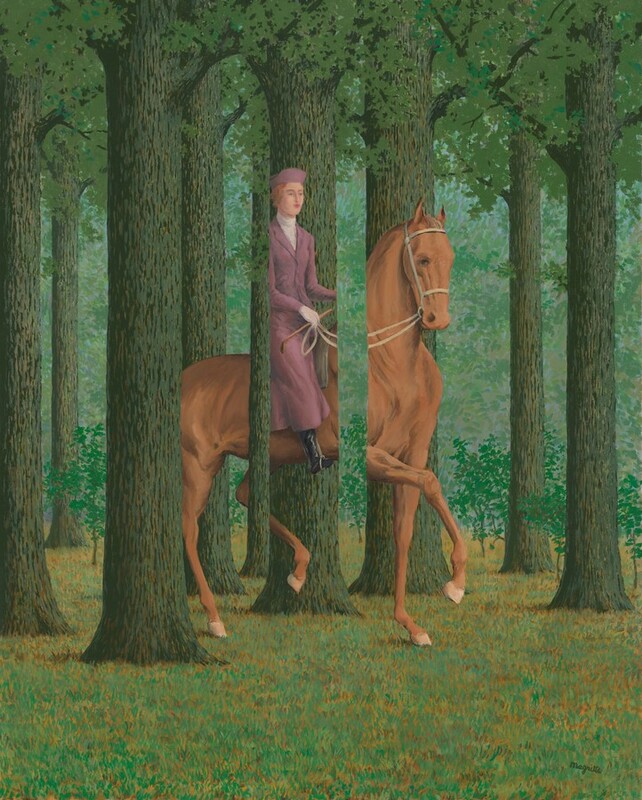 #88
#88
The Signature in white
A rider crosses a forest, but her body and that of the horse pass alternately in front of and behind the trunks. Magritte transforms the rules of superposition into an enigma: the walk remains recognizable while the space ceases to be coherent.
Documentary image and instructions: National Gallery of Art, Washington. This work is not offered for reproduction by Alpha Reproduction.
See the institution's notice →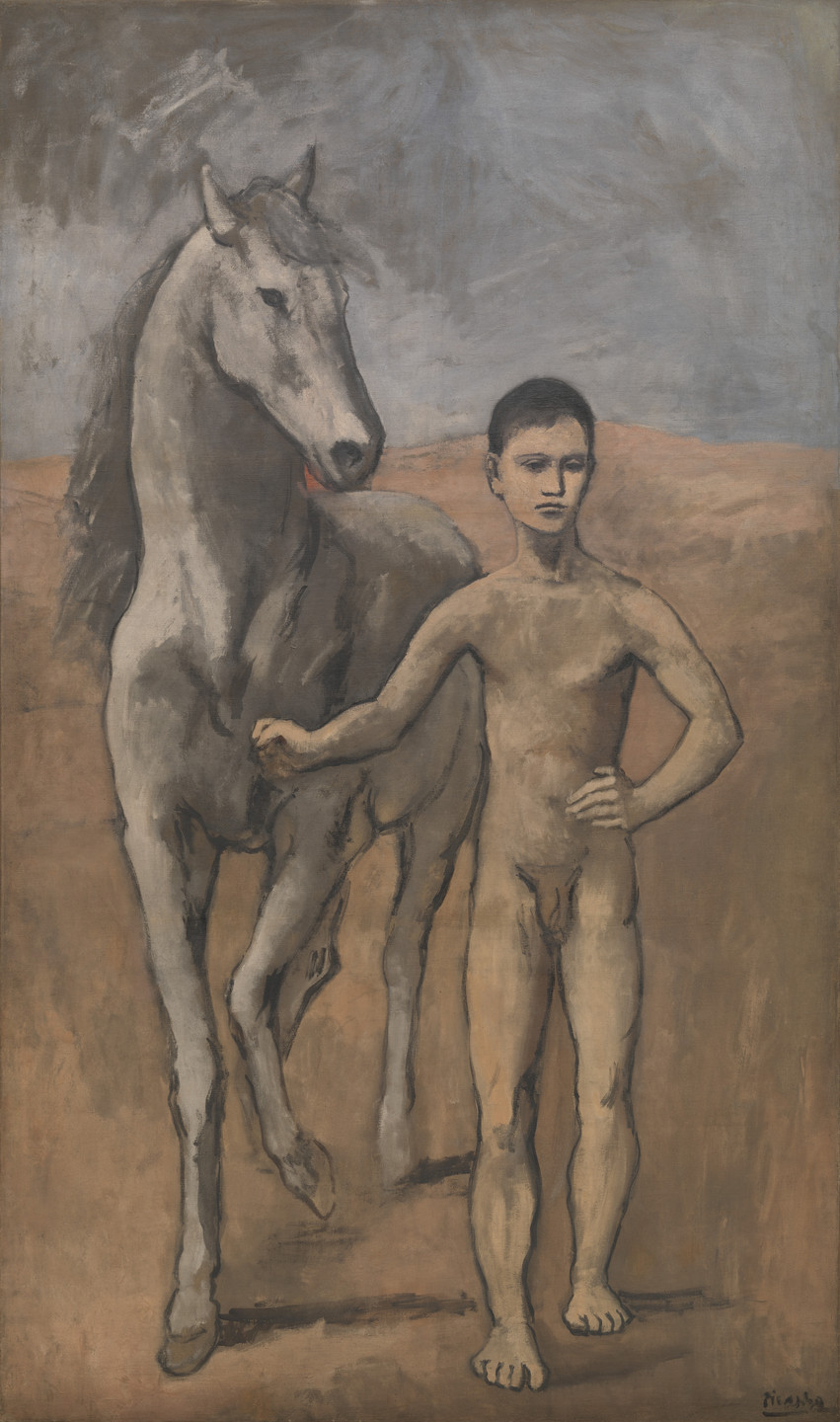 #89
#89
Boy riding a horse
Picasso uses a motif intended for a wall project never before realized: a naked boy drives a horse without bridle. The austere range and archaic simplicity of the silhouettes herald the transition from the pink period to the research that would lead to cubism.
Documentary image and instructions: Museum of Modern Art, New York. This work is not offered for reproduction by Alpha Reproduction.
See the institution's notice →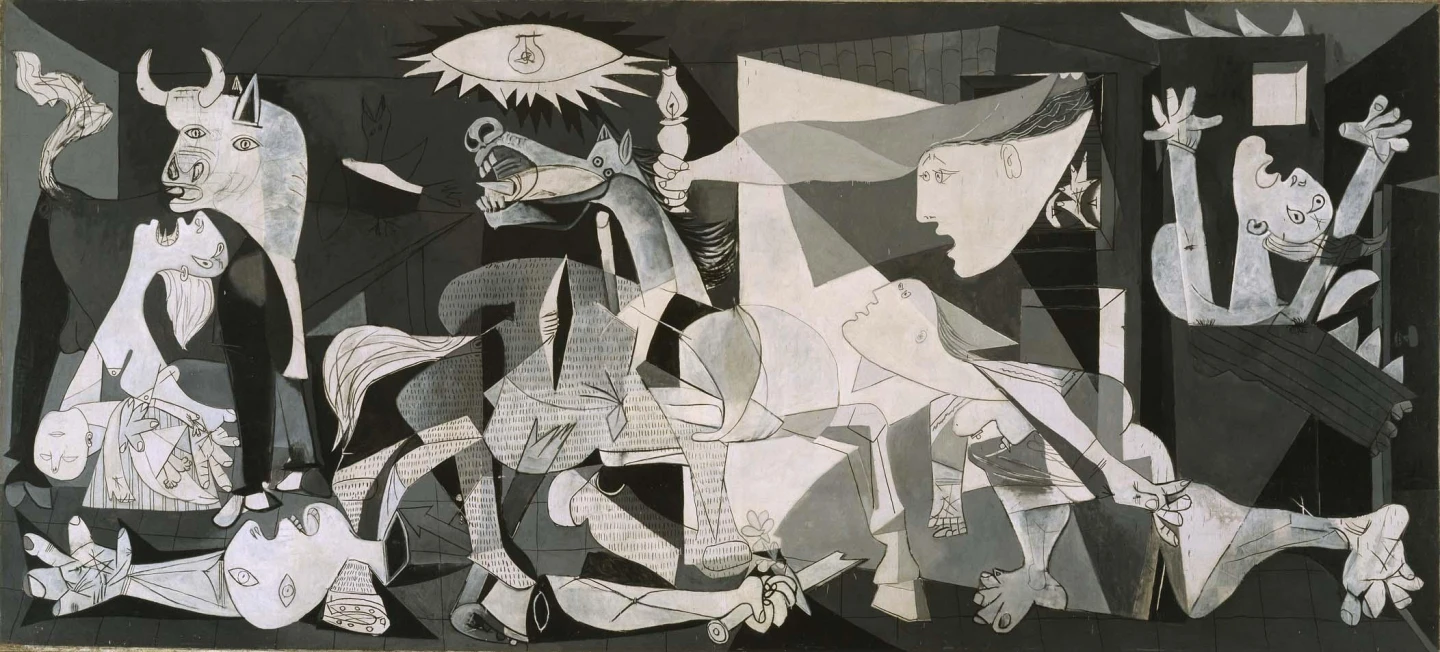 #90
#90
Guernica
In Guernica, the disemboweled horse occupies the center of the bombardment, mouth open in a sharp light. It does not illustrate a precise detail of the attack: with the bull, the women and the dead child, it gives a universal form to civil suffering.
Documentary image and instructions: Museo Reina Sofia, Madrid. This work is not offered for reproduction by Alpha Reproduction.
See the institution's notice →Scrolls, holy horsemen and Renaissance battles close the route.
 #91
#91
White that lights up the night
Attributed to master Tang Han Gan, this imperial horse is attached to a pole but seems to concentrate immense energy. The ink line describes volume, tension and character; the accumulated seals also tell of centuries of collection and admiration.
See this reproduction → #92
#92
One hundred horses
Castiglione, an Italian Jesuit turned court painter in Beijing, unfurls a hundred horses in a vast landscape. European perspective and modeling mingle with the Chinese format of the scroll; diversity of poses and dresses makes the herd a living inventory of the empire.
See this reproduction → #93
#93
Five horses offered as tribute
Li Gonglin depicts five foreign horses taken to the Song court as diplomatic tribute. Each animal and each groom has a precise identity; the sober line transforms political exchange into masterful study of characters.
See this reproduction → #94
#94
Grooms and horses
This long scroll brings together sections painted by three generations of the Zhao family. The grooms and their mounts alternate portrait, movement and calligraphy; the work shows how horse painting could transmit both artistic filiation and literate culture.
See this reproduction → #95
#95
The Vision of Saint Eustace
Pisanello places Saint Eustace in the middle of a sumptuous hunt, just as he sees the crucifix between the antlers of a deer. Horses, dogs and wild animals form a meticulously observed world; religious revelation slips into the courteous pleasure of detail.
See this reproduction → #96
#96
Saint George and the Dragon (Washington version)
Raphael shows the young saint as his spear defeats the dragon. The prancing white horse concentrates the heroic momentum and contrasts its clarity with the monster; the small panel transposes a medieval legend into the elegant balance of the Renaissance.
See this reproduction → #97
#97
Saint George and the Dragon (London version)
Uccello organizes the fight of Saint George as a perspective experience: dragon, princess, cave and horse occupy a space that is both logical and unreal. The white mount, seen in profile, stabilizes the duel while the storm opens the landscape.
See this reproduction → #98
#98
The Battle of San Romano: Niccolo da Tolentino at the head of the Florentines
The first panel of the San Romano cycle, this battle celebrates a Florentine victory of 1432. Uccello lines up broken spears, shortened horses and shiny armor to construct geometric depth; the tumult becomes a spectacular chessboard of perspective.
See this reproduction → #99
#99
The Battle of San Romano: Micheletto da Cotignola's counterattack
In the Louvre panel, Micheletto da Cotignola launches the counterattack by giving the signal to his riders. The horses seen from behind and in profile are distributed like the rays of a fan, a famous demonstration of Uccello's obsession with perspective.
See this reproduction → #100
#100
Saint Martin and the Beggar
Martin, a Roman soldier, shares his cloak with a beggar he met at the gates of Amiens. El Greco lengthens rider and horse until he gives them an unreal elegance; the act of charity dominates Toledo and becomes a spiritual vision rather than an anecdote.
See this reproduction →Editorial method
How the ranking was verified
The selection starts from the museum collections and the Alpha Reproduction catalog, then separately controls title, artist, technique, image and link.
One work, one entry
Translations and title variations have been reconciled to prevent the same painting from appearing twice.
Paintings only
Prints, drawings and sculptures have been discarded; ink on roll is retained when it fully belongs to the pictorial tradition.
Verified images and destinations
The available works use their Alpha Reproduction sheet. Magritte and Picasso remain documentaries and refer directly to museums.
Sources and links
Museums and landmarks used
These institutional records were used to verify major works, dating, collections and associated stories.
European collections
01National Gallery - WhistlejacketOfficial notice of Stubbs' work.02Museo del Prado - Philip IVEquestrian portrait and program of Buen Retiro.03Rouen Museum of Fine ArtsWhite-gray Arabian horse by Géricault.Frequently asked questions
Questions about equestrian painting
Some guidelines for understanding the classification and use of images.
What is the most famous horse painting?
George Stubbs' Whistlejacket is one of the most instantly recognizable equestrian images. The Horse Market of Rosa Bonheur and Bonaparte crossing David's Great Saint Bernard are also among the major icons.
Why so many royal equestrian portraits?
For centuries, mastering a horse meant mastering war, territory and one's own body. The equestrian portrait has therefore become a privileged language of sovereignty.
Are all works offered for reproduction?
No. The still protected works of René Magritte and Pablo Picasso are presented for documentary purposes and their images refer to the corresponding institutions.
How were duplicates eliminated?
French, English titles and old catalog translations were standardized, then images and links were compared. The final hundred entries have distinct titles, images and destinations.
0 comments