

Van Gogh's Wheatfield with Crows • Art & Decoration Guide
Van Gogh's Wheatfield with Crows: The Guide That Looks Under the Varnish
A deep dive into Vincent's ultimate pictorial storm, between persistent myth, historical reality, and tips for bringing this raw energy into your home without turning your living room into a morbid museum.
There are paintings we think we know by heart, so often have they been reproduced, repurposed, and mythologized—until we finally stop before the actual material. Wheatfield with Crows, painted by Vincent van Gogh in July 1890 in Auvers-sur-Oise, is precisely that work which resists ready-made legends about madness and suicide. Far from being a simple illustration of an artist's tragic end, this panoramic landscape is a dizzying technical demonstration where the blue-black sky crushes an intense yellow wheat field, creating a visual tension that seems to announce the storm before the first rumbles are even heard. This guide aims to go beyond the cliché of the last painting to rediscover a living, violent, and extraordinarily modern scene.
 Free image
A deep dive into Vincent's ultimate pictorial storm, between persistent myth, historical reality, and tips for bringing this raw energy into your home without turning your living room into a morbid museum.
Reading method
How to Read This Landscape in Motion
To fully appreciate this canvas beyond its grim reputation, you must set aside the romanticized biography and observe the construction of the image. We will dissect the compositional choices, the violence of the brushstrokes, and the chromatic palette that make this work a powerful decorative object, while verifying historical facts with institutions like the Van Gogh Museum in Amsterdam where it is housed.
Context before prestige
We place Van Gogh's Wheatfield with Crows in its era, its studios, its exhibitions, and its small rebellions. A work without context is sometimes just a very beautiful person who forgot their history.
The signs that betray the style
We identify composition, palette, texture. These clues often say more than grand speeches, especially when they carry gold or nervous brushstrokes.
The work in a real room
We end with the useful question: does this image breathe in your home, or is it just posing like a poster that has read two books?
Historical context
Where does Van Gogh's Wheatfield with Crows come from, and why is it not just a pretty label?

Painted during the very last weeks of his life, while the artist was staying at the Auberge Ravoux under the benevolent but powerless supervision of Dr. Gachet, this painting captures the electric atmosphere of the Auvers plain. Vincent was not trying to illustrate his despair with the naivety of a diary, but rather to convey the health and strength of the countryside he saw as immense and infinitely sad. The context is not that of a man laying down his arms, but of a painter working with creative fury, sometimes producing two canvases a day to capture the changing light of the harvest before it was reaped.
Reducing this work to a simple suicide note would be to forget that it is part of a prolific series of rural landscapes created in this Oise valley. Van Gogh explores the relationship between the plowed earth and the sky, a subject he had cherished since his early days in Belgium with drawings of peasants inspired by Millet. Here, however, the touch has changed: it is broader, faster, almost sculptural, transforming the wheat into a turbulent sea and the sky into a threatening vault that seems to physically weigh on the viewer, far from a morbid label pasted on later by art history.
Artistic style
Why does Van Gogh's Wheatfield with Crows still captivate us?
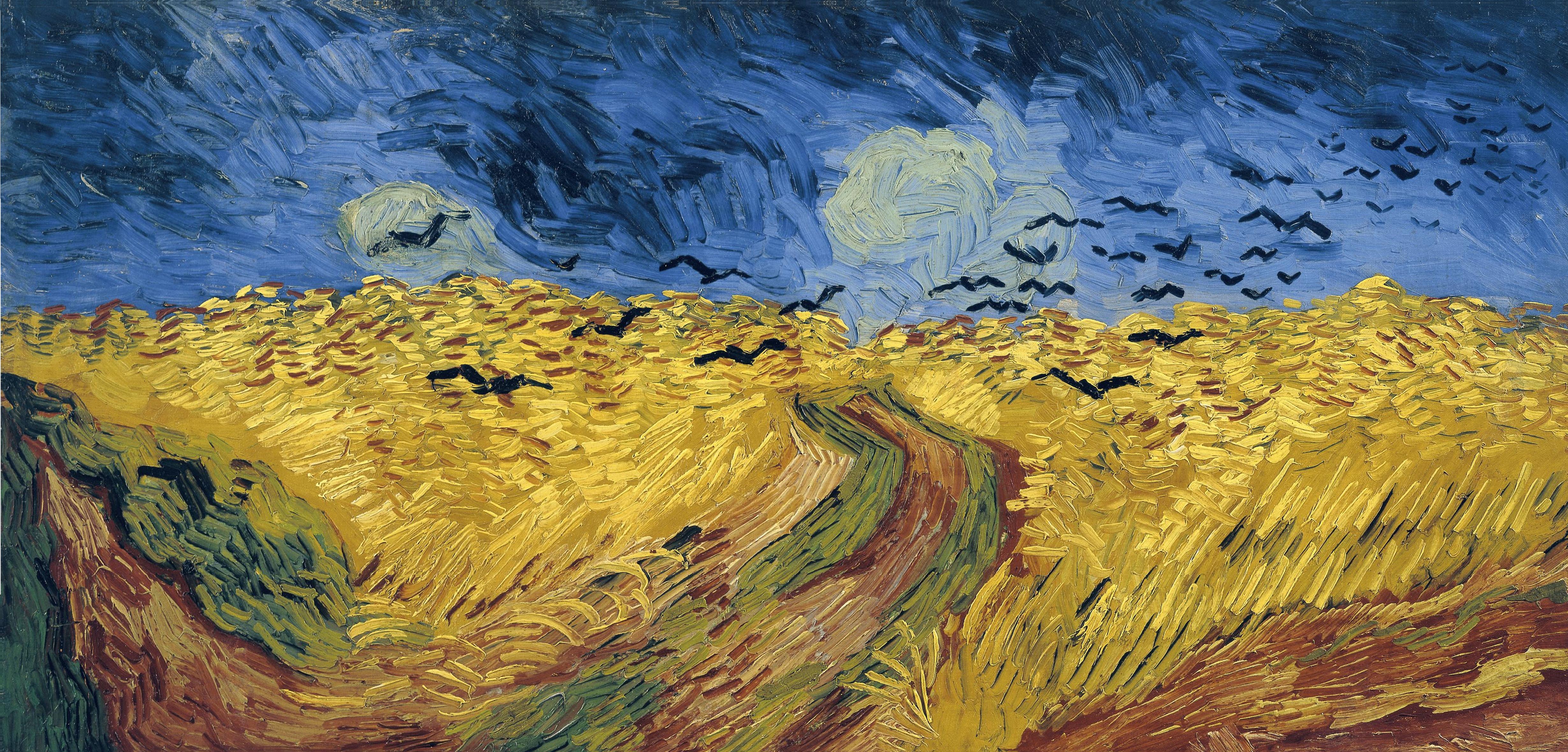
The enduring fascination with this painting lies in its unique ability to communicate a purely visual emotion, without needing words or biographical context. From the first glance, the viewer is struck by the stark contrast between the vibrant cadmium yellow of the ears of wheat and the deep, almost black cobalt blue that dominates the upper half of the canvas. This chromatic opposition creates an optical vibration that literally makes the image tremble, giving the impression that the wind is actually blowing across the canvas and that the black crows will take flight at any moment, crossing the room.
Beyond color, it is the radically modern composition that continues to captivate contemporary eyes accustomed to dynamic images. Here, Van Gogh breaks the classical rules of perspective by offering three diverging paths that lead nowhere, cut off sharply by the bottom of the frame or lost in the vegetation, thus refusing any logical escape for the gaze. This absence of a traditional vanishing point generates a feeling of claustrophobia and urgency that strangely resonates with our anxious times, making this 19th-century landscape a surprisingly current and universal image.
Art & details
The visual signs that betray the style

What immediately identifies Van Gogh's hand in this work is the masterful use of impasto, the technique where paint is applied in such thick layers that it creates a tangible relief on the surface. If you observe a high-quality reproduction, you will see that the brushstrokes do not just color an area, but follow the direction of the wind or the growth of the stems, creating a physical rhythm that guides the eye across the field. Each brushstroke is an autonomous, visible, and deliberate decision, giving the material a life of its own, as if the wheat had been woven filament by filament directly onto the canvas.
Another distinctive sign lies in the treatment of the horizon, placed very high in the frame to accentuate the immensity of the sky and the relative smallness of the earth. This deliberate disproportion allows the artist to deploy all his virtuosity in the representation of the turbulent clouds, painted with rapid spirals and curves that suggest perpetual motion. The crows, meanwhile, are not drawn with anatomical precision but suggested by elongated black spots, thus becoming pure graphic signs that reinforce the dramatic tension without weighing down the overall reading.
Art & details
Works to look at as if they might answer back

To fully understand the uniqueness of this field, it is instructive to compare it with the other wheat canvases Vincent painted a few weeks earlier, such as Green Wheat Field with Cypress at the National Gallery in London. In these earlier versions, the light is softer, greens dominate, and the atmosphere remains serene, showing how the same subject can evolve into an almost apocalyptic intensity within a few days. This comparison reveals that the violence of Wheatfield with Crows is not an accident along the way, but the logical culmination of an obsessive search for the expressive power of nature.
One can also juxtapose this work with the Auvers landscapes painted by Daubigny, an artist Van Gogh deeply admired and whose garden he even painted. Where Daubigny seeks calm harmony and the stability of traditional forms, Van Gogh introduces a visual dissonance that disrupts rural tranquility. By confronting these visions, we realize that our painting is not just a document of a geographical location, but a personal and tumultuous response to the tradition of French landscape, pushing the genre's codes to their breaking point.
Art & details
Symbols, details, and little visual quirks

The crows have often been interpreted as omens of death, a tempting but perhaps reductive reading given the symbolic complexity of the bird in Vincent's work. In the popular culture of the time and in his own letters, these animals could also represent freedom or simply the living presence of wild nature amidst domesticated crops. Their low, disorderly flight primarily adds a layer of horizontal movement that contradicts the verticality of the wheat stalks, creating a directional conflict that prevents the eye from resting and maintains a constant agitation in the reading of the image.
A detail often overlooked but crucial is the presence of these three paths that go in opposite directions, none seeming to offer a clear or reassuring exit. This visual dead end may reflect an existential uncertainty, but above all it functions as a brilliant compositional device that forces the viewer to remain stuck in the foreground, facing the imposing mass of wheat. It is a brilliant little quirk of Van Gogh's to refuse the convenience of a receding perspective, thus forcing us to confront the raw materiality of the landscape without being able to escape toward the distant horizon.
Art & details
Neighbors, allies, and turbulent cousins
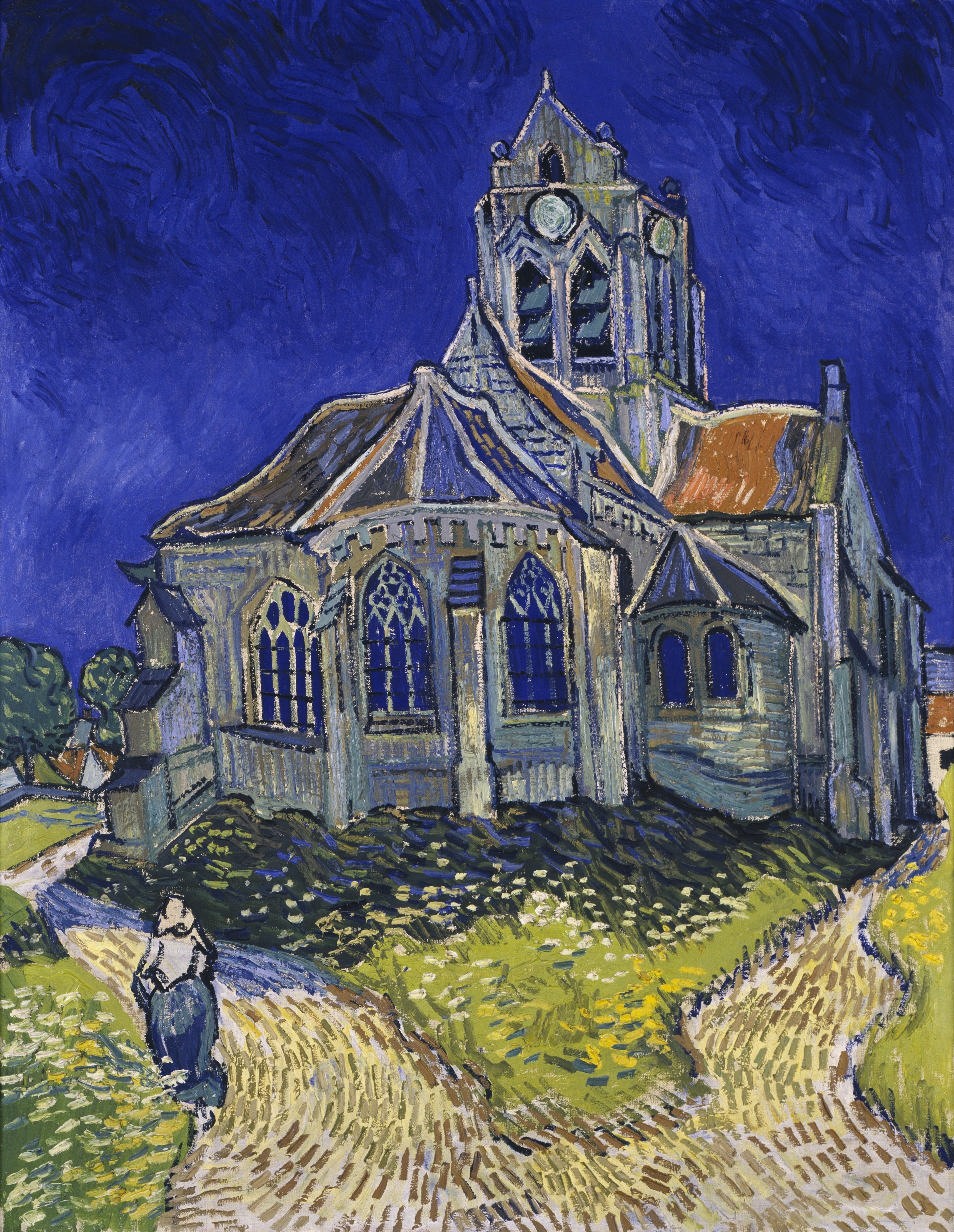
Although Van Gogh is often perceived as a solitary genius, his work in Auvers silently dialogues with that of his contemporaries and predecessors, notably Jean-François Millet, whose harvest scenes he regularly copied. Where Millet humanizes the work of the land by emphasizing the bent figure of the peasant, Van Gogh almost completely erases human presence to let nature express its own dramaturgy alone. This shift in focus marks a major transition toward modernism, where the subject is no longer human action but the pure sensation provoked by the visual environment.
One can also trace links to the Impressionists who painted in the region, although Vincent rejected their sometimes too fleeting approach to light in favor of a more solid and emotional structure. His vibrant fields also anticipate the research of the Fauves like Derain or Matisse, who would push the use of pure, unnatural colors even further to express feelings. Thus, this painting acts as an essential bridge between the realist tradition of the 19th century and the color explosions of the following century, confirming its status as a pivotal piece in the history of Western art.
Art & details
What museums confirm when shortcuts go too fast

Research conducted by the Van Gogh Museum in Amsterdam, where the work has been housed for decades, has significantly nuanced the chronology of the artist's final days. Contrary to popular belief that systematically makes it the very last canvas, technical analyses and the study of correspondence suggest that he probably continued painting afterward, perhaps creating works like Tree Roots or portraits of Dr. Gachet. Curators insist on the danger of reading all of July 1890's production solely through the prism of suicide, which would amount to ignoring the creative vitality that still animated the painter.
Major museums like the Musée d'Orsay in Paris or the Metropolitan Museum of Art in New York often present this work in the broader context of the late landscapes, emphasizing its coherence with the rest of the Auvers production. This institutional perspective reminds us that while the emotional intensity is undeniable, it is part of a continuous and thoughtful artistic process, not a final fit of delirium. Verifying this information with official sources allows us to respect the artist's intelligence and the complexity of his approach, far from romantic simplifications.
Art & details
How to choose a reproduction without panicking the wall?

Integrating a reproduction of this painting into a modern interior requires respecting its chromatic power and its unusual panoramic format, which imposes a certain monumentality. It is advisable to choose a large print, ideally on stretched canvas to restore the texture of the impasto, because a small framed image under glass risks losing all its strength and becoming a simple, bland decorative illustration. The support must be able to convey the depth of the blues and the brilliance of the yellows; otherwise, the subtle balance of the composition may tip toward an overly dark or gloomy atmosphere.
For placement, favor a clear wall in a living room or office where the eye can step back, because the optical vibration effect only works at a sufficient distance. Absolutely avoid narrow hallways or poorly lit rooms that would stifle the natural luminosity of the wheat field; a warm, directed light, such as an adjustable spotlight, will bring out the reliefs of the paint and energize the space. The goal is to create a dramatic focal point that animates the room without overwhelming it, letting the work breathe around it.
Interior decoration
Mistakes to avoid before hanging the painting

The first classic mistake is to automatically associate this image with a gothic, morbid, or excessively dark decor, when its palette is above all solar and earthy. Hanging this painting in a room already filled with dark furniture or heavy fabrics risks creating an oppressive atmosphere that betrays the original intention of capturing the living force of nature. On the contrary, it will thrive better in an environment with light walls, off-white or sand beige, which will serve as a neutral setting to let the contrast between the stormy sky and the golden earth explode.
One must also be wary of cheap reproductions whose colorimetry is often disastrous, turning the complex night blue into a flat black and the vibrant yellow into a dull mustard. Before buying, always check the fidelity of the colors and the sharpness of the details, because a pixelated or poorly printed image will destroy the finesse of the brushstrokes that make the work's charm. A bad reproduction would not only be an aesthetic mistake but a complete misinterpretation of the kinetic energy that Van Gogh wanted to inscribe in the material.
| Room | Suggestion | Decorative effect |
|---|---|---|
| Living room | A work related to Van Gogh's Wheatfield with Crows with a strong composition | Cultivated focal point, warm, and easy to comment on without reciting a label. |
| Bedroom | A soft palette or a more intimate scene | Calm atmosphere, visual presence without unnecessary agitation. |
| Office | A structured, colorful, or graphically sharp image | Creative energy and a small reminder that the wall can also work. |
| Entryway | A vertical format or an immediately readable work | Clear, elegant first impression, and decidedly less timid than a blank white wall. |
To continue the visit
Sources, collections, and truly related paths
A few useful references to verify information, compare free images, and extend the reading without wandering into a museum that didn't ask for anything.
Related articles to read next
Verified collections
Useful blog hubs
Useful sources on this topic
FAQ
Frequently asked questions about Van Gogh's Wheatfield with Crows
What is Van Gogh's Wheatfield with Crows in painting?
Van Gogh's Wheatfield with Crows deserves an in-depth article because this style engages both an era, a way of painting, and a very concrete way of living with images.
How to quickly recognize this style?
Observe especially composition, palette, texture, light, and atmosphere, then how the composition organizes the gaze. If the work holds your attention longer than expected, it's probably not an accident.
Which artists should you know?
You need to cross-reference the central artists of the movement with museums and reliable sources to avoid hasty attributions.
Is this style suitable for modern decoration?
Yes, provided you choose the right format, a palette consistent with the room, and a work whose presence remains pleasant on a daily basis.
Should you choose the most famous work?
Not necessarily. The most famous work can be perfect, but the right choice depends above all on the room, the format, the palette, and the desired atmosphere.
Where to verify the information?
Start with museum notices, Wikipedia/Wikidata for general orientation, then Wikimedia Commons when a free image is needed.
Let the storm in with elegance
Wheatfield with Crows remains a fascinating work not because it marks an end, but because it condenses a vital energy at its peak, defying time and hasty interpretations. For the art lover or decoration enthusiast, welcoming it into your home is a powerful act that requires understanding its visual grammar and giving it the space it demands to exist fully. By going beyond the myth of the last breath to embrace the reality of a landscape in turmoil, you discover a demanding but incredibly stimulating wall companion, capable of transforming an ordinary wall into a window open to the torments and joys of pure creation.
0 comments