

360° projection · scenography · VR · original works
Monet immersive exhibitions: what do we really see and for which audience?
Water Lilies as high as a wall, music, moving images, sometimes a Japanese bridge, a reconstructed workshop or a VR headset. But do we see real Monets? Are all experiences equal? Here's how to read the promises before buying your ticket.
Explanatory diagram, not photograph of a particular exhibition. Real productions adapt their screens, their surface and their route to each location.
Direct response
You see an audiovisual interpretation of Monet, rarely his paintings
The heart of the experience is usually a space film: digital reproductions enlarged, cropped, animated and edited with music, projected on several walls and sometimes on the floor.
What the ticket actually buys
In a large dark room, the visitor no longer places himself in front of a still work. He is inside a montage : a nymphéa detail can reach several meters, a cathedral dissolves, the sea begins to undulate and the colors move from one wall to the next to the rhythm of a score.
Depending on the production, this core is preceded by a chronology, facsimiles, texts, a workshop or a reconstructed garden. It can be followed by an interactive device, a projected coloring or a VR experience. These elements explain the differences in duration and price between two events which nevertheless use almost the same title.
The safest rule: if the page does not explicitly mention loans, lending institutions, and a list of original works, assume that there is no authentic painting. The words "exhibition", "more than 200 works" or "masterpieces presented" may refer to digital images.
Four formats
The word "immersive" covers very different experiences
Before comparing brands, identify the dominant technique. It determines what you will do, how long you will stay and the audiences who will enjoy the visit.
The film around the body
Images on walls and floor, music, transitions and animation. The visitor walks, sits or changes point of view during an audiovisual loop.
Workshop, garden, bridge
The projection is integrated into a succession of settings, texts and interactions. The experience tells more about Monet's life and Giverny's place.
A helmet, an individual trip
The field of vision is completely replaced by a digital space. The session is short, personal and sometimes billed separately.
The Water Lilies of the Orangery
Real paintings surround the visitor in two oval rooms designed with Monet in mind. Here, immersion comes from work, architecture and natural light.
Honest comparison
Six experiences not to be confused
The facilities are itinerant and suitable for buildings. Always check your city page: surface area, duration, accessibility, language and VR may differ from one stage to another.
| Experience | What we see | Original works? | Interaction | Best audience | To check |
|---|---|---|---|---|---|
| Imagine Monet | Discovery room then more than 200 works projected 360° on walls and floor with Image Totale© | Not announced | Free stroll | First immersion, families, image lovers | Loop duration and seats |
| Claude Monet: The Immersive Experience | Life and art, large 360° projection, more than 300 paintings and sketches announced according to the pages, projected coloring, VR on eight works | Not announced | Coloring + VR | Families and visitors looking for several activities | RV included or extra, local area |
| Monet's Garden | Workshop, interactive garden, bridge, then 360° showroom culminating with the Water Lilies | Not announced | Reactive projections | Families, children, visitors attracted by Giverny | Tongue, strollers, accessible steps |
| Monet & Friends Alive | Monet with Pissarro, Renoir, Cézanne, Degas and others, projections, music and multisensory environment | Not announced | Collective immersion | General discovery of impressionism | Actual share devoted to Monet |
| The Water Lilies Obsession | 6 min 19 VR experience around Giverny, late vision and large decorations | No, VR animation | Individual helmet | Curious about VR, adults and teenagers compatible | Equipment, dizziness, minimum age |
| Orangery Museum | Eight original compositions, approximately 200 m² and nearly 100 linear meters in two oval rooms | Yes | Free observation | All audiences interested in the actual work | Attendance and visiting conditions |
Real photographs
What do immersive rooms really look like?
These photographs come from the official producer galleries and the museum. They show visitors, the screens, the seats and the decorations on their real scale - a better landmark than a simple advertising poster.
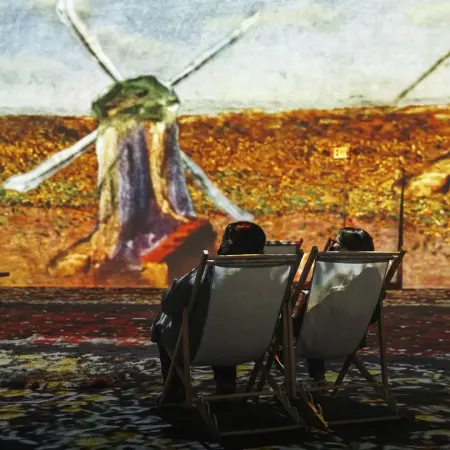
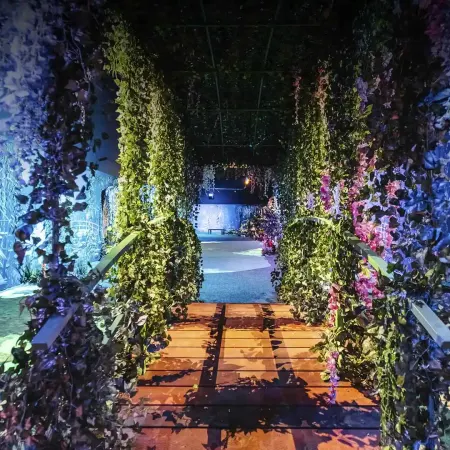
Claude Monet: The Immersive Experience
Two spaces along the route: a projection room with seats and a scenographic passage under the flowers. Official visuals Exhibition Hub /Fever.


Monet's Garden
The first view shows the interaction with a projected image; the second, one of the plant settings of the route. Official photographs Monet's Garden.
%2002.avif)
%2005.avif)
Monet & Friends Alive
The Brisbane Digital Gallery shows screen scale, audience circulation and projection to the ground. Official photographs © Grande Experiences.
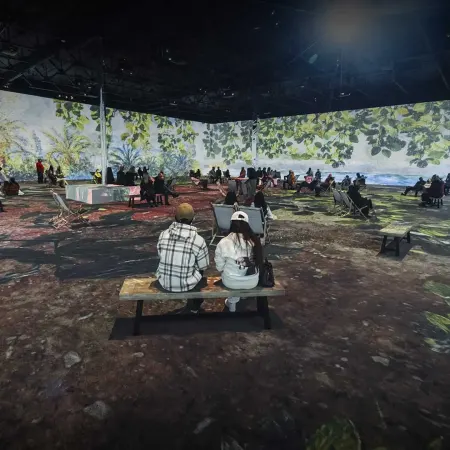

Two rooms, two ways to immerse
On the left, the Exhibition Hub audiovisual gallery; on the right, the Monet's Garden showroom. Images are displayed without cropping to maintain the actual height of the walls and the space available around visitors.
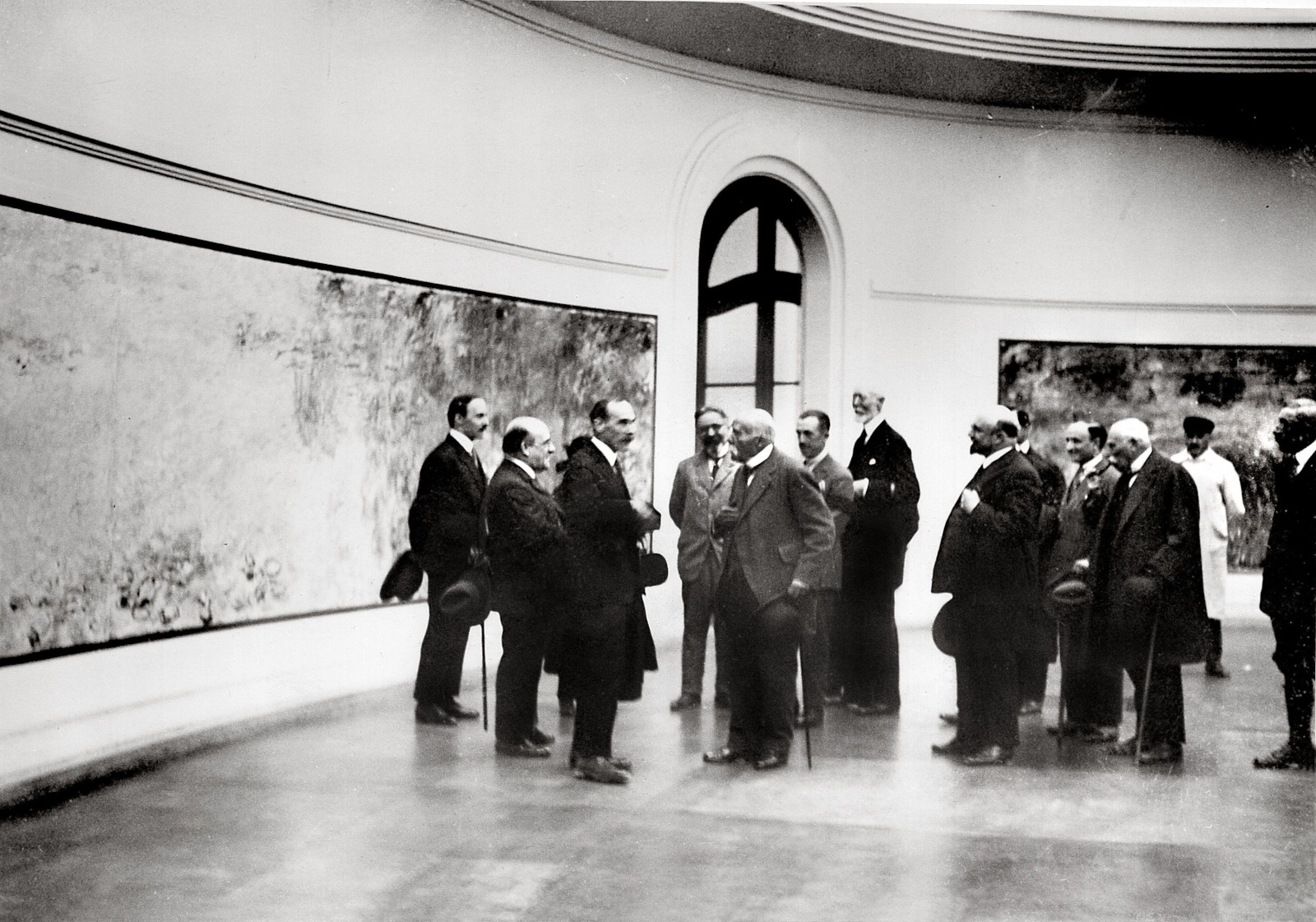
Water Lilies in their true architecture
Historical photograph of a Water Lilies room at the Musée de l'Orangerie: the panels follow the curve of the wall and really surround visitors. Archive of orangery Museum© DR.
To keep in mind: a traveling production changes depending on the city and the building. These views document the actual layout, but screen height, seating, sets and audience density may differ during your visit.
In detail
What each major production actually stages
The following descriptions take the devices announced by their producers, then translate them into concrete experience for the visitor.
Most focused on image flow
Imagine Monet
The announced route begins with a discovery room dedicated to life and work, then leads to the Total Image© space. More than two hundred works are projected on the walls and floor, d'Print, rising sun at the Late Water Lilies. The visitor has no obligatory seat or point of view: he moves in the middle of the composition.
This structure is suitable for those who want a large visual loop without accumulating scenery. It is also easy to share between generations: everyone can look in silence, photograph or get closer to a different area.
A first immersive experience, families and amateurs who already know some icons.
You expect a lot of objects, a realistic garden, an RV or a long technical analysis.
The richest in modules
Claude Monet: The Immersive Experience
The official pages describe an area about life and art, a large two-level projection room, an activity where the visitor's drawing comes to life on the wall and an RV dedicated to inspiring eight works. Depending on the city, the announced surface area and practical details change: the format is adapted to the building.
The main advantage is variety. A family can alternate reading, performing, creating and headphones. The possible downside is a fragmented tour: if you don't do VR or it requires extra, the actual experience may be shorter than the overall advertising suggests.
Families, visitors who like to participate and those who want to try VR.
RV included, wait time, minimum age, language and local site accessibility.
The most scenographed
Monet's Garden
The concept follows a narrative progression. The visitor enters the artist's world, goes through an interpretation of his garden and his bridge, then reaches a projection room where the Water Lilies pond becomes the culmination of the journey. Some wall projections react to movements.
This is often the most intuitive format for children: the house, the garden and the bridge provide concrete benchmarks before the abstraction of large areas of water. On the other hand, the reconstruction should not be confused with the real house of Giverny.
Families, young audiences, future visitors to Giverny and decor lovers.
You only want to see the images without going through narrative installations.
The most collective
Monet & Friends Alive
This production does not promise Monet alone. It tells the story of French impressionism through several artists, Parisian scenes in the open air. The works are enlarged, accompanied by music - Debussy, Ravel, Tchaikovsky or Offenbach according to the official presentation - and integrated into a device combining high definition projection, dynamic sound and perfume.
To discover a movement, this is an advantage: we immediately see that Degas' dance, Pissarro's landscapes and Renoir's bathers are not the same subjects as those of Monet. To study his career precisely, the sharing of time between several painters becomes a limit.
A beginner audience who wants a visual celebration of impressionism in the broad sense.
Sound, scent and visual density can bother people sensitive to stimuli.
The shortest and most individual
Claude Monet - The Water Lilies Obsession
Co-produced with ARTE and the Orsay and Orangerie museums, this experience takes you from the garden to late painting via Monet's troubled vision. A dialogue with Clemenceau structures part of the story. Its exact duration - 6 minutes and 19 seconds - reminds us that it is a concentrated module, not a one-hour exhibition.
The helmet isolates more than the collective projection. It completely fills the field of vision and can cause discomfort or dizziness in some people. Its interest is the museum coherence of the project and its way of treating perception, rather than the quantity of works.
Teenagers and adults curious about VR, interested in the last period.
Motion sickness, dizziness, helmet incompatibility, young age or need to keep the group visible.
The historical model
The Water Lilies of the Orangerie Museum
The Orangery is not a digital exhibition, but it remains the best point of comparison. The eight large compositions brought together in two oval rooms really surround the body. Their surface area of approximately 200 m² and their deployment over nearly 100 linear meters were designed with Monet, in relation to the orientation of the building and the light.
No animation makes the water ripple. The time comes from the visitor's movement, the light, the distance and the gaze which passes from the material to the whole. We see the connections between panels, the thicknesses, the hesitations and the true scale.
Anyone who wants to understand what "monumental" means in Monet.
You are surrounded by original paint, not projector light.
What projection transforms
Gain scale, lose matter
An immersive exhibition is not a neutral reproduction. The director chooses where to cut, when to zoom, how to animate, what color to accentuate and what music to associate with each painting.

A detail can replace the work
The orange sun or a boat can fill a wall while the edges disappear. We discover a fragment, but we easily forget the proportions and emptiness of the complete composition.

Make what was painted move
Grasses, coat, clouds and parasol can be animated. The effect makes the wind immediately noticeable, but adds a temporality that the painting suggests without unfolding it.

Pigments become pixels
The projection emits light and varies with the projector, wall and darkness. A canvas reflects light. The two colored experiences cannot be identical.
For which audience?
A great outing for some, a frustrating visit for others
The right choice depends less on Monet's love than on the way we like to learn: through object, story, movement, sound, play or silent contemplation.
Very good entrance land
The giant images and movement attract attention. Prefer a route with workshop, coloring or garden, and explain beforehand that the paintings are not present.
Often recommendedPossible, but unpredictable
Darkness, volume, waiting and projections on the ground can seduce or frighten. Check strollers, toilets, temporary outings and quiet sessions.
To prepareA door without intimidation
One can walk, speak softly, and sit without knowing the history of art. A solid educational room makes the difference between emotion and simple wallpaper.
Very suitableChoose the achievement
The interest comes from editing between series, music and the relationship with space. If the documentation is poor, the experience may seem repetitive.
VariableA show, not a study tool
Reframing, colorimetry and animation prevent precise analysis. The visit is worth as a cultural phenomenon or contemporary staging of Monet.
In additionVery photogenic
Silhouettes in front of projections, reflections and palette changes easily produce images. Respect other visitors and local rules.
Very suitableLocation matters more than brand
The facilities may be accessible but offer few seats. Check elevators, slope, toilets, queue, armchairs and attendant.
To be checked by cityRequest a sensory guide
Moving images, strong contrasts, projected ground, darkness, perfume or musical bass can overload. A session at reduced volume completely changes the visit.
Necessary precautionsSensory accessibility
"All audiences" does not mean comfortable for everyone
Building accessibility and sensory accessibility are two separate issues. An armchair can enter the room while moving images, sound or lack of seating make the visit difficult.
Questions that really protect the visit
- Is there a warning for photosensitive epilepsy, migraine or dizziness?
- Do the images have flashes, quick transitions, or moving ground?
- Is the sound volume constant? Is there a calm or appropriate session?
- Can we leave the room and come back without losing the ticket?
- Is there a normally lit rest area?
- Are there benches with backs, stools or a folding seat loan?
- Are the texts subtitled, translated or available on the phone?
- Can perfume be avoided in case of allergy or hypersensitivity?
Good museum practices recommend precise sensory information, quiet areas and sessions with reduced volume and raised light. Not all traveling exhibitions offer these devices. Contact the location, not just the international ticket office.
Before buying
Twelve more useful questions than the trailer
A promotional video often mixes several cities and frames spaces at their best. The local sheet must respond to concrete details.
Are there any originals?
Look for a list of works and lenders. Without it, consider that you will see digital reproductions.
What actual duration?
Distinguish between free visit time, length of the main loop and duration of the VR module.
How many rooms?
A large room can be magnificent but very different from a workshop, garden and showroom.
Is VR included?
Check supplement, reservation, age, wait and number of helmets available.
Can we sit down?
The loop can last thirty minutes. Ask for the number and type of seats, not just PRM access.
What sensory warning?
Flashes, volume, perfume, darkness, moving ground and stage smoke must be reported.
What language?
Music is universal, but timeline, voiceover, cartels and application are not.
What child policy?
Recommended age, free, stroller, baby carrier, toilet and temporary outing.
Which niche to choose?
The crowd changes the perception of the ground, the sound level and the possibility of sitting.
Photos allowed?
Control flash, tripod, video and commercial use. A photo does not allow the projection to be obstructed.
Editable ticket?
Temporary events often apply different conditions from public museums.
Who produces?
The exact name avoids confusing several Monet experiences announced in the same city.
Look better
Transform a light show into a real introduction to Monet
The visit becomes richer if we distinguish the first emotional impact, the construction of the montage and the return to the complete works.
Read before entering
Dedicate a few minutes to the chronology and identify four periods: youth, Argenteuil, series, Giverny.
See a loop without a phone
Let the editing give you its rhythm. Photographing immediately turns the room into a background search.
Choose three works
Note the title of a landscape, figure and Water Lilies. Watch how each one is cropped and animated.
Change distance
Near the wall, look at the pixels and detail. In the center, look at the assembly between several surfaces.
Return to the canvas
After the tour, look for dimensions, museum, date and entire image. If possible, then plan the encounter with an original.
Screening or museum?
Two complementary experiences, never interchangeable
One mobilizes the body in a temporal spectacle. The other often requires more silence and attention, but gives access to the historical object and its material.
Enter a montage
- Architectural scale and moving image
- Music, narration, sometimes perfume and interaction
- Freedom to walk and share
- Details visible at very large sizes
- Colors and framing transformed by the device
- No original pictorial material

Meet an object
- True dimensions, support and material
- Brush marks, impasto, repetitions and varnishes
- Color reflected by canvas rather than emitted
- Context given by neighboring works and the cartel
- Looking time decided by the visitor
- Distance and traffic sometimes constrained by crowds

Works to recognize
Twelve paintings often mobilized by immersive stories
The programs vary, but these motifs summarize the most frequent visual journey: Le Havre, family, the outdoors, series, the garden and the Water Lilies.
Print, rising sun
The orange sun becomes a spectacular large-scale light point.
See the work →The Woman with the Umbrella
Wind, clouds and grass lend themselves easily to animation.
See the work →
The Poppies
Red spots can cross walls and guide the eye.
See the work →
Walk in Argenteuil
The family journey and the modern landscape around Paris.
See the work →
Grindstones near Chailly
A simple pattern prepares the logic of series and changes of time.
See the work →
Grinding mill meadow
Digital transitions easily juxtapose several hours and seasons.
See the work →
The Cliffs in Étretat
The arch gives a monumental shape immediately readable on the big screen.
See the work →Rough seas in Étretat
Painted waves often become a moving, sonic sequence.
See the work →The Water Lilies Basin
The Japanese bridge sometimes becomes a physical traversable setting.
See the work →Green harmony
The projection easily spreads foliage and reflections throughout the room.
See the work →Blue water lilies
The disappearance of the edges best prepares for the effect of total immersion.
See the work →Water Lilies
The elongated format nourishes the finals where water, sky and walls merge.
See the work →Important collections
Find the entire works after the screening
Explore the series by pattern and location to reconstruct what the immersive montage brought together, cropped or animated.
Claude Monet
The entire journey, from the first campaigns to late works.
Natural immersionWater Lilies
Basins, reflections, willows and panoramas without horizon.
The actual locationMonet in Giverny
Home, Country, Flower Garden and Water Garden.
NormandyMonet in Étretat
Cliffs, sea and light series on the coast.
Collective contextImpressionism
Compare Monet with Renoir, Pissarro, Sisley and their contemporaries.
Read next
Deepen the work behind the show
These articles allow you to move from projected images to places, museums, photographs and the precise history of Water Lilies.
Frequently asked questions
Find out everything before an immersive Monet exhibition
Are there real paintings by Monet in the immersive exhibitions?
Generally no. Large traveling experiments describe digital reproductions, projections, sets and interactive devices. If there are originals, the page must clearly mention the works and lending institutions.
What is the best immersive exhibition Monet?
Imagine Monet favors a great pure immersion centered on more than 200 works. Claude Monet: The Immersive Experience adds coloring and VR. Monet's Garden offers a scenographic tour. Monet & Friends Alive is suitable if you want to discover several impressionists.
How long does an immersive Monet exhibition last?
Complete routes often take around 60 to 90 minutes depending on the city. The main loop can be shorter and go over several times. VR The Water Lilies obsession lasts precisely 6 minutes and 19 seconds.
Are Monet immersive exhibitions suitable for children?
Yes, especially those with garden, interaction or coloring. However, prepare very young children for darkness, volume and moving images, then check strollers, toilets and the possibility of temporary going out.
Can you visit with a wheelchair?
It depends on the local building. A traveling brand can be accessible in one city and more complex in another. Check elevators, slope, toilets, queue, seats and access to interactive or VR modules.
Is it suitable for photosensitive epilepsy or migraine?
Projections may include contrasts, rapid transitions, darkness and moving images. Consult the sensory warning of the location and ask if there is a calm session. If in medical doubt, seek advice from a healthcare professional.
Is virtual reality included in the post?
Not always. Some cities include it, others sell it extra or require a reservation. Also check minimum age, waiting, glasses, sitting and compatibility with motion sickness.
What is the difference between Imagine Monet and Monet: The Immersive Experience?
Imagine Monet focuses on an educational room then a Total Image© immersion of more than 200 works. The Immersive Experience announces several modules, including a large screening, a coloring activity and a VR around eight works.
Is Monet & Friends Alive all about Monet?
No. The experience includes Pissarro, Renoir, Cézanne and Degas. It is more suitable for a multisensory discovery of impressionism than for an in-depth biography of Monet.
Should you see an immersive exhibition before or after the museum?
Before, it can provide benchmarks and make the museum less intimidating. Afterwards, it allows you to recognize cropping and transformations. In both cases, then return to the complete images and, if possible, the original works.
Verified sources
Official producers, museum and accessibility resources
The devices are described according to their producers. The choice and accessibility recommendations remain independent and invite you to check the profile of each city.
Total Image©
Creators, discovery room, more than 200 works and 360° projections.
Exhibition Hub · FeverThe Immersive Experience
Screening, art and life of Monet, interactive module, VR and cities available.
Monet's GardenStudio, garden, showroom
Scenographed route, bridge, interactive projections and water lilies finale.
Great ExperiencesMonet & Friends Alive
Presented artists, music and collective narrative of impressionism.
SENSORY4Projection, sound and perfume
Description of the multisensory device used by Grande Experiences.
ARTEThe Water Lilies Obsession
Duration of 6 min 19, director, museum partners and VR platforms.
Orangery MuseumThe original cycle
Eight compositions, 200 m², nearly 100 linear meters and light desired by Monet.
GuggenheimSensory environment
Principles for allowing neurodivergent visitors to participate comfortably.
0 comments