

Gustav Klimt • Guide art & décoration
Gustav Klimt : l'or, les femmes et le génie qui faisait briller Vienne
Plongée au cœur de la Sécession viennoise pour comprendre comment un fils de graveur a transformé la peinture en tapisserie précieuse, entre biographie, analyse des œuvres et conseils pour intégrer cette beauté dans un intérieur contemporain.
Il y a des artistes que l'on visite et d'autres que l'on ressent comme une chaleur soudaine sur la peau. Gustav Klimt appartient à cette seconde catégorie, celle des créateurs qui ont compris avant tout le monde que la peinture n'avait pas besoin de imiter la réalité pour la surpasser. Né en 1862 à Baumgarten, dans la banlieue immédiate de Vienne, il grandit dans un foyer où l'artisanat dicte le rythme des jours, son père étant graveur sur or. Cette origine modeste mais technique explique pourquoi ses toiles ne sont jamais de simples images, mais des objets construits avec la patience d'un joaillier et l'audace d'un révolutionnaire. Aujourd'hui encore, ses dorures captivent autant les historiens de l'art que les amateurs cherchant à donner une âme à leurs murs, prouvant que le luxe véritable réside moins dans le prix que dans l'intensité du regard.
 Image libre
The Vienna Secession sets the stage for Klimt: gold, artistic freedom, and a modern Vienna beginning to shake off its constraints.
Méthode de lecture
How to read Klimt beyond the visual shock
To fully appreciate a work by Klimt, whether it's a reproduction or an original canvas, you need to be willing to lose yourself in the details. Don't look for classical perspective or photographic realism; let your eyes glide across the surfaces, follow the arabesques, and decode the secret language of the geometric patterns that surround the human figures.
Context before prestige
We place Gustav Klimt back in his era, his studios, his exhibitions, and his small rebellions. A work without context is sometimes just a very beautiful person who has forgotten their story.
The signs that give away style
We spot gilding, decorative motifs, female figures. These clues often say more than grand speeches, especially when they carry gold or nervous brushstrokes.
The artwork in a real room
Let's end with the real question: does this image breathe in your space, or does it just pose like a poster that's read two books?
Contexte historique
Where does Gustav Klimt's brilliance come from, apart from his remarkable sense of spectacle?
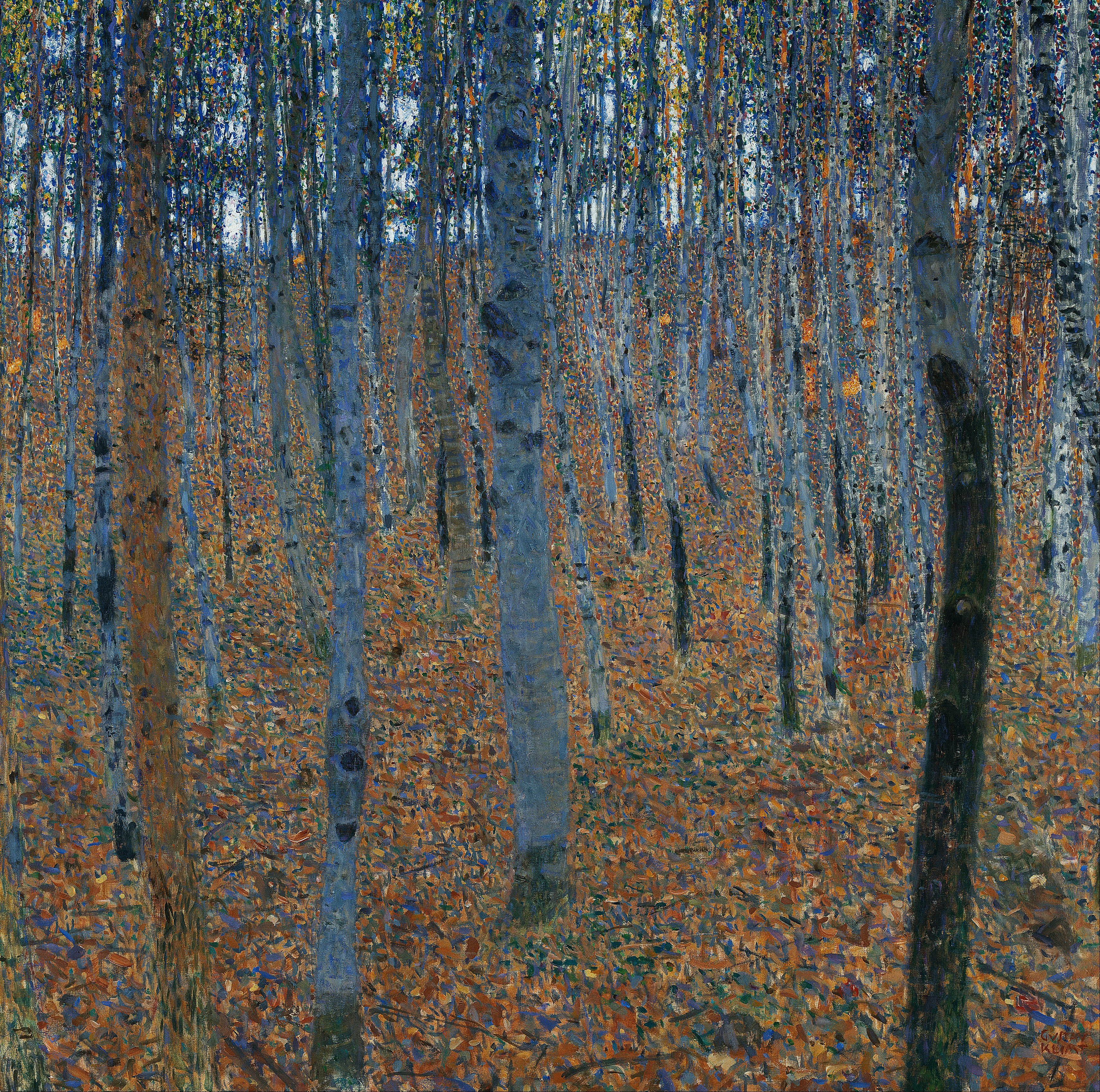
Klimt's rise coincided with a Vienna in the midst of profound transformation—an imperial capital desperately seeking to modernize its image while preserving its grandeur. He quickly understood that a wall could become a living stage, far more powerful than a mere canvas hung on a nail. His first major successes rested on this ability to fuse historical narrative with abundant decoration, already employing flat color planes and complex ornaments that foreshadowed his mature style. Unlike his contemporaries confined within rigid academicism, he dared to introduce a troubling sensuality and a compositional freedom that disturbed the Viennese bourgeoisie as much as they fascinated them. It is this subtle balance between official commissions and aesthetic subversion that laid the foundations of his future international renown.
Style artistique
Vienna is changing, Klimt too: academicism is starting to show

In 1897, the cup runneth over for a generation of artists stifling under the weight of Austrian academic conventions. Gustav Klimt, alongside Josef Hoffmann and Koloman Moser, founds the Vienna Secession, a movement that proclaims its intent to free art from its traditional chains. Their motto, inscribed on the pediment of their pavilion designed by Joseph Maria Olbrich, echoes like a manifesto: "To every age its art, to every art its freedom." This break is not merely stylistic—it is structural: it aims to bring painting, architecture, and design closer together to create a total work of art, the famous Gesamtkunstwerk. The journal Ver Sacrum becomes the mouthpiece of this new vision, spreading refined graphics and bold ideas that shake local conservatism to its core.
The break with the Viennese artistic establishment marked a decisive turning point in Klimt's career, as he gradually moved away from large historical frescoes to focus on more intimate and symbolic subjects. Official commissions became increasingly scarce, particularly after the scandal provoked by his allegorical paintings for the University of Vienna, which authorities deemed too obscure and provocative. Freed from these institutional constraints, the artist then explored new paths, moving away from narrative realism to embrace a more decorative and mysterious visual language. This transitional period was crucial, as it allowed him to refine his exploration of the relationship between the human figure and ornamentation, paving the way for the creative explosion of his Golden Period that would soon follow.
Période dorée
Why all this gold? Because beige lost the debate.

The shift toward gold was not a rich man's whim, but the fruit of an aesthetic revelation during a defining journey to Italy. Around 1903, Klimt discovered the Byzantine mosaics of Ravenna, particularly those of the Basilica of San Vitale, where the light seems to emanate from the material itself rather than being painted onto it. Fascinated by this luminous immateriality, he decided to incorporate gold and silver leaf directly onto his canvases, sometimes even embedding genuine precious materials into the oil paint. This technique, rarely used in modern Western painting since the Middle Ages, radically transforms the perception of the work: the painting no longer reflects light—it generates it, creating a sacred and timeless atmosphere around the secular subjects he depicts.
This golden period, nourished by the Byzantine heritage, gives his portraits and allegories a presence that is at once precious, sensual, and deeply symbolic. For Klimt, gold is not merely a sign of material wealth—it is a tool for isolating figures from everyday reality and projecting them into a dreamlike space. In works such as Portrait of Adele Bloch-Bauer I, the garments and the background merge into a tapestry of geometric and organic patterns, from which the sitter's body emerges like an island of realistic flesh amid an abstract ocean. This striking contrast between the cold minerality of metal and the living warmth of skin creates a unique visual tension that immediately captivates the viewer's gaze.
Portraits féminins
Women in Klimt: Models, Icons, and Knowing Gazes
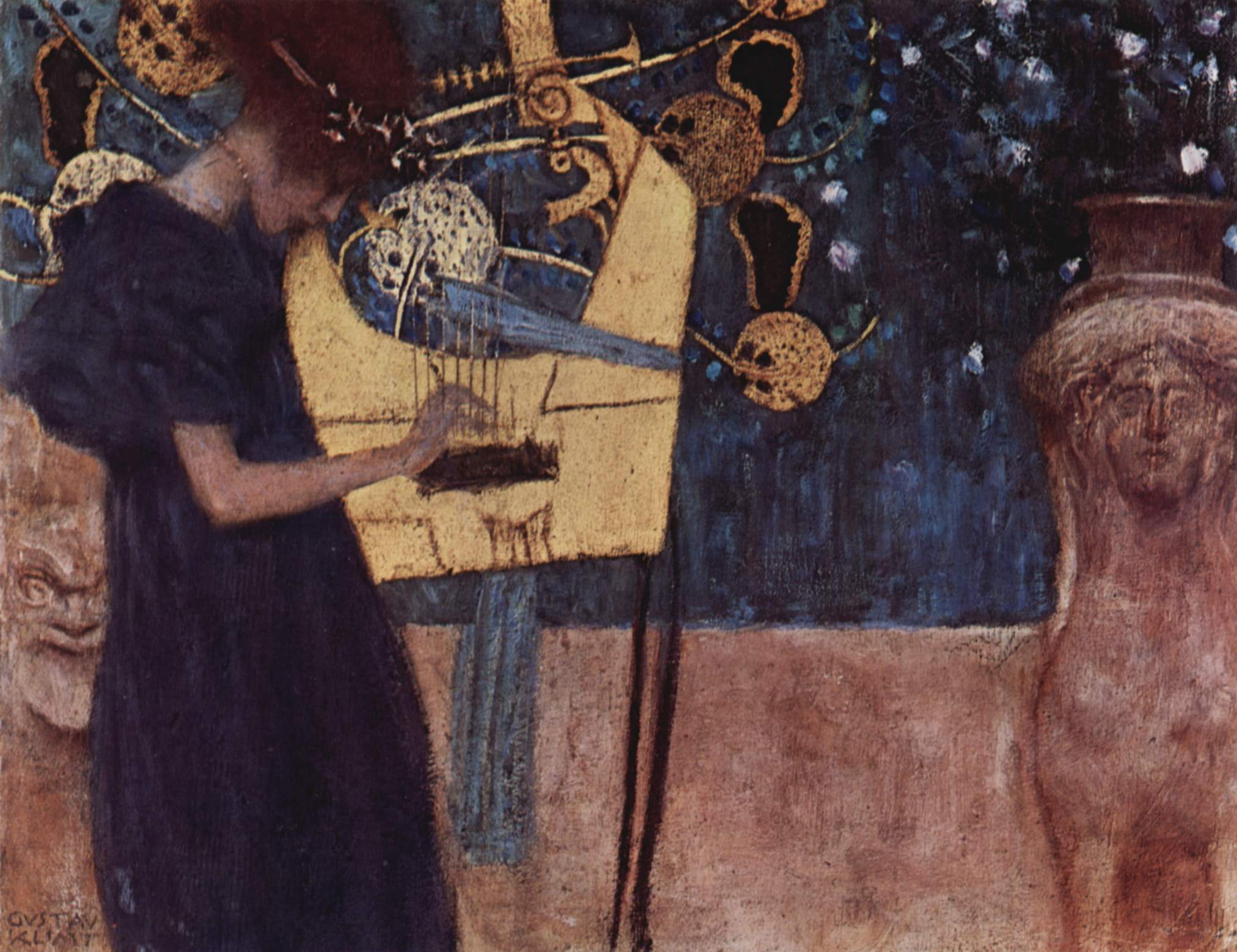
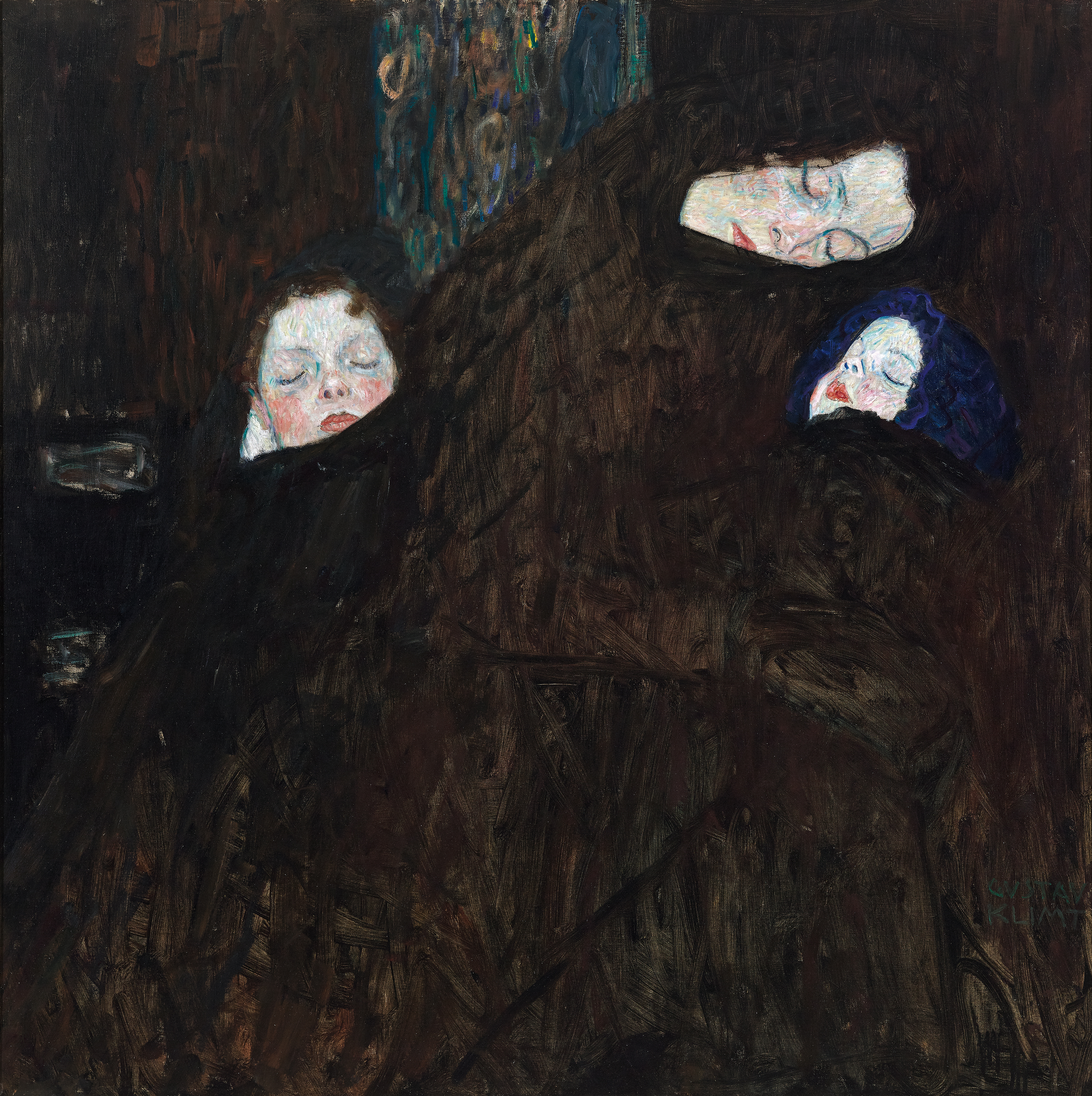
In Klimt's work, women occupy a central place—not as mere objects of passive contemplation, but as forces of nature, goddesses, or predators fully aware of their own power. Whether depicting Judith beheading Holofernes with an expression of troubling voluptuousness, or Danaë receiving Zeus's golden rain in a posture of total surrender, his heroines embody a sexuality that is fully embraced and often dangerous. They do not gaze at the viewer with submission; their eyes are frequently closed or fixed on some distant point, suggesting that they inhabit a rich and inaccessible inner world. This portrayal stands in stark contrast to the Victorian propriety of the era, asserting a vision of femininity that is complex, weaving together motherhood, eroticism, and death within a single sumptuously decorative frame.
Beyond mythology, Klimt excels in portraying women of Viennese high society, transforming his patrons into untouchable icons through an accumulation of patterns and gold. The Portrait of Adele Bloch-Bauer remains the perfect example of this alchemy, where the sitter's personality seems to dissolve into a setting of triangles, stylized eyes, and spirals that protect her as much as they imprison her. Yet beneath this apparent luxury, one senses a subtle psychology, a human fragility that pierces through the golden mask. These works are not merely flattering effigies, but profound explorations of feminine identity at the dawn of the twentieth century, capturing the anguish and longing of an era in the midst of sweeping social and cultural upheaval.
Art & détails
The Kiss: love, gold and enormous pressure on the couch cushions
Created between 1907 and 1908, The Kiss is undoubtedly Klimt's most iconic work, encapsulating in a single painting his entire artistic philosophy and technical mastery. Now housed at the Belvedere Museum in Vienna, this monumental canvas depicts an embracing couple at the edge of a flowery precipice, wrapped in a single cloak woven with distinct patterns. The man, dressed in black and white rectangles evoking rigid masculine strength, leans his head toward the woman, while she, covered in colorful circles and flowers, surrenders herself in a soft, receptive curve. The composition is a masterpiece of balance, where the verticality of the bodies contrasts with the horizontality of the floral ground, creating a visual dynamic that draws the viewer toward the center of the embrace.
What makes Le Baiser so fascinating, beyond its universal subject, is the way Klimt uses ornament to express the merging of souls rather than mere physical closeness. The two figures seem to lose their individual outlines to form a single golden entity, isolated from the rest of the world by this luminous halo. Yet a note of melancholy persists: the woman is kneeling, almost submissive, and the abrupt edge of the meadow evokes the fragility of this moment of grace in the face of existential emptiness. It is this duality between decorative exuberance and emotional depth that makes this canvas a timeless icon, capable of speaking both to museum visitors and to art lovers in their living rooms.
Art & détails
How to recognize Klimt without brandishing a professor's magnifying glass?

Identifying a Klimt painting doesn't require an art history degree—just a keen eye for texture and the way pictorial space is handled. The first major clue lies in his systematic use of flat color: Klimt rejected traditional perspective and classical volumetric modeling in favor of richly ornamented flat surfaces. His backgrounds are never mere neutral backdrops but active fields filled with spirals, scales, diamonds, or eye-like motifs that rival the main figures in importance. This absence of illusionistic depth forces the viewer's gaze to stay on the surface of the canvas, inviting a tactile and decorative reading rather than a narrative one.
Another unmistakable hallmark is the striking contrast between the realism of the faces and hands and the total abstraction of the clothing and surroundings. Klimt often paints flesh with a modeled, almost photographic softness, bringing out the skin tones and psychological expression, before surrounding them with a flood of stylized geometric or vegetal patterns. This tension between the natural and the artificial creates a unique visual vibration, as if the figures were emerging from a golden dream to briefly touch our reality. Moreover, the color palette—often dominated by gold, red, emerald green, and deep black—contributes to that lush, mysterious atmosphere that is instantly recognizable among thousands.
Sécession viennoise
Schiele, Mucha, Moser: the artistic neighbors who don't stay quietly on the doorstep

Although Klimt is a towering figure, he never worked in an artistic vacuum, moving within a dense network of creators who redefined Art Nouveau in Central Europe. Egon Schiele, his most famous protégé, pushed the exploration of the human body into far rawer, more angular territory, stripping away Klimt's ornamentation to reveal the raw nervous tension of existence. Conversely, artists like Alphonse Mucha, though Czech and tied to Parisian Art Nouveau, shared with Klimt this love of curving lines and the idealized woman, even though his approach remained more graphic and commercial in nature. These constant exchanges allowed the Vienna Secession to become an intellectual crossroads where painting was in constant dialogue with architecture and object design.
It is also impossible to talk about Klimt without mentioning his close collaborators such as Koloman Moser and Josef Hoffmann, founders of the Wiener Werkstätte. While Klimt explored the spiritual and symbolic dimension of ornament, Moser and Hoffmann applied those same geometric principles to everyday life, designing furniture, textiles, and everyday objects of stunning modern rigor. This interdisciplinary collaboration perfectly illustrates the ambition of the Secession: to erase the boundary between fine arts and applied arts. Understanding these connections significantly enriches our reading of Klimt, because his paintings are not isolated islands, but rather the centerpieces of a broader project aimed at aesthetically renewing Viennese society at the time.
Art & détails
What museums reveal when the internet speaks too fast

In today's digital age, where images circulate at a dizzying speed, it's crucial to go back to museum sources to grasp the true scale and materiality of Klimt's works. The Belvedere in Vienna holds the world's largest collection, offering an unparalleled immersion in the artist's stylistic evolution, from his academic beginnings to his final unfinished canvases. Similarly, the Leopold Museum, also in Vienna, provides essential context by displaying Klimt alongside Schiele and Kokoschka, making it possible to understand the dynamics of Austrian expressionism. These institutions preserve not only the paintings but also the sketches and correspondence that reveal the painstaking creative process behind the apparent ease of the gilded surfaces.
For readers unable to travel to Austria, the Neue Galerie in New York is a must-visit stop, notably housing the prestigious Portrait of Adele Bloch-Bauer I, repatriated after a long and landmark legal battle. The websites of these museums, along with databases such as Wikidata or Wikimedia Commons, now offer high-quality digital access, allowing for close study of the tiniest details of textures and craquelure. However, no on-screen reproduction can fully capture the physical effect of light bouncing off real gold leaf. Consulting the scholarly resources of these institutions remains the best way to correct the frequent inaccuracies found online and to appreciate the technical complexity of these masterpieces.
Art & détails
Invite Klimt into your home without turning your living room into an imperial palace

Integrating a Klimt reproduction into a modern interior calls for a certain finesse to avoid a kitsch effect or an overly literal historical recreation. The key lies in striking a dialogue between the opulence of the artwork and the sobriety of its surroundings: a gilded canvas will truly shine when hung on a plain wall painted in deep tones such as midnight blue, forest green, or even a matte anthracite gray. These dark hues act as a setting that draws out the natural luminosity of the gilding without competing with it. Steer clear of heavily patterned wallpapers or overly baroque furniture, as they would clash visually with the decorative density already present within the painting itself.
The choice of format and room also plays a key role in the success of this decorative integration. In a living room, a large reproduction of The Kiss or Adele Bloch-Bauer can serve as a majestic focal point above a clean-lined sofa, bringing warmth and character to the space. In contrast, in a bedroom, opt for softer works such as certain landscapes or frieze details, whose palette is often more botanical and soothing. For a creative office, complex allegories can stimulate the imagination, provided you leave enough empty space around the work to give the eye room to rest. The goal is to let the art breathe, not to overwhelm the room under the weight of history.
Décoration intérieure
Mistakes to avoid before hanging gold on the wall

The first common mistake is choosing a reproduction based solely on the fame of the image without taking into account print quality and how materials are rendered. A cheap copy will tend to flatten the gold leaf, turning it into a dull, lifeless yellow that loses all the luminous magic characteristic of Klimt. It is essential to look for high-definition art prints, ideally printed on canvas with durable pigment inks, or even hand-painted reproductions that attempt to recreate the texture and relief of the original. Viewing distance is also a crucial factor: a work this rich in detail requires enough distance to be appreciated as a whole, so avoid hanging it in a narrow hallway.
Finally, beware of visual overload and poor lighting, which can completely distort the impact of a Klimt artwork. Direct, aggressive lighting, such as a poorly aimed halogen spotlight, can create distracting reflections on the golden parts of the print, making the image difficult and tiring to look at. Opt for soft, warm, diffused light that envelops the painting, enhancing its precious quality without overwhelming it. Additionally, don't try to match every element of your decor to the colors of the artwork; let it stand on its own as an autonomous piece. Trying too hard to coordinate your cushions or vases with the painter's motifs risks turning your interior into an artificial stage set rather than a harmonious living space.
| Pièce | Suggestion | Effet décoratif |
|---|---|---|
| Salon | Une oeuvre liée à Gustav Klimt avec une composition forte | Point focal cultivé, chaleureux et facile à commenter sans réciter un cartel. |
| Chambre | Une palette douce ou une scène plus intime | Atmosphère calme, présence visuelle sans agitation inutile. |
| Bureau | Une image structurée, colorée ou graphiquement nette | Énergie créative et petit rappel que le mur peut aussi travailler. |
| Entrée | Un format vertical ou une oeuvre immédiatement lisible | Première impression claire, élégante, et nettement moins timide qu'un vide blanc. |
Pour continuer la visite
Sources, collections, and paths genuinely related to the topic
A few useful references for checking the information, comparing freely-licensed images, and continuing the reading—without dragging an unsuspecting museum into it.
Useful Collections
FAQ
Frequently Asked Questions about Gustav Klimt
What is Gustav Klimt known for in painting?
Gustav Klimt transforms the Vienna Secession, Art Nouveau, and Symbolism into a golden, decorative, and intensely modern language.
How to recognize this style quickly?
Pay particular attention to the gilding, decorative motifs, feminine figures, symbolism and arabesques, then notice how the composition guides your eye. If the piece holds your attention longer than expected, it's probably not by accident.
Which artists should you know?
The main references are Gustav Klimt, Egon Schiele, Koloman Moser, Alphonse Mucha, and Josef Hoffmann.
Does this style suit a modern décor?
Yes, as long as you choose the right format, a palette that matches the room, and a piece whose presence stays enjoyable on a daily basis.
Should we choose the most famous work?
Not necessarily. The most well-known piece may be perfect, but the right choice really depends on the room, the format, the palette, and the atmosphere you're looking to create.
Where to verify the information?
Start with museum records, Wikipedia/Wikidata for general orientation, then Wikimedia Commons when a freely licensed image is needed.
The living legacy of a master of light
Gustav Klimt remains far more than a mere illustrator of the Viennese Belle Époque; he is a visionary who captured the anguish and desire of his time and transfigured them into eternal beauty. His legacy is not confined to the hushed halls of museums—it continues to inspire contemporary creators, interior designers, and anyone who seeks to bring a touch of dream and mystery into their daily lives. Choosing a Klimt work means accepting to live with an image that never fully lets itself be possessed, always revealing a new detail, a new nuance each time the light changes. In a world often too raw and functional, his golds remind us with elegance that art has the power to sublimate matter and elevate the spirit, transforming a simple wall into a window open to the infinite.
0 comments