


Vienna around 1900
Gustav KlimtGold and Modernity
Beneath the precious mosaics, a radical painting of desire, power, life, and death — born in the heart of a Vienna turning the century.
The Kiss, 1908–1909 · Österreichische Galerie Belvedere, Vienna
Gustav Klimt sets two worlds in opposition within a single image. The face, the hands, and sometimes the feet keep a fleshly presence; all around, the garment, the space and the decor turn into signs. Circles, spirals, rectangles, eyes, flowers and gold leaves transform the body into apparition.
This tension explains the power of his paintings. Klimt is neither a mere decorator nor solely the painter of a fin-de-siècle eroticism. Trained in the grand official decorations, he masters academic illusion before abandoning it. With the Vienna Secession, he defends a modernity in which painting, architecture, typography and applied arts can take part in a single environment.
Four keys to recognizing Klimt's language
The line
A supple contour isolates the silhouette, follows a lock of hair, or closes a profile. Drawing gives the body a clear presence amid the decorative abundance.
Ornament
Rectangles, spirals, flowers and signs are not gratuitous additions. They give rhythm to the surfaces and suggest identities, tensions, or roles.
Frontality
Reduced depth, monumental figures and saturated grounds bring painting closer to mosaic, to the icon, to the poster and to the tapestry.
The Contradiction
Beauty and unease coexist. Gold can ennoble an embrace — yet also freeze the body. Flowers often frame themes of time and mortality.

Vienna 1900: a brilliant, unstable, modern city
At the close of the 19th century, Vienna is the capital of a vast empire and an intellectual laboratory. The palaces of the Ring stand alongside industrial transformations, national tensions, antisemitism and new research in medicine, psychology, music and architecture.
In 1897, Klimt leaves the conservative Künstlerhaus with other artists and founds the Vienna Secession. He becomes its first president. Their ambition is not to impose a single style, but to open Vienna to international contemporary art and to bring fine arts, architecture and applied design into closer dialogue.
The building by Joseph Maria Olbrich, its golden dome and the journalVer Sacrumgive this project a visual identity. There, Klimt finds the space to develop his great allegories without submitting to academic conventions.
Breaking with the conservative juries and presenting the European avant-gardes.
Bringing painting, architecture, furniture, sculpture, music and graphic design into dialogue.
Responding to the contradictions of the modern city with a new aesthetic.
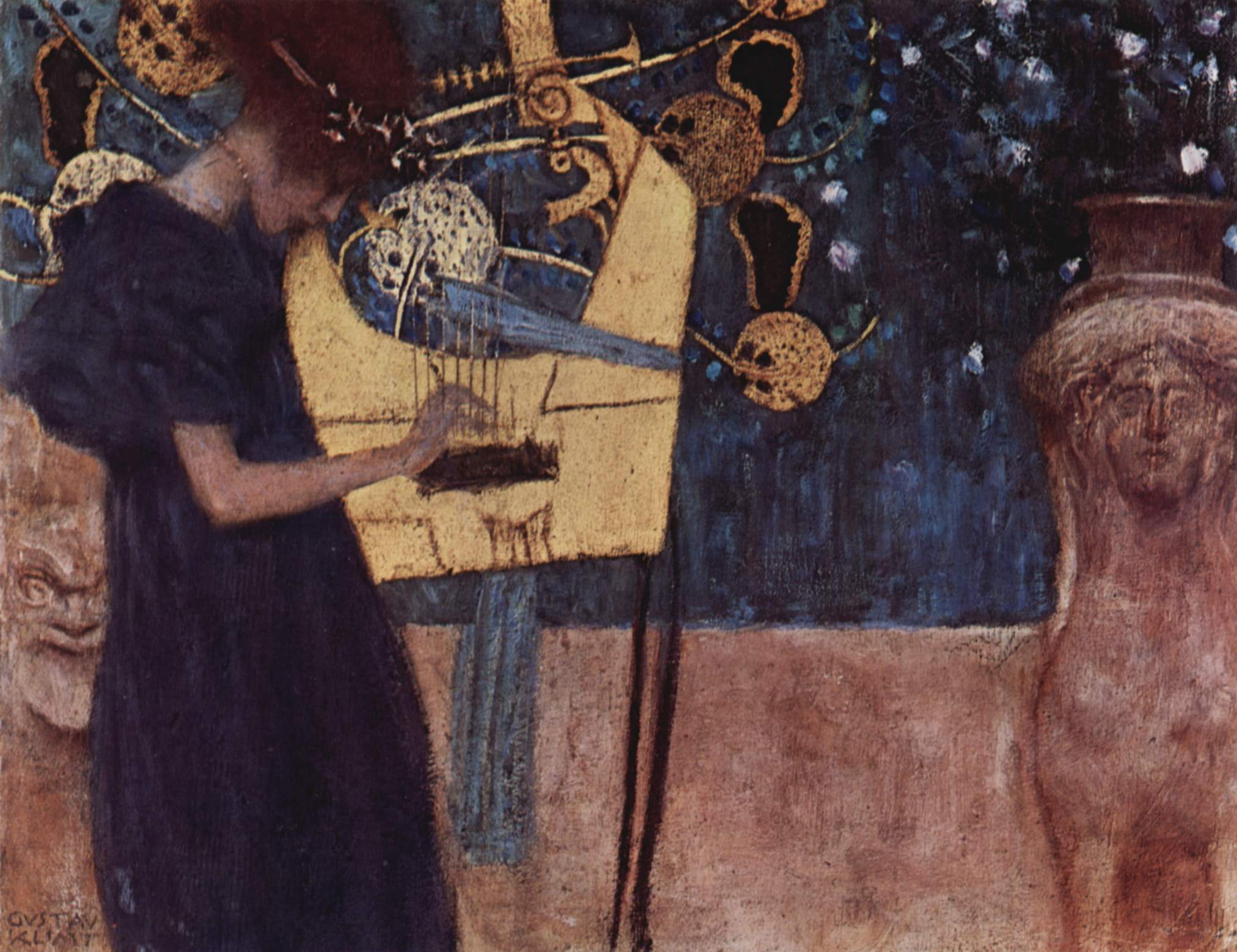
From an official decorator to the painter of the Secession
Academic mastery
Klimt studies at the School of Applied Arts in Vienna. With his brother Ernst and Franz Matsch, he founds the Company of Artists, specialising in decorations for theatres and public buildings. This period grants him a virtuoso technique and an intimate grasp of architecture.
The University Scandal
Commissioned to decorate the ceiling of the University of Vienna, Klimt produced for Philosophy, Medicine and Jurisprudence visions that were dark, sensual and at odds with the institution's official optimism. The controversy became so heated that he returned his fees and reclaimed the paintings.
Engineering the Break
Klimt takes part in founding the association and becomes its first president. Pallas Athéna and Nuda Veritas give this new artistic freedom a combative image.
The Beethoven Frieze
For an exhibition conceived as a total work of art around Beethoven, Klimt deploys a monumental cycle across three walls. Humanity seeks happiness, confronts hostile forces, and finds fulfilment through the arts. Line, monumentality, and gold announce his most famous period.
Modern Icons
After journeys in Italy — notably Ravenna — Klimt pushes the encounter between figure and precious surface even further. Judith, Portrait of Adele Bloch-Bauer I and The Kiss transform portrait, biblical narrative and the couple into almost liturgical visions.
After the gold
The palette grows more vivid and the motifs open to Asian influences and bold colors. The portraits of Friederike Maria Beer and Johanna Staude, the landscapes and the great allegories carry the inquiry forward until Klimt's death in February 1918.
The Golden Period: when painting becomes a precious surface
Why Gold?
Klimt was the son of a gold engraver. Yet his use of metal leaf extends far beyond family history. The Byzantine mosaics he observed in Ravenna, the icon, medieval art, and the decorative arts offered him models in which light does not describe volume — it emanates from the surface.
- Gold lifts the scene out of ordinary time.
- It transforms the garment into a field of signs.
- It captures the actual light of the room.
- Il rapproche peinture, mosaïque et objet précieux.
Une beauté jamais neutre
Dans Le Baiser, les deux corps semblent protégés par un manteau commun, mais ils se tiennent au bord d’un tapis fleuri suspendu dans un espace indéfini. Les motifs rectangulaires du vêtement masculin et les formes circulaires du vêtement féminin ont souvent été lus comme des signes de différence, sans épuiser l’ambiguïté de l’étreinte.
- Realism focuses on faces and hands.
- The decor absorbs the bodies almost entirely.
- Space becomes frontal, with no horizon in sight.
- Sensuality transmutes into a universal image.
Four Visions of Woman, Body and Symbol

Hygieia in Medicine
The goddess faces the viewer, serpent and cup in hand. The decorative authority of the figure stands in sharp contrast to the bleak vision of the human condition that scandalized the university.

Hope I
The pregnancy is shown frontally, poised between the promise of life and threatening figures. Klimt refuses any reassuring sentimentality.
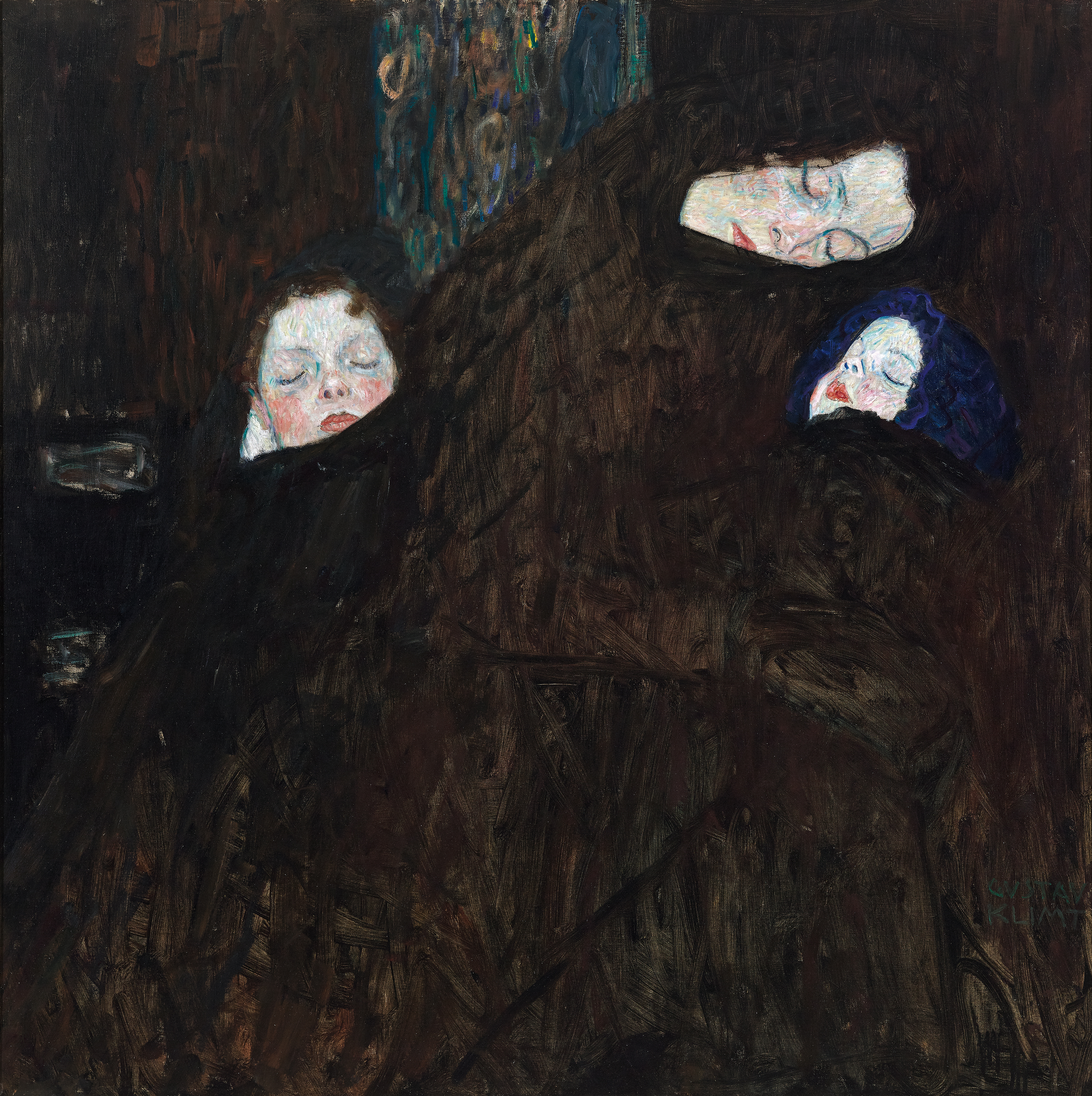
Mother with Two Children
The close-knit group turns sleep into a refuge. The faces emerge from an almost abstract field of colored matter.

Friederike Maria Beer
The late portrait trades gold for acidic colors, Eastern motifs, and an almost theatrical energy. The society figure becomes a modern presence.
For Klimt, ornament does not surround the subject: it reveals what realism alone cannot say.
Social status, desire, threat, fertility, or vanishing take the shape of pattern. Decoration becomes a psychological and symbolic language, never offering a single, fixed reading.
Landscapes: Klimt's secret garden
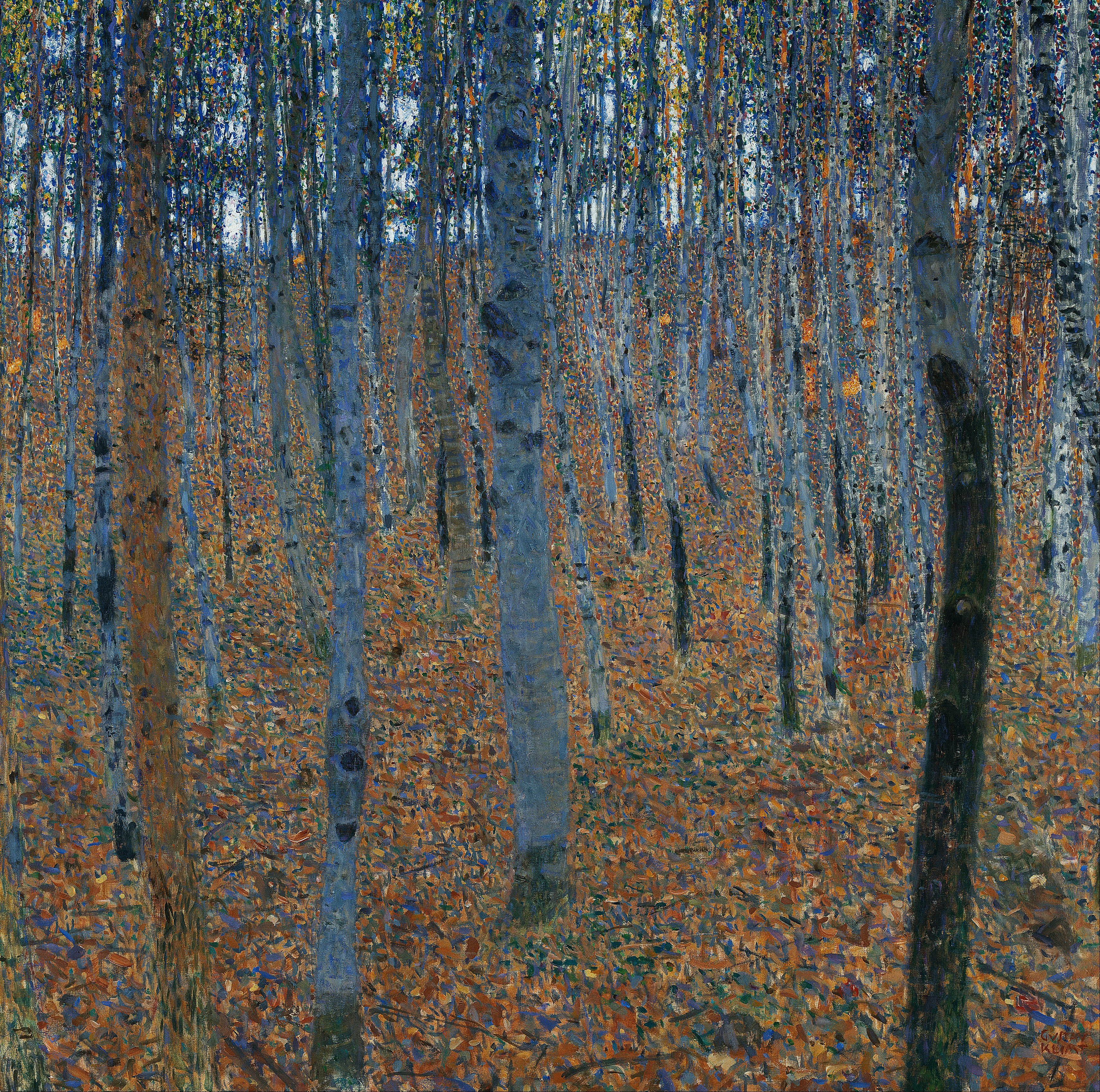
Beech Forest I
The vertical trunks form a grid while the ground is covered with colourful touches. The natural space becomes an immersive tapestry.

Tranquil Pond
A high horizon, reflections, and the square format reduce depth. The water becomes a meditative surface that borders on abstraction.
Klimt painted regularly during his summer stays, especially around the Attersee. He often used a viewfinder to select an almost square fragment of the landscape. Devoid of human figures, these works still preserve his essential principles: frontality, density, a repetitive rhythm, and a hesitation between depth and surface.

Portraits, Models, and the Women of Viennese Modernity
Klimt became a sought-after portraitist of the Viennese bourgeoisie, especially of women from families of collectors, industrialists and intellectuals. These commissions granted him financial independence and opened spaces for experimentation in which clothing, furnishings and background speak as eloquently as the face itself.
He also produced thousands of drawings, often of nude women, in a practice distinct from the official portrait. Their erotic frankness fed the controversies of his time. To look at them today is to hold three things together: the graphic freedom, the social asymmetries between sitter and artist, and the active role played by many women patrons and admirers in Viennese culture.
Features, hands and posture keep the sitter's presence anchored within the setting.
Patterns, fabrics and jewels build a public image as much as they signal a fashion.
Furniture, color and gold place the sitter within a culture of taste and collecting.
Four received ideas about Gustav Klimt
« Klimt always painted in gold »
The Golden Phase is essential but limited. His beginnings are academic, his landscapes explore color, and his late portraits often trade gold for vivid, expressive motifs.
The décor is a thought
The motifs organize the composition, distinguish or merge the bodies, signal a tension, and transform the perception of space. They are never mere filler.
"Le Baiser is an unambiguous image."
The embrace appears protective, yet the kneeling posture, the edge of the flower-strewn meadow, and the merging of the garments sustain a tension. Its fame does not foreclose the meaning of the work.
Klimt belongs to a network
The Secession, Josef Hoffmann, Koloman Moser, the Wiener Werkstätte, the patrons and the models all contribute to the ecosystem in which his art takes shape.
Choosing a Klimt for your décor
A Klimt reproduction acts as a luminous surface. The golden works naturally become the focal point of a room; the portraits create a more vertical presence; the square landscapes install a calm and enveloping atmosphere.
Avoid crowding the painting with gold objects. One or two echoes are enough: a brass lamp, an ochre cushion, or a dark frame. Let matte materials — linen, wool, wood, lime — balance the shine.
| Atmosphere | Artwork | Room | Harmonies |
|---|---|---|---|
| Precious and intimate | The Kiss, golden portraits | Living room, bedroom | Velvet, walnut, brass, raw |
| Bold and symbolic | Judith, Pallas Athena, Hygieia | Entryway, study | Black, burgundy, patinated metal |
| Calm and botanical | Forests, gardens, ponds | Living room, reading nook | Oak, linen, moss green |
| Vibrant and modern | Late portraits | Spacious living room, walk-in closet | Bold colors on a neutral background |
The Klimt, Art Nouveau and Symbolist collections
Start with the Gustav Klimt collection, then narrow down by mood: golden, symbolist, floral, feminine, or tied to Viennese modernity.
Each collection below has been verified in the Alpha Reproduction shop and brings together works available in several formats.
Frequently asked questions
FAQ on Gustav Klimt
Which artistic movement does Gustav Klimt belong to?
Klimt is the leading figure of the Vienna Secession and of Austrian modernity around 1900. His work enters into dialogue with Symbolism, Jugendstil, and Art Nouveau, while retaining a deeply personal identity.
Why did Gustav Klimt use gold?
Gold brings his paintings close to mosaic, icon, and precious object. Klimt also knew metalwork through his father, a gold engraver. His travels to Ravenna deepened his interest in luminous Byzantine surfaces.
When did Klimt paint The Kiss?
The Kiss was painted in 1908 and completed in 1909. The work belongs to Klimt's Golden Period and was acquired by the Austrian state during the artist's lifetime. It is now held at the Belvedere in Vienna.
What is the Vienna Secession?
Founded in 1897 by Klimt and other artists, the Secession set out to break with the conservatism of the Künstlerhaus, to showcase modern international art and to bring painting, architecture, design and the applied arts into closer dialogue.
Did Klimt also paint landscapes?
Yes. His landscapes, often square in format and painted during summer stays, depict forests, gardens, ponds, and shorelines. Their reduced depth and decorative density bring them at times close to abstraction.
Which Klimt painting to choose for a living room?
The Kiss or a golden portrait creates a luminous focal point. For a calmer atmosphere, opt for a square landscape. A symbolist work such as Pallas Athene or Hygieia suits a darker, more theatrical setting.
0 comments