

Claude Monet · flowers · fruits · family table
Still life at Monet: flowers, fruits and painted meals
Monet is associated with millstones, stations, cliffs and water lilies. However, its cut flowers, fruits, pheasants and meal scenes tell another story: that of a painter who learns light on the scale of a table.
Still life in Monet is not a secondary genre. She goes through her youth, accompanies family intimacy, nourishes her garden painting and prepares part of her impressionist gaze: calm color, lively touch, object captured in the air.
Topic guide
Flowers, fruits, pheasants, meals: a journey through the objects painted by Monet before and around impressionism.
Quick response
Did Monet paint still lifes?
Yes. Monet paints still lifes of flowers, fruits, game and meal scenes. These are not his most famous works, but they are essential to understanding his color, his touch and his relationship to daily life.
A laboratory of light
On a table, in a vase or around a meal, Monet is already working on what will make his painting: the vibration of tones, the reflections on surfaces, the air that circulates between objects.
- Topics
- Flowers, fruits, meals, game
- Strong period
- 1860 - 1880
- Museums
- Getty, Cleveland, Orsay, Chicago
- Issue
- Color, material, intimacy

Timeline
From youth bouquets to impressionist tables
The genre appears early in Monet, then moves: from the isolated object to the inhabited table, from the bouquet to the garden.
Objects and flowers
Monet works with bouquets, fruits and materials in a tradition still close to the workshop.
Lunch
The table becomes a family scene: dishes, bread, light and human presence.
Flowers and fruits
A bouquet and a cup of fruit become a ground for colorful pairings.
Apples and grapes
Monet densifies the touch: the fruits are less drawn than shaped by color.
Flowers
The bouquet as a miniature garden
Before the large gardens of Giverny, Monet observed the flowers very closely. The cut flower becomes a small vertical landscape, dense, almost tactile.

Why flowers are important
At Monet, the bouquet is not only decorative. It allows you to work on very tight contrasts: light petals, dark foliage, vase, background, colored shadows.
Immediate color
The flower imposes a lively, unstable, seasonal palette.
Matter
The key can remain visible without losing the pattern.
Proximity
The look gets closer: we are almost in the smell and the texture.
Giverny in germ
The isolated flower prepares the garden as a large bouquet.
Fruits
Apples, grapes: the color placed on the table
The fruits at Monet give a denser, lower, more earthy paint. They concentrate red, green, yellow and warm shadows.

Simple volumes
The apple allows you to test the volume with very few resources: a red, a shadow, a shine.
Hot contrasts
The reds and yellows of the fruits oppose the muted greens and brown bottoms.
Visible key
Monet does not polish the surface: he keeps the pictorial vibration.
Domestic season
The table becomes a calendar: fruits, flowers, meals and interior tell the moment experienced.
Meals
Lunch: when still life meets family life
With Lunch, Monet moves still life to the scene of life. The table is no longer empty: it carries a domestic atmosphere.
A table, not just a stage
In Lunch, meal objects - tablecloth, crockery, bread, carafe, fruit or leftovers - organize the image as much as the figures. It is an interior painting, but also an enlarged still life.
The domestic light, the presence of Camille and the child, the whiteness of the table: everything brings the meal closer to a sensitive experience. Monet paints what is seen, but also what is shared.

Analysis
What Monet is looking for in objects
Flowers, fruits and meals offer it three laboratories: pure color, simple volume and social light from within.
The fragile living
The flower allows for a quick touch, a bright color, an outline that comes undone.
The colored weight
Apples and grapes give a denser, rounder, more material paint.
The inhabited table
Still life becomes a scene: objects, light and family presence mix.
Palette
The table palette: red, cream, green, gold
Still life forces Monet to condense the color. Unlike the open landscape, everything is played out in a tight space.
More examples
A gallery of still lifes by Monet
To see the breadth of the subject, we have to get away from the flower-fruit-meal trio. Monet also painted chrysanthemums, peonies, tulips, peaches, melons, grapes, pears, pheasants and sunflowers.

Jar of Peaches
A jar of peaches allows Monet to work on the transparency of the glass, the orange tones and the light placed on the table.
Image Wikimedia Commons, public domain.
Still Life with Melon
Melon gives a clear, almost sculptural mass in a very simple space.
Image Wikimedia Commons, public domain.
Grapes, quinces and pears
A more abundant still life, where the fruits form a tight landscape of yellows, greens and browns.
Image Wikimedia Commons, public domain.
Pears and grapes
The composition shows how Monet balances round volumes with an already free touch.
Image Wikimedia Commons, public domain.
Peony vase
The petals become material: Monet paints less the outline of the flower than its colored blossoming.
Image Wikimedia Commons, public domain.
Tulip vase
The tulips give a vertical rhythm and a range of reds/roses that Monet treats with soft touches.
Image Wikimedia Commons, public domain.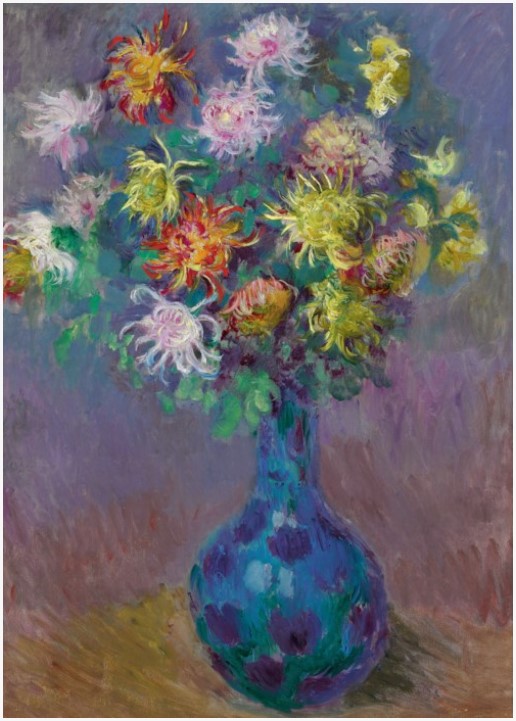
Chrysanthemum vase
A dense, decorative flower, ideal for understanding Monet's passion for floral masses.
Image Wikimedia Commons, public domain.
Still Life with Pheasants and Plovers
Game links Monet to an older tradition of still life, but the touch and colorful accords already announce a modern vision.
Image Wikimedia Commons, public domain.
Bouquet of Sunflowers
Before Van Gogh, Monet also painted sunflowers: a solar, frontal, very decorative bouquet.
Image Wikimedia Commons, public domain.Shop
Monet works to explore
A selection linked to flowers, fruits, meals and interiors at Monet, with useful collections to extend.
Lunch
The family table as a large inhabited still life.
See reproduction
Spring flowers
The bouquet as a concentration of color.
See
Jerusalem artichoke flowers
A floral verticality, close to still life.
See
Pheasants and flowers
A more traditional still life, but already vibrant.
SeeFAQs
Frequently asked questions
To place these paintings in Monet's work without confusing them with his most famous landscapes.
Did Monet paint a lot of still lifes?
He painted fewer than landscapes, but they are important: flowers, fruits, game and meals appear especially in his early days and around the 1860s and 1880s.
What is Monet's best-known still life?
Still Life with Flowers and Fruit from 1869 and Apples and Grapes are among the most cited examples. Lunch expands the genre towards the family scene.
Why talk about meals in an article on still life?
Because the table set is an inhabited still life: objects, dishes, food and domestic light structure the composition.
What connection with Monet's gardens?
Vase flowers and bouquets prepare Monet's attention to living flowers. Later, Giverny becomes like a still life enlarged to the scale of the garden.
Sources
Main references
Free images and museum sheets used to build the route.
0 comments