

Gustav Klimt • Art & Decoration Guide
Gustav Klimt: Gold, Women, and the Genius Who Made Vienna Shine
Gustav Klimt told through the questions readers really ask: life, works, details, context, sources, and decor choices, with a cultured tone but not stuck in a display case.
Imagine a Vienna where the walls of bourgeois salons suffocated under grayish realism, until a man decided that painting should sparkle like a misplaced jewel. Gustav Klimt didn't just paint pictures; he orchestrated a visual revolution by transforming the canvas into a precious surface, blending Byzantine sacredness with the most earthly sensuality. His name immediately evokes golden spirals, intense gazes, and that unique ability to make decorative luxury coexist with deep melancholy. Understanding Klimt means accepting to lose footing in a universe where every square centimeter counts, where emptiness does not exist, and where woman becomes the gravitational center of an artistic cosmos.
 Free image
The Vienna Secession sets Klimt's stage: gold, artistic freedom, and a modern Vienna beginning to shake its frames.
Reading method
How to read this article without falling asleep on your laurels
Rather than reciting a boring chronology worthy of a dusty textbook, we will navigate through the artist's obsessions like exploring a palace of a thousand mirrors. Each section answers a specific curiosity, from the choice of materials to the place of women in his work, including pitfalls to avoid when choosing a reproduction worthy of the name. The goal is to give you the keys to distinguish a simple copy from a living interpretation, while understanding why this Austrian continues to fascinate more than a century after scandalizing Viennese academicism with his bold forms.
Context before prestige
We place Gustav Klimt in his era, his workshops, his exhibitions, and his little revolts. A work without context is sometimes just a very beautiful person who forgot their history.
The signs that betray the style
We spot gilding, decorative patterns, female figures. These clues often say more than grand speeches, especially when they carry gold or nervous brushstrokes.
The work in a real room
We end with the useful question: does this image breathe in your home, or is it just posing like a poster that has read two books?
Historical context
Where does Gustav Klimt come from, besides a very good sense of spectacle?

Born in 1862 in Baumgarten, then a suburb of Vienna now integrated into the capital, Gustav grew up in a modest family but steeped in craftsmanship. His father, Ernst Klimt, was a gold engraver, a biographical detail that takes on its full meaning when observing the technical mastery the son would later deploy with gold leaf. From adolescence, Gustav entered the School of Applied Arts in Vienna, the famous Kunstgewerbeschule, where he did not just learn to draw academic nudes. He absorbed a culture of decoration, learning that painting could cover ceilings, adorn monumental staircases, and dialogue with architecture rather than just timidly hanging on it.
This hybrid training forged an artist capable of thinking in large format, far from the isolated easels of salon painters. His first major works were public commissions for the theaters of Carlsbad or the museums of art history in Vienna, done with his brother Ernst and their friend Franz Matsch. These historical frescoes, although conformist at the time, allowed him to master complex composition and visual narrative. Yet, behind this facade of a serious young man executing the Empire's commissions, the desire to break the rigid codes stifling Viennese creativity at the end of the 19th century was already germinating.
Artistic style
Vienna changes, Klimt too: academicism begins to sweat

The Vienna of 1900 is a boiling cauldron where Freud's psychoanalysis and Mahler's music redefine culture, while official art remains frozen in a reassuring pompier realism. In 1897, tired of the virulent criticism following his allegorical paintings for the University of Vienna, deemed too pornographic and obscure, Klimt slammed the door on the traditional artists' association. He then founded the Vienna Secession with architects like Josef Hoffmann and painter Koloman Moser, proclaiming 'to every age its art, to every art its freedom.' This movement sought not only to exhibit differently; it wanted to abolish the contemptuous hierarchy between fine arts and applied arts.
Their magazine, Ver Sacrum, became the graphic manifesto of this new approach, where typography, illustration, and layout merged into a total work of art. Klimt experimented with complex decorative frames that extended the painting beyond its physical limits, already announcing the obsession with ornament that would characterize his maturity. This break with academicism was not a rejection of technique, but a liberation of the subject: inner and symbolic truth now took precedence over photographic resemblance. The artist understood that the wall of a dining room or a private salon deserved as much conceptual attention as a master's canvas exhibited in a dusty museum.
Golden period
Why all this gold? Because beige had lost the debate

If you feel that Klimt emptied the coffers of the Austrian national bank to paint, you are not entirely wrong about the intention, even if the technique differs. His golden period, begun around 1903, was born directly from a trip to Ravenna, Italy, where he discovered the Byzantine mosaics of the San Vitale church. Fascinated by how these gold tesserae capture divine light to flatten space and spiritualize figures, he decided to import this sacred language into modern profane painting. He replaced traditional perspective and realistic modeling with precious flat areas, using real gold and silver leaf applied with a goldsmith's precision.
This gilding is not a simple luxury gadget intended to flatter the Viennese bourgeoisie; it serves to extract the subjects from their earthly temporality to inscribe them in the eternity of the symbol. In works like the Portrait of Adele Bloch-Bauer I, the gold envelops the patron like a religious reliquary, transforming a Jewish bourgeois woman of the time into a timeless icon. The material becomes message: visual wealth creates a protective barrier around the characters, isolating them in a dreamlike space where the rules of gravity and spatial logic no longer apply. Academic beige had lost the debate against the blinding brilliance of a modernity that fully assumed its decorative dimension.
Female portraits
Women in Klimt: models, icons, and gazes that know things

It is impossible to talk about Klimt without mentioning the central, even monopolistic, place occupied by the female figure in his work. Whether it is portraits of wealthy patrons like Adele Bloch-Bauer or allegorical figures like Judith holding the head of Holofernes, the woman in Klimt is never passive. She possesses an unapologetic sensuality, sometimes disturbing, which contrasts violently with the moral rigidity of the late Victorian era. In Judith I, for example, the biblical heroine is represented not as a pious liberator, but as a femme fatale with half-closed eyes, bathing in an almost erotic ecstasy that scandalized conservative Viennese critics.
These bodies are often fragmented, drowned under waves of geometric or organic patterns that seem to want to absorb them while sublimating them. The hands, faces, and feet are the only parts treated with a soft naturalism, emerging like islands of living flesh in the middle of an ocean of abstract decoration. This tension between carnal reality and ornamental abstraction creates a hypnotic presence: the woman becomes both subject and decor, human and pagan divinity. Klimt captures a mysterious interiority, suggesting that his models know secrets that the viewer, for his part, will never fully penetrate despite the opulence offered to his gaze.
Art & details
The Kiss: love, gold, and enormous pressure on the sofa cushions
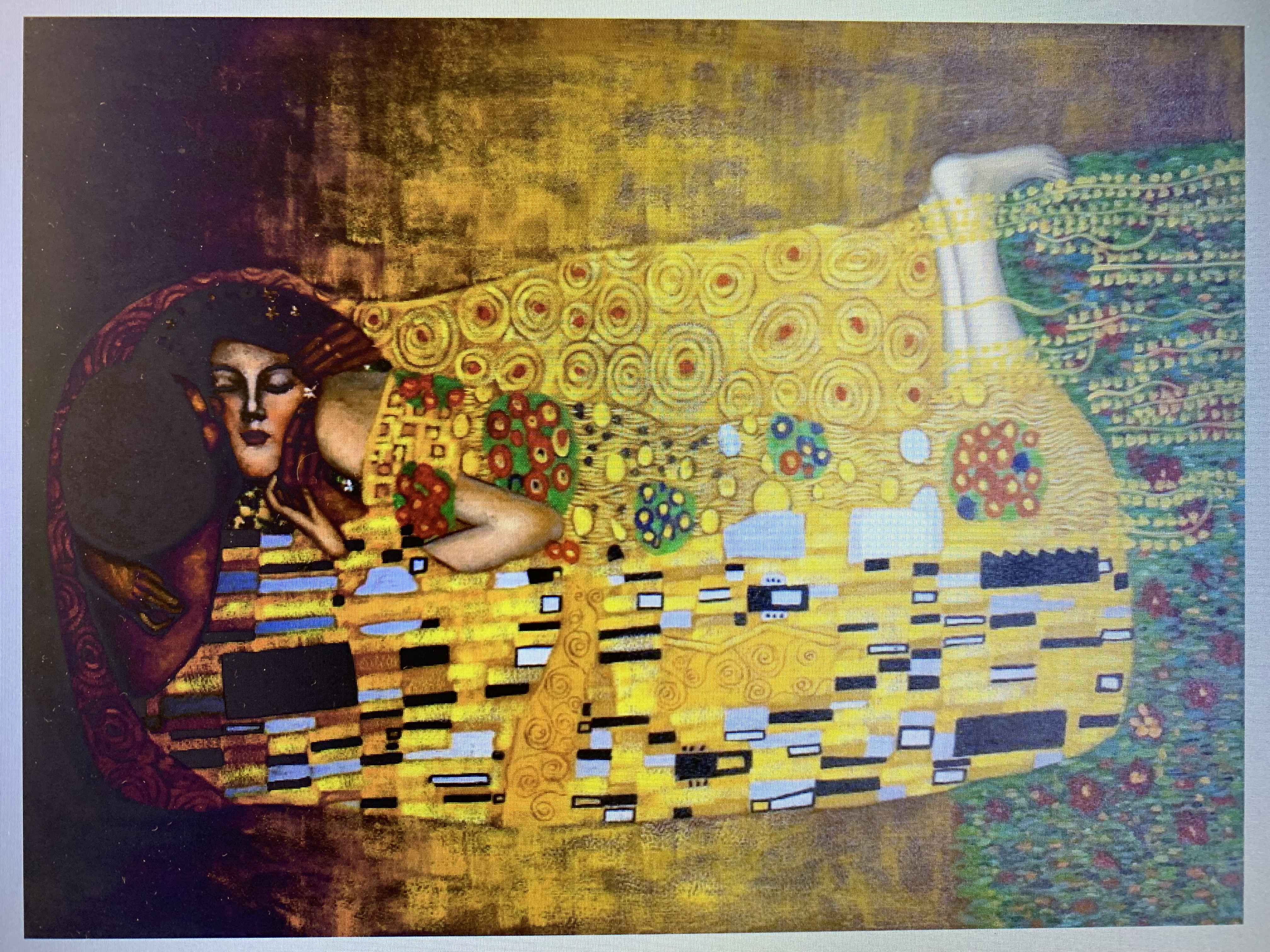
The Kiss, created between 1907 and 1908 and now housed at the Belvedere Museum in Vienna, is undoubtedly the artist's most iconic work, the one that alone summarizes his entire aesthetic philosophy. We see an embracing couple kneeling on a flowered carpet at the edge of an abstract precipice, wrapped in a cloak of solid gold that fuses their two bodies into a single luminous entity. The man, whose robe is adorned with black and white rectangular motifs evoking a structured masculine force, leans his head toward his partner whose outfit explodes with colored circles and soft spirals, symbols of a fluid and abundant femininity.
This painting functions as a secular icon of absolute love, where the physical embrace becomes a spiritual fusion made possible by the magic of gold. The composition is so dense, so saturated with minute hand-painted details, that it exerts an immediate visual pressure on the viewer. There is no background, no sky, no realistic landscape: only this moment suspended in time matters. Hanging a reproduction of this work in an interior means accepting to install a focal point of rare intensity, capable of instantly transforming the atmosphere of a room into a sanctuary dedicated to passion and formal beauty.
Art & details
How to recognize Klimt without brandishing a professor's magnifying glass?

Identifying a Klimt canvas at first glance does not require a doctorate in art history, but rather a particular attention to texture and space management. The most obvious sign is of course the omnipresent use of repetitive patterns covering surfaces and clothing: checkerboards, scales, stylized eyes, spirals, and geometric shapes intertwine to create a complex visual carpet. Unlike the Impressionists who sought to capture the vibration of natural light, Klimt builds an internal light, coming from the reflection on precious materials and the chromatic saturation of his flat areas.
Another infallible clue lies in the treatment of faces and flesh, always smooth, porcelain-like, and slightly rosy, which radically contrasts with the textured richness of the clothes and backgrounds. This dichotomy creates a collage effect before its time, where the real seems to float on an abstract world. Moreover, the composition is often frontal, without deep perspectival recession, forcing the gaze to stay on the surface exploring the infinite details of ornamentation. If you see a woman whose dress seems made of broken and reassembled stained glass with manic precision, you are very likely facing the Klimtian universe.
Vienna Secession
Schiele, Mucha, Moser: the artistic neighbors who don't stay quietly on the landing

Although Klimt dominates the Viennese scene, he should not be isolated from his contemporaries who all contributed to defining Art Nouveau and Central European Symbolism. Egon Schiele, his turbulent protégé, pushed the exploration of the human body much further, towards a raw, angular, and sometimes violent expressiveness that contrasts with the ornate softness of his mentor. Conversely, Alphonse Mucha, although Czech and active in Paris, shares with Klimt this love of curved lines, abundant hair, and the idealized woman, though Mucha's style remains more illustrative and commercial, less psychologically tormented.
Within the Secession itself, artists like Koloman Moser and Josef Hoffmann worked hand in hand with Klimt to create the Total Aesthetic. Moser, in particular, excelled in graphic design and decorative arts, applying the same principles of rigorous geometric patterns found in the dresses of Klimt's portraits. Understanding these connections allows us to grasp that Klimt was not a solitary genius fallen from the sky, but the conductor of a collective movement that sought to reshape the relationship between art and daily life. Their paths cross in the Secession exhibitions and in the commissions for the Stoclet Palace in Brussels, the pinnacle of this interdisciplinary collaboration.
Art & details
What museums tell when the internet talks too fast

In the digital age where a compressed image of three hundred pixels is often enough to judge a work, it is crucial to return to institutional sources to grasp the true dimension of Klimt's work. The Belvedere Museum in Vienna holds the most complete collection, including The Kiss and the Portrait of Adele Bloch-Bauer I, allowing one to appreciate the real scale and physical brilliance of the gilding that no screen can faithfully reproduce. Similarly, the Leopold Museum, with its vast collection of Secession works, offers an indispensable context to understand the artist's stylistic evolution and his ties to Schiele.
For enthusiasts across the Atlantic, the Neue Galerie in New York preserves major pieces from American private collections, offering a different perspective on Klimt's reception in the United States. Databases like Wikidata or Wikimedia Commons are useful for dates and attributions, but they do not replace the experience of the material. The museum labels provide detailed technical analyses on the use of metal leaf and pigments, thus correcting the excessive simplifications often found in superficial blog articles or quick image captions on social media.
Art & details
Inviting Klimt into your home without turning the living room into an imperial palace

Integrating a Klimt reproduction into a contemporary interior requires a bit of finesse to avoid the kitsch effect or a heavy historical reconstruction. The ideal is to play on contrast: a canvas rich in gold and complex details will breathe better on a solid wall, painted in deep tones like forest green, midnight blue, or even a matte anthracite gray. Absolutely avoid framing it in an overloaded gold frame that would compete with the work; prefer a thin frame, black or natural wood, which acts as a clean window opening onto the teeming universe of the painting.
The choice of room is also decisive: in a living room, a large reproduction of The Kiss or the Tree of Life can serve as a centerpiece above a sober sofa, creating an immediate focal point. In a bedroom or office, more intimate formats featuring female portraits or landscape studies bring a touch of poetry and quiet luxury. The important thing is to give the work the necessary space to be contemplated; the visual density of Klimt's patterns requires the eye to step back to appreciate the overall symphony before diving into the microscopic details.
Interior decoration
Mistakes to avoid before hanging gold on the wall

The first classic mistake is to choose a reproduction based solely on the fame of the image without considering print quality and color reproduction. A cheap copy will tend to flatten the gilding, turning it into a dull, uniform yellow that loses all the luminous magic of the original. It is imperative to favor high-definition prints, ideally on canvas with visible texture, or giclée printing techniques capable of simulating the depth of flat areas and the variation of metallic tones.
Next, beware of lighting: placing a Klimt in a dark corner or under too direct and pale light can ruin the visual experience. Gold needs warm, diffuse light to reveal its changing nuances depending on the viewing angle. Finally, don't forget the viewing distance; hanging such a dense work at eye level in a narrow hallway where you cannot step back is counterproductive. Give these paintings room to breathe and your guests time to stop, because looking at Klimt in a hurry is like trying to read a complex poem while skipping every other line.
| Room | Suggestion | Decorative effect |
|---|---|---|
| Living room | A work related to Gustav Klimt with a strong composition | Cultured, warm focal point, easy to comment on without reciting a label. |
| Bedroom | A soft palette or a more intimate scene | Calm atmosphere, visual presence without unnecessary agitation. |
| Office | A structured, colorful, or graphically sharp image | Creative energy and a little reminder that the wall can also work. |
| Entryway | A vertical format or an immediately readable work | Clear, elegant first impression, and decidedly less shy than a white void. |
To continue the visit
Sources, collections, and paths truly related to the subject
A few useful references to verify information, compare free images, and extend reading without going to a museum that didn't ask for anything.
Related articles to read next
Useful blog hubs
FAQ
Frequently asked questions about Gustav Klimt
What is Gustav Klimt in painting?
Gustav Klimt transforms the Vienna Secession, Art Nouveau, and Symbolism into a golden, decorative, and intensely modern language.
How to recognize this style quickly?
Observe especially gilding, decorative patterns, female figures, symbolism, and arabesques, then how the composition organizes the gaze. If the work holds you longer than expected, it's probably not an accident.
Which artists should you know?
The main references are Gustav Klimt, Egon Schiele, Koloman Moser, Alphonse Mucha, and Josef Hoffmann.
Is this style suitable for modern decoration?
Yes, provided you choose the right format, a palette consistent with the room, and a work whose presence remains pleasant on a daily basis.
Should you choose the most famous work?
Not necessarily. The most famous work can be perfect, but the right choice depends above all on the room, format, palette, and desired atmosphere.
Where to verify the information?
Start with museum labels, Wikipedia/Wikidata for general orientation, then Wikimedia Commons when a free image is needed.
The sparkling legacy of a timeless master
Gustav Klimt remains today much more than a simple name associated with Art Nouveau or fin-de-siècle Vienna; he embodies a decorative audacity that continues to dialogue with our modern sensibility. By refusing to choose between pure beauty and symbolic depth, between ornament and feeling, he created a universal visual language that transcends eras without aging. Whether one seeks to understand art history, enrich one's personal culture, or simply beautify one's living space with a careful reproduction, Klimt's approach offers a lasting lesson: art must be lived, felt, and above all, it must dare to shine brightly, even – and especially – in a world that is sometimes too gray.
0 comments