

Van Gogh in Paris: color explodes, brown takes flight
A deep dive into two electrifying years when Vincent van Gogh transforms his dark palette into a luminous symphony, between bohemian encounters and Japanese discoveries.
When Vincent van Gogh arrives at the Gare du Nord in March 1886, his trunks hold a heavy, earthy painting inherited from the peasants of Nuenen. No one suspects that this taciturn Dutchman, who has come to join his brother Theo—an art dealer on rue Lepic—is about to undergo the most spectacular metamorphosis in modern history. Paris is not just a city for him; it is a visual particle accelerator where impressionism already reigns supreme and cafés echo with passionate debates about light. This two-year stay, often overshadowed by the drama of Arles, is in fact the secret laboratory where Van Gogh's genius learned to breathe before taking flight toward the south.
 Free image
In Paris, even the self-portrait changes temperature: the brushstroke stirs, color turns up the volume, and brown begins to pack its things.
Reading method
How to read this pivotal period
To fully appreciate this era, you must forget the myth of the isolated mad painter and observe how Vincent absorbs, digests, and spits back the influences of the capital. Every brushstroke becomes a reply to a friend, every color a victory over northern greyness.
The context before the prestige
We place Van Gogh in Paris within his time, his studios, his exhibitions, and his small revolts. A work without context is sometimes just a very beautiful person who has forgotten their story.
The signs that betray the style
We spot a brightened palette, broken brushwork, self-portraits. These clues often say more than grand speeches, especially when they carry gold or nervous brushstrokes.
The work in a real room
We end with the useful question: does this image breathe in your home, or does it merely pose like a poster that has read two books?
Historical context
Van Gogh arrives in Paris: the gloomy painter steps off the train, color waiting for him on the platform

Vincent's arrival at his brother Theo's place in March 1886 marks a brutal break with his Dutch past. He settles into a small apartment in Montmartre, a neighborhood still village-like at the time but already buzzing with intense artistic life. Theo, who works for the Goupil gallery, immediately introduces his brother into the closed circle of the moderns, showing him canvases by Monet and Renoir he had until then only seen as black-and-white engravings. The shock is violent: Vincent realizes that painting can capture the fleeting moment and no longer only the eternal weight of things. His first outings in the Parisian galleries act like an electric shock, shaking his certainties about the role of shadow and light in pictorial composition.
Daily life in the eighteenth arrondissement offers Vincent a permanent spectacle of modernity under construction. He frequents assiduously the Café du Tambourin, run by Agostina Segatori, where artists in search of recognition and cheap drinks gather. It is there, amid tobacco smoke and animated discussions, that he begins to understand that art no longer has to serve only morality or religion, but also pure sensation. The streets of Paris, with their Haussmannian boulevards and public gardens, offer him an infinity of moving subjects, far removed from the static fields of Brabant. This total immersion in the Parisian cultural ferment lays the first stones of an inner revolution that would soon transform his technique.
Artistic style
Farewell to the browns of Nuenen: Paris opens the windows and the painting coughs with light

The transformation of Van Gogh's palette is radical and almost immediate upon settling in Paris. Gone are the bitumen, burnt ochre, and olive greens that characterized his Potato Eaters; in their place come cobalt blues, lemon yellows, and emerald greens. Under the direct influence of Impressionism, Vincent learns to break down light and to abandon black in order to create contrast. His canvases from this period show a sometimes clumsy but sincere attempt to apply the theory of complementary colors, juxtaposing red and green or blue and orange to intensify visual vibration. The paint itself changes: it becomes more fluid, more airy, as if the artist were seeking to capture the light atmosphere of the capital rather than the density of his native soil.
This chromatic brightening is accompanied by a profound modification of the brushstroke, which shortens and fragments to better seize movement. Vincent observes how Pissarro and Monet treat reflections on water or the foliage of trees and tries to adapt these processes to his own fiery temperament. The backgrounds of his paintings, once dark and indistinct, now open onto blue skies dotted with white clouds or urban backdrops bathed in clarity. Even when he paints interiors, the light seems to filter through the windows, flooding the rooms with a new brightness. This liberation of color is not merely technical; it signals a fierce determination to see the world with optimism, or at least with heightened intensity, definitively rejecting the dark realism of his early years.
Toulouse-Lautrec, Signac, Pissarro: Paris offers him a rather noisy artistic soundtrack

Paris places Vincent in direct contact with the giants of the avant-garde, transforming his provincial isolation into a vibrant artistic brotherhood. He befriends Henri de Toulouse-Lautrec, with whom he shares a taste for cabaret scenes and unvarnished portraits, exchanging ideas about caricature and the simplification of forms. Even more decisive is his encounter with Paul Signac and Georges Seurat, who introduce him to the theories of Neo-Impressionism and Divisionism. Vincent then experiments with the pointillist technique, applying small touches of pure colors side by side, as can be seen in certain views of the Seine or the public gardens. Although he never becomes an orthodox Pointillist, this forced discipline structures his exuberance and teaches him to organize his palette scientifically.
Camille Pissarro also plays a crucial role as a benevolent mentor, encouraging Vincent to paint outdoors and to observe the changing effects of natural light. Sunday afternoons are often devoted to excursions in the Parisian suburbs, where the group of artists sets up their easels facing the same motifs, each interpreting the scene according to their own sensibility. Émile Bernard, the youngest, brings a rebellious energy and ideas about Cloisonnism that will begin to take root in Vincent's mind. These constant exchanges, sometimes heated, create a fertile emulation in which each artist pushes the other to their limits. Vincent is no longer a marginal loner, but an active, if turbulent, member of the most innovative artistic community of his time.
Japanese prints: when Van Gogh discovers that the outline can hold the wheel
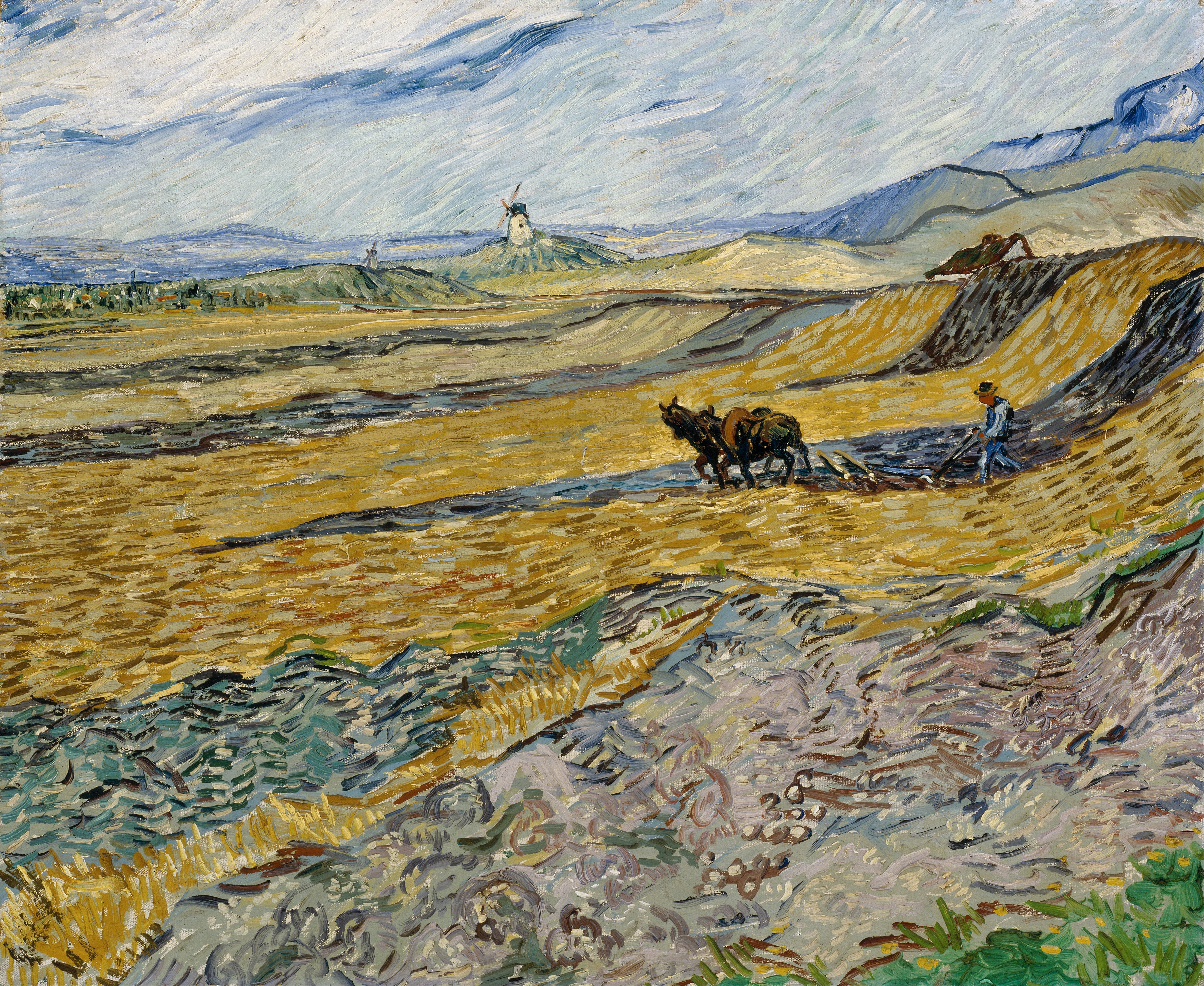
Japonism was raging in Paris in the 1880s, and Vincent devoted himself to it with the fervor of a convert, avidly collecting hundreds of ukiyo-e prints bought from the dealer Siegfried Bing. These images with flat colors, outlined contours, and bold perspectives overturned his conception of pictorial space. He discovers that it is possible to flatten depth, to crop subjects at the edge of the canvas, and to use sharp diagonals to energize composition without resorting to traditional cast shadows. Vincent then begins to copy works by Hiroshige and Eisen directly, attempting to reproduce their graphic simplicity with his own thick paint, creating a fascinating hybrid between Eastern aesthetics and Western exuberance.
The Japanese influence goes beyond mere copying to permeate his entire artistic vision during these Parisian years. He adopts the use of dark outlines to detach forms from the background, a technique that prefigures his later style in Arles but finds here its first systematic application. Flowering cherry trees, curved bridges, and sheets of water become recurring motifs in his paintings, testifying to his desire to create an earthly paradise on canvas. This fascination with Japanese art offers him a radical alternative to European naturalism, allowing him to free color from its descriptive function and make it an autonomous expressive element. Japan becomes for Vincent a visual utopia that he desperately tries to reconstruct in the very heart of the French capital.
The Parisian mirror: free model, stern judge, and chromatic laboratory

Lacking the means to pay professional models and compelled by the need to practice relentlessly, Vincent turns to the only subject always available: himself. The series of self-portraits produced in Paris forms an exceptional intimate journal in which the artist documents his own physical and stylistic transformations. We see his face grow thinner, his gaze intensify, and his red beard take on the appearance of flame under the effect of increasingly rapid, broken brushstrokes. Each canvas is a distinct technical experiment: here he tests Signac's pointillism on his own forehead, there he explores the vibrations of complementary colors in the blue background behind his head. The mirror becomes his most demanding teacher, forcing him into brutal honesty about his progress and his failures.
These self-portraits also reveal a profound quest for identity, that of a man constructing an image of himself as a modern artist in the midst of the turbulent capital. Vincent sometimes depicts himself as a bourgeois in his Sunday best, sometimes as a scruffy painter with palette and brushes, playing with the social codes of his milieu. The diversity of backgrounds, shifting from neutral to swirling, shows how he uses his own face as a testing ground for his theories on color and light. Far from being mere exercises in style, these works capture the psychological intensity of a man in full transformation, conscious of his nascent genius yet tormented by doubt. They remain today the most poignant witnesses to this period of accelerated learning in which Vincent forged the ultimate weapon of his art.
Paris is not merely a setting: it is a machine for accelerating the gaze

The city itself, with its frantic pace and constant mutations, acts as a catalyst on Vincent's perception. He paints the mills of Montmartre still standing before their disappearance, capturing the final hour of a rural world swallowed by galloping urbanization. The construction sites, the factories on the outskirts, and the bustle of the boulevards impose on him a new speed of execution, incompatible with the meditative slowness of his Dutch works. Vincent must learn to paint fast, to grasp the essentials at a glance, for the subject changes or disappears before the canvas is even dry. This urban urgency translates into a more nervous handling, plunging perspectives, and a composition that seems to pull the viewer into the whirlwind of modern life.
Cafés and places of entertainment become favorite subjects, reflecting the Parisian nightlife he observes with a curiosity tinged with melancholy. He depicts illuminated terraces, dance halls, and popular restaurants, seeking to convey the electric atmosphere of these social spaces. Unlike his Impressionist predecessors who celebrated bourgeois leisure, Vincent infuses them with a human tension, an almost palpable presence of the individuals who frequent them. Paris is not for him a mere picturesque backdrop, but a living force that alters his way of seeing and feeling. This immersion in urban modernity prepares his mind to accept radical change and constant experimentation, qualities indispensable for what comes next.
From Paris to Arles: he is not merely fleeing the city, he is seeking a warmer color

In February 1888, exhausted by the gray climate, the incessant noise, and the social tensions of the capital, Vincent makes the crucial decision to leave Paris for the Midi. This departure is not a cowardly flight, but a deliberate strategy to find a purer, more intense light, capable of rivaling the clarity of the Japanese prints he adores. He dreams of a "studio of the South," a colony of artists where color would reign as absolute mistress, far from the compromises and sterile quarrels of Parisian circles. The nervous fatigue accumulated during these two years of intense creative stimulation demands a radical change of air to preserve his mental and artistic health.
The journey to Arles marks the end of his apprenticeship and the beginning of his explosive maturity. Everything he absorbed in Paris—the theory of colors, the broken brushstroke, the boldness of Japanese framing—will now fuse under the Provençal sun to give birth to his definitive style. Paris was the necessary crucible in which the lead of his initial painting was transmuted into chromatic gold. Without these two years of intellectual and visual fermentation at the heart of modernity, the sunflowers, the bedrooms, and the starry nights of Arles would never have seen the day with such power. Vincent's departure seals the success of his Parisian stay: he leaves armed with all the techniques needed to conquer light.
Interior decoration
Choosing a Parisian Van Gogh: enough energy to wake up a wall, not enough to send it running

To integrate a work from this period into a contemporary interior, favor the self-portraits or views of Montmartre that offer a perfect balance between energy and sophistication. The vibrant blue backgrounds of his Parisian portraits pair wonderfully with white or light gray walls, bringing a touch of freshness without dominating the space as the saturated yellows of Arles might. The broken brushwork and complementary colors create a visual vibration that animates a living room or office without being aggressive, inviting attentive contemplation. A reproduction of a portrait with a straw hat or a public garden scene brings that living touch of art history so often missing from overly slick decor.
It is also wise to consider transitional works where the Japanese influence is visible, with their strong outlines and flat areas of color, which work very well in minimalist or Asian-inspired spaces. These paintings have a striking graphic quality that holds up well from a distance, unlike overly fine pointillisms that need to be seen up close. Opting for a vertical format can help structure a narrow wall, while a horizontal format will bring width to a confined room. The important thing is to choose a piece that tells this story of metamorphosis, subtly reminding us that beauty is often born from chaos and the boldness of changing one's perspective.
| Room | Suggestion | Decorative effect |
|---|---|---|
| Living room | A work linked to Van Gogh in Paris with a strong composition | A cultivated focal point, warm and easy to comment on without reciting a wall label. |
| Bedroom | A soft palette or a more intimate scene | A calm atmosphere, visual presence without unnecessary busyness. |
| Office | A structured, colorful, or graphically crisp image | Creative energy and a small reminder that the wall can also do the work. |
| Entryway | A vertical format or an immediately readable work | A clear, elegant first impression, and far less shy than an empty white wall. |
To continue the visit
Sources, collections, and paths genuinely related to the subject
A few useful references to verify the information, compare royalty-free images, and continue reading without dragging an unsuspecting museum into it.
Validated Van Gogh collections
Van Gogh milestones
Useful sources on this topic
FAQ
Frequently Asked Questions about Van Gogh in Paris
What is Van Gogh in Paris in painting?
Paris transformed Van Gogh between 1886 and 1888: the palette lightened, self-portraits multiplied, Japanese prints entered the studio, and encounters with the Impressionists and Neo-Impressionists shifted his entire painting practice.
How can you recognize this style quickly?
Look above all for a lightened palette, broken brushwork, self-portraits, Japonisme, and Montmartre, then notice how the composition guides the eye. If the work holds your attention longer than expected, it is probably no accident.
Which artists should you know?
The key references are Vincent van Gogh, Theo van Gogh, Henri de Toulouse-Lautrec, Paul Signac, and Camille Pissarro.
Is this style suited to modern decor?
Yes, provided you choose the right format, a palette that harmonizes with the room, and a piece whose presence remains pleasing day after day.
Should you pick the most famous work?
Not necessarily. The best-known work can be perfect, but the right choice depends mainly on the room, the format, the palette, and the atmosphere you are after.
Where can you verify the information?
Start with museum entries, use Wikipedia/Wikidata for general orientation, then turn to Wikimedia Commons when a rights-free image is needed.
The luminous legacy of two Parisian years
Van Gogh's stay in Paris remains one of the most fascinating chapters in art history, showing how a stimulating environment can unlock the hidden potential of a genius. In just twenty-four months, Vincent managed to absorb decades of artistic evolution, moving from earthy darkness to an explosion of light and color that would forever change modern painting. Paris gave him the tools, the friends, and the challenges he needed to forge his unique identity, turning him from a follower into a pioneer. Today, looking at his Parisian works means witnessing a master's emergence in real time—a powerful reminder that creativity often needs shock, encounter, and light to reach its full fulfillment.
0 comments