

Van Gogh at the Musée d'Orsay • Art & Decoration Guide
Van Gogh at the Musée d'Orsay: Emotions on Fire, but Label Well Lit
An immersive dive into Van Gogh's work through the lens of the Musée d'Orsay, where biography gives way to material, color, and the tumultuous dialogue with his era.
Entering the nave of the Musée d'Orsay to seek Van Gogh means accepting to set aside the legend of the solitary cursed genius to meet an artist fiercely rooted in his time. Far from simplistic biographical reconstructions, the rooms dedicated to the late 19th century offer a vibrant context where Vincent's canvases dialogue with those of Monet, Gauguin, or Toulouse-Lautrec. Here, one does not come to weep over a tragic fate, but to observe how painting exploded under his brushes between 1886 and 1890. The visitor discovers that emotion in Van Gogh is not a chance occurrence, but the result of a relentless technical construction, a struggle against material, and an insatiable thirst for light that the monumental setting of the former train station magnificently highlights.
 Free image
Orsay keeps its station look and its flair for 19th-century painters: perfect for placing Van Gogh back in the great modern conversation.
Reading Method
Reading the Canvas as a Living Landscape
To fully appreciate Van Gogh at the Musée d'Orsay, one must forget linear reading and adopt a sensory approach. Observe the direction of the brushstrokes, the thickness of the paint, and how colors clash rather than blend. This method allows understanding that each painting is a battlefield where reality is reconquered by pure emotion.
Context before prestige
We place Van Gogh at the Musée d'Orsay in his era, his studios, his exhibitions, and his small revolts. A work without context is sometimes just a very beautiful person who forgot their history.
The signs that betray the style
We identify visible brushstroke, expressive color, post-impressionism. These clues often say more than grand speeches, especially when they carry gold or nervous brushstrokes.
The work in a real room
We end with the useful question: does this image breathe in your home, or does it just pose like a poster that has read two books?
Historical Context
Orsay puts Van Gogh back in his century, and the century already had plenty of noise in the brushes

The Musée d'Orsay accomplishes a discreet but essential miracle: it places Vincent van Gogh back at the heart of the Parisian artistic turmoil of the late 19th century, far from the mythical isolation often attributed to him. Walking through the galleries, one realizes that his works do not float in a spiritual void, but directly respond to the challenges posed by the Impressionists and Realists who preceded or accompanied them. The physical proximity to Monet's water lilies or Degas's dancers reveals an era where painting desperately sought to capture the moment, changing light, and modern life. Van Gogh is not an alien fallen to earth, but an active participant in this great visual conversation, absorbing the lessons of his contemporaries only to twist them to his own will.
This museum context allows us to grasp the radicality of his approach without falling into the trap of hagiography. When observing his canvases alongside those of Seurat or Signac, we better understand his fleeting fascination with pointillism before he freed the brushstroke to give it that jerky, feverish rhythm unique to him. The museum acts as an accelerator of understanding: seeing the Portrait of Doctor Gachet near the Symbolists illuminates the melancholy of the era, while the confrontation with Cézanne's still lifes underscores Vincent's desire to give a soul to the humblest objects. Orsay reminds us that Van Gogh's genius lies in his ability to transform surrounding influences into an entirely new language recognizable among thousands.
Artistic Style
Paris lights up the palette: brown politely takes the exit

Vincent's arrival in Paris in 1886 marks a chromatic rupture as spectacular as a solar explosion in a stormy sky. Before this date, his paintings, influenced by the Dutch school and Millet, bathed in earthy tones, bituminous browns, and heavy grays that seemed held back by northern gravity. Under the influence of his brother Theo, a well-connected art dealer, and his frequent visits to modern galleries, Vincent discovered the clarity of Impressionism and the vibration of complementary colors. Within two years, his palette lightened radically: black almost completely disappeared, replaced by deep blues, emerald greens, and nascent yellows that already heralded the suns of Arles. It was a dazzling technical metamorphosis, visible in the small views of Montmartre where the brushstroke becomes faster and the atmosphere lighter.
This Parisian period is crucial because it armed Vincent for the rest of his artistic adventure, providing him with the colorful vocabulary he would need to express his most intense emotions. He frequented Père Tanguin's restaurant, a true headquarters for the avant-garde, where he exchanged canvases for tubes of paint and discovered Japanese prints that would influence his sense of composition and flat areas of color. In his self-portraits from this period, we see how he tested these new theories, layering touches of red and green, blue and orange, creating an optical tension that makes the canvas surface vibrate. Paris was the indispensable laboratory where the painter learned to make color sing before heading south to push it to its expressive peak.

Where Do We Come From? What Are We? Where Are We Going?
A reproduction related to Van Gogh at the Musée d'Orsay, useful for comparing atmosphere, palette, and wall presence.

The Bedroom at Arles
A reproduction related to Van Gogh at the Musée d'Orsay, useful for comparing atmosphere, palette, and wall presence.

The Starry Night
A reproduction related to Van Gogh at the Musée d'Orsay, useful for comparing atmosphere, palette, and wall presence.
Art & Details
Before the solar yellow: the potato eaters haven't seen the light of the Midi yet

It is tempting to know Van Gogh only through his sunflowers and incandescent wheat fields, but ignoring his dark period means missing half of his human and artistic story. Before the brilliance of Provence, there was Nuenen and Brabant, where Vincent painted The Potato Eaters, a major work that testifies to his social ambition and empathy for the laboring peasantry. In this painting, the faces are modeled from the same earth they cultivate, the hands are gnarled and deformed by effort, and the light from the oil lamp creates dense shadows that envelop the scene with an almost religious gravity. This realistic period shows an artist concerned with truth, refusing to idealize misery in order to better highlight its silent dignity and organic connection to nature.
Understanding this obscure genesis allows us to appreciate with more accuracy the colorful liberation that followed, for it is not a mere decorative whim but a spiritual quest for light after long years of darkness. Even when his palette brightened, Vincent retained this dramatic intensity and attention to the humble, whether worn shoes or empty chairs. The contrast between these Dutch beginnings and the chromatic euphoria of southern France illustrates the trajectory of a man who sought in painting a consolation and transcendence. Without this initial phase of mastering chiaroscuro and narrative composition, the controlled violence of his later works might not have had such emotional impact.
Art & Details
Van Gogh does not copy the Impressionists: he borrows matches from them

Although he was seduced by the freedom of the Impressionists' brushwork, Vincent van Gogh never contented himself with reproducing their fleeting light effects; he used their discoveries as matches to set fire to his own vision of the world. Where Monet sought to capture the instantaneity of a changing atmosphere with almost scientific objectivity, Van Gogh wanted to fix the eternity of an inner emotion by distorting reality at will. His brushstroke, far from blending into the viewer's retinal optics, asserts itself as an autonomous entity, thick, sculptural, sometimes applied directly from the tube onto the canvas without prior mixing. This pictorial matter, called impasto, creates a tangible relief that gives his cypresses and wheat fields an almost menacing physical presence, as if the paint itself were alive and agitated.
This fundamental distinction places Van Gogh on the side of Post-Impressionism, a movement where color and form become vectors of symbolic expression rather than mere natural description. He borrows from the Neo-Impressionists their rigor in using pure colors, but refuses the mathematical rigidity of their pointillism to favor a more organic and tormented rhythm. In his landscapes, the sky is not content to be blue; it turns, it twists, it threatens or consoles, becoming the direct mirror of the artist's state of mind. It is this ability to transform Impressionist technique into a language screaming with sincerity that makes him a pioneer of modern Expressionism, surpassing his masters to pave the way for the Fauves and 20th-century artists.
Art & Details
Saint-Rémy: when the landscape breathes hard enough to make the room vibrate

Vincent's internment at the asylum of Saint-Rémy-de-Provence, far from being a period of sterility, was a time of intense production where the external landscape was internalized and then recreated with rare visionary force. From his window or during his supervised outings in the hospital garden, he painted cypresses standing like black flames against an agitated sky, transforming Mediterranean vegetation into symbols of life and death intertwined. In works like The Starry Night, although kept in New York, whose spirit permeates similar canvases visible at Orsay, the sky becomes a cosmic ocean where stars pulse with their own energy, while the sleeping village seems tiny in the face of universal immensity. Each brushstroke participates in this perpetual movement, giving the impression that the entire canvas is animated by a deep, ample breath.
These Saint-Rémy landscapes demonstrate exceptional mastery of composition and color, where cobalt blue and chrome yellow clash in a dissonant harmony that grips the viewer. Vincent no longer seeks to imitate nature as it appears, but to extract its vibrant essence, using exaggerated perspective and curved lines to guide the gaze in a hypnotic dance. Vegetation is treated with the same vigor as celestial elements, blurring the boundary between earth and sky in a swirling unity. These paintings, exhibited in the natural light of Orsay, seem to capture and redistribute the energy of the Provençal sun, offering the visitor a total sensory experience where painting becomes a habitable, breathing, and infinitely moving space.
Works to Know
Famous works by Van Gogh at the Musée d'Orsay to look at before choosing
For a hand-painted Van Gogh at the Musée d'Orsay reproduction, an oil painting Van Gogh at the Musée d'Orsay, or a copy of a Van Gogh at the Musée d'Orsay painting, the most useful is to compare several images: the gilding, the faces, the density of patterns, and how each work holds the wall.
- At the Moulin RougeA visual entry point to understand Van Gogh at the Musée d'Orsay without turning the article into an inventory.
- Where Do We Come From? What Are We? Where Are We Going?A reproduction related to Van Gogh at the Musée d'Orsay, useful for comparing atmosphere, palette, and wall presence.
- The Bedroom at ArlesA reproduction related to Van Gogh at the Musée d'Orsay, useful for comparing atmosphere, palette, and wall presence.
- The Starry NightA reproduction related to Van Gogh at the Musée d'Orsay, useful for comparing atmosphere, palette, and wall presence.
- The Vision after the SermonA reproduction related to Van Gogh at the Musée d'Orsay, useful for comparing atmosphere, palette, and wall presence.
Art & Details
Auvers: the last weeks are not a shortcut, they are an accelerator

The seventy last days spent in Auvers-sur-Oise, under the benevolent supervision of Doctor Gachet, constitute a period of dizzying creative density where Vincent seems to paint against the clock with feverish urgency. Far from being a mere tragic epilogue, this final phase sees the artist explore new formats, notably double-square canvases, and experiment with even faster, more jerky brushstroke rhythms. The wheat fields with crows, with their stormy sky and black birds rushing toward the viewer, are not only the omen of an announced end, but the culmination of a research on dramatic tension and visual instability. Each painting from this period seems ready to dissolve or explode, capturing a nature that suddenly appears hostile or indifferent to human presence.
Yet, reducing these works to the artist's biography alone would miss their formal audacity and wild beauty. The portraits of Doctor Gachet, with their expression of deep melancholy and swirling background, show an ability to psychoanalyze the model through the sole virtue of color and line. The houses of Auvers, leaning under heavy skies, are built with a geometric solidity that contrasts with the nervous fluidity of the surroundings, creating a fascinating precarious balance. This final acceleration proves that until the end, Vincent kept his curiosity and his will to push the limits of representation intact, making these last weeks not a slowdown, but an artistic sprint of unprecedented intensity.
Art & Details
Van Gogh's faces: no one poses like a polished trinket
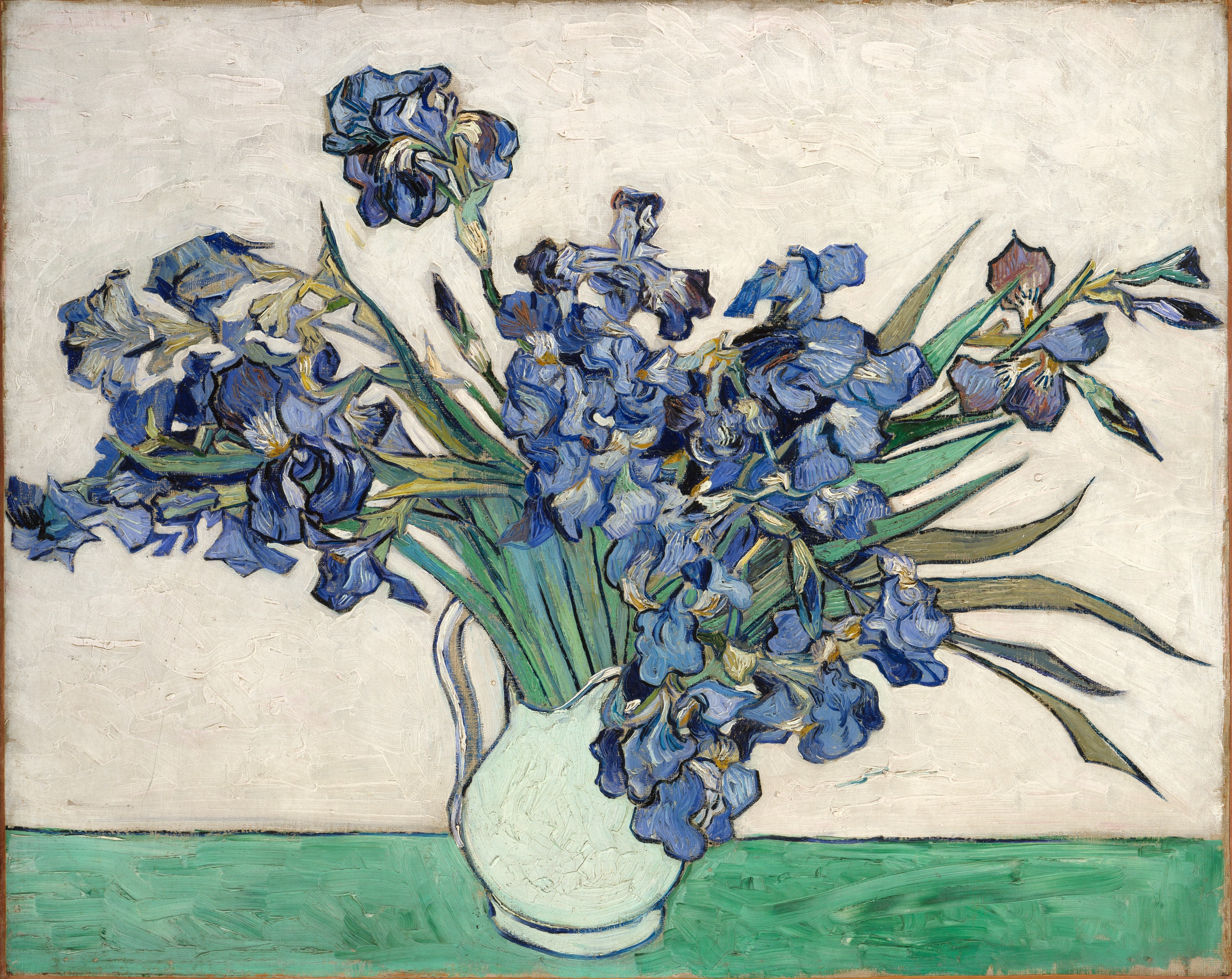
In Van Gogh's work, the portrait is never a simple bourgeois commission intended to flatter the model's features, but a deep psychological investigation conducted with brushstrokes loaded with paint. Whether it is himself, his brother Theo, the postman Roulin, or Doctor Gachet, each face is treated with an intensity that seems to scan the soul as much as the physical features. The backgrounds are never neutral: they vibrate with floral patterns, spirals, or flat areas of complementary colors that isolate the subject while integrating it into a specific emotional environment. The eyes, often painted with disturbing precision amidst freer strokes, seem to follow the viewer, establishing a direct and sometimes uncomfortable connection with the one who looks.
This revolutionary approach to portraiture breaks the academic codes of the time that favored smoothness and idealized resemblance. Vincent does not hesitate to accentuate flaws, harden jaws, or exaggerate skin colors to reveal the inner truth of his models. His numerous self-portraits, made for lack of means to pay professional models, constitute a visual intimate diary where he explores his own states of mind, from fatigue to fierce determination. At the Musée d'Orsay, these faces confront us with raw force, reminding us that behind each layer of paint hides a complex, vulnerable, and deeply alive human presence, far from the coldness of salon trinkets.
Interior Decoration
Choosing a Van Gogh after Orsay: strong emotion, consenting wall advised

Bringing a fragment of Van Gogh's universe home after a visit to Orsay requires reflection, because his works are not mere decorations but active presences that transform the atmosphere of a room. A reproduction of The Bedroom at Arles, with its deliberately distorted perspectives and saturated primary colors, will bring a dynamic energy ideal for an office or creative space, but could quickly saturate a bedroom intended for rest. Conversely, more peaceful landscapes like certain wheat fields or almond branches in bloom can introduce a note of natural serenity, provided their scale is respected and they are given enough breathing space on the wall. The choice must take into account the ambient light of the room, as Vincent's yellows and oranges react strongly to natural and artificial lighting.
It is also crucial to consider the quality of the reproduction, because the magic of Van Gogh lies largely in the texture and relief of his brushwork that flat prints often struggle to render. Preferring canvas prints or relief printing techniques allows you to recover this essential tactile dimension that brings his swirls and impastos to life. Avoid multiplying too intense works in the same space; a single major canvas is enough to define the character of a living room, creating a focal point around which the rest of the furniture can be arranged more soberly. Finally, do not be afraid to associate Van Gogh with modern or industrial design pieces: his rebellious and innovative spirit dialogues perfectly with contemporary aesthetics, creating a stimulating contrast that honors the modernity of his genius.
| Room | Suggestion | Decorative effect |
|---|---|---|
| Living room | A work related to Van Gogh at the Musée d'Orsay with a strong composition | Cultivated focal point, warm, and easy to comment on without reciting a label. |
| Bedroom | A soft palette or a more intimate scene | Calm atmosphere, visual presence without unnecessary agitation. |
| Office | A structured, colorful, or graphically clear image | Creative energy and a small reminder that the wall can also work. |
| Entryway | A vertical format or an immediately readable work | Clear first impression, elegant, and decidedly less timid than a white void. |

The Vision after the Sermon
A reproduction related to Van Gogh at the Musée d'Orsay, useful for comparing atmosphere, palette, and wall presence.

The Card Players
A reproduction related to Van Gogh at the Musée d'Orsay, useful for comparing atmosphere, palette, and wall presence.
To continue the visit
Sources, collections, and paths truly related to the subject
A few useful references to verify information, compare free images, and extend the reading without heading to a museum that didn't ask for anything.
Useful collections
Artists to explore
Related reproductions
FAQ
Frequently asked questions about Van Gogh at the Musée d'Orsay
What is Van Gogh at the Musée d'Orsay in painting?
Van Gogh at the Musée d'Orsay is the opportunity to read the artist in the great French context of the 19th century: Paris, Impressionism, Post-Impressionism, portraits, fields, and emotions that don't fit in a too tame label.
How to quickly recognize this style?
Observe especially visible brushstroke, expressive color, Post-Impressionism, Paris and portraits, then how the composition organizes the gaze. If the work holds you longer than expected, it's probably not an accident.
Which artists should you know?
The main references are Vincent van Gogh, Claude Monet, Camille Pissarro, Paul Cézanne, and Paul Gauguin.
Is this style suitable for modern decoration?
Yes, provided you choose the right format, a palette consistent with the room, and a work whose presence remains pleasant on a daily basis.
Should you choose the most famous work?
Not necessarily. The most famous work can be perfect, but the right choice depends above all on the room, the format, the palette, and the desired atmosphere.
Where to verify the information?
Start with museum notices, Wikipedia/Wikidata for general orientation, then Wikimedia Commons when a free image is needed.
A lasting spark in the living room of history
Visiting Van Gogh at the Musée d'Orsay is ultimately understanding that his legacy lies not in the tragedy of his end, but in the explosive vitality of his work that continues to defy time. This museum offers the ideal setting to grasp the coherence of his journey, from his dark beginnings in Holland to the colorful apotheosis of Provence, passing through the experimental Parisian laboratory. For the art enthusiast or the simple curious person wishing to integrate a reproduction into their interior, the lesson is clear: choosing Van Gogh means accepting to invite a living force, raw emotion, and a demand for truth that will durably transform the living space. Far from being a frozen memory, his art remains a turbulent and inspiring companion, capable of rekindling, day after day, the flame of creativity and wonder before the world.
0 comments