

L'Église d'Auvers • Guide art & décoration
L'Église d'Auvers : Van Gogh tord le village sans demander l'autorisation
Plongée au cœur du chef-d'œuvre de juin 1890, entre réalité architecturale, tourmente intérieure et conseils pour inviter cette intensité chez soi.
Il existe des tableaux que l'on visite et d'autres qui vous saisissent à la gorge dès le premier regard. L'Église d'Auvers, peinte par Vincent van Gogh en juin 1890, appartient résolument à la seconde catégorie. Conservée aujourd'hui au Musée d'Orsay, cette toile ne se contente pas de représenter l'édifice Notre-Dame-de-l'Assomption ; elle le soumet à une tension vibrante qui semble faire onduler les murs mêmes de la pierre. Loin d'être une simple carte postale de la ville d'Auvers-sur-Oise, l'œuvre capture un instant de lucidité vertigineuse, quelques semaines avant la mort de l'artiste. Comprendre ce tableau, c'est accepter que la peinture puisse déformer le réel pour en révéler une vérité plus crue, plus vivante, où le ciel bleu cobalt pèse autant que le sol ocre.
 Image libre
A deep dive into the heart of the June 1890 masterpiece — exploring its architectural reality, inner turmoil, and tips for bringing that same intensity into your own home.
Méthode de lecture
Reading the visual shockwave
To fully appreciate this work, one must let go of the idea of a faithful photographic reproduction. Observe how the lines of force diverge and how the pictorial matter creates its own rhythm, almost musical, guiding your eye far beyond the simple religious subject.
Context over prestige
We restore The Church at Auvers to its era, its studios, its exhibitions, and its small rebellions. A work without context is sometimes just a very beautiful person who has forgotten their story.
The telltale signs of style
We notice composition, palette, texture. These clues often say more than grand speeches, especially when they carry gold or nervous brushstrokes.
The artwork in a real room
Let's end with the useful question: does this image breathe in your space, or does it merely pose like a poster that's read two books?
Contexte historique
The Church at Auvers: the painting doesn't settle in, it immediately establishes its atmosphere

From the very first seconds facing the canvas, we understand that Vincent van Gogh did not seek to flatter the traditional architecture of the church at Auvers. The edifice, usually a symbol of stability and refuge, seems here to waver under the pressure of a deep blue, almost liquid sky that occupies nearly half of the composition. The black, sinuous outlines that surround the building do not serve to calmly delineate it, but to accentuate an internal vibration, as if the stone itself were traversed by an electric current. This visual agitation transforms a banal village scene into a silent drama where the atmosphere becomes the true protagonist of the story.
This particular atmosphere is born from a direct confrontation between the dark mass of the church and the harsh light of a summer afternoon in the Île-de-France region. Van Gogh uses thick brushstrokes, applied with palpable urgency, to convey the oppressive heat and the solitude of the place. The viewer does not simply look at a royalty-free image on a screen; they feel the density of the air and the weight of the silence surrounding the monument. It is this ability to transform a sensory perception into an emotional experience that makes this painting a major work, far beyond its mere documentary value for the heritage of Auvers.
Style artistique
Auvers-sur-Oise: the real setting counts almost as much as the color

To grasp the scope of this work, one must place Van Gogh's brush within the very precise context of his arrival in Auvers-sur-Oise in May 1890. Having left the asylum at Saint-Rémy, the artist sought peace of mind with Dr. Gachet, but his eye remained ferociously sharp when faced with the landscapes he discovered. The Notre-Dame-de-l'Assomption church, situated at the crossroads of several roads, became an ideal subject for him because it combines the human order of architecture with the natural chaos of the surrounding paths. It is no coincidence that this flamboyant Gothic edifice, with its massive buttresses, immediately caught his attention in those particularly productive final weeks of his life.
The actual setting of Auvers offers a complex geography that the painter immediately claims as his own to express his own mental trajectory. The cobbled streets leading to the church, visible on site today as on the canvas, offer receding perspectives that Van Gogh exaggerates to create a sense of vertigo. In painting this specific place, he does more than record a landscape; he engages in a dialogue with the village's history and his own demons. The topographical accuracy of the location, recognizable to anyone who has visited the commune, anchors the work in a tangible reality, making the expressive distortion the artist imposes on it all the more unsettling.
Art & détails
Composition: nothing is still, even when the subject pretends

The composition of The Church at Auvers is a masterful example of controlled imbalance, where nothing seems willing to stay in place. Two dirt paths start from the foreground and diverge sharply, one to the left, the other to the right, preventing the eye from settling comfortably at the center of the image. This forking path forces the viewer to choose a direction, creating immediate narrative tension: should we step into the shadow of the church or follow the light toward the fields? Van Gogh uses these receding lines not to peacefully guide the eye, but to introduce a dynamic instability that contrasts with the rigid verticality of the bell tower.
Beyond these paths, the very structure of the image refuses the classical symmetry typically expected in religious or architectural painting. The steeple, despite being the theoretical central axis, is slightly off-center and tilted, while the tufts of grass in the foreground appear to grow with wild vigor, nibbling away at the space reserved for stone. This spatial arrangement reflects a vision of the world in which established order is constantly threatened by the forces of nature and emotion. Every element of the composition works to disrupt the apparent tranquility of the subject, proving that for Van Gogh, the structure of a painting must above all serve the intensity of feeling.
Art & détails
Colors: Van Gogh doesn't pick a palette, he sparks a conversation

The chromatic palette used in this work is a striking demonstration of the theory of simultaneous contrasts so dear to the artist. The intense ultramarine blue of the sky clashes violently with the orange ochres and pale yellows of the roofs and paths, creating an optical vibration that literally makes the surface of the canvas shimmer. Van Gogh does not use these colors to faithfully depict the light of a June day in France, but to construct a dissonant harmony that channels an inner turmoil. Blue is no longer merely a color of the sky; it becomes a heavy, almost liquid mass, threatening to engulf the fragility of human constructions.
The very matter of the paint itself plays a crucial role in this colorful conversation, with thick impastos that catch the actual light of the room where the painting is displayed. By applying color in distinct, directional strokes, Van Gogh gives each area its own texture: rough for the earth, smoother yet tormented for the sky, striated for the church walls. This tactile approach invites the viewer to perceive color not as a decorative flat surface, but as a living substance, shaped by the painter's hand and mood. It is this alchemy between pure pigments and frenetic gesturality that makes the work unforgettable.
Art & détails
Around the painting: visual neighbors help bring the character into focus

To better grasp the singularity of The Church at Auvers, it is enlightening to place it in dialogue with other major works from Van Gogh's final period, such as Wheatfield with Crows. In both paintings, we find that same use of paths that lead nowhere or that lose themselves in immensity, underscoring a profound sense of isolation. Yet where the wheatfields erupt in an almost apocalyptic turbulence of yellow and black, the church retains a certain mineral density that acts as a dark counterweight amid the blinding light. These visual neighbors help us see that the artist is exploring a range of variations on the theme of ending and transition.
One can also compare this vision of Auvers with church interiors painted by other artists, or even with earlier, more serene interpretations of religious landscapes. The fundamental difference lies in the total absence of conventional spiritual serenity; here, the sacred is treated with the same feverish intensity as a sunflower or a cypress. By observing how Van Gogh handles the neighboring houses of the church in other Auvers canvases, one notices that he applies this same language of curves and saturated colors to his entire environment. The church is therefore not an isolated exception, but the culminating point of a coherent stylistic pursuit carried out during those final months.
Art & détails
The letters: when Van Gogh explains quite well that he doesn't paint at random

Vincent van Gogh's correspondence with his brother Theo offers valuable keys to decoding the intentions behind The Church at Auvers, far removed from purely psychiatric interpretations. In his letters written from Auvers, he often describes his research into perspective effects and color contrasts, showing a keen awareness of his technical choices rather than mere uncontrolled delirium. He explicitly mentions his desire to capture the unique character of old buildings and their integration into the French rural landscape, proving that the distortion of lines is a deliberate aesthetic choice. These texts reveal a lucid artist, working with rigorous method despite the turmoil of his existence.
These historical documents also allow us to contextualize the speed of execution of the work, typical of his working method outdoors during this period. Van Gogh explains how he seeks to simplify forms to achieve a more powerful expression, sacrificing realistic detail in favor of overall emotional impact. Reading these letters, available through resources such as those from the Van Gogh Museum or Wikidata, changes our perspective on the painting: it is no longer the desperate cry of a madman, but the accomplished synthesis of years of practice and theoretical reflection. The painting then becomes a conscious artistic manifesto, documented by the very person who created it.
Art & détails
Popularity: the painting becomes famous, but it deserves more than a hastily printed postcard

It is undeniable that The Church at Auvers has become a popular icon, reproduced on countless items, from coffee mugs to cheap posters found in souvenir shops. This massive celebrity sometimes risks trivializing the work, reducing its vibrant complexity to a simple decorative pattern recognizable among thousands. Yet seeing the original at the Musée d'Orsay reveals a depth and physical presence that no digital reproduction, even in high definition, can fully capture. The actual size of the canvas, the texture of the paint, and the monumental scale of the blue sky create an immersive experience that transcends the simple royalty-free image circulating on the internet.
The persistence of its fame is explained by its unique ability to touch contemporary audiences, who find in its twisted lines a resonance with the anxieties and beauties of the modern world. Unlike a frozen postcard, the painting continues to work on the viewer, imposing its rhythm and color with an authority that does not weaken over time. It therefore deserves to be approached with curiosity and respect, going beyond the automatic cliché that would make it merely the tragic symbol of the artist's final days. Its popularity is justified, provided one takes the time to truly look at what is happening beneath the surface of the image.
Décoration intérieure
Choosing L'Église d'Auvers at home: full of character, so a wall that holds its own
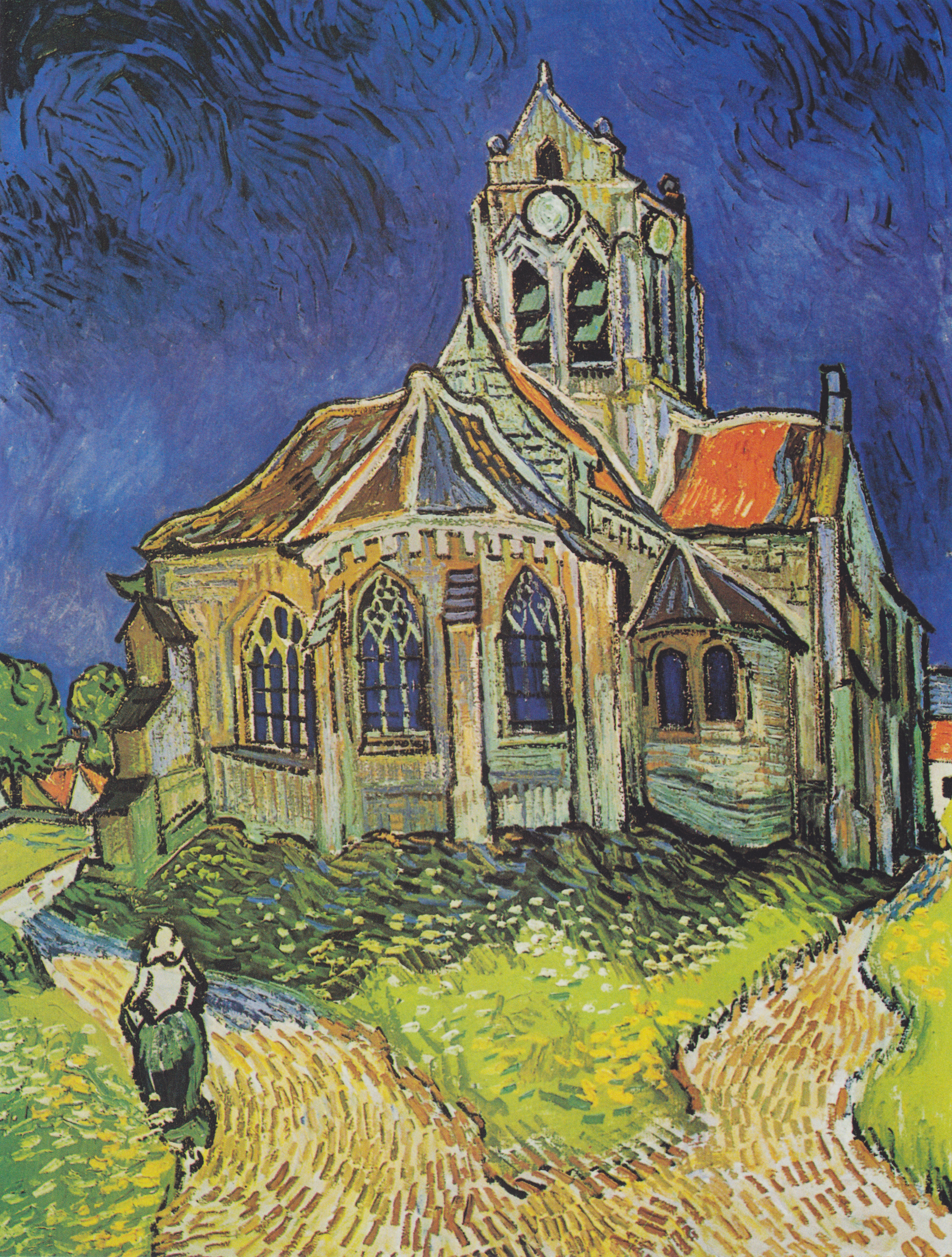
Integrating a reproduction of L'Église d'Auvers into an interior requires careful thought, as the work possesses a chromatic intensity and visual energy that can dominate an entire room. It is advisable to choose a sufficiently large format to allow the details of the brushstrokes and the nuances of cobalt blue to fully express themselves, thus avoiding small prints that could render the image confusing and chaotic. A clear wall, ideally in a living room or office where one spends time in contemplation, will be the best setting for this painting, which demands distance to be properly appreciated. The ambient light of the room will also play a crucial role in the perception of its warm and cool contrasts.
In terms of décor, this painting pairs remarkably well with sleek modern interiors or industrial spaces, where its vivid colors will bring warmth to raw materials like concrete or metal. It should be kept away from too many busy patterns or competing colors, as the work truly shines when given room to radiate on its own. A quality reproduction that preserves the original saturation of the pigments will recreate that unique atmosphere of Auvers-sur-Oise at home, transforming a simple wall into an open window onto Van Gogh's tormented genius. It is a bold decorative choice, one that speaks to a taste for art history that is alive and full of emotion.
| Pièce | Suggestion | Effet décoratif |
|---|---|---|
| Salon | Une oeuvre liée à L'Église d'Auvers avec une composition forte | Point focal cultivé, chaleureux et facile à commenter sans réciter un cartel. |
| Chambre | Une palette douce ou une scène plus intime | Atmosphère calme, présence visuelle sans agitation inutile. |
| Bureau | Une image structurée, colorée ou graphiquement nette | Énergie créative et petit rappel que le mur peut aussi travailler. |
| Entrée | Un format vertical ou une oeuvre immédiatement lisible | Première impression claire, élégante, et nettement moins timide qu'un vide blanc. |
Pour continuer la visite
Sources, collections and paths truly related to the topic
A few useful references for verifying information, comparing free images, and continuing your reading—without dragging a museum into something it never asked for.
Related articles to read next
Verified collections
Useful blog hubs
FAQ
Frequently Asked Questions about The Church at Auvers
What is the Church at Auvers in painting?
The Church of Auvers deserves a thorough article because this style involves an era, a way of painting, and a very concrete way of living with images.
How to recognize this style quickly?
Pay particular attention to composition, palette, texture, light, and atmosphere, then notice how the composition guides the eye. If the piece holds you longer than expected, it's probably not an accident.
Which artists should you know?
Cross-referencing the central artists of the movement with museums and reliable sources is essential to avoid hasty attributions.
Does this style suit a modern décor?
Yes, as long as you choose the right format, a color palette that complements the room, and a piece whose presence remains enjoyable day after day.
Should one choose the most famous work?
Not necessarily. The most well-known piece may be perfect, but the right choice really depends on the room, format, palette, and atmosphere you're looking for.
Where to check the information?
Start with museum records, Wikipedia/Wikidata for general orientation, then turn to Wikimedia Commons when a freely licensed image is needed.
An architecture of the soul
The Church at Auvers is far more than a picturesque depiction of a French village; it is an architecture of the soul, raised by the feverish hand of Vincent van Gogh. By twisting the lines of reality, the artist has bequeathed us a vision in which stone sings and the sky presses down, inviting us to see the world not as it is, but as it is felt. Whether we choose to admire it in the silence of the Musée d'Orsay or to welcome it into our own living room, this work continues to challenge us with an undiminished urgency, more than a century after it was painted under the June sun of 1890.
0 comments