


100 paintings - Frida Kahlo
Frida Kahlo's 100 famous paintings
One hundred separate works and one hundred images, with store links when a corresponding reproduction is available.
From self-portraits to still lifes, Kahlo constructs a work where the body, Mexico, love and politics become a visual grammar of radical precision.
A constructed autobiography
Frida Kahlo: painting your reality without half explaining it
Kahlo does not deliver an illustrated journal. She chooses bodies, objects, animals and landscapes capable of transforming a private experience into a lasting composition.
Important information: cards corresponding to an available reproduction directly use the image and link of the Alpha Reproduction store.
In Kahlo, the symbol never erases reality: it gives it a visible structure.Enter the tables
The 100 paintings in pictures
Self-portraits and founding works: twenty-five images where Kahlo transforms the figure into language.
#1
The Two Fridas
With "The Two Fridas", Frida Kahlo transforms a particular experience into an immediately memorable image. The face is not only a model: it becomes a constructed space where clothes, hairstyle, animals and attributes organize a deliberately staged identity. Around 1940, Kahlo multiplied self-portraits, but each cover changed the signs, the framing and the relationship between figure and background; repetition is never an automatic formula. Dated 1939, the work is documented as "The Two Fridas". repetition is never an automatic formula. Dated 1939, the work is documented as "The Two Fridas". repetition is never an automatic formula. Dated 1939, the work is documented as "The Two Fridas". the location indicated is: Museo de Arte Moderno, Mexico. The location indicated is: Museo de Arte Moderno, Mexico. The link allows you to continue the consultation on the official website of the museum or institution associated cultural. The image and link come from the corresponding file in the Alpha Reproduction store. One click allows you to consult the proposed reproduction, its formats and its options. The work thus remains personal without being reduced to a confidence: its construction allows several reading levels to remain active.
Image: Alpha Reproduction - image of the product sheet · Visual of the reproduction available in the Alpha Reproduction store.
See this reproduction → #2
#2
Self-portrait with a necklace of thorns
"Self-portrait with a necklace of thorns" shows the precision with which Frida Kahlo organizes each sign in an often tightened space. The face is not only a model: it becomes a constructed space where clothes, hairstyle, animals and attributes organize a deliberately staged identity. Around 1940, Kahlo multiplied self-portraits, but each cover changed the signs, the framing and the relationship between figure and background; repetition is never an automatic formula. Dated 1940, Kahlo multiplied the self-portraits, but each cover changed the signs, the framing and the relationship between figure and background; repetition is never an automatic formula. Dated 1940, Kahlo multiplied the self-portraits, but each cover changed the signs, the framing and the relationship between figure and background; repetition is never an automatic formula. Dated 1940, the work is documented as "Self Portrait with Necklace of Thorns". repetition is never an automatic formula. Dated 1940, the work is documented as "Self Portrait with Necklace of Thorns". repetition is never an automatic formula. Dated 1940, the work is documented as "Self Portrait with Neck consultation on the official website of the museum or associated cultural institution. The image and link come from the corresponding file in the Alpha Reproduction store. One click allows you to consult the proposed reproduction, its formats and its options. This tension explains its lasting presence: the image is quickly recognized, but its relationships of gaze, scale and symbol continue to move.
Image: Alpha Reproduction - image of the product sheet · Visual of the reproduction available in the Alpha Reproduction store.
See this reproduction → #3
#3
The Broken Column
In "The Broken Column", the gaze first encounters a clear image before measuring its autobiographical and historical tensions. Kahlo gives a clear form to a difficult bodily or psychological experience; the precision of the objects prevents the image from dissolving into the vague allegory. In the second half of the 1940s, physical pain intensified, while the compositions gained symbolic density and frontality. Dated 1944, the physical pain intensified, while the compositions gained symbolic density and frontality. Dated 1944, the work was documented as "The Broken Column". Dated 1944, the work was documented as "The Broken Column". Dated 1944, the work was documented as "The Broken Column". Dated 1944, the work was documented as "The Broken Column". The location indicated is: Museo Dolores Olmedo, Mexico. The location indicated is: Museo Dolores Olmedo, Mexico. The location indicated is: Museo Dolores Olmedo, Mexico. The link allows you to continue the consultation on the official website of the museum or associated cultural institution. The image and the link comes from the corresponding file in the Alpha Reproduction store. One click allows you to consult the proposed reproduction, its formats and its options. Kahlo does not transform her life into an illustration; she selects the forms capable of holding together intimate experience and pictorial language.
Image: Alpha Reproduction - image of the product sheet · Visual of the reproduction available in the Alpha Reproduction store.
See this reproduction → #4
#4
Henry Ford Hospital (The Flying Bed)
The strength of "Henry Ford Hospital (The Flying Bed)" comes from the coexistence between concrete detail, frontality and symbolic construction. Kahlo gives a clear form to a difficult bodily or psychological experience; the precision of the objects prevents the image from dissolving into vague allegory. During the 1930s, his experience of the body, his stays in the United States and his relationship with Mexico nourished images where the personal story took on historical significance. Dated 1932, his experience of the body, his stays in the United States and his relationship with Mexico nourished images where the personal story took on historical significance. Dated 1932, his experience of the body, his stays in the United States and his relationship with Mexico nourished images where the personal story took on historical significance. Dated 1932, his work is documented as "Henry Ford Hospital (The Flying Bed)". The location indicated is: Museo Dolores Olmedo, Mexico. The location indicated is: Museo Dolores Olmedo, Mexico. The location indicated is: Museo Dolores Olmedo, Mexico. The location indicated is: Museo Dolores Olmedo, Mexico. The location indicated is: Museo Dolores Olmedo, Mexico. The the associated cultural institution. The image and link come from the corresponding file in the Alpha Reproduction store. One click allows you to consult the proposed reproduction, its formats and its options. The painting therefore invites you to look at relationships rather than an isolated symbol: no detail acts alone in the balance of the painting.
Image: Alpha Reproduction - image of the product sheet · Visual of the reproduction available in the Alpha Reproduction store.
See this reproduction → #5
#5
Self-portrait on the border between Mexico and the United States
Beneath its apparent fixity, "Self-portrait on the border between Mexico and the United States" connects the body, memory and territory. The model is defined by its posture, its clothing and a few chosen objects; the economy of decor strengthens the direct relationship between the painted person and the viewer. During the 1930s, his experience of the body, his stays in the United States and his relationship with Mexico nourished images where the personal story took on historical significance. Dated 1932, his experience of the body, his stays in the United States and his relationship with Mexico nourished images where the personal story took on historical significance. Dated 1932, his experience of the body, his stays in the United States and his relationship with Mexico nourished images where the personal story took on historical significance. Dated 1932, his experience of the body, his stays in the United States and his relationship with Mexico nourished images where the personal story took on historical significance. Dated 1932, his experience of the body, his stays in the United States and his relationship with Mexico nourished images where the personal story took on historical significance. Dated 1932, his experience of the body, his stays in the United States and his relationship with Mexico nourished images where the personal story took on historical significance continue the consultation on the official website of the museum or associated cultural institution. The image and link come from the corresponding file in the Alpha Reproduction store. One click allows you to consult the proposed reproduction, its formats and its options. The work thus remains personal without being reduced to a confidence: its construction allows several reading levels to remain active.
Image: Alpha Reproduction - image of the product sheet · Visual of the reproduction available in the Alpha Reproduction store.
See this reproduction → #6
#6
The wounded deer
With "The Wounded Deer", Frida Kahlo transforms a particular experience into an immediately memorable image. Kahlo gives a clear form to a difficult bodily or psychic experience; the precision of the objects prevents the image from dissolving into vague allegory. In the second half of the 1940s, physical pain intensified, while the compositions gained symbolic density and frontality. Dated 1946, the work was documented as "The Wounded Deer". Dated 1946, the work was documented as "The Wounded Deer". Dated 1946, the work was documented as "The Wounded Deer". The location shown is: Museo Dolores Olmedo - institutional resource. The original is not documented in an accessible public collection, the link explicitly leads to a museum resource reference and not to an alleged possession sheet. The image and link come from the corresponding sheet in the Alpha Reproduction store. One click allows you to consult the proposed reproduction, its formats and its options. This tension explains its lasting presence: the image is quickly recognized, but its relationships of gaze, scale and symbol continue to move.
Image: Alpha Reproduction - image of the product sheet · Visual of the reproduction available in the Alpha Reproduction store.
See this reproduction → #7
#7
What water gave me
"What Water Gave Me" shows the precision with which Frida Kahlo organizes each sign in an often tight space. The composition combines observed elements with a very readable symbolic logic, without separating daily life, memory and collective history. During the 1930s, his experience of the body, his stays in the United States and his relationship with Mexico nourished images where the personal story takes on historical significance. Dated 1938, his experience of the body, his stays in the United States and his relationship with Mexico nourished images where the personal story takes on historical significance. Dated 1938, the work is documented as "What the Water Gave Me". Dated 1938, the work is documented as "What the Water Gave Me". The location indicated is: Collection of Daniel Filipacchi, Paris, France - institutional resource. The original is not documented in a public collection accessible, the link explicitly leads to a reference museum resource and not to an alleged detention sheet. The image and link come from the corresponding sheet in the Alpha Reproduction store. One click allows you to consult the proposed reproduction, its formats and its options. Kahlo does not transform her life into an illustration; she selects the forms capable of holding together intimate experience and pictorial language.
Image: Alpha Reproduction - image of the product sheet · Visual of the reproduction available in the Alpha Reproduction store.
See this reproduction → #8
#8
The Suicide of Dorothy Hale
In "The Suicide of Dorothy Hale", the gaze first encounters a clear image before measuring the autobiographical and historical tensions. Kahlo gives a clear form to a difficult bodily or psychological experience; the precision of the objects prevents the image from dissolving into vague allegory. During the 1930s, his experience of the body, his stays in the United States and his relationship with Mexico nourished images where the personal story took on historical significance. Dated 1938, his experience of the body, his stays in the United States and his relationship with Mexico nourished images where the personal story took on historical significance. Dated 1938, his experience of the body, his stays in the United States and his relationship with Mexico nourished images where the personal story took on historical significance. Dated 1938, his experience of the body, his stays in the United States and his relationship with Mexico nourished images where the personal story took on historical significance. Dated 1938, his experience of the body, his stays in the United States and his relationship with Mexico nourished images where the personal story took on historical significance. Dated 1938, his experience of the body, his stays in the United States and his relationship with Mexico nourished images where the personal story took on historical significance. Dated 1 the associated cultural institution. The image and link come from the corresponding file in the Alpha Reproduction store. One click allows you to consult the proposed reproduction, its formats and its options. The painting therefore invites you to look at relationships rather than an isolated symbol: no detail acts alone in the balance of the painting.
Image: Alpha Reproduction - image of the product sheet · Visual of the reproduction available in the Alpha Reproduction store.
See this reproduction → #9
#9
My birth
The strength of "My Birth" comes from the coexistence between concrete detail, frontality and symbolic construction. Kahlo gives a clear form to a difficult bodily or psychological experience; the precision of the objects prevents the image from dissolving into vague allegory. During the 1930s, his experience of the body, his stays in the United States and his relationship with Mexico nourished images where the personal story took on historical significance. Dated 1932, the work is documented as "My Birth". The location indicated is: Private collection of Madonna - institutional resource. The original is not documented in an accessible public collection, the link leads explicitly to a reference museum resource and not to an alleged possession sheet. The image and link come from the corresponding sheet in the Alpha Reproduction store. One click allows you to consult the proposed reproduction, its formats and its options. The work thus remains personal without being reduced to a confidence: its construction allows several reading levels to remain active.
Image: Alpha Reproduction - image of the product sheet · Visual of the reproduction available in the Alpha Reproduction store.
See this reproduction → #10
#10
Self-portrait with cut hair
Beneath its apparent fixity, "Self-portrait with cut hair" connects the body, memory and territory. The face is not only a model: it becomes a constructed space where clothes, hairstyle, animals and attributes organize a deliberately staged identity. Around 1940, Kahlo multiplied self-portraits, but each cover changed the signs, the framing and the relationship between figure and background; repetition is never an automatic formula. Dated 1940, Kahlo multiplied the self-portraits, but each cover changed the signs, the framing and the relationship between figure and background; repetition is never an automatic formula. Dated 1940, the work is documented as "Self Portrait with Cropped Hair". repetition is never an automatic formula. Dated 1940, the work is documented as "Self Portrait with Cropped Hair". the location indicated is: Museum of Modern Art (MoMA), New York. The link allows you to continue the consultation on the official website of museum or associated cultural institution. The image and link come from the corresponding file in the Alpha Reproduction store. One click allows you to consult the proposed reproduction, its formats and its options. This tension explains its lasting presence: the image is quickly recognized, but its relationships of gaze, scale and symbol continue to move.
Image: Alpha Reproduction - image of the product sheet · Visual of the reproduction available in the Alpha Reproduction store.
See this reproduction → #11
#11
Self-portrait - The Frame
With "Self-portrait - The Frame", Frida Kahlo transforms a particular experience into an immediately memorable image. The face is not only a model: it becomes a constructed space where clothing, hairstyle, animals and attributes organize a deliberately staged identity. During the 1930s, his experience of the body, his stays in the United States and his relationship with Mexico nourished images where the personal story took on historical significance. Dated 1938, his experience of the body, his stays in the United States and his relationship with Mexico nourished images where the personal story took on historical significance. Dated 1938, his experience of the body, his stays in the United States and his relationship with Mexico nourished images where the personal story took on historical significance. Dated 1938, his experience of the body, his stays in the United States and his relationship with Mexico nourished images where the personal story took on historical significance. Dated 1938, his experience of the body, his stays in the United States and his relationship with Mexico nourished images where the personal story took on historical significance. Dated 1938, his experience of the body, his stays in the United States and his relationship with Mexico nourished images where the personal story took on historical significance. Dated 1938, associated cultural. The image and link come from the corresponding file in the Alpha Reproduction store. One click allows you to consult the proposed reproduction, its formats and its options. Kahlo does not transform her life into an illustration; she selects the forms capable of holding together intimate experience and pictorial language.
Image: Alpha Reproduction - image of the product sheet · Visual of the reproduction available in the Alpha Reproduction store.
See this reproduction → #12
#12
Frieda and Diego Rivera
"Frieda and Diego Rivera" shows the precision with which Frida Kahlo organizes each sign in an often tight space. The composition combines observed elements with a very readable symbolic logic, without separating daily life, memory and collective history. In these years of training, portraiture and self-portraiture allowed him to assert a precise style while gradually integrating the objects, costumes and spaces that would become his vocabulary. Dated 1931, the portrait and self-portrait allowed him to assert a precise style while gradually integrating the objects, costumes and spaces that would become his vocabulary. Dated 1931, the portrait and self-portrait allowed him to assert a precise style while gradually integrating the objects, costumes and spaces that would become his vocabulary. Dated 1931, the work is documented as "Frieda and Diego Rivera". Dated 1931, the work is documented as "Frieda and Diego Rivera". The location indicated is: San Francisco Museum of Modern Art (SFMOMA). The location indicated is: San Francisco Museum of Modern Art (SFMOMA). The location indicated is: San Francisco Museum of Modern Art (SFMOMA). The location indicated is: San Francisco Museum of Modern Art (SFMOMA). The link allows from the museum or associated cultural institution. The image and link come from the corresponding file in the Alpha Reproduction store. One click allows you to consult the proposed reproduction, its formats and its options. The painting therefore invites you to look at relationships rather than an isolated symbol: no detail acts alone in the balance of the painting.
Image: Alpha Reproduction - image of the product sheet · Visual of the reproduction available in the Alpha Reproduction store.
See this reproduction → #13
#13
My grandparents, my parents and me (Family tree)
In "My grandparents, my parents and me (Family tree)", the gaze first encounters a clear image before measuring the autobiographical and historical tensions. The composition combines observed elements with a very readable symbolic logic, without separating daily life, memory and collective history. During the 1930s, his experience of the body, his stays in the United States and his relationship with Mexico nourished images where the personal story takes on historical significance. Dated 1936, his experience of the body, his stays in the United States and his relationship with Mexico nourished images where the personal story takes on historical significance. Dated 1936, his experience of the body, his stays in the United States and his relationship with Mexico nourished images where the personal story takes on historical significance. Dated 1936, his experience of the body, his stays in the United States and his relationship with Mexico nourished images where the personal story takes on historical significance. Dated 1936, his experience of the body, his stays in the United States and his relationship with Mexico nourish images where the personal story takes on historical significance. Dated 1936, his experience of the body, his stays in the United States and his relationship with Mexico nourish images where the personal story takes on historical significance. Dated 1936, continue the consultation on the official website of the museum or associated cultural institution. The image and link come from the corresponding file in the Alpha Reproduction store. One click allows you to consult the proposed reproduction, its formats and its options. The work thus remains personal without being reduced to a confidence: its construction allows several reading levels to remain active.
Image: Alpha Reproduction - image of the product sheet · Visual of the reproduction available in the Alpha Reproduction store.
See this reproduction → #14
#14
Fulang-Chang and me
The strength of "Fulang-Chang and me" comes from the coexistence between concrete detail, frontality and symbolic construction. The composition combines observed elements with a very readable symbolic logic, without separating daily life, memory and collective history. During the 1930s, his experience of the body, his stays in the United States and his relationship with Mexico nourished images where the personal story takes on historical significance. Dated 1937, his experience of the body, his stays in the United States and his relationship with Mexico nourished images where the personal story takes on historical significance. Dated 1937, the work is documented as "Fulang-Chang and I". Dated 1937, the work is documented as "Fulang-Chang and I". Dated 1937, the work is documented as "Fulang-Chang and I". Dated 1937, the work is documented as "Fulang-Chang and I". The location indicated is: Museum of Modern Art (MoMA), New York. The location indicated is: Museum of Modern Art (MoMA), New York. The location indicated is: Museum of Modern Art (MoMA), New York. The location indicated is: Museum of Modern Art associated. The image and the link come from the corresponding file in the Alpha Reproduction store. One click allows you to consult the proposed reproduction, its formats and its options. This tension explains its lasting presence: the image is quickly recognized, but its relationships of gaze, scale and symbol continue to move.
Image: Alpha Reproduction - image of the product sheet · Visual of the reproduction available in the Alpha Reproduction store.
See this reproduction → #15
#15
A few little injections (Passionately in love)
Beneath its apparent fixity, "A Few Little Bites (Passionately in Love)" connects the body, memory and territory. Kahlo gives a clear form to a difficult bodily or psychological experience; the precision of the objects prevents the image from dissolving into vague allegory. During the 1930s, his experience of the body, his stays in the United States and his relationship with Mexico nourished images where the personal story took on historical significance. Dated 1935, his experience of the body, his stays in the United States and his relationship with Mexico nourished images where the personal story took on historical significance. Dated 1935, the work is documented as "A Few Small Nips (Passionately in Love)". The location shown is: Private collection or location to be verified - institutional resource. The original is not documented in an accessible public collection, the link explicitly leads to a reference museum resource and not to an alleged holding file. The image and link come from the corresponding file in the Alpha Reproduction store. One click allows you to consult the proposed reproduction, its formats and its options.
Image: Alpha Reproduction - image of the product sheet · Visual of the reproduction available in the Alpha Reproduction store.
See this reproduction → #16
#16
Without hope
With "Without Hope", Frida Kahlo transforms a particular experience into an immediately memorable image. Kahlo gives a clear form to a difficult bodily or psychic experience; the precision of the objects prevents the image from dissolving into vague allegory. In the second half of the 1940s, physical pain intensified, while the compositions gained symbolic density and frontality. Dated 1945, the work was documented as "Without Hope". Dated 1945, the work was documented as "Without Hope". Dated 1945, the work was documented as "Without Hope". The location shown is: Collection of Dolores Olmedo Patino, Mexico City, Mexico City. The original is not documented in an accessible public collection, the link explicitly leads to a museum resource reference and not to an alleged possession file. The image and link come from the corresponding file in the Alpha Reproduction store. One click allows you to consult the proposed reproduction, its formats and its options. The painting therefore invites you to look at relationships rather than an isolated symbol: no detail acts alone in the balance of the painting.
Image: Alpha Reproduction - image of the product sheet · Visual of the reproduction available in the Alpha Reproduction store.
See this reproduction → #17
#17
Tree of Hope, stand firm
"Tree of Hope, Stay Firm" shows the precision with which Frida Kahlo organizes each sign in an often tight space. Kahlo gives a clear form to a difficult bodily or psychic experience; the precision of the objects prevents the image from dissolving into the vague allegory. In the second half of the 1940s, physical pain intensified, while the compositions gained symbolic density and frontality. Dated 1946, the physical pain intensified, while the compositions gained symbolic density and frontality. Dated 1946, the work was documented as "Tree of Hope, Remain Strong", while the compositions gained symbolic density and frontality. Dated 1946, the work was documented as "Tree of Hope, Remain Strong". Dated 1946, the work was documented as "Tree of Hope, Remain Strong". Dated 1946, the work was documented as "Tree of Hope, Remain Strong". Dated as "1946, the work was documented as "Tree of Hope, Remain Strong". The location shown is: Collection of Daniel Filipacchi, Paris, France - institutional resource. The original not being documented in a public collection accessible, the link explicitly leads to a reference museum resource and not to an alleged holding sheet. The image and link come from the corresponding sheet in the Alpha Reproduction store. One click allows you to consult the proposed reproduction, its formats and its options. The work thus remains personal without being reduced to a confidence: its construction allows several reading levels to remain active.
Image: Alpha Reproduction - image of the product sheet · Visual of the reproduction available in the Alpha Reproduction store.
See this reproduction → #18
#18
Diego and me
In "Diego and I", the gaze first encounters a clear image before measuring its autobiographical and historical tensions. The face is not only a model: it becomes a constructed space where clothing, hairstyle, animals and attributes organize a deliberately staged identity. In the second half of the 1940s, physical pain intensified, while the compositions gained symbolic density and frontality. Dated 1949, the physical pain intensified, while the compositions gained symbolic density and frontality. Dated 1949, the physical pain intensified, while the compositions gained symbolic density and frontality. Dated 1949, the work was documented as "Diego and I". Dated 1949, the work was documented as "Diego and I". Dated 1949, the work was documented as "Diego and I". Dated 1949, the work was documented as "Diego and I". Dated 1949, the work was documented as "Diego and I". Dated 1949, the work was documented as "Diego and I". Dated 1949, the work was documented as "Diego and I". Dated 1949, the work was documented as "Diego and I". Dated 1949, the work was documented and the link comes from the corresponding file in the Alpha Reproduction store. One click allows you to consult the proposed reproduction, its formats and its options. This tension explains its lasting presence: the image is quickly recognized, but its relationships of gaze, scale and symbol continue to move.
Image: Alpha Reproduction - image of the product sheet · Visual of the reproduction available in the Alpha Reproduction store.
See this reproduction → #19
#19
The loving embrace of the Universe, the Earth (Mexico), myself, Diego and Señor Xolotl
The strength of "The loving embrace of the Universe, the Earth (Mexico), myself, Diego and Señor Xolotl" comes from the coexistence between concrete detail, frontality and symbolic construction. The composition combines observed elements with a very readable symbolic logic, without separating daily life, memory and collective history. In the second half of the 1940s, physical pain intensified, while the compositions gained in symbolic density and frontality. In the second half of the 1940s, physical pain intensified, while the compositions gained in symbolic density and frontality. In the second half of the 1940s, physical pain intensified, while the compositions gained in symbolic density and frontality. Dated 1949, the work was documented as "The Love Embrace of the Universe, the Earth (Mexico), Myself, Diego and Señor Xolotl". The location indicated is: Collection of Jacques & Natasha Gelman, Mexico City, Mexico City - institutional resource. As the original is not documented in an accessible public collection, the link explicitly leads to a reference museum resource and not to an alleged possession sheet. The image and link come from the corresponding sheet in the Alpha Reproduction store. One click allows you to consult the proposed reproduction, its formats and its options.
Image: Alpha Reproduction - image of the product sheet · Visual of the reproduction available in the Alpha Reproduction store.
See this reproduction → #20
#20
Roots
Beneath its apparent fixity, "Roots" connects the body, memory and territory. The composition associates observed elements with a very readable symbolic logic, without separating daily life, memory and collective history. Around 1940, Kahlo multiplied self-portraits, but each cover changed the signs, the framing and the relationship between figure and background; repetition is never an automatic formula. Dated 1943, the work is documented as "Roots". repetition is never an automatic formula. Dated 1943, the work is documented as "Roots". The location indicated is: Private collection or location to be verified - institutional resource. The original not being documented in an accessible public collection, the link explicitly leads to a reference museum resource and not an alleged detention sheet. The image and link come from the corresponding sheet in the Alpha Reproduction store. One click allows you to consult the proposed reproduction, its formats and its options. The painting therefore invites you to look at relationships rather than an isolated symbol: no detail acts alone in the balance of the painting.
Image: Alpha Reproduction - image of the product sheet · Visual of the reproduction available in the Alpha Reproduction store.
See this reproduction → #21
#21
Self-portrait as Tehuana (Diego in my thoughts)
With "Self-portrait as Tehuana (Diego in My Thoughts)", Frida Kahlo transforms a particular experience into an immediately memorable image. The face is not only a model: it becomes a constructed space where clothes, hairstyle, animals and attributes organize a deliberately staged identity. Around 1940, Kahlo multiplied self-portraits, but each cover changed the signs, the framing and the relationship between figure and background; repetition is never an automatic formula. Dated 1940, Kahlo multiplied the self-portraits, but each cover changed the signs, the framing and the relationship between figure and background; repetition is never an automatic formula. Dated 1940-1940, Kahlo multiplied the self-portraits, but each cover changed the signs, the framing and the relationship between figure and background; repetition is never an automatic formula. Dated 1940-1943, the work is documented as "Self Portrait as a Tehuana". repetition is never an automatic formula. Dated 1940-1943, the work is documented as "Self Portrait as a Tehuana". repetition is never an automatic formula. Dated 1940-1943, the work is documented as "Self Portrait as a Tehuana". the As the original is not documented in an accessible public collection, the link explicitly leads to a reference museum resource and not to an alleged possession sheet. The image and link come from the corresponding sheet in the Alpha Reproduction store. One click allows you to consult the proposed reproduction, its formats and its options. The work thus remains personal without being reduced to a confidence: its construction allows several reading levels to remain active.
Image: Alpha Reproduction - image of the product sheet · Visual of the reproduction available in the Alpha Reproduction store.
See this reproduction → #22
#22
Self-portrait dedicated to Leon Trotsky (Between the curtains)
"Self-portrait dedicated to Leon Trotsky (Between the curtains)" shows the precision with which Frida Kahlo organizes each sign in an often tight space. The model is defined by its posture, its clothing and a few chosen objects; the economy of decor strengthens the direct relationship between the painted person and the viewer. During the 1930s, his experience of the body, his stays in the United States and his relationship with Mexico nourished images where the personal story took on historical significance. Dated 1937, his experience of the body, his stays in the United States and his relationship with Mexico nourished images where the personal story took on historical significance. Dated 1937, his experience of the body, his stays in the United States and his relationship with Mexico nourished images where the personal story took on historical significance. Dated 1937, his experience of the body, his stays in the United States and his relationship with Mexico nourished images where the personal story took on historical significance. Dated 1937, his experience of the body, his stays in the United States and his relationship with Mexico nourished images where the personal story took on historical significance. Dated 1937, his experience of the body, his stays in the United States and his relationship with Mexico nourished images where the personal story took on historical significance. Dated 1937, link allows you to continue the consultation on the official website of the museum or associated cultural institution. The image and link come from the corresponding file in the Alpha Reproduction store. One click allows you to consult the proposed reproduction, its formats and its options. This tension explains its lasting presence: the image is quickly recognized, but its relationships of gaze, scale and symbol continue to move.
Image: Alpha Reproduction - image of the product sheet · Visual of the reproduction available in the Alpha Reproduction store.
See this reproduction → #23
#23
The Dream (The Bed)
In "The Dream (The Bed)", the gaze first encounters a clear image before measuring its autobiographical and historical tensions. The composition combines observed elements with a very readable symbolic logic, without separating daily life, memory and collective history. Around 1940, Kahlo multiplied the self-portraits, but each cover changed the signs, the framing and the relationship between figure and background; repetition is never an automatic formula. Dated 1940, the work is documented as "The Dream (The Bed)", but each rep changes the signs, the framing and the relationship between figure and background; repetition is never an automatic formula. Dated 1940, the work is documented as "The Dream (The Bed)". The location indicated is: Unknown - institutional resource. The original is not documented in an accessible public collection, the link explicitly leads to a reference museum resource and not to an alleged detention sheet. The image and link come from the corresponding sheet in the Alpha Reproduction store. One click allows you to consult the proposed reproduction, its formats and its options. Kahlo does not transform her life into an illustration; she selects the forms capable of holding together intimate experience and pictorial language.
Image: Alpha Reproduction - image of the product sheet · Visual of the reproduction available in the Alpha Reproduction store.
See this reproduction → #24
#24
My nanny and me
The strength of "My Nanny and Me" comes from the coexistence between concrete detail, frontality and symbolic construction. The model is defined by its posture, its clothing and a few chosen objects; the economy of the decor strengthens the direct relationship between the painted person and the viewer. During the 1930s, his experience of the body, his stays in the United States and his relationship with Mexico nourished images where the personal story took on historical significance. Dated 1937, his experience of the body, his stays in the United States and his relationship with Mexico nourished images where the personal story took on historical significance. Dated 1937, his experience of the body, his stays in the United States and his relationship with Mexico nourished images where the personal story took on historical significance. Dated 1937, his experience of the body, his stays in the United States and his relationship with Mexico nourished images where the personal story took on historical significance. Dated 1937, the work is documented as "My Nurse and I". Dated 1937, the work is documented as "My Nurse and I". The location indicated is: Museo Dolores Olmedo, Mexico City, Mexico City. The location indicated is: Museo Dolores Olmedo, Mexico City, Mexico City. The location indicated is: Museo Dolores Olmedo, Mexico associated cultural. The image and link come from the corresponding file in the Alpha Reproduction store. One click allows you to consult the proposed reproduction, its formats and its options. The painting therefore invites us to look at relationships rather than an isolated symbol: no detail acts alone in the balance of the painting.
Image: Alpha Reproduction - image of the product sheet · Visual of the reproduction available in the Alpha Reproduction store.
See this reproduction → #25
#25
Memory (The Heart)
Beneath its apparent fixity, "Souvenir (The Heart)" connects the body, memory and territory. Kahlo gives a clear form to a difficult bodily or psychological experience; the precision of the objects prevents the image from dissolving into vague allegory. During the 1930s, his experience of the body, his stays in the United States and his relationship with Mexico nourished images where the personal story took on historical significance. Dated 1937, his experience of the body, his stays in the United States and his relationship with Mexico nourished images where the personal story took on historical significance. Dated 1937, the work is documented as "Memory (The Heart)". The location indicated is: Collection of Michel Petitjean, Paris, France - institutional resource. The original is not documented in an accessible public collection, the link explicitly leads to a reference museum resource and not to an alleged possession sheet. The image and link come from the corresponding sheet in the Alpha Reproduction store. One click allows you to consult the proposed reproduction, its formats and its options. The work thus remains personal without being reduced to a confidence: its construction allows several reading levels to remain active.
Image: Alpha Reproduction - image of the product sheet · Visual of the reproduction available in the Alpha Reproduction store.
See this reproduction →Accident, love, loss and Mexican identity compose an autobiography that rejects literal illustration.
 #26
#26
The Bus
With "The Bus", Frida Kahlo transforms a particular experience into an immediately memorable image. The composition combines observed elements with a very readable symbolic logic, without separating daily life, memory and collective history. In these years of training, the portrait and the self-portrait allowed him to assert a precise style while gradually integrating the objects, costumes and spaces which would become his vocabulary. Dated 1929, the portrait and self-portrait allowed him to assert a precise style while gradually integrating the objects, costumes and spaces which would become his vocabulary. Dated 1929, the work is documented as "The Bus". The location indicated is: Museo Dolores Olmedo, Mexico City, Mexico City. The location indicated is: Museo Dolores Olmedo, Mexico City, Mexico City. The location indicated is: Museo Dolores Olmedo, Mexico City, Mexico City. The location indicated is: Museo Dolores Olmedo, Mexico City, Mexico City. The location indicated is: Museo Dolores Olmedo, Mexico City, Mexico City. The location indicated is: Museo Dolores Olmedo, Mexico City, Mexico City. The location indicated is: Museo Dolores Olmedo, Mexico City, Mexico City. The location indicated is: Museo Dolores Olmedo, Mexico City, Mexico City. The location indicated is: associated. The image and the link come from the corresponding file in the Alpha Reproduction store. One click allows you to consult the proposed reproduction, its formats and its options. This tension explains its lasting presence: the image is quickly recognized, but its relationships of gaze, scale and symbol continue to move.
Image: Alpha Reproduction - image of the product sheet · Visual of the reproduction available in the Alpha Reproduction store.
See this reproduction → #27
#27
Me and my parrots
"Me and my parrots" shows the precision with which Frida Kahlo organizes each sign in an often tight space. The composition combines observed elements with a very readable symbolic logic, without separating daily life, memory and collective history. Around 1940, Kahlo multiplied self-portraits, but each cover changed the signs, the framing and the relationship between figure and background; repetition is never an automatic formula. Dated 1941, the work is documented as "Me and My Parrots". repetition is never an automatic formula. Dated 1941, the work is documented as "Me and My Parrots". Repetition is never an automatic formula. Dated 1941, the work is documented as "Me and My Parrots". The location indicated is: Collection of Mr. & Mrs. Harold H. Stream, New Orleans, Louisiana, United States - institutional resource. The original not being not documented in an accessible public collection, the link explicitly leads to a reference museum resource and not to an alleged holding file. The image and link come from the corresponding file in the Alpha Reproduction store. One click allows you to consult the proposed reproduction, its formats and its options.
Image: Alpha Reproduction - image of the product sheet · Visual of the reproduction available in the Alpha Reproduction store.
See this reproduction → #28
#28
Self-portrait with a monkey - 1940
In "Self-portrait with a monkey - 1940", the gaze first encounters a clear image before measuring its autobiographical and historical tensions. The face is not only a model: it becomes a constructed space where clothing, hairstyle, animals and attributes organize a deliberately staged identity. Around 1940, Kahlo multiplied self-portraits, but each cover changed the signs, the framing and the relationship between figure and background; repetition is never an automatic formula. Dated 1940, Kahlo multiplied the self-portraits, but each cover changed the signs, the framing and the relationship between figure and background; repetition is never an automatic formula. Dated 1940, Kahlo multiplied the self-portraits, but each cover changed the signs, the framing and the relationship between figure and background; repetition is never an automatic formula. Dated 1940, Kahlo multiplied the self-portraits, but each cover changed the signs, the framing and the relationship between figure and background; repetition is never an automatic formula. Dated 1940, Kahlo multiplied the self-portraits, but each cover changed the signs, the framing and the relationship between figure and background; repetition is never an automatic formula. Dated 1940, the work is documented as "Self Portrait with Monkey". the location consultation on the official website of the museum or associated cultural institution. The image and link come from the corresponding file in the Alpha Reproduction store. One click allows you to consult the proposed reproduction, its formats and its options. The painting therefore invites you to look at relationships rather than an isolated symbol: no detail acts alone in the balance of the painting.
Image: Alpha Reproduction - image of the product sheet · Visual of the reproduction available in the Alpha Reproduction store.
See this reproduction → #29
#29
Marxism will give health to the sick
The strength of "Marxism will give health to the sick" comes from the coexistence between concrete detail, frontality and symbolic construction. The composition combines observed elements with a very readable symbolic logic, without separating daily life, memory and collective history. The works of recent years alternate between self-portraits, political positions and still lifes, where the fruits retain chromatic energy despite the fragility of the body. Dated 1954, the work is documented as "Marxism Will Give Health to the Sick", where the fruits retain chromatic energy despite the fragility of the body. Dated 1954, the work is documented as "Marxism Will Give Health to the Sick". The location indicated is: Frida Kahlo Museum, Coyoacân, Mexico. The link allows you to continue the consultation on the site official of the museum or associated cultural institution. The image and link come from the corresponding file in the Alpha Reproduction store. One click allows you to consult the proposed reproduction, its formats and its options. The work thus remains personal without being reduced to a confidence: its construction allows several reading levels to remain active.
Image: Alpha Reproduction - image of the product sheet · Visual of the reproduction available in the Alpha Reproduction store.
See this reproduction → #30
#30
Viva la Vida, watermelons
Beneath its apparent fixity, "Viva la Vida, watermelons" connects the body, memory and territory. Still life preserves the concrete presence of fruits and plants, while circulating signs of vitality, injury, territory and starting again. Works in recent years alternate between self-portraits, political positions and still lifes, where fruits retain chromatic energy despite the fragility of the body. Dated 1954, the work is documented as "Viva la Vida, Watermelons". The location indicated is: Private collection or location to be verified - institutional resource. The original is not documented in a collection accessible public, the link explicitly leads to a reference museum resource and not to an alleged detention sheet. The image and link come from the corresponding file in the Alpha Reproduction store. A click allows you to consult the proposed reproduction, its formats and its options. This tension explains its lasting presence: the image is quickly recognized, but its relationships of gaze, scale and symbol continue to move.
Image: Alpha Reproduction - image of the product sheet · Visual of the reproduction available in the Alpha Reproduction store.
See this reproduction →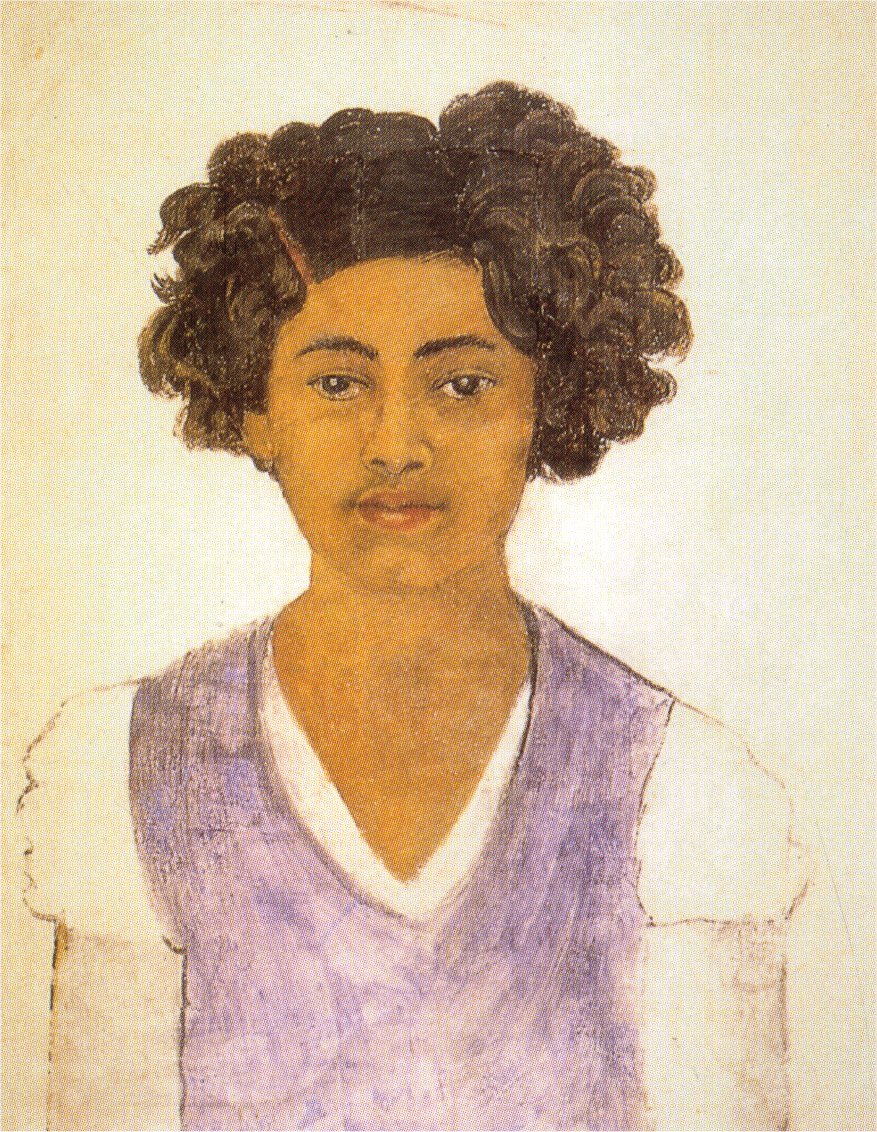 #31
#31
Self-portrait - 1922
With "Self-Portrait - 1922", Frida Kahlo transforms a particular experience into an immediately memorable image. The face is not only a model: it becomes a constructed space where clothing, hairstyle, animals and attributes organize a deliberately staged identity. In these years of training, portraiture and self-portraiture allowed him to assert a precise style while gradually integrating the objects, costumes and spaces that would become his vocabulary. Dated 1922, the portrait and self-portrait allowed him to assert a precise style while gradually integrating the objects, costumes and spaces that would become his vocabulary. Dated 1922, the portrait and self-portrait allowed him to assert a precise style while gradually integrating the objects, costumes and spaces that would become his vocabulary. Dated 1922, the portrait and self-portrait allowed him to assert a precise style while gradually integrating the objects, costumes and spaces that would become his vocabulary. Dated 1922, the work is documented as "Self Portrait". The location indicated is: Private collection, Boston, Massachusetts, United States - institutional resource. The original is not documented in an accessible public collection, the link explicitly leads to a reference museum resource and not to an alleged detention sheet. The image is only used to identify and comment on the work. No certain product is associated with this painting; a click opens the website of the museum or cultural reference institution. Kahlo does not transform her life into an illustration; she selects the forms capable of holding intimate experience and pictorial language together.
Image: WikiArt - documentary catalog by Frida Kahlo · Documentary image; rights to be verified with the museum and rights holders. No associated products.
See the museum or institution → #32
#32
Self-portrait with velvet dress
"Self-portrait with velvet dress" shows the precision with which Frida Kahlo organizes each sign in an often tight space. The model is defined by its posture, its clothing and a few chosen objects; the economy of the decor strengthens the direct relationship between the painted person and the viewer. In these years of training, portraiture and self-portraiture allowed him to assert a precise style while gradually integrating the objects, costumes and spaces that would become his vocabulary. Dated 1926, the portrait and self-portrait allowed him to assert a precise style while gradually integrating the objects, costumes and spaces that would become his vocabulary. Dated 1926, the portrait and self-portrait allowed him to assert a precise style while gradually integrating the objects, costumes and spaces that would become his vocabulary. Dated 1926, the portrait and self-portrait allowed him to assert a precise style while gradually integrating the objects, costumes and spaces that would become his vocabulary. Dated 1926, the portrait and self-portrait allowed him to assert a precise style while gradually integrating the objects, costumes and spaces that would become his vocabulary. Dated 1926, the work is documented as "Self-portrait in a Velvet Dress". The location indicated is: Private collection, Mexico City, Mexico City - institutional resource. As the original is not documented in an accessible public collection, the link explicitly leads to a reference museum resource and not to an alleged possession sheet. The image and link come from the corresponding sheet in the Alpha Reproduction store. One click allows you to consult the proposed reproduction, its formats and its options. The painting therefore invites you to look at the relationships rather than an isolated symbol: no detail acts alone in the balance of the painting.
Image: Alpha Reproduction - image of the product sheet · Visual of the reproduction available in the Alpha Reproduction store.
See this reproduction → #33
#33
Portrait of Alicia Galant
In "Portrait of Alicia Galant", the gaze first encounters a clear image before measuring the autobiographical and historical tensions. The model is defined by its posture, its clothing and a few chosen objects; the economy of decor strengthens the direct relationship between the painted person and the viewer. In these years of training, the portrait and the self-portrait allowed him to assert a precise style while gradually integrating the objects, costumes and spaces which would become his vocabulary. Dated 1927, the portrait and the self-portrait allowed him to assert a precise style while gradually integrating the objects, costumes and spaces which would become his vocabulary. Dated 1927, the portrait and the self-portrait allowed him to assert a precise style while gradually integrating the objects, costumes and spaces which would become his vocabulary. Dated 1927, the portrait and the self-portrait allowed him to assert a precise style while gradually integrating the objects, costumes and spaces which would become his vocabulary. Dated 1927, the portrait and the self-portrait allowed him to assert a precise style while gradually integrating the objects, costumes and spaces which would become his vocabulary. Dated 1927, the portrait and the self-portrait allowed him to assert a precise style while gradually integrating the objects, costumes and spaces which would become his vocabulary. Dated 1927, the work and the self consultation on the official website of the museum or associated cultural institution. The image and link come from the corresponding file in the Alpha Reproduction store. One click allows you to consult the proposed reproduction, its formats and its options. The work thus remains personal without being reduced to a confidence: its construction allows several reading levels to remain active.
Image: Alpha Reproduction - image of the product sheet · Visual of the reproduction available in the Alpha Reproduction store.
See this reproduction → #34
#34
Portrait of Miguel N. Lira
The strength of "Portrait of Miguel N. Lira" comes from the coexistence between concrete detail, frontality and symbolic construction. The model is defined by its posture, its clothing and a few chosen objects; the economy of decor strengthens the direct relationship between the painted person and the viewer. In these years of training, the portrait and the self-portrait allowed him to assert a precise style while gradually integrating the objects, costumes and spaces which would become his vocabulary. Dated 1927, the portrait and the self-portrait allowed him to assert a precise style while gradually integrating the objects, costumes and spaces which would become his vocabulary. Dated 1927, the work is documented as "Portrait of Miguel N. Lira". The location indicated is: Private collection or location to be verified - institutional resource. The original not being documented in an accessible public collection, the link explicitly leads to a reference museum resource and not to an alleged holding file. The image and link come from the corresponding file in the Alpha Reproduction store. One click allows you to consult the proposed reproduction, its formats and its options.
Image: Alpha Reproduction - image of the product sheet · Visual of the reproduction available in the Alpha Reproduction store.
See this reproduction → #35
#35
Portrait of Alejandro Gomez Arias
Beneath its apparent fixity, "Portrait of Alejandro Gomez Arias" connects the body, memory and territory. The model is defined by its posture, its clothing and a few chosen objects; the economy of decor strengthens the direct relationship between the painted person and the viewer. In these years of training, the portrait and the self-portrait allowed him to assert a precise style while gradually integrating the objects, costumes and spaces which would become his vocabulary. Dated 1928, the portrait and the self-portrait allowed him to assert a precise style while gradually integrating the objects, costumes and spaces which would become his vocabulary. Dated 1928, the portrait and the self-portrait allowed him to assert a precise style while gradually integrating the objects, costumes and spaces which would become his vocabulary. Dated 1928, the work is documented as "Portrait of Alejandro Gomez Arias". In these formative years, the portrait and the self-portrait allowed him to assert a precise style while gradually integrating the objects, costumes and spaces which would become his vocabulary. Dated 1928, the work is documented as "Portrait of Alejandro Gomez Arias". The location indicated is: Private collection, Mexico - institutional resource. The original is not documented in an accessible public collection, the link explicitly leads to a reference museum resource and not to an alleged possession sheet. The image and link come from the corresponding sheet in the Alpha Reproduction store. One click allows you to consult the proposed reproduction, its formats and its options. Kahlo does not transform her life into an illustration; she selects the forms capable of holding together intimate experience and pictorial language.
Image: Alpha Reproduction - image of the product sheet · Visual of the reproduction available in the Alpha Reproduction store.
See this reproduction → #36
#36
Portrait of Cristina, my sister
With "Portrait of Cristina, My Sister", Frida Kahlo transforms a particular experience into an immediately memorable image. The model is defined by its posture, its clothing and a few chosen objects; the economy of decor strengthens the direct relationship between the painted person and the viewer. In these years of training, the portrait and the self-portrait allowed him to assert a precise style while gradually integrating the objects, costumes and spaces which would become his vocabulary. Dated 1928, the portrait and the self-portrait allowed him to assert a precise style while gradually integrating the objects, costumes and spaces which would become his vocabulary. Dated 1928, the portrait and the self-portrait allowed him to assert a precise style while gradually integrating the objects, costumes and spaces which would become his vocabulary. Dated 1928, the work is documented as "Portrait of Cristina My Sister". Dated 1928, the work is documented as "Portrait of Cristina My Sister". Dated 1928, the work is documented as "Portrait of Cristina My Sister". Dated 1928, the work is documented as "Portrait of Cristina My Sister". Dated 1928, the work is documented as "Portrait of Cristina My Sister". Dated 1928, the work is documented as "Portrait of not documented in an accessible public collection, the link explicitly leads to a reference museum resource and not to an alleged possession sheet. The image and link come from the corresponding sheet in the Alpha Reproduction store. One click allows you to consult the proposed reproduction, its formats and its options. The painting therefore invites you to look at relationships rather than an isolated symbol: no detail acts alone in the balance of the painting.
Image: Alpha Reproduction - image of the product sheet · Visual of the reproduction available in the Alpha Reproduction store.
See this reproduction → #37
#37
Diego and Frida
"Diego and Frida" shows the precision with which Frida Kahlo organizes each sign in an often tight space. The face is not only a model: it becomes a constructed space where clothes, hairstyle, animals and attributes organize a deliberately staged identity. In these years of training, portraiture and self-portraiture allowed him to assert a precise style while gradually integrating the objects, costumes and spaces that would become his vocabulary. Dated 1929-1944, the portrait and self-portrait allowed him to assert a precise style while gradually integrating the objects, costumes and spaces that would become his vocabulary. Dated 1929-1944, the portrait and self-portrait allowed him to assert a precise style while gradually integrating the objects, costumes and spaces that would become his vocabulary. Dated 1929-1944, the portrait and self-portrait allowed him to assert a precise style while gradually integrating the objects, costumes and spaces that would become his vocabulary. Dated 1929-1944, the work is documented as "Diego and Frida". The location indicated is: Private collection or location to be verified - institutional resource. The original is not documented in an accessible public collection, the link explicitly leads to a reference museum resource and not to an alleged possession sheet. The image and link come from the corresponding sheet in the Alpha Reproduction store. One click allows you to consult the proposed reproduction, its formats and its options. The work thus remains personal without being reduced to a confidence: its construction allows several reading levels to remain active.
Image: Alpha Reproduction - image of the product sheet · Visual of the reproduction available in the Alpha Reproduction store.
See this reproduction →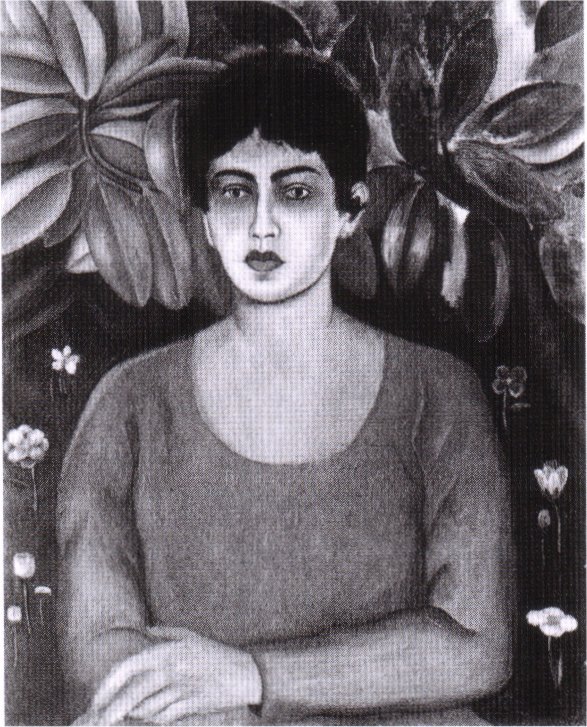 #38
#38
Portrait of Lupe Marin
In "Portrait of Lupe Marîn", the gaze first encounters a clear image before measuring the autobiographical and historical tensions. The model is defined by its posture, its clothing and a few chosen objects; the economy of decor strengthens the direct relationship between the painted person and the viewer. In these years of training, the portrait and the self-portrait allowed him to assert a precise style while gradually integrating the objects, costumes and spaces which would become his vocabulary. Dated 1929, the portrait and the self-portrait allowed him to assert a precise style while gradually integrating the objects, costumes and spaces which would become his vocabulary. Dated 1929, the portrait and the self-portrait allowed him to assert a precise style while gradually integrating the objects, costumes and spaces which would become his vocabulary. Dated 1929, the portrait and the self-portrait allowed him to assert a precise style while gradually integrating the objects, costumes and spaces which would become his vocabulary. Dated 1929, the work and the self-portrait allowed him to assert a precise style while gradually integrating the objects, costumes and spaces which would become his vocabulary. Dated 1929, the work is documented as "Portrait of Lupe Marín". In these formative years, the portrait and the self-portrait allowed him to assert a precise style while gradually integrating the objects, an accessible public collection, the link explicitly leads to a reference museum resource and not to an alleged detention sheet. The image is only used to identify and comment on the work. No certain product is associated with this painting; a click opens the website of the museum or cultural reference institution. This tension explains its lasting presence: the image is quickly recognized, but its relationships of gaze, scale and symbol continue to move.
Image: WikiArt - documentary catalog by Frida Kahlo · Documentary image; rights to be verified with the museum and rights holders. No associated products.
See the museum or institution → #39
#39
Portrait of Virginia (Little Girl)
The strength of "Portrait of Virginia (Little Girl)" comes from the coexistence between concrete detail, frontality and symbolic construction. The model is defined by its posture, its clothing and a few chosen objects; the economy of decor strengthens the direct relationship between the painted person and the viewer. In these years of training, the portrait and the self-portrait allowed him to assert a precise style while gradually integrating the objects, costumes and spaces which would become his vocabulary. Dated 1929, the portrait and the self-portrait allowed him to assert a precise style while gradually integrating the objects, costumes and spaces which would become his vocabulary. Dated 1929, the portrait and the self-portrait allowed him to assert a precise style while gradually integrating the objects, costumes and spaces which would become his vocabulary. Dated 1929, the work and the self-portrait allowed him to assert a precise style while gradually integrating the objects, costumes and spaces which would become his vocabulary. Dated 1929, the work and the self-portrait allowed him to assert a precise style while gradually integrating the objects, costumes and spaces which would become his vocabulary. Dated 1929, the work is documented as "Portrait of Virginia (Little Girl)". The location consultation on the official website of the museum or associated cultural institution. The image and link come from the corresponding file in the Alpha Reproduction store. One click allows you to consult the proposed reproduction, its formats and its options. Kahlo does not transform her life into an illustration; she selects the forms capable of holding together intimate experience and pictorial language.
Image: Alpha Reproduction - image of the product sheet · Visual of the reproduction available in the Alpha Reproduction store.
See this reproduction → #40
#40
Self-portrait - Time flies
Beneath its apparent fixity, "Self-portrait - Time flies" connects the body, memory and territory. The face is not only a model: it becomes a constructed space where clothing, hairstyle, animals and attributes organize a deliberately staged identity. In these years of training, portraiture and self-portraiture allowed him to assert a precise style while gradually integrating the objects, costumes and spaces that would become his vocabulary. Dated 1929, the portrait and self-portrait allowed him to assert a precise style while gradually integrating the objects, costumes and spaces that would become his vocabulary. Dated 1929, the portrait and self-portrait allowed him to assert a precise style while gradually integrating the objects, costumes and spaces that would become his vocabulary. Dated 1929, the portrait and self-portrait allowed him to assert a precise style while gradually integrating the objects, costumes and spaces that would become his vocabulary. Dated 1929, the portrait and self-portrait allowed him to assert a precise style while gradually integrating the objects, costumes and spaces that would become his vocabulary. Dated 1929, the portrait and self-portrait allowed him to assert a precise style while gradually integrating the objects, costumes and spaces that would become his vocabulary. an accessible public collection, the link explicitly leads to a reference museum resource and not to an alleged holding file. The image and link come from the corresponding file in the Alpha Reproduction store. One click allows you to consult the proposed reproduction, its formats and its options. The painting therefore invites you to look at relationships rather than an isolated symbol: no detail acts alone in the balance of the painting.
Image: Alpha Reproduction - image of the product sheet · Visual of the reproduction available in the Alpha Reproduction store.
See this reproduction → #41
#41
Two women
With "Two Women", Frida Kahlo transforms a particular experience into an immediately memorable image. The composition combines observed elements with a very readable symbolic logic, without separating daily life, memory and collective history. In these years of training, portraiture and self-portraiture allowed her to assert a precise style while gradually integrating the objects, costumes and spaces that would become her vocabulary. Dated 1929, the portrait and self-portrait allowed her to assert a precise style while gradually integrating the objects, costumes and spaces that would become her vocabulary. Dated 1929, the work is documented as "Two Women". The location indicated is: Museum of Fine Arts, Boston - institutional resource. The original not being documented in an accessible public collection, the link leads explicitly to a reference museum resource and not to an alleged holding file. The image and link come from the corresponding file in the Alpha Reproduction store. One click allows you to consult the proposed reproduction, its formats and its options. The work thus remains personal without being reduced to a confidence: its construction allows several reading levels to remain active.
Image: Alpha Reproduction - image of the product sheet · Visual of the reproduction available in the Alpha Reproduction store.
See this reproduction → #42
#42
Portrait of a woman in white
"Portrait of a Woman in White" shows the precision with which Frida Kahlo organizes each sign in an often tight space. The model is defined by its posture, its clothing and a few chosen objects; the economy of the decor strengthens the direct relationship between the painted person and the viewer. In these years of training, the portrait and the self-portrait allowed him to assert a precise style while gradually integrating the objects, costumes and spaces which would become his vocabulary. Dated 1930, the portrait and the self-portrait allowed him to assert a precise style while gradually integrating the objects, costumes and spaces which would become his vocabulary. Dated 1930, the portrait and the self-portrait allowed him to assert a precise style while gradually integrating the objects, costumes and spaces which would become his vocabulary. Dated 1930, the work is documented as "Portrait of a Woman in White". Dated 1930, the work is documented as "Portrait of a Woman in White". Dated 1930, the work is documented as "Portrait of a Woman in White". Dated 1930, the work is documented as "Portrait of a Woman in White". Dated 1930, the work is documented as "Port not being documented in an accessible public collection, the link explicitly leads to a reference museum resource and not to an alleged holding file. The image and link come from the corresponding file in the Alpha Reproduction store. One click allows you to consult the proposed reproduction, its formats and its options.
Image: Alpha Reproduction - image of the product sheet · Visual of the reproduction available in the Alpha Reproduction store.
See this reproduction → #43
#43
Self-portrait - 1930
In "Self-portrait - 1930", the gaze first encounters a clear image before measuring its autobiographical and historical tensions. The face is not only a model: it becomes a constructed space where clothing, hairstyle, animals and attributes organize a deliberately staged identity. In these years of training, portraiture and self-portraiture allowed him to assert a precise style while gradually integrating the objects, costumes and spaces that would become his vocabulary. Dated 1930, the portrait and self-portrait allowed him to assert a precise style while gradually integrating the objects, costumes and spaces that would become his vocabulary. Dated 1930, the portrait and self-portrait allowed him to assert a precise style while gradually integrating the objects, costumes and spaces that would become his vocabulary. Dated 1930, the portrait and self-portrait allowed him to assert a precise style while gradually integrating the objects, costumes and spaces that would become his vocabulary. Dated 1930, the portrait and self-portrait allowed him to assert a precise style while gradually integrating the objects, costumes and spaces that would become his vocabulary. Dated 1930, the portrait and self-portrait allowed him to assert a precise style while gradually integrating the objects, costumes and spaces that would As the original is not documented in an accessible public collection, the link explicitly leads to a reference museum resource and not to an alleged possession sheet. The image and link come from the corresponding sheet in the Alpha Reproduction store. One click allows you to consult the proposed reproduction, its formats and its options. Kahlo does not transform her life into an illustration; she selects the forms capable of holding intimate experience and pictorial language together.
Image: Alpha Reproduction - image of the product sheet · Visual of the reproduction available in the Alpha Reproduction store.
See this reproduction → #44
#44
Portrait of Dr Leo Eloesser
The strength of "Portrait of Dr. Leo Eloesser" comes from the coexistence between concrete detail, frontality and symbolic construction. The model is defined by its posture, its clothing and a few chosen objects; the economy of the decor strengthens the direct relationship between the painted person and the viewer. In these years of training, portraiture and self-portraiture allowed him to assert a precise style while gradually integrating the objects, costumes and spaces that would become his vocabulary. Dated 1931, the portrait and self-portrait allowed him to assert a precise style while gradually integrating the objects, costumes and spaces that would become his vocabulary. Dated 1931, the portrait and self-portrait allowed him to assert a precise style while gradually integrating the objects, costumes and spaces that would become his vocabulary. Dated 1931, the portrait and self-portrait allowed him to assert a precise style while gradually integrating the objects, costumes and spaces that would become his vocabulary. Dated 1931, the work is documented as "Portrait of Dr. Leo Eloesser". The location indicated is: University of California, School of Medicine, San Francisco, United States - resource institutional. As the original is not documented in an accessible public collection, the link explicitly leads to a reference museum resource and not to an alleged possession sheet. The image and link come from the corresponding file in the Alpha Reproduction store. One click allows you to consult the proposed reproduction, its formats and its options.
Image: Alpha Reproduction - image of the product sheet · Visual of the reproduction available in the Alpha Reproduction store.
See this reproduction → #45
#45
Portrait of Eva Frederick
Beneath its apparent fixity, "Portrait of Eva Frederick" connects the body, memory and territory. The model is defined by its posture, its clothing and a few chosen objects; the economy of decor strengthens the direct relationship between the painted person and the viewer. In these years of training, the portrait and the self-portrait allowed him to assert a precise style while gradually integrating the objects, costumes and spaces which would become his vocabulary. Dated 1931, the portrait and the self-portrait allowed him to assert a precise style while gradually integrating the objects, costumes and spaces which would become his vocabulary. Dated 1931, the portrait and the self-portrait allowed him to assert a precise style while gradually integrating the objects, costumes and spaces which would become his vocabulary. Dated 1931, the work and the self-portrait allowed him to assert a precise style while gradually integrating the objects, costumes and spaces which would become his vocabulary. Dated 1931, the work is documented as "Portrait of Eva Frederick". The location indicated is: Museo Dolores Olmedo, Mexico City, Mexico City. The location indicated is: Museo Dolores Olmedo, Mexico City, Mexico City. The link allows you to continue the consultation on from the museum or associated cultural institution. The image and link come from the corresponding file in the Alpha Reproduction store. One click allows you to consult the proposed reproduction, its formats and its options. The work thus remains personal without being reduced to a confidence: its construction allows several reading levels to remain active.
Image: Alpha Reproduction - image of the product sheet · Visual of the reproduction available in the Alpha Reproduction store.
See this reproduction → #46
#46
Portrait of Luther Burbank
With "Portrait of Luther Burbank", Frida Kahlo transforms a particular experience into an immediately memorable image. The model is defined by its posture, its clothing and a few chosen objects; the economy of decor strengthens the direct relationship between the painted person and the viewer. In these years of training, the portrait and the self-portrait allowed him to assert a precise style while gradually integrating the objects, costumes and spaces which would become his vocabulary. Dated 1931, the portrait and the self-portrait allowed him to assert a precise style while gradually integrating the objects, costumes and spaces which would become his vocabulary. Dated 1931, the work and the self-portrait allowed him to assert a precise style while gradually integrating the objects, costumes and spaces which would become his vocabulary. Dated 1931, the work is documented as "Portrait of Luther Burbank". The location indicated is: Museo Dolores Olmedo, Mexico City, Mexico City. The link allows you to continue the consultation on the official website of the museum or associated cultural institution. The image and link come from the corresponding file in the Alpha Reproduction store. One click allows you to consult the proposed reproduction, its formats and its options. This tension explains its lasting presence: the image is quickly recognized, but its relationships of gaze, scale and symbol continue to move.
Image: Alpha Reproduction - image of the product sheet · Visual of the reproduction available in the Alpha Reproduction store.
See this reproduction →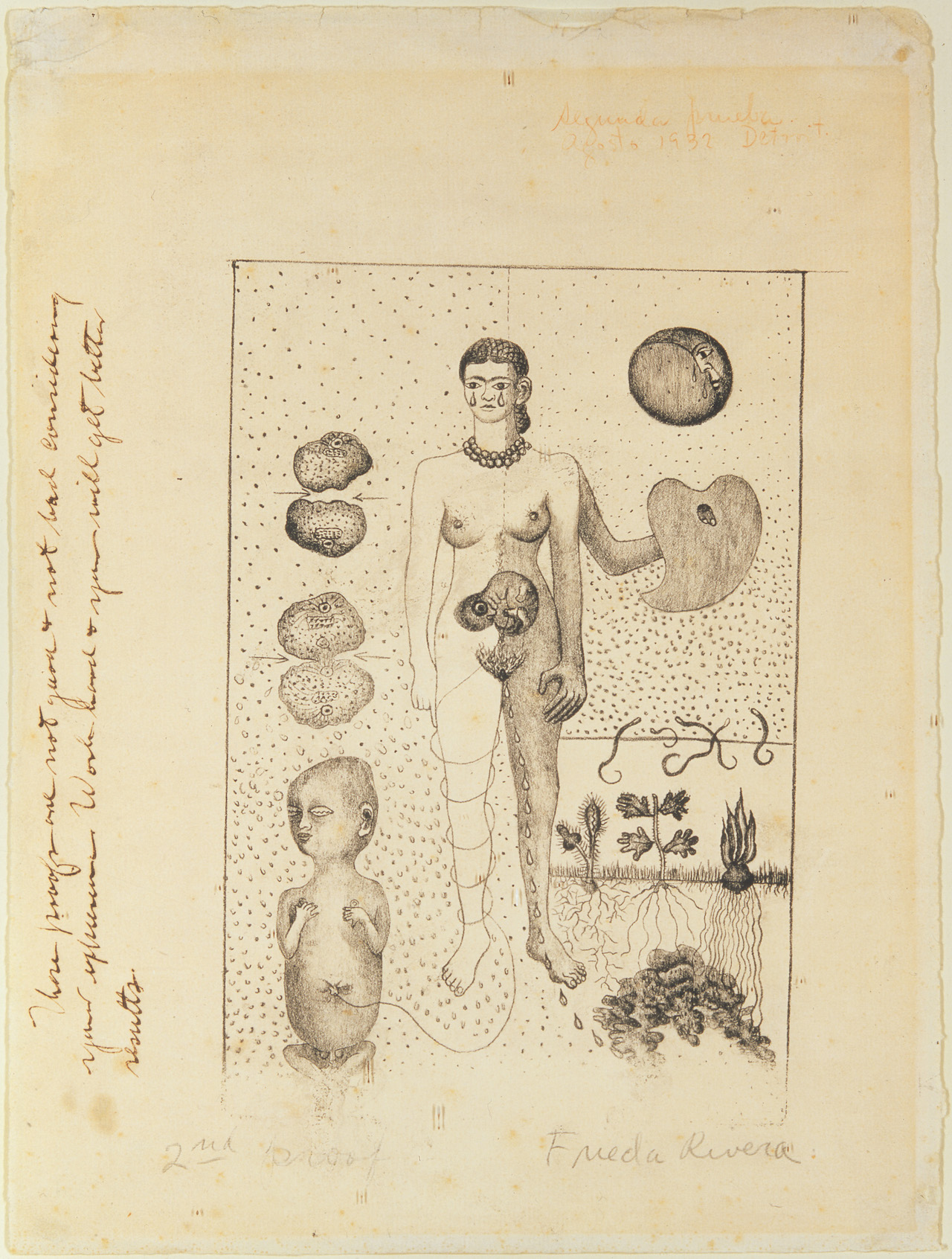 #47
#47
Frida and the miscarriage
"Frida and the Miscarriage" shows the precision with which Frida Kahlo organizes each sign in an often tight space. The face is not only a model: it becomes a constructed space where clothing, hairstyle, animals and attributes organize a deliberately staged identity. During the 1930s, his experience of the body, his stays in the United States and his relationship with Mexico nourished images where the personal story takes on historical significance. Dated 1932, his experience of the body, his stays in the United States and his relationship with Mexico nourished images where the personal story takes on historical significance. Dated 1932, the work is documented as "Frida and the Miscarriage". The location shown is: Private collection or location to be verified - institutional resource. The original is not documented in one an accessible public collection, the link explicitly leads to a reference museum resource and not to an alleged detention sheet. The image is only used to identify and comment on the work. No certain product is associated with this painting; a click opens the website of the museum or cultural reference institution.
Image: WikiArt - documentary catalog by Frida Kahlo · Documentary image; rights to be verified with the museum and rights holders. No associated products.
See the museum or institution → #48
#48
My dress hangs there
In "My dress hangs there", the gaze first encounters a clear image before measuring the autobiographical and historical tensions. The composition combines observed elements with a very readable symbolic logic, without separating daily life, memory and collective history. During the 1930s, his experience of the body, his stays in the United States and his relationship with Mexico nourished images where the personal story takes on historical significance. Dated 1933, his experience of the body, his stays in the United States and his relationship with Mexico nourished images where the personal story took on historical significance. Dated 1933, his experience of the body, his stays in the United States and his relationship with Mexico nourished images where the personal story took on historical significance. Dated 1933, his experience of the body, his stays in the United States and his relationship with Mexico nourished images where the personal story took on historical significance. Dated 1933, his experience of the body, his stays in the United States and his relationship with Mexico nourished images where the personal story took on historical significance. Dated 1933, the work is documented as "My Dress Hangs There". Dated 1933, the work is documented as "My Dress Hangs There". Dated 1933 an accessible public collection, the link explicitly leads to a reference museum resource and not to an alleged holding file. The image and link come from the corresponding file in the Alpha Reproduction store. One click allows you to consult the proposed reproduction, its formats and its options. The painting therefore invites you to look at relationships rather than an isolated symbol: no detail acts alone in the balance of the painting.
Image: Alpha Reproduction - image of the product sheet · Visual of the reproduction available in the Alpha Reproduction store.
See this reproduction → #49
#49
Self-portrait with necklace
The strength of "Self-portrait with a necklace" comes from the coexistence between concrete detail, frontality and symbolic construction. The face is not only a model: it becomes a constructed space where clothing, hairstyle, animals and attributes organize a deliberately staged identity. During the 1930s, his experience of the body, his stays in the United States and his relationship with Mexico nourished images where the personal story took on historical significance. Dated 1933, his experience of the body, his stays in the United States and his relationship with Mexico nourished images where the personal story took on historical significance. Dated 1933, his experience of the body, his stays in the United States and his relationship with Mexico nourished images where the personal story took on historical significance. Dated 1933, his experience of the body, his stays in the United States and his relationship with Mexico nourished images where the personal story took on historical significance. Dated 1933, his experience of the body, his stays in the United States and his relationship with Mexico nourished images where the personal story took on historical significance. Dated 1933, his experience of the body, his stays in the United States and his relationship with Mexico nourished images where the personal story took on historical significance. Dated 1 documented in an accessible public collection, the link explicitly leads to a reference museum resource and not to an alleged possession sheet. The image and link come from the corresponding sheet in the Alpha Reproduction store. One click allows you to consult the proposed reproduction, its formats and its options. The work thus remains personal without being reduced to a confidence: its construction allows several reading levels to remain active.
Image: Alpha Reproduction - image of the product sheet · Visual of the reproduction available in the Alpha Reproduction store.
See this reproduction → #50
#50
Very ugly self-portrait
Beneath its apparent fixity, "Very Ugly Self-Portrait" connects the body, memory and territory. The model is defined by its posture, its clothing and a few chosen objects; the economy of the decor strengthens the direct relationship between the painted person and the viewer. During the 1930s, his experience of the body, his stays in the United States and his relationship with Mexico nourished images where the personal story took on historical significance. Dated 1933, his experience of the body, his stays in the United States and his relationship with Mexico nourished images where the personal story took on historical significance. Dated 1933, his experience of the body, his stays in the United States and his relationship with Mexico nourished images where the personal story took on historical significance. Dated 1933, his experience of the body, his stays in the United States and his relationship with Mexico nourished images where the personal story took on historical significance. Dated 1933, the work is documented as "Self-Portrait Very Ugly". During the 1930s, his experience of the body, his stays in the United States and his relationship with Mexico nourished images where the personal story took on historical significance. Dated 1933, his experience of the accessible, the link explicitly leads to a reference museum resource and not to an alleged detention sheet. The image and link come from the corresponding file in the Alpha Reproduction store. A click allows you to consult the proposed reproduction, its formats and its options. This tension explains its lasting presence: the image is quickly recognized, but its relationships of gaze, scale and symbol continue to move.
Image: Alpha Reproduction - image of the product sheet · Visual of the reproduction available in the Alpha Reproduction store.
See this reproduction →Monkeys, dogs, plants, hairstyles and clothing constantly shift the line between portrait and allegory.
 #51
#51
Self-portrait with curly hair
With "Self-portrait with curly hair", Frida Kahlo transforms a particular experience into an immediately memorable image. The face is not only a model: it becomes a constructed space where clothing, hairstyle, animals and attributes organize a deliberately staged identity. During the 1930s, his experience of the body, his stays in the United States and his relationship with Mexico nourished images where the personal story took on historical significance. Dated 1935, his experience of the body, his stays in the United States and his relationship with Mexico nourished images where the personal story took on historical significance. Dated 1935, his experience of the body, his stays in the United States and his relationship with Mexico nourished images where the personal story took on historical significance. Dated 1935, his experience of the body, his stays in the United States and his relationship with Mexico nourished images where the personal story took on historical significance. Dated 1935, his experience of the body, his stays in the United States and his relationship with Mexico nourished images where the personal story took on historical significance. Dated 1935, his body experience, his stays in the United States and his relationship with Mexico nourished images where the personal story took on historical significance. Dated 193 an accessible public collection, the link explicitly leads to a reference museum resource and not to an alleged possession sheet. The image and link come from the corresponding sheet in the Alpha Reproduction store. One click allows you to consult the proposed reproduction, its formats and its options. Kahlo does not transform her life into an illustration; she selects the forms capable of holding together intimate experience and pictorial language.
Image: Alpha Reproduction - image of the product sheet · Visual of the reproduction available in the Alpha Reproduction store.
See this reproduction → #52
#52
Me and my doll
"Me and my doll" shows the precision with which Frida Kahlo organizes each sign in an often tight space. The model is defined by its posture, its clothing and a few chosen objects; the economy of decor strengthens the direct relationship between the painted person and the viewer. During the 1930s, his experience of the body, his stays in the United States and his relationship with Mexico nourished images where the personal story took on historical significance. Dated 1937, the work's experience of the body, his stays in the United States and his relationship with Mexico nourished images where the personal story took on historical significance. Dated 1937, the work is documented as "Me and My Doll". The location shown is: Collection of Jacques & Natasha Gelman, Mexico City, Mexico City - institutional resource. The original not being documented in one accessible public collection, the link explicitly leads to a reference museum resource and not to an alleged holding file. The image and link come from the corresponding file in the Alpha Reproduction store. One click allows you to consult the proposed reproduction, its formats and its options.
Image: Alpha Reproduction - image of the product sheet · Visual of the reproduction available in the Alpha Reproduction store.
See this reproduction → #53
#53
Portrait of Diego Rivera
In "Portrait of Diego Rivera", the gaze first encounters a clear image before measuring the autobiographical and historical tensions. The model is defined by its posture, its clothing and a few chosen objects; the economy of decor strengthens the direct relationship between the painted person and the viewer. During the 1930s, his experience of the body, his stays in the United States and his relationship with Mexico nourished images where the personal story took on historical significance. Dated 1937, his experience of the body, his stays in the United States and his relationship with Mexico nourished images where the personal story took on historical significance. Dated 1937, his experience of the body, his stays in the United States and his relationship with Mexico nourished images where the personal story took on historical significance. Dated 1937, his experience of the body, his stays in the United States and his relationship with Mexico nourished images where the personal story took on historical significance. Dated 1937, his experience of the body, his stays in the United States and his relationship with Mexico nourished images where the personal story took on historical significance. Dated 1937, his experience of the body, his stays in the United States and his relationship with Mexico nourished images where the personal story took on historical significance. Dated As the original is not documented in an accessible public collection, the link explicitly leads to a reference museum resource and not to an alleged possession sheet. The image and link come from the corresponding file in the Alpha Reproduction store. One click allows you to consult the proposed reproduction, its formats and its options.
Image: Alpha Reproduction - image of the product sheet · Visual of the reproduction available in the Alpha Reproduction store.
See this reproduction → #54
#54
The Late Dimas
The strength of "The Late Dimas" comes from the coexistence between concrete detail, frontality and symbolic construction. The composition combines observed elements with a very readable symbolic logic, without separating daily life, memory and collective history. During the 1930s, his experience of the body, his stays in the United States and his relationship with Mexico nourished images where the personal story takes on historical significance. Dated 1937, his experience of the body, his stays in the United States and his relationship with Mexico nourished images where the personal story takes on historical significance. Dated 1937, the work is documented as "The Deceased Dimas". Dated 1937, the work is documented as "The Deceased Dimas". Dated 1937, the work is documented as "The Deceased Dimas". The location indicated is: Museo Dolores Olmedo, Mexico City, Mexico City. The location indicated is: Museo Dolores Olmedo, Mexico City, Mexico City. The location indicated is: Museo Dolores Olmedo, Mexico City, Mexico City. The location indicated is: Museo Dolores Olmedo, Mexico City, Mexico City. The location indicated is: Museo Dolores Olmedo, Mexico associated. The image and the link come from the corresponding file in the Alpha Reproduction store. One click allows you to consult the proposed reproduction, its formats and its options. This tension explains its lasting presence: the image is quickly recognized, but its relationships of gaze, scale and symbol continue to move.
Image: Alpha Reproduction - image of the product sheet · Visual of the reproduction available in the Alpha Reproduction store.
See this reproduction → #55
#55
Four residents of Mexico City
Beneath its apparent fixity, "Four inhabitants of Mexico" connects the body, memory and territory. The model is defined by its posture, its clothing and a few chosen objects; the economy of decor strengthens the direct relationship between the painted person and the viewer. During the 1930s, his experience of the body, his stays in the United States and his relationship with Mexico nourished images where the personal story took on historical significance. Dated 1938, the work is documented as "Four Inhabitants of Mexico". During the 1930s, his experience of the body, his stays in the United States and his relationship with Mexico nourished images where the personal story took on historical significance. Dated 1938, the work is documented as "Four Inhabitants of Mexico". The location indicated is: Private collection or location to be verified - institutional resource. The original is not documented in a collection accessible public, the link explicitly leads to a reference museum resource and not to an alleged detention sheet. The image and link come from the corresponding sheet in the Alpha Reproduction store. One click allows you to consult the proposed reproduction, its formats and its options. Kahlo does not transform her life into an illustration; she selects the forms capable of holding intimate experience and pictorial language together.
Image: Alpha Reproduction - image of the product sheet · Visual of the reproduction available in the Alpha Reproduction store.
See this reproduction → #56
#56
Fruits of the earth
With "Fruits of the Earth", Frida Kahlo transforms a particular experience into an immediately memorable image. Still life retains the concrete presence of fruits and plants, while circulating signs of vitality, injury, territory and beginning again. During the 1930s, his experience of the body, his stays in the United States and his relationship with Mexico nourished images where the personal story took on historical significance. Dated 1938, his experience of the body, his stays in the United States and his relationship with Mexico nourished images where the personal story took on historical significance. Dated 1938, his experience of the body, his stays in the United States and his relationship with Mexico nourished images where the personal story took on historical significance. Dated 1938, his work is documented as "Fruits of the Earth". Dated 1938, his work is documented as "Fruits of the Earth". The location indicated is: Collection of National Bank of Mexico, Mexico City, Mexico City - institutional resource. The original not being documented in one an accessible public collection, the link explicitly leads to a reference museum resource and not to an alleged holding file. The image and link come from the corresponding file in the Alpha Reproduction store. One click allows you to consult the proposed reproduction, its formats and its options. The painting therefore invites you to look at relationships rather than an isolated symbol: no detail acts alone in the balance of the painting.
Image: Alpha Reproduction - image of the product sheet · Visual of the reproduction available in the Alpha Reproduction store.
See this reproduction → #57
#57
Girl in the Death Mask (She plays alone)
"Girl in the Death Mask (She Plays Alone)" shows the precision with which Frida Kahlo organizes each sign in an often tight space. Kahlo gives a clear form to a difficult bodily or psychic experience; the precision of the objects prevents the image from dissolving into vague allegory. During the 1930s, her experience of the body, her stays in the United States and her relationship to Mexico nourished images where the personal story took on historical significance. Dated 1938, her experience of the body, her stays in the United States and her relationship to Mexico nourished images where the personal story took on historical significance. Dated 1938, her experience of the body, her stays in the United States and her relationship to Mexico nourished images where the personal story took on historical significance. Dated 1938, her body experience, her stays in the United States and her relationship to Mexico nourished images where the personal story took on historical significance. Dated 1938, her body experience, her stays in the United States and her relationship to Mexico nourished images where the personal story took on historical significance. Dated 1938, her body experience, her stays in the United States and her relationship to Mexico nourished images where the personal story took on historical or the associated cultural institution. The image and link come from the corresponding file in the Alpha Reproduction store. One click allows you to consult the proposed reproduction, its formats and its options. The work thus remains personal without being reduced to a confidence: its construction allows several reading levels to remain active.
Image: Alpha Reproduction - image of the product sheet · Visual of the reproduction available in the Alpha Reproduction store.
See this reproduction → #58
#58
Me with my dog itzcuintli
In "Me with my dog itzcuintli", the gaze first encounters a clear image before measuring its autobiographical and historical tensions. The composition combines observed elements with a very readable symbolic logic, without separating daily life, memory and collective history. During the 1930s, his experience of the body, his stays in the United States and his relationship with Mexico nourished images where the personal story takes on historical significance. Dated 1938, his experience of the body, his stays in the United States and his relationship with Mexico nourished images where the personal story took on historical significance. Dated 1938, his experience of the body, his stays in the United States and his relationship with Mexico nourished images where the personal story took on historical significance. Dated 1938, his experience of the body, his stays in the United States and his relationship with Mexico nourished images where the personal story took on historical significance. Dated 1938, his experience of the body, his stays in the United States and his relationship with Mexico nourished images where the personal story took on historical significance. Dated 1938, his experience of the body, his stays in the United States and his relationship to Mexico nourished images where the personal story took on historical significance. Dated 1938, an accessible public collection, the link explicitly leads to a reference museum resource and not to an alleged holding sheet. The image and link come from the corresponding sheet in the Alpha Reproduction store. A click allows you to consult the proposed reproduction, its formats and its options. This tension explains its lasting presence: the image is quickly recognized, but its relationships of gaze, scale and symbol continue to move.
Image: Alpha Reproduction - image of the product sheet · Visual of the reproduction available in the Alpha Reproduction store.
See this reproduction → #59
#59
Pitahayas
The strength of "Pitahayas" comes from the coexistence between concrete detail, frontality and symbolic construction. Still life retains the concrete presence of fruits and plants, while circulating signs of vitality, injury, territory and beginning again. During the 1930s, his experience of the body, his stays in the United States and his relationship with Mexico nourished images where the personal story took on historical significance. Dated 1938, his experience of the body, his stays in the United States and his relationship with Mexico nourished images where the personal story took on historical significance. Dated 1938, his experience of the body, his stays in the United States and his relationship with Mexico nourished images where the personal story took on historical significance. Dated 1938, the work is documented as "Pitahayas". The location indicated is: Madison Museum of Contemporary Art, Madison, Wisconsin, United States. The location indicated is: Madison Museum of Contemporary Art, Madison, Wisconsin, United States. The location indicated is: Madison Museum of Contemporary Art, Madison, Wisconsin, United States. The location indicated is: Madison Museum of Contemporary Art, Madison, Wisconsin, United States. The location indicated is: Madison the associated cultural institution. The image and link come from the corresponding file in the Alpha Reproduction store. One click allows you to consult the proposed reproduction, its formats and its options. Kahlo does not transform his life into an illustration; she selects the forms capable of holding together intimate experience and pictorial language.
Image: Alpha Reproduction - image of the product sheet · Visual of the reproduction available in the Alpha Reproduction store.
See this reproduction → #60
#60
Self-portrait with a monkey - 1938
Beneath its apparent fixity, "Self-portrait with a monkey - 1938" connects the body, memory and territory. The face is not only a model: it becomes a constructed space where clothing, hairstyle, animals and attributes organize a deliberately staged identity. During the 1930s, his experience of the body, his stays in the United States and his relationship with Mexico nourished images where the personal story took on historical significance. Dated 1938, his experience of the body, his stays in the United States and his relationship with Mexico nourished images where the personal story took on historical significance. Dated 1938, his experience of the body, his stays in the United States and his relationship with Mexico nourished images where the personal story took on historical significance. Dated 1938, his experience of the body, his stays in the United States and his relationship with Mexico nourished images where the personal story took on historical significance. Dated 1938, his experience of the body, his stays in the United States and his relationship with Mexico nourished images where the personal story took on historical significance. Dated 1938, his experience of the body, his stays in the United States and his relationship with Mexico nourished images where the personal story took on historical significance from the associated cultural institution. The image and link come from the corresponding file in the Alpha Reproduction store. One click allows you to consult the proposed reproduction, its formats and its options. The painting therefore invites you to look at relationships rather than an isolated symbol: no detail acts alone in the balance of the painting.
Image: Alpha Reproduction - image of the product sheet · Visual of the reproduction available in the Alpha Reproduction store.
See this reproduction → #61
#61
Prickly pears (Still life with cactus fruits)
With "Prickly Pear (Still Life with Cactus Fruits)", Frida Kahlo transforms a particular experience into an immediately memorable image. Still life retains the concrete presence of fruits and plants, while circulating signs of vitality, injury, territory and starting again. During the 1930s, his experience of the body, his stays in the United States and his relationship with Mexico nourished images where the personal story took on historical significance. Dated 1938, his experience of the body, his stays in the United States and his relationship with Mexico nourished images where the personal story took on historical significance. Dated 1938, his experience of the body, his stays in the United States and his relationship with Mexico nourished images where the personal story took on historical significance. Dated 1938, his experience of the body, his stays in the United States and his relationship with Mexico nourished images where the personal story took on historical significance. Dated 1938, his experience of the body, his stays in the United States and his relationship with Mexico nourished images where the personal story took on historical significance. Dated 1938, his experience of the body, his stays in the United States and his relationship with Mexico nourished images where the personal story took on historical significance. As the original is not documented in an accessible public collection, the link explicitly leads to a reference museum resource and not to an alleged possession sheet. The image and link come from the corresponding file in the Alpha Reproduction store. One click allows you to consult the proposed reproduction, its formats and its options.
Image: Alpha Reproduction - image of the product sheet · Visual of the reproduction available in the Alpha Reproduction store.
See this reproduction → #62
#62
Two nudes in the forest (The Earth itself)
"Two Nudes in the Forest (The Earth Itself)" shows the precision with which Frida Kahlo organizes each sign in an often tight space. The composition combines observed elements with a very readable symbolic logic, without separating daily life, memory and collective history. Around 1940, Kahlo multiplied self-portraits, but each cover changed the signs, the framing and the relationship between figure and background; repetition is never an automatic formula. Dated 1939, the work is documented as "Two Nudes in the Forest (The Earth Itself)". The location indicated is: Private collection or location to be verified - institutional resource. The original not being documented in an accessible public collection, the link explicitly leads to a reference museum resource and not to an alleged holding file. The image and link come from the corresponding file in the Alpha Reproduction store. One click allows you to consult the proposed reproduction, its formats and its options.
Image: Alpha Reproduction - image of the product sheet · Visual of the reproduction available in the Alpha Reproduction store.
See this reproduction → #63
#63
Self-portrait dedicated to Dr. Eloesser
In "Self-portrait dedicated to Dr. Eloesser", the gaze first encounters a clear image before measuring the autobiographical and historical tensions. The face is not only a model: it becomes a constructed space where clothing, hairstyle, animals and attributes organize a deliberately staged identity. Around 1940, Kahlo multiplied self-portraits, but each cover changed the signs, the framing and the relationship between figure and background; repetition is never an automatic formula. Dated 1940, Kahlo multiplied the self-portraits, but each cover changed the signs, the framing and the relationship between figure and background; repetition is never an automatic formula. Dated 1940, Kahlo multiplied the self-portraits, but each cover changed the signs, the framing and the relationship between figure and background; repetition is never an automatic formula. Dated 1940, the work is documented as "Self Portrait Dedicated to Dr Eloesser". Repetition is never an automatic formula. Dated 1940, the work is documented as "Self Portrait Dedicated to Dr Eloesser". Repetition is never an automatic formula. Dated 1940, the work is documented as "Self Portrait Dedic consultation on the official website of the museum or associated cultural institution. The image and link come from the corresponding file in the Alpha Reproduction store. One click allows you to consult the proposed reproduction, its formats and its options. Kahlo does not transform her life into an illustration; she selects the forms capable of holding together intimate experience and pictorial language.
Image: Alpha Reproduction - image of the product sheet · Visual of the reproduction available in the Alpha Reproduction store.
See this reproduction → #64
#64
Self-portrait dedicated to Sigmund Firestone
The strength of "Self-portrait dedicated to Sigmund Firestone" comes from the coexistence between concrete detail, frontality and symbolic construction. The face is not only a model: it becomes a constructed space where clothing, hairstyle, animals and attributes organize a deliberately staged identity. Around 1940, Kahlo multiplied self-portraits, but each cover changed the signs, the framing and the relationship between figure and background; repetition is never an automatic formula. Dated 1940, Kahlo multiplied the self-portraits, but each cover changed the signs, the framing and the relationship between figure and background; repetition is never an automatic formula. Dated 1940, Kahlo multiplied the self-portraits, but each cover changed the signs, the framing and the relationship between figure and background; repetition is never an automatic formula. Dated 1940, the work is documented as "Self Portrait Dedicated to Sigmund Firestone". repetition is never an automatic formula. Dated 1940, the work is documented as "Self Portrait Dedicated to Sigmund Firestone". repetition is never an automatic formula. Dated 1940, the work is documented as "Self Portrait Dedicated to Sigmund Firestone". repetition is never an automatic formula. institutional. As the original is not documented in an accessible public collection, the link explicitly leads to a reference museum resource and not to an alleged possession sheet. The image and link come from the corresponding file in the Alpha Reproduction store. One click allows you to consult the proposed reproduction, its formats and its options.
Image: Alpha Reproduction - image of the product sheet · Visual of the reproduction available in the Alpha Reproduction store.
See this reproduction → #65
#65
Self-portrait with braid
Beneath its apparent fixity, "Self-portrait with braid" connects the body, memory and territory. The face is not only a model: it becomes a constructed space where clothing, hairstyle, animals and attributes organize a deliberately staged identity. Around 1940, Kahlo multiplied self-portraits, but each cover changed the signs, the framing and the relationship between figure and background; repetition is never an automatic formula. Dated 1941, the work is documented as "Self Portrait with Braid". repetition is never an automatic formula. Dated 1941, the work is documented as "Self Portrait with Braid". repetition is never an automatic formula. Dated 1941, the work is documented as "Self Portrait with Braid". repetition is never an automatic formula. Dated 1941, the work is documented as "Self Portrait with Braid". repetition is never an automatic formula. Dated 1941, the work is documented as "Self Portrait with Braid". repetition is never an automatic formula. Dated 1941, the work is documented as "Self Portrait with Braid". repetition is never an automatic formula. Dated 1941, the work is documented as "Self Portrait with Braid". repetition is never an documented in an accessible public collection, the link explicitly leads to a reference museum resource and not to an alleged holding file. The image and link come from the corresponding file in the Alpha Reproduction store. One click allows you to consult the proposed reproduction, its formats and its options.
Image: Alpha Reproduction - image of the product sheet · Visual of the reproduction available in the Alpha Reproduction store.
See this reproduction → #66
#66
Self-portrait in red and gold dress
With "Self-Portrait in Red and Gold Dress", Frida Kahlo transforms a particular experience into an immediately memorable image. The model is defined by its posture, its clothing and a few chosen objects; the economy of the decor reinforces the direct relationship between the painted person and the viewer. Around 1940, Kahlo multiplied the self-portraits, but each cover changed the signs, the framing and the relationship between figure and background; repetition is never an automatic formula. Dated 1941, the work is documented as "Self-Portrait in Red and Gold Dress". Repetition is never an automatic formula. Dated 1941, the work is documented as "Self-Portrait in Red and Gold Dress". Repetition is never an automatic formula. Dated 1941, the work is documented as "Self-Portrait in Red and Gold Dress". Repetition is never an automatic formula. Dated 1941, the work is documented as "Self-Portrait in Red and Gold Dress". Repetition is never an automatic formula. Dated 1941, the work is documented as "Self-Portrait in Red and Gold Dress". Repetition is never an automatic formula. Dated 1941, the work is documented as "Self-Portrait in not documented in an accessible public collection, the link explicitly leads to a reference museum resource and not to an alleged holding file. The image and link come from the corresponding file in the Alpha Reproduction store. One click allows you to consult the proposed reproduction, its formats and its options.
Image: Alpha Reproduction - image of the product sheet · Visual of the reproduction available in the Alpha Reproduction store.
See this reproduction → #67
#67
Self-portrait with Bonito
"Self-portrait with Bonito" shows the precision with which Frida Kahlo organizes each sign in an often tight space. The model is defined by its posture, its clothing and a few chosen objects; the economy of the decor reinforces the direct relationship between the painted person and the viewer. Around 1940, Kahlo multiplied the self-portraits, but each cover changed the signs, the framing and the relationship between figure and background; repetition is never an automatic formula. Dated 1941, the work is documented as "Self-Portrait with Bonito". Repetition is never an automatic formula. Dated 1941, the work is documented as "Self-Portrait with Bonito". Repetition is never an automatic formula. Dated 1941, the work is documented as "Self-Portrait with Bonito". Repetition is never an automatic formula. Dated 1941, the work is documented as "Self-Portrait with Bonito". Repetition is never an automatic formula. Dated 1941, the work is documented as "Self-Portrait with Bonito". Repetition is never an automatic formula. Dated 1941, the work is documented as "Self-Portrait with Bonito". Repetition is never an automatic an accessible public collection, the link explicitly leads to a reference museum resource and not to an alleged detention sheet. The image and link come from the corresponding sheet in the Alpha Reproduction store. One click allows you to consult the proposed reproduction, its formats and its options. Kahlo does not transform her life into an illustration; she selects the forms capable of holding together intimate experience and pictorial language.
Image: Alpha Reproduction - image of the product sheet · Visual of the reproduction available in the Alpha Reproduction store.
See this reproduction → #68
#68
Portrait of Lucha Maria, a young girl from Tehuacan
In "Portrait of Lucha Maria, a young girl from Tehuacân", the gaze first encounters a clear image before measuring the autobiographical and historical tensions. The model is defined by its posture, its clothing and a few chosen objects; the economy of the decor reinforces the direct relationship between the painted person and the viewer. Around 1940, Kahlo multiplied the self-portraits, but each cover changed the signs, the framing and the relationship between figure and background; repetition is never an automatic formula. Dated 1940, Kahlo multiplied the self-portraits, but each cover changed the signs, the framing and the relationship between figure and background; repetition is never an automatic formula. Dated 1940, Kahlo multiplied the self-portraits, but each cover changed the signs, the framing and the relationship between figure and background; repetition is never an automatic formula. Dated 1940, Kahlo multiplied the self-portraits, but each cover changed the signs, the framing and the relationship between figure and background; repetition is never an automatic formula. Dated 1940, Kahlo multiplied the self-portraits, but each cover changed the signs, the framing and the relationship between figure and background; repetition is never an automatic formula. Dated 19 Mexico City, Mexico City - institutional resource. As the original is not documented in an accessible public collection, the link explicitly leads to a reference museum resource and not to an alleged holding file. The image and link come from the corresponding file in the Alpha Reproduction store. One click allows you to consult the proposed reproduction, its formats and its options.
Image: Alpha Reproduction - image of the product sheet · Visual of the reproduction available in the Alpha Reproduction store.
See this reproduction → #69
#69
Portrait of Marucha Lavin
The strength of "Portrait of Marucha Lavîn" comes from the coexistence between concrete detail, frontality and symbolic construction. The model is defined by its posture, its clothing and a few chosen objects; the economy of the decor reinforces the direct relationship between the painted person and the viewer. Around 1940, Kahlo multiplied self-portraits, but each cover changed the signs, the framing and the relationship between figure and background; repetition is never an automatic formula. Dated 1942, the work is documented as "Portrait of Marucha Lavin". Repetition is never an automatic formula. Dated 1942, the work is documented as "Portrait of Marucha Lavin". Repetition is never an automatic formula. Dated 1942, the work is documented as "Portrait of Marucha Lavin". Repetition is never an automatic formula. Dated 1942, the work is documented as "Portrait of Marucha Lavin". Repetition is never an automatic formula. Dated 1942, the work is documented as "Portrait of Marucha Lavin". Repetition is never an automatic formula. Dated 1942, the work is documented as "Portrait of Marucha Lavin". Repetition is never an automatic formula. not being documented in an accessible public collection, the link explicitly leads to a reference museum resource and not to an alleged holding file. The image and link come from the corresponding file in the Alpha Reproduction store. One click allows you to consult the proposed reproduction, its formats and its options.
Image: Alpha Reproduction - image of the product sheet · Visual of the reproduction available in the Alpha Reproduction store.
See this reproduction → #70
#70
Self-portrait with a monkey and a parrot
Beneath its apparent fixity, "Self-portrait with a monkey and a parrot" connects the body, memory and territory. The face is not only a model: it becomes a constructed space where clothes, hairstyle, animals and attributes organize a deliberately staged identity. Around 1940, Kahlo multiplied self-portraits, but each cover changed the signs, the framing and the relationship between figure and background; repetition is never an automatic formula. Dated 1942, Kahlo multiplied the self-portraits, but each cover changed the signs, the framing and the relationship between figure and background; repetition is never an automatic formula. Dated 1942, the work is documented as "Self Portrait with Monkey and Parrot". the repetition is never an automatic formula. Dated 1942, the work is documented as "Self Portrait with Monkey and Parrot". the location indicated is: MALBA, Buenos Aires, Argentina. The link allows you to continue the consultation on the site official of the museum or associated cultural institution. The image and link come from the corresponding file in the Alpha Reproduction store. One click allows you to consult the proposed reproduction, its formats and its options. This tension explains its lasting presence: the image is quickly recognized, but its relationships of gaze, scale and symbol continue to move.
Image: Alpha Reproduction - image of the product sheet · Visual of the reproduction available in the Alpha Reproduction store.
See this reproduction → #71
#71
Still life (Round)
With "Still Life (Round)", Frida Kahlo transforms a particular experience into an immediately memorable image. Still life preserves the concrete presence of fruits and plants, while circulating signs of vitality, injury, territory and starting again. Around 1940, Kahlo multiplied self-portraits, but each cover changed the signs, the framing and the relationship between figure and background; repetition is never an automatic formula. Dated 1942, the work is documented as "Still Life (Round)". repetition is never an automatic formula. Dated 1942, the work is documented as "Still Life (Round)". The location indicated is: Frida Kahlo Museum, Coyoacân, Mexico. The location indicated is: Frida Kahlo Museum, Coyoacân, Mexico. The location indicated is: Frida Kahlo Museum, Coyoacân, Mexico. The location indicated is: Frida Kahlo Museum, Coyoacân, Mexico. The link allows you to continue the consultation on the official website of the museum or the associated cultural institution. The image and link come from the corresponding file in the Alpha Reproduction store. One click allows you to consult the proposed reproduction, its formats and its options. Kahlo does not transform his life into an illustration; she selects the forms capable of holding together intimate experience and pictorial language.
Image: Alpha Reproduction - image of the product sheet · Visual of the reproduction available in the Alpha Reproduction store.
See this reproduction → #72
#72
Flower of life (Flower of flame)
"Flower of Life (Flower of Flame)" shows the precision with which Frida Kahlo organizes each sign in an often tight space. Still life preserves the concrete presence of fruits and plants, while circulating signs of vitality, injury, territory and starting again. Around 1940, Kahlo multiplied the self-portraits, but each cover changed the signs, the framing and the relationship between figure and background; repetition is never an automatic formula. Dated 1943, the work is documented as "Flower of Life (Flame Flower)". The location indicated is: Museo Dolores Olmedo, Mexico City, Mexico City. The link allows you to continue the consultation on the official website of the museum or associated cultural institution. The image and link come from the corresponding file in the Alpha Reproduction store. One click allows you to consult the proposed reproduction, its formats and its options. The painting therefore invites you to look at relationships rather than an isolated symbol: no detail acts alone in the balance of the painting.
Image: Alpha Reproduction - image of the product sheet · Visual of the reproduction available in the Alpha Reproduction store.
See this reproduction → #73
#73
Portrait of Natasha Gelman
In "Portrait of Natasha Gelman", the gaze first encounters a clear image before measuring the autobiographical and historical tensions. The model is defined by its posture, its clothing and a few chosen objects; the economy of the decor reinforces the direct relationship between the painted person and the viewer. Around 1940, Kahlo multiplied the self-portraits, but each cover changed the signs, the framing and the relationship between figure and background; repetition is never an automatic formula. Dated 1940, Kahlo multiplied the self-portraits, but each cover changed the signs, the framing and the relationship between figure and background; repetition is never an automatic formula. Dated 1940, Kahlo multiplied the self-portraits, but each cover changed the signs, the framing and the relationship between figure and background; repetition is never an automatic formula. Dated 1943, the work is documented as "Portrait of Natasha Gelman". Repetition is never an automatic formula. Dated 1943, the work is documented as "Portrait of Natasha Gelman". Repetition is never an automatic formula. Dated 1943, the work is documented as "Portrait of Natasha Gelman". Repetition is never an automatic formula. Dated 1943, the work is institutional. As the original is not documented in an accessible public collection, the link explicitly leads to a reference museum resource and not to an alleged possession sheet. The image and link come from the corresponding file in the Alpha Reproduction store. One click allows you to consult the proposed reproduction, its formats and its options.
Image: Alpha Reproduction - image of the product sheet · Visual of the reproduction available in the Alpha Reproduction store.
See this reproduction → #74
#74
Self-portrait with monkeys
The strength of "Self-portrait with monkeys" comes from the coexistence between concrete detail, frontality and symbolic construction. The face is not only a model: it becomes a constructed space where clothing, hairstyle, animals and attributes organize a deliberately staged identity. Around 1940, Kahlo multiplied self-portraits, but each cover changed the signs, the framing and the relationship between figure and background; repetition is never an automatic formula. Dated 1940, Kahlo multiplied the self-portraits, but each cover changed the signs, the framing and the relationship between figure and background; repetition is never an automatic formula. Dated 1943, the work is documented as "Self Portrait with Monkeys". repetition is never an automatic formula. Dated 1943, the work is documented as "Self Portrait with Monkeys". repetition is never an automatic formula. Dated 1943, the work is documented as "Self Portrait with Monkeys". repetition is never an automatic formula. Dated 1943, the work is documented as "Self Portrait with Monkeys". the location indicated is: Collection of Jacques & Natasha Gelman, Mexico City, Mexico City - institutional resource. As the original is not documented in an accessible public collection, the link explicitly leads to a reference museum resource and not to an alleged possession sheet. The image and link come from the corresponding file in the Alpha Reproduction store. One click allows you to consult the proposed reproduction, its formats and its options.
Image: Alpha Reproduction - image of the product sheet · Visual of the reproduction available in the Alpha Reproduction store.
See this reproduction → #75
#75
The Bride afraid to see life open
Beneath its apparent fixity, "The Bride Frightened to See Life Open" connects the body, memory and territory. The composition combines observed elements with a very readable symbolic logic, without separating daily life, memory and collective history. Around 1940, Kahlo multiplied the self-portraits, but each cover changed the signs, the framing and the relationship between figure and background; repetition is never an automatic formula. Dated 1943, the work is documented as "The Bride Frightened at Seeing Life Opened". repetition is never an automatic formula. Dated 1943, the work is documented as "The Bride Frightened at Seeing Life Opened". The repetition is never an automatic formula. Dated 1943, the work is documented as "The Bride Frightened at Seeing Life Opened". The indicated location is: Collection of Jacques & Natasha Gelman, Mexico City, Mexico City - institutional resource. The original not being documented in an accessible public collection, the link explicitly leads to a reference museum resource and not to an alleged holding file. The image and link come from the corresponding file in the Alpha Reproduction store. One click allows you to consult the proposed reproduction, its formats and its options.
Image: Alpha Reproduction - image of the product sheet · Visual of the reproduction available in the Alpha Reproduction store.
See this reproduction →Recent years have brought together physical pain, political commitment and the vitality of still lifes.
 #76
#76
Thinking about death
With "Thinking of Death", Frida Kahlo transforms a particular experience into an immediately memorable image. Kahlo gives a clear form to a difficult bodily or psychic experience; the precision of the objects prevents the image from dissolving into the vague allegory. Around 1940, Kahlo multiplied self-portraits, but each repetition changed the signs, the framing and the relationship between figure and background; repetition is never an automatic formula. Dated 1943, the work is documented as "Thinking About Death". Repetition is never an automatic formula. Dated 1943, the work is documented as "Thinking About Death". The location indicated is: Collection of Dolores Olmedo Patino, Mexico City, Mexico. The original not being documented in an accessible public collection, the link explicitly leads to a reference museum resource and not to an alleged detention sheet. The image and link come from the corresponding sheet in the Alpha Reproduction store. One click allows you to consult the proposed reproduction, its formats and its options. The painting therefore invites you to look at the relationships rather than an isolated symbol: no detail acts alone in the balance of the painting.
Image: Alpha Reproduction - image of the product sheet · Visual of the reproduction available in the Alpha Reproduction store.
See this reproduction → #77
#77
Portrait of Doña Rosita Morillo
"Portrait of Doña Rosita Morillo" shows the precision with which Frida Kahlo organizes each sign in an often tight space. The model is defined by its posture, clothing and a few chosen objects; the economy of decor strengthens the direct relationship between the painted person and the viewer. In the second half of the 1940s, physical pain intensified, while the compositions gained symbolic density and frontality. Dated 1944, the physical pain intensified, while the compositions gained symbolic density and frontality. Dated 1944, the work was documented as "Portrait of Doña Rosita Morillo". Dated 1944, the work was documented as "Portrait of Doña Rosita Morillo". Dated 1944, the work was documented as "Portrait of Doña Rosita Morillo". Dated 1944, the work was documented as "Portrait of Doña Rosita Morillo". Dated 1944, the work was documented as "Portrait of Doña Rosita Morillo". Dated 1944, the work was documented as "Portrait of Doña Rosita Morillo". Dated 1944, the work was documented as "Portrait of Doña Rosita Morillo". D the link explicitly leads to a reference museum resource and not to an alleged possession sheet. The image and link come from the corresponding sheet in the Alpha Reproduction store. One click allows you to consult the proposed reproduction, its formats and its options. The work thus remains personal without being reduced to a confidence: its construction allows several reading levels to remain active.
Image: Alpha Reproduction - image of the product sheet · Visual of the reproduction available in the Alpha Reproduction store.
See this reproduction → #78
#78
Landscape
In "Landscape", the gaze first encounters a clear image before measuring its autobiographical and historical tensions. The composition combines observed elements with a very readable symbolic logic, without separating daily life, memory and collective history. In the second half of the 1940s, physical pain intensified, while the compositions gained in symbolic density and frontality. Dated 1945, the work was documented as "Landscape". The location indicated is: Private collection or location to be verified - institutional resource. Dated 1945, the work is documented as "Landscape". The location indicated is: Private collection or location to be verified - institutional resource. The original not being documented in an accessible public collection, the link explicitly leads to a reference museum resource and not a so-called holding sheet. The image and link come from the corresponding sheet in the Alpha Reproduction store. One click allows you to consult the proposed reproduction, its formats and its options. This tension explains its lasting presence: the image is quickly recognized, but its relationships of gaze, scale and symbol continue to move.
Image: Alpha Reproduction - image of the product sheet · Visual of the reproduction available in the Alpha Reproduction store.
See this reproduction → #79
#79
Magnolias
The strength of "Magnolias" comes from the coexistence between concrete detail, frontality and symbolic construction. Still life retains the concrete presence of fruits and plants, while circulating signs of vitality, injury, territory and starting again. In the second half of the 1940s, physical pain intensified, while the compositions gained symbolic density and frontality. Dated 1945, the work was documented as "Magnolias". Dated 1945, the work was documented as "Magnolias". The location shown is: Collection of Balbina Azcarraga, Mexico City, Mexico City - institutional resource. The original not being documented in an accessible public collection, the link leads explicitly to a reference museum resource and not to an alleged detention sheet. The image and link come from the corresponding sheet in the Alpha Reproduction store. One click allows you to consult the proposed reproduction, its formats and its options. Kahlo does not transform her life into an illustration; she selects the forms capable of holding together intimate experience and pictorial language.
Image: Alpha Reproduction - image of the product sheet · Visual of the reproduction available in the Alpha Reproduction store.
See this reproduction → #80
#80
Moses
Beneath its apparent fixity, "Moses" connects the body, memory and territory. The composition combines observed elements with a very readable symbolic logic, without separating daily life, memory and collective history. In the second half of the 1940s, physical pain intensified, while the compositions gained symbolic density and frontality. Dated 1945, the work was documented as "Moses". The location indicated is: Private collection - institutional resource. The original is not documented in an accessible public collection, the link explicitly leads to a reference museum resource and not to an alleged file detention. The image and link come from the corresponding file in the Alpha Reproduction store. One click allows you to consult the proposed reproduction, its formats and its options. The painting therefore invites us to look at relationships rather than an isolated symbol: no detail acts alone in the balance of the painting.
Image: Alpha Reproduction - image of the product sheet · Visual of the reproduction available in the Alpha Reproduction store.
See this reproduction → #81
#81
Self-portrait with a little monkey
With "Self-Portrait with a Little Monkey", Frida Kahlo transforms a particular experience into an immediately memorable image. The face is not only a model: it becomes a constructed space where clothes, hairstyle, animals and attributes organize a deliberately staged identity. In the second half of the 1940s, physical pain intensified, while the compositions gained symbolic density and frontality. Dated 1945, the physical pain intensified, while the compositions gained symbolic density and frontality. Dated 1945, the work was documented as "Self Portrait with Small Monkey". Dated 1945, the work was documented as "Self Portrait with Small Monkey". Dated 1945, the work was documented as "Self Portrait with Small Monkey". Dated 1945, the work was documented as "Self Portrait with Small Monkey". Dated 1945, the work was documented as "Self Portrait with Small Monkey". Dated 1945, the work was documented as "Self Portrait with Small Monkey". Dated 1945, the work was documented as "Self Portrait with Small Monkey". Dated 1945, the work was documented as "Self Portrait with Small Monkey". Dated 194 associated cultural. The image and link come from the corresponding file in the Alpha Reproduction store. One click allows you to consult the proposed reproduction, its formats and its options. The work thus remains personal without being reduced to a confidence: its construction allows several reading levels to remain active.
Image: Alpha Reproduction - image of the product sheet · Visual of the reproduction available in the Alpha Reproduction store.
See this reproduction → #82
#82
The mask
"The Mask" shows the precision with which Frida Kahlo organizes each sign in an often tight space. The composition combines observed elements with a very readable symbolic logic, without separating daily life, memory and collective history. In the second half of the 1940s, physical pain intensified, while the compositions gained in symbolic density and frontality. Dated 1945, the work was documented as "The Mask". Dated 1945, the work is documented as "The Mask". The location indicated is: Museo Dolores Olmedo, Mexico City, Mexico City. The location indicated is: Museo Dolores Olmedo, Mexico City, Mexico City. The location indicated is: Museo Dolores Olmedo, Mexico City, Mexico City. The location indicated is: Museo Dolores Olmedo, Mexico City, Mexico City. The location indicated is: Museo Dolores Olmedo, Mexico City, Mexico City. The location indicated is: Museo Dolores Olmedo, Mexico City, Mexico City. The location indicated is: Museo Dolores Olmedo, Mexico City, Mexico City. The location indicated is: Museo Dolores Olmedo, Mexico City, Mexico City. The location indicated is: Museo Dolores Olmedo, Mexico City, Mexico City. The corresponding sheet in the Alpha Reproduction store. One click allows you to consult the proposed reproduction, its formats and its options. This tension explains its lasting presence: the image is quickly recognized, but its relationships of gaze, scale and symbol continue to move.
Image: Alpha Reproduction - image of the product sheet · Visual of the reproduction available in the Alpha Reproduction store.
See this reproduction → #83
#83
Self-portrait with loose hair
In "Self-portrait with loose hair", the gaze first encounters a clear image before measuring its autobiographical and historical tensions. The face is not only a model: it becomes a constructed space where clothing, hairstyle, animals and attributes organize a deliberately staged identity. In the second half of the 1940s, physical pain intensified, while the compositions gained symbolic density and frontality. Dated 1947, the physical pain intensified, while the compositions gained symbolic density and frontality. Dated 1947, the physical pain intensified, while the compositions gained symbolic density and frontality. Dated 1947, the work was documented as "Self Portrait with Loose Hair". Dated 1947, the work was documented as "Self Portrait with Loose Hair". Dated 1947, the work was documented as "Self Portrait with Loose Hair". Dated 1947, the work was documented as "Self Portrait with Loose Hair". Dated 1947, the work was documented as "Self Portrait with Loose Hair". Dated 1947, the work was documented as "Self Portrait with Loose Hair". Dated 1947, the work was documented as "Self Portrait with Loose Hair". Dated 194 in an accessible public collection, the link explicitly leads to a reference museum resource and not to an alleged possession sheet. The image and link come from the corresponding sheet in the Alpha Reproduction store. One click allows you to consult the proposed reproduction, its formats and its options. Kahlo does not transform her life into an illustration; she selects the forms capable of holding together intimate experience and pictorial language.
Image: Alpha Reproduction - image of the product sheet · Visual of the reproduction available in the Alpha Reproduction store.
See this reproduction → #84
#84
Sun and life
The strength of "Sun and Life" comes from the coexistence between concrete detail, frontality and symbolic construction. The composition combines observed elements with a very readable symbolic logic, without separating daily life, memory and collective history. In the second half of the 1940s, physical pain intensified, while the compositions gained symbolic density and frontality. Dated 1947, the work was documented as "Sun and Life". Dated 1947, the work was documented as "Sun and Life". The location shown is: Collection of Manuel Perusquia, Galeria Arvil, Mexico City, Mexico City - institutional resource. The original not being documented in an accessible public collection, the link leads explicitly to a reference museum resource and not to an alleged detention sheet. The image and link come from the corresponding sheet in the Alpha Reproduction store. One click allows you to consult the proposed reproduction, its formats and its options. The painting therefore invites you to look at the relationships rather than an isolated symbol: no detail acts alone in the balance of the painting.
Image: Alpha Reproduction - image of the product sheet · Visual of the reproduction available in the Alpha Reproduction store.
See this reproduction → #85
#85
Self-portrait - 1948
Beneath its apparent fixity, "Self-portrait - 1948" connects the body, memory and territory. The face is not only a model: it becomes a constructed space where clothing, hairstyle, animals and attributes organize a deliberately staged identity. In the second half of the 1940s, physical pain intensified, while the compositions gained symbolic density and frontality. Dated 1948, the work was documented as "Self Portrait". Dated 1948, the work was documented as "Self Portrait". The location shown is: Private collection, Boston, Massachusetts, United States - institutional resource. The original not being documented in an accessible public collection, the link leads explicitly to a reference museum resource and not to an alleged holding file. The image and link come from the corresponding file in the Alpha Reproduction store. One click allows you to consult the proposed reproduction, its formats and its options. The work thus remains personal without being reduced to a confidence: its construction allows several reading levels to remain active.
Image: Alpha Reproduction - image of the product sheet · Visual of the reproduction available in the Alpha Reproduction store.
See this reproduction → #86
#86
Portrait of Frida's family
With "Portrait of Frida's Family", Frida Kahlo transforms a particular experience into an immediately memorable image. The face is not only a model: it becomes a constructed space where clothes, hairstyle, animals and attributes organize a deliberately staged identity. The works of recent years alternate between self-portraits, political positions and still lifes, where the fruits retain chromatic energy despite the fragility of the body. Dated 1950-1954, the work is documented as "Portrait of Frida's Family". Dated 1950-1954, the work is documented as "Portrait of Frida's Family". Dated 1950-1954, the work is documented as "Portrait of Frida's Family". Dated 1950-1954, the work is documented as "Portrait of Frida's Family". Dated 1950-1954, the work is documented as "Portrait of Frida's Family". Dated 1950-1954, the work is documented as "Portrait of Frida's Family". The location indicated is: Frida Kahlo Museum, Coyoacân, Mexico. The location indicated is: Frida Kahlo Museum, C from the museum or associated cultural institution. The image and link come from the corresponding file in the Alpha Reproduction store. One click allows you to consult the proposed reproduction, its formats and its options. This tension explains its lasting presence: the image is quickly recognized, but its relationships of gaze, scale and symbol continue to move.
Image: Alpha Reproduction - image of the product sheet · Visual of the reproduction available in the Alpha Reproduction store.
See this reproduction → #87
#87
Coconut
"Coconut" shows the precision with which Frida Kahlo organizes each sign in an often tight space. Still life preserves the concrete presence of fruits and plants, while circulating signs of vitality, injury, territory and starting again. Works from recent years alternate between self-portraits, political positions and still lifes, where fruits retain chromatic energy despite the fragility of the body. Dated 1951, the work is documented as "Coconuts". The location indicated is: Museo de Arte Moderno, Mexico City, Mexico City. The location indicated is: Museo de Arte Moderno, Mexico City, Mexico City. The location indicated is: Museo de Arte Moderno, Mexico City, Mexico City. The location indicated is: Museo de Arte Moderno, Mexico City, Mexico City. The location indicated is: Museo de Arte Moderno, Mexico City, Mexico City. The location indicated is: Museo de Arte Moderno, Mexico City, Mexico City. The location indicated is: Museo de Arte Moderno, Mexico City, Mexico City. The link allows you to continue the consultation on the official website of the museum or the associated cultural institution. The image and link come from the corresponding file in the Alpha Reproduction store. One click allows you to consult the proposed reproduction, its formats and its options. Kahlo does not transform his life into an illustration; she selects the forms capable of holding together intimate experience and pictorial language.
Image: Alpha Reproduction - image of the product sheet · Visual of the reproduction available in the Alpha Reproduction store.
See this reproduction → #88
#88
Portrait of my father
In "Portrait of My Father", the gaze first encounters a clear image before measuring the autobiographical and historical tensions. The model is defined by its posture, its clothing and a few chosen objects; the economy of the decor strengthens the direct relationship between the painted person and the viewer. Works from recent years alternate between self-portraits, political positions and still lifes, where the fruits retain chromatic energy despite the fragility of the body. Dated 1951, the work has been documented as "Portrait of My Father", where the fruits retain chromatic energy despite the fragility of the body. Dated 1951, the work is documented as "Portrait of My Father". The location indicated is: Frida Kahlo Museum, Coyoacân, Mexico. The link allows you to continue the consultation on the site official of the museum or associated cultural institution. The image and link come from the corresponding file in the Alpha Reproduction store. One click allows you to consult the proposed reproduction, its formats and its options. The painting therefore invites you to look at relationships rather than an isolated symbol: no detail acts alone in the balance of the painting.
Image: Alpha Reproduction - image of the product sheet · Visual of the reproduction available in the Alpha Reproduction store.
See this reproduction → #89
#89
Self-portrait with the portrait of Doctor Farill
The strength of "Self-portrait with the portrait of Doctor Farill" comes from the coexistence between concrete detail, frontality and symbolic construction. The model is defined by its posture, its clothing and a few chosen objects; the economy of the decor strengthens the direct relationship between the painted person and the viewer. Works in recent years alternate between self-portraits, political positions and still lifes, where the fruits retain chromatic energy despite the fragility of the body. Dated 1951, the work is documented as "Self-Portrait with the Portrait of Doctor Farill". Dated 1951, the work is documented as "Self-Portrait with the Portrait of Doctor Farill". Dated 1951, the work is documented as "Self-Portrait with the Portrait of Doctor Farill". The location indicated is: Galeria Arvil, Mexico City, Mexico City - institutional resource. As the original is not documented in an accessible public collection, the link explicitly leads to a reference museum resource and not to an alleged possession sheet. The image and link come from the corresponding file in the Alpha Reproduction store. One click allows you to consult the proposed reproduction, its formats and its options.
Image: Alpha Reproduction - image of the product sheet · Visual of the reproduction available in the Alpha Reproduction store.
See this reproduction →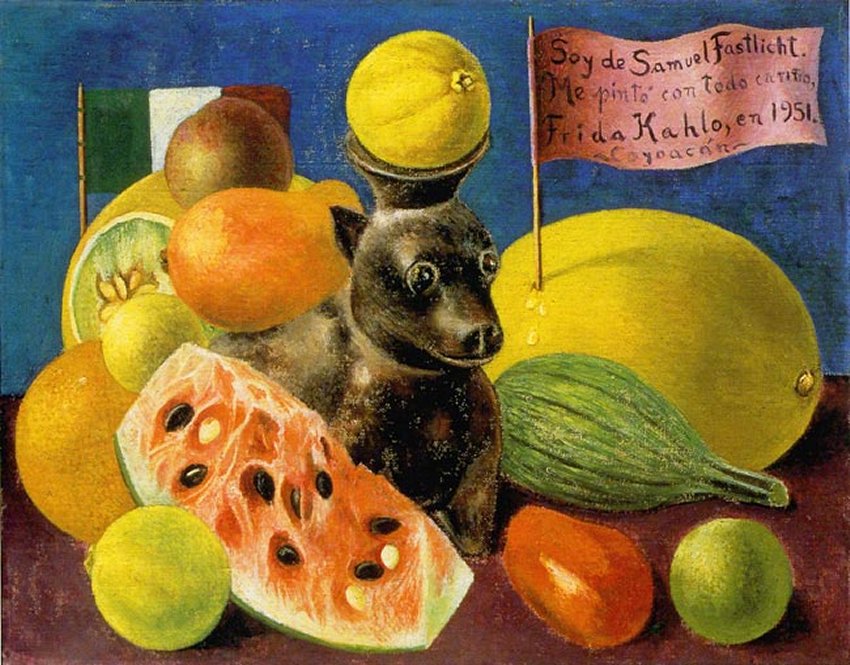 #90
#90
Still life
Beneath its apparent fixity, "Still Life" connects the body, memory and territory. Still life preserves the concrete presence of fruits and plants, while circulating signs of vitality, injury, territory and starting again. Works in recent years alternate between self-portraits, political positions and still lifes, where fruits retain chromatic energy despite the fragility of the body. Dated 1951, the work is documented as "Still Life". The location indicated is: Private collection or location to be verified - institutional resource. The original is not documented in an accessible public collection, the link explicitly leads to a reference museum resource and not to an alleged detention sheet. The image is only used to identify and comment on the work. No certain product is associated with this painting; a click opens the website of the museum or cultural reference institution. This tension explains its lasting presence: the image is quickly recognized, but its relationships of gaze, scale and symbol continue to move.
Image: WikiArt - documentary catalog by Frida Kahlo · Documentary image; rights to be verified with the museum and rights holders. No associated products.
See the museum or institution → #91
#91
Still life with parrot
With "Still Life with a Parrot", Frida Kahlo transforms a particular experience into an immediately memorable image. Still life preserves the concrete presence of fruits and plants, while circulating signs of vitality, injury, territory and starting again. Works in recent years alternate between self-portraits, political positions and still lifes, where fruits retain chromatic energy despite the fragility of the body. Dated 1951, the work is documented as "Still life with parrot". The location indicated is: Private collection or location to be verified - institutional resource. The original is not documented in one an accessible public collection, the link explicitly leads to a reference museum resource and not to an alleged detention sheet. The image and link come from the corresponding sheet in the Alpha Reproduction store. One click allows you to consult the proposed reproduction, its formats and its options. Kahlo does not transform her life into an illustration; she selects the forms capable of holding together intimate experience and pictorial language.
Image: Alpha Reproduction - image of the product sheet · Visual of the reproduction available in the Alpha Reproduction store.
See this reproduction → #92
#92
Still life with parrot and flag
"Still Life with Parrot and Flag" shows the precision with which Frida Kahlo organizes each sign in an often tight space. Still life retains the concrete presence of fruits and plants, while circulating signs of vitality, injury, territory and starting again. Works in recent years alternate between self-portraits, political positions and still lifes, where fruits retain chromatic energy despite the fragility of the body. Dated 1951, the work is documented as "Still Life with Parrot and Flag", where fruits retain chromatic energy despite the fragility of the body. Dated 1951, the work is documented as "Still Life with Parrot and Flag", where fruits retain chromatic energy despite the fragility of the body. Dated 1951, the work is documented as "Still Life with Parrot and Flag", where fruits retain chromatic energy despite the fragility of the body. Dated 1951, the work is documented as "Still Life with Parrot and Flag", where fruits retain chromatic energy despite the fragility of the body. Dated 1951, the work is documented as "Still Life with Parrot and Flag", where fruits retain chromatic energy despite the not being documented in an accessible public collection, the link explicitly leads to a reference museum resource and not to an alleged holding file. The image and link come from the corresponding file in the Alpha Reproduction store. One click allows you to consult the proposed reproduction, its formats and its options.
Image: Alpha Reproduction - image of the product sheet · Visual of the reproduction available in the Alpha Reproduction store.
See this reproduction → #93
#93
Crying Coconut or Coconut Tears
In "Coconut in Tears or Coconut Tears", the eye first encounters a clear image before measuring the autobiographical and historical tensions. Still life preserves the concrete presence of fruits and plants, while circulating signs of vitality, injury, territory and starting again. Works in recent years alternate between self-portraits, political positions and still lifes, where fruits retain chromatic energy despite the fragility of the body. Dated 1951, the work is documented as "Weeping Coconuts or Coconut Tears", where fruits retain chromatic energy despite the fragility of the body. Dated 1951, the work is documented as "Weeping Coconuts or Coconut Tears", where fruits retain chromatic energy despite the fragility of the body. Dated 1951, the work is documented as "Weeping Coconuts or Coconut Tears", where fruits retain chromatic energy despite the fragility of the body. Dated 1951, the work is documented as "Weeping Coconuts or Coconut Tears". The location shown is: Los Angeles County Museum of Art, Los Angeles, United States. The link allows you to continue consulting on the official website of the museum or associated cultural institution. The image and link come from the corresponding file in the Alpha Reproduction store. One click allows you to consult the proposed reproduction, its formats and its options. The work thus remains personal without being reduced to a confidence: its construction allows several reading levels to remain active.
Image: Alpha Reproduction - image of the product sheet · Visual of the reproduction available in the Alpha Reproduction store.
See this reproduction → #94
#94
People's Congress for Peace
The strength of "People's Congress for Peace" comes from the coexistence between concrete detail, frontality and symbolic construction. The composition combines observed elements with a very readable symbolic logic, without separating daily life, memory and collective history. The works of recent years alternate between self-portraits, political positions and still lifes, where the fruits retain chromatic energy despite the fragility of the body. Dated 1952, the work is documented as "Congress of Peoples for Peace". The location indicated is: Private collection or location to be verified - institutional resource. The original is not documented in one an accessible public collection, the link explicitly leads to a reference museum resource and not to an alleged holding sheet. The image and link come from the corresponding sheet in the Alpha Reproduction store. A click allows you to consult the proposed reproduction, its formats and its options. This tension explains its lasting presence: the image is quickly recognized, but its relationships of gaze, scale and symbol continue to move.
Image: Alpha Reproduction - image of the product sheet · Visual of the reproduction available in the Alpha Reproduction store.
See this reproduction → #95
#95
Living nature
Beneath its apparent fixity, "Living Nature" connects the body, memory and territory. Still life preserves the concrete presence of fruits and plants, while circulating signs of vitality, injury, territory and starting again. Works in recent years alternate between self-portraits, political positions and still lifes, where fruits retain chromatic energy despite the fragility of the body. Dated 1952, the work is documented as "Living Nature". The location indicated is: Collection of Maria Félix, Mexico City, Mexico City - institutional resource. The original is not documented in a public collection accessible, the link explicitly leads to a reference museum resource and not to an alleged detention sheet. The image and link come from the corresponding sheet in the Alpha Reproduction store. One click allows you to consult the proposed reproduction, its formats and its options. Kahlo does not transform her life into an illustration; she selects the forms capable of holding together intimate experience and pictorial language.
Image: Alpha Reproduction - image of the product sheet · Visual of the reproduction available in the Alpha Reproduction store.
See this reproduction → #96
#96
Fruit of life
With "Fruit of Life", Frida Kahlo transforms a particular experience into an immediately memorable image. Still life retains the concrete presence of fruits and plants, while circulating signs of vitality, injury, territory and starting again. Works in recent years alternate between self-portraits, political positions and still lifes, where fruits retain chromatic energy despite the fragility of the body. Dated 1953, the work is documented as "Fruit of Life". The location indicated is: Collection of Raquel M. de Espinosa Ulloa, Mexico City, Mexico City - institutional resource. The original not being documented in one an accessible public collection, the link explicitly leads to a reference museum resource and not to an alleged holding file. The image and link come from the corresponding file in the Alpha Reproduction store. One click allows you to consult the proposed reproduction, its formats and its options. The painting therefore invites you to look at relationships rather than an isolated symbol: no detail acts alone in the balance of the painting.
Image: Alpha Reproduction - image of the product sheet · Visual of the reproduction available in the Alpha Reproduction store.
See this reproduction → #97
#97
Still life with watermelons
"Still Life with Watermelons" shows the precision with which Frida Kahlo organizes each sign in an often tight space. Still life retains the concrete presence of fruits and plants, while circulating signs of vitality, injury, territory and starting again. Works from recent years alternate between self-portraits, political positions and still lifes, where fruits retain chromatic energy despite the fragility of the body. Dated 1953, the work is documented as "Still Life with Watermelons", where fruits retain chromatic energy despite the fragility of the body. Dated 1953, the work is documented as "Still Life with Watermelons", where fruits retain chromatic energy despite the fragility of the body. Dated 1953, the work is documented as "Still Life with Watermelons", where fruits retain chromatic energy despite the fragility of the body. Dated 1953, the work is documented as "Still Life with Watermelons". The location indicated is: Museo de Arte Moderno, Mexico City, Mexico City. The link allows you to continue the consultation on the site official of the museum or associated cultural institution. The image and link come from the corresponding file in the Alpha Reproduction store. One click allows you to consult the proposed reproduction, its formats and its options. The work thus remains personal without being reduced to a confidence: its construction allows several reading levels to remain active.
Image: Alpha Reproduction - image of the product sheet · Visual of the reproduction available in the Alpha Reproduction store.
See this reproduction → #98
#98
Self-portrait with the portrait of Diego on the chest and Maria between the eyebrows
In "Self-portrait with the portrait of Diego on the chest and Maria between the eyebrows", the gaze first encounters a clear image before measuring the autobiographical and historical tensions. The face is not only a model: it becomes a constructed space where clothing, hairstyle, animals and attributes organize a deliberately staged identity. Works in recent years alternate between self-portraits, political positions and still lifes, where fruits retain chromatic energy despite the fragility of the body. Dated 1954, the work is documented as "Self Portrait with a Portrait of Diego on the Breast and Maria Between the Eyebrows". location indicated is: Private Collection, California, United States - institutional resource. As the original is not documented in an accessible public collection, the link explicitly leads to a reference museum resource and not to an alleged holding file. The image and link come from the corresponding file in the Alpha Reproduction store. One click allows you to consult the proposed reproduction, its formats and its options.
Image: Alpha Reproduction - image of the product sheet · Visual of the reproduction available in the Alpha Reproduction store.
See this reproduction → #99
#99
Self-portrait with Stalin
The strength of "Self-portrait with Stalin" comes from the coexistence between concrete detail, frontality and symbolic construction. The face is not only a model: it becomes a constructed space where clothing, hairstyle, animals and attributes organize a deliberately staged identity. Works in recent years alternate between self-portraits, political positions and still lifes, where fruits retain chromatic energy despite the fragility of the body. Dated 1954, the work is documented as "Self Portrait with Stalin". Dated 1954, the work is documented as "Self Portrait with Stalin". The location indicated is: Frida Kahlo Museum, Coyoacân, Mexico. The location indicated is: Frida Kahlo Museum, Coyoacân, Mexico. The location indicated is: Frida Kahlo Museum, Coyoacân, Mexico. The location indicated is: Frida Kahlo Museum, Coyoacân, Mexico. The link allows you to continue the consultation on the official website of museum or associated cultural institution. The image and link come from the corresponding file in the Alpha Reproduction store. One click allows you to consult the proposed reproduction, its formats and its options. Kahlo does not transform her life into an illustration; she selects the forms capable of holding together intimate experience and pictorial language.
Image: Alpha Reproduction - image of the product sheet · Visual of the reproduction available in the Alpha Reproduction store.
See this reproduction → #100
#100
Still life with the flag
Beneath its apparent fixity, "Still Life with the Flag" connects the body, memory and territory. Still life preserves the concrete presence of fruits and plants, while circulating signs of vitality, injury, territory and starting again. Works from recent years alternate between self-portraits, political positions and still lifes, where fruits retain chromatic energy despite the fragility of the body. Dated 1954, the work is documented as "Still Life with Flag", where fruits retain chromatic energy despite the fragility of the body. Dated 1954, the work is documented as "Still Life with Flag". The location indicated is: Frida Kahlo Museum, Coyoacân, Mexico. The location indicated is: Frida Kahlo Museum, Coyoacân, Mexico. The location indicated is: Frida Kahlo Museum, Coyoacân, Mexico. The location indicated is: Frida Kahlo Museum, Coyoacân, Mexico. The location indicated is: Frida Kahlo Museum, Coyoacân, Mexico. The location indicated is: Frida Kahlo Museum, Coyoacân, Mexico. The location indicated is associated cultural. The image and link come from the corresponding file in the Alpha Reproduction store. One click allows you to consult the proposed reproduction, its formats and its options. The painting therefore invites us to look at relationships rather than an isolated symbol: no detail acts alone in the balance of the painting.
Image: Alpha Reproduction - image of the product sheet · Visual of the reproduction available in the Alpha Reproduction store.
See this reproduction →What the journey reveals
Three gestures at the heart of the work
Kahlo frames, associates and repeats until the experience and the painting hold together.
Look at yourself
The self-portrait is not a passive mirror: it creates a presence and controls how it will be seen.
Connect
Ribbons, roots, veins and gazes connect the body, loved ones, animals and the landscape.
Hold
The sharpness of the drawing gives a stable form to what, in experience, remains painful or contradictory.
One life, five benchmarks
Follow Frida Kahlo
Magdalena Carmen Frida Kahlo Calderon grew up in Casa Azul, south of Mexico City.
A serious bus accident requires a long convalescence during which painting takes a central place.
Their emotional and artistic relationship, crossed by separations and reunions, nourishes several major works.
The double self-portrait becomes a monumental synthesis of identity, rupture and vital circulation.
Shortly before his death, red watermelons maintained in the painting an affirmation of life that had become legendary.
Kahlo in depth
From intimate face to collective history
The body is Kahlo's first territory. Immobilized, cared for, operated on or dressed, it is never only biological: it carries a family, social and political history.
His self-portraits do not repeat a stable identity. Hairstyles, jewelry, animals and costumes modify the figure, while the frontal gaze maintains a direct relationship with the viewer.
Mexico appears in clothing, plants, pre-Columbian objects and the shape of the retablo. These elements do not decorate the image; they inscribe personal experience in a chosen culture.
Kahlo often employs a simple perspective and precise contours. This clarity makes credible the impossible connections between anatomy, landscape, machine, root or memory.
The relationship with Diego Rivera runs through the work, but it does not provide a single key. Kahlo organizes desire, addiction, anger and separation as distinct visual forces.
The latest still lifes move the self-portrait towards the fruits. Cut, ripe or arranged frontally, they maintain color and vitality when the artist's body becomes more fragile.
Four reading keys
How to watch Frida Kahlo
Start with the relationships between the signs, then check the context without reducing the table to the biography.
Observe frontality
The painted gaze fixes the viewer's place and stabilizes a composition often crossed by tensions.
Track connections
Threads, veins, roots and ribbons indicate what unites or separates the figures.
Name before interpreting
A plant, costume or medical tool first has a concrete presence before becoming a symbol.
Expand biography
Mexican history, gender and politics are as essential as episodes of privacy.
Works, shop and institutions
Continue after the hundredth painting
Images and buttons primarily open the files of the Alpha Reproduction store. Works without a certain product refer to a reference museum resource.
Frequently asked questions
Frida Kahlo, between self-portrait and history
Essential benchmarks on works, museums, private collections and image rights.
What is Frida Kahlo's most famous painting?
The Two Fridas, painted in 1939 and kept at the Museo de Arte Moderno in Mexico City, is often considered his most famous painting. The Broken Column and the Self-Portrait with the Thorn Collar have also become iconic images.
Why did Frida Kahlo paint so many self-portraits?
The self-portrait offers him a model that is always available, but above all a space to build his identity. Each version changes clothes, animals, wounds, hairstyles or objects that frame the face.
Was Frida Kahlo surreal?
André Breton associated it with surrealism, but Kahlo refused to present his paintings as dreams. She claimed to paint her reality, even when her images bring together impossible elements.
Where to see Frida Kahlo's main paintings?
The Museo Frida Kahlo, the Museo Dolores Olmedo and the Museo de Arte Moderno in Mexico City preserve major ensembles or works. The MoMA, SFMOMA, Phoenix Art Museum, Center Pompidou and National Museum of Women in the Arts also present them.
Why do some links not correspond to a holding museum?
Several works belong to private collections or have an uncertain location. In these cases, the article says so explicitly and redirects to a reference museum resource on Frida Kahlo, without falsely attributing the original to the museum.
Are Frida Kahlo's images royalty free?
No. Works and their reproductions remain protected in many countries. The images in this article are used for information and documentary consultation; the conditions of use must be verified with institutions and rights holders.
Does Alpha Reproduction offer reproductions of these paintings?
A reproduction is offered when the card links to an Alpha Reproduction product sheet. When no certain correspondence is available, the link leads to a museum or cultural reference institution.
How is this selection of 100 works organized?
The most famous images open the route. The following works are grouped into four chapters: invention of the self-portrait, story of the body, animals and symbols, then late works and still lifes.
0 comments