Haarlem, Amsterdam and Van Coninxloo
The Flemish landscape tradition provides the vocabulary that Seghers will transform. This milestone sheds light on the "Hercules Seghers" collection by favoring figures.
Around 1589/90 -1633/40 · Visionary landscape and experimental print
Discover the rocky landscapes and experimental prints of Hercules Seghers, hand-reproduced in oil on canvas.

Around 1589/90 -1633/40 · Visionary landscape and experimental print
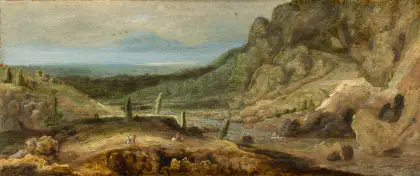
Probably born in Haarlem around 1589 or 1590 into a family from Ghent, Hercules Seghers learned painting in Amsterdam from the Flemish landscaper Gillis van Coninxloo. Received at the guild of Saint Luke of Haarlem in 1612, he quickly returned to Amsterdam, where in 1619 he bought a large house on the Lindengracht. His paintings and engravings deviate deeply from the descriptive Dutch landscape. His paintings and engravings deviate profoundly from the descriptive Dutch landscape. His paintings and engravings deviate deeply from the descriptive Dutch landscape. Steep mountains, deserted valleys, isolated trees and distant architecture make up spaces that seem both observed and impossible. Seghers experiments especially with etching: colored prepared papers, textile prints, varied inks, brush highlights and drypoint retouching makes each print almost unique. The Rijksmuseum today lists 182 known prints taken from 53 plates, a rarity which measures both the fragility of the work and its audacity. His financial situation deteriorated at the end of the 1620s; he left Amsterdam for Utrecht then The Hague, where the last documentary traces date from 1633. Rembrandt owned several of his works, took one of his plates and clearly admired his freedom. Died on an unknown date between 1633 and 1640, Seghers appeared today as one of the most modern experimenters of the 17th century. The "Hercules Seghers" selection offers its own journey on this subject. His reading favors figures.
Seghers prints less a place than a possibility: same plate, other paper, other color, and the landscape begins again like a new world.
Course & style
Probably born in Haarlem around 1589 or 1590 into a family from Ghent, Hercules Seghers learned painting in Amsterdam from the Flemish landscaper Gillis van Coninxloo. Received at the guild of Saint Luke of Haarlem in 1612, he quickly returned to Amsterdam, where in 1619 he bought a large house on the Lindengracht. His paintings and engravings deviate deeply from the descriptive Dutch landscape. His paintings and engravings deviate profoundly from the descriptive Dutch landscape. His paintings and engravings deviate deeply from the descriptive Dutch landscape. Steep mountains, deserted valleys, isolated trees and distant architecture make up spaces that seem both observed and impossible. Seghers experiments especially with etching: colored prepared papers, textile prints, varied inks, brush highlights and drypoint retouching makes each print almost unique. The Rijksmuseum today lists 182 known prints taken from 53 plates, a rarity which measures both the fragility of the work and its audacity. His financial situation deteriorated at the end of the 1620s; he left Amsterdam for Utrecht then The Hague, where the last documentary traces date from 1633. Rembrandt owned several of his works, took one of his plates and clearly admired his freedom. Died on an unknown date between 1633 and 1640, Seghers appeared today as one of the most modern experimenters of the 17th century.
The Flemish landscape tradition provides the vocabulary that Seghers will transform. This milestone sheds light on the "Hercules Seghers" collection by favoring figures.
Plates, supports and colors produce deliberately different prints.
Utrecht, The Hague then the silence of the archives precede Rembrandt's admiration.
Cliffs and mountains fragment space into strange and silent masses. This line guides a reading of "Hercules Seghers" centered on the figures.
Inks and foundations vary the time, season and material of the same pattern.
Each print receives alterations and accidents which give it an individual character.
A tiny walker measures the immensity of an almost unreal territory.
Explore by universe
Works, visual language and historical landmarks make up a route exclusively devoted to Hercules Seghers.
River, road and mountains open a journey without a certain destination.
For space. Reading "Hercules Seghers" by the figures.The imaginary relief brings together observations, memories and engraved motifs.
For dizzinessGnarled trunk and branches become the protagonists of the landscape.
For silenceTwo prints of the same plate may appear to be two different works.
To understandCollection and reuse of a plaque demonstrate exceptional admiration.
For historyA medium horizontal retains the amplitude of rocks and distances.
To chooseWorks to discover
The associated reproductions will appear here as soon as they are put online in this new collection.
Our method
Each painting is made in oil on canvas by a specialized artist, then checked with you before shipping.
Each reproduction is unique. Slight variations of touch and material testify to the painter's manual work.
Choose wisely
Hercules Seghers' subjects and tones call for a format, place and framing chosen for the precise work.
Frequently asked questions
Yes. Each reproduction is hand painted in oil on canvas, without printing.
The painter uses the composition, values, colors and materials visible in the chosen work from the Hercules Seghers collection, with particular attention paid to the figures.
Yes. The dimensions are adapted respecting the proportions and balance of the selected work.
Detailed photographs are sent before shipping; you can request edits before sending.
reproduction custom
Send us an image, a museum reference or the name of a work: we can make one reproduction personalized.
Buying guide
From your choice to delivery, you stay in control thanks to photo validation and included retouching.
Select the painting and the dimensions suitable for your interior.
Your reproduction is made by hand, in painting at oil on canvas.
You receive a photo and can request up to 7 sets of edits.
After validation, it is protected, rolled and sent with FedEx tracking.
Advice & guarantees
Simple answers on the painting by hand, formats, alterations and delivery of your reproduction.
The essential points before choosing your reproduction.
Yes. Every reproduction is made by hand in painting at theoil on canvas by an experienced artist. This is neither a print nor a printed canvas.
Yes. Before shipping, we send you a detailed photo of the canvas. Up to 7 sets of edits are included to adjust the rendering before your validation.
The estimated date is displayed near the buy button. It includes the time of painting, your photo validation then FedEx tracked delivery.
Yes, you can choose a standard format or ask us for a custom size to suit your space.
Depending on the options available, the canvas can be delivered alone, mounted on a frame or prepared for framing. Details are shown on the product page.
Yes. You can send us an image, museum reference, name of a work or photo to request one reproduction personalized.
Some useful guidelines for choosing a work, its format and the location that will best highlight it.
This selection brings together works designed for art lovers who want to rediscover the spirit of one painting famous in a hand painted canvas. Each reproduction can be adapted to the desired format and validated in photos before shipment.
The available formats allow the work to be adapted to a more specific living room, bedroom, office or decorative project. There painting is carried out at theoil on canvas with particular attention to colors, textures and general balance.
If you are looking for a similar work, a similar artist or a specific format, you can ask for advice. Reproductions can be adjusted before sending using photo validation.