
Haarlem and landscape training
Dutch visual culture prepares the spatial structure that Post will transport to the tropics. This milestone sheds light on the "Frans Post" collection by favoring composition.
1612 -1680 · Dutch landscape and colonial Brazil
Discover Frans Post, hand reproduced in oil on canvas.

1612 -1680 · Dutch landscape and colonial Brazil
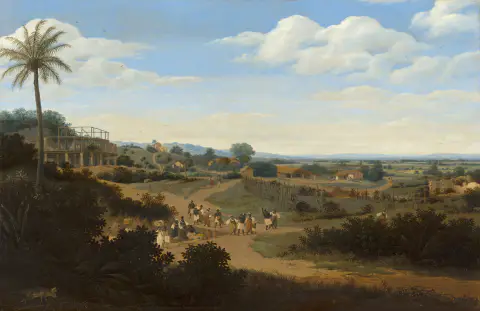
Frans Jansz Post was born in Haarlem in 1612. In 1637, he accompanied Johan Maurits from Nassau-Siegen to Brazil as part of the administration of the Dutch West India Company. For seven years, he observed and drew the northeastern coastline, its forts, its plantations, its churches, its reliefs, its vegetation, its animals and the populations subject to the colonial order. The few paintings executed on site adopted relatively direct topographical observation. Returning to Haarlem in 1644, Post transformed his studies into a vast cycle of landscapes intended for the Dutch market. Returning to Haarlem in 1644, Post transformed his studies into a vast cycle of landscapes intended for the Dutch market. Returning to Haarlem in 1644, Post transformed his studies into a vast cycle of landscapes intended for the Dutch market. Returning to Haarlem in 1644, Post transformed his studies into a vast cycle of landscapes intended for the Dutch market. Returning to Haarlem in 1644, Post transformed his studies into a vast cycle of landscapes intended for the Dutch market. Returning to Haarlem in bright, low horizon and immense sky - with palm trees, cacti, capivaras, anteaters, snakes and Brazilian buildings. Late works become more imaginative and decorative, bringing together in the same view motifs observed in different places. The Rio Sao Francisco and Fort Maurice combine geography, military architecture and exotic animals. The mills, ox carts and planters' homes also document a sugar economy based on slavery, a reality that the ordered beauty of the compositions should not mask. Post died in Haarlem in 1680. His known corpus includes 155 paintings, 57 drawings and 35 engravings, an exceptional ensemble in the history of european representations of Brazil. The "Frans Post" selection notably compares A Brazilian landscape and The Rio Sao Francisco and Fort Maurice. His reading favors composition.
Post grafts Brazil onto the space of the Dutch landscape: under a familiar sky, each plant, animal and building shifts the gaze.
Course & style
Frans Jansz Post was born in Haarlem in 1612. In 1637, he accompanied Johan Maurits from Nassau-Siegen to Brazil as part of the administration of the Dutch West India Company. For seven years, he observed and drew the northeastern coastline, its forts, its plantations, its churches, its reliefs, its vegetation, its animals and the populations subject to the colonial order. The few paintings executed on site adopted relatively direct topographical observation. Returning to Haarlem in 1644, Post transformed his studies into a vast cycle of landscapes intended for the Dutch market. Returning to Haarlem in 1644, Post transformed his studies into a vast cycle of landscapes intended for the Dutch market. Returning to Haarlem in 1644, Post transformed his studies into a vast cycle of landscapes intended for the Dutch market. Returning to Haarlem in 1644, Post transformed his studies into a vast cycle of landscapes intended for the Dutch market. Returning to Haarlem in 1644, Post transformed his studies into a vast cycle of landscapes intended for the Dutch market. Returning to Haarlem in bright, low horizon and immense sky - with palm trees, cacti, capivaras, anteaters, snakes and Brazilian buildings. Late works become more imaginative and decorative, bringing together in the same view motifs observed in different places. The Rio Sao Francisco and Fort Maurice combine geography, military architecture and exotic animals. The mills, ox carts and planters' homes also document a sugar economy based on slavery, a reality that the ordered beauty of the compositions should not mask. Post died in Haarlem in 1680. His known corpus includes 155 paintings, 57 drawings and 35 engravings, an exceptional ensemble in the history of european representations of Brazil.
Dutch visual culture prepares the spatial structure that Post will transport to the tropics. This milestone sheds light on the "Frans Post" collection by favoring composition.
Drawings and paintings observe forts, plantations, reliefs, plants, animals and colonial society.
On-site studies and landscape conventions combine into increasingly imaginative views.
A low horizon and an extended sky give breadth to the earth, forts and silhouettes. This line guides a reading of "Frans Post" centered on composition.
Palm trees, cacti and exotic animals mark the place without disrupting the balance of the Dutch landscape.
Fort, church, mill or residence structure the distance and place the territory in colonial history.
After 1644, separately observed patterns were recomposed into coherent but not strictly topographical images.
Explore by universe
Works, visual language and historical landmarks make up a journey exclusively devoted to Frans Post.
Sky, vegetation and habitat make up a broad image where Brazilian land becomes the real subject.
Landmark work by Frans Post. Reading of "Frans Post" through composition.The capivara in the foreground, the river and the fortification combine natural observation and colonial geography.
Landmark work by Frans PostThe movement of the tank measures the extent of the landscape and recalls the human activities which organize the territory.
Landmark work by Frans PostThe large tropical tree opens up the depth and transforms a botanical motif into a monumental threshold of the landscape.
Landmark work by Frans PostA low horizon and an extended sky give breadth to the earth, forts and silhouettes. This line guides a reading of "Frans Post" centered on composition.
Reading key for Frans PostPalm trees, cacti and exotic animals mark the place without disrupting the balance of the Dutch landscape.
Reading key for Frans PostWorks to discover
Each card refers directly to its reproduction available on Shopify.


Our method
Each painting is made in oil on canvas by a specialized artist, then checked with you before shipping.
Each reproduction is unique. Slight variations of touch and material testify to the painter's manual work.
Choose wisely
Frans Post's subjects and tones call for a format, place and framing chosen for the precise work.
Frequently asked questions
Yes. Each reproduction is hand painted in oil on canvas, without printing.
The painter uses the composition, values, colors and materials visible in the chosen work from the Frans Post collection, with particular attention paid to composition.
Yes. The dimensions are adapted respecting the proportions and balance of the selected work.
Detailed photographs are sent before shipping; you can request edits before sending.


reproduction custom
Send us an image, a museum reference or the name of a work: we can make one reproduction personalized.
Buying guide
From your choice to delivery, you stay in control thanks to photo validation and included retouching.
Select the painting and the dimensions suitable for your interior.
Your reproduction is made by hand, in painting at oil on canvas.
You receive a photo and can request up to 7 sets of edits.
After validation, it is protected, rolled and sent with FedEx tracking.
Advice & guarantees
Simple answers on the painting by hand, formats, alterations and delivery of your reproduction.
The essential points before choosing your reproduction.
Yes. Every reproduction is made by hand in painting at theoil on canvas by an experienced artist. This is neither a print nor a printed canvas.
Yes. Before shipping, we send you a detailed photo of the canvas. Up to 7 sets of edits are included to adjust the rendering before your validation.
The estimated date is displayed near the buy button. It includes the time of painting, your photo validation then FedEx tracked delivery.
Yes, you can choose a standard format or ask us for a custom size to suit your space.
Depending on the options available, the canvas can be delivered alone, mounted on a frame or prepared for framing. Details are shown on the product page.
Yes. You can send us an image, museum reference, name of a work or photo to request one reproduction personalized.
Some useful guidelines for choosing a work, its format and the location that will best highlight it.
This selection brings together works designed for art lovers who want to rediscover the spirit of one painting famous in a hand painted canvas. Each reproduction can be adapted to the desired format and validated in photos before shipment.
The available formats allow the work to be adapted to a more specific living room, bedroom, office or decorative project. There painting is carried out at theoil on canvas with particular attention to colors, textures and general balance.
If you are looking for a similar work, a similar artist or a specific format, you can ask for advice. Reproductions can be adjusted before sending using photo validation.