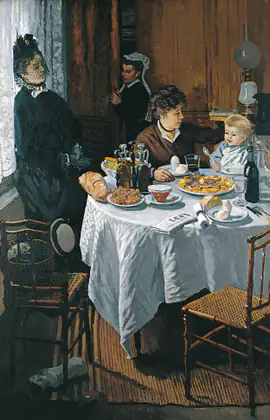
A composition adjusted by the axis of the lamp
The suspension, its tank and the back of the chair in the foreground align vertically. Around this axis, the four figures form an irregular and living circle.

2 · Exemple de la sélection
La photo principale correspond à la couleur de cadre choisie. Chaque couleur est illustrée par une œuvre d’exemple différente.
Préparation de la sélection…
Ces médias montrent uniquement la réalisation, le support, la texture et les finitions. L’œuvre commandée reste celle affichée dans les blocs bleus.
3 · Mise en situation
Reproduction d’art premium
Choisissez le tirage Fine Art, le canvas imprimé, la peinture à l’huile ou la version numérique.
Trois fichiers JPG haute résolution : le fichier original, une version optimisée pour l’impression et une version optimisée pour les écrans. Jusqu’à 7 680 px sur le côté long, 300 DPI et sans filigrane.
Imprimez l’œuvre chez vous ou auprès de l’imprimeur de votre choix, ou utilisez la version écran sur ordinateur, tablette et téléphone.
Produit numérique uniquement : aucun tableau ni cadre physique n’est expédié.
Après votre commande, les trois fichiers sont contrôlés puis envoyés manuellement par e-mail.
Comprendre les formats
Claude Monet · A family table lit by a hanging lamp · EG Bührle Collection
Four people gather around a round table covered with a white tablecloth. A hanging lamp, placed exactly above the meal, focuses the light on faces, dishes and hands; all around, the room sinks into browns. This rare interior scene shows Monet attentive to nocturnal contrasts before his major outdoor research.

Look at the work
The pendant light descends in line with the canvas and its white lampshade directly illuminates the table. A child sits on the left, two figures face the viewer and a man seen from behind closes the foreground. The circular arrangement brings the bodies together around the light.
On the right, the fireplace brings a second orange warmth to the parquet floor and the coat. A carafe, plates and a few dishes punctuate the tablecloth; on the shelf, gray vases remain almost absorbed by the wall. The left background remains much darker.
The tablecloth and the lamp draw two very different whites: one collects the figures, the other suspends the light source above them.
Composition, touch and light
Three precise elements allow us to understand this composition and the essential difficulties of faithful reproduction.
The suspension, its tank and the back of the chair in the foreground align vertically. Around this axis, the four figures form an irregular and living circle.
The lamp produces yellow whites on the table and faces. The fireplace adds deeper oranges to the right, while the corners of the room remain almost black browns.
Monet uses some warm tones and shadows to indicate features. The readability of the scene comes more from attitudes, hands and direction of gaze than from portrait detail.
Reference image
The image corresponds to inventory 75 of the EG Bührle Collection Foundation, Wildenstein version 129. The file of 2,347 × 1,800 px has been kept at its native definition and encoded in WebP.
Its lampshade and globe dominate without being uniformly white; yellows, grays and small black accents define its structure.
Its dark mass and the back of the chair close the table. It should not completely merge with the bottom.
Cream white, gray green and yellow juxtapose. The dishes and hands emerge through small differences rather than strong contours.
Documented benchmarks
Painted in 1868 -1869, this painting of 50 × 65 cm is kept by the EG Bührle Collection Foundation under inventory 75 and classified Wildenstein 129.
The Wildenstein catalog lists the work under number 129. Its secondary name recalls the identification traditionally associated with the family group represented around the table.
Durand-Ruel acquired the painting directly from the artist in February 1873. It then went through several collections before its acquisition by Emil Bührle in 1944.
The heirs of Emil Bührle donated the work to the foundation in 1960. The collection notice confirms the date 1868 -1869, the dimensions, the signature at the bottom left and the Wildenstein number 129.
Your reproduction
Fidelity here depends on precise relationships between light, touch, depth and color temperature.
| Title | Dinner, known as The Sisley Family, W129 |
|---|---|
| Artist | Claude Monet (1840 -1926) |
| Date | 1868 - 1869 |
| Original technique | Oil on canvas |
| Dimensions | 50 × 65 cm |
| Orientation | Horizontal |
| Conservation | EG Bührle Collection Foundation, Zurich, Switzerland |
| Inventory | 75 · Wildenstein 129 |
| Your reproduction | Handmade oil painting on canvas |
Presentation in your interior
This intimate scene is suitable for a cozy dining room, library or living room. A walnut, weathered black or mahogany brown frame prolongs the darkness and brings out the luminous tablecloth.

Impression d’art sur papier mat Hahnemühle German Etching 310 g, au grain fin. Un rendu précis, élégant et plus accessible, idéal pour les détails et les nuances.

Impression sur toile d’artiste 400 g. Sa texture donne davantage de relief et un aspect tableau, avec plusieurs présentations adaptées au décor.

Reproduction peinte entièrement à la main sur commande. Chaque toile est une pièce unique : ce n’est ni une impression numérique ni un poster sur toile.
Explore the topics and styles associated with this reproduction.
Compare the finishes
Compare paper prints, printed canvas, hand-painted oil and digital files. The physical examples illustrate each finish; your order uses the artwork selected above.


A pigment print on Hahnemühle German Etching 310 gsm paper. Its matte, finely textured surface brings out detail and subtle colour. This is a print, not a hand-painted canvas.
Choose this option if you want to arrange your own framing.
A pigment print on Hahnemühle German Etching 310 gsm paper. Its matte, finely textured surface brings out detail and subtle colour. This is a print, not a hand-painted canvas.
A slim, traditional frame that keeps attention on the artwork.
A pigment print on Hahnemühle German Etching 310 gsm paper. Its matte, finely textured surface brings out detail and subtle colour. This is a print, not a hand-painted canvas.
Choose a Box frame for a deeper profile and a more pronounced presence on the wall.


Your artwork printed on 400 gsm artist canvas. The woven texture adds depth, with a choice of rolled, stretched or floating-frame presentation. This is a print, not an oil painting.
A framed canvas with visible depth. Choose the frame colour and canvas edge in the configurator.
Your artwork printed on 400 gsm artist canvas. The woven texture adds depth, with a choice of rolled, stretched or floating-frame presentation. This is a print, not an oil painting.
Not ready to hang: have it stretched or framed locally before displaying it.
Your artwork printed on 400 gsm artist canvas. The woven texture adds depth, with a choice of rolled, stretched or floating-frame presentation. This is a print, not an oil painting.
A clean, frameless canvas presentation. Choose the canvas edge finish in the configurator.


An artist recreates your chosen artwork by hand in oil paint on canvas. Brushwork and small variations make each reproduction individual; it is not a digital print.
Your painting is delivered rolled. Arrange stretching or framing locally after receipt.
An artist recreates your chosen artwork by hand in oil paint on canvas. Brushwork and small variations make each reproduction individual; it is not a digital print.
Choose your own local framer to prepare the finished painting for display.
Your selected artwork

Preview only. Your three files are prepared after purchase.
Files only · no physical delivery
Receive your selected artwork as three high-resolution JPG files, prepared to suit its orientation. Use them for printing or displaying the artwork on a screen.
Choose digital if you want to organise your own printing or use the artwork on a screen.
Same artist
Continuez avec des œuvres connues du même artiste, sélectionnées pour comparer les sujets, les formats et les ambiances sans mélanger avec les styles génériques.