1
You choose the size
Select the desired size before ordering.


Reproduction sur toile
Le format s'adapte automatiquement au tableau original.
Peinture à l'huile sur toile roulée, sans cadre. Taille personnalisée sur demande.
Explore the subjects and styles associated with this reproduction.
Artwork description
Italian Renaissance · Legendary portrait
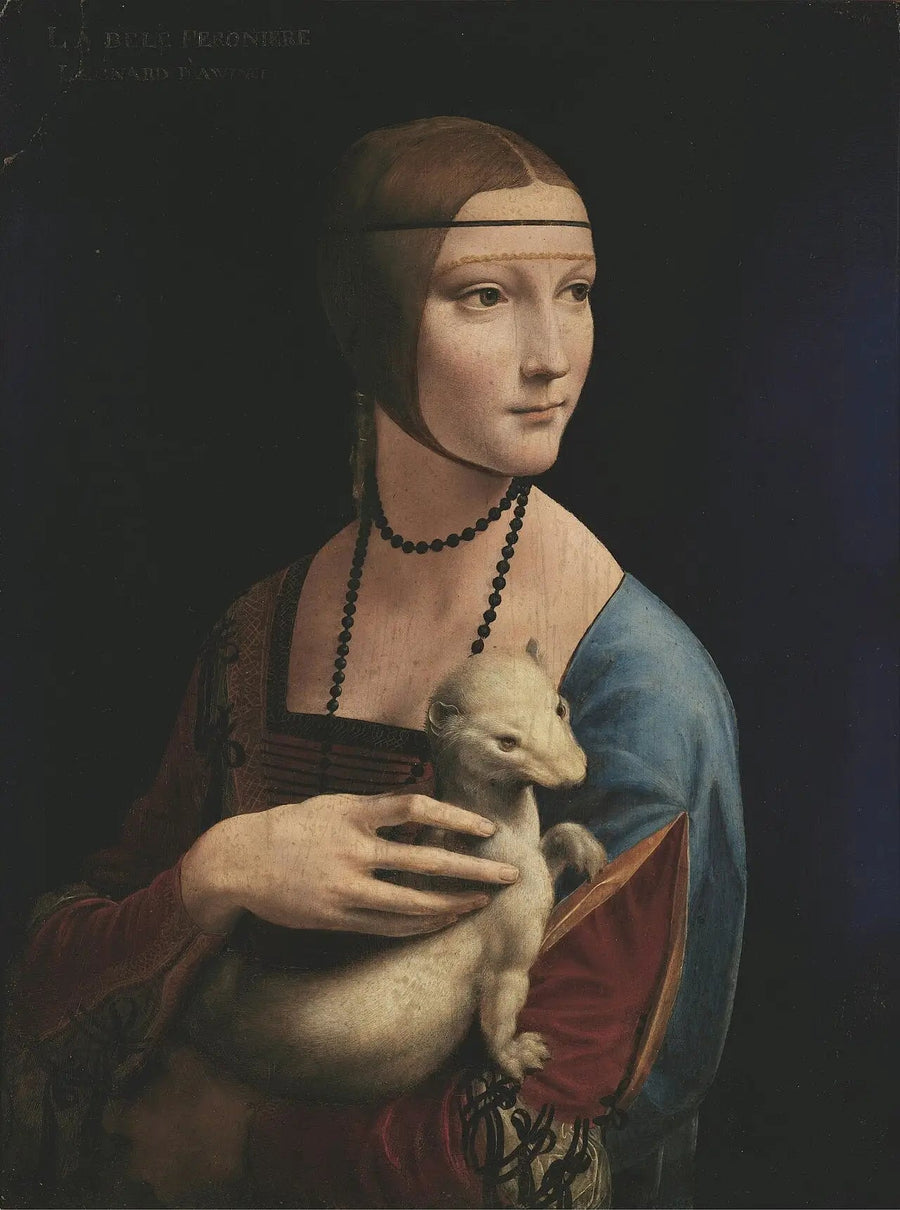
The most admired female portrait of the Italian Renaissance, translated into an oil-on-canvas reproduction with its original craquelure, earthy palette, and misty landscape.

Key references
Half-length portrait of a woman, shown in three-quarter view, hands crossed, with a serene expression and direct gaze.
Hand-painted oil on canvas reproduction, with glazes, impasto, and a network of craquelure.
Leonardo da Vinci, a leading figure of the Italian Renaissance, the Louvre, Paris.
Composition
The painting presents a half-length portrait of a seated woman, turned in three-quarter view toward the viewer. Her right hand rests with great delicacy on the left wrist, the two crossed hands forming a stable, hieratic foreground that anchors the figure in space. The face, lit by a light from the left, displays a peaceful expression and a gaze that seems to follow the observer.
The subject wears a dark dress with fine folds, drawn close to the bust and held by a draped fabric falling over the left shoulder. A transparent veil, barely denser than a shadow, covers the hair and adds a vibration of matter between the flesh and the background. The complexion, built up in successive glazes, stands out with extreme softness against the dress, giving the face that velvety presence that has made the work so renowned.
In the background opens a mountain landscape with winding paths, animated by a small bridge and crossed by streams that recede toward the horizon. The successive planes lose sharpness with distance, crossed by milky blues and deep greens where the outlines fade. The overall palette plays on earthy tones, warm ochres, and misty grays, traversed by a dense network of craquelure that marks the age of the original model and gives the reproduction all its depth of material.
Context
The Mona Lisa is the most famous work of Leonardo da Vinci, a central figure of the Italian Renaissance — a painter, engineer, and theorist whose research influenced all of Western art. The painting is said to have been started in Italy, then worked on for a long time and finally brought to France, according to testimonies passed down by ancient sources in art history. The renown of the work lies as much in the subtlety of its execution as in the legendary aura surrounding its model and the personality of its author.
The painting belongs to the French national collections and has endured through the centuries while retaining an intact power of attraction. Stolen at the end of the 19th century, found beyond the Alps, exhibited since under exceptional security conditions, it has become an object of popular fascination — reproduced, commented upon, diverted, and cited in countless works. Its presence in the collections of the Louvre makes it an essential reference for understanding the Italian Renaissance and the evolution of the portrait in Europe.
Choosing an oil reproduction of the Mona Lisa means bringing into your home one of the most analyzed images in the history of art, a painting that has nourished five centuries of commentary, myths, and interpretations.
Manner of painting
Leonardo da Vinci's work rests on a rigorous science of light and modeling. In the Mona Lisa, the transitions between shadow and clarity never occur in abrupt steps: the volumes of the face, neck, and hands are built up through almost imperceptible gradients, where the contours seem to dissolve into the surrounding flesh. This work of sfumato, achieved through layers of extremely fine glazes, gives the figure a presence that is both precise and elusive — a technique that has set the standard.
The background landscape follows the same logic. The successive planes lose sharpness with distance, the blues become milky, the greens darken, and forms fade as if seen through a light mist. This atmospheric perspective is one of the great technical innovations of the Italian Renaissance, and Leonardo pushes it here to a degree of refinement that makes the background almost more suggestive than descriptive.
The brushwork, everywhere, remains even, with no visible impasto, except for the highlights on the lips, the corners of the eyes, and the roots of the hair. It is this alliance between an almost invisible material and an intense psychological presence that makes the painting a unique case study in the history of the portrait.
Decorative interest
An oil reproduction of the Mona Lisa quickly becomes the focal point of a room: the direct gaze and enigmatic expression of the subject capture attention as soon as you enter. In a living room, above a low sofa or a console, it imposes a cultivated, almost museum-like presence that will dialogue with bookshelves, woodwork, or noble materials such as velvet and aged leather.
It also lends itself well to an office, a spacious entryway, or a wide hallway — rooms where the horizontal format of the portrait naturally finds its place. The earthy, misty tones of the painting blend with neutral palettes — off-white, beige, warm gray, taupe, terracotta — and stand out against walls painted in muted shades better than against overly saturated colors.
To make the oil material vibrate and reveal the craquelure of the subject, plan for grazing light slightly off-axis: a side sconce or a spotlight placed at thirty degrees from the painting brings out the relief of the impasto. On the other hand, avoid placing it in a room with direct sunlight — harsh light flattens the depth of the glazes and shadows.
Reproduction
Our studio reproduces the Mona Lisa in oil on canvas, through successive layers that seek to recapture the visual density of the original model. The face, hands, and dress receive modeling built up in fine glazes, while the background landscape keeps a freer touch, in flat areas and slightly blurred scumbling.
The characteristics of the source painting are found in the pictorial material: a natural network of craquelure across the surface, soft transitions between flesh and fabric, the bluish depth of the distant mountains. The edges of the brush remain perceptible in the highlights, and the relief of the impasto gives the canvas a true grain that only oil painting can offer.
The reproduction is delivered rolled, without stretcher bars or frame, to give you the freedom to present it according to your decorative project. Once unrolled and installed, it retains the living texture of an oil painting, with its contrasts, transparencies, and the warmth of its ochres and earth tones.
The reproduction is made on canvas and shipped rolled, without a frame, to facilitate transport and final installation.
Practical questions
The Mona Lisa is above all a secular portrait, that of a woman represented in half-length. Leonardo da Vinci also tackled major religious subjects during his career, but this painting belongs to the tradition of the Italian Renaissance portrait, and not to a sacred commission.
The reproduction is delivered rolled, without frame or stretcher bars, to let you choose its presentation. Once mounted on the support of your choice, it retains the grain, the craquelure, and the depth of an authentic oil painting.
Each reproduction is hand-painted in successive stages: undercoat, modeling, glazes, highlights, drying between layers. The lead time varies depending on the size chosen and the studio's workload, and will be confirmed after your order.
Avoid direct sunlight, damp rooms, and impacts. Gentle dusting with a soft brush is enough, always working in the direction of the brushstroke. Never use any liquid product on the painted surface.
Yes, the portrait is immediately identifiable: three-quarter pose, crossed hands, dark veil, direct gaze, misty landscape in the background. These elements constitute the visual signature of the work and are found in full in the reproduction.
Final word
An oil reproduction of the Mona Lisa is not a simple wall decoration: it is the presence of a pinnacle of the Italian Renaissance, with its material, its modeling, and its gaze. To be installed in a place where you enjoy pausing.


Custom order
A simple and reassuring process, from selecting the size to the tracked delivery of your canvas.
Select the desired size before ordering.
Your reproduction is hand-painted entirely in oil.
We send you a photo to validate the result before shipping.
You receive your canvas rolled, protected, and shipped with tracking.
Same artist
Continuez avec des œuvres connues du même artiste, sélectionnées pour comparer les sujets, les formats et les ambiances sans mélanger avec les styles génériques.