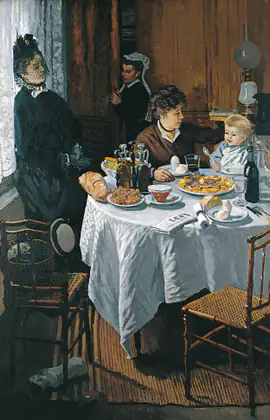
The version given by Monet in Le Havre
In 1910, the artist offered this painting to his hometown. This direct gift, now kept at MuMa, combines one of his most innovative motifs with Monet's Le Havre history.

2 · Exemple de la sélection
La photo principale correspond à la couleur de cadre choisie. Chaque couleur est illustrée par une œuvre d’exemple différente.
Préparation de la sélection…
Ces médias montrent uniquement la réalisation, le support, la texture et les finitions. L’œuvre commandée reste celle affichée dans les blocs bleus.
3 · Mise en situation
Reproduction d’art premium
Choisissez le tirage Fine Art, le canvas imprimé, la peinture à l’huile ou la version numérique.
Trois fichiers JPG haute résolution : le fichier original, une version optimisée pour l’impression et une version optimisée pour les écrans. Jusqu’à 7 680 px sur le côté long, 300 DPI et sans filigrane.
Imprimez l’œuvre chez vous ou auprès de l’imprimeur de votre choix, ou utilisez la version écran sur ordinateur, tablette et téléphone.
Produit numérique uniquement : aucun tableau ni cadre physique n’est expédié.
Après votre commande, les trois fichiers sont contrôlés puis envoyés manuellement par e-mail.
Comprendre les formats
Claude Monet · 1904 · donation of 1910 to Le Havre · W1664
A few green leaves and pale flowers float on water saturated with blue, mauve and pink. No horizon fixes the gaze: the surface of the pool becomes the entire painting. Monet offered this painting from 1904 to the city of Le Havre in 1910; it is identified Wildenstein 1664.

Look at the work
The almost square framing removes the bridge, the bank and the direct sky. The water lilies, divided into small groups, alone give scale. Some are clearly placed on the water; others blend into reflections until they become simple colored signs.
Vertical blue-purple streaks suggest the reflected trees, while pink and turquoise passages open the surface. Monet superimposes these directions without enclosing them in a classic perspective: the gaze can read water, reflection and paint at the same time.
W1664 no longer represents a landscape around the basin: the landscape now exists inside the water.
Composition, touch and light
Three precise elements allow us to understand this composition and the essential difficulties of faithful reproduction.
In 1910, the artist offered this painting to his hometown. This direct gift, now kept at MuMa, combines one of his most innovative motifs with Monet's Le Havre history.
The canvas belongs to the phase where Monet focuses his gaze on the sheet of water. Its format of 89 × 93 cm and its Wildenstein number 1664 allow it to be differentiated from the many nearby Water Lilies.
The museum places the work in the work which leads to the forty-eight Water Landscapes presented by Durand-Ruel in 1909. The gradual disappearance of topographical landmarks announces a more decorative and more abstract painting.
Reference image
Only one image is used: the complete view of W1664, preserved as a real WebP of 1,200 × 1,150 px, without artificial enlargement.
The leaves form neither grid nor regular crown. Their gaps and changes in scale create the movement of the gaze, particularly between the lower zone and the center.
Water color results from multiple layers. Cool tones dominate, but pink passages warm up the reflections and prevent the surface from becoming uniform.
The flowers and leaves have short, sometimes thick accents. On the contrary, reflections require longer and more transparent gestures. Their superposition creates the spatial ambiguity specific to the work.
Documented benchmarks
The MuMa of Le Havre dates this painting from 1904, indicates a format of 89 × 93 cm and recalls the artist's gift to the city in 1910; it corresponds to Wildenstein 1664.
This almost square oil on canvas measures 89 × 93 cm. Its arrangement of leaves and reflections makes it possible to identify this particular version in Giverny's vast corpus.
Monet himself offered the work to the city of Le Havre. This direct provenance constitutes an essential landmark of its material history.
Monet transforms a pool that he had converted into a pictorial laboratory. Here, the absence of shore and horizon focuses all attention on reflections, depths and floating flowers.
Your reproduction
Fidelity here depends on precise relationships between light, touch, depth and color temperature.
| Title | Water Lilies W1664 |
|---|---|
| Artist | Claude Monet (1840 -1926) |
| Date | 1904 |
| Original technique | Oil on canvas |
| Dimensions | 89 × 93 cm |
| Orientation | Almost square |
| Conservation | MuMa - André Malraux Museum of Modern Art, Le Havre, France |
| Inventory | Gift of the artist in 1910 · Wildenstein 1664 |
| Your reproduction | Handmade oil painting on canvas |
Presentation in your interior
Deep blues and pink accents create an enveloping feeling, ideal in a living room, bedroom or rest area. Light wood, natural linen and bluish gray walls extend its palette without competing with it.

Impression d’art sur papier mat Hahnemühle German Etching 310 g, au grain fin. Un rendu précis, élégant et plus accessible, idéal pour les détails et les nuances.

Impression sur toile d’artiste 400 g. Sa texture donne davantage de relief et un aspect tableau, avec plusieurs présentations adaptées au décor.

Reproduction peinte entièrement à la main sur commande. Chaque toile est une pièce unique : ce n’est ni une impression numérique ni un poster sur toile.
Explore the topics and styles associated with this reproduction.
Compare the finishes
Compare paper prints, printed canvas, hand-painted oil and digital files. The physical examples illustrate each finish; your order uses the artwork selected above.


A pigment print on Hahnemühle German Etching 310 gsm paper. Its matte, finely textured surface brings out detail and subtle colour. This is a print, not a hand-painted canvas.
Choose this option if you want to arrange your own framing.
A pigment print on Hahnemühle German Etching 310 gsm paper. Its matte, finely textured surface brings out detail and subtle colour. This is a print, not a hand-painted canvas.
A slim, traditional frame that keeps attention on the artwork.
A pigment print on Hahnemühle German Etching 310 gsm paper. Its matte, finely textured surface brings out detail and subtle colour. This is a print, not a hand-painted canvas.
Choose a Box frame for a deeper profile and a more pronounced presence on the wall.


Your artwork printed on 400 gsm artist canvas. The woven texture adds depth, with a choice of rolled, stretched or floating-frame presentation. This is a print, not an oil painting.
A framed canvas with visible depth. Choose the frame colour and canvas edge in the configurator.
Your artwork printed on 400 gsm artist canvas. The woven texture adds depth, with a choice of rolled, stretched or floating-frame presentation. This is a print, not an oil painting.
Not ready to hang: have it stretched or framed locally before displaying it.
Your artwork printed on 400 gsm artist canvas. The woven texture adds depth, with a choice of rolled, stretched or floating-frame presentation. This is a print, not an oil painting.
A clean, frameless canvas presentation. Choose the canvas edge finish in the configurator.


An artist recreates your chosen artwork by hand in oil paint on canvas. Brushwork and small variations make each reproduction individual; it is not a digital print.
Your painting is delivered rolled. Arrange stretching or framing locally after receipt.
An artist recreates your chosen artwork by hand in oil paint on canvas. Brushwork and small variations make each reproduction individual; it is not a digital print.
Choose your own local framer to prepare the finished painting for display.
Your selected artwork

Preview only. Your three files are prepared after purchase.
Files only · no physical delivery
Receive your selected artwork as three high-resolution JPG files, prepared to suit its orientation. Use them for printing or displaying the artwork on a screen.
Choose digital if you want to organise your own printing or use the artwork on a screen.
Same artist
Continuez avec des œuvres connues du même artiste, sélectionnées pour comparer les sujets, les formats et les ambiances sans mélanger avec les styles génériques.