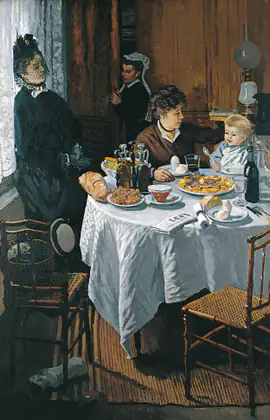
A center dominated by colored whites
The dress, tablecloth and sleeves are never uniform white. They receive blue, pink, ocher and the green shadows of the clearing; these gaps give the light its power without erasing the volumes.

2 · Exemple de la sélection
La photo principale correspond à la couleur de cadre choisie. Chaque couleur est illustrée par une œuvre d’exemple différente.
Préparation de la sélection…
Ces médias montrent uniquement la réalisation, le support, la texture et les finitions. L’œuvre commandée reste celle affichée dans les blocs bleus.
3 · Mise en situation
Reproduction d’art premium
Choisissez le tirage Fine Art, le canvas imprimé, la peinture à l’huile ou la version numérique.
Trois fichiers JPG haute résolution : le fichier original, une version optimisée pour l’impression et une version optimisée pour les écrans. Jusqu’à 7 680 px sur le côté long, 300 DPI et sans filigrane.
Imprimez l’œuvre chez vous ou auprès de l’imprimeur de votre choix, ou utilisez la version écran sur ordinateur, tablette et téléphone.
Produit numérique uniquement : aucun tableau ni cadre physique n’est expédié.
Après votre commande, les trois fichiers sont contrôlés puis envoyés manuellement par e-mail.
Comprendre les formats
Claude Monet · Central fragment of the monumental project of 1865 -1866 · Musée d'Orsay
Around a white tablecloth covered with fruit, dishes and baskets, four figures appear in a clearing. The light dress of the seated woman captures an almost blinding light, while the standing men and women stand out in the deep greens. This central fragment is one of only two preserved remains of Monet's monumental Luncheon on the Grass.

Look at the work
In the foreground, the tablecloth extends diagonally and bears an abundant still life: fruit, bread, bottle, dishes, basket and fabrics. The seated woman opens her arms and turns her face towards the viewer. Behind her, a standing man holds a garment or blanket, while a woman in a light dress leans towards the group.
On the left, the bearded figure remains partially caught in the shadows. The Musée d'Orsay notes its striking resemblance to Gustave Courbet, who came to see Monet and Bazille during the winter of 1865 -1866. The vertical birches and low branches give a natural architecture to this open-air social gathering.
This fragment should not be read as a randomly cropped painting: it preserves the luminous core of a composition which originally measured more than four by six meters.
Composition, touch and light
Three precise elements allow us to understand this composition and the essential difficulties of faithful reproduction.
The dress, tablecloth and sleeves are never uniform white. They receive blue, pink, ocher and the green shadows of the clearing; these gaps give the light its power without erasing the volumes.
Dark clothing, foliage and trunks respond to each other with color. Monet avoids the effect of silhouettes placed in front of a setting: the characters belong to the same fragmented light as the trees.
The tablecloth and gestures open the space to the right, while the birches rise almost parallel. This opposition stabilizes a scene that is nevertheless dense and explains its effectiveness on a monumental scale.
Reference image
The image shows the central part kept at the Musée d'Orsay, inventory RF 1987 12 and catalog Wildenstein 63/2. The WebP file of 2,247 × 2,590 px respects the current shape of the fragment and allows figures such as the still life.
Its sleeves, dress and tablecloth fit into a wide light area. Their internal limits must be preserved by small cold and warm variations without creating a dark outline.
His face, his coat and his beard combine brown, green and colored black. An opaque black mass would make his posture disappear and break the gradual passage towards the undergrowth.
The fruits, baskets and containers are precise but subordinate to the whole. Their ocher, red and brown touches must punctuate the tablecloth without becoming a succession of meticulously surrounded objects.
Documented benchmarks
This central fragment painted in 1865 -1866 measures 248.7 × 218 cm and weighs 97 kg. It is kept at the Musée d'Orsay under the inventory RF 1987 12 and cataloged Wildenstein 63/2.
Monet began this immense composition in the spring of 1865 as a tribute as well as a challenge to Manet's Déjeuner sur l'herbe, shown at the Salon des Refusés of 1863. He wanted to present it at the Salon of 1866.
Pawned for rent, the canvas is kept rolled up in a cellar and suffers from humidity. Monet recovered it in 1884, cut it out and kept three fragments; only two are known today.
After remaining with Monet and then in the collection of his son Michel, this fragment entered the national collections by donation in 1987. An additional strip had already been removed on the right after 1920.
Your reproduction
Fidelity here depends on precise relationships between light, touch, depth and color temperature.
| Title | Lunch on the Grass, central fragment W63/2 |
|---|---|
| Artist | Claude Monet (1840 -1926) |
| Date | 1865 - 1866 |
| Original technique | Oil on canvas |
| Dimensions | 248.7 × 218 cm |
| Orientation | Monumental vertical |
| Conservation | Musée d'Orsay, Paris, France |
| Inventory | RF 1987 12 · Wildenstein 63/2 |
| Your reproduction | Handmade oil painting on canvas |
Presentation in your interior
This spectacular fragment is suitable for a high-ceilinged living room, entrance or library. A walnut, bronze or deep green frame highlights the undergrowth; an ivory, light stone or gray green wall reveals the large white areas.

Impression d’art sur papier mat Hahnemühle German Etching 310 g, au grain fin. Un rendu précis, élégant et plus accessible, idéal pour les détails et les nuances.

Impression sur toile d’artiste 400 g. Sa texture donne davantage de relief et un aspect tableau, avec plusieurs présentations adaptées au décor.

Reproduction peinte entièrement à la main sur commande. Chaque toile est une pièce unique : ce n’est ni une impression numérique ni un poster sur toile.
Explore the topics and styles associated with this reproduction.
Compare the finishes
Compare paper prints, printed canvas, hand-painted oil and digital files. The physical examples illustrate each finish; your order uses the artwork selected above.


A pigment print on Hahnemühle German Etching 310 gsm paper. Its matte, finely textured surface brings out detail and subtle colour. This is a print, not a hand-painted canvas.
Choose this option if you want to arrange your own framing.
A pigment print on Hahnemühle German Etching 310 gsm paper. Its matte, finely textured surface brings out detail and subtle colour. This is a print, not a hand-painted canvas.
A slim, traditional frame that keeps attention on the artwork.
A pigment print on Hahnemühle German Etching 310 gsm paper. Its matte, finely textured surface brings out detail and subtle colour. This is a print, not a hand-painted canvas.
Choose a Box frame for a deeper profile and a more pronounced presence on the wall.


Your artwork printed on 400 gsm artist canvas. The woven texture adds depth, with a choice of rolled, stretched or floating-frame presentation. This is a print, not an oil painting.
A framed canvas with visible depth. Choose the frame colour and canvas edge in the configurator.
Your artwork printed on 400 gsm artist canvas. The woven texture adds depth, with a choice of rolled, stretched or floating-frame presentation. This is a print, not an oil painting.
Not ready to hang: have it stretched or framed locally before displaying it.
Your artwork printed on 400 gsm artist canvas. The woven texture adds depth, with a choice of rolled, stretched or floating-frame presentation. This is a print, not an oil painting.
A clean, frameless canvas presentation. Choose the canvas edge finish in the configurator.


An artist recreates your chosen artwork by hand in oil paint on canvas. Brushwork and small variations make each reproduction individual; it is not a digital print.
Your painting is delivered rolled. Arrange stretching or framing locally after receipt.
An artist recreates your chosen artwork by hand in oil paint on canvas. Brushwork and small variations make each reproduction individual; it is not a digital print.
Choose your own local framer to prepare the finished painting for display.
Your selected artwork

Preview only. Your three files are prepared after purchase.
Files only · no physical delivery
Receive your selected artwork as three high-resolution JPG files, prepared to suit its orientation. Use them for printing or displaying the artwork on a screen.
Choose digital if you want to organise your own printing or use the artwork on a screen.
Same artist
Continuez avec des œuvres connues du même artiste, sélectionnées pour comparer les sujets, les formats et les ambiances sans mélanger avec les styles génériques.