


Two edges that don't have the same weight
The fallout on the left remains airy, those on the right are long and tight. This asymmetry maintains the central opening and prevents the willows from becoming a decorative frame.


2 · Exemple de la sélection
La photo principale correspond à la couleur de cadre choisie. Chaque couleur est illustrée par une œuvre d’exemple différente.
Préparation de la sélection…
Ces médias montrent uniquement la réalisation, le support, la texture et les finitions. L’œuvre commandée reste celle affichée dans les blocs bleus.
3 · Mise en situation

Reproduction d’art premium
Choisissez le tirage Fine Art, le canvas imprimé ou la peinture à l’huile, puis le format et les finitions disponibles.
Comprendre les formats
Claude Monet · 1916 -1919 · Marmottan 5164 · W1852
Willow branches fall from both edges and leave an opening of purple and cream light in the center. The water lilies are concentrated in the lower part, where the blue-green leaves bear several pink flowers. Nearly two meters wide, the canvas gives up the bank as it does the sky: branches, reflected clouds and the surface of the pool occupy a single continuous space.

Look at the work
The left side begins with spaced verticals, petrol blue and dark green, which descend over still clear water. On the right, the curtain tightens and becomes almost a wall. Between the two, horizontal lilac, white and pale pink marks evoke the reflected clouds. The directions overlap without it always being possible to distinguish the real branch from its image in the water.
Floating leaves are rare at the top, then gain size and density toward the bottom edge. Pink flowers are grouped rather than scattered: several respond to each other on the right, while a few isolated accents balance the left. Deep blues appear under the leaves and advance the light areas of the center.
The gaze can no longer choose between looking at the pool and looking at the sky: Monet brings them together in a single material crossed by willows.
Composition, touch and light
Three precise elements allow us to understand this composition and the essential difficulties of faithful reproduction.
The fallout on the left remains airy, those on the right are long and tight. This asymmetry maintains the central opening and prevents the willows from becoming a decorative frame.
Cream, mauve, gray blue and pale pink overlap in the center. These opaque colors must retain their material to evoke a luminous reflection without resembling a void.
The largest water lilies are placed in the lower third. Their spacing, overlaps and surrounding blues replace the traditional perspective.
Details and visual documents
The additional images show the difficult-to-read passages in the full view and, where it exists, the actual appearance of the work at the museum.


The main view measures 1,500 × 1,122 px. The actual photograph of the Water Lilies Room measures 2,816 × 2,112 px and the native detail 760 × 820 px. No files have been artificially enlarged; all three media are real decodable WebPs.
Documented benchmarks
These facts concern this precise version and are verified from the notice of the institution which keeps it.
The Marmottan Monet Museum dates the work from 1916 -1919 and indicates a format of 150 × 197 cm. The canvas bears the stamp of the workshop at the bottom right and corresponds to number 1852 of the Wildenstein catalog raisonné.
The museum notice recalls that Monet had planted four so-called Babylonian weeping willows around the pool. In his late compositions, he gradually removed the trunk, the bank and the stable viewpoint to preserve only the branches and their reflections.
Remaining in the Giverny workshop after the death of Claude Monet, this large painting entered the Marmottan Monet Museum thanks to the legacy of his son Michel in 1966.
Your reproduction
Fidelity here depends on precise relationships between light, touch, depth and color temperature.
| Title | Water lilies, Marmottan 5164 |
|---|---|
| Artist | Claude Monet (1840 -1926) |
| Date | 1916 - 1919 |
| Original technique | Oil on canvas |
| Dimensions | 150 × 197 cm |
| Orientation | Panoramic horizontal |
| Conservation | Marmottan Monet Museum, Paris, France |
| Inventory | inv. 5164 · Wildenstein 1852 |
| Your reproduction | Handmade oil painting on canvas |
Presentation in your interior
Lilac, mist blue, petrol green, soft pink and pearly cream make up a bright but deep atmosphere. This panoramic reproduction is suitable for a wide wall, accompanied by light oak, natural textiles and soft side lighting.

Impression d’art sur papier mat Hahnemühle German Etching 310 g, au grain fin. Un rendu précis, élégant et plus accessible, idéal pour les détails et les nuances.

Impression sur toile d’artiste 400 g. Sa texture donne davantage de relief et un aspect tableau, avec plusieurs présentations adaptées au décor.

Reproduction peinte entièrement à la main sur commande. Chaque toile est une pièce unique : ce n’est ni une impression numérique ni un poster sur toile.
Explore the topics and styles associated with this reproduction.
L’œuvre et sa reproduction
Découvrez l’histoire et l’atmosphère de cette œuvre, puis choisissez une reproduction à l’huile réalisée à la main selon vos dimensions.
À propos de l’œuvre
Claude Monet · 1916 -1919 · Marmottan 5164 · W1852
Willow branches fall from both edges and leave an opening of purple and cream light in the center. The water lilies are concentrated in the lower part, where the blue-green leaves bear several pink flowers. Nearly two meters wide, the canvas gives up the bank as it does the sky: branches, reflected clouds and the surface of the pool occupy a single continuous space.
Look at the work
The left side begins with spaced verticals, petrol blue and dark green, which descend over still clear water. On the right, the curtain tightens and becomes almost a wall. Between the two, horizontal lilac, white and pale pink marks evoke the reflected clouds. The directions overlap without it always being possible to distinguish the real branch from its image in the water.
Floating leaves are rare at the top, then gain size and density toward the bottom edge. Pink flowers are grouped rather than scattered: several respond to each other on the right, while a few isolated accents balance the left. Deep blues appear under the leaves and advance the light areas of the center.
The gaze can no longer choose between looking at the pool and looking at the sky: Monet brings them together in a single material crossed by willows.
Composition, touch and light
Three precise elements allow us to understand this composition and the essential difficulties of faithful reproduction.
The fallout on the left remains airy, those on the right are long and tight. This asymmetry maintains the central opening and prevents the willows from becoming a decorative frame.
Cream, mauve, gray blue and pale pink overlap in the center. These opaque colors must retain their material to evoke a luminous reflection without resembling a void.
The largest water lilies are placed in the lower third. Their spacing, overlaps and surrounding blues replace the traditional perspective.
Details and visual documents
The additional images show the difficult-to-read passages in the full view and, where it exists, the actual appearance of the work at the museum.
The main view measures 1,500 × 1,122 px. The actual photograph of the Water Lilies Room measures 2,816 × 2,112 px and the native detail 760 × 820 px. No files have been artificially enlarged; all three media are real decodable WebPs.
Documented benchmarks
These facts concern this precise version and are verified from the notice of the institution which keeps it.
The Marmottan Monet Museum dates the work from 1916 -1919 and indicates a format of 150 × 197 cm. The canvas bears the stamp of the workshop at the bottom right and corresponds to number 1852 of the Wildenstein catalog raisonné.
The museum notice recalls that Monet had planted four so-called Babylonian weeping willows around the pool. In his late compositions, he gradually removed the trunk, the bank and the stable viewpoint to preserve only the branches and their reflections.
Remaining in the Giverny workshop after the death of Claude Monet, this large painting entered the Marmottan Monet Museum thanks to the legacy of his son Michel in 1966.
Your reproduction
Fidelity here depends on precise relationships between light, touch, depth and color temperature.
| Title | Water lilies, Marmottan 5164 |
|---|---|
| Artist | Claude Monet (1840 -1926) |
| Date | 1916 - 1919 |
| Original technique | Oil on canvas |
| Dimensions | 150 × 197 cm |
| Orientation | Panoramic horizontal |
| Conservation | Marmottan Monet Museum, Paris, France |
| Inventory | inv. 5164 · Wildenstein 1852 |
| Your reproduction | Handmade oil painting on canvas |
Presentation in your interior
Lilac, mist blue, petrol green, soft pink and pearly cream make up a bright but deep atmosphere. This panoramic reproduction is suitable for a wide wall, accompanied by light oak, natural textiles and soft side lighting.
Une peinture à l’huile sur toile réalisée entièrement à la main, sans impression numérique.
Vous recevez des photos détaillées et pouvez demander des ajustements.
Les dimensions sont calculées pour respecter les proportions de l’original.
Un doute sur le format ou les couleurs ?
From order to delivery
You remain in control until your final validation reproduction.
Select the dimensions appropriate to the proportions of the work.
Production at painting at oil on canvas by a specialized artist.
Receive detailed photos and request up to 7 sets of edits before validation.
Your canvas is rolled in reinforced packaging, with tracking until delivery.
Frequently asked questions
Everything you need to know about creating, retouching, validating and delivering your painting.
Yes. Every reproduction is carried out at the painting at theoil on canvas by a specialized artist. This is neither a print nor a digital transfer.
Yes. Choose one of the formats offered or contact us for a particular dimension adapted to your wall and the proportions of the work.
When the painting and the drying is complete, we send you detailed photos before any shipment so that you can validate the result.
You can request up to 7 sets of edits from the photos received, before giving your final validation.
The canvas is shipped rolled, frameless, in reinforced packaging designed to protect it during international transport.
Upon shipment, you will receive a tracking number to track the delivery of your reproduction until its delivery.
Same artist
Continuez avec des œuvres connues du même artiste, sélectionnées pour comparer les sujets, les formats et les ambiances sans mélanger avec les styles génériques.


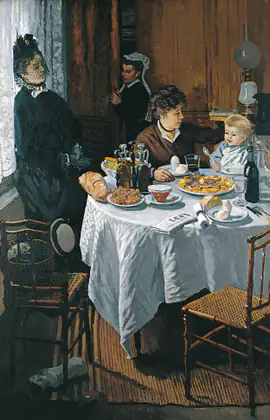


The reproduction keeps the original proportions, so you can choose the scale that feels right for your wall.


Preview only. Frames are not sold on this website. Your painting is delivered as rolled, unframed canvas.