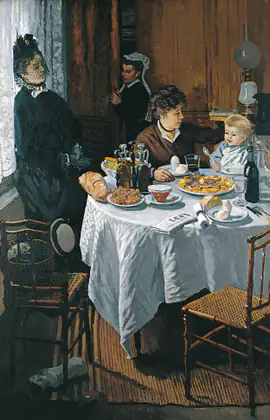
A composition regulated like a staff
The Musée d'Orsay compares the magpie placed on the portal to a note on a musical staff. The hedge provides the horizontal line and the gate uprights create the vertical rhythm.

2 · Exemple de la sélection
La photo principale correspond à la couleur de cadre choisie. Chaque couleur est illustrée par une œuvre d’exemple différente.
Préparation de la sélection…
Ces médias montrent uniquement la réalisation, le support, la texture et les finitions. L’œuvre commandée reste celle affichée dans les blocs bleus.
3 · Mise en situation
Reproduction d’art premium
Choisissez le tirage Fine Art, le canvas imprimé, la peinture à l’huile ou la version numérique.
Trois fichiers JPG haute résolution : le fichier original, une version optimisée pour l’impression et une version optimisée pour les écrans. Jusqu’à 7 680 px sur le côté long, 300 DPI et sans filigrane.
Imprimez l’œuvre chez vous ou auprès de l’imprimeur de votre choix, ou utilisez la version écran sur ordinateur, tablette et téléphone.
Produit numérique uniquement : aucun tableau ni cadre physique n’est expédié.
Après votre commande, les trois fichiers sont contrôlés puis envoyés manuellement par e-mail.
Comprendre les formats
Claude Monet · A magpie on a snowy barrier · Musée d'Orsay
A black magpie is placed on a gate, a tiny accent living in the expanse of snow. The fence and hedge cut the landscape in two, while the blue-purple shadows in the foreground lead to the trees, roofs and milky sky. Monet transforms white into a range of colors and makes winter light the main subject.

Look at the work
The gate occupies the left of the center and its vertical uprights interrupt the long hedge. The magpie rests on the upper crossbar like a punctuation. Behind, a few branches and chimneys emerge above the snow-covered walls.
In the foreground, shadows stretch diagonally from the right. They are neither gray nor black: they mix blue, mauve, green and cream. The sky and snowy surfaces exchange tones, which makes the edge of the horizon deliberately soft.
White is never empty: it changes according to sky, shadow, earth and reflected light.
Composition, touch and light
Three precise elements allow us to understand this composition and the essential difficulties of faithful reproduction.
The Musée d'Orsay compares the magpie placed on the portal to a note on a musical staff. The hedge provides the horizontal line and the gate uprights create the vertical rhythm.
The large diagonal of shadow in the foreground gives depth to the terrain. The light and cold areas oppose each other without hard contours, making snow that is both solid and melting noticeable.
Monet replaces the traditional browns of the winter landscape with colored whites and luminous blues. This audacity contributed to the refusal of the painting by the jury of the Salon of 1869.
Reference image
The reference corresponds exactly to the RF 1984 164 inventory of the Musée d'Orsay, Wildenstein 133 version. The high definition file was reduced to 3,000 × 2,034 px and encoded in WebP for precise zoom.
Its warm black contrasts with the light crossbar. Enlarging it or hardening its details would reduce the impression of vast winter silence.
Periwinkle blues, purples and grey greens shape the snow. Neutral grays that are too uniform would make the light characteristic of the work disappear.
Trees, walls and chimneys are indicated with less contrast than the gate. This hierarchy maintains depth despite the white dominance.
Documented benchmarks
Painted in Étretat during the winter of 1868 -1869, this oil on canvas measuring 89 × 130 cm is kept at the Musée d'Orsay under the inventory RF 1984 164 and classified Wildenstein 133.
The Orsay notice specifies that Monet creates the painting on the motif. He applies the same observation requirement to fugitive states of nature as to landscapes of good weather.
The very clear bias, based on perception rather than academic description, confuses the jury. Orsay presents the work as a major milestone in the impressionist landscape before the group's first exhibition.
After the Carlander, Durand-Ruel and Guerlain collections, La Pie was acquired in 1984 then assigned to the Musée d'Orsay. It bears the number RF 1984 164.
Your reproduction
Fidelity here depends on precise relationships between light, touch, depth and color temperature.
| Title | The Pius W133 |
|---|---|
| Artist | Claude Monet (1840 -1926) |
| Date | 1868 - 1869 |
| Original technique | Oil on canvas |
| Dimensions | 89 × 130 cm |
| Orientation | Horizontal |
| Conservation | Musée d'Orsay, Paris, France |
| Inventory | RF 1984 164 · Wildenstein 133 |
| Your reproduction | Handmade oil painting on canvas |
Presentation in your interior
Its large horizontal format and bluish whites illuminate a living room, bedroom or room with natural materials. An off-white, blond oak or bluish gray frame reinforces the feeling of air without closing the landscape.

Impression d’art sur papier mat Hahnemühle German Etching 310 g, au grain fin. Un rendu précis, élégant et plus accessible, idéal pour les détails et les nuances.

Impression sur toile d’artiste 400 g. Sa texture donne davantage de relief et un aspect tableau, avec plusieurs présentations adaptées au décor.

Reproduction peinte entièrement à la main sur commande. Chaque toile est une pièce unique : ce n’est ni une impression numérique ni un poster sur toile.
Explore the topics and styles associated with this reproduction.
Compare the finishes
Compare paper prints, printed canvas, hand-painted oil and digital files. The physical examples illustrate each finish; your order uses the artwork selected above.


A pigment print on Hahnemühle German Etching 310 gsm paper. Its matte, finely textured surface brings out detail and subtle colour. This is a print, not a hand-painted canvas.
Choose this option if you want to arrange your own framing.
A pigment print on Hahnemühle German Etching 310 gsm paper. Its matte, finely textured surface brings out detail and subtle colour. This is a print, not a hand-painted canvas.
A slim, traditional frame that keeps attention on the artwork.
A pigment print on Hahnemühle German Etching 310 gsm paper. Its matte, finely textured surface brings out detail and subtle colour. This is a print, not a hand-painted canvas.
Choose a Box frame for a deeper profile and a more pronounced presence on the wall.


Your artwork printed on 400 gsm artist canvas. The woven texture adds depth, with a choice of rolled, stretched or floating-frame presentation. This is a print, not an oil painting.
A framed canvas with visible depth. Choose the frame colour and canvas edge in the configurator.
Your artwork printed on 400 gsm artist canvas. The woven texture adds depth, with a choice of rolled, stretched or floating-frame presentation. This is a print, not an oil painting.
Not ready to hang: have it stretched or framed locally before displaying it.
Your artwork printed on 400 gsm artist canvas. The woven texture adds depth, with a choice of rolled, stretched or floating-frame presentation. This is a print, not an oil painting.
A clean, frameless canvas presentation. Choose the canvas edge finish in the configurator.


An artist recreates your chosen artwork by hand in oil paint on canvas. Brushwork and small variations make each reproduction individual; it is not a digital print.
Your painting is delivered rolled. Arrange stretching or framing locally after receipt.
An artist recreates your chosen artwork by hand in oil paint on canvas. Brushwork and small variations make each reproduction individual; it is not a digital print.
Choose your own local framer to prepare the finished painting for display.
Your selected artwork

Preview only. Your three files are prepared after purchase.
Files only · no physical delivery
Receive your selected artwork as three high-resolution JPG files, prepared to suit its orientation. Use them for printing or displaying the artwork on a screen.
Choose digital if you want to organise your own printing or use the artwork on a screen.
Same artist
Continuez avec des œuvres connues du même artiste, sélectionnées pour comparer les sujets, les formats et les ambiances sans mélanger avec les styles génériques.