À propos de l’œuvre
La plage de Scheveningen, par Vincent van Gogh
Vincent van Gogh · August 11, 1882 · Scheveningen, The Hague
Scheveningen Beach in calm weather, F2Reproduction of oil painting on canvas
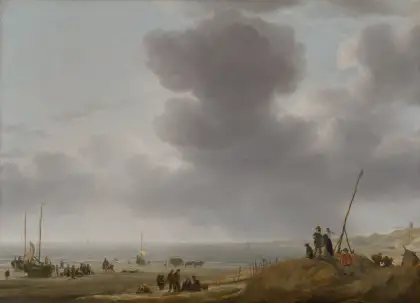
Three fishing boats are pulled close to shore under pale skies, their masts and ropes cutting thin vertical lines. Van Gogh here paints the beach in calm weather, a distinct version of the famous F4 storm navy.

Look at the work
Bomschuiten motionless at the water's edge
Two boats group together on the left while a third occupies the right. Their black hulls are connected by masts, folded sails, ropes and small red pennants.
Some figures walk between the boats and the beach. Pink ocher sand fills the foreground; a strip of white foam then a gray-green sea separate this land from the very clear blue sky.
Scheveningen Beach in Calm Weather F2/JH173 is an oil on paper mounted on a 35.5 × 49.5 cm panel painted on August 11, 1882. On sale at Sotheby's in 2022, it is in a private collection.
Composition, touch and color
Three observations specific to this painting
The composition balances the heavy masses of the hulls and the almost transparent network of rigging. The sand, foam, sea and sky form four light bands that let the silhouettes breathe.
The masts give the measure of the sky
Three vertical axes dominate the landscape. Diagonally drawn ropes connect them to hulls and create a light architecture above the boats.
The figures enliven the shore
The characters are tiny but their blue, red and black clothing introduces precise accents. They also indicate the scale of heavy fishing boats.
Calm arises from horizontal bands
The foam almost follows a continuous line and the horizon remains low. The movements of the brush in the sand are wider, without producing the violence of the F4 version.
Documented benchmarks
Precisely identify the original work
The date August 11, 1882, the paper support and the references F2/JH173 identify the navy in calm weather. It should not be confused with Sea view at Scheveningen F4/JH187, painted during a windy episode.
The calm navy F2/JH173
Here, boats rest near the shore and waves remain low. F4 instead shows rough seas under stormy skies and belongs to the Van Gogh Museum.
An oil on paper fixed on a panel
Van Gogh takes a light support to the beach then paints directly facing the pattern. The paper is now mounted on a rigid panel.
A work sold in November 2022
The painting was offered at Sotheby's Modern Evening Auction in New York. The sales notice documents its version, dimensions and origin.
Your reproduction
What the painter must preserve
The painter must preserve the three distinct boats, the very fine masts, the red pennants, the figures of the shore, the strip of foam and the wide pink ocher passages of the sand.
- The three black shells
- Masts and fine ropes
- The little red flags
- Figures between boats
- Bands of sand, foam and sea
Work sheet
| Title | Scheveningen Beach in calm weather, F2 |
|---|---|
| Artist | Vincent van Gogh (1853 -1890) |
| Date | August 11, 1882 |
| Place of creation | Scheveningen, The Hague |
| Original technique | Oil on paper mounted on panel |
| Dimensions | 35.5 × 49.5 cm |
| Inventory | F2 · JH173 |
| Conservation | Private collection |
| Your reproduction | Handmade oil painting on canvas |
From order to shipping
In your interior
A light navy in sand, blue and brown
The horizontal format brings a luminous breath to a living room, an office or a bedroom. Pale blues and ochres match light oak, ecru linen and pearl gray.
Frequently asked questions
Before ordering
Is this a canvas print?
No. Each reproduction is manually painted in oil on canvas. Brushstrokes and material variations belong to the final result.
How is the visual reference chosen?
The documentary reference of 2526 × 1746 px has been retained at its native definition and converted into a real WebP without enlargement.
Can I check the result before shipping?
Yes. Photographs of the finished painting are sent to you; you can request alterations before validating the shipment.
Are custom formats possible?
Yes. The format can be adapted to your wall while maintaining the proportions and balance of the original composition.