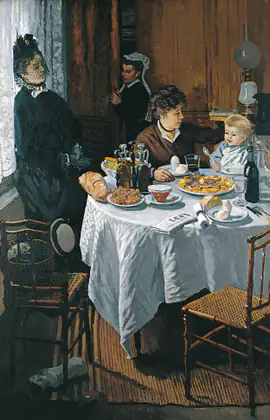
A dress that builds the foreground
The fabric draws a large light triangle and gives the basis of the composition. Its folds are indicated by colorful variations and supple touches, never by systematic gray lines.

2 · Exemple de la sélection
La photo principale correspond à la couleur de cadre choisie. Chaque couleur est illustrée par une œuvre d’exemple différente.
Préparation de la sélection…
Ces médias montrent uniquement la réalisation, le support, la texture et les finitions. L’œuvre commandée reste celle affichée dans les blocs bleus.
3 · Mise en situation
Reproduction d’art premium
Choisissez le tirage Fine Art, le canvas imprimé ou la peinture à l’huile, puis le format et les finitions disponibles.
Comprendre les formats
Claude Monet · Camille in Argenteuil · Walters Art Museum
Camille Monet reads under the lilacs of the Argenteuil garden. Its very light pink color unfolds on the grass and receives spots of sunlight, while the cool shade of the foliage opens towards a luminous meadow.

Look at the work
Sitting directly in the grass, Camille turns her chest slightly towards her book. Her dress occupies almost the entire lower part: it is not painted as a white surface, but as a set of roses, lilacs, blues and cream shards. The hat, face and hands remain more concentrated, forming a small, calm core in the middle of the fabric.
The dark curtain of the lilacs frames the figure and stops on the right on a heavily lit area of grass. Round spots of sunlight pass through the foliage and land on the dress. The contrast between green shadow and yellow light gives the sensation of a precise moment, while maintaining the elegant readability of the silhouette.
The portrait is not based on the detail of the face, but on the way in which the light transforms Camille's dress and connects her presence to the garden.
Composition, touch and light
Three precise elements allow us to understand this composition and the essential difficulties of faithful reproduction.
The fabric draws a large light triangle and gives the basis of the composition. Its folds are indicated by colorful variations and supple touches, never by systematic gray lines.
The dark foliage protects the figure and intensifies the right clearing. Greens range from warm olive to deep green, with brown and blue passages that maintain shade transparency.
Small light touches land on the grass and dress. Their shape and spacing should appear irregular, like light filtered by leaves, not like an added pattern.
Reference image
The high definition reference from the Walters Art Museum's digitization allows you to observe the very pale roses of the dress, the yellow touches in the grass and the dark structure of the lilacs.
Camille occupies the left and bottom, balanced by the bright opening of the garden on the right.
The dress combines powder pink, lilac, cold blue and cream to remain luminous without becoming a white mass.
Clear keys pass through the canopy and spread across the figure and grass in an irregular rhythm.
Documented benchmarks
The Walters Art Museum notice links this painting to Monet's life in Argenteuil, Camille and the second impressionist exhibition.
Monet represents his first wife in the garden of their house in Argenteuil, where the family settled at the end of 1871.
The painting appears at the impressionist group's second exhibition, a decisive moment for the public affirmation of the new painting.
Mary Cassatt owned the work around 1889. Henry Walters acquired it in 1903; she then entered the museum by bequest in 1931.
Your reproduction
Fidelity here depends on precise relationships between light, touch, depth and color temperature.
| Title | Spring or The W205 E-Reader |
|---|---|
| Artist | Claude Monet (1840 -1926) |
| Date | 1872 |
| Original technique | Oil on canvas |
| Dimensions | 50 × 65.5 cm |
| Orientation | Horizontal |
| Conservation | Walters Art Museum, Baltimore, Maryland, United States |
| Inventory | 37.11 · Wildenstein 205 |
| Your reproduction | Handmade oil painting on canvas |
Presentation in your interior
The powder pink color and greens of the garden bring luminous softness to a bedroom, living room or reading corner. An ivory, light wood or matte gold frame supports the delicacy of the palette without rivaling the sun spots.

Impression d’art sur papier mat Hahnemühle German Etching 310 g, au grain fin. Un rendu précis, élégant et plus accessible, idéal pour les détails et les nuances.

Impression sur toile d’artiste 400 g. Sa texture donne davantage de relief et un aspect tableau, avec plusieurs présentations adaptées au décor.

Reproduction peinte entièrement à la main sur commande. Chaque toile est une pièce unique : ce n’est ni une impression numérique ni un poster sur toile.
Explore the topics and styles associated with this reproduction.
Compare the finishes
One of our own Jesus artworks is shown in every tab, so you can compare the material, depth and handcrafted character without changing the composition.


Best for fine detail
A precise pigment print on finely textured Hahnemühle German Etching 310 gsm paper.
Ideal for nuanced detail, subtle tones and an elegant paper finish.


Most decorative
A rich pigment print on heavyweight artist canvas with the depth and presence of a ready-to-display piece.
Ideal when you want texture, depth and a strong decorative presence.


Most handcrafted
A unique reproduction painted entirely by hand in oils on canvas, with natural variations in every brushstroke.
Ideal for the singular presence and living texture of a handmade painting.
Same artist
Continuez avec des œuvres connues du même artiste, sélectionnées pour comparer les sujets, les formats et les ambiances sans mélanger avec les styles génériques.