


Arabesque branches
The large loops at the top should remain distinct from the hanging verticals. They give the initial momentum of the entire composition.

2 · Exemple de la sélection
La photo principale correspond à la couleur de cadre choisie. Chaque couleur est illustrée par une œuvre d’exemple différente.
Préparation de la sélection…
Ces médias montrent uniquement la réalisation, le support, la texture et les finitions. L’œuvre commandée reste celle affichée dans les blocs bleus.
3 · Mise en situation

Reproduction d’art premium
Choisissez le tirage Fine Art, le canvas imprimé ou la peinture à l’huile, puis le format et les finitions disponibles.
Comprendre les formats
Claude Monet · 1920 -1922 · Musée d'Orsay · W1942
The trunk disappears behind a tangle of green, yellow, red and purple branches. In this vertical canvas, Monet transforms the Giverny willow into a cascade of gestures that descends to a thin strip of orange water.

Look at the work
The branches start from the top in large emerald green and acid yellow loops, then extend into darker verticals. On the left, reds and blacks thicken the shadow; in the center, a few whites and yellows open bright gaps.
The lower half becomes more purple, blue and red. The gestures remain suspended before a horizontal orange, pink and dark blue band which suggests water. This opposition between vertical fall and low line gives all its tension to the composition.
The willow is not described leaf by leaf: its weight, movement and light are condensed in the direction of the brush itself.
Composition, touch and light
Three precise elements allow us to understand this composition and the essential difficulties of faithful reproduction.
The large loops at the top should remain distinct from the hanging verticals. They give the initial momentum of the entire composition.
Greens dominate in the center, reds reinforce the left, and purples accumulate at the bottom. This distribution avoids uniform polychromy.
The horizontal orange and blue touches at the bottom are essential. They give a visual soil to the tree without transforming the scene into a traditional landscape.
Details and visual documents
The additional images show the difficult-to-read passages in the full view and, where it exists, the actual appearance of the work at the museum.


The best exact public view measures 913 × 1016 px. The two details of 760 × 430 px are direct cropping of the same W1942 file. No enlargements were applied; all three images are real WebPs.
Documented benchmarks
These facts concern this precise version and are verified from the notice of the institution which keeps it.
The Musée d'Orsay preserves this oil on vertical canvas measuring 110 × 100 cm, dated between 1920 and 1922. A "Claude Monet" stamp appears at the bottom left.
The work belonged to Philippe Meyer until 2007. Accepted by the State in 2000 subject to usufruct, it effectively joined the Musée d'Orsay after its renunciation of usufruct.
The canvas belongs to Giverny's late research. The thick gestures, the acidic contrasts and the erasure of the trunk make the plant motif an almost autonomous structure.
Your reproduction
Fidelity here depends on precise relationships between light, touch, depth and color temperature.
| Title | Weeping willow, Giverny |
|---|---|
| Artist | Claude Monet (1840 -1926) |
| Date | 1920 - 1922 |
| Original technique | Oil on canvas |
| Dimensions | 110 × 100 cm |
| Orientation | Vertical |
| Conservation | Musée d'Orsay, Paris, France |
| Inventory | RF 2000 21 · Wildenstein 1942 |
| Your reproduction | Handmade oil painting on canvas |
Presentation in your interior
This vertical reproduction becomes a very expressive focal point. Its acidic greens, purples and reds match a cream, plum, deep green or warm gray wall, with a side light revealing impasto.

Impression d’art sur papier mat Hahnemühle German Etching 310 g, au grain fin. Un rendu précis, élégant et plus accessible, idéal pour les détails et les nuances.

Impression sur toile d’artiste 400 g. Sa texture donne davantage de relief et un aspect tableau, avec plusieurs présentations adaptées au décor.

Reproduction peinte entièrement à la main sur commande. Chaque toile est une pièce unique : ce n’est ni une impression numérique ni un poster sur toile.
Explore the topics and styles associated with this reproduction.
L’œuvre et sa reproduction
Découvrez l’histoire et l’atmosphère de cette œuvre, puis choisissez une reproduction à l’huile réalisée à la main selon vos dimensions.
À propos de l’œuvre
Claude Monet · 1920 -1922 · Musée d'Orsay · W1942
The trunk disappears behind a tangle of green, yellow, red and purple branches. In this vertical canvas, Monet transforms the Giverny willow into a cascade of gestures that descends to a thin strip of orange water.
Look at the work
The branches start from the top in large emerald green and acid yellow loops, then extend into darker verticals. On the left, reds and blacks thicken the shadow; in the center, a few whites and yellows open bright gaps.
The lower half becomes more purple, blue and red. The gestures remain suspended before a horizontal orange, pink and dark blue band which suggests water. This opposition between vertical fall and low line gives all its tension to the composition.
The willow is not described leaf by leaf: its weight, movement and light are condensed in the direction of the brush itself.
Composition, touch and light
Three precise elements allow us to understand this composition and the essential difficulties of faithful reproduction.
The large loops at the top should remain distinct from the hanging verticals. They give the initial momentum of the entire composition.
Greens dominate in the center, reds reinforce the left, and purples accumulate at the bottom. This distribution avoids uniform polychromy.
The horizontal orange and blue touches at the bottom are essential. They give a visual soil to the tree without transforming the scene into a traditional landscape.
Details and visual documents
The additional images show the difficult-to-read passages in the full view and, where it exists, the actual appearance of the work at the museum.
The best exact public view measures 913 × 1016 px. The two details of 760 × 430 px are direct cropping of the same W1942 file. No enlargements were applied; all three images are real WebPs.
Documented benchmarks
These facts concern this precise version and are verified from the notice of the institution which keeps it.
The Musée d'Orsay preserves this oil on vertical canvas measuring 110 × 100 cm, dated between 1920 and 1922. A "Claude Monet" stamp appears at the bottom left.
The work belonged to Philippe Meyer until 2007. Accepted by the State in 2000 subject to usufruct, it effectively joined the Musée d'Orsay after its renunciation of usufruct.
The canvas belongs to Giverny's late research. The thick gestures, the acidic contrasts and the erasure of the trunk make the plant motif an almost autonomous structure.
Your reproduction
Fidelity here depends on precise relationships between light, touch, depth and color temperature.
| Title | Weeping willow, Giverny |
|---|---|
| Artist | Claude Monet (1840 -1926) |
| Date | 1920 - 1922 |
| Original technique | Oil on canvas |
| Dimensions | 110 × 100 cm |
| Orientation | Vertical |
| Conservation | Musée d'Orsay, Paris, France |
| Inventory | RF 2000 21 · Wildenstein 1942 |
| Your reproduction | Handmade oil painting on canvas |
Presentation in your interior
This vertical reproduction becomes a very expressive focal point. Its acidic greens, purples and reds match a cream, plum, deep green or warm gray wall, with a side light revealing impasto.
Une peinture à l’huile sur toile réalisée entièrement à la main, sans impression numérique.
Vous recevez des photos détaillées et pouvez demander des ajustements.
Les dimensions sont calculées pour respecter les proportions de l’original.
Un doute sur le format ou les couleurs ?
From order to delivery
You remain in control until your final validation reproduction.
Select the dimensions appropriate to the proportions of the work.
Production at painting at oil on canvas by a specialized artist.
Receive detailed photos and request up to 7 sets of edits before validation.
Your canvas is rolled in reinforced packaging, with tracking until delivery.
Frequently asked questions
Everything you need to know about creating, retouching, validating and delivering your painting.
Yes. Every reproduction is carried out at the painting at theoil on canvas by a specialized artist. This is neither a print nor a digital transfer.
Yes. Choose one of the formats offered or contact us for a particular dimension adapted to your wall and the proportions of the work.
When the painting and the drying is complete, we send you detailed photos before any shipment so that you can validate the result.
You can request up to 7 sets of edits from the photos received, before giving your final validation.
The canvas is shipped rolled, frameless, in reinforced packaging designed to protect it during international transport.
Upon shipment, you will receive a tracking number to track the delivery of your reproduction until its delivery.
Same artist
Continuez avec des œuvres connues du même artiste, sélectionnées pour comparer les sujets, les formats et les ambiances sans mélanger avec les styles génériques.


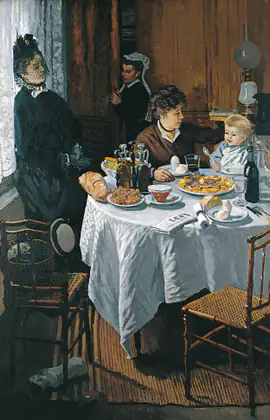


The reproduction keeps the original proportions, so you can choose the scale that feels right for your wall.


Preview only. Frames are not sold on this website. Your painting is delivered as rolled, unframed canvas.