

18th - 20th centuries · oil paintings
The 100 paintings in pastel colors
One hundred paintings where powder pinks, pale blues, colored whites and luminous mauves tell the story of intimacy, the outdoors and modern invention.

A light before being a style
A gentleness that knows how to build
A pastel palette does not mean a shy painting. In Morisot, Cassatt and Renoir, roses, blues and whites bring the figures together without enclosing them. In Monet, Sisley, Sorolla or Turner, they make the air, snow, mist and reflections more mobile than any contour.
This story begins long before the word "pastel" meant wise decoration. Fragonard and Boucher's rococo already uses light chords to showcase desire, culture and power. In the 19th century, Ingres pushed satin blue to the point of unreal, then the Impressionists brought these colors into modern life, from train stations to beaches.
Chromatic softness does not eliminate contrast: it shifts it towards fine differences in temperature, light and material.
It connects skin tones, fabrics and light while avoiding the saturation of a bold red.
Mixed with white or gray, it moves away from planes and gives air to the sky, water or shadows.
Halfway between blue and yellow, it softens vegetation and refreshes skin tones.
It colors snow, shadows and whites without weighing them down with a neutral gray.
100 paintings where softness becomes structure
Editorial rankingImages that have become universal
Pastel palette icons
Berthe Morisot
The Cradle
Berthe Morisot painted her sister Edma watching over her daughter Blanche in 1872. The veil of the cradle extends the window curtain and draws a fragile protective enclosure around the child. Presented at the first impressionist exhibition from 1874, the work made a family interior a modern subject, with observed tenderness rather than motherhood transformed into a congratulatory card.
See the painting →
Claude Monet
The Magpie
Monet painted La Pie in Étretat during the winter of 1868-1869. The Salon of 1869 refused the canvas, whose blue and purple shadows contradicted the academic idea of simply white snow. Placed on a barrier, the magpie gives scale and the rhythm of this silent landscape: a tiny bird is enough to announce impressionist research a few years before their official baptism.
See the painting →
Mary Cassatt
The Child's Bath
Cassatt observes a daily gesture: a woman holds the child firmly while she washes his feet. The plunging framing, carpet patterns and simplified outlines owe much to the Japanese prints she admired. Painted in 1893, Le Bain de l'enfant transforms a domestic scene into a monumental composition without making the treatment lose its concrete softness.
See the painting →
Vincent van Gogh
Almond tree in bloom
Van Gogh painted this almond tree in Saint-Rémy to celebrate the birth of his nephew Vincent Willem. The branches seen very closely stand out against a turquoise sky, according to a framing inspired by Japanese prints. Offered to Theo and Jo, the canvas associates the first flowering tree of spring with a promise of starting again that became all the more moving a few months before the painter's death.
See the painting →
Claude Monet
Print, rising sun
Monet painted the port of Le Havre in 1872 then presented the painting to Nadar during the 1874 exhibition. The critic Louis Leroy ridiculed his title and despite himself coined the word "impressionist". Between blue mist, orange sun and boat Silhouettes, Impression, Rising Sun proves that a very small view can trigger a considerably larger art story.
See the painting →
John Singer Sargent
Carnation, Lily, Lily, Rose
Sargent paints two little girls lighting lanterns in an English garden, only during the few minutes when the twilight light reaches the desired balance. He takes the canvas again evening after evening for two summers and even moves flowers in pots. This patience gives whites, mauves and roses a brightness that seems spontaneous, which is a small victory for the organization over the weather.
See the painting →
Mary Cassatt
Little Girl in a blue armchair
Cassatt shows a child slumped in a vast blue armchair, far from the polite poses expected in a bourgeois portrait. The seats cut by the frame and the little sleeping dog give the room an oblique rhythm. Refused by the jury american of the Universal Exhibition of 1878, the canvas today appears deliciously undisciplined in modernity.
See the painting →
Pierre-Auguste Renoir
Pink and Blue
Renoir paints Alice and Élisabeth Cahen of Antwerp in two chiffon dresses, one pink and the other blue. Commissioned by their father, the banker Louis Cahen of Antwerp, this double portrait from 1881 contrasts colors while uniting the sisters by installation and light. The lightness of the fabrics hides a very carefully adjusted composition.
See the painting →
Joaquin Sorolla
The Horse Bath
On El Cabañal beach, a boy guides a white horse into the water after the fishermen's work. Sorolla painted The Horse Bath in 1909 with a light that almost dissolves the line between skin, wet dress and reflection. The scene daily life takes on a monumental scale, while the horse crosses the Mediterranean with the professional calm of someone who already knows the program.
See the painting →
Pierre-Auguste Renoir
Young girls at the piano
Young Girls at the Piano was born from a public commission in 1892 intended for the Luxembourg Museum, a sign that Renoir was then fully recognized. Two young women lean over a score, brought together by the curves of dresses, hair and furniture. Renoir painted several versions before choosing the state one; even quiet scenes can therefore experience a dress rehearsal.
See the painting →
Joaquin Sorolla
The Pink Bathrobe
The Pink Bathrobe belongs to the large beach scenes painted by Sorolla in Valencia in 1916. Two women change under a bathhouse; the pink fabric filters the light and transforms an ordinary gesture into colorful architecture. The sea appears at the bottom in small openings, as if the painter had installed a temporary workshop directly in the breeze.
See the painting →
Pierre-Auguste Renoir
The Two Sisters, on the terrace
On the terrace of the Maison Fournaise in Chatou, Renoir places two models in front of the Seine and a basket of balls of wool. Despite the title, they were probably not sisters. The red of the hat, the blue of the clothing and the flowers soften the landscape without erasing it; the scene retains the animation of an afternoon at the water's edge.
See the painting →
Jean-Honoré Fragonard
The Happy Chances of the Escarpolette
A young man hidden in roses watches his mistress rush onto a swing pushed by a complacent husband or clergyman. Fragonard transforms this libertine order into a whirlwind of foliage, pink satin and light. The shoe that flies away and the Cupid asking for silence sum up the rococo spirit with relative discretion.
See the painting →
Alexandre Cabanel
The Birth of Venus
Alexandre Cabanel exhibited The Birth of Venus at the Salon of 1863, where Napoleon III immediately bought it. Lying on the sea rather than standing on a shell, the goddess offers to official taste a smooth nudity justified by Antiquity. Pearly flesh, turquoise water and cupids make the painting an emblem of academicism soon attacked by the avant-gardes.
See the painting →
Jean-Auguste-Dominique Ingres
Princess de Broglie
Pauline de Broglie poses in a blue satin dress in which Ingres follows each reflection with almost unreal precision. The jewelry, lace and golden armchair assert its rank, but the reserved gaze introduces a distance melancholic. Completed in 1853, the portrait became one of the peaks of the painter's worldly elegance.
See the painting →
Jean-Auguste-Dominique Ingres
Madame Moitessier
Ingres worked for twelve years on the portrait of Marie-Clotilde-Inès Moitessier and along the way abandoned the idea of including her daughter. The gesture of the hand against the temple comes from an ancient painting of Herculaneum, while the mirror repeats it profile. The floral dress, pink damask and jewelry create meticulous luxury around a face that remains surprisingly calm.
See the painting →
François Boucher
The Marquise de Pompadour
Boucher represents Jeanne-Antoinette de Pompadour surrounded by books, scores and refined objects, not as a simple favorite but as a woman of culture and power. The sea green dress unfolds among roses and blues of the decor. Painted in 1756, the portrait transformed rococo taste into a true political program of elegance.
See the painting →
James Abbott McNeill Whistler
Symphony in White No. 1: The Girl in White
Jo Hiffernan poses in a white dress in front of a white curtain, but Whistler multiplies the differences in material between muslin, fur, carpet and background. Refused by the Royal Academy then by the Salon, the work was shown at the Salon des Refusés 1863. His musical title emphasizes the agreement of tones rather than a story that the public stubbornly sought to impose on him.
See the painting →
James Abbott McNeill Whistler
Symphony in White No. 2: The Little White Girl
Jo Hiffernan stands in front of a fireplace, his face reflected in the mirror and a Japanese fan in his hand. Whistler contrasts the white dress with pink flowers, light wood and oriental accents without recounting a specific scene. Exposed in 1865, the canvas inspired verses in Swinburne which were then printed on its frame, a pretty case of painting having received its legend after the fact.
See the painting →
Berthe Morisot
Summer day
In Summer Day, painted in 1879, two women sit in a boat on Lake Bois de Boulogne. Morisot cuts the boats and neighboring silhouettes as a moving gaze would, then leaves the touches of blue, white and green mingle with the surface of the water. The social walk becomes an experience of proximity and movement.
See the painting →Figures and intimate spaces
Powder roses, light flesh and interiors

JMW Turner
The Fighting Temeraire Tugged to Her Last Berth to be Broken Up, 1838
Turner shows in 1839 the old warship Temeraire towed to the shipyard where it will be dismantled. The pale boat, hero of Trafalgar, slides behind a dark tugboat under an almost unreal sunset. Between memory national and industrial revolution, the painting makes a technical farewell an elegy; even famous ships eventually meet logistics.
See the painting →
Henri de Toulouse-Lautrec
The bed
Toulouse-Lautrec painted around 1892 two women sleeping in an unmade bed, probably met in the brothels he frequented as an observer and friend. The tight framing, the pink sheets and the close faces avoid everything manufactured show. The Bed shows a calm and daily intimacy, very far from the moralizing gaze that the subject often attracted.
See the painting →
Georges Seurat
The Circus
Seurat exhibited Le Cirque at the Salon des Indépendants in 1891 a few days before his death, leaving certain areas unfinished. The yellow track, the rider, the clown and the stands obey calculated curves which accelerate the show. The painter applies his optical theory to popular entertainment and reveals, behind the light colors, the almost mechanical discipline of the party.
See the painting →
Joaquin Sorolla
Walk by the sea
Sorolla painted his wife Clotilde and their daughter Maria walking on Valencia beach in 1909. The wind swells the sails, the white dresses and the parasols while the sea is reduced to a few blue shards. Walk by the sea unites family portrait and monumental outdoors; fashion negotiates bravely with a breeze that has not signed any contract.
See the painting →
Henri Matisse
Luxury, calm and voluptuousness
The title comes from Baudelaire's Invitation to Travel. Matisse painted Luxury, Calm and Voluptuousness in 1904 after a stay in Saint-Tropez with Signac, still using a divided touch. Roses, yellows and blues do not copy it light: they build a modern paradise that heralds Fauvism and its decision to let color lead the conversation.
See the painting →
Frédéric Bazille
The Pink Dress
Bazille paints his cousin Thérèse des Hours from behind, sitting on Méric's family terrace in front of the village of Castelnau. The pink and gray dress occupies the shade while the Languedoc landscape opens into a clear light. From 1864, this opposition between a nearby figure and the open air announces impressionist research to which Bazille's early death will give a brutal end.
See the painting →
John william waterhouse
The Lady of Shalott
Waterhouse illustrates Tennyson's poem as the Lady of Shalott leaves her island to join Camelot and her destiny. The chain becomes free, two candles are already extinguished and the tapestry slides into the boat. The pale tones of the face, reed and sky make autumn attractive, but every detail announces that the journey will be relatively little round trip.
See the painting →
Pierre Puvis de Chavannes
Young Girls by the sea
Puvis de Chavannes painted three isolated young women in 1879 on an almost empty coast. Each adopts a different attitude: sleep, daydream or wait, without an explicit story bringing them together. Powdery roses, blue grays and calm line of the sea give Young Girls by the Sea the appearance of an ancient fresco found in a modern dream.
See the painting →
Claude Monet
Woman with umbrella facing right
Monet painted two female figures in the umbrella in the meadows of Giverny in 1886, using Suzanne Hoschedé as a model. Here, the wind tilts the grass and the veil while the sky occupies almost the entire canvas. The portrait fades away at the sensation of a bright moment, captured quickly enough that the clouds don't have time to change their minds.
See the painting →
Alfred Sisley
The Flood in Port Marly
Sisley painted the flood of the Seine at Port-Marly in 1876, when water invaded the main street and forced residents to travel by boat. The stable facades are reflected in a moving surface under a milky sky. The Flood at Port-Marly does not transform the disaster into melodrama: it precisely measures the way in which a familiar landscape suddenly becomes navigable.
See the painting →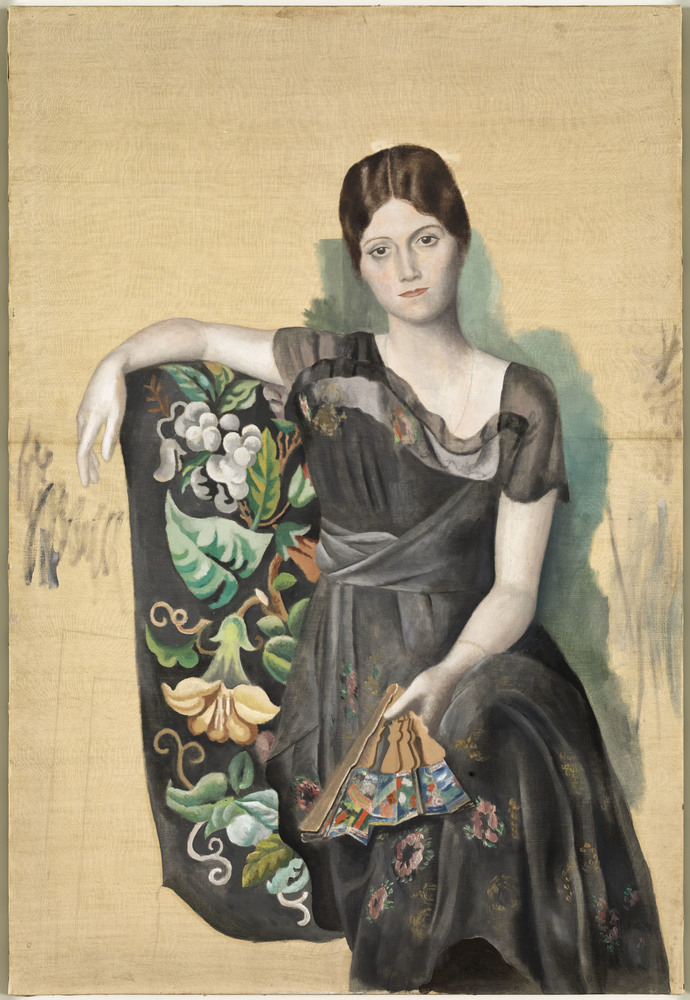
Pablo Picasso
Portrait of Olga in an armchair
Picasso married the dancer Olga Khokhlova in 1918 and painted her shortly after in an armchair, at the beginning of her neoclassical period. The precise design of the face and hands contrasts with the unfinished background and the softly colored dress. This elegant restraint marks a departure from Cubism, but the armchair itself retains enough angles not to completely forget the family.
See the work at the museum →
Edgar Degas
The Dance Class
Degas painted this class around 1873-1876 in the former rehearsal room of the Opera on rue Le Peletier. Ballet master Jules Perrot directs students who stretch, wait or correct their outfits. The Dance Class shows less the show than its preparation: discipline, fatigue and ambition appear under the tender whites, pinks and greens of the tutus and ribbons.
See the painting →
William Bouguereau
The Birth of Venus
Bouguereau exhibited The Birth of Venus at the Salon of 1879 and deployed a composition inspired by Raphael and ancient tradition. The goddess stands on a shell surrounded by nymphs, newts and cupids. Pearly flesh and milky blues show all the academic virtuosity of the painter, who clearly had not planned a modest welcoming committee.
See the painting →
Pierre-Auguste Renoir
Dancing in the city
Renoir presented Danse à la ville in 1883 with Danse à la campagne, two panels designed as social variations. Suzanne Valadon poses with Paul Lhôte in a worldly interior, white dress and perfectly held gloves. The dance seems controlled, almost silent, the opposite of the country version; the couple clearly knows the steps and rules of the living room.
See the painting →
Berthe Morisot
Young woman in ball gown
Morisot painted around 1879 a young woman absorbed in the preparations for an evening, enveloped in whites, roses and flowers. The quick touch dissolves the garment in the air without making the face disappear. Young woman in ball groom less interested in the spectacle of the party than in the moment when the model becomes an image, just before entering the eyes of others.
See the painting →
Claude Monet
Regattas in Argenteuil
In Argenteuil, Monet painted the sailboats of the basin in 1872 where Parisians came to spend their leisure time. The hulls and houses are repeated in the water in broken touches, while the clear sky lightens the entire scene. Regattas at Argenteuil belongs to the moment when the modern suburbs, the railway and Sunday become subjects perfectly worthy of a large painting.
See the painting →
James Abbott McNeill Whistler
Symphony in gray and green: the ocean
Whistler painted this navy at Valparaiso in 1866, during the Spanish-South American conflict, but eliminated almost any military anecdote. The sea, distant boats and the sky become an accord of gray, green and blue. The title musical says the relationship between tones matters as much as location, great news for the ocean, finally freed from the obligation to tell a battle.
See the painting →
John william waterhouse
Daytime dreams
Waterhouse shows a young woman interrupting her reading near an open window. The flowers, light clothing and Mediterranean landscape give Daytime Dreams the atmosphere of suspended time. Rather than illustrating an episode dramatic, the Pre-Raphaelite painter observes the moment when the mind leaves the page; the book remains open, but it has clearly lost the competition.
See the painting →
Edvard Munch
Woman in blue dress
Munch places a woman dressed in blue in a space where the decor and body seem to share the same mood. The dress absorbs light then sends it back towards the face, while the contours remain supple. This portrait shows how the norwegian painter could render a psychological presence with a calm palette, without immediately summoning the cry, the bridge and all their emotional security service.
See the painting →
Henri de Toulouse-Lautrec
Portrait of Mr. Paul Sescau (Portrait of Mr. Paul Sescau)
Paul Sescau was a photographer and friend of Toulouse-Lautrec, who also designed a famous poster for him. In this portrait, the dark silhouette, pale face and low tones evoke the artificial lighting of Montmartre cafés. THE model is not treated as a solemn notable: he belongs to the living network of artists, printers and photographers who shape the image of fin de siècle Paris.
See the painting →Air, snow and distance
Pale blues, mauves and colored grays

Joaquin Sorolla
Instant
In Instantané, Sorolla adopts an abrupt framing inspired by photography and represents Clotilde holding a small Kodak camera on the beach in Biarritz. Painted in 1906, the canvas makes the act of looking at its true subject. THE whites, mauves and marine blues install a moving light; the painter here observes a photographer who, very reasonably, returns the favor.
See the painting →
Joaquin Sorolla
Before the bath
Before the bath captures the moment when bodies, fabrics and sand are still waiting for contact with water. Sorolla distributes the whites and roses in a coastal light which erases the contours without losing the gestures. The scene does not search not a great story: it makes you feel the heat, the preparation and that second of calm before the beach becomes noisy again.
See the painting →
Joaquin Sorolla
Getting out of the bath
Sorolla paints the exit from the bath as a transition between the shine of the sea and the shelter of the fabrics. A woman helps another figure to cover herself, a practical gesture that the light transforms into a ballet of whites and roses. Wet fabrics keep the weight of reality; the elegance of the scene comes less from the pose than from the precision with which the painter follows each reflection.
See the painting →
John william waterhouse
Lady on a balcony, Capri
In Capri, Waterhouse installs a woman on a balcony bathed in light, between light walls, sea and vegetation. The Italian stay nourishes in him a taste for Mediterranean architecture which precedes his great literary scenes. There soft palette makes the balcony a threshold between interior and landscape; the model is less hesitant to go out than to leave a very good light.
See the painting →
John william waterhouse
Saint Eulalia
Waterhouse exhibited Saint Eulalia in 1885 and chose to show the young martyr after her torture, lying on the Mérida forum. According to legend, miraculous snow covers his nudity. The painter contrasts pale flesh and white linens and the pink tones of the architecture, giving the scene a cold beauty that makes its violence even more disturbing.
See the painting →
John william waterhouse
Flora
Waterhouse paints Flora as a spring figure surrounded by flowers, foliage and light fabrics. The Roman goddess is not engaged in spectacular action: her presence is enough to organize the season around her. The roses and the diluted greens remind us how much the painter knew how to make a mythological subject an almost tactile scene, perfume not included but strongly suggested.
See the painting →
John william waterhouse
Miranda, first version
Miranda comes from Shakespeare's The Tempest. In this first version, Waterhouse shows her facing the sea, observing the ship broken by Prospero's magic. The pale sky and the agitated fabrics establish the wait before the drama, while let the figure remain tiny in front of the elements. The work announces the painter's lasting interest in heroines placed on the edge of an impractical destiny.
See the painting →
John william waterhouse
The white feathered fan
A young woman holds a wide range of white feathers in an interior in cream, pink and brown tones. Waterhouse uses the accessory to multiply textures and frame the face without weighing down the pose. The feathered fan blanches belongs to his aesthetic portraits, where contemporary fashion receives an almost mythological gravity without the need for an oracle in the next room.
See the painting →
John william waterhouse
At rest
At rest suspends all narration around a seated figure, absorbed in a silent pause. Waterhouse softens the contours and lets the tones of skin, fabric and wall respond to each other. This economy reveals a less theatrical side from her work: the model does not play either a magician or a condemned heroine, a significant advantage for a person who simply wanted to sit down.
See the painting →
John william waterhouse
In Capri
Waterhouse paints figures and architecture observed during his Italian travels in Capri. Here, the clear light unifies terrace, clothing and sea without dissolving the volumes. In Capri belongs to this Mediterranean vein where antiquity remains in the background and where contemporary life is sufficient. The decor already has everything it needs; adding a myth would almost have seemed rude.
See the painting →
Joaquin Sorolla
My wife and my children
Sorolla brings together Clotilde and their three children in a family portrait painted with very clear light. The white clothes and pink touches bring the figures together without freezing them in a ceremonial pose. My wife and my children shows that the beach painter also knew how to organize an intimate group; everyone keeps their presence, even when the father officially holds the brush and therefore the last word.
See the painting →
Joaquin Sorolla
Maria in La Granja
In La Granja, Sorolla paints her daughter Maria in the royal gardens, surrounded by a cooler light than that of the Valencian beaches. The light color stands out against the greens and mauves of the park. The portrait combines walking and health family discovery and observation; the young woman is not an accessory to the landscape, but the point around which the air takes on its color.
See the painting →
Joaquin Sorolla
Joaquin Sorolla Garcia in white
Sorolla represents his son Joaquin dressed in white, with a sobriety that lets the light shape the body. The light costume and the lightly loaded background avoid the official pose and give the portrait family proximity. The painter does not don't try to turn the child into a little notable; white retains the spontaneity of the model while very conveniently providing a playground for each reflection.
See the painting →
Henri Matisse
Renée, Green Harmony
Matisse painted Renée in the Nice years, when fabrics, armchairs and walls became as active as the model. The green range is softened by pinks and whites which prevent the decor from closing. Renée, Green Harmony shows a portrait constructed by colored chords: the person remains present, but the entire room discreetly participates in the conversation.
See the painting →
James Abbott McNeill Whistler
Harmony in blue and silver: Trouville
Whistler painted Trouville in 1865 and placed on the beach a silhouette often identified with Gustave Courbet, then his companion. The sea, sand and sky are reduced to long blue and gray bands. The title of Harmony in blue and silver transforms the landscape into tonal accord; the human figure is mainly used to measure how calm the horizon can be.
See the painting →
Claude Monet
Gondolas in Venice
Monet stayed in Venice in 1908 and painted the gondolas from the Palazzo Barbaro. He then reworked the paintings in his studio before exhibiting them in Paris in 1912. The boats became black silhouettes on pink water, blue and purple; the city is less described than dissolved in its reflection, which prevents it from any traffic problems.
See the painting →
Claude Monet
Parliament, sunset
Between 1899 and 1904, Monet painted the Parliament of London from a window of St. Thomas Hospital, still at the same time but under changing atmospheres. At sunset, the stone disappears into the purple mist and the orange reflections. The political monument becomes a measure of the air; Big Ben can impose the time, but certainly not the color.
See the painting →
Caspar david friedrich
The Monk by the sea
A tiny monk stands before a dark sea and a huge sky, without a boat, tree or architecture to reassure the eye. Friedrich radically simplifies the landscape and places the horizon very low. Exhibited in Berlin in 1810, the canvas is purchased by the Crown Prince of Prussia and becomes one of the founding images of the romantic sublime.
See the painting →
Caspar david friedrich
The Sea of Ice
Friedrich completed The Sea of Ice in 1823-1824 without having seen the Arctic represented. It is based on studies of the frozen Elbe near Dresden and on accounts of polar expeditions; a ship's stern appears almost submerged. Little understood during his lifetime, the work transforms human failure into ice architecture and silence into a real catastrophe.
See the painting →
Alfred Sisley
Snow effect in Louveciennes
Sisley painted Snow Effect in Louveciennes in 1874, during one of the winters when the region became his laboratory of light. The path, houses and trees dissolve into bluish whites under a low sky. Snow is not one empty: it reflects each nuance and forces the landscape to speak softly, which it does with remarkable precision.
See the painting →Paint diffused light
Gardens, beaches and milky landscapes

Alfred Sisley
Place du Chenil in Marly, snow effect
In Marly-le-Roi, Sisley observes a square covered in snow and some tiny figures caught in the cold. The facades and the floor are linked by colorful grays which make the air almost palpable. Painted in 1874, La Place du Chenil shows that impressionism does not depend on bright sunshine; a pale sky can hold the entire composition perfectly without raising its voice.
See the painting →
Edvard Munch
Woman in blue in front of blue water
Munch painted a woman in blue in 1931 in front of a body of water that almost took on the color of her dress. The figure and landscape seem to belong to the same interior state, separated only by a few contours. The late work preserves the psychological tension of the painter with a soothed palette; even calm, in Munch, keeps a door ajar to worry.
See the painting →
JMW Turner
The Charbonniers in the moonlight
Turner exposed Les Charbonniers to moonlight in 1835. On the Tyne, workers transferred coal to ships under a moon that transformed smoke, water and sails into silver material. Industrial work becomes nocturnal luminous rather than a simple document. The scene reminds us that maritime poetry also depends on people busy moving cargo while the public admires the reflection.
See the painting →
Pierre Puvis de Chavannes
The Poor Fisherman
Puvis de Chavannes presented Le Pauvre Pêcheur at the Salon of 1881, where its severe simplicity disconcerted. A man waits in a boat while a woman and a child occupy the bare shore. Gray roses, dull greens and pale skies refuse the picturesque. The painting gradually acquired a considerable influence on Seurat, Gauguin and the symbolists.
See the painting →
Claude Monet
Saint-lazare Station
Monet obtained authorization to work in Saint-Lazare station in 1877 and devoted an entire series to his glass roofs, locomotives and plumes of steam. Here, the blue and pink of the smoke absorb the architecture without removing it train movement. The modern landscape is now interior, noisy and punctual only when the railway company allows it.
See the painting →
Vincent van Gogh
Seascape near Saintes-Maries-de-la-Mer
Van Gogh went to Saintes-Maries-de-la-Mer in June 1888 and painted the boats directly on the beach. He observes the colors of the Mediterranean, notes the rapid movements of the waves and reinforces the contours as in the prints japanese. Seascape near Saintes-Maries gives blue, green and sand an almost enameled clarity, very different from the northern skies.
See the painting →
Joaquin Sorolla
The Sierra Nevada in winter
Sorolla discovered the Sierra Nevada during his stays in Granada and painted the snow in dry light, far from the humid effects of Valencia. The mauves of the mountains and the pink whites shape the relief without weighing it down. The landscape winter becomes a study of atmosphere; the mountain remains still, but the color changes quickly enough to provide all the necessary movement.
See the painting →
Claude Monet
The Argenteuil Bridge
Monet painted Le Pont d'Argenteuil in 1874, at a time when the new bridge, sailboats and walkers sum up the modernity of the Parisian suburbs. The piles structure the canvas while their reflections break in the clear water. Engineering and leisure peacefully share the same landscape, without asking impressionism to choose sides.
See the painting →
Joaquin Sorolla
The Three Sails
Three women carrying baskets advance on the beach in front of three inclined sails. Sorolla repeats the shapes to unite human work, wind and rhythm of the coastline. The whites, pinks and blues remain light despite the effort of the displacement. The Three Veils thus gives a work scene the cadence of a Mediterranean procession, led by a very sure breeze.
See the painting →
Joaquin Sorolla
Imminent storm, Valencia
In Valencia, Sorolla shows boats pulled on the sand under a purple-gray sky that heralds the storm. The dark hulls and the line of foam replace the agitation with heavy waiting. Imminent storm holds the moment before tipping: Fishermen anticipated the danger, while clouds seemed slightly upset at having been outstripped.
See the painting →
Jean-Baptiste Camille Corot
The Narni Bridge
Corot discovered Narni during his first Italian stay in 1826. The ruined Roman bridge and valley allowed him to study clear light before the more poetic landscapes of his maturity. Painted on the motif, The Bridge of Narni maintains the freshness of a study while precisely organizing river, architecture and distance; travel here becomes a method of looking.
See the painting →
Jean-Baptiste Camille Corot
Chartres Cathedral
Corot painted Chartres Cathedral in 1830 after taking up a study begun during a previous trip. Two mounds of earth, recently cut trees and a few figures give the Gothic monument a very environment daily. The light stone does not crush the landscape: it settles there with the same luminous modesty as the paths and the sky.
See the painting →
Camille Pissarro
White jelly
Pissarro painted White Jelly in 1873 near Pontoise and presented it the following year at the first impressionist exhibition. The critic Louis Leroy mocks its thick furrows and its knife fingerboard, but this material translates precisely the weight of the frozen ground and the effort of the peasant. The painting therefore belongs to the history of the movement as much as to that of a winter morning.
See the painting →
Arthur Streeton
'The purple noon's transparent might'
Streeton borrows its title from a verse by Shelley and gives the Hawkesbury River an almost cosmic scale. The heat blues the distances, the stream winds between the hills and a dark tree holds the foreground. Painted in 1896, The purple noon's transparent might makes you feel the dazzling and that hour when even the cicadas seem to have increased the volume.
See the painting →
Arthur Streeton
Near Heidelberg
Near Heidelberg narrows the landscape around a path, fences and vegetation faded by the sun. Streeton builds depth through the gaps between warm ochres and distant blues, without transforming the countryside into a setting heroic. This modesty of motive is its strength: modern Australia appears in an ordinary plot, looked at long enough to become memorable.
See the painting →
Charles Conder
Rickett's Point
At Ricketts Point, Charles Conder stretches the shoreline on a thin panel, as if the coast refuses to fit into a conventional format. Rocks, water and distant silhouettes are indicated with a vivacity that favors the impression of space. The landscape remains readable but gains a decorative lightness; the bay seems to have posed just long enough before resuming its movement.
See the painting →
Tom Roberts
Slumbering sea, Mentone
In Mentone, the sea appears drowsy but Tom Roberts keeps the surface moving with small variations of blue, gray and sand. Tiny walkers give scale, while the shoreline cuts the composition with a almost Japanese simplicity. Slumbering Sea shows the painter doing a lot with very little: a few figures, a strip of water and enough air to reset the day.
See the painting →
Joaquin Sorolla
Ladies on the beach
Sorolla brings together several women on a beach where umbrellas, light dresses and sand filter the light. Ladies on the beach does not only describe seaside fashion: the arrangement of silhouettes transforms the shore into a scene social. Pink and white tones retain the warmth of the sun without hardening faces, proof that a walk can require as much organization as a collective portrait.
See the painting →
Joaquin Sorolla
Ladies' walk on Biarritz beach
In Biarritz, Sorolla follows a group of elegant women advancing near the water under a cooler sky than that of Valencia. Purples, blue grays and light fabrics reflect the Atlantic light. The walk remains worldly, but the wind disturbs the silhouettes just enough to remind us that the beach does not recognize any clothing regulations.
See the painting →
Alfred Sisley
The Church of Moret after the rain
In 1894, Sisley painted a series of the Notre-Dame de Moret church under different lights. After the rain, the facade retains the humidity of the sky and the stones reflect subtle yellows, pinks and grays. The architectural motif becomes as changeable as a cloud; the church remains in place, but its color refuses any administrative permanence.
See the painting →The color released from the pattern
Modern gentleness: divisionism and abstraction

Charles-Francois Daubigny
The Harvest
Daubigny paints the harvest with the attention of a landscaper who knows the work of the fields as much as their light effects. The pale sheaves and clear sky widen the space around the figures. Rather than dramatizing the effort rural, he lets the rhythm of gestures and millstones structure the scene, paving the way for naturalism and outdoor painters.
See the painting →
Charles-Francois Daubigny
The banks of the Oise
On the banks of the Oise, Daubigny often works from his workshop boat, the Botin, to directly follow the reflections and changes of the sky. Blues, greens and pinks blend into a humid light. The landscape seems peaceful, but this tranquility is the result of a moving gaze, installed on a boat which probably had to negotiate with each swirl.
See the painting →
Alfred Sisley
View of the village
Sisley places the village beyond a path and fields which gradually lead towards the houses. The pale tones of the ground, sky and roofs build the distance without spectacular effect. View of the village belongs to this proximity painting where an ordinary site becomes accurate by weather, time and direction of gaze; no bell tower needs to campaign to be noticed.
See the painting →
Alfred Sisley
The plain of Veneux-Nadon
In Veneux-Nadon, near Moret-sur-Loing, Sisley observes an open plain where paths, trees and sky share the canvas almost equally. Painted in 1881, the work favors soft light and depth without monuments. The modest motif reveals its fidelity to the outdoors: the landscape does not wait for an event, it just needs to be given time.
See the painting →
Jean-Baptiste Camille Corot
Boat fishing near willows
Corot sets up a small boat under the willows and lets the branches filter a silver light. The scene belongs to its maturity, when memories of observed sites mingle with freer poetry. Fishing becomes a pretext to balance water, foliage and sky; the fish, if it exists, philosophically accepts not being the main subject.
See the painting →
Charles-Francois Daubigny
The barges
Daubigny paints the barges of the Oise in a clear range where the water and the sky occupy more space than the boats. From his workshop boat, he can follow river traffic without adopting a fixed view from the shore. THE work boats give the landscape its modern scale and prevent the river from becoming a simple bucolic retreat.
See the painting →
Joaquin Sorolla
Children on the beach
Sorolla observes naked children playing at the water's edge in Valencia and transforms their wet bodies into surfaces of light. The pink sand, purple shadows and shallow blue of the sea avoid any rigid contours. Children on the beach captures the freedom of the game without posing the figures; the Mediterranean provides the setting, the mirror and fairly approximate surveillance.
See the painting →
Alfred Sisley
The Mantes Road
The Route de Mantes crosses an open landscape that Sisley painted in 1874, the year of the first impressionist exhibition. The pale path leads towards the horizon between fields and trees, under a sky which regulates all the depth. None monument does not hold the eye: the circulation of air and light on the ground become the real events of the canvas.
See the painting →
Alfred Sisley
The Regattas in Molesey
Sisley stayed in England in 1874 thanks to the support of collector Jean-Baptiste Faure and painted Molesey's regattas on the Thames. The flags, sails and their colorful reflections animate a very clear composition. The work brings British leisure closer to its French landscapes; on the water, nationalities count less than the direction of the wind.
See the painting →
Joaquin Sorolla
Valencia beach in the morning light
On Valencia beach, the morning light cools the shadows and gives the sails, sand and clothes a special softness. Sorolla chooses the time when work begins before the hot weather. The scene remains active, but its pale palette slows down the gaze and reveals every transition between water, earth and air.
See the painting →
Rupert Bunny
Sea idyll
Sea Idyll installs female figures on the edge of a calm sea, in an atmosphere where Rupert Bunny mixes classicism, sensuality and fin de siècle reverie. The bodies form a supple frieze in front of the horizon and the muffled palette moves away the scene of the simple beach bath. The painting reminds us that an Australian painter could look towards Puvis de Chavannes and the Mediterranean rather than towards the bush.
See the painting →
August Macke
Garden on the shores of Lake Thun
Macke painted the gardens around Lake Thun, Switzerland, in 1913, where he stayed with his family. The trees, paths and water are simplified into colorful plans, but the light retains a summery softness. Garden by the lake Thun announces the research carried out the following year in Tunisia; the journey begins here without leaving the cool alpine.
See the painting →
Joaquin Sorolla
Garden of Maison Sorolla in 1920
In the garden of his Madrid house, Sorolla painted a space in 1920 that he himself designed from Andalusian and Italian souvenirs. The walls, ponds and foliage filter a more intimate light than that of the beaches. The garden becomes a figureless self-portrait: each plant knows its place, even if the sun continues to modify the plan.
See the painting →
Jean-Baptiste Camille Corot
Avignon, view of Villeneuve-lès-Avignon
Corot painted Avignon seen from Villeneuve-lès-Avignon during his stay in the South in 1836. The city and the palace of the Popes appear beyond the Rhône, framed by trees and a very simple foreground. The clear light organizes them masses without excessive detail; the monument becomes a distant presence rather than an early postcard.
See the painting →
Paul Signac
The Port of Saint-Tropez
Signac moved to Saint-Tropez in 1892 and helped make the port a hotbed of neo-impressionism. In this 1901 view, the separate touches of pink, blue and yellow recompose the Mediterranean light from a distance. The masts structure the surface while the water multiplies the colors; the port is working, but the paint already seems to be on vacation.
See the painting →
Paul Signac
The Château des Papes in Avignon
Signac paints the Popes' Palace from the other bank of the Rhône and transforms the Gothic mass into a luminous mosaic. The little pink, mauve and blue touches dissolve the stone without making the architecture disappear. The monument medieval thus enters into a modern theory of color; after several centuries of gravity, it finally obtains a sufficiently joyful reflection.
See the painting →
Claude Monet
Woman with umbrella turned left
Monet painted a second Woman with an Umbrella turned to the left in 1886, still with Suzanne Hoschedé as a model. The inclination of the body, the veil and the grass reflect the same gust as the fast sky. Designed as a counterpart to the version facing right, the canvas shows that a change of orientation is enough to completely recompose light and movement.
See the painting →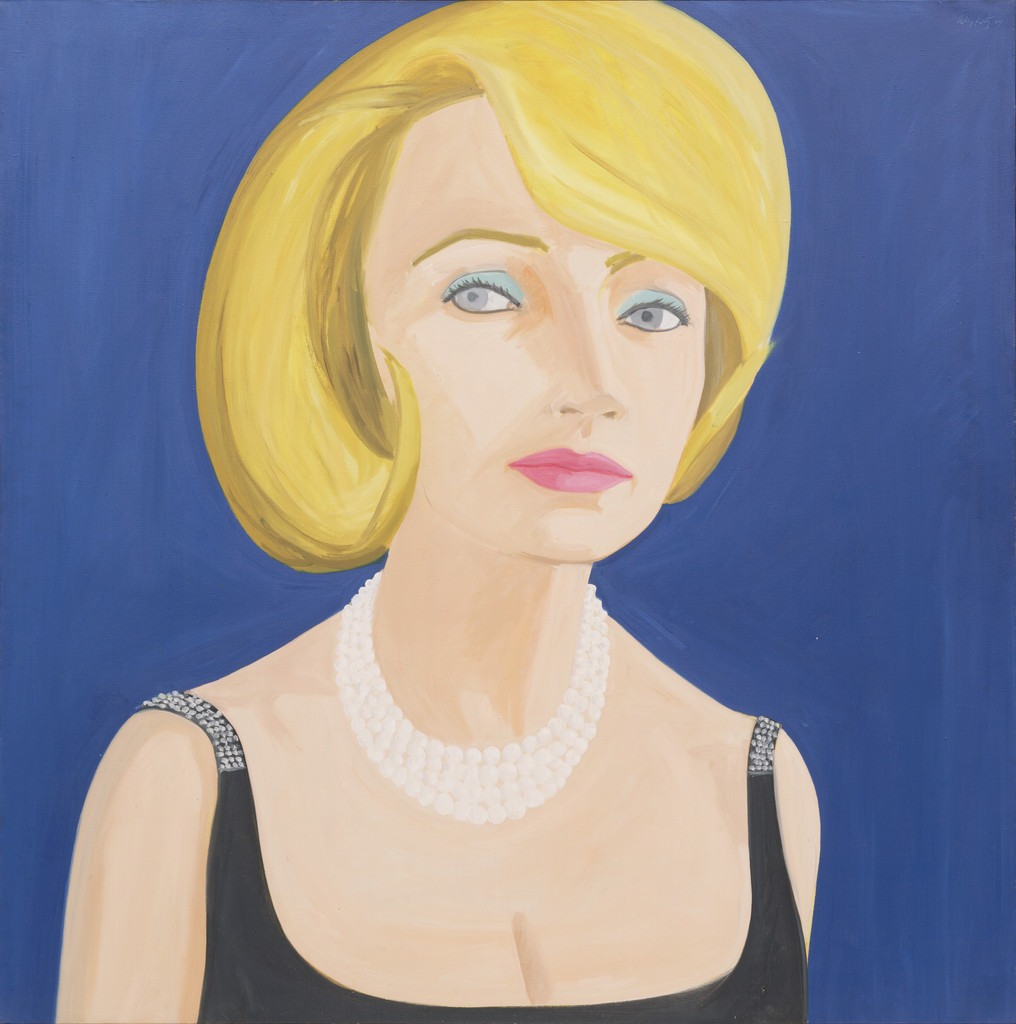
Alex Katz
Lita
Alex Katz painted Lita in 1964 with the sharp flat areas and close framing that distinguish his portraits. The face and the pale blue background are free of any superfluous modeling, like an advertising image slowed down to silence. This economy gives the model an immediate presence; pastel is no longer atmosphere, but calm and resolutely modern surface.
See the work at the museum →
Georges Seurat
The Poseuses
Seurat painted Les Poseuses between 1886 and 1888 in response to criticism who considered the figures of La Grande Jatte too stiff. Three successive poses of the same model occupy the workshop in front of part of his large painting. The tones roses and blues demonstrate that divisionism can shape the body; optical theory passes an academic drawing exam here.
See the painting →
Wassily Kandinsky
Sky blue
In 1940, in Neuilly-sur-Seine, Kandinsky populated a blue background with small biomorphic shapes inspired by zoology and the microscopic world. War then made his material situation difficult, but Bleu de ciel built a universe floating and playful. Creatures appear to swim, dance or chat; none considered it necessary to provide instructions.
See the painting →Matter and light
How do painters make a pastel color?
In oil, lightening does not always consist of mechanically adding white. The painter can superimpose a transparent glaze on a clear preparation, juxtapose small complementary touches or fold down a color with one earth. Each of these methods changes the depth: mixing with white makes the shade more opaque; the glaze retains internal light; the divided touch makes the color vibrate in the eye.
The 19th century particularly exploited these possibilities. Shadows cease to be brown or black and become blue, pink or purple. The Impressionists observed these gaps in snow, dresses and reflections; Whistler them organizes in harmonies; modern painters extend them to the entire surface. The pastel palette thus tells a story of light as much as an aesthetic preference.
Historical, covering and slightly warm; it gives body to old skin tones and lights.
Colder and more transparent, it is suitable for sails, subtle blends and delicate lights.
Transparent, they produce luminous roses when placed on or mixed with a light base.
Overseas, cobalt or ceruleum change temperature and depth depending on the white that accompanies them.
A hint of ocher, earth or complementary reduces the green without taking away all its freshness.
A color in motion
Why these colors stay in memory
Clarity can soften a transition, isolate a silhouette or make an entire sky vibrate. Each painting that follows uses this range for a specific reason: to tell a scene, to measure a light or to give silence a color of its own.
0 comments