

Catalogue raisonné · F & JH · method
How many artworks did Van Gogh create?
The most solid answer is "approximately 2,000 known works": nearly 1,100 drawings, some 850 to 870 paintings, plus a small set of prints, watercolors, and sketches whose categories overlap.

The Starry Night, Saint-Rémy.

Sorrow, pencil study.

The lithograph of the Eaters.
Short answer
Van Gogh left about 2,000 known works
This number is a scientific estimate, not a definitively fixed count. It describes the body of work currently identified by international research.
Why do we also read "2,100 works"?
The figure of 2,100 has become very popular in mainstream biographies. It remains acceptable as a order of magnitude, especially when it groups together about 860 paintings and over a thousand drawings. But presented as an exact inventory, it gives a false impression of certainty.
The total changes depending on whether we include watercolors with drawings, count the front and back of a sheet separately, incorporate sketches made in letters, or count a print as a single design rather than by impression. A lost but documented work can also receive a place in a catalog without being visible today.
The most honest formulation is therefore: Van Gogh produced about 2,000 known works, including some 850 to 870 paintings and nearly 1,100 drawings. The rest includes prints, watercolors, studies, and sketches, sometimes already counted in the previous categories.
Scope of the calculation
A "work" is not always a framed canvas
For Van Gogh, drawing and painting form a single laboratory. Yet catalogs must turn this continuous practice into searchable categories.
Oils, mainly on canvas
The most frequently cited group includes oils on canvas, but also supports such as cardboard, mounted canvas, or panel. Successive versions of the same subject are separate works.
Pencil, pen, charcoal, chalk
The Van Gogh Museum mentions nearly 1,100 drawings. Independent studies, preparatory sheets, watercolors, and heightened drawings may be classified differently across databases.
Lithographs and prints
Van Gogh is not a prolific printmaker. For prints, one must distinguish the design, the stone or plate, and the different printed proofs.
Archives, not automatically works
The letters constitute a major intellectual work, but are not normally added to the artistic total. Their sketches, however, may receive their own entry.
The painted corpus
The paintings: about 850 to 870 objects, not 2,000
The number of paintings is less than the total number of works. This distinction avoids the most common error in Van Gogh research.

A brief career, an extraordinarily dense output
Van Gogh decided late to become an artist. The bulk of his work was produced between 1880 and 1890. In a decade, his language evolved from charcoal-drawn peasants to the complementary colors of Paris, then to the rhythms of Arles, Saint-Rémy, and Auvers.
Saying he painted "about 860 paintings" does not mean there is a single figure accepted by all publications. Some counts include a work on the border between painting and drawing, others classify it among works on paper. Paintings known only from documents may be cataloged as lost.
The repetitions are not administrative duplicates. Van Gogh painted several Sunflowers, three versions of The Bedroom, many olive trees and cypresses. Each canvas has its own dimensions, material, provenance, and number.
- One version = one artwork: two similar Arles bedrooms are not to be confused.
- One motif = multiple records: sunflowers, orchards, self-portraits, and fields recur.
- A title may vary: museums interpret or specify the same subject differently.
Nearly 1,100 sheets
Drawing is not a secondary draft: it is "the root of everything"
Before the brilliant color, Van Gogh learns to measure proportions, construct a body, render a field, and organize light in black and white.

Why do the drawings complicate the total?
The same sheet may have a drawing on the front and another on the back. Some databases describe the physical object as a single sheet, while the catalog gives two entries for the compositions. A watercolor may be classified as a colored drawing or as an autonomous work. A sketch in a letter has both documentary and visual status.
The Van Gogh Museum holds about half of the drawn corpus. This concentration explains why its notes and exhibitions are essential, but it does not transform the approximately 500 drawings in Amsterdam into a general total. The other sheets are found notably at the Kröller-Müller Museum, in many public collections, and with private owners.
The drawings also show what paintings alone conceal: Van Gogh was not simply an instinctive colorist. He worked on perspective, hatching, simplification of volumes, and the expressive efficiency of a line. Counting his works without counting his drawings amounts to removing half of his learning and his thinking.
Lithographs and prints
For prints, should we count the image or each impression?
The question may seem technical, but it perfectly illustrates why adding categories without method produces incompatible totals.
Design, plate, print
In painting, a canvas usually corresponds to a single object. In printmaking, the same plate allows multiple impressions. A catalog of the artist's works may count the design only once; a museum inventory will count each preserved sheet.
Van Gogh experimented with lithography, notably to disseminate his figure studies. His printed corpus remains small compared to that of his paintings and drawings. Therefore, one should not invent a precise total without stating the chosen rule.
The example of The Potato Eaters is enlightening: drawing, lithography, and painting are not three interchangeable states. They form three works or groups of related objects, created with different goals and techniques.
Illustrated correspondence
The 820 letters written by Vincent are not an additional 820 works
They document the creation with exceptional precision, but archives and graphic works do not automatically overlap.
A tool for work, memory, and transmission
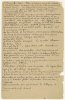
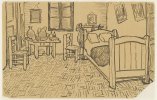
The online critical edition lists 820 letters written by Van Gogh and 83 letters addressed to him. Vincent talks about readings, money, health, technique, and ongoing paintings. He sometimes inserts a sketch to show Theo the organization of a canvas or the placement of a color.
A letter is first a manuscript document. Its sketch can however be described as a sketch and receive a catalog number. Depending on the research carried out, one will consult the entire letter, the page, or the drawing it contains. Adding the 820 letters to the 2,000 works would be methodologically incorrect.
This distinction does not diminish their value. The letters constitute the main source for understanding Van Gogh's intentions, dating certain works, identifying lost paintings, and tracking shipments intended for Theo. They precisely help the catalogs decide what exists, what existed, and what corresponds to which object.
The two reference systems
F and JH: two numbers to identify a work without ambiguity
Titles change according to languages and museums. Catalogue numbers create a more stable concordance between an image, a provenance, and the bibliography.
| System | Author and edition | Number format | Scope and usage |
|---|---|---|---|
| F | Jacob-Baart de la Faille, first edition in 1928; major revised edition in 1970. | F 612, F 82, F 482… | First major reference catalogue raisonné. The F number remains ubiquitous in museums, sales, and bibliographies. |
| JH | Jan Hulsker, catalogue published in 1980, then revised and expanded edition in 1996. | JH 1731, JH 764, JH 1771… | Broadly chronological order, including paintings, drawings, graphic works, and letter sketches. The edition provides a concordance with F. |
| Van Gogh Worldwide | Scientific platform bringing together museums, technical data, and research. | Records linked to F and JH numbers. | Contemporary access point. The database starts notably from the 1970 catalog and evolves with new data and attributions. |
The Starry Night
Saint-Rémy-de-Provence, June 1889. The same painting also bears the number JH 1731.
- Technique
- Oil on canvas
- Collection
- MoMA, New York
- Date
- June 1889
- Concordance
- JH 1731
The Potato Eaters
Nuenen, April-May 1885. The main painting also bears the number JH 764.
- Technique
- Oil on canvas
- Collection
- Van Gogh Museum
- Date
- 1885
- Concordance
- JH 764
Why the total fluctuates
Six problems prevent a perfectly fixed count
The catalogue raisonné does not photograph an immobile truth. It formulates the most convincing state of knowledge at a given date.
Recto and verso
A sheet can bear two compositions. Do we count one physical sheet, two images, or one main entry with sub-entry?
Lost works
A letter, a photograph, or an old inventory can prove the existence of a work that is now untraceable. It remains historically relevant.
Copies and versions
Van Gogh revisited his own motifs and copied Millet, Delacroix, or Hiroshige. An autograph replica is a distinct work, not a duplicate to be eliminated.
Hybrid categories
Pencil under watercolor, gouache, ink, and highlights make the boundary between drawing, painting, and mixed work sometimes conventional.
Attributions
A work enters or leaves the corpus when provenance, support, pigments, style, and documents are reassessed by specialists.
Fragments and states
A support can be cut down, transformed, or reused. The catalog must decide how to link the current object to its historical state.

A discovery can still modify the corpus
In 2013, the Van Gogh Museum announced the authentication of Sunset at Montmajour, painted in 1888. The work was long known but had been rejected in the 20th century. Study of the style, canvas, pigments, provenance, and a letter from Vincent allowed its status to be reconsidered.
The museum reports having received around 5,500 authentication requests over the decades and having confirmed only about ten works, including three paintings. This report shows why spectacular announcements must be treated with caution.
A new painting does not dramatically change the general estimate: 'around 2,000' remains true. But each decision alters the precise mapping of the corpus, the concordances, and sometimes our understanding of a period.
Ten years of creation
Production accelerates and changes form according to location
The final total becomes more understandable when one follows the successive functions of drawing and painting.
Learning through drawing
Miners, workers, bent figures, and landscapes. Van Gogh copies manuals, studies Millet, and seeks the solidity of a figure.
The dark earth
Studies of heads, weavers, and peasants lead to the The Potato Eaters. Drawing and painting progress together.
Color breaks free
Under the influence of Impressionism and Neo-Impressionism, the palette brightens. Flowers, views of Montmartre, and self-portraits multiply.
The language becomes Van Gogh
Orchards, Yellow House, Sunflowers, Starry Night, cypresses and olive trees. The line acquires its own movement.
75 paintings in 70 days
The Van Gogh Museum estimates that around 75 paintings were created in 70 days: portraits, houses, gardens, wheat fields, and panoramic formats.
Twelve visual landmarks
Twelve paintings to explore the painted corpus
They are not merely 860 paintings: they show the extraordinary breadth achieved in just a few years, from Nuenen to Auvers.
The Potato Eaters
The great peasant manifesto of the dark years.
See the work →
Self-portrait
The face becomes a field of directional brushstrokes.
See the work →
Sunflowers
A series designed for the Yellow House.
See the work →
Café Terrace at Night
A night built without dominant black.
See the work →
The Yellow House
The real place becomes a collective studio project.
See the work →
The Bedroom
Three versions prove that a motif is not a single object.
See the work →The Starry Night
F 612 / JH 1731, two systems for one canvas.
See the work →
The Iris
The asylum garden becomes a decorative rhythm.
See the work →
Olive Trees and Alpilles
A series where the landscape seems to breathe.
See the work →
Almond Tree in Blossom
A birth gift inspired by Japanese prints.
See the work →
The Church of the World
Architecture bends under color.
See the work →
Wheatfield with Crows
An intense horizontal format, without being his last certain painting.
See the work →Practical method
How to verify a number or an artwork?
The correct instinct is not to look for an isolated total, but to understand the source, the category, and the number that support the information.
Naming the corpus
Are you speaking of all works, only paintings, drawings, or objects held by a museum?
Read the notice
Identify title, date, medium, dimensions, location, provenance, and F/JH numbers.
Compare F and JH
Cross-referencing prevents taking two titles or two translations for two different works.
Check the status
Preserved, lost, disputed attribution, recto-verso, or autograph copy: the status changes the interpretation.
Prioritize institutions
Van Gogh Worldwide, the Van Gogh Museum, and the holding museums publish revised data.
Accept a range
"About 2,000" is more scientifically accurate than an overly precise total without a stated method.

Shop collections
Explore Van Gogh's work by locations, themes, and periods
The figure of 2,000 comes alive when you compare the works and the transformations of his palette.
Vincent van Gogh
The major paintings, portraits, landscapes, flowers, and night scenes.
Essential selection100 Popular Van Gogh
An instant selection of the most searched-for images.
1883–1885Van Gogh in Nuenen
Peasants, weavers, potatoes, and an earth palette.
1886–1888Van Gogh in Paris
Flowers, Montmartre, self-portraits, and modern color.
1888–1889Van Gogh in Arles
Yellow House, orchards, cafés, the Rhône, and Sunflowers.
1889–1890Van Gogh in Saint-Rémy
Nights, cypresses, olive trees, irises, and views from the asylum.
70 Last DaysVan Gogh in Auvers
Churches, houses, gardens, wheat fields, and panoramic formats.
FacesSelf-portraits
A series of experiments in color, brushwork, and identity.
Still lifeFlowers of Van Gogh
Sunflowers, irises, roses, gladioli, and almond trees.
TerritoriesLandscapes of Van Gogh
Fields, roads, orchards, hills and villages.
Blue and yellowNight paintings
Starry skies, cafés and artificial lights.
The artistic contextPost-Impressionism
Van Gogh, Gauguin, Cézanne and color after Impressionism.
To prolong
Reading Van Gogh beyond the numbers
The places, letters and series explain how these thousands of objects form a coherent body of work.
Frequently Asked Questions
Understanding Everything About the Number of Van Gogh's Works
How Many Works Did Vincent van Gogh Create?
The reference answer is approximately 2,000 known works. Van Gogh Worldwide uses this estimate for the overall corpus. The figure mainly includes paintings and drawings, with graphic works and mixed categories.
How Many Paintings Did Van Gogh Paint?
Depending on the scope considered, generally around 850 to 870 paintings are cited, often rounded to 860. This number should not be confused with the roughly 2,000 works in all techniques.
How Many Drawings Did Van Gogh Create?
The Van Gogh Museum states that the artist produced nearly 1,100 drawings. The museum holds about 500, almost half of this drawn body of work.
Why do some biographies mention 2,100 works?
2,100 is a round number often used publicly, adding around 860 paintings and over 1,000 works on paper. It remains plausible as an order of magnitude, but about 2,000 is the most cautious institutional phrasing.
Do Van Gogh's letters count as works?
The 820 preserved written letters are major archives, but they are not normally added to the total of artistic works. Sketches present in some letters may nevertheless be cataloged as sketches.
What do the numbers F and JH mean?
F refers to the catalogue raisonné of Jacob-Baart de la Faille, JH to that of Jan Hulsker. The same work often has both references, for example The Starry Night, F 612 / JH 1731.
Did Van Gogh produce many prints?
No, his printed body of work is small compared to his paintings and drawings. To count it, one must distinguish the number of lithographed designs and the number of physical proofs pulled from each image.
Do different versions of a painting count separately?
Yes. The three painted versions of The Bedroom, for example, are distinct works. Each has its own support, dimensions, provenance, and catalog numbers.
Is a lost work included in the catalog?
It can be if its existence is sufficiently documented by a letter, a photograph, an inventory, or an old provenance. Its 'lost' status must then be clearly indicated.
Does the Van Gogh Museum own all of Van Gogh's works?
No. It holds the largest collection, with 205 paintings and about 500 drawings, but Van Gogh's works are spread across the Kröller-Müller Museum, many international museums, and private collections.
Can we still discover an unknown Van Gogh?
It is possible but very rare. Authentication requires a convergence of provenance, documents, style, support, pigments, and technical analysis. In 2013, Sunset at Montmajour was thus reintegrated into the corpus.
Which database should be used to search for a specific work?
Van Gogh Worldwide is the best scientific starting point, supplemented by the records of the Van Gogh Museum, the Kröller-Müller Museum, and the museum that holds the object. Also search for the F and JH numbers.
Reference Sources
Where do the figures in this article come from?
The orders of magnitude are based on scientific platforms, catalogs, and institutions that preserve and study the work.
Van Gogh Worldwide
International platform: approximately 2,000 works and data related to catalogs.
DrawingsVan Gogh Museum
Gallery texts: nearly 1,100 drawings and the fundamental role of drawing.
CorrespondenceVan Gogh Letters
Critical edition: 820 letters written by Vincent and 83 received.
JH CatalogJan Hulsker, 1996 edition
Paintings, drawings, graphic works, and sketches from letters with F concordance.
Bibliographic recordLibrary of Congress
Reference of the revised edition of The Complete Van Gogh.
Shared researchKröller-Müller Museum
Presentation of Van Gogh Worldwide and the corpus of about 2,000 works.
AuthenticationVan Gogh Museum, Q&A
Authentication requests and cases of Sunset at Montmajour.
OverVan Gogh Museum
About 75 paintings created during the 70 days spent in Auvers.
0 comments